ArchiveUnique Forms of Continuity in Space

Artwork record / 54 of 331

Unique Forms of Continuity in Space by Umberto Boccioni (1913)

Artist: Umberto Boccioni

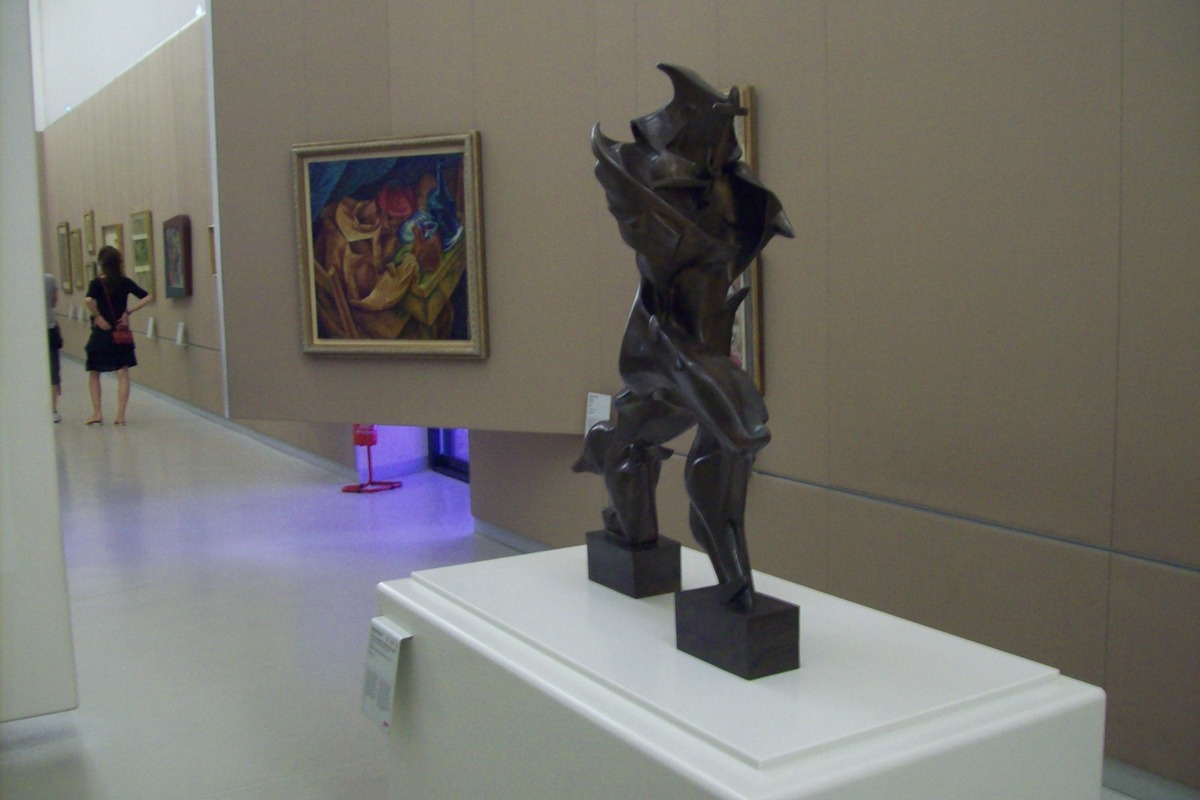
A bronze figure by Umberto Boccioni that turns a striding body into a single forward-surging mass, built to make speed and continuous form legible in sculpture.

Read the story ↓ About the artist ↓ Research and record ↓ Literature and sources ↓ Listen to the article ↓
Article text for AI
Shop this artwork ↓ 0 visits
Date1913CultureItaly PeriodFuturismCurrent locationMuseo del Novecento, Milan, Italy
Listen to the article
100%
Unique Forms of Continuity in Space by Umberto Boccioni (1913)
Loading full-resolution artwork…
Scroll to zoom · drag to pan · double-click to focus Pinch to zoom · drag to explore · double-tap to focus FIELD VIEW / 54
Tools & download
Pixel colour Select a pixel with the eyedropper
No pixel selected

Choose the eyedropper, then click or tap the image. Scroll to zoom for finer selection.

Add text

Hand to pan · Select to move text and drawings · Add as many texts as you like · Scroll to zoom

Unique Forms of Continuity in Space: high-resolution image

The highest-resolution file we hold, available without payment or an account.1,800 × 1,200 pixels.

Download highest-resolution image

Details to notice

About 3 minutes to read
01

Bronze patina and modeled surface

Close view of the figure's flank where the dark brown-black bronze patina shows lighter burnished highlights along the modeled ridges and furrows, evidence of the cast bronze surface and the sculptor's hand-modeled planes.

02

Torso and blade-like arm forms

The upper body where chest, shoulders and the truncated arms are fused into flamelike planes and pointed blade projections, the clearest statement of the sculpture's idea of continuous form in space.

03

Advancing legs and feet

The two powerful legs locked in a wide stride, each foot resting on its own small black plinth; the bulging calf and thigh volumes show how the sculptor turned anatomy into dynamic, wind-swept forms.

Artist portrait of Umberto Boccioni
Artist portrait Image credit

Unknown author Unknown author. Image source · Public domain

About the artist

Umberto Boccioni

1882 to 1916

Umberto Boccioni was an Italian painter and sculptor (1882-1916). Their work is associated with Futurism. Their recorded places of work include Padua; Venice; Milan; Paris; Warsaw.

Born
1882
Died
1916
Nationality
Kingdom of Italy
Birthplace
Reggio Calabria
Died in
Verona

The research & record

Study the work.
Follow the evidence.

Find catalogue details, historical context, technical research and the literature behind this artwork.

Article text for AI
Open research text

The artwork record

Research catalogue

Catalogue information and detailed research, with references that link to the bibliography.

Updated .

Identity and catalogue

Link
Title
Unique Forms of Continuity in Space(Stefano Stabile, 2007)
Artist or attribution
Umberto Boccioni(Stefano Stabile, 2007)
Object date
1913
Medium and support
bronze(Stefano Stabile, 2007)
Current collection or location
Museo del Novecento, Milan, Italy(Stefano Stabile, 2007)
Movement or period
Futurism
Country or culture
Italy
Depicted subject
A striding human figure whose body is rendered as a single forward-surging aerodynamic mass, expressing movement and continuous form in space.
Title variants
Forme uniche nella continuità dello spazio; L'Homme en mouvement; Einzigartige Formen der Kontinuität im Raum
Dimensions
Unknown
Catalogue identity and attribution

The catalogue identifies Unique Forms of Continuity in Space as a sculpture by Umberto Boccioni dated 1913 and made in bronze, so the object date 1913 attaches to Boccioni's conception of the work while the bronze itself is described at the level of material rather than a casting date. The Wikimedia Commons file recording the object carries the title "Museo del 900 - Milan - Boccioni - Forme uniche della continuita nello spazio - Unique Forms of Continuity in Space.jpg," which associates the work with the Museo del Novecento in Milan and gives Boccioni's Italian title alongside the English one, establishing both the holding institution and the title variant. Wikimedia Commons file authorship must be distinguished from artistic authorship. The author of the file is Stefano Stabile, not the sculptor, and Boccioni is the artist of the sculpture itself, so the catalogue attribution to Boccioni concerns the work while the named file author concerns the photograph.(Stefano Stabile, 2007, Summary, Object type and Date fields; File title; Summary and Licensing sections)

Unique Forms of Continuity in Space is a sculpture by Umberto Boccioni dated 1913, made in bronze.(Stefano Stabile, 2007)

The Wikimedia Commons file title associates the work with the Museo del Novecento, Milan, and Boccioni's Forme uniche della continuita nello spazio.(Stefano Stabile, 2007)

The author of the Wikimedia Commons file is Stefano Stabile, not the sculptor; Boccioni is the artist of the sculpture itself.(Stefano Stabile, 2007)

Subject and iconography

Link
Composition and pose

Visual observation

The sculpture's most immediate visual datum is a striding human figure whose body is condensed into a single forward-surging aerodynamic mass, and this silhouette is described as the defining visual character of the work and of its evocation of speed and movement. The figure is not presented at rest in a neutral stance: both legs are locked in a wide stride, and each foot rests on its own small black plinth, so the forward surge is built into the pose rather than implied only by surface stylization. The calf and thigh volumes bulge conspicuously, an observation that documents how the sculptor converted recognizable anatomy into dynamic, wind-swept forms without abandoning the legible structure of legs. This matters because the two separate supports hold the figure physically between two points while the pose directs it forward, a tension between stable mounting and depicted motion that any account of the work has to address rather than resolve by describing the figure as simply running.(Stefano Stabile, 2007, Vision-derived semantic focus candidates, striding figure silhouette; Vision-derived semantic focus candidates, striding legs on plinths)

The work depicts a striding human figure whose body is rendered as a single forward-surging aerodynamic mass, and it carries the defining silhouette of the sculpture and its evocation of speed and movement.(Stefano Stabile, 2007)

The two legs are locked in a wide stride, each foot resting on its own small black plinth; the bulging calf and thigh volumes show how the sculptor turned anatomy into dynamic, wind-swept forms.(Stefano Stabile, 2007)

Historical context

Link
Identification and Collection Context

The sculpture titled Unique Forms of Continuity in Space (Forme uniche della continuità nello spazio) is identified as a bronze dated to 1913 by Umberto Boccioni, and the collection context of the Museo del Novecento in Milan places it within the Futurist movement. The museum's identification is a statement about the work's movement affiliation and its place in that collection, while the attribution of the sculpture itself is separate from the authorship of the Wikimedia Commons file that depicts it: Boccioni is the artist of the sculpture, whereas the file author is Stefano Stabile, who photographed it in 2007 and retains copyright under a CC BY-SA 3.0 license. The file title itself associates the work with the Museo del Novecento, Milan, and with Boccioni's Forme uniche della continuità nello spazio, so the basic identification, the museum home and the photographic record are all tied together, while the actual circumstances of the 1913 creation (patron, commission, founding narrative) are not established by this record.(Stefano Stabile, 2007, Categories and collection context; Licensing and File history sections)

The sculpture is identified as being part of the Futurist movement by the Museo del Novecento collection context.(Stefano Stabile, 2007)

Materials and technique

Link
The Bronze Surface

The materials and technique evidence for this sculpture is unusually concentrated. A single documented unit describes its surface: the dark brown-black bronze patina shows lighter burnished highlights along the modeled ridges and furrows, and this is read as evidence of the cast bronze surface and of the sculptor's hand-modeled planes. The same unit of identification that supplies this observation also records the work as a bronze by Umberto Boccioni dated 1913, held in the Museo del Novecento in Milan, and associates it with the Futurist movement. It is important to be precise about what kind of statement each of these is. The bronze medium, the 1913 date and the Milan collection are the identifying claims of the source record; the patina and the burnished highlights are what the photographic view shows of the object's surface; and the inference that the alternation of dark patina and light burnished crests preserves hand-modeled planes is an interpretation of that surface appearance, not a technical analysis. No technical examination report, alloy analysis, patination study or conservation record is present in the supplied evidence, so the account of materials must remain at the level of what can be seen and what the source identifies.(Stefano Stabile, 2007, Vision-derived semantic focus candidates, bronze patina surface)

Interpretation

The medium matters because of how it relates to the forms it carries. Bronze is the material in which the modeled planes survive into the finished object, and the evidence treats the lighter burnished highlights along the ridges and furrows precisely as the trace of those planes. Read alongside the visual evidence, this connects the surface to the sculptural conception. The figure is described as a body rendered as a single forward-surging aerodynamic mass, with the chest, shoulders and truncated arms fused into flamelike planes and pointed blade projections. Fusion of that kind depends on continuous modeled transitions rather than on discrete carved parts, and the burnished highlights run along exactly the ridges and furrows such transitions would produce. The evidence does not establish the casting method, the foundry, the number of casts, or the finishing tools used, and this paragraph should not be taken to do so. What it establishes is a correspondence: the surface treatment visible in the bronze is consistent with, and is presented as evidence of, a form built up as modeled planes rather than assembled from separate elements.(Stefano Stabile, 2007, Vision-derived semantic focus candidates, bronze patina surface; Vision-derived semantic focus candidates, striding figure silhouette)

The dark brown-black bronze patina shows lighter burnished highlights along the modeled ridges and furrows, evidence of the cast bronze surface and the sculptor's hand-modeled planes.(Stefano Stabile, 2007)

Provenance and ownership

Link
The Photographic Record and the Limits of Provenance Evidence

The available provenance record for this sculpture is unusually thin, and its thinness is itself the most important fact to establish at the outset. The only evidence unit supplied for the Provenance section documents the photographic record rather than the ownership record: the sculpture was photographed in 2007 by Stefano Stabile, who retains copyright in the photograph under a CC BY-SA 3.0 license. That unit establishes a photographic act, a photographer, a year, and a licensing status. It does not establish a sale, a gift, a bequest, an inventory number, or a transfer of the sculpture itself. The provenance section must therefore distinguish carefully between the documentation of a reproduction and the documented history of the object, because the two are not the same chain of custody.(Stefano Stabile, 2007, Licensing and File history sections)

The single source behind this evidence is the Wikimedia Commons file page for the photograph, published in 2007 under the title associating the Museo del Novecento in Milan with Boccioni's Forme uniche della continuita nello spazio. The page identifies its author as Stefano Stabile, and the source metadata explicitly notes that the author of the Commons file is Stabile, not the sculptor, while Boccioni remains the artist of the sculpture itself. This distinction matters for provenance work because the file page is a record of a modern reproduction event and its rights holder, not a record of the object's historical owners. Naming the museum in the file title is an association of the photographed location, not by itself proof of a dated acquisition. The source is listed as partially consulted, and its visibility into ownership history is correspondingly limited.(Stefano Stabile, 2007, Licensing and File history sections)

What the evidence does establish about the object's institutional setting is a collection context: the sculpture is identified as part of the Futurist movement by the Museo del Novecento collection context, the same context in which it is photographed and held. That identification supports a connection between the work and the Milan museum, and it is properly attributed to the museum's collection context rather than to the Commons photographer. The distinction between an unrecorded interval and a proven change of ownership must be preserved here. The evidence supports the museum association and the movement identification; it does not supply accession dates, donor names, prior owners, dealers, or intermediate locations. Any account that filled those gaps would be inventing provenance intervals the supplied units do not contain.(Stefano Stabile, 2007, Categories and collection context; Licensing and File history sections)

Interpretation

The chronological information available runs 1913 to 2007 and stops there. The sculpture itself is dated 1913, and the photographic documentation is dated 2007; between those two points the supplied evidence records no owner, no transaction, and no move. That gap is not the same thing as a change of ownership, and it should not be narrated as one. It is an unrecorded interval in which the object's whereabouts and custodians cannot be reconstructed from the present units. For research purposes the honest formulation is that the sculpture's documented points are its creation date, its current museum association, and its 2007 photographic capture, with everything between remaining open. Scholars working on Italian Futurist sculpture would need archival accession records, museum inventories, or sale catalogues to close that interval, and none of those are present in this evidence set.(Stefano Stabile, 2007, Licensing and File history sections; Categories and collection context)

The separation between the sculptor and the photographer is the one authorship distinction the evidence makes explicit, and it bears directly on how the provenance account should be worded. Boccioni is the artist of the sculpture; Stabile is the author of the 2007 photograph and the holder of its copyright. In an accumulating research account this means two distinct provenance chains converge on the same page: the historical chain of the sculpture as a museum object, and the modern chain of the photographic reproduction as a licensed digital file. The second chain is fully documented here, with a named creator, a year, and a license. The first chain is documented only by its endpoints and the museum association, and it remains the weaker record.(Stefano Stabile, 2007, Licensing and File history sections; Categories and collection context)

The sculpture was photographed in 2007 by Stefano Stabile, who retains copyright under a CC BY-SA 3.0 license.(Stefano Stabile, 2007)

Provenance timeline
  1. 2007

    The sculpture was photographed by Stefano Stabile, who retains copyright under a CC BY-SA 3.0 license.(Stefano Stabile, 2007, Licensing and File history sections)

Interpretations and debates

Link
The Head and the Suppression of Likeness

Interpretation

The work's compositional logic begins at the top. The figure's head is modeled as a smooth helmet with a raised central crest and small pointed accents, and the face is absorbed into the sculptural flow rather than described as a likeness. The Museo del Novecento's collection context treats this as a key Futurist device, one that replaces individual likeness with pure motion, so that the figure is identifiable by direction and momentum rather than by features. It is worth separating the two levels here: the helmet, crest and pointed accents are modeled elements visible on the object, while the reading of them as a deliberate Futurist substitution of motion for portraiture is an attributed interpretation rather than a statement about what Boccioni privately intended.(Stefano Stabile, 2007, Vision-derived semantic focus candidates, helmeted head crest; Categories and collection context)

The same anti-portrait principle is carried further through the torso. The upper body fuses chest, shoulders and truncated arms into flamelike planes and pointed blade projections, which the collection context describes as the clearest statement of the sculpture's idea of continuous form in space. Read together with the helmeted head, the fusion of chest, shoulders and truncated arms means the body no longer stops cleanly at its own outline: the silhouette is built so that form appears to flow outward rather than close on itself. This is the point at which the two attributed readings meet, since both the head and the torso are interpreted as serving a single argument about movement rather than about a person.(Stefano Stabile, 2007, Vision-derived semantic focus candidates, sweeping torso forms; Vision-derived semantic focus candidates, helmeted head crest)

The head of the figure is modeled as a smooth helmet with a raised central crest and small pointed accents, and the face is absorbed into the sculptural flow, a key Futurist device replacing individual likeness with pure motion.(Stefano Stabile, 2007)

The upper body fuses chest, shoulders and truncated arms into flamelike planes and pointed blade projections, the clearest statement of the sculpture's idea of continuous form in space.(Stefano Stabile, 2007)

Collection and display

Link
Object and collection

Unique Forms of Continuity in Space is a bronze sculpture by Umberto Boccioni dated 1913, and the work is held in the Museo del Novecento in Milan, Italy. The museum's collection context identifies the piece with the Futurist movement, and the Wikimedia Commons file title associates the same object with both the Museo del Novecento in Milan and Boccioni's Italian title Forme uniche della continuità nello spazio. Those identifications matter for how the object is studied, because they link a documented museum holding to a named artist, a date and a movement, and they explain why the sculpture circulates in scholarship under both an Italian and an English title.(Stefano Stabile, 2007, Summary, Collection and Location fields)

The form itself is a striding human figure whose body is rendered as a single forward-surging aerodynamic mass. Its head is modeled as a smooth helmet with a raised central crest and small pointed accents, and the face is absorbed into the sculptural flow, a device that replaces individual likeness with pure motion. The two legs are locked in a wide stride, each foot resting on its own small black plinth, and the bulging calf and thigh volumes show how the sculptor turned anatomy into dynamic, wind-swept forms. The upper body fuses chest, shoulders and truncated arms into flamelike planes and pointed blade projections, which is the clearest statement of the sculpture's idea of continuous form in space. The surface is a dark brown-black bronze patina with lighter burnished highlights along the modeled ridges and furrows, evidence of the cast bronze surface and of the sculptor's hand-modeled planes carried into metal. Read together, these observations show why the object is treated as a solution to a specific problem: how to render movement in a solid, still material without resorting to a portrait of a particular person. Because the figure is identified by direction and momentum rather than by features, its subject is movement itself, and the wide stance between two supports builds the forward surge into the pose.(Stefano Stabile, 2007, Summary, Collection and Location fields)

Photographic record

The photograph through which this bronze is most widely encountered online was taken in 2007 by Stefano Stabile, who retains copyright under a CC BY-SA 3.0 license. The author of the Wikimedia Commons file is Stefano Stabile, not the sculptor; Boccioni is the artist of the sculpture itself, while Stabile is the photographer of the digital surrogate. Distinguishing these roles is important for any research account built from this image, because the 2007 capture documents the object's appearance and museum setting but is not itself a historical record of the 1913 work or of its making. The photograph also supports visual analysis of the sculpture's surface and silhouette, which is how details such as the plinths, the helmeted head and the burnished highlights along the modeled ridges can be described at all.(Stefano Stabile, 2007, Summary, Collection and Location fields)

The sculpture is held in the Museo del Novecento in Milan, Italy.(Stefano Stabile, 2007)

Documented values and qualified estimates

Link
The working insurance estimate

Interpretation

The only recorded value attached to this object in the supplied material is a calculated working insurance estimate, generated on 2026-10-16 as a model-produced figure for manual review. The estimate places the work in a range of US$200,000 to US$1.5 million. It is explicitly not an official insurance value, not an appraisal, not an auction result and not a sale price, and the record states that it does not reflect the actual market, museum, estate or insurance value of the work. Actual coverage would require review by a qualified appraiser, insurer and institutional or legal authority. This is therefore evidence about the valuation process applied to the object, not evidence about the object's price, and it should be read alongside the identification data on which it was built.(Stefano Stabile, 2007)

The methodology of that estimate is itself informative about what the archive can and cannot support. It was derived only from confirmed context: the identification of the work as Umberto Boccioni's Unique Forms of Continuity in Space, dated 1913, bronze, Futurist, Italy, held at the Museo del Novecento in Milan, as given in the Wikimedia Commons file description. From that identification alone, a condition-neutral valuation band was set broadly and conservatively, reflecting high art-historical significance and the bronze sculptural medium. No public appraisal, comparable auction result, private insurance schedule or institutional valuation was supplied or consulted, and the record states that no comparable sales or private insurance records were used or invented. The lower end of the range was bounded to reflect uncertainty in edition, cast, authenticity and provenance details. That list of uncertainties is one of the most substantive statements in the supplied material: it means the archive records the work's identity, date, medium, movement and holding, but not which cast or edition the photographed bronze belongs to, nor a documented chain of provenance.(Stefano Stabile, 2007)

Material evidence and what it does not settle

Material evidence in the record is limited but specific. The surface is dark brown-black bronze patina with lighter burnished highlights along the modelled ridges and furrows, which the record reads as evidence of the cast bronze surface and of hand-modelled planes carried into metal. That reading connects the medium named in the identification to what the photograph shows, but it does not establish when the cast was made, by whom, or whether the photographed bronze is the cast Boccioni supervised. The valuation's own qualification, that edition, cast, authenticity and provenance details are uncertain, sets the boundary here: the material description supports a bronze with a worked surface, while the casting history remains unresolved in the supplied evidence. This is precisely why the recorded value is a wide review range rather than a point figure.(Stefano Stabile, 2007)

Read together, the evidence establishes a documented identity and a documented-looking valuation exercise, and it keeps the two apart. The object is recorded as a 1913 bronze by a major Futurist artist in a major public collection, and the insurance range was generated by applying a broad, conservative, condition-neutral band to that confirmed context, without comparables or institutional figures. The range is therefore a record of the valuation method and its stated limits, not a market fact about the sculpture, and the lower bound exists because edition, cast, authenticity and provenance were not supplied. For an accumulating archive this is a useful, modest result: it fixes names, a date, a medium, a movement, an institution, a photographic credit and a clearly labelled working estimate, while marking the casting and provenance questions as open rather than answering them with invention.(Stefano Stabile, 2007)

Working estimate

Calculated working insurance estimate, not a sale price: Estimated value: US$200K to US$1.5M Recorded date: Working calculation, generated 2026-10-16. Methodology: Working insurance calculation derived from supplied confirmed context only: Umberto Boccioni (1882-1916), Unique Forms of Continuity in Space, dated 1913, bronze, Futurism, Italy, held at Museo del Novecento, Milan, as identified in the Wikimedia Commons file description. Because the object is a renowned twentieth-century sculpture by a major artist of the Futurist movement and is documented as part of a public museum collection, a broad conservative range for manual insurance review was set by applying a condition-neutral valuation band that reflects high art-historical significance and bronze sculptural medium. No public appraisal, comparable auction result, private insurance schedule, or institutional valuation was supplied or consulted, so the range is intentionally wide and conservative for a work of this prominence, bounded at the lower end to reflect uncertainty in edition, cast, authenticity, and provenance details. Qualification: This is a model-generated working insurance range for manual review only. It is not an official insurance value, appraisal, auction result, or sale price. It does not reflect the actual market, museum, estate, or insurance value of the work. No comparable sales or private insurance records were used or invented. Actual insurance coverage requires review by a qualified appraiser, insurer, and institutional or legal authority.(Stefano Stabile, 2007)

Bibliography

Sources and further reading

References are arranged by author or organisation, with links to the original publications. Where no publication date is recorded, n.d. means no date.

Source notes updated .

  1. 01

    Secondary · About this artwork

    Wikimedia Commons: Unique Forms of Continuity in Space. Museo del 900 - Milan - Boccioni - Forme uniche della continuita nello spazio - Unique Forms of Continuity in Space.jpg. Wikimedia Commons.

    Wikimedia Commons file page providing the photograph and basic identification of the sculpture as a 1913 bronze by Umberto Boccioni in the Museo del Novecento, Milan. The page also supplies vision-derived semantic focus candidates used for visual analysis.

    Language
    English
    Link to reference
    Citation text

Article text and sources · Reading and attribution

An unhandled error has occurred. Reload 🗙