To the Blue
Artist: Wassily Kandinsky · 1939

To the Blue: high-resolution image
The original file is hosted by Wikimedia Commons, available without payment or an account.
Open high-resolution image on Wikimedia CommonsThe complete story
The story About 5 minutes to read
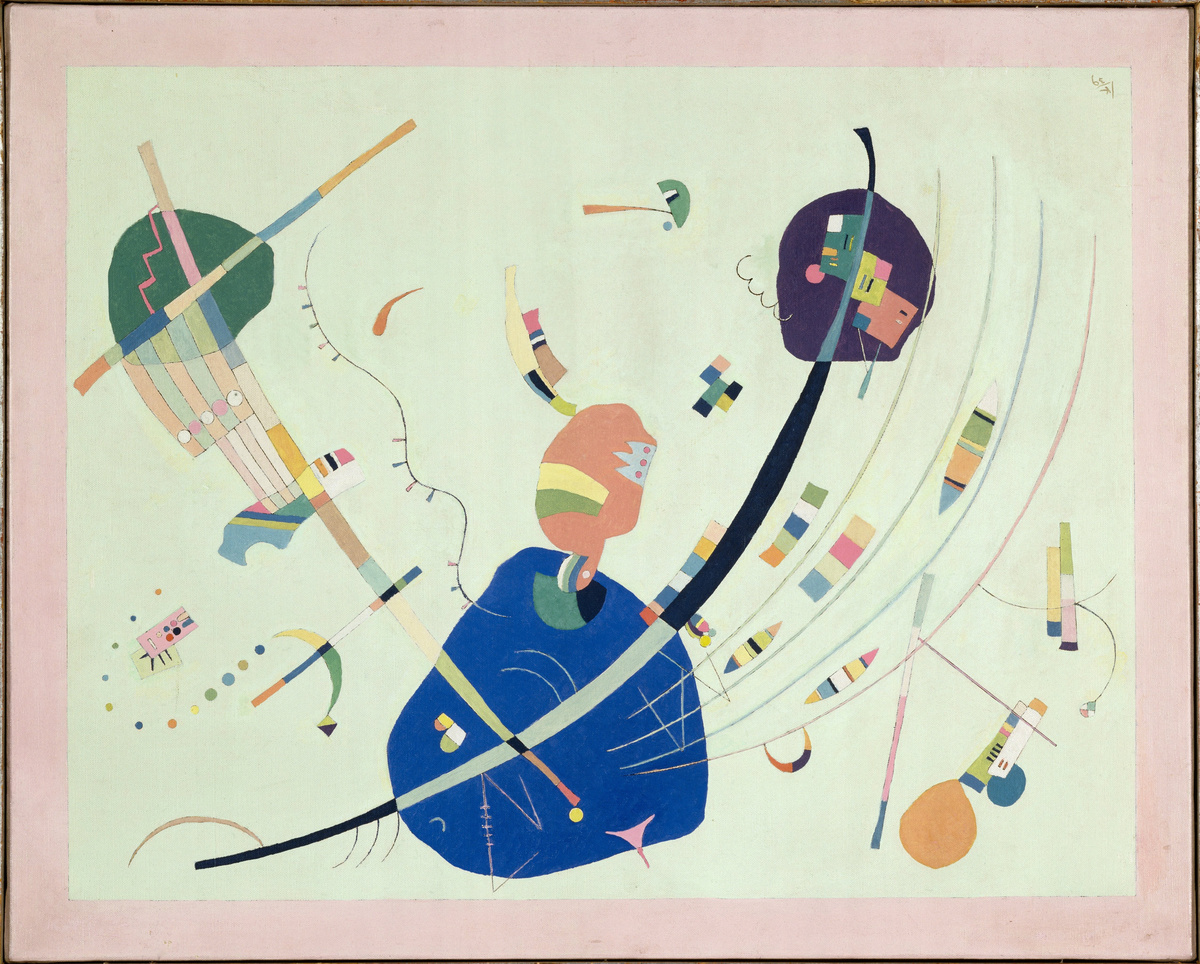
This is To the Blue, a painting Wassily Kandinsky made in 1939. It's abstract, so it doesn't show a scene from a story. Instead, Kandinsky has arranged colour and shape across the canvas. The title names blue, and a large blue mass fills much of the centre and left side.
That blue area is crossed by a thick black arc, which cuts diagonally through it. The contrast gives the blue mass a strong structural edge. Near the centre, a rounded salmon-pink form rises up. It has a striped band and a small facial marking, so it reads a little like a creature or a figure. In the upper left, a dark green rounded form is crossed by pale diagonal rods. On the upper right, a violet circular mass is balanced by coloured rectangular planes and a pink facial fragment. Down in the lower right, an orange bulb, a blue disc and a striped cylinder are linked by thin rods. Together they form a compact constellation of forms.
Across the canvas, rounded and angular shapes alternate. The black arc and the thin rods create lines that connect or divide the colour areas. The painting is made with oil and Ripolin on canvas. Ripolin is an enamel paint, and its use here isn't explained in the record, but it belongs to the work's material identity. What you see is a composition organised by colour and form rather than by a depicted event. The arrangement itself is the subject.
Kandinsky made this painting in 1939. The supplied record doesn't say where he was living or what prompted the work, so we can't add that context here. The record also doesn't offer a statement from the artist about this painting's meaning. That means we should be careful not to invent his intentions. What we can say is that the painting is abstract and that its title points to blue. The blue mass is the largest colour area, so the title and the composition reinforce each other.
The record describes the composition but doesn't explain it. So the reading I'm offering is based on what's visible, not on a documented interpretation. The dark arc sets up a contrast with the blue. The pink form draws attention because it is rounded and centred. The linked forms in the lower right create a small system of their own. These are visual effects, not claims about what Kandinsky felt or intended. The painting works by balancing separate clusters of shape and colour.
So To the Blue is an abstract painting that asks you to look at how colour and shape relate. The blue mass, the black arc, the pink form and the linked constellation each play a part. The record doesn't tell us a story behind the work, and that's fine. The painting's subject is its own arrangement, and the title gives us one clear point of entry: blue.
The story and its sources
Historical claims are linked to the records below. Close looking and interpretation are identified in the passage notes.
- Passage 1Documented historyWikimedia Commons: To the Blue
- Passage 2Close lookingWikimedia Commons: To the Blue
- Passage 3Close lookingWikimedia Commons: To the Blue
- Passage 4Documented historyWikimedia Commons: To the Blue
- Passage 5InterpretationWikimedia Commons: To the Blue
- Passage 6InterpretationWikimedia Commons: To the Blue
Details to notice
About 3 minutes to readLower-right orange cluster
An orange bulb, blue disc, and striped projectile-like cylinder are linked by thin rods, forming a compact, playful constellation in the lower right.
Violet geometric face
A deep violet circular mass contains colored rectangular planes and a pink facial fragment. It serves as the upper-right counterweight to the green orb and connects to the black arc.
Green orb and rods
A dark green rounded form is crossed by pale diagonal rods and trailing striped bands. It opens the painting's upper-left diagonal rhythm and balances the violet orb opposite.
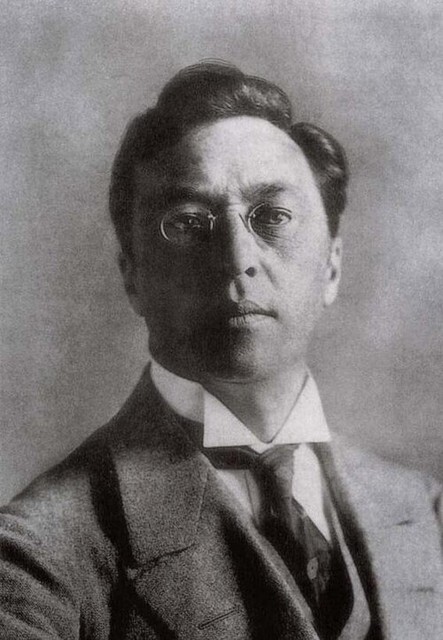
Artist portrait Image credit
未知上傳者. Image source · Public domain
About the artist
Wassily Kandinsky
1866 to 1944
Wassily Kandinsky was an avant-garde painter of Russian origin (1866–1944). Their work is associated with Expressionism; Symbolism; Bauhaus. Their recorded places of work include Paris; Munich; Weimar; Rapallo; The Hague; Russia; Stockholm; Switzerland; Tunis.
- Born
- 1866
- Died
- 1944
- Nationality
- Russian Empire; Russian Soviet Federative Socialist Republic; Soviet Union; France; Germany
- Birthplace
- Moscow
- Died in
- Neuilly-sur-Seine
Biography sources
The research & record
Study the work.
Follow the evidence.
Find catalogue details, historical context, technical research and the literature behind this artwork.
The artwork record
Research catalogue
Catalogue information and detailed research, with references that link to the bibliography.
Updated .
Identity and catalogue
Link- Title
- To the Blue(Wikimedia Commons: To the Blue, n.d.)
- Artist or attribution
- Wassily Kandinsky
- Object date
- 1939
- Medium and support
- Oil and Ripolin on canvas(Wikimedia Commons: To the Blue, n.d.)
- Dimensions
- 61 cm × 81 cm(Wikimedia Commons: To the Blue, n.d.)
- Current collection or location
- Musée National d'Art Moderne, Centre Pompidou, Paris, France(Wikimedia Commons: To the Blue, n.d.)
- Movement or period
- Abstract art(Wikimedia Commons: To the Blue, n.d.)
- Country or culture
- Germany / France
- Depicted subject
- An abstract composition without a single narrative episode. Geometric and biomorphic forms, including a large blue mass, a central pinkish figure, a black arc, and several rounded orbs, are arranged across the canvas as a non-representational arrangement of colour and shape. The work organises colour and form rather than depicting a story.
- Title variants
- Vers le bleu
- Accession number
- AM 81-65-69
- Support
- Canvas
Read valuation records and their limitations
Catalogue title and attribution
The painting is catalogued under the title 'To the Blue', given in French as 'Vers le bleu', and is attributed to Wassily Kandinsky, with a date of 1939. The work is classified as an abstract painting without a depicted narrative subject, so the record establishes its genre by the absence of a story rather than by the presence of identifiable figures or a scene. The canvas measures 61 cm in height and 81 cm in width, a horizontal format that the catalogue records alongside the title, artist and date as basic object data.(Wikimedia Commons: To the Blue, n.d., File record; Genre field; Dimensions field)
The title and the artist's name come from the Commons file record, which is an aggregator entry rather than the owning museum's own object page. The record preserves the French title alongside the English one, which matters for searching and for matching the work against French-language cataloguing. Because the supplied evidence offers only this single record for title, attribution, genre and dimensions, these catalogue facts rest on that one source and are not corroborated here by a second independent document. The date of 1939 belongs to the making of the painting as stated in the record; no later catalogue, revision or re-dating is documented in the supplied units, so the object date should not be confused with any subsequent publication or record date.(Wikimedia Commons: To the Blue, n.d., File record; Genre field; Dimensions field)
The painting is titled 'To the Blue' (French: 'Vers le bleu') and was made by Wassily Kandinsky in 1939.(Wikimedia Commons: To the Blue, n.d.)
The work is an abstract painting, without a depicted narrative subject.(Wikimedia Commons: To the Blue, n.d.)
The canvas measures 61 cm in height and 81 cm in width.(Wikimedia Commons: To the Blue, n.d.)
Subject and iconography
LinkRead valuation records and their limitations
The recorded composition
Visual observation
The supplied record for To the Blue provides a short description of the painted surface rather than an interpretive account. It identifies a large blue mass occupying much of the central and left area of the canvas, and it notes that a thick black arc cuts diagonally across that blue, producing what the description calls a strong structural intersection. These two elements establish the work's dominant axis: a broad field of colour interrupted by a single heavy linear stroke. The record does not state whether the arc passes in front of or behind the blue, nor how the paint was applied in either area, so the description should be treated as a report of visible arrangement rather than of layering or facture. The description belongs to an aggregator file record rather than to the owning museum's own object page, which is a qualification worth carrying forward whenever the wording of the description is used as evidence.(Wikimedia Commons: To the Blue, n.d., Image description)
Near the centre of the composition the record describes a rounded salmon-pink biomorphic form with a striped band and a small facial marking. The word biomorphic is the record's own characterization, and it is useful precisely because it stops short of identification: the form is described as rising near the centre and as carrying features that suggest a body or a face, but the record does not name it as a figure, a creature or a portrait. The striped band and the small facial marking are the details that make the form legible as something organic within an otherwise non-narrative arrangement. Any reading of this form as a character belongs to the viewer's response, not to the documented description.(Wikimedia Commons: To the Blue, n.d., Image description)
The upper zone of the canvas is described in terms of balance between two differentiated clusters. At the upper left appears a dark green rounded form crossed by pale diagonal rods. At the upper right appears a violet circular mass accompanied by coloured rectangular planes and a pink facial fragment. The record presents the green form as balancing the violet cluster, which is a statement about compositional distribution rather than about symmetry: the two areas are not described as mirroring each other, but as occupying corresponding upper positions with different internal contents. The pale rods crossing the green form and the rectangular planes near the violet mass introduce angular and linear elements into a composition otherwise described through rounded masses, while the pink facial fragment at the upper right repeats, in partial form, the facial marking noted on the central salmon-pink shape.(Wikimedia Commons: To the Blue, n.d., Image description)
In the lower right the record identifies a compact group: an orange bulb, a blue disc and a striped cylinder linked by thin rods, forming what it calls a constellation of forms. This cluster differs in character from the large blue mass and the black arc, because its components are small, multiple and joined by connectors rather than fused into a single field. The thin rods are described as linking the elements, which makes this the one part of the composition where the record explicitly describes connection between separate shapes. Read together with the upper-left rods and the upper-right planes, the description yields a canvas organized by the alternation of rounded masses and linear or angular elements distributed across the surface rather than arranged around a depicted subject. The record characterizes the work as abstract, without a depicted narrative subject, and the visual description is consistent with that characterization without supplying any statement by the artist about the painting's meaning.(Wikimedia Commons: To the Blue, n.d., Image description)
Material evidence and the visible surface
The visible arrangement cannot be separated from the material conditions recorded for the object. The painting is executed in oil and Ripolin on canvas. Ripolin is an enamel paint, and the record does not explain its use in this work, so the presence of enamel belongs to the work's material identity without carrying an attributed motive. Because the visual description does not specify which areas of the composition are oil and which are Ripolin, the relationship between the recorded medium and the described colour areas remains undetermined in the supplied evidence. This is a limit on what can be claimed: the blue mass, the black arc and the smaller forms can be described, and the medium can be stated, but the two cannot yet be mapped onto one another from this record alone.(Wikimedia Commons: To the Blue, n.d., Medium field; Image description)
Interpretation
The description supports a reading of the painting as a composition organized by colour and form rather than by a depicted event, with the title pointing to blue and the blue mass standing as the largest described colour area. On that basis the title and the composition can be said to reinforce one another. This is an interpretive synthesis drawn from the record's own description, not a documented statement of the artist's intention, and the record supplies no statement from the artist about the painting's meaning. The clustering of forms into a central rising shape, two balancing upper zones and a linked lower-right constellation is likewise a description of visual effect, not a claim about what the painter felt or meant. Set within a larger history of abstract painting, the value of this record lies in what it documents precisely: a 1939 abstract composition in oil and Ripolin whose surface is distributed across named colour areas and whose linear elements both cut and connect them. The record does not establish predecessors, successors or influences for this work, and none should be inferred from resemblance alone.(Wikimedia Commons: To the Blue, n.d., Image description; Medium field)
Visual observation
The composition includes a large blue mass occupying much of the central and left area of the canvas.(Wikimedia Commons: To the Blue, n.d.)
A thick black arc cuts diagonally across the blue mass, creating a strong structural intersection.(Wikimedia Commons: To the Blue, n.d.)
A rounded salmon-pink biomorphic form with a striped band and a small facial marking rises near the centre of the composition.(Wikimedia Commons: To the Blue, n.d.)
A dark green rounded form crossed by pale diagonal rods appears in the upper-left area, balancing a violet circular mass with coloured rectangular planes and a pink facial fragment in the upper right.(Wikimedia Commons: To the Blue, n.d.)
In the lower right, an orange bulb, a blue disc and a striped cylinder are linked by thin rods, forming a compact constellation of forms.(Wikimedia Commons: To the Blue, n.d.)
Materials and technique
LinkRead valuation records and their limitations
Support and medium
The material record for this painting is compact but decisive on one point: the work is executed in oil and Ripolin on canvas. Ripolin is an enamel paint, and its presence means the surface is not a single-medium oil picture but a combination of traditional oil paint and a manufactured enamel product. The evidence supplied does not explain where, how or in what proportion the Ripolin was applied, nor whether it was used for particular colour areas, lines or accents. Any account of the making that assigns Ripolin to a specific passage of the composition would therefore exceed what the record establishes. What can be said is that the two materials together constitute the work's material identity, and that the enamel component distinguishes the object's substance from the mere arrangement of its forms.(Wikimedia Commons: To the Blue, n.d., Medium field)
The medium information belongs to a file record that also fixes the object's basic physical parameters: a canvas 61 cm high and 81 cm wide, painted by Wassily Kandinsky in 1939 under the title To the Blue (French: Vers le bleu). These dimensions describe a relatively small easel painting, and the stated support of canvas is the only support the evidence documents. No ground layer, priming, stretcher, signature, inscription or later treatment is recorded in the supplied units, and none should be inferred. The medium field and the dimension field come from the same aggregator record rather than from the owning museum's own object page, a qualification that applies to the technical data as much as to the title and date.(Wikimedia Commons: To the Blue, n.d., Medium field)
What the surface shows and what the record documents
Interpretation
Read together, the documented medium and the observed composition support a limited but useful synthesis. The painting's subject is its own arrangement of colour and form rather than a depicted event, and the material choice of oil with Ripolin belongs to that arrangement as a fact of the object's construction. The enamel component is consistent with a surface built from distinct colour areas and linear elements, but the evidence does not permit the further step of explaining why Ripolin was chosen or what effect it produced. The responsible conclusion is that the work's material identity is documented at the level of medium, support and dimensions, while its layer structure, tools and application sequence remain unrecorded in the supplied evidence.(Wikimedia Commons: To the Blue, n.d., Medium field; Image description)
The painting is executed in oil and Ripolin on canvas.(Wikimedia Commons: To the Blue, n.d.)
Collection and display
LinkRead valuation records and their limitations
Institutional Location
The object's documented location is split between two institutional records. The painting is recorded in the collection of the Musée National d'Art Moderne, Centre Pompidou, Paris, under accession number AM 81-65-69, a number that identifies it as an entering work within that museum's holdings. The same file record, however, lists the Strasbourg Museum of Modern and Contemporary Art (MAMCS) as an additional holding institution. The record does not clarify how these two collections relate to this exact object: it does not say whether one institution is the owner and the other a depositary, whether the work has moved between them, or whether the Strasbourg mention reflects a loan, a joint listing, or an aggregation error. Both the Paris accession number and the Strasbourg holding are documented facts in the record, but the relationship between them remains unresolved.(Wikimedia Commons: To the Blue, n.d., Collection and Accession number fields; Collection field)
Interpretation
Taken together, the two institutional references establish only a dual listing, not a provenance narrative. The Paris record carries a specific accession number, while the Strasbourg reference appears without an equivalent number or date. This asymmetry matters for how the object's history can be written: the accession number gives the Centre Pompidou listing a precise administrative anchor, but nothing in the record supplies dates of entry, transfer, or loan for either institution. Any account of how the painting moved between collections would require documentation that this record does not contain. What can responsibly be stated is that the object is recorded at the Musée National d'Art Moderne, Centre Pompidou, and is also associated with MAMCS in the same file, with that association left unexplained.(Wikimedia Commons: To the Blue, n.d., Collection and Accession number fields; Collection field)
The painting is recorded in the collection of the Musée National d'Art Moderne, Centre Pompidou, Paris, with accession number AM 81-65-69.(Wikimedia Commons: To the Blue, n.d.)
The same file record also lists the Strasbourg Museum of Modern and Contemporary Art (MAMCS) as a holding institution, without clarifying the relationship between the two collections for this exact object.(Wikimedia Commons: To the Blue, n.d.)
Documented values and qualified estimates
LinkRead valuation records and their limitations
The Working Valuation and Its Basis
Interpretation
The only value figure attached to this record is a model-generated working insurance range. It sets an estimated value of US$8M to US$25M, and it carries a recorded date describing it as a working calculation generated 2026-10-30. That date belongs to the calculation, not to the painting, which the source record dates to 1939. The two dates are easily confused because both appear in the same documentary package, but the interval between them is more than eighty years, and the later figure describes a modern administrative exercise rather than any transaction or condition of the work at the time it was made.(Wikimedia Commons: To the Blue, n.d.)
The methodology recorded for the range is narrow and explicit. It was calculated as a broad, conservative working insurance range from the confirmed identification only: a 1939 oil and Ripolin on canvas by Wassily Kandinsky, 61 by 81 cm, held by the Musee National d'Art Moderne, Centre Pompidou, with accession number AM 81-65-69. The range is said to reflect the artist's canonical standing in abstract art, the late-career date, the mixed oil and Ripolin medium, and the museum-scale canvas. Because no confirmed public sale price, auction estimate, or official valuation was supplied, the range is deliberately wide and anchored low to avoid overstating value; it is intended only as a review baseline pending specialist comparables and provenance research. Read carefully, the figure is a function of the object's identification and general art-historical position, not of any verified market event. The wide spread between the low and high ends encodes the absence of evidence rather than confidence about a midpoint.(Wikimedia Commons: To the Blue, n.d.)
The qualifications, although phrased in the register of an insurance file, carry consequences for how the object should be described in research. The range is for manual review only; it is not an official insurance value, appraisal, auction result or sale price, and it does not reflect access to private insurance records or verified comparable sales. Final insurance scheduling should be set by a qualified appraiser using confirmed provenance, condition, exhibition history and current market evidence. This qualification lists the categories of information that the supplied record does not contain, and it should not be read as implying that such information exists but was withheld. For the present archive, the range has value as an indicator of what the confirmed identification of the work consists of: artist Wassily Kandinsky, date 1939, oil and Ripolin on canvas, dimensions 61 by 81 cm, collection Musée National d'Art Moderne, Centre Pompidou, accession number AM 81-65-69.(Wikimedia Commons: To the Blue, n.d.)
The valuation rests on the same identification that the Commons file record supplies, so its components can be checked line by line against that record. The title is To the Blue, in French Vers le bleu; the maker is Wassily Kandinsky; the year is 1939. The medium is oil and Ripolin on canvas, and the canvas measures 61 cm in height and 81 cm in width. The painting is recorded in the collection of the Musée National d'Art Moderne, Centre Pompidou, Paris, with accession number AM 81-65-69. The same file record also lists the Strasbourg Museum of Modern and Contemporary Art (MAMCS) as a holding institution, without clarifying the relationship between the two collections for this exact object. That unresolved double listing is a discrepancy in the record rather than a fact about the painting, and it matters for value because an insurance schedule depends on knowing which institution holds the object.(Wikimedia Commons: To the Blue, n.d.)
Material Identification as a Value Driver
The valuation methodology treats the date and the medium as value-bearing categories, and the source record supplies the material basis for that judgment. The medium is oil and Ripolin on canvas. The record does not say how the two media are distributed across the surface, what the Ripolin contributes to the colour effects the source describes, or what prompted its use, and it should not be used to support a claim about the artist's intent. Its support is limited to the work's material identity. Within the valuation, the mixed oil and Ripolin medium is one of four listed drivers alongside the artist's canonical standing in abstract art, the late-career date of 1939, and the museum-scale canvas of 61 by 81 cm, each identified from the confirmed record and not from market evidence.(Wikimedia Commons: To the Blue, n.d.)
The source record establishes that To the Blue is an abstract painting without a depicted narrative subject, so the work's subject is its own arrangement of colour and form. The valuation cites the artist's canonical standing in abstract art as a driver; the supplied units support that standing through the attribution and the abstract character of this work, but they do not supply exhibition history, literature or comparable prices, so the strength of the driver remains an assumption rather than a demonstrated factor in a market result.(Wikimedia Commons: To the Blue, n.d.)
The source record describes what is visible, and the valuation treats part of that visibility as value-bearing without stating so. A large blue mass occupies much of the central and left area of the canvas. A thick black arc cuts diagonally across the blue mass, creating a strong structural intersection. A rounded salmon-pink biomorphic form with a striped band and a small facial marking rises near the centre of the composition. A dark green rounded form crossed by pale diagonal rods appears in the upper left, balancing a violet circular mass with coloured rectangular planes and a pink facial fragment in the upper right. In the lower right, an orange bulb, a blue disc and a striped cylinder are linked by thin rods, forming a compact constellation of forms. These visual descriptions matter within the value section because the working range assumes a late, museum-scale abstract canvas by a canonical artist. The record supplies no condition report, no comparative sales and no appraisal, so the range remains a review baseline that a qualified appraiser would be expected to revise using confirmed provenance, condition, exhibition history and current market evidence.(Wikimedia Commons: To the Blue, n.d.)
Working estimate
Calculated working insurance estimate, not a sale price: Estimated value: US$8M to US$25M Recorded date: Working calculation, generated 2026-10-30. Methodology: Calculated as a broad, conservative working insurance range from the confirmed identification only: a 1939 oil and Ripolin on canvas by Wassily Kandinsky, 61 by 81 cm, held by the Musee National d'Art Moderne, Centre Pompidou, with accession number AM 81-65-69. The range reflects the artist's canonical standing in abstract art, the late-career date, the mixed oil and Ripolin medium, and the museum-scale canvas. Because no confirmed public sale price, auction estimate, or official valuation was supplied, the range is deliberately wide and anchored low to avoid overstating value; it is intended only as a review baseline pending specialist comparables and provenance research. Qualification: This is a model-generated working range for manual review only. It is not an official insurance value, appraisal, auction result, or sale price, and it does not reflect access to private insurance records or verified comparable sales. Final insurance scheduling should be set by a qualified appraiser using confirmed provenance, condition, exhibition history, and current market evidence.(Wikimedia Commons: To the Blue, n.d.)
Further reading
Books for a closer look
Paid links. As an Amazon Associate I earn from qualifying purchases.

Open Library Kandinsky: Russian and Bauhaus years, 1915-1933.
Solomon R. Guggenheim Museum
Catalogue record for 'Kandinsky' with subjects including Abstract Art, Centre Georges Pompidou, Musée national d'art moderne, exhibitions and catalogues raisonnés. These recorded subjects align with the artwork's documented facts: an abstract 1939 Kandinsky held at the Musée National d'Art Moderne, Centre Pompidou. It is the strongest catalogue candidate for object- and collection-specific study, though the record alone does not confirm 'To the Blue' is discussed.
ISBN 0892070447

Open Library Kandinsky, complete writings on art
G.K. Hall
'Kandinsky, complete writings on art' is recorded as a collection of Kandinsky's writings on modern art. It is relevant as a primary-source compilation connected to the artist of this abstract 1939 painting, though the catalogue record does not establish that it addresses 'To the Blue' specifically or that its contents were consulted.
ISBN 0805799508
Bibliography
Sources and further reading
References are arranged by author or organisation, with links to the original publications. Where no publication date is recorded, n.d. means no date.
Source notes updated .
No recorded sources match these filters. Reset the filters to see the full bibliography.
- 03
Book
Kandinsky, complete writings on art. G.K. Hall.
'Kandinsky, complete writings on art' is recorded as a collection of Kandinsky's writings on modern art. It is relevant as a primary-source compilation connected to the artist of this abstract 1939 painting, though the catalogue record does not establish that it addresses 'To the Blue' specifically or that its contents were consulted.
- ISBN
- 0805799508
Citation text
- 02
Book
Kandinsky: Russian and Bauhaus years, 1915-1933. Solomon R. Guggenheim Museum.
Catalogue record for 'Kandinsky' with subjects including Abstract Art, Centre Georges Pompidou, Musée national d'art moderne, exhibitions and catalogues raisonnés. These recorded subjects align with the artwork's documented facts: an abstract 1939 Kandinsky held at the Musée National d'Art Moderne, Centre Pompidou. It is the strongest catalogue candidate for object- and collection-specific study, though the record alone does not confirm 'To the Blue' is discussed.
- ISBN
- 0892070447
Citation text
- 01
Secondary · About this artwork
Wikimedia Commons: To the Blue (n.d.). Wikimedia Commons: To the Blue. Wikimedia Commons.
Commons file record supplied as the discovery source. Gives title, artist, date, medium, dimensions, collection, accession number and a short visual description. It is an aggregator record, not the owning museum's own object page.
- Language
- English
Citation text
Art to live with
Bring this painting
home.
A piece of the archive, made yours. Explore To the Blue in a size and finish that fits your space.
Your text and annotations appear on these editions. Adding to cart saves that design for printing.
Combine this painting with your favourites01 / Find your edition
Made for you
Suggested from your location. Change it if you're sending elsewhere or using a VPN. Prices and delivery are shown in GBP.
1 product
Choose an edition to make it yours
iPhone 12 Mini ? Glossy ? back view
iPhone 12 Mini · Glossy

iPhone 12 Mini ? Glossy ? back view

iPhone 12 Mini ? Glossy ? back view

iPhone 12 Mini ? Glossy ? back view
Tough phone case
GBP 16.34
Delivery GBP 4.22 / Total GBP 20.56
A two-layer phone case with a printed polycarbonate shell and a shock-absorbing inner liner.
Two layers with a shock-absorbing TPU liner
Case & print details
- Device
- Apple · iPhone 12 Mini
- Material
- Polycarbonate shell with a TPU inner liner
- Artwork
- Outer back and wrapped edges from one template
- Finish
- Glossy
- Version
- Standard version
- Printing
- Dye sublimation
- Print file
- 1,122 × 1,831 px · 95 × 155 mm · PNG · 300 dpi recommended
Rear outline and camera openings follow this variant's Printify template. Case depth and small hardware remain illustrative.
Supplier product detailsFit and fill keep the painting’s proportions. Stretch changes them.
Move and zoom the painting on your tough phone case.
Made to order with your design
Made to order
US delivery only
The 30 cm ruler is scaled alongside your selected print. Keep the painting’s proportions with a black background, or stretch it to fill. Frame width, material texture and screen colours are illustrative.
Keep exploring