Identity and catalogue
Link- Title
- The Starry Night
- Artist or attribution
- Vincent van Gogh
- Medium and support
- Oil painting
- Movement or period
- Post-Impressionism
- Country or culture
- Dutch
- Depicted subject
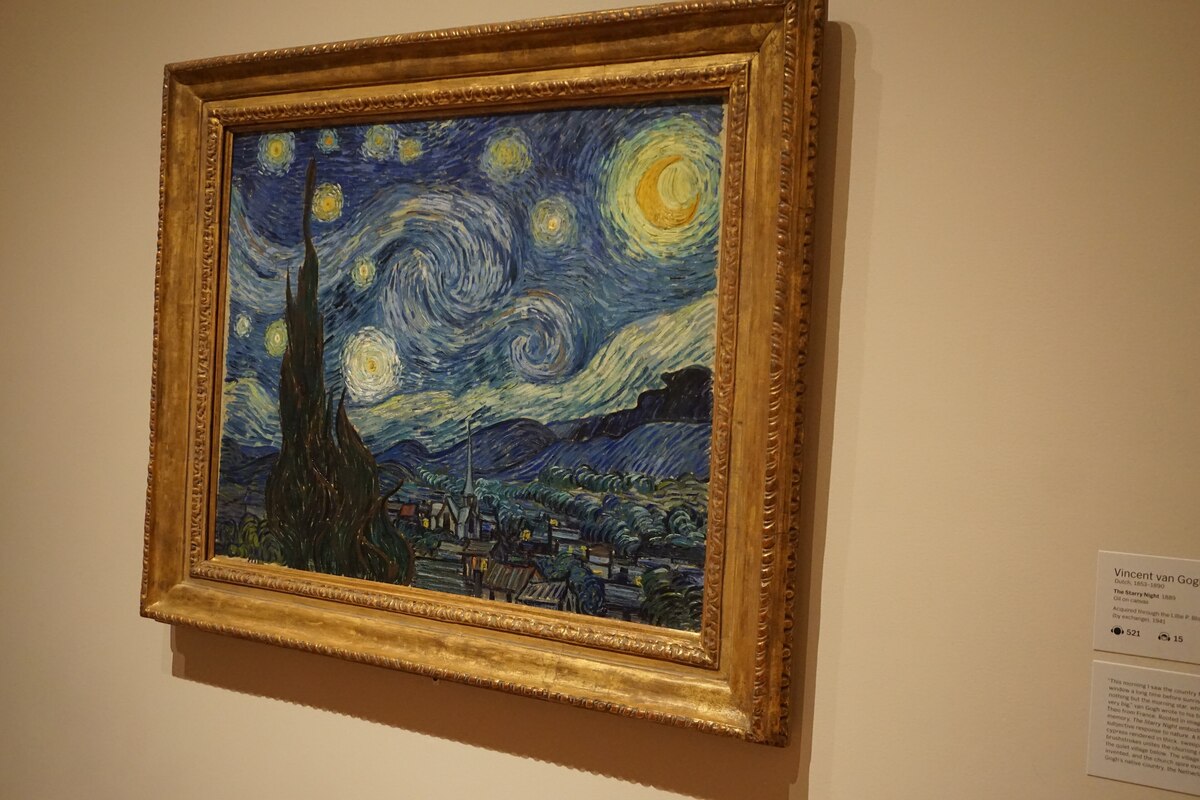
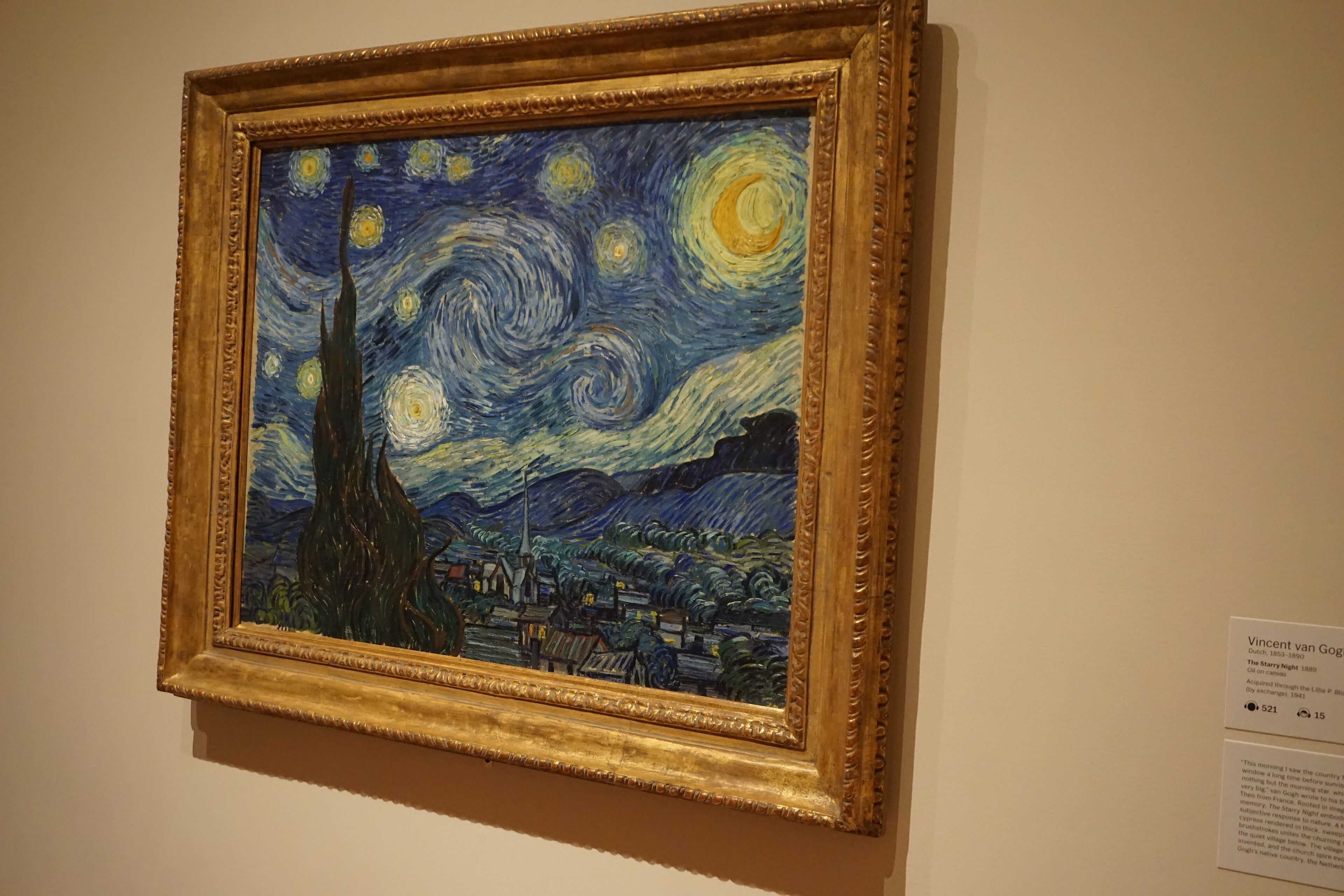
- A nocturnal landscape painted in June 1889 at Saint-Rémy, showing a predawn sky pulsing with motion, in which the moon and stars radiate concentric bands of yellow, pink, green, and forget-me-not blue light while the surrounding space churns. The composition combines observed and imagined views of Saint-Rémy, including a radiant Venus, a towering cypress, a sleepy village, and a pointed church spire.(The Museum of Modern Art (MoMA), New York, n.d.)
- Dimensions
- Unknown
Catalogue identity
The catalogue entry for this object establishes its core identity as a painting by Vincent van Gogh, made in June 1889 at Saint-Rémy. The institution holding the work, The Museum of Modern Art (MoMA) in New York, publishes this attribution, date and place of execution together with its curatorial and technical research record, and the museum's page also supplies a reading list that includes the 2008 exhibition catalogue Vincent van Gogh: The Starry Night by Richard Thomson. The date of the canvas is thus established as 1889, not as any later date attached to its cataloguing, publication or institutional interpretation: those later dates belong to the scholarship and exhibition history surrounding the object rather than to the making of the painting itself. On this record the object is a night scene made during a specific month of a specific year in a specific place, and that conjunction of maker, place and date is the anchor for everything else in this account.(The Museum of Modern Art (MoMA), New York, n.d.)
The support and subject of the painting are documented through the museum's description: the canvas depicts a predawn sky that pulses with motion, in which the moon and stars gleam and radiate concentric bands of yellow, pink, green and forget-me-not blue light, while the space around them churns. Below that sky sit the elements repeated across the literature, a towering cypress, a sleepy village and a pointed church spire. The institution's curatorial essay, by Annemarie Iker, a Mellon-Marron Research Consortium Fellow writing in 2020, is the attributed source for the description of subject, creation context and scholarly interpretation. What the picture shows, then, and what the museum says about it, are presented on the record as inseparable parts of the same catalogue entry.(The Museum of Modern Art (MoMA), New York, n.d.)
Van Gogh's own words
An important qualification attaches to the letters. Despite being usually eager to discuss his art, Van Gogh had surprisingly little to say about The Starry Night in his letters to family and friends, so what is known about its making comes largely from the work itself and from the wider pattern of his night painting rather than from a detailed first-person account of this canvas. That asymmetry should be weighed when any assertion about the picture's intention is made: the object is unusually well documented as a made thing and less well documented as a described thing. Attributions of meaning to this specific canvas therefore rest more heavily on the physical and technical record and on the surrounding practice than on a direct commentary about this particular work.(The Museum of Modern Art (MoMA), New York, n.d.)
Colour as programme
Interpretation
Taken together, the documented units describe an object that cannot be reduced either to a record of one view or to pure invention. It is a painting by Vincent van Gogh made in June 1889 at Saint-Rémy and held by The Museum of Modern Art, New York. It depicts a predawn sky whose moon and stars radiate concentric bands of yellow, pink, green and forget-me-not blue while the surrounding space churns, above a cypress, a village and a church spire. Venus beside the cypress corresponds to a planet documented as visible in spring 1889, while the cypress, village and spire were not visible from the artist's residence and were worked from studies made elsewhere in Saint-Rémy, and perhaps beyond. The artist's letters set out a programmatic view of night colour and an explicit acknowledgement of exaggeration combined with subject matter found in the real world, and the museum's scholarship describes the result as a fusion of observed and imagined views of Saint-Rémy, of astronomical realities, spiritual aspirations and artistic imperatives. Within a larger history of art and material culture the object matters on these documented terms: as a night painting that anchors a documented celestial event, that assembles rather than records its terrain, that was made in the same asylum summer as a body of olive grove canvases, and that has prompted countless viewers to look carefully, as its creator urged his sister, beyond the visual cliché of white spots on blue-black. The same evidential base also preserves the limits of the account: the artist said comparatively little about this canvas, and the sources of some of its elements remain located only imprecisely.(The Museum of Modern Art (MoMA), New York, n.d.)
Saint-Rémy, May and June 1889
The documented setting for The Starry Night is specific and consequential: Van Gogh relocated from Arles to nearby Saint-Rémy and entered an asylum there in May 1889 after mental illness, and in June 1889, while at Saint-Rémy, he devoted an entire canvas to his nocturnal vision. This places the painting at the start of his stay in the institution rather than in the Arles period that preceded it. The June 1889 date and the Saint-Rémy location rest on institutional cataloguing rather than on a surviving letter in which Van Gogh describes beginning or finishing this particular canvas, a distinction that matters for how confidently the commission and creation circumstances can be reconstructed.(The Museum of Modern Art (MoMA), New York, n.d.)
The Starry Night did not arise as an isolated experiment. Since leaving Paris for southern France, Van Gogh was enchanted by the prospect of painting the sky in the hours between sunset and sunrise, and two Arles paintings, Café Terrace at Night and Starry Night Over the Rhône, already include glimpses of a night sky. Those Arles works establish a pre-existing ambition to paint darkness itself rather than a single sudden inspiration at the asylum. The June 1889 canvas is where that ambition, previously carried in a corner or a portion of a composition, becomes the entire subject.(The Museum of Modern Art (MoMA), New York, n.d.)
A letter to his sister Willemien records Van Gogh's position on how such a sky should be painted: the night, he wrote, is even more richly colored than the day, colored in the most intense violets, blues, and greens, and to paint a starry sky it is not nearly enough to put white spots on blue-black. This is the clearest statement of intent tied to the nocturnal project, and it is stated as a general principle rather than as a description of this canvas. His surviving correspondence also shows, in the same period, a broader fixation on color as a vehicle of meaning: he wrote to Willemien that what he was most passionate about was the portrait, the modern portrait, which he sought by way of color. Color, on this evidence, was not decorative for him but the medium through which he pursued his central pictorial concerns, which is why the night sky could be treated as a colour problem rather than a lighting problem.(The Museum of Modern Art (MoMA), New York, n.d.)
A second letter, to Émile Bernard, bears directly on the picture's relation to the visible world. Van Gogh wrote that he exaggerated and sometimes made changes to the subject, but still did not invent the whole of the painting; on the contrary, he found it ready-made but to be untangled in the real world. Read as a statement of method, this describes a practice that begins in observation and then alters it, so that exaggeration and fidelity are not alternatives. The evidence does not record Bernard's reply, nor any response from Bernard to a description of The Starry Night specifically, and the letter does not name the canvas; it establishes the artist's stated working principle rather than a documented account of this painting's making.(The Museum of Modern Art (MoMA), New York, n.d.)
Assembled from observation
The painting's relationship to the actual terrain of Saint-Rémy is more complicated than a single vantage point would suggest. The towering cypress, sleepy village, and pointed church spire in The Starry Night were not visible from Van Gogh's residence at Saint-Rémy; he turned to studies made elsewhere in Saint-Rémy, and perhaps beyond, while at work on these elements. The qualification "perhaps beyond" is the evidence's own and should be preserved: the working studies that fed these motifs are not fully documented. The same period supplies a related working habit, since Van Gogh painted multiple canvases in an olive grove adjacent to the asylum throughout the summer of 1889, captivated by the ever-shifting hue of the trees. That adjacent subject, worked repeatedly as its color changed, shows him assembling motifs from sustained outdoor observation rather than relying on a single window view.(The Museum of Modern Art (MoMA), New York, n.d.)
One element of the sky can be tied to an identifiable astronomical body. To the right of the cypress in The Starry Night burns Venus, a planet that did in fact illuminate the night sky in spring 1889. The correspondence between a painted point of light and a real planet's visibility is a documented technical fact, but it should not be extended to the whole composition: the evidence supports Venus specifically and does not establish that every star, the moon, or the exact configuration of the sky matches an observed night. Applied carefully, the astronomical finding shows that the depiction is neither purely symbolic nor a literal record, since a real and verifiable object sits within a sky whose surrounding structure scholars describe as partly imagined.(The Museum of Modern Art (MoMA), New York, n.d.)
What the evidence supports
Interpretation
The cumulative evidence supports a specific kind of claim about this object and no more. The Starry Night is tied to a documented time and place through the June 1889 Saint-Rémy date, to a documented ambition through the letters on the sky between sunset and sunrise and the earlier Arles night scenes, to a documented working method through the letter to Bernard, and to an identifiable celestial body through Venus. What the record does not supply is a detailed account of the commission or a first-person description of this canvas, and the placement of the cypress, village, and spire in a view not visible from the residence shows that the scene was assembled rather than recorded. The painting matters in a larger history of art and material culture because it sits at the convergence of those documented strands: night as a subject pursued over years, color theorized as the core of his art, and observation that was freely altered without being abandoned.(The Museum of Modern Art (MoMA), New York, n.d.)
To the right of the cypress in The Starry Night burns Venus, a planet that did in fact illuminate the night sky in spring 1889.(The Museum of Modern Art (MoMA), New York, n.d.)
The towering cypress, sleepy village, and pointed church spire in The Starry Night were not visible from Van Gogh's residence at Saint-Rémy; he turned to studies made elsewhere in Saint-Rémy, and perhaps beyond, while at work on these elements.(The Museum of Modern Art (MoMA), New York, n.d.)
Van Gogh wrote to his sister Willemien that the night is even more richly colored than the day, colored in the most intense violets, blues, and greens, and that to paint a starry sky it is not nearly enough to put white spots on blue-black.(The Museum of Modern Art (MoMA), New York, n.d.)
Van Gogh had surprisingly little to say about The Starry Night in his letters to family and friends, despite being usually eager to discuss his art.(The Museum of Modern Art (MoMA), New York, n.d.)
Van Gogh relocated from Arles to nearby Saint-Rémy and entered an asylum in May 1889 after mental illness.(The Museum of Modern Art (MoMA), New York, n.d.)
Van Gogh painted multiple canvases in an olive grove adjacent to the asylum at Saint-Rémy throughout the summer of 1889, captivated by the ever-shifting hue of the trees.(The Museum of Modern Art (MoMA), New York, n.d.)
Since leaving Paris for southern France, Van Gogh was enchanted by the prospect of painting the sky in the hours between sunset and sunrise.(The Museum of Modern Art (MoMA), New York, n.d.)
A night sky can be glimpsed in two paintings from Arles, Café Terrace at Night and Starry Night Over the Rhône.(The Museum of Modern Art (MoMA), New York, n.d.)
In Saint-Rémy, in June 1889, Van Gogh devoted an entire canvas to his nocturnal vision with The Starry Night.(The Museum of Modern Art (MoMA), New York, n.d.)
Van Gogh wrote to Émile Bernard that he exaggerated and sometimes made changes to the subject, but still did not invent the whole of the painting; on the contrary, he found it ready-made but to be untangled in the real world.(The Museum of Modern Art (MoMA), New York, n.d.)
For Van Gogh, color was central to the modern portrait; he wrote to his sister Willemien that what he was most passionate about was the portrait, the modern portrait, which he sought by way of color.(The Museum of Modern Art (MoMA), New York, n.d.)
Reception and literature
LinkA Painting With Little First-Person Commentary
The Starry Night occupies an unusual position in the documentation of its own making. Van Gogh, who was ordinarily eager to discuss his art in letters to family and friends, had surprisingly little to say about this particular canvas. The paradox matters for any account of its reception: the painting that would become among the most widely recognized images in modern art was not accompanied by a detailed first-person narrative of its creation. What can be established about its making therefore rests on the work itself, on the broader pattern of Van Gogh's night painting, and on the general statements about color and invention that he set down in correspondence during the same period.(The Museum of Modern Art (MoMA), New York, n.d.)
Visual observation
The evidence of the canvas itself describes a predawn sky that pulses with motion, in which the moon and stars gleam and radiate concentric bands of yellow, pink, green, and forget-me-not blue light while the space around them churns. This visual character is not incidental to the painting's later reception but constitutive of it: the rings of color around the luminaries, and the turbulent intervals between them, are what generations of viewers have responded to and reproduced. The transcription of that experience into language, however, has repeatedly risked reducing the picture to a formula, which is precisely what Van Gogh warned against when he wrote to his sister Willemien that to paint a starry sky it is not nearly enough to put white spots on blue-black. The Starry Night has, in turn, prompted countless viewers to look carefully, as its creator urged his sister, in order to see beyond that visual cliché. Reception of the painting can thus be understood as a long negotiation between the evident optical richness of the surface and the temptation to summarize it.(The Museum of Modern Art (MoMA), New York, n.d.)
Interpretation
Taken together, the evidence indicates that the meanings the painting has accumulated were built on a creation story that is itself composite. A predawn sky pulsing with motion and radiating concentric bands of color; Venus actually visible in the spring of 1889; a cypress, village, and spire drawn from studies made elsewhere; a letter in which the artist insists he exaggerated and altered but did not invent the whole; a letter in which the night is said to be more richly colored than the day; and a conspicuous silence about this canvas in the correspondence. Because the artist left no detailed account of this particular picture, later cultural roles, including its standing as an emblem of nocturnal vision or of creative intensity, have been attached to a work whose own genesis is reconstructed from the painting and its wider context rather than from the artist's testimony about it. That gap is part of the object's history and should be preserved in any account of how it came to mean what it means.(The Museum of Modern Art (MoMA), New York, n.d.)
Interpretations and debates
LinkInterpretation
Interpretation
The Starry Night has attracted a large body of interpretation in which the relation between observation and invention is the central problem. The Museum of Modern Art's institutional account records that scholars have determined that Van Gogh fused observed and imagined views of Saint-Rémy in the painting, incorporating astronomical realities, spiritual aspirations and artistic imperatives. This is a scholarly reading rather than a statement of the painter's private intent, and it rests on comparing the canvas with what could and could not have been observed from his residence. Because no detailed first-person account of the canvas survives, interpretation has to proceed by inference from the work and from the wider pattern of his night painting, which is why institutional and curatorial assessments often hedge their claims rather than assert them as documented fact.(The Museum of Modern Art (MoMA), New York, n.d.)
Van Gogh had surprisingly little to say about The Starry Night in his letters to family and friends, despite being usually eager to discuss his art. The absence is materially important for interpretation, because it means the canvas cannot be explained by a first-person statement attached to it; the statements about the night sky, about exaggeration, and about the modern portrait belong to the surrounding correspondence and to other occasions, and must be brought to bear by readers rather than found as commentary on this work. It is also the reason the scholarly attribution of fused observation and imagination is framed as a determination by scholars working from the object and its context.(The Museum of Modern Art (MoMA), New York, n.d.)
One comparable statement extends the same logic to an earlier subject. Van Gogh likened the coarse finish of the painted Potato Eaters to the homespun fabrics worn by his sitters, both the product of manual labor. The reasoning is worth noting because it draws an analogy between a property of the paint surface and the material life of the people depicted, and it shows that he was prepared to explain technical roughness by reference to the subject rather than to skill or finish. It remains a likening attributed to him rather than a documented program for the later nocturnal canvas, and it should not be transferred to The Starry Night as though it had been said of it.(The Museum of Modern Art (MoMA), New York, n.d.)
The lines of evidence do not all pull in the same direction. The astronomical placement of Venus and the painted treatment of light support a partially observed sky, while the cypress, village and spire require studies made elsewhere and perhaps beyond Saint-Rémy, which supports an assembled scene. The painter's letter to Bernard explicitly accepts exaggeration and alteration while denying that the whole was invented, and his letters are largely silent on this specific canvas. A responsible synthesis therefore keeps three things apart: what is visibly depicted, what the correspondence and the astronomical record establish about the season and the site, and what scholars infer when they describe a fusion of observation, spiritual aspiration and artistic imperative. That last term in particular belongs to the attributed scholarly reading rather than to any surviving statement by the painter about this picture.(The Museum of Modern Art (MoMA), New York, n.d.)
Documented values and qualified estimates
LinkRecorded values
Interpretation
The Starry Night was painted by Vincent van Gogh in June 1889 at Saint-Rémy and is held in the permanent collection of The Museum of Modern Art, New York, where it is described as a canonical Post-Impressionist work devoted entirely to the artist's nocturnal vision. The only valuation figure in the supplied record is a model-generated working insurance range of US$850 million to US$1.2 billion, recorded as a working calculation generated 2026-10-16. That range is expressly produced for manual insurance review only and is not claimed as an official insurance value, appraisal, auction result, or sale price. No official insurance value, appraisal, auction record, or documented acquisition price was supplied.(The Museum of Modern Art (MoMA), New York, n.d.)(Andrew Milligan sumo, 2018)
The valuation unit sets out its own methodology and limits. Because no official insurance value, appraisal, auction record, or documented acquisition price was supplied, and because comparable open-market transactions for works of this rarity and cultural status are effectively absent, the range is derived from a broad order-of-magnitude schedule applied to a museum-held, one-of-a-kind, superlative Van Gogh night painting. The schedule anchors at the upper tier of the global art market for irreplaceable museum-quality masterworks, with a low end well below any speculative open-market figure and a high end bounded to reflect insurance review conservatism. The qualification is explicit: it is a conservative working range for manual review only, not based on comparable sales, private insurance records, or any confidential valuation, and no public appraisal is claimed and no private insurance data was accessed. Actual insurance values for museum-held works of this nature are typically determined by institutional policy rather than open-market pricing, and final figures require review by a qualified fine-art appraiser or underwriter together with confirmation of provenance, condition, and coverage terms.(The Museum of Modern Art (MoMA), New York, n.d.)(Andrew Milligan sumo, 2018)
Read together, the institutional and valuation records distinguish what is documented about the object's identity from what remains undetermined about its monetary value. MoMA's record establishes authorship, date, place of execution, permanent collection status, and canonical standing; the valuation record states plainly that no official figure, appraisal, sale, or acquisition price exists in the supplied evidence and that its own range is a review aid rather than a market fact. The Wikimedia photograph confirms circulation of the image without adding provenance or valuation data. The resulting position is that The Starry Night's monetary value is not documented here at all, while its cultural status as an irreplaceable museum work is the premise from which any such valuation would have to proceed.(The Museum of Modern Art (MoMA), New York, n.d.)(Andrew Milligan sumo, 2018)
Working estimate
Calculated working insurance estimate, not a sale price: Working insurance range: US$850M to US$1.2B Recorded date: Working calculation, generated 2026-10-16. Methodology: Conservative working range for manual insurance review only. Based on the confirmed context: an authenticated oil painting by Vincent van Gogh, executed June 1889 at Saint-Remy, held in the permanent collection of The Museum of Modern Art, New York, and described by MoMA as a canonical Post-Impressionist work devoted entirely to the artist's nocturnal vision. Because no official insurance value, appraisal, auction record, or documented acquisition price was supplied, and because comparable open-market transactions for works of this rarity and cultural status are effectively absent, the range is derived from a broad order-of-magnitude schedule applied to a museum-held, one-of-a-kind, superlative Van Gogh night painting. The schedule anchors at the upper tier of the global art market for irreplaceable museum-quality masterworks, with a low end well below any speculative open-market figure and a high end bounded to reflect insurance review conservatism. No public appraisal is claimed and no private insurance data was accessed. Qualification: This is a model-generated working insurance range for manual review only. It is not an official insurance value, appraisal, auction result, or sale price. It is not based on comparable sales, private insurance records, or any confidential valuation. Actual insurance values for museum-held works of this nature are typically determined by institutional policy, not by open-market pricing. Final figures require review by a qualified fine-art appraiser or underwriter and confirmation of provenance, condition, and coverage terms.(The Museum of Modern Art (MoMA), New York, n.d.)(Andrew Milligan sumo, 2018)