Identity and catalogue
Link- Title
- The Snake Charmer
- Object date
- 1907
- Dimensions
- height: 16,900 mm; width: 18,900 mm (as recorded in the supplied Wikimedia Commons file record)
- Movement or period
- Naïve or primitive painting; part of Rousseau's Jungles series
- Country or culture
- France
- Depicted subject
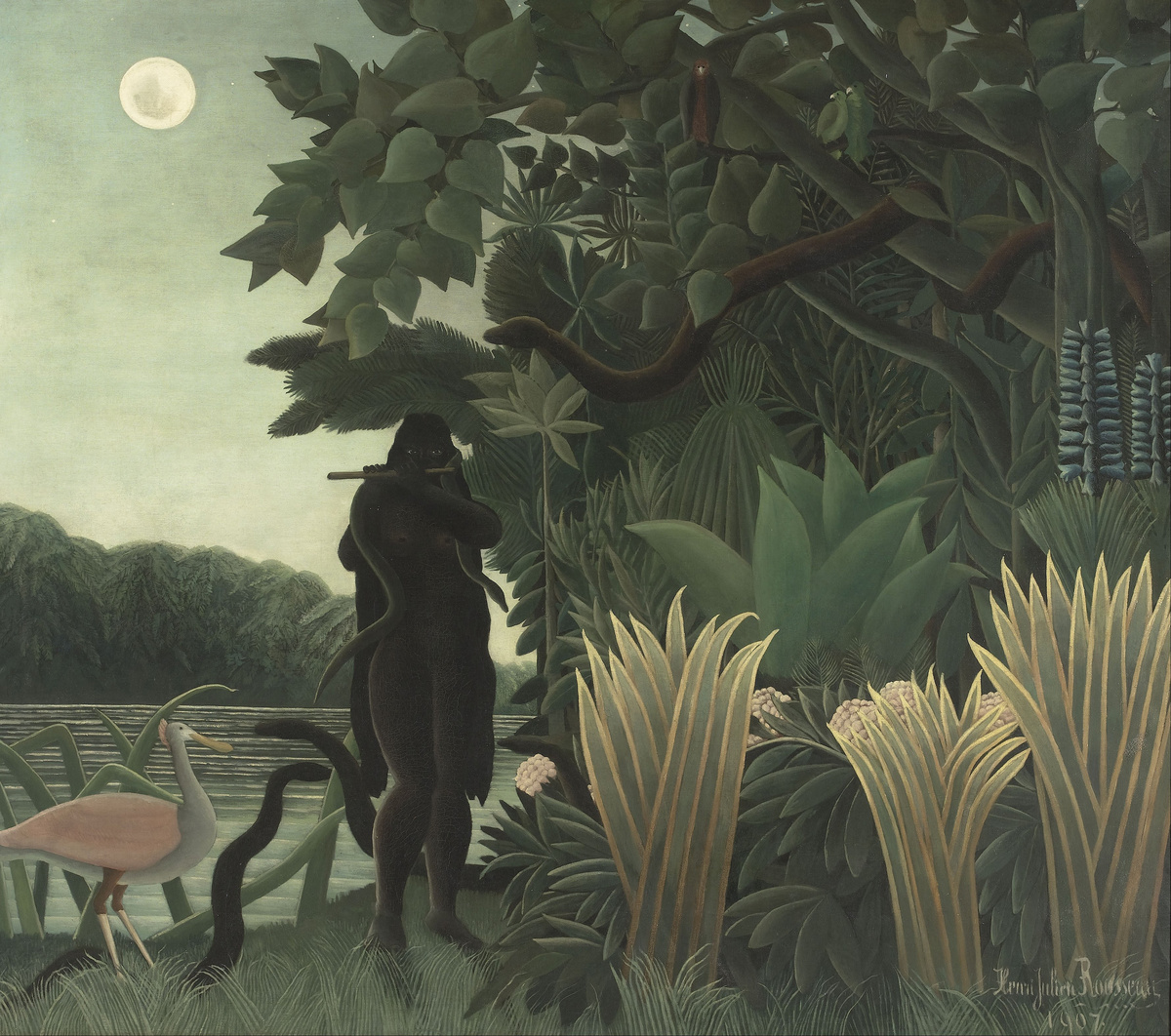
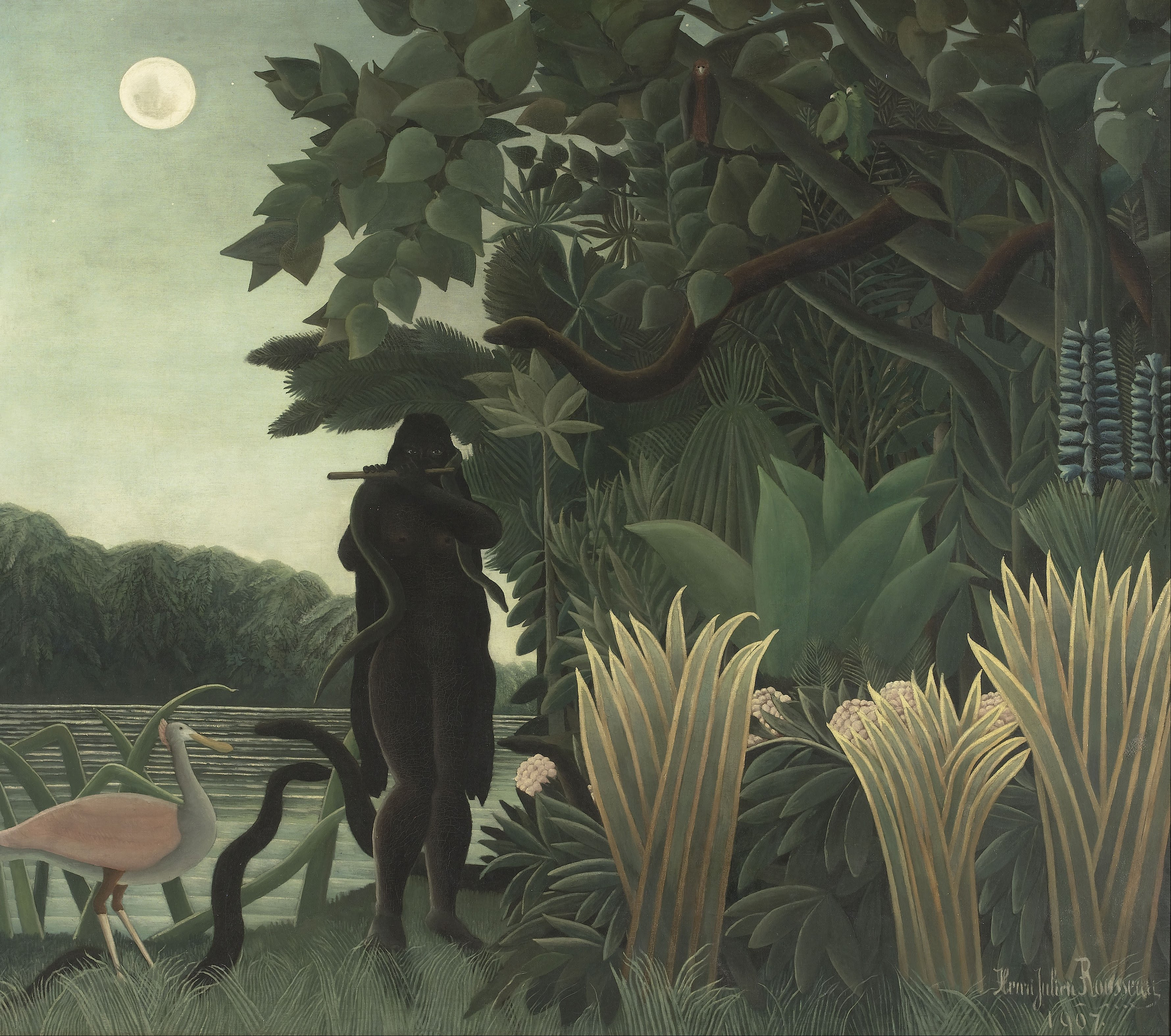
- A landscape painting showing a dark, silhouetted woman standing on a riverbank, playing a flute with a snake coiled over her shoulders, while a black snake moves through the grass near her feet and a pale wading bird stands among the reeds.(Wikimedia Commons: The Snake Charmer, n.d.)
- Support
- canvas
Catalogue identity and title variants
The painting is catalogued as The Snake Charmer by Henri Rousseau, known as le Douanier (1844-1910), dated 1907, with the French title La Charmeuse de serpents. It belongs to Rousseau's series titled Jungles. The object type is recorded as a painting, and its genre is recorded as landscape painting. The work is additionally referenced under the title La Charmeuse de serpents in the Panorama de l'art database, so the French title circulates in more than one reference source rather than functioning only as a translation of the English catalogue title.(Wikimedia Commons: The Snake Charmer, n.d., File information, Summary; File information, Summary, Series title; File information, Summary, References)
The work is catalogued as RF 1937 7 at the Musée d'Orsay and is associated with the artist Henri Rousseau. The accession number places the object within the museum's numbered holdings, while the catalogue's association of the work with Rousseau is the institution's attribution record for this painting. Both the identification and the accession identifier belong to the same catalogue entry, which is the basis for tying the title, the artist and the object number together as one object rather than as separate claims.(Wikimedia Commons: The Snake Charmer, n.d., File information, Summary)
Rights status and its evidential basis
Interpretation
The work is in the public domain because the artist died in 1910, and the copyright term is life plus 100 years or fewer in the country of origin. That status is a consequence of the documented death date of the artist in the identification record, not of a separate assertion about the painting's history. It also means the title variants and the object data attached to the painting can be reproduced and consulted without the restrictions that would apply to a work still in copyright.(Wikimedia Commons: The Snake Charmer, n.d., Licensing)
Provenance and collection entry
The painting's entry into the collection is recorded through the Jacques Doucet bequest in 1936, which is the provenance event that connects the work to the Musée d'Orsay accession number RF 1937 7. This bequest is documented separately from the object's 1907 date, so the moment the painting was made and the moment it entered public hands are two distinct events in the record and should not be conflated in the catalogue account.(Wikimedia Commons: The Snake Charmer, n.d., File information, Summary, Object history; File information, Summary)
Subject and iconography
LinkVisual observation
The only visual information the consulted source record supplies about this painting's composition is its title, The Snake Charmer (La Charmeuse de serpents). The discovery record reproduces the object's identification data rather than describing what appears on the canvas, so the excerpted text establishes a subject named by the title but no further visual details such as figure, setting, palette or arrangement. Any account of the scene's internal organisation therefore has to be separated carefully from what this particular evidence unit actually states, and the record's own annotation confirms its scope: it is a reproduction of title, artist, date, medium, dimensions, collection, accession number, object history, exhibition history and catalogue references, not a curatorial essay on the work's meaning.(Wikimedia Commons: The Snake Charmer, n.d., File information, Summary, Title)
Materials and technique
LinkVisual observation
The Snake Charmer (La Charmeuse de serpents) is an oil on canvas by Henri Rousseau, known as le Douanier, the French painter who lived from 1844 to 1910. The painting is dated 1907 and measures 169 cm in height by 189 cm in width, dimensions the source records as 16,900 mm by 18,900 mm. The work belongs to the group of Rousseau's paintings known as the Jungles series, and its genre is given as landscape painting. It is held in the collection of the Musée d'Orsay, Paris, under accession number RF 1937 7, and is listed in Henri Rousseau's catalogue raisonné of 1984 by Certigny as number 250.(Wikimedia Commons: The Snake Charmer, n.d., File information, Summary; File information, Summary, Title)
Evidence for materials and making
Interpretation
Documentation of the object's making is limited in the supplied evidence to a single material fact: the medium is oil on canvas. This identification comes from the source's file information summary, which is a discovery record cataloguing the object's title, artist, date, medium, dimensions, collection, accession number, provenance history and catalogue references, rather than a technical study of the work. The record does not supply the canvas type, ground or preparation layer, pigments, binding media analysis, varnish or conservation treatment, and no sampling, cross-section, imaging or laboratory method is documented in the supplied units. Accordingly, the account of materials here rests on the object-level medium statement and on the digitized image itself, not on technical examination of the physical paint layers.(Wikimedia Commons: The Snake Charmer, n.d., File information, Summary; File information, Summary, Source/Photographer)
The digital surrogate through which the painting can be studied was made available through the Google Art Project at maximum zoom level, as stated in the source's Source/Photographer field. That high-resolution availability supports close looking at the image, but it is a record of the digitized photograph, not a record of physical analysis: viewing the file at high magnification establishes what the reproduction shows, not what pigment or layer structure the canvas carries. The distinction matters for the account of materials and technique, because the only medium statement in the evidence is the documentary oil-on-canvas designation, while the zoomable file is the basis for any visual description of the picture's surface as reproduced.(Wikimedia Commons: The Snake Charmer, n.d., File information, Summary, Source/Photographer; File information, Summary)
Visual observation
The source's own description of the image content is minimal. The excerpted text describes the image only as a snake charmer, giving the title La Charmeuse de serpents and no further visual details. The material account therefore cannot be extended into a description of depicted objects, colours or handling from the source's summary alone; what the summary establishes is the subject designation implied by the title, while the medium, dimensions and catalogue data are the concrete object facts it supplies. This qualification keeps the materials section within what the evidence supports: an oil-on-canvas painting of documented size and date, with no technical analysis of its preparation, pigments or layers reported.(Wikimedia Commons: The Snake Charmer, n.d., File information, Summary, Title; File information, Summary)
Digital examination and its limits
Technical examination
The technical basis for close study of this painting, as documented in the supplied record, is a digitized image made available through the Google Art Project at its maximum zoom level. That detail matters because it defines how the object has been examined in this line of research: the reproduction permits magnification of the surface as captured by the imaging campaign, but the evidence says nothing about infrared reflectography, X-radiography, pigment sampling, cross-sections or conservation treatment. Accordingly, no underdrawing, pentimento or material analysis of the paint layers can be reported here, and any claim about what lies beneath the visible surface would exceed the evidence. What the technical record establishes is a viewing condition, namely that the image can be studied at high magnification through the Google Art Project, while the findings it permits remain limited to what is visible in the digitized photograph rather than to the physical object's stratigraphy.(Wikimedia Commons: The Snake Charmer, n.d., File information, Summary, Source/Photographer)
Interpretation
The distinction between an observed finding and a proposed explanation is especially sharp for this object, since the only technical unit available concerns image access rather than physical examination. The digitized image at maximum zoom supports observation of the painted surface as recorded, but it cannot certify pigments, dates of execution within the year 1907, alterations by the artist, or later interventions. This limitation should be weighed alongside the documentary evidence: the medium is recorded as oil on canvas, and the object's identification rests on a discovery record rather than a technical report. A cautious research position, therefore, treats the high-resolution image as a tool for visual description and comparison, and treats any material or processual account of the painting as a question still open to instrumental study rather than a settled finding. The evidence supplied here does not attribute to any scholar or institution a technical interpretation of the picture, so no such interpretation is asserted.(Wikimedia Commons: The Snake Charmer, n.d., File information, Summary, Source/Photographer; File information, Summary)
Provenance and ownership
LinkDocumented Transfer
The documented ownership history of Henri Rousseau's The Snake Charmer is brief and rests on a single recorded event. The painting entered a public collection through the Jacques Doucet bequest in 1936, the transfer by which it passed from private possession into institutional hands. The record supplies no earlier owner, agent, dealer or sale, and no price or transaction date before the bequest. The account therefore establishes one legible stage of ownership and leaves the preceding decades unrecorded rather than unowned; an absent chain of custody is not evidence that no transfer occurred, only that none is documented in the surviving record.(Wikimedia Commons: The Snake Charmer, n.d., File information, Summary, Object history)
The bequest is conventionally dated 1936, while the painting's accession number in the Musée d'Orsay, Paris, is RF 1937 7. The one-year separation between the year of the bequest and the year embedded in the accession identifier is a routine feature of museum registration, where a bequest accepted or finalized in one year may be inventoried and numbered in the next. The evidence does not narrate the intervening administrative steps, so the relationship between the 1936 event and the 1937 number remains an inference from the two dates rather than a documented sequence. What is supported is the substance: the Doucet bequest is the recorded route by which the work reached the Musée d'Orsay and acquired its institutional identity.(Wikimedia Commons: The Snake Charmer, n.d., File information, Summary, Object history)
Custody and Documentation
Interpretation
Read together, the evidence permits a chronology that is precise at one end and silent at the other. The painting is dated 1907, so roughly three decades separate its making from the 1936 bequest, and no intermediate owner, location or movement is documented. The record does not describe how the work came into Jacques Doucet's possession, whether it was bought directly from the artist or otherwise, nor whether it changed hands between 1907 and the bequest. This unrecorded interval should be distinguished from a proven change of ownership: the evidence proves the bequest, it does not prove continuity of a single private owner across those years. The scholarly value of stating the gap plainly is that later research can be directed at precisely this interval without being mistaken for correcting a documented chain.(Wikimedia Commons: The Snake Charmer, n.d., File information, Summary, Object history)
Provenance timeline
- 1936
The painting entered the collection through the Jacques Doucet bequest.(Wikimedia Commons: The Snake Charmer, n.d., File information, Summary, Object history)
Reception and literature
LinkFrom Private Bequest to Public Collection
The established scholarly listing of Rousseau's known works is the Henri Rousseau catalogue raisonné of 1984 by Certigny, in which The Snake Charmer is entered as number 250. The catalogue raisonné is the standard reference for establishing which works belong to the artist's oeuvre, so its inclusion of this painting is part of what secures its status as a documented Rousseau. Reference to entry 250 is the form in which the painting is cited within that literature. The catalogue also functions as a reception document in its own right: by the 1980s the painting was sufficiently established to occupy a numbered place in the systematic record of the artist's output.(Wikimedia Commons: The Snake Charmer, n.d., File information, Summary, References)
Institutional Display and Curatorial Framing
A distinct later stage of reception is institutional exhibition. The painting was included in Le Modèle noir de Géricault à Matisse, held at the Mémorial ACTe from 13 September to 29 December 2019. This is a posthumous showing, separated from the painting's creation by more than a century, and it places the work within a curatorial framework concerned with black figures in French art from Géricault to Matisse. The exhibition therefore assigned the painting a role in a history of representation rather than presenting it solely as a Rousseau jungle. The exhibition dates establish a specific, bounded moment of public display, and the venue at the Mémorial ACTe is itself part of how the work was framed for audiences at that time.(Wikimedia Commons: The Snake Charmer, n.d., File information, Summary, Exhibition history)
Collection and display
LinkObject and medium
The Snake Charmer, known in French as La Charmeuse de serpents, is an oil on canvas painting by Henri Rousseau, the French painter known as le Douanier who lived from 1844 to 1910. It is dated 1907 and measures 169 cm in height by 189 cm in width, dimensions recorded in the source file as 16,900 mm by 18,900 mm. The painting belongs to the group of works known as Rousseau's Jungles series and is classified in the genre of landscape painting. Its subject and scale place it among the large canvases of Rousseau's late career, the same period in which his jungle imagery reached its most ambitious form.(Wikimedia Commons: The Snake Charmer, n.d., File information, Summary, Collection)
The painting is in the collection of the Musée d'Orsay in Paris, France, where it carries the accession number RF 1937 7. That accession number ties the work to the museum's twentieth-century holdings and provides the museum's own identifier for the object, distinct from the title and artist attribution by which the painting is generally known. Together with the title, artist, date, medium and dimensions, these details constitute the object's core identification in the collection record.(Wikimedia Commons: The Snake Charmer, n.d., File information, Summary, Collection; File information, Summary, Accession number)
Provenance and the Doucet bequest
The painting entered public hands through the Jacques Doucet bequest in 1936, and the Musée d'Orsay record preserves that bequest as the object's documented history of transfer. The accession number RF 1937 7, with its 1937 component, relates the work to that bequest context as recorded by the museum. The bequest, rather than a direct purchase or an earlier museum transfer, is therefore the event that brought the painting into the French national collection as the evidence presents it.(Wikimedia Commons: The Snake Charmer, n.d., File information, Summary, Collection; File information, Summary, Accession number)
The painting is listed in the Henri Rousseau catalogue raisonné published in 1984 by Certigny, where it appears as number 250. The catalogue raisonné functions as the standard listing of Rousseau's known works, so the entry number gives the painting a stable place in the scholarly enumeration of the artist's output and allows the object to be identified independently of its museum record. That catalogue reference and the Musée d'Orsay accession number are separate systems of identification, one bibliographic and one institutional, and the evidence establishes both.(Wikimedia Commons: The Snake Charmer, n.d., File information, Summary, Collection; File information, Summary, Accession number)
Modern exhibition history
Beyond its permanent collection, the painting has a documented exhibition history: it was shown in Le Modèle noir de Géricault à Matisse at the Mémorial ACTe from 13 September 2019 to 29 December 2019. That display places the work within a curated account of race and representation in French art from Géricault to Matisse, a context in which Rousseau's jungle painting is presented alongside other works rather than as an isolated object. The evidence records the venue, the exhibition title and the dates of display, establishing the 2019 showing as part of the painting's public life after its entry into the museum.(Wikimedia Commons: The Snake Charmer, n.d., File information, Summary, Collection)
Documented values and qualified estimates
LinkThe recorded insurance range and its basis
Interpretation
The single supplied evidence unit for this section is a working valuation record, not a market document. It states a calculated working insurance estimate of US$8M to US$25M for Henri Rousseau's The Snake Charmer, 1907, oil on canvas, and records the date of that calculation as 2026-10-16. The estimate is generated rather than appraised: the record describes it as a conservative working insurance range calculated from confirmed institutional context only, widened to account for the absence of official appraisal, condition report, provenance depth, and private comparable data. The record explicitly states that no comparables, auction results, or insurance records were accessed or invented. Because the range rests on institutional identification alone, its limits are part of the evidence it provides, and the figure should be treated as a provisional banding rather than as a valuation of the work.(Wikimedia Commons: The Snake Charmer, n.d.)
The institutional context on which the range depends is stated within the same record: the work is identified as Henri Rousseau's The Snake Charmer, 1907, oil on canvas, from the Jungles series, held by the Musee d'Orsay under accession number RF 1937 7, with a Jacques Doucet bequest in 1936. Those identification points are what the methodology treats as confirmed, and the range is described as using broad, high-level art-market insurance banding for comparable museum-grade late Rousseau jungle paintings. As a major museum-held painting by a canonical artist in a celebrated series, with secure public collection status and no offered sale history in the supplied excerpts, the work is placed in that banding by category rather than by any transaction. The record also notes that dimensions in the supplied record are internally inconsistent and were not used as a value multiplier, so no size-based adjustment enters the calculation.(Wikimedia Commons: The Snake Charmer, n.d.)
Qualifications and what the figure does not establish
The record's qualifications govern how the figure may be used. It states that the estimate is a model-generated working insurance range for manual review only and that it is not an official insurance value, appraisal, auction result, or sale price. It further states that the range is not based on verified comparables, condition assessment, provenance review, or private insurance data, and that actual insurance scheduling requires a qualified appraiser and professional evaluation. The record adds that the local system will set the price_date to the generation date and that no appraisal, insurance, or market date is inferred. Read together, these statements mean the US$8M to US$25M band records an internal working calculation with a generation date, not a claim about what the painting would bring or has brought in any market.(Wikimedia Commons: The Snake Charmer, n.d.)
Working estimate
Calculated working insurance estimate, not a sale price: Estimated value: US$8M to US$25M Recorded date: Working calculation, generated 2026-10-16. Methodology: Conservative working insurance range calculated from confirmed institutional context only. The work is identified as Henri Rousseau's The Snake Charmer, 1907, oil on canvas, from the Jungles series, held by the Musee d'Orsay under accession number RF 1937 7, with a Jacques Doucet bequest in 1936. As a major museum-held painting by a canonical artist in a celebrated series, with secure public collection status and no offered sale history in the supplied excerpts, the range uses broad, high-level art-market insurance banding for comparable museum-grade late Rousseau jungle paintings. The range is widened to account for the absence of official appraisal, condition report, provenance depth, and private comparable data. No comparables, auction results, or insurance records were accessed or invented. Dimensions in the supplied record are internally inconsistent and were not used as a value multiplier. Qualification: This is a model-generated working insurance range for manual review only. It is not an official insurance value, appraisal, auction result, or sale price. It is not based on verified comparables, condition assessment, provenance review, or private insurance data. Actual insurance scheduling requires a qualified appraiser and professional evaluation. The local system will set the price_date to the generation date; no appraisal, insurance, or market date is inferred here.(Wikimedia Commons: The Snake Charmer, n.d.)