Identity and catalogue
Link- Movement or period
- Romanticism
- Country or culture
- British
- Depicted subject
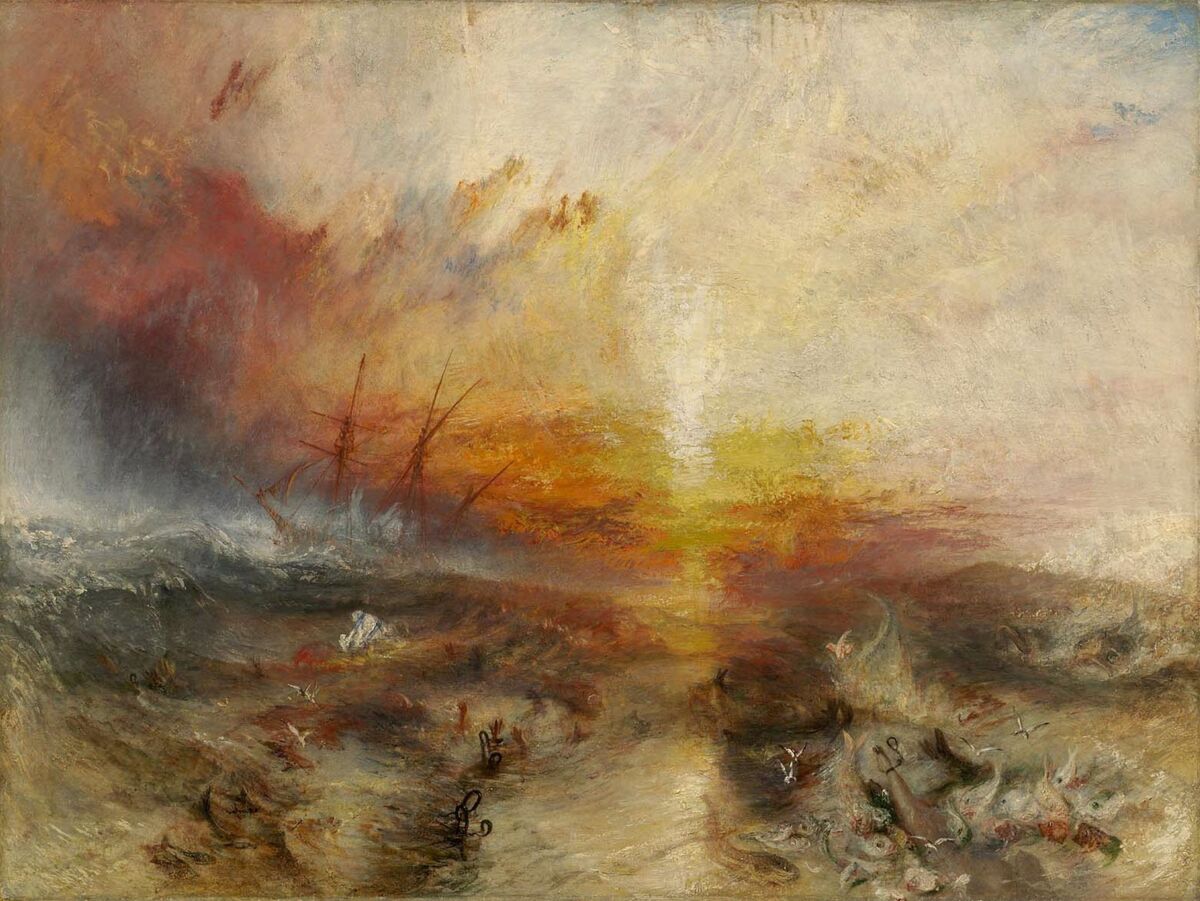
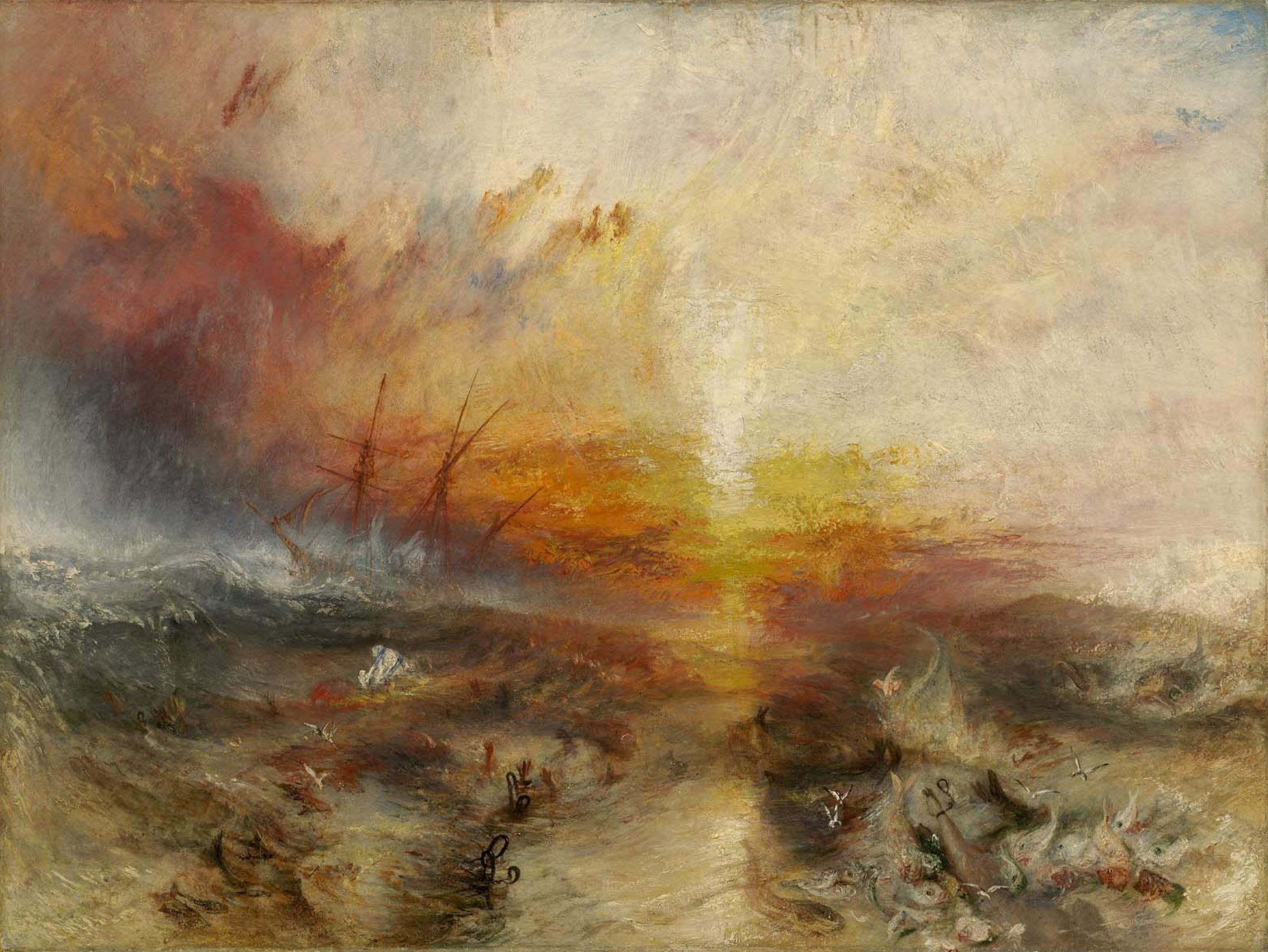
- A slave ship at sea in a coming typhoon, its crew having thrown enslaved people overboard; the full title reads Slavers throwing overboard the Dead and Dying, Typhoon coming on.(Wikimedia Commons: The Slave Ship, n.d.)
- Title variants
- Slavers throwing overboard the Dead and Dying, Typhoon coming on; Le Négrier; La nave negriera; Das Sklavenschiff
- Accession number
- 99.22
- Support
- canvas
Catalogue identity and attribution
The painting is recorded under the full title Slavers throwing overboard the Dead and Dying, Typhoon coming on, and is commonly known as The Slave Ship. It is attributed to J. M. W. Turner, the British painter and printmaker who lived from 1775 to 1851. The work carries the date 1840. It is painted in oil on canvas, and is classified as marine art, associated with the Romantic period. The recorded dimensions are 90.8 cm high by 122.6 cm wide, given elsewhere as 91 by 123 cm or about 36 by 48 inches. The painting belongs to the collection of the Museum of Fine Arts, Boston, under accession number 99.22.(Wikimedia Commons: The Slave Ship, n.d., Summary, Description; Summary, Artist; Summary, Date; Summary, Dimensions; Captions; Summary, Object type and Genre; file usage, Romanticism)
Subject and Catalogued Associations
The object treated here is recorded under a long descriptive title, Slavers throwing overboard the Dead and Dying, Typhoon coming on, and is commonly known as The Slave Ship. That title is itself the record's primary statement about subject matter: it names slavers casting the dead and the dying overboard as a typhoon comes on, so the action and the weather are presented together rather than as separate elements. Because the title is the source's description of the action, it establishes the subject as the record frames it; it does not function as eyewitness testimony to any particular voyage, and the supplied material does not supply the number of people involved, their names, or the precise circumstances of a single crossing. The painting's catalogued associations extend the subject into the Zong massacre and the broader history of the Atlantic slave trade, an association recorded in the catalogue rather than a claim that a specific episode has been definitively identified as the scene depicted.(Wikimedia Commons: The Slave Ship, n.d., Captions; Summary, Description; File usage on other wikis)
Interpretation
Read together, these units support a distinction that matters for the object's history: secure identification of the work and its institutional home does not settle the question of why it was made or how its subject was chosen. The record establishes a title naming a slave ship, people thrown overboard, and a coming typhoon; it establishes catalogued associations with the Zong massacre and the Atlantic slave trade; and it establishes the Museum of Fine Arts, Boston as the source of the reproduced image. It does not establish an eyewitness basis for the scene, a named participant in a specific event, or a documented chain of commission. The object's importance within a larger history of art and material culture therefore rests on a conjunction the record states plainly rather than on a reconstructed narrative: a marine subject, a human crime, and a storm are held together in one titled image.(Wikimedia Commons: The Slave Ship, n.d., Captions; Summary, Description; File usage on other wikis; Source/Photographer; Licensing)
The subject is described in the title as slavers throwing overboard the dead and dying as a typhoon comes on.(Wikimedia Commons: The Slave Ship, n.d.)
The painting's catalogued associations include the Zong massacre and the broader history of the Atlantic slave trade.(Wikimedia Commons: The Slave Ship, n.d.)
Materials and technique
LinkDocumented Support and Medium
The physical description that the supplied evidence documents most directly is the painting's support and medium: the work is oil on canvas. That is the single explicit materials statement in the evidence. While it is a brief technical fact, it anchors the section, because oil on canvas places the picture within the dominant practice of nineteenth-century British painting and determines how its surface behaves, how light passes into and scatters back from the paint film, and how the work has aged. The evidence does not specify the type, weave or weight of the canvas, the presence of a preparatory ground, the pigments used, the medium or varnish applied, or any conservation treatment or lining, and no such claims should be inferred. Likewise, the source describes the work as a marine painting and as belonging to the Romantic period, but these are classificatory labels rather than material evidence; they tell us where cataloguers place the picture, not what it is made of. Technical examination and visual inference must therefore be kept apart here: the medium is documented, and broader questions about layer structure, preparation, and pigment remain open in the supplied record.(Wikimedia Commons: The Slave Ship, n.d., Summary, Medium)
Title, Scale and the Conditions of Making
The same source supplies the title under which the work is recorded, Slavers throwing overboard the Dead and Dying, Typhoon coming on, commonly shortened to The Slave Ship, along with the attribution to J. M. W. Turner (1775 to 1851) and the date 1840. These facts are relevant to materials and technique even though they are not themselves technical, because a dated, titled, exhibited picture implies a moment and a format: the evidence gives the dimensions as 90.8 centimetres high by 122.6 centimetres wide, stated elsewhere as 91 by 123 centimetres or about 36 by 48 inches. That is a scale at which a painter working in oil on canvas could lay in broad areas of sea and sky with sweeping brushwork and could rework the surface before it dried, and the horizontal format suits the marine subject. The evidence also records that the painting belongs to the Museum of Fine Arts, Boston, under accession number 99.22, and that the file reproduces a photographic reproduction of a two-dimensional public domain work sourced from that museum. It is worth stating plainly that the evidence supports the attribution and the date as recorded facts but does not describe Turner's studio procedure, his materials suppliers, or his working sequence. Nothing in this unit should be stretched into a claim about how the paint was actually applied.(Wikimedia Commons: The Slave Ship, n.d., Summary, Medium)
Reception and literature
LinkReproduction and Reference Use
The corpus of documentation for this painting is not a single monument of scholarship but a layered record that includes at least one digital reproduction and its licensing apparatus. The supplied record states that it reproduces the painting as a faithful photographic reproduction of a two dimensional public domain work of art, sourced from the Museum of Fine Arts, Boston. That formulation carries its own evidentiary weight: the image circulating online is offered as a reproduction rather than as an original document, and its rights status is derived from the public domain status of the underlying flat object, not from any claim about the painting's authorship, date or meaning. It also identifies the source as the museum that holds the work, which anchors the reproduction to an institutional object rather than to an anonymous scan. The same record is frank about its own limits, and the surrounding project annotation describes the file as a discovery and reference aid and says that an institutional object record remains the preferable source for catalogue identity. Read together, these statements mark a recurring feature of the painting's later life: it is knowable to most viewers through mediated images whose reliability depends on the care and openness of the holding institution, and whose descriptive captions are a step removed from the object itself.(Wikimedia Commons: The Slave Ship, n.d., Source/Photographer; Licensing; File usage on other wikis)
That same file record sets out, in plain terms, the range of subjects the image has been used to illustrate: marine painting, Western painting, slavery at common law, and the Royal Academy Exhibition of 1840. This list is not a sequence of interpretations but a map of how the picture has been put to work. One use is stylistic and generic, placing the canvas within the histories of marine and Western painting. A second is legal and historical, invoking the topic of slavery at common law, the doctrinal terrain in which enslaved people were argued to be property and in which the moral and jurisdictional questions raised by the slave trade were litigated. A third is biographical and institutional, tying the picture to the exhibition context in which it first met a public. The evidence does not rank these uses or claim that they are equivalent; it records that they are catalogued associations of a single image. Taken as reception history rather than as biography of the artist, the list shows a nineteenth century oil painting moving through several communities of inquiry at once, each finding in it a usable illustration of a different subject.(Wikimedia Commons: The Slave Ship, n.d., File usage on other wikis)
How the Subject Has Been Framed
The most concrete surviving evidence about the painting's early public reception is its place in the Royal Academy Exhibition of 1840. The supplied record notes explicitly that the image has been used to illustrate that exhibition, which is evidence of later documentary use rather than of the original hanging itself; it does not describe the gallery, the crowd, or what reviewers wrote. What it does establish is a secure institutional and chronological anchor: the work was associated with a specific annual exhibition in the year recorded for the painting. For reception history this is a starting point, not a verdict. The exhibition supplied an occasion on which the picture could be seen as a public statement rather than a private possession, and it is the moment to which much later catalogue and reference use returns. The same record gives no account of critical responses, sales, or later ownership, and the account should not manufacture them.(Wikimedia Commons: The Slave Ship, n.d., File usage on other wikis)
Reproduction and Reference Use
Interpretation
The later reception of the picture has a technical dimension as well as a literary one. Because the reproduction is a photograph of a flat public domain work, the visible image is available for reuse and for the kind of encyclopedic reference uses the record catalogues, and its fidelity is asserted rather than demonstrated in the record itself. The annotation's caution that the institutional object record is the preferable source for catalogue identity is a real qualification on the reach of the digital document: it can support attribution of subject and association, but it is not the catalogue. This is a quiet but consequential point for how the painting's meanings accumulate. Where the object record would carry curatorial authority, the media file carries reuse value, and its circulation across topics such as marine painting, Western painting, slavery at common law, and the 1840 exhibition is itself part of the painting's modern life. It has become a standard illustration for several distinct histories at once, which is a different kind of fame from the fame of a single dramatic event.(Wikimedia Commons: The Slave Ship, n.d., Source/Photographer; Licensing; File usage on other wikis)
The supplied record reproduces the painting as a faithful photographic reproduction of a two dimensional public domain work of art, sourced from the Museum of Fine Arts, Boston.(Wikimedia Commons: The Slave Ship, n.d.)
The file is recorded as having been used to illustrate related subjects including marine painting, Western painting, slavery at common law, and the Royal Academy Exhibition of 1840.(Wikimedia Commons: The Slave Ship, n.d.)
Collection and display
LinkObject record and catalogued identity
The painting known as The Slave Ship is recorded under the fuller title Slavers throwing overboard the Dead and Dying, Typhoon coming on, and is credited to J. M. W. Turner, the British painter and printmaker who lived from 1775 to 1851. It is dated 1840 and is painted in oil on canvas. Its recorded dimensions are 90.8 cm high by 122.6 cm wide, given elsewhere as 91 by 123 cm or approximately 36 by 48 inches. In cataloguing terms the work is classified as marine art and associated with the Romantic period, and its catalogued associations include the Zong massacre and the broader history of the Atlantic slave trade. The recorded title states the subject as slavers throwing overboard the dead and dying as a typhoon comes on, a description of the action rather than a claim of eyewitness testimony: the work belongs to the history of the Atlantic slave trade as a subject, not to a recorded observation by the artist of a single voyage.(Wikimedia Commons: The Slave Ship, n.d., Summary, Collection; Accession number)
The painting belongs to the collection of the Museum of Fine Arts, Boston, with accession number 99.22. Its recorded associations extend beyond the canvas itself: the file is noted as having been used to illustrate marine painting, Western painting, slavery at common law, and the Royal Academy Exhibition of 1840. The supplied record also reproduces the painting as a faithful photographic reproduction of a two dimensional public domain work of art sourced from the Museum of Fine Arts, Boston. Because the available account rests on a Wikimedia Commons file record that credits the museum, the catalogue data it carries (title, artist, date, medium, dimensions and accession number) is best treated as a reference aid, with an institutional object record remaining the preferable source for catalogue identity.(Wikimedia Commons: The Slave Ship, n.d., Summary, Collection; Accession number)
Documented values and qualified estimates
LinkThe documented object and its valuation basis
Interpretation
The object at the centre of this record is securely identified in the supplied documentation as an oil on canvas of 1840 by J. M. W. Turner (1775 to 1851), a British painter and printmaker, and as a securely attributed, high-prominence work of that artist held by the Museum of Fine Arts, Boston under accession number 99.22. The full title recorded for the painting is Slavers throwing overboard the Dead and Dying, Typhoon coming on, commonly known as The Slave Ship. The work is dated 1840, is executed in oil on canvas, and measures approximately 90.8 cm high by 122.6 cm wide, given elsewhere as 91 by 123 cm or about 36 by 48 inches. It is classified as marine art and associated with the Romantic period, with Turner placed as one of the most celebrated figures in British Romanticism. The subject is described in the title itself as slavers throwing overboard the dead and dying as a typhoon comes on, and the painting's catalogued associations include the Zong massacre and the broader history of the Atlantic slave trade. These are the confirmed facts on which any valuation discussion of this object must rest, and they are the only facts the working valuation evidence reports as its inputs.(Wikimedia Commons: The Slave Ship, n.d.)
The supplied figure and how it was produced
The single value figure supplied for this object is a model-generated working range, not a market fact. It is recorded as a calculated working insurance estimate with an estimated insurance range of US$80M to US$200M, recorded as a working calculation generated 2026-10-16. The stated methodology is a broad working range derived from the confirmed artwork context: a securely attributed, high-prominence oil on canvas of 1840 by Turner, held by the Museum of Fine Arts, Boston under accession number 99.22. The calculation states that it uses only the supplied institutional record and public file documentation, which confirm artist, title, date, medium, dimensions of approximately 90.8 by 122.6 cm, and museum collection status. Because no official insurance schedule, appraisal, auction result, or sale record was supplied for this specific painting, the range is set conservatively as a broad order-of-magnitude band for manual review only. The factors named in the calculation are Turner's canonical market standing, the painting's museum-held masterpiece status, its exceptional art-historical prominence, and its inclusion of a sensitive historical subject that would affect loan, transport, and exhibition exposure. No comparable sales or private valuation data were used or invented.(Wikimedia Commons: The Slave Ship, n.d.)
Qualifications on the working estimate
The qualification attached to that range is as consequential as the range itself. The evidence describes it as a model-generated working range for manual review, not an official insurance value, appraisal, auction result, or sale price. It is not based on an inspection of the physical artwork, an official museum valuation, an insurer's schedule, or any comparable sale record, and it should not be used to bind coverage, settle a claim, or establish market value. Any actual insurance amount would require a qualified appraiser, the institution's collection records, condition reporting, and institution-specific coverage terms. Put plainly, the same evidence unit that supplies the US$80M to US$200M band also supplies the reasons it cannot function as a documented valuation: the absence of a schedule, appraisal, auction result or sale record for this painting, and the absence of physical inspection, condition reporting and institution-specific coverage terms.(Wikimedia Commons: The Slave Ship, n.d.)
Read together, these statements establish a relationship rather than a single number. The confirmed object context supplies artist, title, date, medium, approximate dimensions and museum collection status; the working calculation converts that context into a broad order-of-magnitude band and explicitly flags the sensitive historical subject as a factor bearing on loan, transport and exhibition exposure. What the evidence does not establish is any actual transaction, coverage or appraisal figure, and the calculation makes no claim to one. The honest scholarly position is therefore that this painting has a documented identity and an undocumented monetary value, that the only figure in the record is a review-stage construct, and that any dollar amount for the work remains to be supplied by qualified appraisal, institutional collection records, condition reporting and institution-specific terms.(Wikimedia Commons: The Slave Ship, n.d.)
Circulation, exhibition and reference use
The sensitivities named in the valuation reasoning connect to a documented creation and circulation history rather than to market data alone. The painting was exhibited in the Royal Academy Exhibition of 1840, and the supplied record notes that its image has been used to illustrate that exhibition. The supplied record also states that the painting is reproduced as a faithful photographic reproduction of a two dimensional public domain work of art, sourced from the Museum of Fine Arts, Boston, and that the file is recorded as having been used to illustrate related subjects including marine painting, Western painting, slavery at common law, and the Royal Academy Exhibition of 1840. Those uses document the painting's role as a reference image across several distinct lines of inquiry, which is consistent with the exceptional art-historical prominence cited as a valuation factor while remaining independent of any monetary figure.(Wikimedia Commons: The Slave Ship, n.d.)
There is also a factual distinction the evidence preserves and that a valuation account should not flatten. The title names the subject as slavers throwing overboard the dead and dying as a typhoon comes on, and the title is the source's description of the action, not a claim of eyewitness testimony: the work depicts a practice belonging to the history of the Atlantic slave trade rather than an event its maker witnessed. The catalogued association with the Zong massacre is an association in a catalogue, not a claim that this painting depicts that exact episode. The title also does not establish the number of people, their names, or the precise circumstances of any single voyage. These qualifications matter to valuation because the sensitive-subject factor invoked by the working calculation rests on a subject documented through the title and catalogue associations, with the scale of human loss left unspecified by the record.(Wikimedia Commons: The Slave Ship, n.d.)
The estimate as evidence about itself
One caution belongs to the working estimate as a piece of evidence in its own right. It is a working calculation generated 2026-10-16, and it states that it derives its inputs from the supplied institutional record and public file documentation. It therefore postdates and depends on the object description rather than adding independent documentation of value. The only primary source supplied here is the Wikimedia Commons file record, which credits the Museum of Fine Arts, Boston and gives title, artist, date, medium, dimensions, accession number and image licensing information, and which is itself described as a discovery and reference aid, with an institutional object record remaining the preferable source for catalogue identity. The file is recorded as partially consulted. A valuation figure resting on a discovery aid is, at best, provisional, and the evidence does not present it otherwise.(Wikimedia Commons: The Slave Ship, n.d.)
Working estimate
Calculated working insurance estimate, not a sale price: Estimated insurance range: US$80M to US$200M Recorded date: Working calculation, generated 2026-10-16. Methodology: Broad working range derived from the confirmed artwork context: a securely attributed, high-prominence oil on canvas of 1840 by J. M. W. Turner (1775 to 1851), one of the most celebrated figures in British Romanticism, held by the Museum of Fine Arts, Boston under accession number 99.22. The calculation uses only the supplied institutional record and public file documentation, which confirm artist, title, date, medium, dimensions of approximately 90.8 by 122.6 cm, and museum collection status. Because no official insurance schedule, appraisal, auction result, or sale record was supplied for this specific painting, the range is set conservatively as a broad order-of-magnitude band for manual review only, reflecting Turner's canonical market standing, the painting's museum-held masterpiece status, its exceptional art-historical prominence, and its inclusion of a sensitive historical subject that would affect loan, transport, and exhibition exposure. No comparable sales or private valuation data were used or invented. Qualification: This is a model-generated working range for manual review, not an official insurance value, appraisal, auction result, or sale price. It is not based on an inspection of the physical artwork, an official museum valuation, an insurer's schedule, or any comparable sale record. It should not be used to bind coverage, settle a claim, or establish market value. Any actual insurance amount would require a qualified appraiser, the institution's collection records, condition reporting, and institution-specific coverage terms.(Wikimedia Commons: The Slave Ship, n.d.)