ArchiveThe Potato Eaters

Artwork record / 212 of 331

The Potato Eaters by Vincent van Gogh (April-May 1885)

Artist: Vincent van Gogh

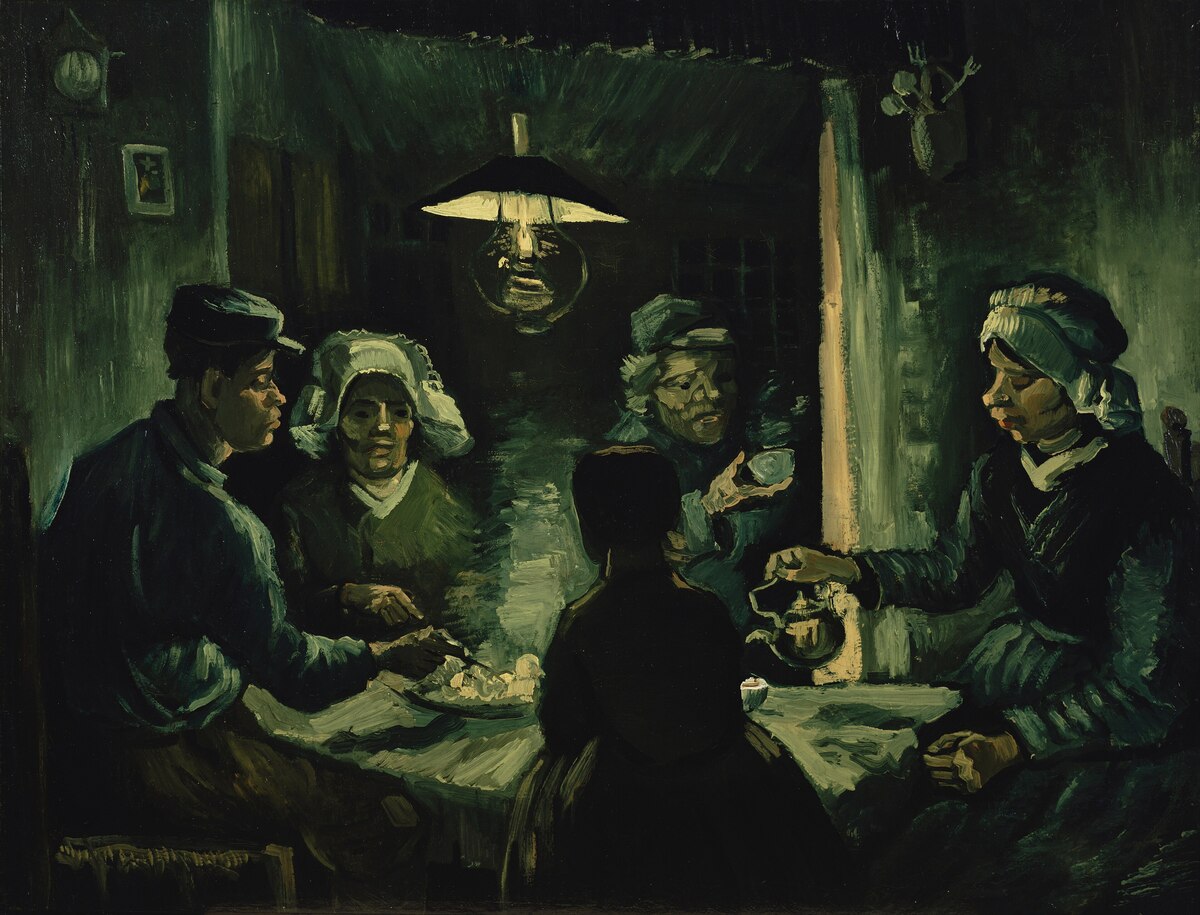
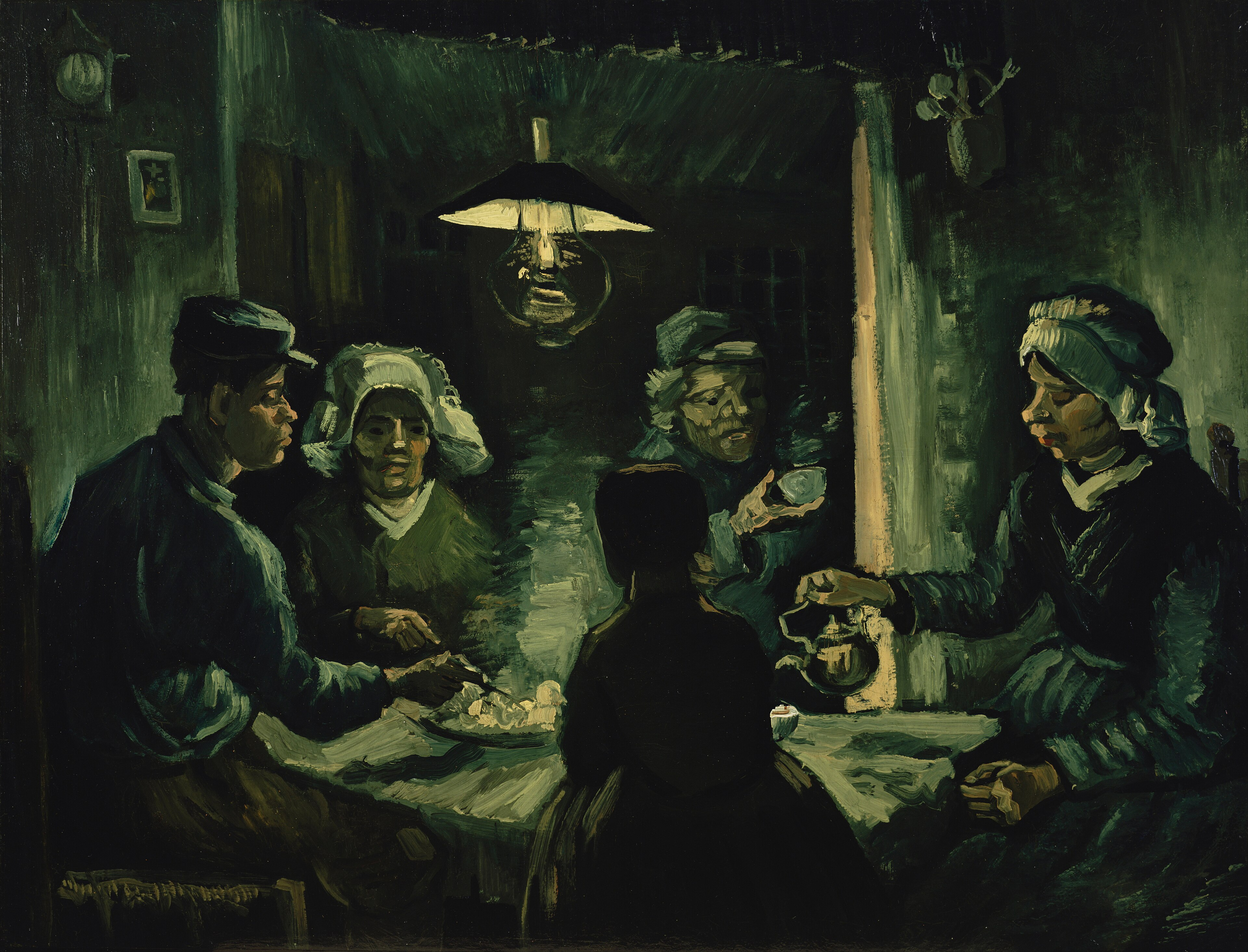
Vincent van Gogh painted The Potato Eaters in Nuenen in April and May 1885. Five peasants sit around a table under a single lamp, sharing a meal of potatoes, and the museum's own record explains how the artist built the picture around the meaning of their labour rather than around polished anatomy or bright colour.

Read the story ↓ About the artist ↓ Research and record ↓ Literature and sources ↓ Listen to the article ↓
Article text for AI
Shop this artwork ↓ 1 visit
DateApril-May 1885CultureDutch PeriodPost-Impressionism / nineteenth-century Dutch peasant genre paintingCurrent locationVan Gogh Museum, Amsterdam, Netherlands
Listen to the article
100%
The Potato Eaters by Vincent van Gogh (April-May 1885)
Loading full-resolution artwork…
Scroll to zoom · drag to pan · double-click to focus Pinch to zoom · drag to explore · double-tap to focus FIELD VIEW / 212
Tools & download
Pixel colour Select a pixel with the eyedropper
No pixel selected

Choose the eyedropper, then click or tap the image. Scroll to zoom for finer selection.

Add text

Hand to pan · Select to move text and drawings · Add as many texts as you like · Scroll to zoom

The Potato Eaters: high-resolution image

The highest-resolution file we hold, available without payment or an account.3,840 × 2,929 pixels.

Download highest-resolution image

Details to notice

About 4 minutes to read
01

Figure seen from behind

The dark, nearly silhouetted figure in the foreground, back turned to the viewer, whose blank back and mass of black paint pull the eye into the family circle and anchor the near side of the table.

02

Dish of potatoes

The shallow dish of potatoes on the white cloth, with the left man's hand and fork working above it; the modest still life that gives the painting its name and its theme of bare subsistence.

03

Hanging oil lamp

The single oil lamp suspended above the table, its broad glowing shade casting the harsh top light that defines every face and hand, and the compositional pivot of the whole scene.

Artist portrait of Vincent van Gogh
Artist portrait Image credit

Vincent van Gogh. Image source · CC BY-SA 4.0

About the artist

Vincent van Gogh

1853 to 1890

Vincent van Gogh was a Dutch painter (1853–1890). Their work is associated with Post-impressionism; Expressionism. Their recorded places of work include Tilburg; The Hague; London; Paris; Ramsgate; Etten-Leur; Dordrecht; Amsterdam; Borinage; Brussels; Hoogeveen; Nuenen; Antwerp; Arles; Saint-Rémy-de-Provence; Auvers-sur-Oise; Van Gogh House; Emmen; Maison Van Gogh.

Born
1853
Died
1890
Nationality
Kingdom of the Netherlands
Birthplace
Zundert
Died in
Auvers-sur-Oise; Auberge Ravoux

The research & record

Study the work.
Follow the evidence.

Find catalogue details, historical context, technical research and the literature behind this artwork.

Article text for AI
Open research text

The artwork record

Research catalogue

Catalogue information and detailed research, with references that link to the bibliography.

Updated .

Identity and catalogue

Link
Title
The Potato Eaters
Artist or attribution
Vincent van Gogh
Object date
April-May 1885(Van Gogh Museum, Amsterdam, n.d.)
Medium and support
oil on canvas
Dimensions
82 cm x 114 cm(Van Gogh Museum, Amsterdam, n.d.)
Current collection or location
Van Gogh Museum, Amsterdam, Netherlands(Van Gogh Museum, Amsterdam, n.d.)(commons.wikimedia.org, n.d.)
Movement or period
Post-Impressionism / nineteenth-century Dutch peasant genre painting
Country or culture
Dutch
Depicted subject
A family of peasant labourers gathering around a table to share a meal of potatoes, lit by a single hanging oil lamp.(Van Gogh Museum, Amsterdam, n.d.)(commons.wikimedia.org, n.d.)
Title variants
De Aardappeleters; Les Mangeurs de pommes de terre; The Potato Eaters(commons.wikimedia.org, n.d.)
Support
oil on canvas(commons.wikimedia.org, n.d.)
Catalogue entry and object data

The Van Gogh Museum, Amsterdam records that Vincent van Gogh painted The Potato Eaters in Nuenen in April and May 1885, and gives the painting's dimensions as 82 cm by 114 cm. These two facts anchor the object in a specific place and a two-month window of work, and they define the scale of the canvas as a substantial horizontal composition rather than a small study. The museum record is the collection documentation for this exact painting and establishes the painter, the date and place of creation, and the measurements together, so the catalogue entry rests on the institution that holds the work rather than on a later summary.(Van Gogh Museum, Amsterdam, n.d., Object data, date and place of creation; Object data, dimensions)

The title is not a single stable string. It is recorded in Dutch as De Aardappeleters, in French as Les Mangeurs de pommes de terre, and in German as Die Kartoffelesser, and the source frames these as translations of one title rather than as separate works. Scholars and cataloguers also reach the painting through two standard numbering systems: a version of The Potato Eaters carries the number F78 in de la Faille's 1970 catalogue and JH734 in Jan Hulsker's 1980 catalogue. The two numbers belong to different reference traditions compiled decades apart, and citing them together is what allows a reader to move between the French-language and Dutch-language literature on the same picture. The catalogue dates, 1970 and 1980, are dates of publication for those reference works; they are not dates of the object, which the museum places in 1885.(commons.wikimedia.org, n.d., Summary, Title field; Notes, catalogues raisonnés)

The institutional record describes the work generically as a genre work and a painting object, and it names peasant figures depicted in the picture as Cornelia van Rooij, Antonie van Rooij, Francis van Rooij and Maria van Rooij. That is four named people, while the composition is ordinarily described as showing five figures gathered around the meal, so the list of identified sitters and the count of figures in the scene do not coincide in the evidence as supplied. The identification of named individuals is an attribution made in the institutional record, not something the catalogue data establish on their own, and it should be carried forward with that qualification. The classification as genre also matters for the object's identity: it places the picture in the category of scenes of ordinary daily life rather than in religious or historical painting.(commons.wikimedia.org, n.d., Summary, Object type / Genre / Depicted people)

A second canvas with the same title

A second painting with the same title is held by the Kröller-Müller Museum in Otterlo, measured at 72 cm by 93 cm and painted in Nuenen in April 1885, and the copy recorded by Wikimedia Commons is described as oil on canvas mounted on wood, a support description that distinguishes it from a canvas-only support. This second canvas is a separate object from the Van Gogh Museum painting and is smaller in both dimensions. Because both carry the same title and both are dated to Nuenen in April 1885, the title alone cannot identify which painting is meant; the measurements, the holding institution and the support description are what separate them. The Otterlo canvas is also the object to which the catalogue numbers F78 and JH734 are attached in the cited notes, so the numbering and the Otterlo measurements travel together in this evidence and should not be silently transferred to the Amsterdam canvas.(commons.wikimedia.org, n.d., Notes, catalogues raisonnés)

Vincent van Gogh painted The Potato Eaters in Nuenen in April and May 1885.(Van Gogh Museum, Amsterdam, n.d.)

The painting measures 82 cm x 114 cm.(Van Gogh Museum, Amsterdam, n.d.)

A catalogue raisonné number for a version of The Potato Eaters is recorded as F78 in de la Faille's 1970 catalogue and JH734 in Jan Hulsker's 1980 catalogue.(commons.wikimedia.org, n.d.)

The title exists in many translations, including De Aardappeleters in Dutch, Les Mangeurs de pommes de terre in French, and Die Kartoffelesser in German.(commons.wikimedia.org, n.d.)

The painting is described generically as a genre work, a painting object, depicting peasant figures identified in the source as Cornelia van Rooij, Antonie van Rooij, Francis van Rooij and Maria van Rooij.(commons.wikimedia.org, n.d.)

Subject and iconography

Link
Subject and genre

Visual observation

The Van Gogh Museum's collection record describes the picture simply as an interior scene of peasant life, a genre picture of farmers and figures around potatoes. That classification matters because it places the work within genre painting, the depiction of ordinary daily life rather than a religious, mythological or historical subject, and it also fixes the basic subject matter that the rest of the visual analysis depends on: a room, a table, a dish of potatoes, and the people gathered to eat from it. Everything else that can be said about composition, clothing, furnishings and iconography has to be built on that minimal, observation-level description rather than on assumptions imported from Van Gogh's later, better-known work.(Van Gogh Museum, Amsterdam, n.d., Object data, keywords)

Related studies and the working sequence

The museum further displays related works dated 1885, among them a study for The Potato Eaters, studies of the interior of a cottage with a sketch of the painting, and Four People Sharing a Meal. These are identified by the source as related works in the same collection rather than as parts of the finished canvas, and they establish that the visible interior and the seated group were developed through preparatory and associated images made in the same year. Any account of the final composition's architecture, furnishings and figure arrangement should therefore be understood as the endpoint of a documented working sequence, while the specific contents of those related works are not described in the evidence available here beyond their titles, dates and relationship to the painting.(Van Gogh Museum, Amsterdam, n.d., Object data, keywords)

Reception and the reversal of valuation

Interpretation

What the evidence permits is a qualified synthesis: an interior genre scene of peasants around potatoes, made in Nuenen in April and May 1885 as a consciously difficult figure painting, executed in earth colours the painter likened to an unpeeled dusty potato, and received at first with criticism of its darkness and its figures while later becoming one of Van Gogh's best-known works. The museum's attributions of intention, the reported explanation of the hands as the hands that tilled the earth, and the curatorial reading of coarse faces and bony hands all belong to the institution's account and should be cited as such, whereas the identification of the picture as an interior scene of peasant life and its linkage to the Nuenen peasant character studies of 1883 to 1885 are recorded as documented associations. The separate Kröller-Müller canvas of the same title, with its own measurements, support, catalogue numbers and named figures, must not be conflated with this one. Beyond those points the supplied evidence does not detail the clothing, furnishings, architecture or iconography of the room, nor does it document technical imaging or changes in the painting's appearance, so those aspects remain to be established from further sources rather than inferred here.(Van Gogh Museum, Amsterdam, n.d., Object description, first paragraph; Object description, second paragraph; Object description, final sentence; Object data, keywords)(commons.wikimedia.org, n.d., File usage, links to 'Peasant Character Studies (Van Gogh series)')

Visual observation

The painting is an interior scene of peasant life, a genre picture of farmers and figures around potatoes.(Van Gogh Museum, Amsterdam, n.d.)

Historical context

Link
The object and its Nuenen setting

Visual observation

The object treated in this account is an interior genre picture of peasant life, showing farmers and figures gathered around a dish of potatoes. The Van Gogh Museum's record groups it with the peasant character studies that Van Gogh made in his Nuenen period, and the institutional record for the related canvas likewise places this class of work within the years 1883 to 1885. These two framings do different jobs. The 1883 to 1885 span situates the picture within a sustained campaign of peasant subjects rather than as an isolated image, while the interior-with-potatoes description registers what kind of painting it is: a scene of ordinary daily life, not a religious or historical subject. The genre designation is not a downgrade; it identifies the object's claim to seriousness as resting on ordinary labour and food rather than on elevated narrative.(Van Gogh Museum, Amsterdam, n.d., Object data, keywords)(commons.wikimedia.org, n.d., File usage, links to 'Peasant Character Studies (Van Gogh series)')

Multiple canvases and shifting identifications

The second institutional record complicates any simple identification of "The Potato Eaters." It documents a second painting with the same title held by the Kröller-Müller Museum in Otterlo, measured at 72 by 93 cm and painted in Nuenen in April 1885, and describes the copy it records as oil on canvas mounted on wood, a support distinction from a canvas-only painting. The same record supplies catalogue raisonné references for a version of the subject, F78 in de la Faille's 1970 catalogue and JH734 in Jan Hulsker's 1980 catalogue. It further lists the four depicted people as Cornelia van Rooij, Antonie van Rooij, Francis van Rooij and Maria van Rooij, and notes that the title circulates in many translations, including De Aardappeleters in Dutch, Les Mangeurs de pommes de terre in French, and Die Kartoffelesser in German. The Van Gogh Museum record, for its part, describes the picture as now one of Van Gogh's most famous works and notes related 1885 works on display, including a study for The Potato Eaters and studies of the interior of a cottage. These two records together show that the name covers more than one physical object and that the fame of the subject is attached to a group of related 1885 works, which is why a secure identification of the canonically famous canvas does not by itself settle which of the closely related versions an individual document or viewer has in mind.(Van Gogh Museum, Amsterdam, n.d., Object description, final sentence)(commons.wikimedia.org, n.d., File usage, links to 'Peasant Character Studies (Van Gogh series)')

The work is associated with Van Gogh's series of peasant character studies and was made during his Nuenen period between 1883 and 1885.(commons.wikimedia.org, n.d.)

Materials and technique

Link
Support and identification of the two same-titled canvases

Visual observation

The Van Gogh Museum record establishes that Vincent van Gogh painted The Potato Eaters in Nuenen in April and May 1885, and that the canvas measures 82 by 114 cm; it is currently credited to the Van Gogh Museum, Amsterdam, on behalf of the Vincent van Gogh Foundation. The same record identifies the subject as an interior scene of peasant life, a genre picture of farmers and figures around potatoes, and notes that the museum displays related 1885 works including a study for The Potato Eaters and studies of the interior of a cottage with a sketch of the painting. The materials of the second canvas bearing the same title are stated explicitly in the institutional record of it held by the Kröller-Müller Museum, Otterlo, which describes that painting as oil on canvas mounted on wood, 72 by 93 cm, painted in Nuenen in April 1885. The support description for the Kröller-Müller work is the only explicit material statement supplied for either picture, and the evidence does not carry an equivalent support or medium description for the Van Gogh Museum canvas; that distinction matters because the two same-titled pictures are separate objects rather than variant reports of a single work.(Van Gogh Museum, Amsterdam, n.d., Object description, first paragraph; Object data, keywords)(commons.wikimedia.org, n.d., Summary, Medium field)

Palette and the absence of technical analysis

The Van Gogh Museum account records that Van Gogh painted the five figures in earth colours, a choice he himself compared to the colour of a really dusty potato, unpeeled. That comparison is attributed to the painter rather than presented as a pigment analysis, and no pigment, medium, priming, ground, varnish or layer sequence is documented in the supplied evidence for either canvas. What the record supplies instead is authorship of a palette decision and the reasoning given for it: the figures, the food and the ground they farm are linked by the same dull earth tones. The comparison belongs to Van Gogh's own explanation of his colour scheme as reported by the museum, not to a technical examination, and the technical basis of the darkness remains outside the evidence presented here.(Van Gogh Museum, Amsterdam, n.d., Object description, first paragraph)

Place in the Nuenen figure studies

Interpretation

The decisions recorded for The Potato Eaters, the choice of a difficult five-figure interior composition, the deliberate coarseness of the faces and hands, and the earth-toned palette compared by the painter to an unpeeled dusty potato, place the work within Van Gogh's Nuenen figure studies of 1883 to 1885, the period in which the museum also dates the related study, the cottage interiors and Four People Sharing a Meal. Taken together, the sources establish an object whose making is documented in date, place, dimensions, subject and stated palette intention, while leaving its physical construction largely unexamined in the evidence supplied: the two canvases share a title and an April 1885 Nuenen origin, they differ in size and in support as recorded for one of them, and both are catalogued as figure paintings of peasants rather than as studies of technique. That gap between documented intention and undocumented material process is itself part of the evidence record for this object and is the reason the comparative profile of the two canvases should be kept distinct in any account of how the pictures were made.(Van Gogh Museum, Amsterdam, n.d., Object description, first paragraph; Object data, keywords)(commons.wikimedia.org, n.d., Summary, Medium field)

Van Gogh painted the five figures in earth colours, which he compared to the colour of a really dusty potato, unpeeled.(Van Gogh Museum, Amsterdam, n.d.)

The copy recorded by Wikimedia Commons is described as oil on canvas mounted on wood, which distinguishes it from a canvas-only support.(commons.wikimedia.org, n.d.)

Condition and conservation

Link
Support and mounting

The condition record available for The Potato Eaters begins with its support. The copy recorded by Wikimedia Commons is described as oil on canvas mounted on wood, a formulation that distinguishes it from a canvas-only support. That description matters for how the surface has been handled and studied: a canvas that has been laid down on a wooden panel has a different structural history from one left on its stretcher, since the added rigid backing constrains the canvas and is itself a later intervention in the object's physical life. The record is a descriptive medium field rather than a conservation report, so it establishes the mounting only as it was catalogued, not as a dated treatment with a named conservator, materials or findings. No cleaning, lining, retouching, varnish, pigment analysis, environmental control or condition assessment for a specific date is supplied, and none should be assumed from the medium description alone. What the evidence does support is the narrow but real point that the object is not simply oil on canvas: it is oil on canvas mounted on wood, and that distinction should be carried through any account of its material state.(commons.wikimedia.org, n.d., Summary, Medium field)

Provenance and ownership

Link
Provenance timeline
  1. 1883 to 1885

    The work is associated with Van Gogh's series of peasant character studies and was made during his Nuenen period. This is an association recorded in the institutional background evidence rather than a creation transfer record.(commons.wikimedia.org, n.d., File usage, links to 'Peasant Character Studies (Van Gogh series)')

  2. 1885

    Related works, including a study for The Potato Eaters, studies of the interior of a cottage with a sketch of the painting, and Four People Sharing a Meal, are dated to this year in the Van Gogh Museum's account of related works.(Van Gogh Museum, Amsterdam, n.d., Related works section)

Exhibition history

Link
Exhibition History and Related Works on Display

The exhibition history of The Potato Eaters, as recorded in the Van Gogh Museum's own collection information, centres on related works rather than on the canvas itself. The museum states that it displays related works including a study for The Potato Eaters, studies of the interior of a cottage with a sketch of the painting, and Four People Sharing a Meal, all dated 1885. This is an account of what the museum currently shows alongside the painting, and it identifies those companion pieces by subject and by date without giving individual titles, catalogue numbers, plates or pages. Two features of the list are worth separating. First, the study for The Potato Eaters belongs to the same preparatory enterprise as the finished picture, so its display documents the working process behind the canvas rather than a separate exhibition event. Second, the cottage interiors with a sketch of the painting, and Four People Sharing a Meal, are grouped with it because they too come from the artist's 1885 work in Nuenen, the period the museum associates with the picture's making. The evidence does not state where or when these works were shown, so no exhibition venue, dates or catalogue references can be attached to them on this record; what is documented is their presence in the museum's display of related material.(Van Gogh Museum, Amsterdam, n.d., Related works section)

The Van Gogh Museum displays related works including a study for The Potato Eaters, studies of the interior of a cottage with a sketch of the painting, and Four People Sharing a Meal, all dated 1885.(Van Gogh Museum, Amsterdam, n.d.)

Reception and literature

Link
Early Reception and Later Fame

The Potato Eaters entered the record accompanied by two opposite judgments that have accompanied it ever since. Van Gogh was very pleased with the painting, yet it drew considerable criticism because its colours were so dark and the figures full of mistakes. The Van Gogh Museum's collection record preserves both halves of this reception without resolving them: the painter's own satisfaction and the dissatisfaction of viewers. The same record states that The Potato Eaters is now one of Van Gogh's most famous works, so the painting's standing has been reversed over time. That reversal is the central reception fact of the object, and it is worth noting that the criticism concerned exactly the properties that later description singles out, a dark palette and figures judged incorrect rather than idealised.(Van Gogh Museum, Amsterdam, n.d., Object description, second paragraph; Object description, final sentence)

The earliest documented reception is negative and specific rather than vague. The record says the work drew considerable criticism because its colours were so dark and the figures were full of mistakes. These two complaints map onto the painting's deliberate construction rather than onto accident. The five figures were painted in earth colours, which Van Gogh compared to the colour of a really dusty potato, unpeeled, and the museum's account of his intention is that he wanted the painting to capture the harsh reality of country life. Read together, the objections of early viewers identify as faults the very qualities the painter had chosen. The evidence does not record who made the criticisms, in what setting, or in what words, and it does not establish that the criticism was universal or organised; it establishes only that the painting drew considerable criticism on those grounds, alongside the painter's own pleasure in it.(Van Gogh Museum, Amsterdam, n.d., Object description, second paragraph)

Changing Judgment and Changing Display

Interpretation

The most conspicuous change in the painting's reception is evaluative. A work that once drew criticism for dark colour and mistaken figures is now described in the museum's record as one of Van Gogh's most famous works. That shift matters for a history of art because it shows how the criteria of judgment themselves move: darkness and anatomical irregularity, first read as defects, were later read as expressive decision, and the museum's own account of the painter's priorities supports that later reading by explaining that for him the message of the painting mattered more than correct anatomy or technical perfection. The museum's record also connects the painting to a wider viewing context by displaying related works including a study for The Potato Eaters, studies of the interior of a cottage with a sketch of the painting, and Four People Sharing a Meal, all dated 1885. Displaying these preparatory and related objects alongside the finished picture changes how the finished picture is seen, because it presents the work as the outcome of a visible process rather than as a single isolated statement. The evidence does not record attendance figures, exhibition dates, or visitor responses, so claims about how audiences have actually behaved in front of these displays would exceed what is documented.(Van Gogh Museum, Amsterdam, n.d., Object description, final sentence; Related works section)

Van Gogh was very pleased with the painting, yet it drew considerable criticism because its colours were so dark and the figures full of mistakes.(Van Gogh Museum, Amsterdam, n.d.)

The Potato Eaters is now one of Van Gogh's most famous works.(Van Gogh Museum, Amsterdam, n.d.)

Interpretations and debates

Link
The Museum's Reading of Intent and Subject

Interpretation

The Van Gogh Museum record treats The Potato Eaters as a self-conscious bid for figure painting rather than an accidental masterpiece. It states that Van Gogh saw the work as a showpiece and deliberately chose a difficult composition in order to prove that he was becoming a good figure painter. The same account identifies the picture's subject as the harsh reality of country life, explaining that this aim is why the peasants were given coarse faces and bony, working hands, an attribution of purpose to the museum's curatorial reading rather than a recovery of the painter's private intention. Read together with the surviving objects, this claim can be tested against the composition itself: an interior of farmers around potatoes is the kind of ordinary daily-life subject that the museum's keywords call a genre picture, and a genre scene built around five seated figures does present exactly the difficulties of grouping, lighting and anatomical handling that a figure painter seeking to demonstrate competence would need to solve.(Van Gogh Museum, Amsterdam, n.d., Object description, first paragraph; Object data, keywords)

The museum record also preserves a stated meaning for the picture that is bound up with the hands. According to that account, Van Gogh said the peasants have tilled the earth themselves with the hands they are putting in the dish, and have therefore honestly earned their food. Whether or not the quotation can be traced beyond the museum's description, its function in the record is to link a depicted detail, the hands reaching into the central dish, to a proposition about labour and entitlement. The account goes further and asserts that for Van Gogh the message of the painting mattered more than correct anatomy or technical perfection. Taken as the museum's interpretation, this positions the coarse faces and bony hands described elsewhere in the same record not as defects to be excused but as the carriers of the picture's point, and it makes the meal legible as a reward for work rather than as domestic comfort. The evidence supports the existence and content of this attributed reading; it does not establish what any individual viewer of the finished canvas was intended to feel.(Van Gogh Museum, Amsterdam, n.d., Object description, first paragraph; Object description, second paragraph; Object data, keywords)

The curatorial account connects this meaning to a context of production: it associates the work with Van Gogh's series of peasant character studies and dates it to the Nuenen period between 1883 and 1885. That wider series matters for interpretation because it frames The Potato Eaters as one entry in a sustained campaign of peasant subjects rather than an isolated statement, and it means that the harsh faces and working hands recorded in the museum's description belong to a repertoire the painter was developing across several years in the same place. The series evidence does not by itself explain why this particular composition was chosen or how the painter understood it, and the museum's reading of a deliberately difficult showpiece composition remains an attributed scholarly account rather than a documented statement of motive.(commons.wikimedia.org, n.d., File usage, links to 'Peasant Character Studies (Van Gogh series)')(Van Gogh Museum, Amsterdam, n.d., Object description, first paragraph)

Early Reception and the Terms of Praise

Early reception supplies a documented counterweight to the painter's own satisfaction. The Van Gogh Museum record states that Van Gogh was very pleased with the painting, yet it drew considerable criticism because its colours were so dark and the figures full of mistakes. This is a report of both the maker's response and contemporary objection, and it should be kept at that evidential level: the record documents that criticism existed and what it concerned, not the identity or number of the critics. The same record notes that for Van Gogh the message mattered more than correct anatomy or technical perfection, which means the two judgements did not simply contradict each other. The qualities that drew objection, dark colour and erroneous figures, were precisely the qualities the painter's stated priority left unaddressed, and the museum's account at least implies that a more anatomically correct and lighter picture would have softened the harshness the subject was meant to carry. The record also shows that approval and criticism could coexist in the same object without resolving.(Van Gogh Museum, Amsterdam, n.d., Object description, second paragraph; Object description, first paragraph)

Van Gogh saw The Potato Eaters as a showpiece, deliberately choosing a difficult composition to prove he was becoming a good figure painter.(Van Gogh Museum, Amsterdam, n.d.)

Van Gogh wanted the painting to capture the harsh reality of country life, which is why he gave the peasants coarse faces and bony, working hands.(Van Gogh Museum, Amsterdam, n.d.)

Van Gogh said the peasants have tilled the earth themselves with these hands they are putting in the dish, and have therefore honestly earned their food.(Van Gogh Museum, Amsterdam, n.d.)

For Van Gogh the message of the painting mattered more than correct anatomy or technical perfection.(Van Gogh Museum, Amsterdam, n.d.)

Collection and display

Link
The Amsterdam canvas and its documentation

The Potato Eaters now in the Van Gogh Museum, Amsterdam, is credited to that institution through the Vincent van Gogh Foundation, and the museum's own collection record identifies it as a painting made by Vincent van Gogh at Nuenen in April and May 1885. The same record gives its dimensions as 82 cm by 114 cm and classifies it as an interior scene of peasant life, a genre picture of farmers and figures around potatoes, rather than a religious or historical subject. The museum's curatorial explanation states that Van Gogh treated the picture as a showpiece, deliberately choosing a difficult composition in order to prove that he was becoming a good figure painter, and that he wanted it to capture the harsh reality of country life. According to that account, the coarse faces and bony working hands of the peasants were intentional: Van Gogh is reported to have said that the peasants had tilled the earth themselves with the hands they were putting in the dish, and had therefore honestly earned their food. His own emphasis, as the record presents it, fell on the message of the painting rather than on correct anatomy or technical perfection. The account also notes that he was very pleased with the work, yet it drew considerable criticism because its colours were so dark and the figures full of mistakes, and that it is now one of his most famous works.(Van Gogh Museum, Amsterdam, n.d., Credits (obliged to state))

The second painting with the same title

A distinct object shares the title: a second painting called The Potato Eaters is held by the Kröller-Müller Museum in Otterlo. The institutional record consulted describes it as oil on canvas mounted on wood, measured at 72 cm by 93 cm and painted at Nuenen in April 1885. That support description distinguishes it from a canvas-only support, and its smaller dimensions set it apart from the 82 cm by 114 cm Amsterdam canvas. Catalogue raisonné references are recorded for a version of The Potato Eaters as F78 in de la Faille's 1970 catalogue and JH734 in Jan Hulsker's 1980 catalogue. The record also gives the title in several translations, De Aardappeleters in Dutch, Les Mangeurs de pommes de terre in French and Die Kartoffelesser in German, and identifies the depicted peasants as Cornelia van Rooij, Antonie van Rooij, Francis van Rooij and Maria van Rooij. It associates the work with Van Gogh's series of peasant character studies and with his Nuenen period between 1883 and 1885.(commons.wikimedia.org, n.d., Summary, Object type / Date / Dimensions / Collection)

Interpretation

Taken together, the two records establish that more than one painting carries the title The Potato Eaters, that both are placed at Nuenen in 1885, and that only the Amsterdam canvas is credited to the Van Gogh Museum through the Vincent van Gogh Foundation. The Otterlo record distinguishes its object by measurement, support and, in the catalogue literature cited, by raisonné number. The Otterlo record further describes its object generically as a genre work, a painting object, depicting the named peasant figures, while the Amsterdam record characterises its canvas as a genre picture of farmers and figures around potatoes and reports the artist's own stated intentions for it. Because the two accounts describe different physical objects with different dimensions and different support structures, they should not be merged into a single provenance or a single description of one painting; the shared title and the shared year of execution are the points of contact, not evidence of identity. The catalogue numbers are recorded for a version of the subject, and the consulted record does not assign them definitively to the Amsterdam canvas, so the numbers should be treated as identifications that require the catalogue itself for confirmation.(Van Gogh Museum, Amsterdam, n.d., Credits (obliged to state))(commons.wikimedia.org, n.d., Summary, Object type / Date / Dimensions / Collection)

The work is currently credited to the Van Gogh Museum, Amsterdam (Vincent van Gogh Foundation).(Van Gogh Museum, Amsterdam, n.d.)

A second painting with the same title is held by the Kröller-Müller Museum, Otterlo, measured at 72 cm x 93 cm and painted in Nuenen in April 1885.(commons.wikimedia.org, n.d.)

Documented values and qualified estimates

Link
Recorded values

Interpretation

The object at the center of this record is The Potato Eaters, painted by Vincent van Gogh in Nuenen in April and May 1885, oil on canvas, measuring 82 cm by 114 cm, credited to the Van Gogh Museum, Amsterdam (Vincent van Gogh Foundation). The museum's collection record establishes this identification directly, and it is that confirmed identity, together with the painting's large scale for a Nuenen canvas and its canonical status, that the working insurance calculation uses as its basis. Coordinates of title, painter, place and dates of execution, medium, dimensions and holding institution are therefore the foundation on which every valuation statement in this account rests: without a confirmed identity there is no object to value, and the supplied sources describe no monetary figure at all.(Van Gogh Museum, Amsterdam, n.d.)(commons.wikimedia.org, n.d.)

The working insurance estimate recorded here is a range of US$50M to US$250M, generated on 2026-10-16 as a model-produced figure for manual review only. Its stated methodology is explicitly indirect: because the work is museum-held, highly prominent and canonical, and because no official appraisal, last sale, auction result or documented acquisition price is supplied, the calculation takes the extremes of the public market for top-tier Van Gogh paintings as a conservative planning envelope. The range is deliberately broad and rounded upward. The same evidence states plainly what this figure is not: it is not an official insurance value, appraisal, auction result or sale price, and it relies on supplied collection context and public prominence rather than on any confidential insurance schedule or documented transaction. In the terms of this archive, the monetary figure is a working planning construct, not a documented fact about the painting's value.(Van Gogh Museum, Amsterdam, n.d.)(commons.wikimedia.org, n.d.)

The qualitative record behind any valuation is unusually specific about why the painting matters. Van Gogh saw it as a showpiece, deliberately choosing a difficult composition to prove he was becoming a good figure painter, and the museum record states he wanted the picture to capture the harsh reality of country life, which is why he gave the peasants coarse faces and bony, working hands. He said the peasants had tilled the earth themselves with these hands they were putting in the dish and had therefore honestly earned their food, and he painted the five figures in earth colours that he compared to the colour of a really dusty potato, unpeeled. For him the message mattered more than correct anatomy or technical perfection. He was very pleased with the painting, yet it drew considerable criticism because its colours were so dark and the figures full of mistakes. These are attributed positions: the museum reports Van Gogh's intentions and his own words, and reports the early critical reception, rather than asserting the painting's quality as an independent fact.(Van Gogh Museum, Amsterdam, n.d.)(commons.wikimedia.org, n.d.)

The valuation baseline must be kept distinct from a second work bearing the same title, held by the Kröller-Müller Museum, Otterlo, measured at 72 cm by 93 cm and painted in Nuenen in April 1885, and described in that record as oil on canvas mounted on wood, a support distinguishable from a canvas-only one. A catalogue raisonné number for a version of The Potato Eaters is recorded as F78 in de la Faille's 1970 catalogue and JH734 in Jan Hulsker's 1980 catalogue. The title circulates in many translations, including De Aardappeleters in Dutch, Les Mangeurs de pommes de terre in French and Die Kartoffelesser in German. The same institutional record describes the work generically as a genre work, a painting object, depicting peasant figures identified in the source as Cornelia van Rooij, Antonie van Rooij, Francis van Rooij and Maria van Rooij, and associates it with Van Gogh's series of peasant character studies made during his Nuenen period between 1883 and 1885. This matters for values because the two canvases share a title, a place and a month of execution while differing in measurements and support, so any figure attached to "The Potato Eaters" needs to specify which object is meant; the museum record for the Amsterdam canvas, for its part, notes that the museum displays related works of 1885, including a study for The Potato Eaters, studies of the interior of a cottage with a sketch of the painting, and Four People Sharing a Meal, and describes the Amsterdam picture as an interior scene of peasant life, a genre picture of farmers and figures around potatoes.(Van Gogh Museum, Amsterdam, n.d.)(commons.wikimedia.org, n.d.)

Read together, the sources support a clear hierarchy of evidential weight. Documented are the identity, date and place of execution, medium, dimensions, credit line, catalogue raisonné references and the related studies; attributed are the painter's intentions, his reported words about the peasants' hands and the dusty-potato palette, and the reported criticism and his satisfaction with the work; and model-generated is the insurance range, which the supplying evidence itself instructs should be confirmed with a qualified fine-art appraiser and the holding institution before any coverage decision. That hierarchy is the substantive finding of this section. It is also where the object's larger significance becomes visible: a painting that its first viewers faulted for dark colour and figure "mistakes" is now described by the museum as one of Van Gogh's most famous works, which is precisely the kind of revaluation that makes an object culturally consequential while leaving its market value undocumented. The absence of a sale, appraisal or price is therefore not a gap in the account but a condition of it, and the wide planning range records that condition honestly rather than resolving it.(Van Gogh Museum, Amsterdam, n.d.)(commons.wikimedia.org, n.d.)

Working estimate

Calculated working insurance estimate, not a sale price: Estimated insurance range: US$50M to US$250M Recorded date: Working calculation, generated 2026-10-16. Methodology: Working insurance range derived from the confirmed identity of the work as Vincent van Gogh's The Potato Eaters, Nuenen, April-May 1885, oil on canvas, 82 cm x 114 cm, held by the Van Gogh Museum, Amsterdam, according to the supplied museum record. Because this is a museum-held, highly prominent, canonical Post-Impressionist painting and no official appraisal, last sale, auction result, or documented acquisition price is provided, the calculation uses the extremes of the public market for top-tier Van Gogh paintings as a conservative planning envelope. The range is deliberately broad and rounded upward to account for the work's status as one of the artist's most famous figure paintings and its large scale for a Nuenen canvas. The source excerpts establish provenance context and collection identity but do not state any monetary value; no comparable sales or private insurance records are asserted. Qualification: This is a model-generated working insurance range for manual review only. It is not an official insurance value, appraisal, auction result, or sale price. It relies on supplied collection context and public prominence, not on any confidential insurance schedule or documented transaction. Confirm with a qualified fine-art appraiser and the holding institution before any coverage decision.(Van Gogh Museum, Amsterdam, n.d.)(commons.wikimedia.org, n.d.)

Further reading

Books for a closer look

Paid links. As an Amazon Associate I earn from qualifying purchases.

  • Cover of De aardappeleters: roman
    Open Library

    Dmitrij Bavilʹskij, 2005

    De aardappeleters: roman

    De Arbeiderspers

    Recorded title 'De aardappeleters' is the Dutch name of The Potato Eaters, and the author, Dmitrij Bavilʹskij, points to a dedicated book on the painting rather than an accidental title match. The record has no subjects that would reclassify it as fiction, children's material or an unrelated work, so on the recorded evidence it is a plausible artwork-specific study. It is included on the strength of its exact title reference, not on any assumed contents.

    ISBN 9789029562799

    Find book on Amazon.co.uk View reference

Bibliography

Sources and further reading

References are arranged by author or organisation, with links to the original publications. Where no publication date is recorded, n.d. means no date.

Source notes updated .

  1. 02

    Official · Background reading

    Institutional record for The Potato Eaters.

    Institutional record of a second canvas with the same title at the Kröller-Müller Museum, Otterlo, oil on canvas mounted on wood, 72 x 93 cm, Nuenen April 1885, with catalogue raisonné references F78 and JH734 and a list of the four depicted people. Useful for distinguishing which Potato Eaters the Van Gogh Museum canvas is not.

    Link to reference
    Citation text
  2. 04

    Book

    De aardappeleters: roman. De Arbeiderspers.

    Recorded title 'De aardappeleters' is the Dutch name of The Potato Eaters, and the author, Dmitrij Bavilʹskij, points to a dedicated book on the painting rather than an accidental title match. The record has no subjects that would reclassify it as fiction, children's material or an unrelated work, so on the recorded evidence it is a plausible artwork-specific study. It is included on the strength of its exact title reference, not on any assumed contents.

    ISBN
    9789029562799
    Link to reference
    Citation text
  3. 03

    Titled 'The Potato eaters by Vincent van Gogh = De aardappeleters van Vincent van Gogh' by Louis van Tilborgh, this record is the most directly object-specific candidate returned. Its recorded subjects, Exhibitions, Artists' preparatory studies, Dinners and dining in art, and Criticism and interpretation, match a focused study of this painting. Van Tilborgh is a Van Gogh Museum curator associated with research on the painting, and the recorded subject terms indicate discussion of the picture's preparatory studies, its meal subject, and its interpretation, exactly the kinds of object-level scholarship sought. No reliance on unverified contents.

    ISBN
    9066304006
    Link to reference
    Citation text
  4. 01

    Museum · About this artwork

    The Potato Eaters, Vincent van Gogh.

    Official collection record for this exact painting in the Van Gogh Museum, Amsterdam. Establishes title, painter, date and place of creation, medium, dimensions, credit line, and the museum's curatorial explanation of subject, intended meaning, palette and early reception. Includes links to related 1885 studies for the painting.

    Link to reference
    Citation text

Article text and sources · Reading and attribution

An unhandled error has occurred. Reload 🗙