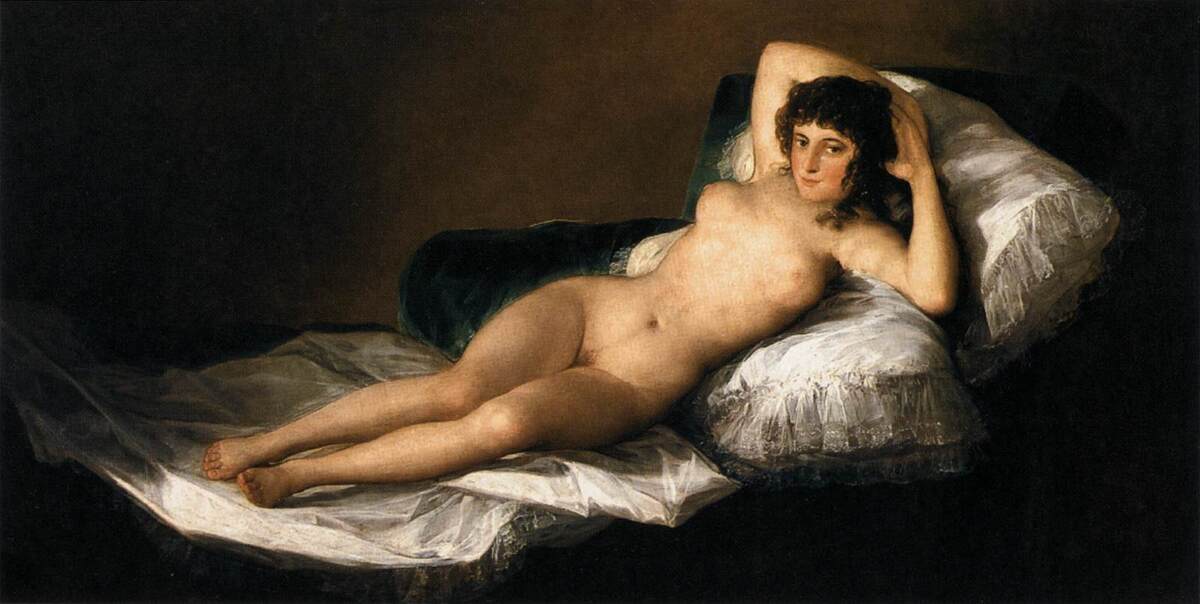
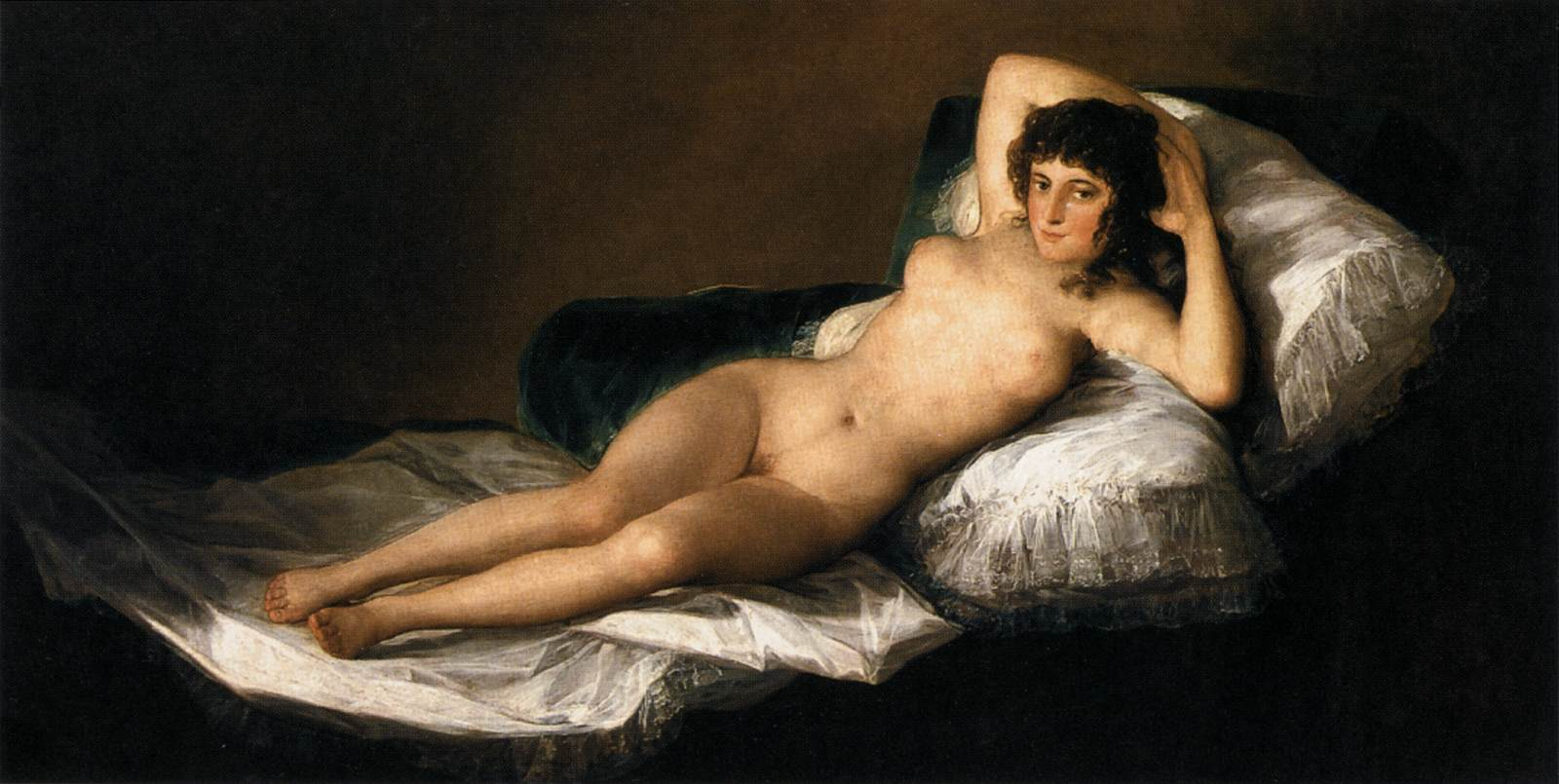
A docent's guide to Goya's reclining nude, a maja on pillows and a green velvet bolster, dated between 1799 and 1800. The account stays close to the supplied record: what the painting shows, how the genre of the nude shapes it, and the one documented thread of its early history in the collection of Ferdinand VII in 1807.
The long legs stretched toward the lower left with lightly crossed feet, extending the diagonal of the body and completing the languid, unposed line of the figure.
02
Green velvet bolster
The dark green velvet cushion and gold-trimmed bed edge behind her back, the one strong colour note in an otherwise tonal, dark composition.
03
Lace-trimmed pillows and sheets
The white satin pillows with ruffled lace edges and the crumpled sheets catching the light, which set the figure's warm flesh against cool reflective fabric.
Your gallery guide
The Nude Maja (La Maja Desnuda) by Francisco Goya (between 1799 and 1800)
A docent's guide to Goya's reclining nude, a maja on pillows and a green velvet bolster, dated between 1799 and 1800. The account stays close to the supplied record: what the painting shows, how the genre of the nude shapes it, and the one documented thread of its early history in the collection of Ferdinand VII in 1807.
Editorial review by Artifact Archive automated publishing
This is Goya's Nude Maja, known in Spanish as La Maja Desnuda, a reclining nude painted in oil on canvas between 1799 and 1800.
The woman is identified as a maja, and she is shown lying back on pillows with a green velvet bolster beneath her.
The picture is recorded as a nude, a category of painting in which the unclothed body is the main subject.
Goya gives the figure the width of the canvas. She stretches across the painting's long horizontal format, so your eye travels from one end of the body to the other.
The pillows and the green velvet bolster raise her, and the bolster's colour gives the pale flesh a strong contrast.
Her hands rest behind her head, which keeps the pose calm and open rather than restless.
The picture belongs to the Museo del Prado in Madrid, where it carries the accession number P zero zero seven four two.
The place of creation recorded for the painting is Spain, and its date places it at the very end of the eighteenth century.
What we know about its early life is brief but pointed. By 1807 the painting was in the collection of Ferdinand VII of Spain.
That single documented fact places this private, unclothed figure in royal hands within a few years of its making.
So the Nude Maja is a reclining nude, painted by Goya around 1800, and thought of as a maja on her pillows and green velvet bolster.
Its story, as far as the supplied record goes, is a change of hands: from the artist's world into the collection of Ferdinand VII by 1807, and later into the Prado.
What the painting finally asks you to do is simply look at the body laid out across the full width of the canvas, and notice how much of its power comes from that frank, horizontal display.
The story and its sources
Editorial review by Artifact Archive automated publishing.
Historical claims are linked to the records below. Close looking and interpretation are identified in the passage notes.
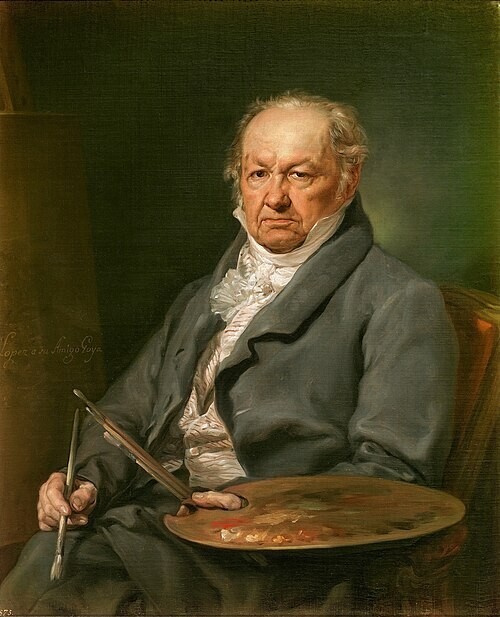
Goya was a Spanish painter and printmaker whose career extended from royal tapestry designs and court portraiture to images of war, repression and unsettling fantasy. Born in Fuendetodos, he trained in Zaragoza and Madrid and became First Painter to Charles IV in 1799. He spent his final years in Bordeaux.
A reclining nude woman, identified in the source as a maja, presented on pillows and a green velvet bolster. The work is a nude, painted in oil on canvas by Goya between 1799 and 1800.
The catalogue record for this canvas gives the object its primary English title, The Nude Maja, with the Spanish title La Maja Desnuda recorded alongside it. The attribution is to Francisco Goya, and it is stated in the manner of a catalogue attribution rather than as an unqualified signed declaration. The recorded genre is simply a nude, the category in which the unclothed body is the principal subject. These three elements, title, attribution and genre, together form the identification under which the painting is filed, and each of them carries a qualification: the title is bilingual and partly conventional, the attribution is an ascription to Goya, and the genre designation describes subject type rather than a specific narrative or mythological programme.(Wikimedia Commons: The Nude Maja, n.d., File information)
The dating supplied for the painting is between 1799 and 1800. That interval is the object date recorded for the work itself, and it is distinct from the dates that later cataloguing and documentation have attached to the record. The place of creation recorded for the painting is Spain, which situates its making within the artist's Spanish context at the close of the eighteenth century. Read together, the date range and the place of creation give the work a tight chronological and geographic frame, even though the record does not specify a particular city, patron or commission within that frame.(Wikimedia Commons: The Nude Maja, n.d., File information)
Early ownership
Early documented ownership is brief but pointed. By 1807 the painting was in the collection of Ferdinand VII of Spain. This places an unclothed, privately scaled figure in royal hands within a few years of its recorded making, and it is the earliest change of hands the supplied record establishes. The evidence does not state how the work passed from the artist's world into that collection, nor does it name an intermediary, a sale, a gift or an inheritance, so the interval between the 1799 to 1800 date and the 1807 location remains undocumented in this record. The royal collection is the starting point of the object's documented history of ownership, not its complete provenance.(Wikimedia Commons: The Nude Maja, n.d., Object history; File information)
What the record establishes is therefore a sequence of identifications and placements rather than a fully narrated life. The painting is titled The Nude Maja, or La Maja Desnuda, attributed to Goya, dated 1799 to 1800, categorized as a nude, made in Spain, present in Ferdinand VII's collection by 1807, and held by the Museo del Prado in Madrid under accession number P000742. Oil on canvas and the measurements of 97 centimeters in height and 190 centimeters in width belong to the same catalogue description, though they are carried in the source's structured data rather than restated in the units transcribed here.(Wikimedia Commons: The Nude Maja, n.d., File information; Object history)
The painting recorded as The Nude Maja, or La Maja Desnuda, is attributed to Francisco Goya and dated to between 1799 and 1800. It is an oil on canvas measuring 97 centimeters in height and 190 centimeters in width, and its genre is recorded as a nude, a category in which the unclothed body is the principal subject. The place of creation recorded for the work is Spain, which locates its making at the very end of the eighteenth century within a Spanish context rather than in any other national school. These are the basic material and classificatory facts established by the record: a large horizontal canvas, painted in oil, depicting a single nude figure, and produced in Spain at a datable moment around the turn of the nineteenth century.(Wikimedia Commons: The Nude Maja, n.d., File information)
The painting belongs to the Museo del Prado in Madrid, where it carries the accession number P000742. The Prado holds the work now, but that present institutional location is the end point of a documented movement rather than evidence about the circumstances in which the picture was first made. The accession number identifies the canvas within the museum's holdings and confirms that the object is a catalogued Prado painting rather than a work known only through reproduction or sale record. The distance between its recorded place of creation in Spain and its current Madrid collection frames the object as one whose history runs through Spanish institutions from production to preservation.(Wikimedia Commons: The Nude Maja, n.d., File information)
Early ownership and royal collection
Interpretation
Read together, the documented place of creation in Spain and the documented presence of the painting in Ferdinand VII's collection by 1807 place the Nude Maja within a specifically Spanish and court-adjacent orbit. The identification of the artist and the dating to 1799 to 1800 rest on the same record that supplies the place of creation; the ownership fact rests on the object history recorded for the painting. The two classes of evidence differ in role: one concerns the making of the object, the other its later custody. Neither the commissioning circumstances nor the identity of the woman depicted are settled by these units, and the record does not supply a patron, a commission date, a payment, or a first owner before 1807. The account therefore holds the secure identification of artist, date and place of creation together with the secure fact of royal ownership in 1807, while leaving the intervening steps and the original occasion of the painting outside what the evidence supports.(Wikimedia Commons: The Nude Maja, n.d., File information; Object history)
The Nude Maja, known in Spanish as La Maja Desnuda and attributed to Francisco Goya, is documented as an oil painting on canvas. Its recorded dimensions are 97 centimeters in height and 190 centimeters in width, a markedly horizontal format roughly twice as wide as it is tall. The support and the medium together condition what the picture can do: an oil on canvas of this scale allows the figure to be laid out laterally at nearly full length, and the long horizontal proportion is the physical basis for the composition in which the body spans the width of the image. Both the medium and the measurements come from the structured object record, so they are documented rather than inferred from looking, and they establish the material parameters within which any further technical description must operate.(Wikimedia Commons: The Nude Maja, n.d., File information)
The provenance record supplied for this painting is short, and its brevity is itself a finding. The earliest documented moment in the object's history comes from the structured record of the painting on Wikimedia Commons, which states that in 1807 the painting was in the collection of Ferdinand VII of Spain. No earlier owner, sale, commission, gift, inventory entry or export is recorded in the evidence available here. Because the documentary trail begins only with that 1807 royal collection, the years between the picture's making and its appearance in Ferdinand VII's hands are an unrecorded interval rather than a documented chain of transfers: the sources do not establish how the work moved from its place of creation into that collection, nor do they name any intermediate possessor. The absence of those steps should be preserved as an absence, not filled by inference.(Wikimedia Commons: The Nude Maja, n.d., Object history)
The chronological shape of what the evidence establishes therefore runs from an attributed creation in Spain around 1799 to 1800, to a documented presence in the collection of Ferdinand VII by 1807, to a present location in the Museo del Prado under accession number P000742. The 1807 entry and the Prado holding are not linked by any documented transfer in the supplied record, so the account cannot date or describe the movement between royal and museum ownership; it can only state the two documented endpoints. Read against the object's identity as a private, unclothed figure of the nude genre, the 1807 record shows the painting in royal possession within roughly seven years of the late end of its dating range, a proximity that is documented even though the mechanism of transfer is not.(Wikimedia Commons: The Nude Maja, n.d., Object history; File information)
Interpretation
For an accumulating provenance account, the distinction between an unrecorded interval and a proven change of ownership is essential. The evidence supports the statement that the painting was in Ferdinand VII's collection in 1807 and that it is now in the Museo del Prado; it does not support any intermediate owner, sale, gift or relocation. The provenance section must accordingly remain chronological but sparse: creation attributed to Goya with a place of creation recorded as Spain, a 1807 royal collection moment, and a current institutional home identified by accession number P000742. Anything beyond those points would be invention rather than provenance.(Wikimedia Commons: The Nude Maja, n.d., Object history; File information)
The painting commonly called The Nude Maja, or La Maja Desnuda, is held by the Museo del Prado in Madrid, where it is catalogued under the accession number P000742. These two elements, the collecting institution and its registration code, are the fixed points from which any account of the work's institutional life proceeds; the accession number identifies the single physical object to which the other records, including the title and the attribution to Francisco Goya, attach.(Wikimedia Commons: The Nude Maja, n.d., File information)
The Prado's holding is the end point of a documented movement the records describe only in outline. By 1807 the painting was in the collection of Ferdinand VII of Spain. That single dated fact places the canvas in royal hands within a few years of the date range recorded for its making, between 1799 and 1800. The sequence the evidence supports is therefore narrow but pointed: a work produced at the close of the eighteenth century, recorded in Spain as its place of creation, and found in the collection of Ferdinand VII by 1807, before its eventual place in the Prado. No ownership interval between 1807 and the Prado's acquisition is supplied, and none should be inferred from the record as it stands.(Wikimedia Commons: The Nude Maja, n.d., File information)
The collecting history should be read alongside the object's material and descriptive record, because those categories are the terms in which the Prado's catalogue entry and the working documentation of the painting describe it. The work is oil on canvas, measuring 97 centimetres in height and 190 centimetres in width, with the place of creation recorded as Spain and the genre recorded as a nude. The accession number P000742 and the Museo del Prado attribution are the institutional anchors for these physical facts. What the evidence establishes is the object's medium, format and assigned category; the meaning of those categories within Goya's career is a separate question the record does not settle here.(Wikimedia Commons: The Nude Maja, n.d., File information)
The single evidence unit supplied for this section is a model-generated working insurance estimate, not an appraisal, auction result, sale price, or official insurance value. Its recorded date is given as a working calculation generated 2026-10-16, and it places the estimated value of the work at US$500 million to US$2 billion. The producing source states that this range was calculated for manual review only and that it was not derived from comparable sales, private insurance records, or any transaction data, which the methodology expressly says were neither used nor invented. The estimate is therefore best understood as a structured exercise in reasoning about value from documented context rather than a record of any market event.(Wikimedia Commons: The Nude Maja, n.d.)
The inputs behind that range are the object-specific facts the same unit confirms: an oil on canvas by Francisco Goya dated between 1799 and 1800, measuring 97 cm by 190 cm, held at the Museo del Prado with accession number P000742, and described as a highly prominent Spanish painting. The methodology states that the range reflects the extreme rarity, canonical status, and museum-held context of the work, with deliberate conservative widening to account for the absence of confirmed current market transactions and for the object's non-market status. Read against the record of the painting, this means the figure is a function of institutional standing, physical scale, attribution and date, not of any reported offer, sale, or insurance placement, none of which the evidence supplies.(Wikimedia Commons: The Nude Maja, n.d.)
The qualifications attached to the unit matter as much as the number. It states that the artwork is a museum-held public collection object and is not assumed to be available for sale or insurance placement, that the range is illustrative, and that it must not be used for underwriting, financial, or transactional decisions without independent professional review. Because the estimate is described as model-generated and for manual review only, any research account that cites it has to carry those limits forward rather than restating the dollar figures as an established value. The estimate is a claim about how the documented context of the painting might be translated into a notional order of magnitude, and its own text binds it to review rather than to decision.(Wikimedia Commons: The Nude Maja, n.d.)
Placed beside the reception history of the painting, the valuation unit shows what a canonical museum object accrues beyond its physical description. The documented record of the work covers title, attribution, date, medium, dimensions, collection, accession number, object history and references; the valuation unit adds a different kind of statement, one that reads those same attributes as indicators of rarity and canonical status. This makes the estimate a useful artifact of institutional value language even where its figures are unusable, because it demonstrates how strongly provenance in a public collection, secure attribution, and a narrow date band shape contemporary descriptions of worth. The evidence does not establish that any such valuation has ever been adopted or acted upon by the museum or by any market participant.(Wikimedia Commons: The Nude Maja, n.d.)
Working estimate
Calculated working insurance estimate, not a sale price: Estimated value: US$500M to US$2B Recorded date: Working calculation, generated 2026-10-16. Methodology: Broad working insurance range calculated for manual review only, using confirmed context that the work is an oil on canvas by Francisco Goya dated between 1799 and 1800, measures 97 cm by 190 cm, is held at Museo del Prado with accession number P000742, and is a highly prominent Spanish painting. The range reflects the extreme rarity, canonical status, and museum-held context of the work, with conservative widening to account for the absence of confirmed current market transactions and the non-market status of the object. No comparable sales or private insurance records were used or invented. Qualification: This is a model-generated working range for manual review only. It is not an official insurance value, appraisal, auction result, or sale price. The artwork is a museum-held public collection object and is not assumed to be available for sale or insurance placement. The range is illustrative and must not be used for underwriting, financial, or transactional decisions without independent professional review.(Wikimedia Commons: The Nude Maja, n.d.)
Further reading
Books for a closer look
Paid links. As an Amazon Associate I earn from qualifying purchases.
A Goya catalogue record whose recorded subjects include Catalogues raisonnés, Museo del Prado, Spanish Painting, Painting, and Criticism and interpretation. These subjects indicate an object-oriented scholarly catalogue context in which Goya's paintings, including the Prado's Maja, would be documented, although the record does not confirm treatment of this specific canvas.
Francisco de Goya: prints in the collection of Manchester City Art Galleries, City Art Gallery, Mosley Street, Manchester, 14 September-1 December.
City of Manchester Cultural Services
Recorded subjects include Painting, Spanish Painting, Painting, Conservation and restoration, Expertising, and exhibition venues, which point to a documented technical and exhibition history of Goya's paintings. This makes it potentially relevant to study of the Maja's materials and display, though the record does not name the work.
References are arranged by author or organisation, with links to the original publications. Where no publication date is recorded, n.d. means no date.
Source notes updated .
No recorded sources match these filters. Reset the filters to see the full bibliography.
02
Book
Francisco Goya (1969).Goya. Kodansha International.
A Goya catalogue record whose recorded subjects include Catalogues raisonnés, Museo del Prado, Spanish Painting, Painting, and Criticism and interpretation. These subjects indicate an object-oriented scholarly catalogue context in which Goya's paintings, including the Prado's Maja, would be documented, although the record does not confirm treatment of this specific canvas.
Recorded subjects include Painting, Spanish Painting, Painting, Conservation and restoration, Expertising, and exhibition venues, which point to a documented technical and exhibition history of Goya's paintings. This makes it potentially relevant to study of the Maja's materials and display, though the record does not name the work.
Wikimedia Commons: The Nude Maja (n.d.). Wikimedia Commons: File:Francisco de Goya y Lucientes - The Nude Maja (La Maja Desnuda) - WGA10044.jpg. Wikimedia Commons.
Discovery and structured-data record for the painting, including title, artist, date, medium, dimensions, collection, accession number, object history and references.
Advertising supports the archive. These preferences control aggregate page counting, reading activity and ad-delivery diagnostics. They use no visitor tracking cookie.