Identity and catalogue
Link- Title
- The Last Judgment
- Artist or attribution
- School of Michelangelo Buonarroti
- Current collection or location
- Metropolitan Museum of Art, New York, United States
- Movement or period
- Italian Renaissance
- Country or culture
- Italy
- Depicted subject
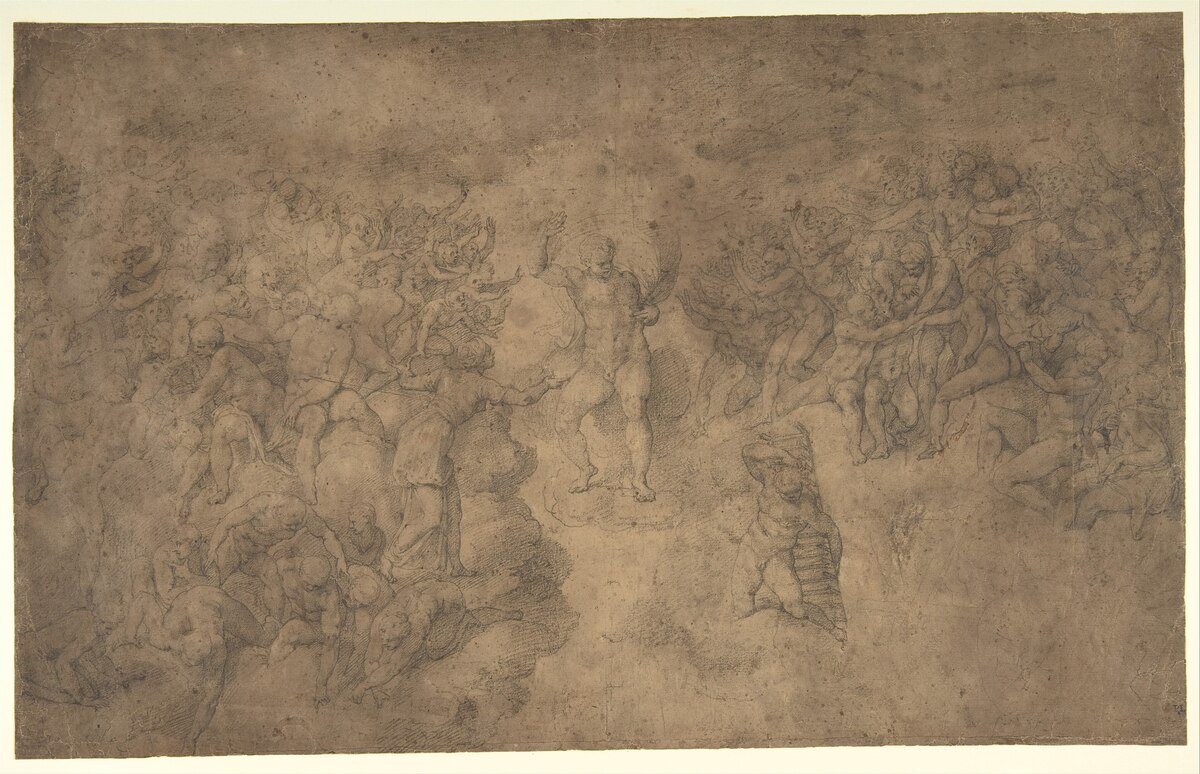
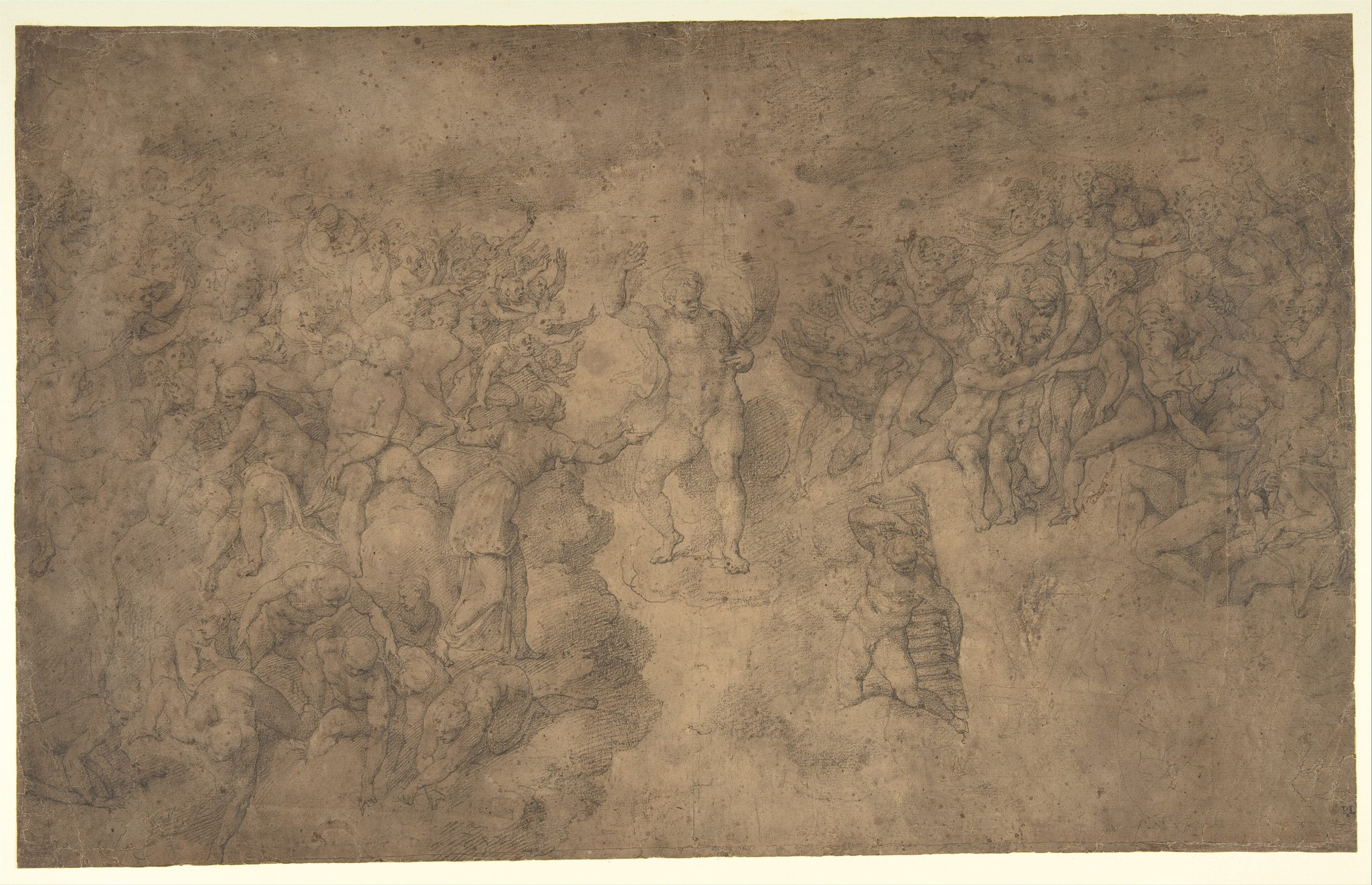
- A drawing of the Last Judgment, depicting the Day of Judgment with a central judge, angels, and resurrected souls, created after Michelangelo's famous fresco in the Sistine Chapel.(Wikimedia Commons: The Last Judgment, n.d.)
- Attribution qualification
- Attributed to the school of Michelangelo Buonarroti
Catalogue title, attribution and date
The Metropolitan Museum of Art catalogues this sheet under the title "The Last Judgment," with an attribution to the school of Michelangelo Buonarroti rather than to Michelangelo himself. The drawing is dated 1570-90, a range that places its making in the decades after Michelangelo's death in 1564 and that is separate from any later catalogue or record date attached to the object. Its subject is the Last Judgment, drawn from Christian tradition, and it is grouped in the museum's categories for drawings after Michelangelo Buonarroti and works after the Last Judgment by Michelangelo. The sheet belongs to the Drawings and Prints department of the Metropolitan Museum of Art, New York, and carries the accession number 67.152.(Wikimedia Commons: The Last Judgment, n.d., Summary; Date; Title; Categories: Drawings after Michelangelo Buonarroti; Works after the Last Judgment by Michelangelo)
Visual conventions and the copy after Michelangelo
The drawing depicts the Last Judgment, a subject from Christian tradition, and the catalogue describes a central figure, likely Christ as judge, surrounded by angels and resurrected souls. The composition is understood as following Michelangelo's Last Judgment fresco in the Sistine Chapel, which depicts the Second Coming of Christ and the final judgment of souls. Within that relationship, the sheet takes its place in a tradition of copies made after Michelangelo's famous fresco, created in the late sixteenth century, so that the 1570-90 date on the drawing and the late sixteenth-century horizon of the copy tradition converge on the same period. The evidence describes the drawing as after the fresco without asserting that it reproduces the fresco's full colour, scale or every figure.(Wikimedia Commons: The Last Judgment, n.d., Title; Date; Categories: Drawings after Michelangelo Buonarroti; Works after the Last Judgment by Michelangelo; Summary)
Interpretation
Read together, the catalogue information supports a qualified account of what this object is and why it matters. It is a late sixteenth-century drawing on brownish paper, attributed to Michelangelo's school rather than to the master, dated 1570-90, of a size suitable for study and circulation, and connected by its subject and its category to the Sistine Chapel fresco. That combination places it within the wider material history of drawings made after celebrated works, where the medium of black chalk on paper carries line and shadow rather than the fresco's colour and monumental scale. The attribution term "school of Michelangelo Buonarroti" and the date range 1570-90 remain the catalogue's formulation, and the drawing's relationship to the fresco is presented as a tradition of copies rather than as a documented autograph work by Michelangelo.(Wikimedia Commons: The Last Judgment, n.d., Summary; Date; Dimensions; Categories: Drawings after Michelangelo Buonarroti; Works after the Last Judgment by Michelangelo; Title)
Subject and iconography
LinkThe subject and its place in a copy tradition
Visual observation
The sheet known as The Last Judgment is attributed to the school of Michelangelo Buonarroti and dated to 1570 to 1590, a period in the later sixteenth century when Michelangelo's fresco in the Sistine Chapel was already a canonical point of reference for European artists and their audiences. The composition it records is the Last Judgment, the Christian subject in which Christ returns to judge the souls of the dead, and the drawing is described in its catalog record as after Michelangelo's fresco, which depicts the Second Coming of Christ and the final judgment of souls. The attribution to Michelangelo's school and the dating are the catalog's own characterizations rather than conclusions drawn from a signature or a documented commission, so they frame the object as a product of a workshop or follower milieu rather than as an autograph work by Michelangelo himself. The subject itself, the Last Judgment, is a subject from Christian tradition, which is why the imagery can be recognized in the drawing even where individual figures are compressed or abbreviated.(Wikimedia Commons: The Last Judgment, n.d., Structured data: depicts Day of Judgment; Categories: Drawings after Michelangelo Buonarroti; Works after the Last Judgment by Michelangelo; Categories)
Within the drawing, the central figure is described as likely Christ acting as judge, surrounded by angels and resurrected souls. The word likely matters: the identification of the central figure is an inference from the composition's subject and its placement, not a documented label on the sheet. Around that central figure the angels and resurrected souls are arranged so that the moment of judgment remains legible, with the saved and the damned, the heavenly and the human, distinguished by their positions and by the direction of their movement rather than by any surviving color. Because the sheet is a drawing after a fresco, the narrative the viewer reads is the narrative of the fresco itself, filtered through a later hand that decided which parts of the enormous wall composition to compress, which figures to keep conspicuous near the center, and which to subordinate or reduce.(Wikimedia Commons: The Last Judgment, n.d., Structured data: depicts Day of Judgment; Categories: Drawings after Michelangelo Buonarroti; Works after the Last Judgment by Michelangelo)
Collection, acquisition, and study context
The drawing is in the collection of the Metropolitan Museum of Art, New York, where it is housed in the Drawings and Prints department. Its accession number is 67.152, and the museum acquired it in 1967 as a purchase from the Arthur A. Houghton, Jr. Gift. This accession history is part of the object's evidence because it fixes the sheet in a public collection and associates it with a documented acquisition event and a named donor gift rather than leaving it in an anonymous private or market context. The collection context also explains why the drawing can be studied alongside other drawings after Michelangelo and other late sixteenth-century copies, since museum departments of drawings and prints typically group such study sheets together. The evidence does not supply provenance intervals before 1967, so the object's earlier whereabouts cannot be reconstructed from the supplied units and should not be guessed at.(Wikimedia Commons: The Last Judgment, n.d., Structured data: depicts Day of Judgment; Categories)
Interpretation
Read together, the visible composition, the medium, and the catalog's categories support a qualified interpretation of the sheet's purpose and significance. The drawing keeps the subject of the Last Judgment and the central action of judgment while translating them onto a small sheet in chalk, which makes it legible as an act of close study and as an object meant for circulation among artists and collectors rather than for a wall. The evidence does not state that the drawing was made as a devotional exercise, and it does not attribute a private intention to the draftsman; what the evidence does establish is that the sheet is a late sixteenth-century copy after Michelangelo's fresco, and that the shift from fresco to black chalk on brownish paper changes how the scene reads. That combination of derivation and material difference is what gives the object its place in the larger history of copies after Michelangelo and of drawing as a medium of transmission in the late sixteenth century.(Wikimedia Commons: The Last Judgment, n.d., Structured data: depicts Day of Judgment; Categories: Drawings after Michelangelo Buonarroti; Works after the Last Judgment by Michelangelo; Categories; Medium)
A copy after the Sistine Chapel Last Judgment
The drawing belongs to the long visual tradition surrounding Michelangelo Buonarroti's Last Judgment fresco in the Sistine Chapel, which depicts the Second Coming of Christ and the final judgment of souls. The museum cataloguing treats the sheet as a work after that fresco rather than as an independent invention, grouping it under drawings after Michelangelo Buonarroti and under works after the Last Judgment. The object itself is attributed to the school of Michelangelo Buonarroti and dated 1570 to 1590, so its making falls within the later sixteenth century, decades after the fresco was completed. It was drawn in black chalk on brownish paper and measures 10-11/16 by 17-1/16 inches, that is 27.2 by 43.4 centimeters. It is now in the Drawings and Prints department of the Metropolitan Museum of Art, New York, under accession number 67.152.(Wikimedia Commons: The Last Judgment, n.d., Categories: Drawings after Michelangelo Buonarroti; Works after the Last Judgment by Michelangelo; Categories; Credit line)
Visual observation
What the sheet shows corresponds to the subject named in the documentary record: a central figure, likely Christ as judge, surrounded by angels and resurrected souls. That description is an observation drawn from the image rather than a statement about the lost or surviving fresco, and it matches the subject catalogued as the Day of Judgment. Because the drawing is a copy after a monumental fresco, the formal decisions on the sheet are best understood in relation to that source: the central judge remains the organizing point of the composition, with the surrounding figures arranged around him. The medium is a further formal condition of the object. Black chalk on brownish paper records line and shadow rather than the full color and monumental scale of the fresco, so the translation onto a small sheet changes how the scene reads even while it preserves the subject and the central action.(Wikimedia Commons: The Last Judgment, n.d., Structured data: depicts Day of Judgment; Categories: Drawings after Michelangelo Buonarroti; Works after the Last Judgment by Michelangelo)
Copies, study and later acquisition
The documentary record places the drawing within a tradition of copies made after Michelangelo's famous fresco in the late sixteenth century, which is consistent with the 1570 to 1590 date assigned to the sheet. Within that tradition, copying functioned as close study of a celebrated work rather than mere reproduction, and the evidence for this object supports describing it as a later hand's engagement with the Last Judgment: the subject and the central action are retained and translated onto a small sheet. How the sheet circulated, who used it, and what devotional or pedagogical purposes it served are not established by the supplied evidence and are not asserted here. Its later history is documented at one point: the Metropolitan Museum of Art acquired the drawing in 1967 as a purchase from the Arthur A. Houghton, Jr. Gift.(Wikimedia Commons: The Last Judgment, n.d., Categories; Credit line; Categories: Drawings after Michelangelo Buonarroti; Works after the Last Judgment by Michelangelo)
The drawing is after Michelangelo's Last Judgment fresco in the Sistine Chapel, which depicts the Second Coming of Christ and the final judgment of souls.(Wikimedia Commons: The Last Judgment, n.d.)
The drawing is part of a tradition of copies made after Michelangelo's famous fresco, created in the late 16th century.(Wikimedia Commons: The Last Judgment, n.d.)
Materials and technique
LinkSupport and medium
The medium is black chalk, applied to brownish paper. The source consulted gives no further detail about the paper's manufacture, its weight or tone beyond the description brownish, nor about whether the chalk is natural or fabricated, and no preparation layer, wash, heightening or fixative is documented for the sheet. The medium statement is therefore the full extent of what the supplied catalogue information establishes about the drawing's physical make-up, and it should not be read as a description of the drawing's appearance in any greater specificity than that.(Wikimedia Commons: The Last Judgment, n.d., Medium)
Visual observation
Because the sheet is described as a drawing in chalk on coloured paper rather than as a painting or print, the object belongs to the graphic rather than the mural tradition that its subject ultimately derives from. The source consulted describes the drawing as following Michelangelo's Last Judgment fresco in the Sistine Chapel, a fresco depicting the Second Coming of Christ and the final judgment of souls, and it places the sheet within a tradition of copies made after that fresco in the late sixteenth century. Read together, these units establish a relationship between two distinct material systems: a monumental wall painting executed in fresco and a small chalk drawing on paper made after it. The evidence does not record how the draughtsman studied the fresco, whether from the wall itself, from an intermediate drawing, or from another copy, and it does not name the draughtsman; attribution is given only as the school of Michelangelo Buonarroti, with a date range of 1570 to 1590. The material difference between fresco and chalk is documented by the medium statement, while the derivation from the fresco is asserted by the catalogue's description of the drawing, so the two kinds of claim should be kept distinct: the medium is a technical fact about the sheet, and the relationship to Michelangelo's fresco is a scholarly characterisation of the drawing's subject and lineage.(Wikimedia Commons: The Last Judgment, n.d., Medium; Structured data: depicts Day of Judgment)
The drawing's dimensions are recorded as 10 and 11 sixteenths by 17 and 1 sixteenth inches, that is 27.2 by 43.4 centimetres. These measurements matter for the account of materials and technique because they confirm that the composition known from Michelangelo's fresco has been accommodated onto a single sheet of modest size, roughly the scale of a large study page rather than a cartoon or full-scale copy. The evidence supplied does not state whether the sheet has been trimmed, whether the drawing occupies the whole of it, or whether any margins, joins or losses exist, so the relationship between the recorded sheet size and the drawn composition remains only partly documented.(Wikimedia Commons: The Last Judgment, n.d., Medium; Structured data: depicts Day of Judgment)
Subject in chalk
The subject executed in these materials is the Last Judgment, described as a subject from Christian tradition, with a central figure understood as likely Christ as judge surrounded by angels and resurrected souls. The description of that central figure as likely Christ is itself qualified in the source, so the identification of the principal figure is offered as an interpretation of the composition rather than as an inscription or a document. What the material evidence supports is that the drawing translates a complex multi-figure mural subject into black chalk line and tone on brownish paper, a medium that records contour and shadow rather than the full colour and monumental scale of the fresco. Nothing in the supplied evidence describes how the chalk was handled, whether the drawing was worked up broadly and then refined, whether hatching or smudging was used to model the bodies, or whether any part of the sheet was left unresolved, and no tool other than the chalk itself is documented.(Wikimedia Commons: The Last Judgment, n.d., Medium; Structured data: depicts Day of Judgment)
Within the history of art, the significance of an object like this one lies less in its medium's refinement than in what the medium enabled: a monumental fresco subject could be studied, copied and circulated on a light, portable sheet. The source consulted places the drawing in a late sixteenth-century tradition of copies after Michelangelo's famous fresco, and it documents the sheet's later institutional life as a drawing held in the Drawings and Prints department of the Metropolitan Museum of Art, with the accession number 67.152, acquired by the Museum in 1967 as a purchase from the Arthur A. Houghton, Jr. Gift. Those collection facts are not techniques of making, but they are part of the object's material history, since they record where the sheet now resides and how it entered a public collection, and they frame the conditions under which the materials described here have been examined and catalogued.(Wikimedia Commons: The Last Judgment, n.d., Medium; Structured data: depicts Day of Judgment)
Provenance and ownership
LinkDocumented Acquisition
The section on provenance rests on a single documented transaction. The Metropolitan Museum of Art acquired the drawing in 1967, and the credit line records that acquisition as a purchase from the Arthur A. Houghton, Jr. Gift. The museum's accession number for the sheet is 67.152, a number whose leading element corresponds to the 1967 year of entry, and the drawing is housed within the museum's Drawings and Prints department. These details are catalog data rather than a narrative of ownership, and they establish an institutional moment of acquisition without describing the series of hands the sheet passed through before it reached the museum.(Wikimedia Commons: The Last Judgment, n.d., Credit line)
Because the available record names only the 1967 purchase and the Houghton gift, earlier ownership is not documented here. The interval before that year is therefore an unrecorded period, not a demonstrated change of ownership: no sale, bequest, or intermediate owner is supplied by the evidence, and no inference of continuous or interrupted descent should be drawn from the silence. What the evidence does establish is that the sheet, later catalogued as the school of Michelangelo Buonarroti and dated 1570 to 90 in black chalk on brownish paper, entered a public collection in the twentieth century through a transaction connected to Arthur A. Houghton, Jr.; any account of how it travelled before then would require evidence not present in these units.(Wikimedia Commons: The Last Judgment, n.d., Credit line)
The Copy After Michelangelo
The object acquired in 1967 is a drawing after Michelangelo's Last Judgment fresco in the Sistine Chapel, a subject that depicts the Second Coming of Christ and the final judgment of souls. Its composition centres on a figure generally understood as Christ the judge, surrounded by angels and resurrected souls, and it belongs to a tradition of copies made after Michelangelo's famous fresco in the late sixteenth century. This identification places the sheet within a larger history of artistic response to the Sistine Chapel, where the fresco itself supplied the subject and the central action that later hands translated onto smaller supports.(Wikimedia Commons: The Last Judgment, n.d., Credit line; Categories: Drawings after Michelangelo Buonarroti; Works after the Last Judgment by Michelangelo; Categories)
Provenance timeline
- 1967
The drawing entered the Metropolitan Museum of Art through a purchase associated with the Arthur A. Houghton, Jr. Gift, and was given accession number 67.152.(Wikimedia Commons: The Last Judgment, n.d., Credit line)
Reception and literature
LinkThe Object and Its Documented Record
The Metropolitan Museum of Art holds this drawing of the Last Judgment in its Drawings and Prints department under accession number 67.152. The sheet measures 10-11/16 by 17-1/16 inches (27.2 by 43.4 cm) and is executed in black chalk on brownish paper. The Museum's catalog information dates the work to 1570-90 and attributes it to the school of Michelangelo Buonarroti. The drawing entered the collection in 1967 as a purchase from the Arthur A. Houghton, Jr. Gift, a provenance detail that fixes the point at which the object moved from private hands into a public study collection. That accession date and credit line are part of the drawing's documented record rather than of the subject it depicts, and they establish the institutional conditions under which later scholarship and viewing have taken place.(Wikimedia Commons: The Last Judgment, n.d., Credit line; Categories)
After Michelangelo: Copy as Study
The drawing is after Michelangelo's Last Judgment fresco in the Sistine Chapel, which depicts the Second Coming of Christ and the final judgment of souls. The Met sheet belongs to a tradition of copies made after that fresco, created in the late sixteenth century. As the catalog frames it, the drawing was made in the context of a practice in which copying a celebrated fresco was itself a mode of close study rather than mere duplication. The translation into black chalk on brownish paper changes how the scene reads relative to its monumental source: the chalk records line and shadow rather than the fresco's full color and scale, so the drawing carries the subject and central action of the Sistine composition onto a small sheet suited to study and circulation. This small-format, monochrome treatment is one of the ways the object signals its place within a copy tradition rather than presenting itself as an independent invention.(Wikimedia Commons: The Last Judgment, n.d., Categories; Categories: Drawings after Michelangelo Buonarroti; Works after the Last Judgment by Michelangelo)
From Study to Collection
Interpretation
Read together, the catalog information and the composition suggest that this sheet mattered less as a finished devotional image than as a working record of an admired model. The copy tradition after Michelangelo's Last Judgment depended on the circulation of such drawings, and the use of black chalk on brownish paper indicates a medium adapted to study rather than to the display conditions of fresco. The drawing's acquisition in 1967 as a purchase from the Arthur A. Houghton, Jr. Gift places it within the Met's Drawings and Prints holdings, where it can be considered alongside other works after Michelangelo. In that setting the sheet's later cultural role is inseparable from its original function as an exercise in translation, and its meaning accumulates from both: it is at once a late sixteenth-century object of study and a modern museum object whose attribution and date are part of its institutional record.(Wikimedia Commons: The Last Judgment, n.d., Categories; Credit line; Structured data: depicts Day of Judgment)
Collection and display
LinkThe sheet in the Metropolitan Museum of Art
The drawing titled The Last Judgment, attributed to the school of Michelangelo Buonarroti and dated to 1570-90, is today in the collection of the Metropolitan Museum of Art, New York, where it is housed in the Drawings and Prints department under the accession number 67.152. Those three pieces of catalog information locate the sheet institutionally: the department assignment places it within the museum's works on paper rather than its paintings or sculpture holdings, and the accession number provides the unique identifier by which the object is tracked and requested in the collection. The Wikimedia Commons file page that supplies this catalog data was donated by the Metropolitan Museum of Art as part of an open access project, which is why the title, attribution, date, medium, dimensions, collection, accession number and credit line appear together in one record.(Wikimedia Commons: The Last Judgment, n.d., Collection; Current location; Accession number)
In material terms the sheet is black chalk on brownish paper, measuring 10-11/16 by 17-1/16 inches (27.2 by 43.4 cm). It was acquired by the Metropolitan Museum of Art in 1967 as a purchase from the Arthur A. Houghton, Jr. Gift. The credit line and the accession number belong to the same acquisition moment: the number 67.152 encodes the year 1967, matching the documented purchase date, so the institutional record of the object begins with that 1967 entry rather than with any earlier ownership history. The evidence available here does not specify what the sheet's whereabouts were before that acquisition, and none should be inferred.(Wikimedia Commons: The Last Judgment, n.d., Accession number)
Subject and place in the copy tradition
The subject is the Last Judgment, a subject drawn from Christian tradition. A central figure, likely Christ as judge, is surrounded by angels and resurrected souls. This composition follows Michelangelo's Last Judgment fresco in the Sistine Chapel, which depicts the Second Coming of Christ and the final judgment of souls. The drawing belongs to the tradition of copies made after Michelangelo's famous fresco, created in the late sixteenth century, and the 1570-90 dating of the sheet places it within that copyist tradition rather than within Michelangelo's own lifetime production. The attribution is to the school of Michelangelo Buonarroti, not to the master himself, so the catalog record distinguishes the drawing as a later product of his circle or followers.(Wikimedia Commons: The Last Judgment, n.d., Collection)
Documented values and qualified estimates
LinkThe Object and Its Attribution
Interpretation
The drawing catalogued as The Last Judgment is a black chalk work on brownish paper measuring 27.2 by 43.4 cm (10-11/16 by 17-1/16 inches), attributed to the School of Michelangelo Buonarroti and dated 1570 to 90. It is held by the Metropolitan Museum of Art in New York, within the Drawings and Prints department, under accession number 67.152. Its subject is the Last Judgment, a theme from Christian tradition, and the sheet presents a central figure, likely Christ as judge, surrounded by angels and resurrected souls. The composition belongs to a late sixteenth-century tradition of copies made after Michelangelo's Last Judgment fresco in the Sistine Chapel, which depicts the Second Coming of Christ and the final judgment of souls.(Wikimedia Commons: The Last Judgment, n.d.)
The Met acquired the drawing in 1967 through purchase and the Arthur A. Houghton, Jr. Gift. This acquisition history and the institutional setting recorded in the catalog information matter to the object's position within larger histories of collecting and of the study of Michelangelo: a late sixteenth-century copy after a canonical fresco entered a major encyclopedic museum's drawings collection in the later twentieth century, where it documents both the reception of Michelangelo and the practices of drawing after celebrated monuments. In the same catalog record, the credit line and accession number are given as identifying data rather than art-historical argument, which means the object's documentary status rests on museum cataloguing rather than on connoisseurial demonstration of a specific hand.(Wikimedia Commons: The Last Judgment, n.d.)
Recorded Value and Its Limits
The recorded valuation context is explicit about the limits of what counts as evidence. A working insurance estimate generated on 2026-10-16 places a broad range of US$500K to US$2M for the drawing. The methodology described calculates that range for manual insurance review from the confirmed context: a black chalk drawing on brownish paper, 27.2 by 43.4 cm, dated 1570 to 90, attributed to the School of Michelangelo Buonarroti, held by the Metropolitan Museum of Art under accession 67.152, and acquired via purchase and the Arthur A. Houghton, Jr. Gift in 1967. The range is described as conservative because the work is a school or copy after Michelangelo's Last Judgment rather than an autograph Michelangelo, which the methodology says substantially lowers market value compared with originals. The stated rationale combines the Old Master drawing market for works of this period, medium, and scale with the prominence of the subject and the institutional collection history, supporting a broad band rather than a precise figure.(Wikimedia Commons: The Last Judgment, n.d.)
The same source qualifies its number in terms that must be carried with any use of it. It states that the estimate is a model-generated working insurance range for manual review only, not an official insurance value, appraisal, auction result, or sale price, and that it does not rely on comparable sales or private insurance records. No comparable sales, private insurance records, or appraisals were used, and the source states that actual insurance values should be determined by a qualified appraiser. Read as a whole, the unit establishes two things at once: a documented working figure and the conditions under which that figure should not be treated as a market fact. The figure is therefore best understood as an internal planning device tied to the catalogued object, not as evidence of what the drawing has fetched or would fetch.(Wikimedia Commons: The Last Judgment, n.d.)
The relationship between the drawing's physical description and its valuation is one of the more legible connections in the record. The medium and support, black chalk on brownish paper, and the dimensions, 27.2 by 43.4 cm, are among the confirmed facts the valuation methodology names as inputs, along with the date span 1570 to 90, the school attribution, the Met accession, and the 1967 acquisition. This means the value range is explicitly anchored to the same catalogued attributes that define the sheet as an object, and it changes in principle if those attributes change. The attribution as school or copy rather than autograph is treated by the methodology as the single factor that substantially lowers value relative to originals, which places the drawing's market position in direct relation to the question of authorship that the attribution leaves open.(Wikimedia Commons: The Last Judgment, n.d.)
Because the drawing depicts the Last Judgment after Michelangelo's fresco, its subject is not incidental to its value but is one of the named supports for the broad band: the methodology cites the prominence of the subject together with the institutional collection history. The same record is careful about what the estimate is not. It is not the result of comparable sales analysis, it is not an appraisal, and it does not draw on private insurance records. The Old Master drawing market for works of this period, medium, and scale is invoked as a general context rather than as a set of transactions, so the resulting figure should be read as a reasoned bracket rather than a measured price. Preserving both the number and its conditions keeps the account honest about the difference between a working calculation and documented market evidence.(Wikimedia Commons: The Last Judgment, n.d.)
Working estimate
Calculated working insurance estimate, not a sale price: Estimated value: US$500K to US$2M Recorded date: Working calculation, generated 2026-10-16. Methodology: This broad working range is calculated for manual insurance review using the confirmed context: a black chalk drawing on brownish paper, 27.2 x 43.4 cm, dated 1570 to 90, attributed to the School of Michelangelo Buonarroti, held by the Metropolitan Museum of Art (accession 67.152) and acquired via purchase and the Arthur A. Houghton, Jr. Gift in 1967. The range is conservative because the work is a school or copy after Michelangelo's Last Judgment rather than an autograph Michelangelo, which substantially lowers market value compared with originals. The Old Master drawing market for works of this period, medium, and scale, combined with the prominence of the subject and the institutional collection history, supports a broad band rather than a precise figure. No comparable sales, private insurance records, or appraisals were used. Qualification: This is a model-generated working insurance range for manual review only. It is not an official insurance value, appraisal, auction result, or sale price. It does not rely on comparable sales or private insurance records. Actual insurance values should be determined by a qualified appraiser.(Wikimedia Commons: The Last Judgment, n.d.)