Identity and catalogue
Link- Artist or attribution
- Johannes Vermeer
- Medium and support
- Oil on canvas
- Current collection or location
- Louvre, Paris, France
- Movement or period
- Dutch Golden Age
- Country or culture
- Dutch
Catalogue entry
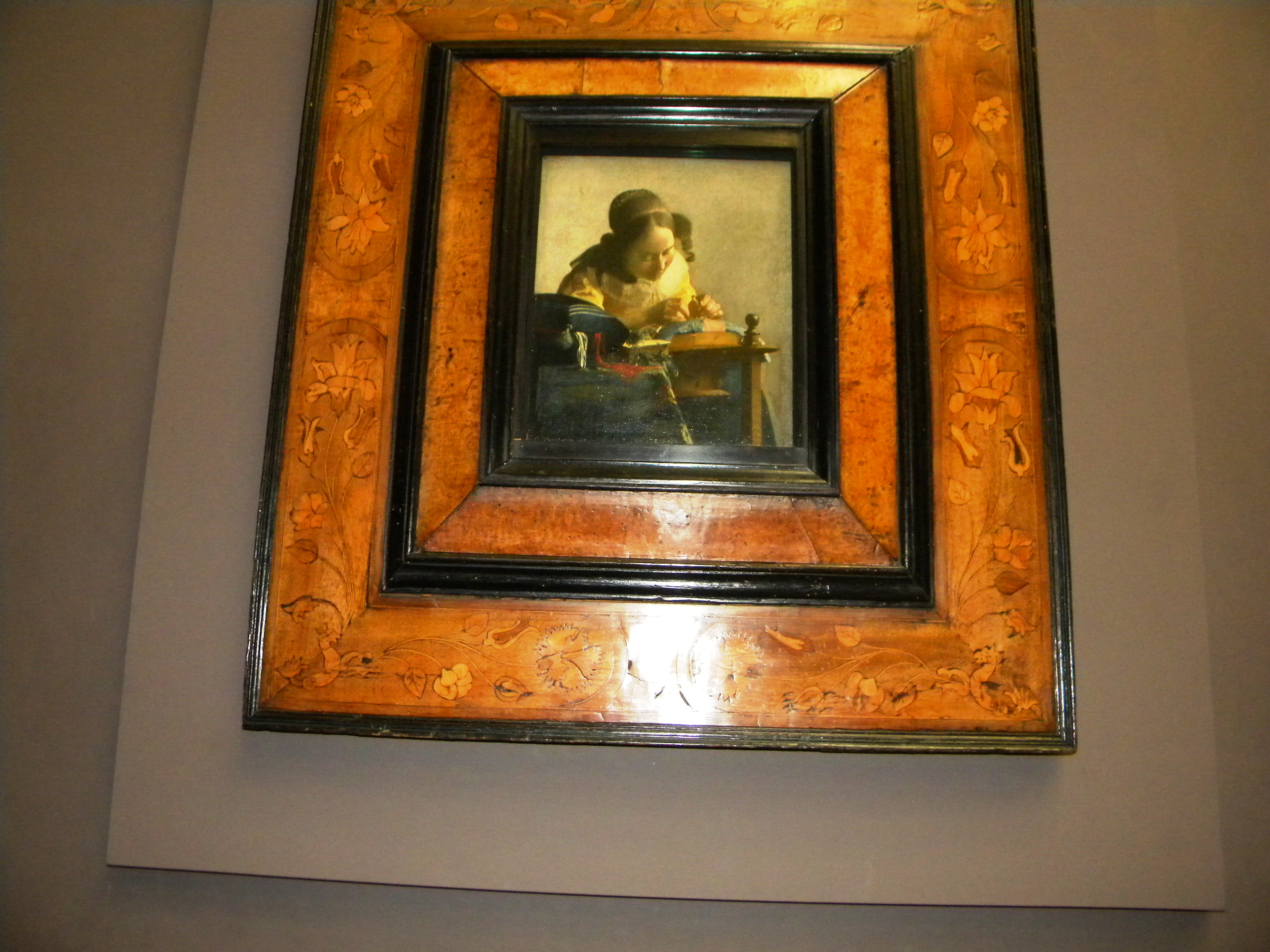
The catalogue identifies the work as The Lacemaker, a painting by the Dutch artist Johannes Vermeer, completed around 1669 to 1670 and held in the Louvre, Paris. The single supplied primary evidence unit does not record a precise completion date, an accession number, a support description, inscriptions, or dimensions, all of which have been treated elsewhere in this record for their own sake. The date is phrased as approximate, so the object date should be distinguished from any later catalogue or scholarly date assigned to the work. The attribution to Vermeer is stated directly in this account rather than qualified, while the dating carries the qualification.(Wikipedia fallback: The Lacemaker (Vermeer), n.d.)
Interpretation
Taken together, the record separates layers of information about the object. The catalogue layer supplies the title, the attribution to Vermeer, the approximate 1669 to 1670 date and the Louvre location; the description layer supplies the yellow bodice, the bobbins in the left hand, the pin placed in the pillow, the 24.5 cm by 21 cm measurement, the blank wall and the spilling red and white lace; and the technical layer supplies the shared canvas bolt with A Young Woman Seated at the Virginals. The optical proposal, the probability of the shared original dimensions, the Netscher comparison and the Dali reception are all attributed rather than established, and the evidence does not fix how far the canvas match should alter the catalogue date. What the combination does establish is why the object matters: a small, intensely focused depiction of a craft, made by a painter whose handling of focus and material support continues to raise technical questions about how it was composed.(Wikipedia fallback: The Lacemaker (Vermeer), n.d.)
Subject and iconography
LinkThe lacemaker at work: observed composition
Visual observation
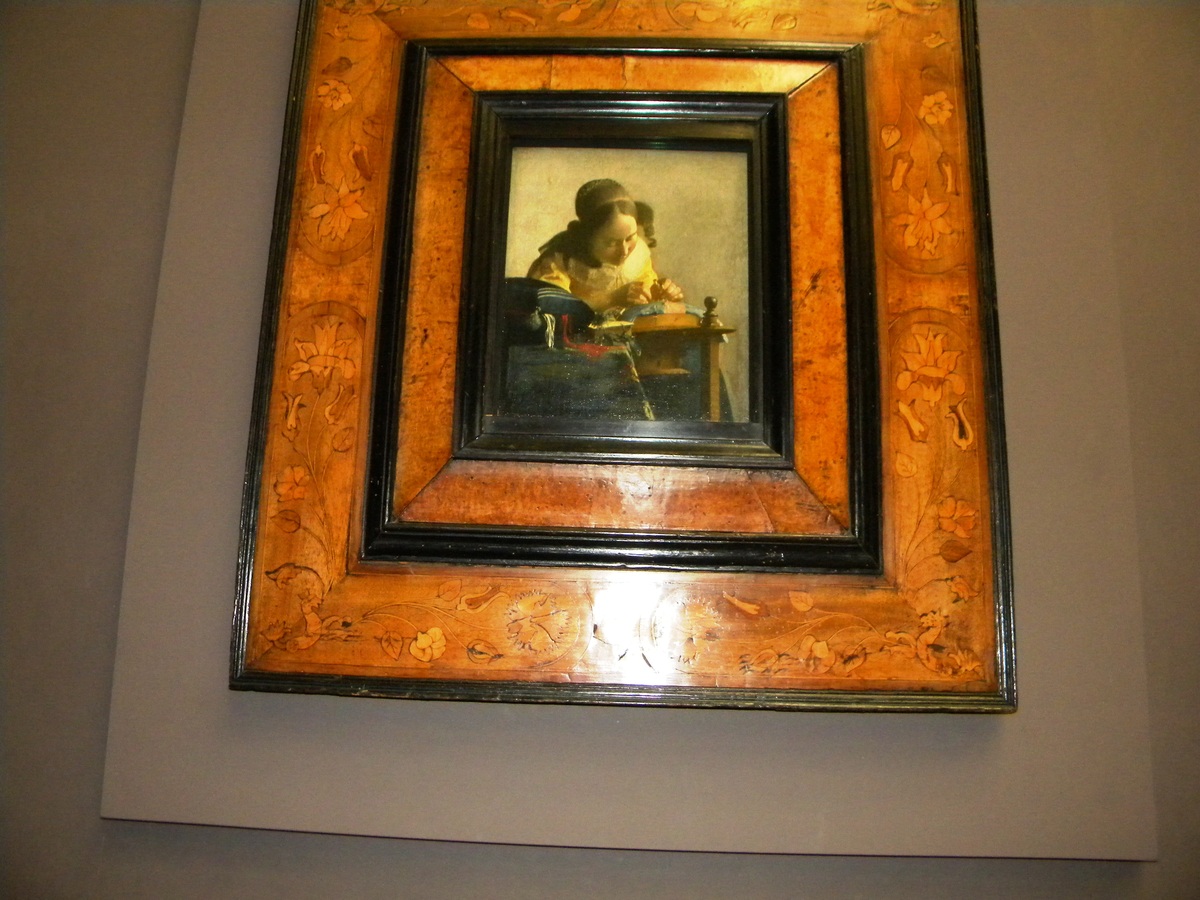
The most fundamental level of evidence for this painting is what it shows: a young woman wearing a yellow bodice, holding up a pair of bobbins in her left hand as she carefully places a pin in the pillow on which she is making her bobbin lace. The recorded action is therefore not generic domestic labor but a specific, identifiable craft technique. Bobbin lace is made by manipulating multiple weighted threads wound on bobbins, working them over a prickling pattern and fixing the crossings with pins inserted into a firm pillow. The painting's account of the gesture is precise in the technical sense: one hand lifts the pair of bobbins while the other positions the pin, which is the moment of fixing a crossing rather than of winding or threading. Nothing in the observed description identifies the sitter, the location, or the occasion, and the account should not be pushed further than the evidence allows. What can be said is that the composition selects a single instant from a continuous and repetitive process, and that the instrument of that process, the pair of bobbins, is held up in the hand at the center of the action rather than lying passively on the cushion.(Wikipedia fallback: The Lacemaker (Vermeer), n.d.)
Scale is part of the painting's design rather than an incidental fact. At 24.5 cm by 21 cm, the work is the smallest of Vermeer's paintings. That measurement bears directly on the visual experience of the object and on the way its composition works. In a panel of this size, the woman and her lace occupy most of the available surface, and the hands and face that carry the action are compressed into a small field. The small scale also means that the recorded precision of the craft gesture, the placing of a pin and the lifting of the bobbins, is achieved within a very confined area of paint, which is one reason the painting's handling of detail has attracted close technical attention. The size should be treated as a documented dimension rather than as a rhetorical claim about intimacy or monumentality, and it is worth noting that the same source that records the measurement also records the work's usual attribution and date context in the broader literature.(Wikipedia fallback: The Lacemaker (Vermeer), n.d.)
Visual contrast and the handling of paint
Within the same image there is an important internal contrast between two kinds of painted material. In The Lacemaker, the red and white of the lace is spilling from the sewing cushion in a near-liquid form, contrasting sharply with the precision of the lace she is shown working on. This is a difference not between two subjects but between two ways of rendering near-identical materials: the finished or in-progress lace at the worker's hands is described with tight control, while the mass on the cushion is described as soft and flowing, almost as if it were liquid rather than thread. The observation is a description of the painted surface and of the impression it gives, not a claim about what the physical threads actually did in the room. The contrast is nevertheless visually consequential, because it separates the disciplined work of the hands from the accumulated material, and it may be one of the reasons the painting is read as being about concentration rather than about the products of the craft. Any interpretation built on this contrast depends on recognizing that the near-liquid appearance is a feature of the rendering, while the precision belongs to the depicted activity.(Wikipedia fallback: The Lacemaker (Vermeer), n.d.)
Visual conventions, optical effects and depth of field
Interpretation
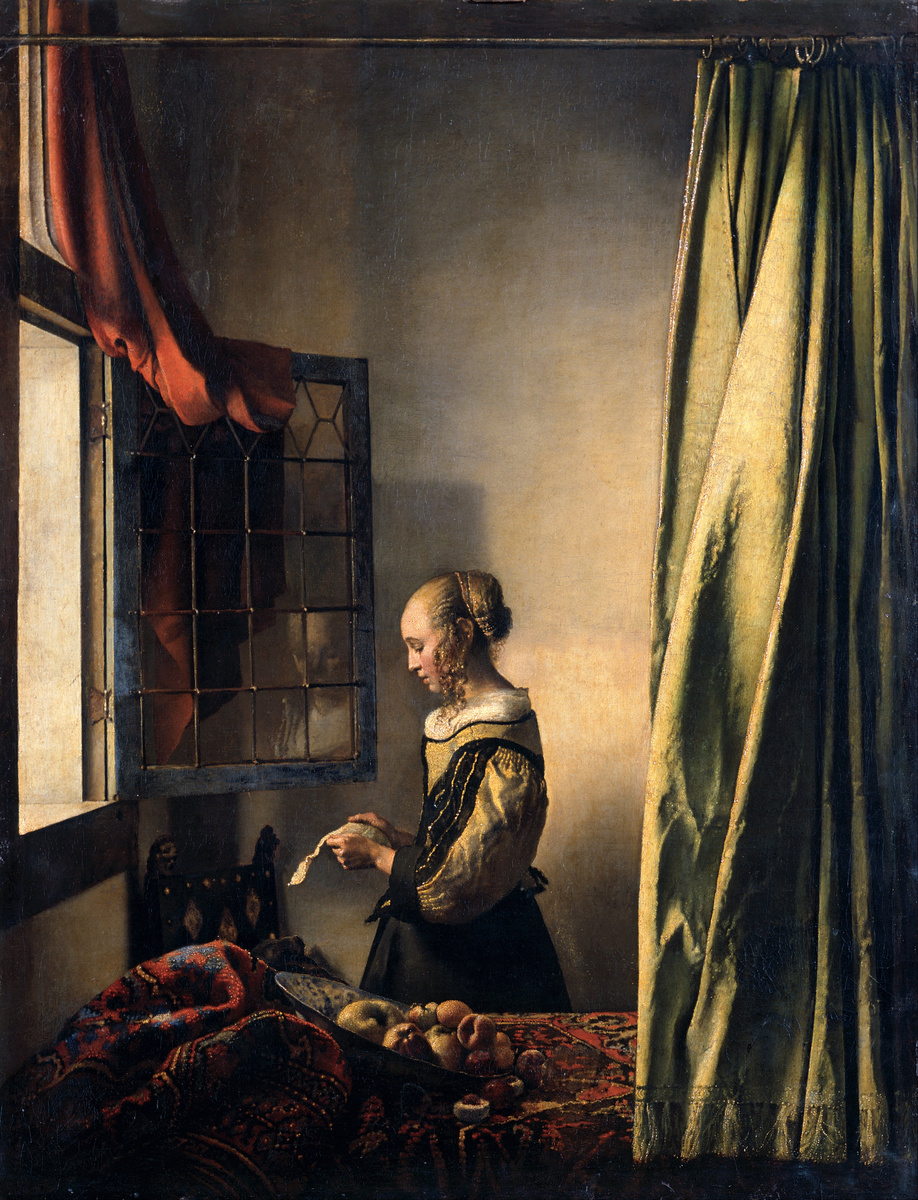
The painting's handling of focus connects it to a broader visual convention within Vermeer's own work and to a technical debate that cannot be settled by observation alone. The girl is set against a blank wall, probably because the artist sought to eliminate any external distractions from the central image; the blank background is thus an observed feature with an attributed motive. It is likely that the artist undertook careful study before he executed the work, and the art of lacemaking is portrayed closely and accurately. This is an assessment of accuracy in the depicted craft, offered with qualification rather than as proof of preparatory study. Some believe Vermeer may have used a camera obscura while composing the work, and the specific evidence cited for that belief is optical: many effects typical of projection can be seen, in particular the blurring of the foreground. The camera obscura explanation is attributed to those who advance it and is presented as a possibility, not a documented fact of method. What can be described with more confidence is the pictorial result: by rendering areas of the canvas as out-of-focus, Vermeer is able to suggest depth of field. That device is described as unusual for Dutch Baroque painting of the era but common in his interior works starting as early as 1657 in Girl Reading a Letter at an Open Window. The convention, then, is not unique to this painting; it belongs to a consistent practice within Vermeer's interiors, and in this composition the softening of the foreground helps direct attention toward the lacemaker's activity. The optical effects and the craft accuracy belong to different registers of evidence and should be distinguished accordingly: the first is inferred from appearance and debated, the second is an assessment of how faithfully the depicted work is rendered.(Wikipedia fallback: The Lacemaker (Vermeer), n.d.)
Materials and technique
LinkSupport and Weave Structure
The support of The Lacemaker has been studied through the weave of its canvas, and this is where the most concrete material evidence about the painting's making begins. Documentation records that the canvas used for The Lacemaker was cut from the same bolt as that used for A Young Woman Seated at the Virginals, and that both paintings seem to have had identical dimensions originally. Read literally, the shared bolt means the two supports were prepared from one length of cloth, so their thread count, weave pattern and selvedge-to-selvedge spacing should correspond. The claim about identical original dimensions is a second, related inference: it suggests that whoever cut the cloth laid out the two canvases to the same measurements rather than trimming one to fit a frame. Because the statement is phrased as what the evidence seems to show, it should be treated as a strong technical indication rather than an absolute certainty, but it is the kind of indication that links the two works at the level of physical preparation, not just style.(Wikipedia fallback: The Lacemaker (Vermeer), n.d.)
The weave match has consequences beyond the canvas itself. It raises the question of whether The Lacemaker, which is usually dated about 1669 to 1670, should be dated somewhat later. The reasoning is indirect but material: if two paintings share a support cut from one bolt, they are likely to have been made within a relatively short span, so the established dating of one work can bear on the plausible dating of the other. The evidence also records the limits of that inference. The date of The Lacemaker is not fixed; the weave match with Young Woman Seated suggests it might be later, but scholars' proposed dates are not far apart, and the dating of late Vermeers is mostly guesswork. In other words, the technical finding is solid enough to open a chronological question, but it does not by itself settle the date, and the documentary record preserves the disagreement rather than resolving it. This is a case where the material evidence and the art-historical chronology are in dialogue, and the honest account holds both the confirmed weave match and the unresolved date together.(Wikipedia fallback: The Lacemaker (Vermeer), n.d.)(C. Richard Johnson Jr. and Don H. Johnson, n.d., PDF page 1)
Optical Effects and the Question of Projection
The technique of the painting extends beyond its physical support into the way it represents space and focus. Some believe Vermeer may have used a camera obscura while composing the work: many optical effects typical of projection can be seen, in particular the blurring of the foreground. This is an attributed interpretation, not a documented fact about the making of the painting, and it should be reported as a view that some hold. What supports the interpretation is the observable behavior of the paint. By rendering areas of the canvas as out-of-focus, Vermeer is able to suggest depth of field in a manner unusual for Dutch Baroque painting of the era but common in his interior works starting as early as 1657 in Girl Reading a Letter at an Open Window. The material point is that the blurred passages are a deliberate handling of paint, and the question of whether that handling was guided by a lens, by close observation of optical effects, or by both is exactly what remains a matter of scholarly interpretation.(Wikipedia fallback: The Lacemaker (Vermeer), n.d.)(C. Richard Johnson Jr. and Don H. Johnson, n.d., PDF page 1)
Canvas weave and its measurement
Technical examination
Technical study of The Lacemaker begins with its canvas, the physical support that carries every subsequent mark. Measured thread counts for the painting give an average of 11.9 threads per centimetre in the vertical direction and 12.4 threads per centimetre horizontally. These figures are the kind of data produced by weave analysis, in which the density and pattern of the fabric are recorded and compared against measurements taken from other canvases. On their own the numbers describe a single piece of cloth, but their value lies in comparison: once the weave of one painting is characterised in this way, it can be set beside the weave of another to test whether the two supports might have come from the same bolt of fabric. The evidence establishes the measurement itself; it does not, by itself, identify a manufacturer, a supplier or a date of manufacture for the cloth.(C. Richard Johnson Jr. and Don H. Johnson, n.d., PDF page 1)
That comparative step has been taken, and it is reported as a technical finding rather than an attribution. Computer analysis of canvas weave is said to confirm the suggestion made by Sheldon and Costaras that Young Woman Seated and The Lacemaker could well be from the same bolt of cloth. The wording matters: the result is presented as confirmation of an existing proposal, so the finding is attributed to a computational method that supports a suggestion advanced by named scholars, not a direct physical demonstration that the two canvases were cut from one roll. The related claim recorded for the object is that the canvas was cut from the same bolt as that used for A Young Woman Seated at the Virginals, and that both paintings seem to have had identical dimensions originally. Taken together, the weave measurement and the weave match connect The Lacemaker to another painting through the material of its support rather than through style or subject, and the qualification that the original dimensions only seem identical leaves open how closely the two works corresponded before any later changes to their edges or formats.(C. Richard Johnson Jr. and Don H. Johnson, n.d., PDF page 1)(Wikipedia fallback: The Lacemaker (Vermeer), n.d.)
Interpretation
The weave match has chronological consequences, and they are debated rather than settled. The Lacemaker is usually dated about 1669 to 1670, but the evidence records that the date is not fixed: the match with Young Woman Seated suggests the painting might be later, and the question is raised whether it should be dated somewhat later still. Against any confident redating, the same evidence notes that scholars' proposed dates are not far apart and that the dating of late Vermeers is mostly guesswork. This is a case where a technical result opens a question without closing it. The weave comparison can support the possibility of a shared bolt and therefore of a closer working relationship between two paintings in time, but it cannot by itself supply a year, because the evidence offers no independent date for the cloth and no firm anchor for when either canvas was used. The technical finding and the art-historical date should be kept distinct, with the reattribution of The Lacemaker to a later moment remaining a proposal.(C. Richard Johnson Jr. and Don H. Johnson, n.d., PDF page 1)(Wikipedia fallback: The Lacemaker (Vermeer), n.d.)
Reception and literature
LinkComparison and Contemplative Tone
Interpretation
The Lacemaker has attracted comparison with other paintings as well as later reinterpretation, and these two strands of reception can be distinguished by what the evidence actually records. The work is often compared to a 1662 canvas by the Dutch portrait and genre painter Caspar Netscher, which is similarly contemplative in tone. The comparison rests on shared mood rather than any documented relation between the two artists or their workshops, so it functions as a critical and art-historical juxtaposition of temperament, not as evidence of influence, copying or direct encounter. What makes the pairing useful is precisely that it isolates a quality, quiet absorption, that viewers and scholars have repeatedly found in The Lacemaker and then sought elsewhere in Dutch painting of the period.(Wikipedia fallback: The Lacemaker (Vermeer), n.d.)
The painting's later cultural life is documented through the work of Salvador Dali, who admired Vermeer and painted his own version of The Lacemaker in 1955, probably on commission by Robert Lehman, and who around the same time produced The Paranoiac-Critical Study of Vermeer's Lacemaker. The evidence preserves important qualifications: the commission by Lehman is stated as probable rather than certain, and the two works are described as contemporary with one another without a fixed sequence. Dali's admiration is thus the documented starting point, and the two pictures represent different modes of appropriation. One is a painted version, the other a paranoiac-critical study, and the distinction matters because the second mobilises Dali's own interpretive method rather than simply restating Vermeer's image. Attribution of this episode belongs to the account describing it; the commission remains a probability, not an established fact.(Wikipedia fallback: The Lacemaker (Vermeer), n.d.)
Interpretation
Dali's engagement with The Lacemaker becomes more legible when set against what the painting actually shows, since his version and study respond to a depicted action that is small, exact and physically specific. The work shows a young woman wearing a yellow bodice, holding up a pair of bobbins in her left hand as she carefully places a pin in the pillow on which she is making her bobbin lace. The yellow bodice and the gesture of pin placement are the features a later artist would have to reckon with, and Dali's two works indicate that the composition could be approached both as an image to be remade and as an image to be interrogated. The evidence does not record Dali's stated reasons or any text accompanying the works, so the motivation behind each remains unattributed and should not be inferred.(Wikipedia fallback: The Lacemaker (Vermeer), n.d.)
Interpretations and debates
LinkReading the Composure of the Scene
Interpretation
The Lacemaker is a painting by the Dutch artist Johannes Vermeer, completed around 1669 to 1670 and held in the Louvre, Paris, and it shows a young woman wearing a yellow bodice, holding up a pair of bobbins in her left hand as she carefully places a pin in the pillow on which she is making her bobbin lace. Measured at 24.5 cm x 21 cm, it is the smallest of Vermeer's paintings. The blank wall behind the girl has been read as a deliberate compositional choice: the work's account proposes that she is set against it probably because the artist sought to eliminate any external distractions from the central image. That is an attributed interpretation rather than a recorded statement of intent, and it should be weighed as such. It gains some support from what the picture itself displays, since the red and white of the lace spilling from the sewing cushion in a near-liquid form contrasts sharply with the precision of the lace she is shown working on, so that the soft, undifferentiated mass frames and heightens the exactness of the activity at the center. Together the small scale, the emptied background and the contrast between flowing thread and precise work focus attention on the lacemaker herself rather than on any setting or narrative incident.(Wikipedia fallback: The Lacemaker (Vermeer), n.d.)
A second attributed reading concerns the artist's preparation: the account holds that it is likely Vermeer undertook careful study before he executed the work, because the art of lacemaking is portrayed closely and accurately. Here the claim rests on the fidelity of the depicted craft, including the handling of the bobbins and the placement of the pin, rather than on any external document about Vermeer's working method. The inference is therefore plausible but unverifiable from the evidence supplied, and it describes the artist's presumed practice rather than his private intention. Read alongside the depiction of the near-liquid spilling threads and the precise lace under construction, the accuracy claim is best treated as an observation about the picture's level of detail that has been extended into a hypothesis about how the painter prepared for it.(Wikipedia fallback: The Lacemaker (Vermeer), n.d.)
The Optics Question
The best-known technical interpretation is optical rather than iconographic. Some believe Vermeer may have used a camera obscura while composing the work, on the grounds that many optical effects typical of projection can be seen in it, in particular the blurring of the foreground. This is presented as a belief held by some, not as an established fact, and it concerns the working method the artist may have employed. A related account describes the result of such rendering in pictorial terms: by rendering areas of the canvas as out-of-focus, Vermeer is able to suggest depth of field in a manner unusual for Dutch Baroque painting of the era but common in his interior works starting as early as 1657 in Girl Reading a Letter at an Open Window. The optical hypothesis and the depth-of-field description address different questions, one about tools and one about pictorial effect, and neither displaces the other. What the evidence supports is a description of the image's handling of focus and an attributed, contested explanation of how that handling came about; the camera obscura proposal should not be restated as a documented fact about the making of this painting.(Wikipedia fallback: The Lacemaker (Vermeer), n.d.)
Weave, Date and the Limits of Technical Evidence
Technical study has produced the strongest material finding bearing on the object's place among Vermeer's works. The Lacemaker actually has an average of 11.9 threads per centimeter vertically and 12.4 horizontally, and computer analysis confirms the suggestion by Sheldon and Costaras that Young Woman Seated and The Lacemaker could well be from the same bolt of cloth. The account of that comparison also records that the canvas used was cut from the same bolt as that used for A Young Woman Seated at the Virginals, and that both paintings seem to have had identical dimensions originally. These are measurements and a weave comparison, and the thread counts are the quantitative basis on which the match was assessed. The dating consequence is stated cautiously in the evidence: this weave match raises the question of whether The Lacemaker, which is usually dated about 1669 to 1670, should be dated somewhat later. The same source qualifies the point further, noting that the date is not fixed, that scholars' proposed dates are not far apart, and that the dating of late Vermeers is mostly guesswork. The weave evidence therefore opens a question about chronology without settling it, and the familiar 1669 to 1670 dating remains a conventional attribution rather than a fixed fact.(C. Richard Johnson Jr. and Don H. Johnson, n.d., PDF page 1)
Interpretation and Its Limits
The readings gathered here differ in kind, and keeping them apart matters for how the object is understood. The claims about the blank wall and about the artist's careful preliminary study are interpretive proposals about intention and method, offered as what is probable or likely, and they remain attributed to the account that advances them. The camera obscura proposal is likewise attributed to some observers and rests on perceived optical effects, while the observation that out-of-focus passages produce a depth of field unusual for Dutch Baroque painting is a description of the canvas that stands on its own. The thread counts and the weave match are technical findings, but even they yield only a question about a later date, not a revised chronology, because the evidence itself concedes that late Vermeer dating is largely guesswork. What emerges is a converging set of suggestions, about how the picture directs attention, how it may have been prepared and composed, and when it may have been made, none of which should be promoted above the confidence its evidence supports. The painting matters within a larger history because its small scale, emptied background and selective focus mark an extreme point in Vermeer's treatment of concentrated interior attention, and because the technical study of its canvas ties it materially to another of his works and opens a genuine, unresolved question about the sequence of his late production.(Wikipedia fallback: The Lacemaker (Vermeer), n.d.)(C. Richard Johnson Jr. and Don H. Johnson, n.d., PDF page 1)
The disputed date of The Lacemaker
Disputed account
The dating of The Lacemaker is a reported tradition rather than a settled fact. The painting is usually dated about 1669 to 1670, but that date is not fixed. Technical study shows that its canvas matches the one used for A Young Woman Seated at the Virginals, and that weave match raises the question of whether The Lacemaker should be dated somewhat later. The qualification matters: scholars' proposed dates are not far apart, and the dating of late Vermeers is mostly guesswork, so the weave match reopens the question of date without resolving it. The evidence therefore supports two related but distinct propositions: that the two paintings could well be from the same bolt of cloth, and that this possibility bears on when The Lacemaker was made, while leaving the traditional 1669 to 1670 placement standing as a proposal rather than a documented date.(C. Richard Johnson Jr. and Don H. Johnson, n.d., PDF page 4)
By rendering areas of the canvas as out-of-focus, Vermeer is able to suggest depth of field in a manner unusual for Dutch Baroque painting of the era but common in his interior works starting as early as 1657 in Girl Reading a Letter at an Open Window.(Wikipedia fallback: The Lacemaker (Vermeer), n.d.)
Disputed account
The date of The Lacemaker is not fixed; the weave match with Young Woman Seated suggests it might be later, but scholars' proposed dates are not far apart and dating of late Vermeers is mostly guesswork.(C. Richard Johnson Jr. and Don H. Johnson, n.d.)
Documented values and qualified estimates
LinkThe object and its recorded value
Interpretation
The Lacemaker is a painting by the Dutch artist Johannes Vermeer, completed around 1669 to 1670 and held in the Louvre, Paris. At 24.5 cm by 21 cm, it is the smallest of Vermeer's paintings. That combination of scale, attribution and permanent museum location frames the object in the supplied evidence as a unique, irreplaceable masterpiece rather than a commodity with ordinary comparables. A working insurance estimate of US$500M to US$1B is recorded as a model-generated range calculated for manual review only, generated on 2026-10-16. Its price date is intentionally left blank because no appraisal, insurance, or market date was supplied, and the evidence states plainly that the figure is not an official insurance value, appraisal, auction result, or sale price and does not reflect any actual policy limit, museum valuation, or market transaction.(C. Richard Johnson Jr. and Don H. Johnson, n.d.)(Wikipedia fallback: The Lacemaker (Vermeer), n.d.)
The methodology recorded alongside the estimate explains why the range is broad rather than precise. The calculation is described as a conservative working insurance range intended for manual review, and its reasoning rests on the painting's confirmed identity as a Johannes Vermeer oil on canvas of about 1669 to 1670, on its status as the smallest of his accepted works, on its permanent home at the Louvre, and on the fact that Vermeer is among the most prominent Dutch Golden Age painters and that only about thirty-six paintings are generally accepted as his. No comparable sales or private insurance records were used. The broad band begins at a high minimum for a unique, irreplaceable museum masterpiece and extends upward to reflect the absence of direct auction or sale evidence. The evidence further states that actual insurance values for a museum-held Vermeer require formal appraisal and specialist review, so the recorded figure should be read as a working annotation rather than a determination about the object.(C. Richard Johnson Jr. and Don H. Johnson, n.d.)(Wikipedia fallback: The Lacemaker (Vermeer), n.d.)
How the recorded values relate
Taken together, the recorded values attached to this object are of several kinds and do not reduce to one another. There is the physical value established by measurement: 24.5 cm by 21 cm, the smallest of Vermeer's accepted paintings, on canvas whose weave was averaged at about 11.9 threads per centimeter vertically and 12.4 horizontally and which matches, to the satisfaction of computer analysis, a companion work. There is the historical value of an accepted Vermeer of about 1669 to 1670 in the Louvre, one of roughly thirty-six accepted works, with a date that technical evidence suggests could be somewhat later but that scholars place within a narrow range. There is the reception value of a painting compared to a 1662 Netscher and reworked by Dali in 1955. And there is the monetary figure, which the evidence itself declines to treat as documented: a model-generated working insurance range of US$500M to US$1B for manual review, not an official insurance value, appraisal, auction result, or sale price, based on no comparable sales or private insurance records, with no price date supplied. My own reading of this distribution is that the estimate is best understood as an artifact of the object's documentary record rather than as a fact about its market, since the same evidence is careful to state what the figure is not. The more durable values are the ones the physical and technical evidence can support, and they are also the ones that explain why the painting matters within a larger history of art: a small, precisely observed image of concentrated labor, made on cloth shared with another painting, whose dating remains an open scholarly question and whose optical effects continue to be argued over.(C. Richard Johnson Jr. and Don H. Johnson, n.d.)(Wikipedia fallback: The Lacemaker (Vermeer), n.d.)
Working estimate
Calculated working insurance estimate, not a sale price: Estimated value: US$500M to US$1B Recorded date: Working calculation, generated 2026-10-16. Methodology: Conservative working insurance range calculated for manual review only. The painting is a confirmed Johannes Vermeer oil on canvas of about 1669 to 1670, the smallest of his accepted works, held at the Louvre. Vermeer is among the most prominent Dutch Golden Age painters, and only about thirty-six paintings are generally accepted. The range reflects that scarcity, canonical status, and permanent museum collection context, which makes ordinary market comparables or replacement sales inapplicable. The broad range begins at a high minimum for a unique, irreplaceable museum masterpiece and extends upward to reflect the absence of direct auction or sale evidence. No comparable sales or private insurance records were used. Qualification: This is a model-generated working range for manual review only. It is not an official insurance value, appraisal, auction result, or sale price. It does not reflect any actual policy limit, museum valuation, or market transaction. Price date is intentionally left blank because no appraisal, insurance, or market date was supplied. Actual insurance values for a museum-held Vermeer require formal appraisal and specialist review.(C. Richard Johnson Jr. and Don H. Johnson, n.d.)(Wikipedia fallback: The Lacemaker (Vermeer), n.d.)