Book
Bosch, the garden of earthly delights. NDE Pub.
Catalogue record titled for Bosch's Garden of Earthly Delights with subjects criticism and interpretation and Dutch painting, indicating a focused treatment of the work.
- ISBN
- 1553210271
Artwork record / 235 of 331
Artist: Hieronymus Bosch
A docent-led reading of Bosch's three-part painting, moving from Paradise through a crowded garden to a dark hell, and asking what the supplied record can and cannot tell us about its meaning.
Read the story ↓ About the artist ↓ Research and record ↓ Literature and sources ↓ Listen to the article ↓Your browser could not copy automatically. Select the research text below, then copy it.
Open the complete research text
The highest-resolution file we hold, available without payment or an account.3,840 × 2,186 pixels.
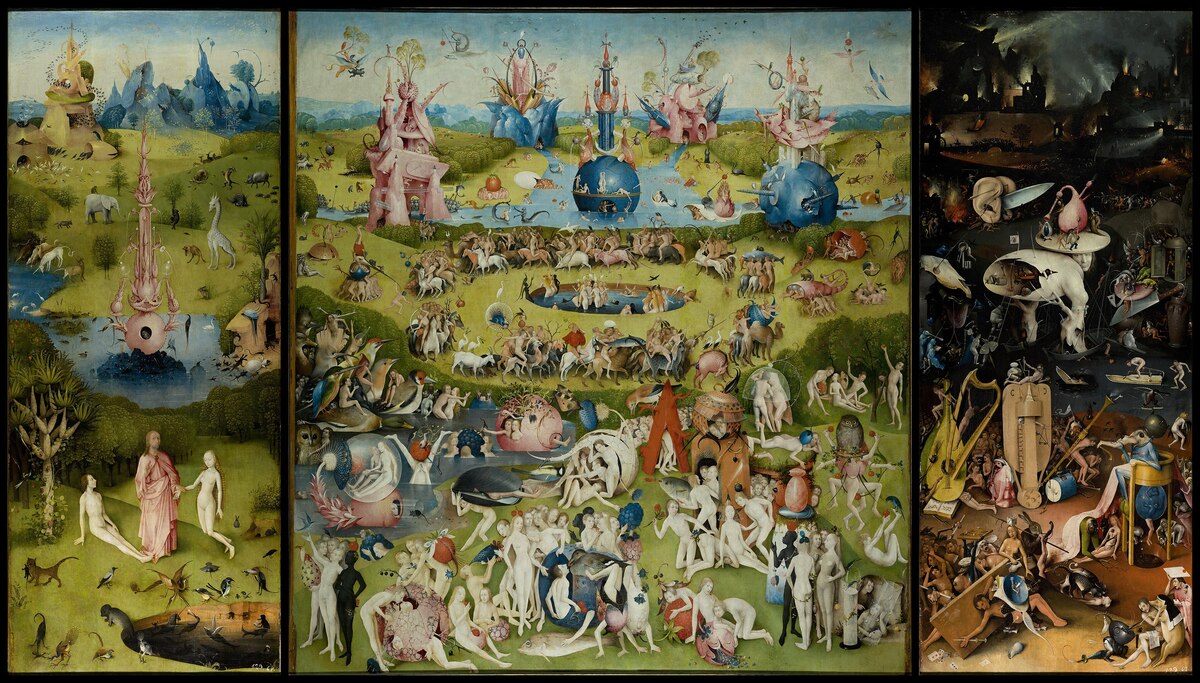
Download highest-resolution imageThe dark blue sphere containing small figures, crowned by a slender spire at the centre of the middle panel, with bathers in the pools around it; the vertical axis of the garden's circular design.
The giant lute, harp and hurdy-gurdy in the lower left of the hell shutter, played by demons and pinning naked sinners beneath them; music turned into punishment, the panel's signature inversion.
The tall pink fountain rising from a dark basin in the left shutter, with an owl perched in its niche; the ambivalent symbol at the centre of the paradise panel, part waterwork, part omen.
Your gallery guide
A docent-led reading of Bosch's three-part painting, moving from Paradise through a crowded garden to a dark hell, and asking what the supplied record can and cannot tell us about its meaning.
Editorial review by Artifact Archive automated publishing
Explore the researchThe story About 4 minutes to read
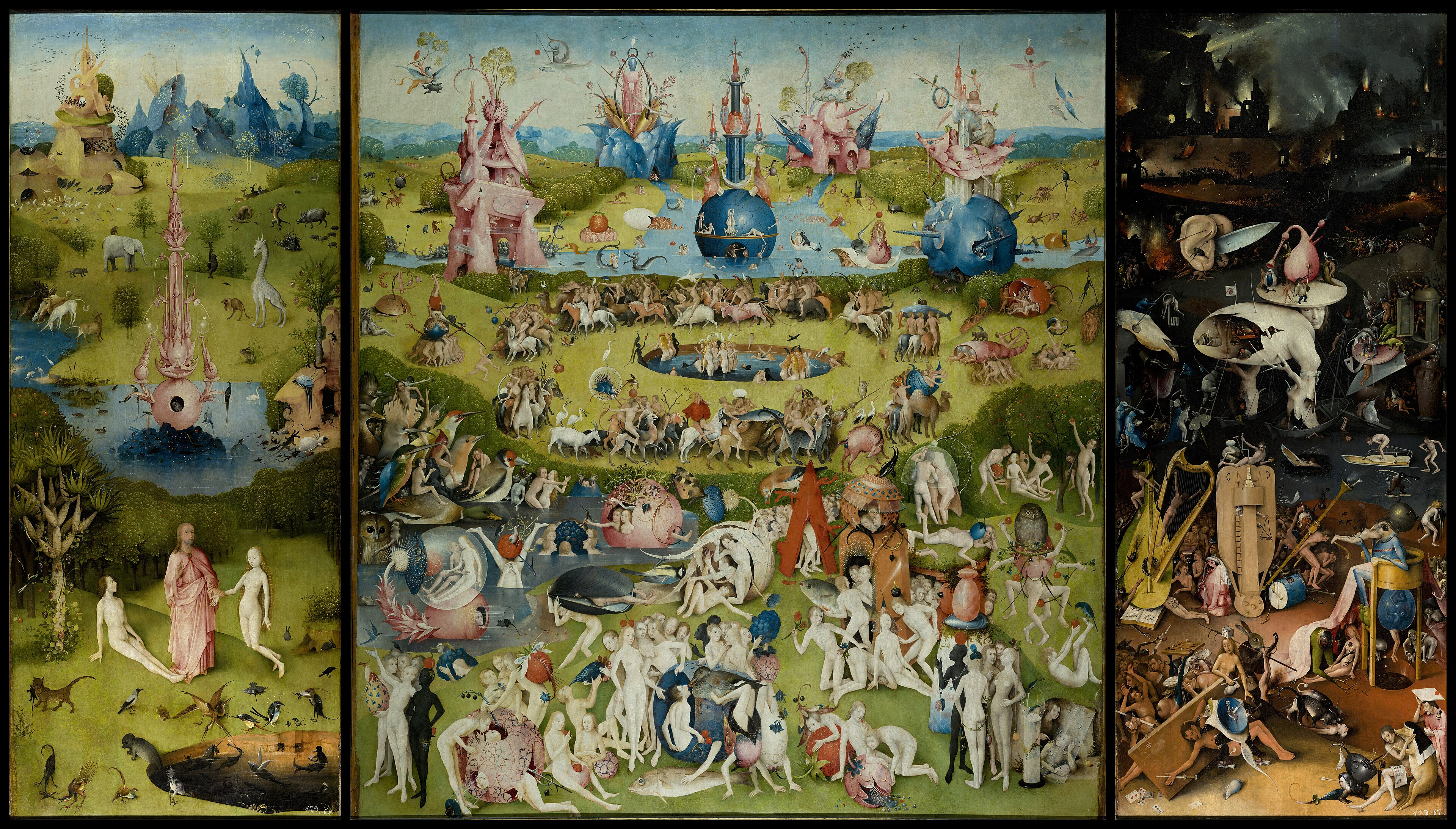
This is The Garden of Earthly Delights, a triptych attributed to Hieronymus Bosch, which means it is made of three panels hinged together. The left shutter shows Paradise, the central panel shows a wide garden crowded with nude figures and fantastical mounts, and the right shutter shows a dark hell. In the left panel, Adam and Eve are presented by Christ, so the story begins inside sacred history.
The painting is one continuous surface divided by its own construction. On the left, the first humans stand in a green Paradise. The middle opens into a broad garden with a round pool at its centre, filled with nude figures, animals and strange mounts. On the right, that openness closes into darkness. Sinners are crushed beneath giant musical instruments, and a hybrid tree-man rises among the torment.
The record identifies the subject of the left shutter as Paradise and the right shutter as Hell. The centre gives the work the name by which it is known: a garden of earthly delights. The structured data also lists the Garden of Eden, hell and a unicorn among the depicted subjects. So the three panels move from creation, through earthly pleasure, to punishment.
That movement is the argument the painting makes visually. The middle panel is not a neutral landscape. Its scale, its crowding and its pool of nude figures make pleasure look abundant, social and absorbing. Set between Paradise and Hell, that abundance acquires a warning. An informed reading is that the centre shows humanity caught in earthly delight, with the right panel showing the consequence.
The artist is given as Hieronymus Bosch, a Dutch painter whose dates are recorded as about 1450 to 1516. The place of creation is recorded as the Netherlands. Dating is not settled in the record. The file identifies the work as circa 1495 to 1505, while a closely related catalogue reference dates it from circa 1480 to circa 1490.
The object history begins before 1517, when the work is associated with Henry III, Count of Nassau, in Brussels. In 1538 it was inherited by William I, Prince of Orange. In 1568 it is recorded as confiscated by Fernando Alvarez de Toledo, third Duke of Alba. In 1591 it is recorded as purchased by Philip II of Spain and transferred to the Monasterio de El Escorial.
What the painting gives us is a sequence we can follow with our eyes: a beginning, an overflowing middle, and an ending. The details of the end are Bosch's invention, not a report of an event. Read together, the three panels ask the visitor to hold pleasure and consequence in one view. That is the understanding the work leaves us with.
Editorial review by Artifact Archive automated publishing.
Historical claims are linked to the records below. Close looking and interpretation are identified in the passage notes.
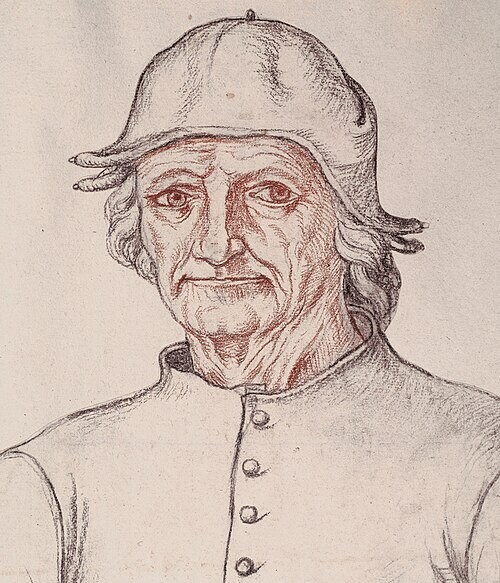
Attributed to Jacques Le Boucq. Image source · Public domain
About the artist
1450 to 1516
Hieronymus Bosch was a painters in art (1450–1516). Their work is associated with Early Netherlandish painting; Northern Renaissance.
The research & record
Find catalogue details, historical context, technical research and the literature behind this artwork.
Your browser could not copy automatically. Select the research text below, then copy it.
Open the complete research textThe artwork record
Catalogue information and detailed research, with references that link to the bibliography.
Updated .
The work is catalogued as The Garden of Earthly Delights by Hieronymus Bosch, a painting held in the Museo del Prado, Madrid. The record gives its date as circa 1495 to 1505 and its attribution to Hieronymus Bosch. The artist is further identified as a Dutch painter whose dates are recorded as circa 1450 to 1516, with alternative name forms including Jheronimus Bosch, Jheronimus van Aken and Jheronimus Anthonissoen van Aken. The place of creation is recorded as the Netherlands. This cluster of identifications, painter, title, repository and approximate date, is the frame within which every other claim about the object is made, and it is worth noting that the attribution and the date are both catalogue positions rather than facts inscribed on the work.(Wikimedia Commons: The Garden of Earthly Delights, n.d., Captions; Summary, Artist; Place of creation)
The Museo del Prado accession number for the work is P002823. The record is also associated with the Museu del Prado authority file Q160112 and Wikidata item Q321303. These identifiers matter because they fix the object across institutional and linked-data systems: the accession number ties it to the Prado's own holdings, while the authority file and Wikidata item connect it to the wider network of records through which the painting is cited, reproduced and searched. They also mark a distinction the catalogue itself maintains, between the physical object in Madrid and the numerous documentary and digital surrogates that stand in for it.(Wikimedia Commons: The Garden of Earthly Delights, n.d., Accession number; Authority file)
Dating is not settled in the record. The file identifies the work as circa 1495 to 1505, while a closely related catalogue reference by the Royal Institute for Cultural Heritage Photolibrary dates it from circa 1480 to circa 1490. The two ranges are close but not identical, and the difference should be preserved rather than smoothed away: the record's own dating and the related catalogue dating represent separate acts of judgement about the same object, and neither is presented as a fixed date of execution. This is an object date in the loose sense of a proposed period, not a documented moment of completion, and later catalogue dates should not be mistaken for the date of the painting itself.(Wikimedia Commons: The Garden of Earthly Delights, n.d., Captions)
The file is identified as The Garden of Earthly Delights by Hieronymus Bosch, a painting in the Museo del Prado, Madrid, dated circa 1495 to 1505 and attributed to Hieronymus Bosch.(Wikimedia Commons: The Garden of Earthly Delights, n.d.)
The Museo del Prado accession number for the work is P002823.(Wikimedia Commons: The Garden of Earthly Delights, n.d.)
The artist is given as Hieronymus Bosch, a Dutch painter whose dates are recorded as circa 1450 to 1516, with alternative names including Jheronimus Bosch, Jheronimus van Aken and Jheronimus Anthonissoen van Aken.(Wikimedia Commons: The Garden of Earthly Delights, n.d.)
The record is associated with the Museu del Prado authority file Q160112 and Wikidata item Q321303.(Wikimedia Commons: The Garden of Earthly Delights, n.d.)
Visual observation
The record identifies the work as a triptych, that is, a painting made of three panels hinged together, with the left shutter described as Paradise and the right shutter as Hell. The structured data for the same record lists Garden of Eden, hell, and a unicorn among the subjects depicted. Those entries do not coincide exactly with the captions: the captions name the outer panels Paradise and Hell, while the structured data reaches for Eden and, less obviously, a unicorn. Taken together, the three-part structure and these subject terms establish the basic visual programme of the object as a movement from a first, sacred place, through an earthly middle, to a dark ending, and they also show that the record's own description of what is depicted is layered rather than singular. Nothing in the supplied evidence describes the central panel in the structured data, so the name by which the work is known, a garden of earthly delights, rests on the captions and on the title of the file rather than on a listed subject term.(Wikimedia Commons: The Garden of Earthly Delights, n.d., Captions; Structured data, depicts)
Interpretation
The visible programme belongs to a specific historical setting as well as to a workshop. The object history in the record begins before 1517, when the work is associated with Henry III, Count of Nassau, in Brussels, and in 1538 it was inherited by William I, Prince of Orange. In 1568 it is recorded as confiscated by Fernando Alvarez de Toledo, third Duke of Alba, and at an unknown date it was acquired by Don Ferdinando de Toledo. In 1591 it is recorded as purchased by Philip II of Spain and transferred to the Monasterio de El Escorial. A work that moved from a Nassau collection in Brussels through confiscation in the Netherlands and into the Spanish royal collection and then El Escorial carried its Paradise, garden and Hell imagery across confessions and courts. The record's list of depicted subjects therefore describes not only what a viewer sees but what several successive owners chose to keep, transfer and display.(Wikimedia Commons: The Garden of Earthly Delights, n.d., Captions; Structured data, depicts)
Visual observation
The structured data in the record lists Garden of Eden, hell, and a unicorn among the subjects depicted in the image.(Wikimedia Commons: The Garden of Earthly Delights, n.d.)
The work is described as a triptych with a left shutter of Paradise and a right shutter of Hell.(Wikimedia Commons: The Garden of Earthly Delights, n.d.)
The record for this triptych places its making in the Netherlands and credits it to Hieronymus Bosch, a Dutch painter whose dates are given as about 1450 to 1516, with alternative name forms including Jheronimus Bosch, Jheronimus van Aken and Jheronimus Anthonissoen van Aken. The work is held in the Museo del Prado, Madrid, under accession number P002823, and is dated circa 1495 to 1505. A closely related catalogue reference from the Royal Institute for Cultural Heritage Photolibrary instead dates it circa 1480 to circa 1490, and the Royal Institute for Cultural Heritage Photolibrary together with the Koldeweij, Vandenbroeck and Vermet catalogue give its dimensions as 220 cm high by 390 cm wide. These dates and measurements matter for how the object is studied because they frame it as a large-scale Netherlandish panel painting of the late fifteenth or early sixteenth century rather than a small devotional picture, and they show that the documentary record does not deliver a single agreed date of execution.(Wikimedia Commons: The Garden of Earthly Delights, n.d., Place of creation)
Interpretation
Taken as a whole, the evidence supports a qualified account of the object's context. The Prado record secures identification through accession number, dimensions and attribution, and the provenance entries document a sequence of noble and royal ownership from before 1517 through the Duke of Alba's confiscation, the purchase by Philip II in 1591, and the Escorial residence until 1939. But secure identification does not settle the commissioning circumstances: the record does not name who ordered the painting, does not give a date or place for its first commission, does not explain the undated acquisition by Don Ferdinando de Toledo, and does not resolve the disagreement between the circa 1495 to 1505 dating and the circa 1480 to 1490 catalogue reference. Interpretive claims about how the triptych form serves a moral program, or about the household status of an early owner, remain inferences built on the documented sequence of ownership and format rather than statements the evidence itself makes.(Wikimedia Commons: The Garden of Earthly Delights, n.d., Place of creation)
The place of creation is recorded as the Netherlands.(Wikimedia Commons: The Garden of Earthly Delights, n.d.)
Visual observation
The work under discussion is a triptych, that is, a three-part painted construction whose panels are joined by hinges, and the record describes it as having a left shutter showing Paradise and a right shutter showing Hell, with the central panel giving the work the name by which it is known. Any account of its materials and technique has to begin from the physical format this establishes: the painting is not a single flat picture but a folding object whose shutters are both images and moving parts. The dimensions recorded by the Royal Institute for Cultural Heritage Photolibrary and by the Koldeweij, Vandenbroeck and Vermet catalogue are 220 cm high by 390 cm wide, figures that describe the work as a large-scale ensemble rather than a cabinet piece. Those measurements are the only metrical data supplied here, and they should be understood as the documented size of the object as catalogued, not as a reconstruction of individual panel widths or of the thickness and profile of the supports.(Wikimedia Commons: The Garden of Earthly Delights, n.d., References; Captions)
Attribution, dating and place of making frame every technical question about how the object was produced. The artist is given as Hieronymus Bosch, a Dutch painter whose dates are recorded as circa 1450 to 1516, with alternative names including Jheronimus Bosch, Jheronimus van Aken and Jheronimus Anthonissoen van Aken, and the place of creation is recorded as the Netherlands. Dating is not settled within the record: the file identifies the work as circa 1495 to 1505, while a closely related catalogue reference by the Royal Institute for Cultural Heritage Photolibrary dates it from circa 1480 to circa 1490. That divergence matters for materials history because it bears on the working period, workshop practice and the sequence of related productions in which the triptych is placed, and it should be carried forward as an open discrepancy rather than resolved by preference. The accession number P002823 and the associated Museu del Prado authority file Q160112 and Wikidata item Q321303 identify the institution and catalogue identity under which the object is now documented.(Wikimedia Commons: The Garden of Earthly Delights, n.d., References)
The documented history of ownership and movement begins before 1517, when the work is associated with Henry III, Count of Nassau, in Brussels, and continues in 1538 when it was inherited by William I, Prince of Orange. In 1568 it is recorded as confiscated by Fernando Alvarez de Toledo, third Duke of Alba, and at an unknown date it was acquired by Don Ferdinando de Toledo; in 1591 it is recorded as purchased by Philip II of Spain and transferred to the Monasterio de El Escorial. In 1939 the work was transferred from the Monasterio de El Escorial to the Museo del Prado in Madrid, where it is held. These movements matter to material history because a painting of this size and construction, repeatedly relocated between court, monastic and museum settings over more than four centuries, has a physical biography as well as an iconographic one: the record establishes the sequence of transfers but supplies no conservation history, intervention, reframing or condition report, so nothing here documents treatments, losses or restorations. The intervals that remain unknown, including the acquisition by Don Ferdinando de Toledo, should be stated as unknown rather than inferred.(Wikimedia Commons: The Garden of Earthly Delights, n.d., References)
Technical examination
Technical study of this object has to begin with the recognition that the most widely circulated digital files are not the painting but descendants of it. The source photograph used in the record was distributed through the Prado in Google Earth project and then scaled down from that project's eighth zoom level, with JPEG compression quality set at Photoshop 10. Every edge, glaze and craquelure pattern consulted in a compressed derivative therefore passes through at least two stages of loss, first by scaling and then by lossy encoding, before a viewer ever reaches the screen. The record is candid about this limitation and points to a remedy: a higher resolution version of the image exists as a set of tiles, which preserves detail that the single scaled file cannot carry.(Wikimedia Commons: The Garden of Earthly Delights, n.d., Credit and Source/Photographer; Captions)
The distinction between the delivered file and the underlying scan is itself a technical finding. The file appears in 30,000 by 17,078 pixels, while its metadata records a width of 39,136 pixels and a height of 22,279 pixels for the underlying scan. The two sets of numbers do not match, so the archival record documents a downsampled derivative rather than the full capture. For research purposes this matters because measurements taken from the delivered file, whether of panel joins, brushwork scale or condition losses, describe the derivative and not the painting's documented imaging data. The ratio between the two resolutions also supplies a rough sense of how much visual information the delivered file omits.(Wikimedia Commons: The Garden of Earthly Delights, n.d., Original file)
The Royal Institute for Cultural Heritage Photolibrary and the Koldeweij, Vandenbroeck and Vermet catalogue give the work's dimensions as 220 cm high by 390 cm wide.(Wikimedia Commons: The Garden of Earthly Delights, n.d.)
Technical examination
The source photograph was distributed through the Prado in Google Earth project and scaled down from the eighth zoom level, with JPEG compression quality set to Photoshop 10.(Wikimedia Commons: The Garden of Earthly Delights, n.d.)
A higher resolution version of this image is available as a set of tiles.(Wikimedia Commons: The Garden of Earthly Delights, n.d.)
The file appears in 30,000 by 17,078 pixels, with metadata recording a width of 39,136 pixels and a height of 22,279 pixels in the underlying scan.(Wikimedia Commons: The Garden of Earthly Delights, n.d.)
The object history supplied by the Wikimedia Commons record opens before 1517, when The Garden of Earthly Delights is associated with Henry III, Count of Nassau, in Brussels. The record does not explain how the work came into that association, and it is presented as an object history rather than as a documented act of commission or purchase, so the earliest moment in the chain is stated as an association rather than a recorded transaction. The next recorded step follows in 1538, when the work was inherited by William I, Prince of Orange. Between those two points, the record establishes continuity through inheritance, which places the painting within a known noble holding before its later movements.(Wikimedia Commons: The Garden of Earthly Delights, n.d., Object history)
That holding was broken in 1568, when the work is recorded as confiscated by Fernando Alvarez de Toledo, third Duke of Alba. The record treats this as a documented confiscation, not merely a change of location. A second transfer in the same account is less precisely dated: at an unknown date the painting was acquired by Don Ferdinando de Toledo. Because the record gives no year for that acquisition, it cannot be placed chronologically between 1568 and the next fixed point in 1591, and the account itself leaves the interval open rather than implying a continuous documented possession. The distinction matters for provenance: a confiscation in 1568 is a documented intervention, while the later acquisition by Don Ferdinando de Toledo is recorded without a date, and the gap between them is an unrecorded interval rather than a proven sequence of ownership.(Wikimedia Commons: The Garden of Earthly Delights, n.d., Object history)
In 1591 the record states that the work was purchased by Philip II of Spain and transferred to the Monasterio de El Escorial. This is the first point in the supplied history where the account gives an explicit purchase and a named institutional destination, and it moves the painting from noble and military possession into a royal monastic collection. The object remains connected with El Escorial in the record until 1939, when it was transferred from the Monasterio de El Escorial to the Museo del Prado, Madrid. That transfer belongs to the twentieth-century history of the painting and is the final documented movement in the supplied chain. The Commons file likewise identifies the work as a painting in the Museo del Prado, Madrid, and gives the Museo del Prado accession number P002823, which anchors the object in the Prado's holdings and supplies the identifier by which the institution records it.(Wikimedia Commons: The Garden of Earthly Delights, n.d., Object history)
Interpretation
The supplied evidence supports a consolidated provenance sequence: association with Henry III, Count of Nassau, in Brussels before 1517; inheritance by William I, Prince of Orange, in 1538; confiscation in 1568 by Fernando Alvarez de Toledo, third Duke of Alba; acquisition at an unknown date by Don Ferdinando de Toledo; purchase in 1591 by Philip II of Spain and transfer to the Monasterio de El Escorial; and transfer in 1939 from El Escorial to the Museo del Prado, Madrid, where the work is identified by accession number P002823. The account's weak points are stated in the record itself: the undated acquisition by Don Ferdinando de Toledo and the two competing date ranges of circa 1495 to 1505 and circa 1480 to circa 1490, the latter from a closely related catalogue reference by the Royal Institute for Cultural Heritage Photolibrary. As an interpretive synthesis, the chain shows a painting that moved from Netherlandish noble possession, through confiscation and a second acquisition, into the Spanish royal collection, and finally into a modern public museum, while its digital reproduction became a widely circulated Commons image and a 2010 Pictures of the Year candidate. Each of those transitions is documented at different levels of precision, and the intervals that the record leaves open should remain open rather than being filled by inference.(Wikimedia Commons: The Garden of Earthly Delights, n.d., Object history)
The object history in the record begins before 1517, when the work is associated with Henry III, Count of Nassau, in Brussels, and was inherited in 1538 by William I, Prince of Orange.(Wikimedia Commons: The Garden of Earthly Delights, n.d.)
In 1568 the work is recorded as confiscated by Fernando Alvarez de Toledo, third Duke of Alba, and at an unknown date was acquired by Don Ferdinando de Toledo.(Wikimedia Commons: The Garden of Earthly Delights, n.d.)
In 1591 the work is recorded as purchased by Philip II of Spain and transferred to the Monasterio de El Escorial.(Wikimedia Commons: The Garden of Earthly Delights, n.d.)
In 1939 the work was transferred from the Monasterio de El Escorial to the Museo del Prado, Madrid.(Wikimedia Commons: The Garden of Earthly Delights, n.d.)
The object history in the record begins with the work associated with Henry III, Count of Nassau, in Brussels.(Wikimedia Commons: The Garden of Earthly Delights, n.d., Object history)
The work was inherited by William I, Prince of Orange.(Wikimedia Commons: The Garden of Earthly Delights, n.d., Object history)
The work is recorded as confiscated by Fernando Alvarez de Toledo, third Duke of Alba; at an unknown date it was acquired by Don Ferdinando de Toledo.(Wikimedia Commons: The Garden of Earthly Delights, n.d., Object history)
The work is recorded as purchased by Philip II of Spain and transferred to the Monasterio de El Escorial.(Wikimedia Commons: The Garden of Earthly Delights, n.d., Object history)
The work was transferred from the Monasterio de El Escorial to the Museo del Prado, Madrid.(Wikimedia Commons: The Garden of Earthly Delights, n.d., Object history)
The reception history recorded for this object has a documentary anchor in the digital file that carries it into wide circulation. The file is described as a faithful photographic reproduction of a two-dimensional public domain work of art, the condition of public domain being tied in the record to the author's death in 1516. That legal and technical characterization matters for reception because it explains how a large Netherlandish triptych held in Madrid could become an image available for unrestricted reuse, study and re-publication. Reproduction is not incidental to the work's modern life; it is the mechanism through which the object has been distributed far beyond the rooms of the Museo del Prado, where the file identifies the painting as held and gives the accession number P002823.(Wikimedia Commons: The Garden of Earthly Delights, n.d., Licensing)
The scale of that reproduction is documented rather than merely asserted. The source photograph was distributed through the Prado in Google Earth project, scaled down from the eighth zoom level, and saved with JPEG compression quality set to Photoshop 10. The record states that a higher resolution version is available as a set of tiles, and the file appears in 30,000 by 17,078 pixels, while metadata records a width of 39,136 pixels and a height of 22,279 pixels in the underlying scan. These are not neutral technical details. They describe an imaging programme undertaken with a major museum and a global mapping platform, and they show that the abundant, crowded middle panel of the triptych can be examined in a photograph at a level of detail no gallery visitor could sustain. The same record notes that the painting is dated circa 1495 to 1505 and attributed to Hieronymus Bosch, held in the Museo del Prado in Madrid, with the artist recorded as a Dutch painter whose dates are about 1450 to 1516 and alternative names including Jheronimus Bosch, Jheronimus van Aken and Jheronimus Anthonissoen van Aken. The cataloguing of aliases is itself a reception fact: it registers scholarly and archival debate over the painter's name and identity that runs alongside admiration of the image.(Wikimedia Commons: The Garden of Earthly Delights, n.d., Licensing)
Public recognition of the file is separately documented. It is a featured picture on Wikimedia Commons and was a Pictures of the Year candidate in 2010. A featured designation and a year-end candidacy are community acts of selection and evaluation, not museum acts. They show the reproduction being judged on its own merits as an image, and they place the painting within an online culture of comparative appraisal in which a sixteenth-century Netherlandish triptych competes with contemporary photography. The same Commons record associates the file with the Museu del Prado authority file Q160112 and the Wikidata item Q321303, linking the reproduction to structured authority control. Reception here is administrative and networked as well as aesthetic: the image is classified, cross-referenced and made retrievable by the same machinery that catalogues modern media.(Wikimedia Commons: The Garden of Earthly Delights, n.d., Categories)
Interpretation
Later literary and intellectual reception is registered in the record through the category The Vertigo of Lists, identified as a book referenced in the Commons record, in which the work is included. This is a distinct stage of reception from the museum catalogue or the photographic file. It shows the painting drawn into a written argument about accumulation, enumeration and excess, the same qualities a viewer confronts in the central panel. The inclusion does not establish that the book discusses the object in any particular way, only that the painting has been placed within a category of list-making and vertigo. That placement nevertheless demonstrates how the work's apparent abundance, which the visual record describes, has made it available for an interpretive tradition quite separate from its original devotional or courtly setting.(Wikimedia Commons: The Garden of Earthly Delights, n.d., Categories)
The digital file is a faithful photographic reproduction of a two-dimensional public domain work of art, with the author having died in 1516.(Wikimedia Commons: The Garden of Earthly Delights, n.d.)
The file is a featured picture on Wikimedia Commons and was a Pictures of the Year candidate in 2010.(Wikimedia Commons: The Garden of Earthly Delights, n.d.)
The work is included in the category The Vertigo of Lists, a book referenced in the Commons record.(Wikimedia Commons: The Garden of Earthly Delights, n.d.)
Disputed account
This research account concerns The Garden of Earthly Delights, a triptych attributed to Hieronymus Bosch and held in the Museo del Prado, Madrid, where it carries the accession number P002823. The artist is given as a Dutch painter whose dates are recorded as approximately 1450 to 1516, with alternative name forms including Jheronimus Bosch, Jheronimus van Aken and Jheronimus Anthonissoen van Aken, and the place of creation is recorded as the Netherlands. The work is described as a triptych with a left shutter of Paradise and a right shutter of Hell; the record identifies the subjects of those shutters in exactly those terms, while the structured data in the same record lists the Garden of Eden, hell and a unicorn among the depicted subjects. The central panel supplies the name by which the work is known. Its scale is substantial: the Royal Institute for Cultural Heritage Photolibrary and the Koldeweij, Vandenbroeck and Vermet catalogue give the dimensions as 220 cm high by 390 cm wide. The digital file from which this record derives is a faithful photographic reproduction of a two-dimensional public domain work of art, the author having died in 1516; the source photograph was distributed through the Prado in Google Earth project, scaled down from the eighth zoom level, with JPEG compression quality set to Photoshop 10. That work exists at very high resolution: the file appears in 30,000 by 17,078 pixels, while metadata records a width of 39,136 pixels and a height of 22,279 pixels in the underlying scan, and a higher resolution version is available as a set of tiles. The file is a featured picture on Wikimedia Commons and was a Pictures of the Year candidate in 2010. The record is associated with the Museu del Prado authority file Q160112 and Wikidata item Q321303, and the work is included in the category The Vertigo of Lists, a book referenced in the Commons record.(Wikimedia Commons: The Garden of Earthly Delights, n.d., References)
A closely related catalogue reference by the Royal Institute for Cultural Heritage Photolibrary dates the work from circa 1480 to circa 1490.(Wikimedia Commons: The Garden of Earthly Delights, n.d.)
The Garden of Earthly Delights is held in the Museo del Prado in Madrid, where it carries accession number P002823. That single location is the end point of a long movement of the object, and the record preserves the institutional identifiers attached to it: the Prado authority file Q160112 and the Wikidata item Q321303. The work is a triptych, and the record describes its shutters as a left shutter of Paradise and a right shutter of Hell. The artist is given as Hieronymus Bosch, a Dutch painter whose dates are recorded as circa 1450 to 1516, with alternative names including Jheronimus Bosch, Jheronimus van Aken and Jheronimus Anthonissoen van Aken, and the place of creation is recorded as the Netherlands. The dimensions given by the Royal Institute for Cultural Heritage Photolibrary and the Koldeweij, Vandenbroeck and Vermet catalogue are 220 cm high by 390 cm wide.(Wikimedia Commons: The Garden of Earthly Delights, n.d., Captions)
Dating is not settled among the records. The file identifies the work as circa 1495 to 1505, while a closely related catalogue reference by the Royal Institute for Cultural Heritage Photolibrary dates it from circa 1480 to circa 1490. Both attributions sit within the same attribution to Bosch and the same recorded place of creation in the Netherlands, so the disagreement is one of chronology rather than authorship or origin. The object history in the record begins before 1517, when the work is associated with Henry III, Count of Nassau, in Brussels, and was inherited in 1538 by William I, Prince of Orange. In 1568 the work is recorded as confiscated by Fernando Alvarez de Toledo, third Duke of Alba, and at an unknown date was acquired by Don Ferdinando de Toledo. In 1591 the work is recorded as purchased by Philip II of Spain and transferred to the Monasterio de El Escorial. In 1939 the work was transferred from the Monasterio de El Escorial to the Museo del Prado, Madrid. These intervals of ownership and transfer explain why an object painted in the Netherlands now hangs in Madrid, and they also show that the record preserves an acquisition in 1591 and a twentieth-century transfer as separate documented events.(Wikimedia Commons: The Garden of Earthly Delights, n.d., Captions)
The record's structured data lists Garden of Eden, hell, and a unicorn among the subjects depicted in the image, alongside the description of the work as a triptych with a left shutter of Paradise and a right shutter of Hell. The named subjects and the shutter descriptions are two different levels of description held in the same record: one enumerates motifs, the other describes the construction of the panels and the broad subjects of the outer shutters. The centre panel is the one that gives the work the name by which it is known, a garden of earthly delights, so the title is tied to the middle rather than to either shutter. Read together with the accession, dimensions and object history, these subject terms are part of the same documentary apparatus that fixes the object's identity for catalogue and collection purposes.(Wikimedia Commons: The Garden of Earthly Delights, n.d., Captions)
The digital file is a faithful photographic reproduction of a two-dimensional public domain work of art, with the author having died in 1516. The source photograph was distributed through the Prado in Google Earth project and scaled down from the eighth zoom level, with JPEG compression quality set to Photoshop 10. The file appears in 30,000 by 17,078 pixels, with metadata recording a width of 39,136 pixels and a height of 22,279 pixels in the underlying scan, and a higher resolution version of this image is available as a set of tiles. The file is a featured picture on Wikimedia Commons and was a Pictures of the Year candidate in 2010. These photographic and file-level facts are distinct from the facts of the painting: the pixel dimensions describe a scan and its derivatives, not the 220 by 390 cm panel, and the public domain status rests on the author's death in 1516 rather than on the current location of the work.(Wikimedia Commons: The Garden of Earthly Delights, n.d., Captions)
Interpretation
The record is associated with the Museu del Prado authority file Q160112 and Wikidata item Q321303, and the work is included in the category The Vertigo of Lists, a book referenced in the Commons record. Those links place the painting inside two overlapping systems of description: an institutional authority file and a general reference database, plus a thematic grouping drawn from a book. The category is a reception fact about how the work is grouped in later writing, not a fact about the painting's making. Taken with the accession number, the dimensions, the two competing date ranges and the documented sequence of owners and transfers, the record shows that a single object can be stabilized by many different kinds of statement at once, and that each statement answers a different question about it.(Wikimedia Commons: The Garden of Earthly Delights, n.d., Captions)
The work is held in the Museo del Prado in Madrid.(Wikimedia Commons: The Garden of Earthly Delights, n.d.)
Interpretation
The Garden of Earthly Delights is recorded as a triptych containing a left shutter described as Paradise and a right shutter described as Hell, with the central panel giving the work the name by which it is known and a broad garden of earthly delight organized around a round pool. The structured data attached to the same record lists the Garden of Eden, hell and a unicorn among the subjects depicted, which means the described subjects are more granular than the three-part shutter scheme alone: Eden is named alongside the left panel's Paradise, while the unicorn is a single identifiable creature within a crowded iconography that includes nude figures, animals and fantastical mounts in the centre panel. The Wikimedia Commons file is the immediate carrier of this record and is presented as a faithful photographic reproduction of a two-dimensional public domain work of art, the author having died in 1516, so the digital object is a substitute image for a physical painting rather than the painting itself. That distinction matters for how the record's descriptive claims should be read, because the subjects and the shutter scheme are properties asserted of the artwork while the pixel dimensions, file history and compression settings are properties of the reproduction.(Wikimedia Commons: The Garden of Earthly Delights, n.d.)
The work is attributed to Hieronymus Bosch, identified in the record as a Dutch painter whose dates are given as approximately 1450 to 1516, with alternative name forms including Jheronimus Bosch, Jheronimus van Aken and Jheronimus Anthonissoen van Aken. The place of creation is recorded as the Netherlands. The same record dates the painting circa 1495 to 1505, while a closely related catalogue reference, that of the Royal Institute for Cultural Heritage Photolibrary, dates it from circa 1480 to circa 1490. The attribution and the broad early sixteenth century horizon are therefore stable in the record, but the two decades of disagreement in the dating are not resolved by it. The dimensions are given as 220 cm high by 390 cm wide in both the Royal Institute for Cultural Heritage Photolibrary and the Koldeweij, Vandenbroeck and Vermet catalogue, so the scale of the panel is one of the better established physical facts, and its very large format is part of what makes the crowded composition possible.(Wikimedia Commons: The Garden of Earthly Delights, n.d.)
The Museo del Prado, Madrid, holds the work under accession number P002823, and the object history in the record begins before 1517, when the work is associated with Henry III, Count of Nassau, in Brussels. In 1538 it was inherited by William I, Prince of Orange. In 1568 it is recorded as confiscated by Fernando Alvarez de Toledo, third Duke of Alba, and at an unknown date it was acquired by Don Ferdinando de Toledo. In 1591 it is recorded as purchased by Philip II of Spain and transferred to the Monasterio de El Escorial. In 1939 it was transferred from the Monasterio de El Escorial to the Museo del Prado, Madrid. That sequence traces a movement from a noble collection in Brussels through inheritance and confiscation into Spanish royal and monastic possession, and only in the twentieth century into a public museum. The record also associates the work with the Museu del Prado authority file Q160112 and the Wikidata item Q321303 and places it in the category of The Vertigo of Lists, a book referenced in the Commons record.(Wikimedia Commons: The Garden of Earthly Delights, n.d.)
The digital reproduction has its own documented history. It was distributed through the Prado in Google Earth project and scaled down from the eighth zoom level, with JPEG compression quality set to Photoshop 10. It appears in 30,000 by 17,078 pixels, while metadata records a width of 39,136 pixels and a height of 22,279 pixels in the underlying scan, and a higher resolution version is available as a set of tiles. The file is a featured picture on Wikimedia Commons and was a Pictures of the Year candidate in 2010. These details explain why the record can support close visual description of crowds of small figures and strange mounts while remaining a derived, processed image rather than the archive negative or the panel itself.(Wikimedia Commons: The Garden of Earthly Delights, n.d.)
The insurance evidence in this section is a calculated working estimate of US$250M to US$1.2B, recorded as a working calculation generated on 2026-10-16. Its methodology is explicit about what it used: the Bosch attribution, the canonical standing of a Northern Renaissance master, the circa 1495 to 1505 dating, oil on panel, dimensions of approximately 220 cm by 390 cm, the large triptych format, the Museo del Prado setting with accession number P002823, and a documented transfer history through elite European collections before the Spanish royal collection and the Prado. Because the work is in a major public collection and not on the open market, the range is not based on comparable auction sales or private insurance files; it is described as a conservative, wide calculation for manual review only, reflecting the work's status as a singular old master icon. The qualification states that it is not an official insurance value, appraisal, auction result or sale price, that no public appraisal, insurance schedule or verified comparable sale was accessed, and that actual coverage limits should be set by qualified appraisers and insurers. The range should therefore be read as a measure of cultural standing inferred from confirmed context, not as market evidence about the painting.(Wikimedia Commons: The Garden of Earthly Delights, n.d.)
Read together, these records establish an object of exceptional scale and canonical attribution whose documented life runs from a Brussels collection before 1517 through confiscation, royal purchase, El Escorial and the Prado, and whose visual structure of Paradise, garden and Hell has been reproduced at very high resolution for public access. The valuation evidence shows how such an object is converted into a financial figure by inference from status and collection context rather than from transactions, and the qualification attached to that figure shows the boundary between a working calculation and an appraisal. The evidentiary weight lies differently across the record: physical scale and collection history are documented, attribution is stable but dated to two competing spans of about two decades, and the value range is explicitly a model-generated estimate pending professional review.(Wikimedia Commons: The Garden of Earthly Delights, n.d.)
Working estimate
Calculated working insurance estimate, not a sale price: Estimated value: US$250M to US$1.2B Recorded date: Working calculation, generated 2026-10-16. Methodology: This broad working range is derived from confirmed context only. The work is attributed to Hieronymus Bosch, a canonical Northern Renaissance master, dated circa 1495 to 1505, oil on panel, and approximately 220 cm by 390 cm. It is a large triptych and the source record presents it in the Museo del Prado, Madrid, with accession number P002823 and a documented transfer history through elite European collections before entering the Spanish royal collection and later the Prado. Those factors point to a museum-hold masterpiece of exceptional cultural importance. Because the work is in a major public collection and not on the open market, the range is not based on comparable auction sales or private insurance files. It is a conservative, wide calculation for manual review only, reflecting the work's status as a singular old master icon while acknowledging that precise insurance figures would require professional appraisal and specialist fine art underwriting. Qualification: This is a model-generated working range for manual review. It is not an official insurance value, appraisal, auction result, or sale price. The source material supports the artwork's identity and collection context, but no public appraisal, insurance schedule, or verified comparable sale was accessed. Actual coverage limits should be set by qualified appraisers and insurers.(Wikimedia Commons: The Garden of Earthly Delights, n.d.)
Further reading
Paid links. As an Amazon Associate I earn from qualifying purchases.

NDE Pub.
Catalogue record titled for Bosch's Garden of Earthly Delights with subjects criticism and interpretation and Dutch painting, indicating a focused treatment of the work.
ISBN 1553210271
Bibliography
References are arranged by author or organisation, with links to the original publications. Where no publication date is recorded, n.d. means no date.
Source notes updated .
No recorded sources match these filters. Reset the filters to see the full bibliography.
Book
Bosch, the garden of earthly delights. NDE Pub.
Catalogue record titled for Bosch's Garden of Earthly Delights with subjects criticism and interpretation and Dutch painting, indicating a focused treatment of the work.
Scholarly study by Reindert Falkenburg indexed under Bosch, criticism and interpretation, and specifically the Garden of delights, so it addresses this painting directly rather than the artist only in general.
Secondary · About this artwork
Wikimedia Commons: The Garden of Earthly Delights (n.d.). Wikimedia Commons File: The Garden of Earthly Delights by Bosch High Resolution.jpg. Wikimedia Commons.
Discovery and reference record for the reproduced painting, with captions, object history, accession number, catalogue references and licensing information.
Art to live with
A piece of the archive, made yours. Explore The Garden of Earthly Delights in a size and finish that fits your space.
Choose your edition Combine this painting with your favourites
10 × 8 in / 25.4 × 20.3 cm · Standard

10 × 8 in / 25.4 × 20.3 cm · Standard

10 × 8 in / 25.4 × 20.3 cm · Standard

10 × 8 in / 25.4 × 20.3 cm · Standard
A gallery paper print with a smooth art-paper surface. Choose a size that suits the painting.
Choose size and finish
10 × 8 in / 25.4 × 20.3 cm · Black frame

10 × 8 in / 25.4 × 20.3 cm · Black frame

10 × 8 in / 25.4 × 20.3 cm · Black frame

10 × 8 in / 25.4 × 20.3 cm · Black frame

10 × 8 in / 25.4 × 20.3 cm · Black frame
A ready-to-hang wooden frame with a clear Perspex cover and a semi-gloss printed insert, made in the UK.
Choose size and finish


11oz · 2 image repeats
11oz · Standard


11oz · 2 image repeats


11oz · 2 image repeats


11oz · 2 image repeats


11oz · 2 image repeats


11oz · 2 image repeats
An 11oz white ceramic mug with AAA+ ORCA coating and a C-shaped handle. Dishwasher and microwave safe, printed and dispatched in the UK.
Choose size and finish
15 × 16.5 in / 38 × 42 cm · Black

15 × 16.5 in / 38 × 42 cm · Black

15 × 16.5 in / 38 × 42 cm · Black

15 × 16.5 in / 38 × 42 cm · Black

15 × 16.5 in / 38 × 42 cm · Black

15 × 16.5 in / 38 × 42 cm · Black
A cotton tote with reinforced handles and artwork on the front, printed and dispatched in the UK.
Choose size and finish
8.7 × 8.7 in / 22 × 22 cm · Standard

8.7 × 8.7 in / 22 × 22 cm · Standard

8.7 × 8.7 in / 22 × 22 cm · Standard
A rectangular PU leather mouse mat with a non-slip base, printed locally for your delivery country.
Choose size and finish
A5 · Glossy cover · Lined pages

A5 · Glossy cover · Lined pages

A5 · Glossy cover · Lined pages

A5 · Glossy cover · Lined pages

A5 · Glossy cover · Lined pages

A5 · Glossy cover · Lined pages
An A5 notebook with 150 lined pages, a glossy laminated front cover carrying your artwork, black wire-o binding and a white back cover.
Choose size and finish