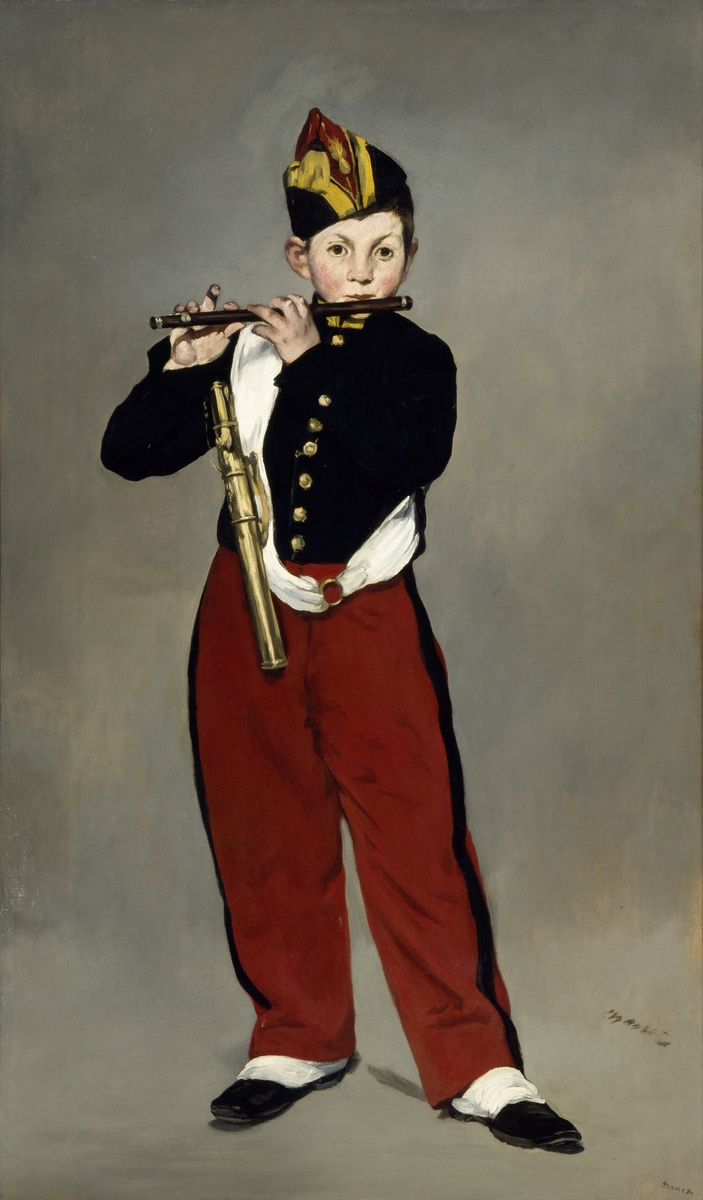
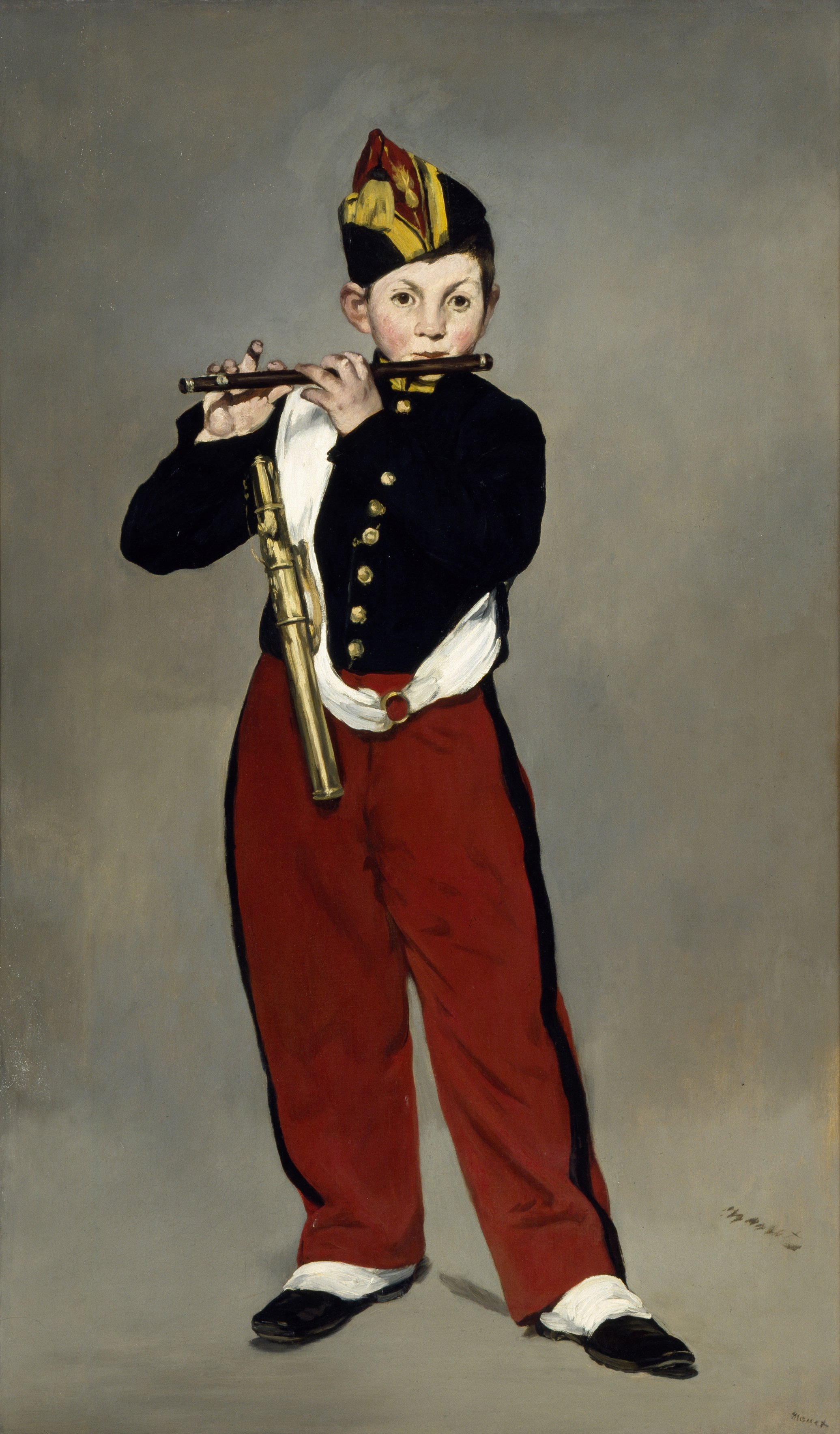
A young military musician stands alone before us, holding his fife to his lips. Manet painted this boy fifer in 1866, and the picture is now in the Musée d'Orsay in Paris.
The wide-legged red trousers with dark side stripes, ending in white gaiters and flat black shoes planted in a firm stance, an emphatic flat block of colour that anchors the figure's hieratic symmetry.
02
White sash with red rosette
The broad white sash knotted at the waist and pinned with a small red rosette, one of the most broadly brushed and brightest passages in the picture, dividing the black jacket from the red trousers.
03
Gilded instrument or case at the side
A long slender gilded cylindrical object hanging diagonally against the red trousers, painted with loose highlights. It reads either as a second instrument or as the fife's carrying case, and its metallic sheen contrasts with the matte black jacket.
Your gallery guide
The Fifer by Édouard Manet (1866)
A young military musician stands alone before us, holding his fife to his lips. Manet painted this boy fifer in 1866, and the picture is now in the Musée d'Orsay in Paris.
Editorial review by Artifact Archive automated publishing
This is Édouard Manet's The Fifer, painted in 1866. It shows a boy fifer in the uniform of a French infantry soldier, holding his fife to his lips.
A fife is a small, high-pitched flute used by military musicians. The boy stands facing us, and the fife is the instrument he is shown playing.
The boy faces us almost straight on, and his fife is held up to his mouth. He stands alone against a plain, shallow background.
There is little scenery to distract us. The dark uniform and the pale background push the figure forward, so the whole picture gathers around his pose and the instrument at his lips.
He does not look out at us. His face stays steady, and the moment feels paused rather than moving, as if the music is about to sound.
Manet made this a figure painting, not a scene from a battle or a camp. The subject is the fifer himself, alone and centred.
Military fifers were part of infantry life in the nineteenth century, and this boy's uniform marks him as one of those musicians.
The picture entered the Musée d'Orsay in Paris, and it is catalogued in the standard Manet catalogues by Orienti in 1967 and by Rouart and Wildenstein in 1975.
Before the museum years, the canvas passed through private hands. Between 1872 and 1873 it belonged to the Durand-Ruel collection, acquired from the artist.
From 1873 to 1893 it belonged to the collection of Jean-Baptiste Faure. That history shows the picture was collected early, close to Manet's own circle of buyers, rather than forgotten until later.
What stays with you is the plainness of the encounter. A boy in uniform, a small flute, a face held level toward the viewer, and almost nothing else to look at.
Manet gives us the musician rather than the music, and the silence around him is part of the picture's hold.
The story and its sources
Editorial review by Artifact Archive automated publishing.
Historical claims are linked to the records below. Close looking and interpretation are identified in the passage notes.
Édouard Manet was a French painter (1832–1883). Their work is associated with Impressionism. Their recorded places of work include Paris; Rio de Janeiro; Florence; Venice; Amsterdam; Haarlem; Zaltbommel.
The identity record for the painting known as The Fifer begins with its maker and its own date: it is attributed to Édouard Manet and dated 1866. It is catalogued as a figure painting rather than as a narrative scene, and it is held in the collection of the Musée d'Orsay in Paris. Within that collection it carries the accession number RF 1992. The object date, 1866, belongs to the making of the canvas; the accession number belongs to a much later phase of institutional registration, and the two should not be conflated. The same file metadata supports the medium and dimensions recorded for the work, oil on canvas measuring 160.5 by 97 centimetres, and describes the depicted subject as a boy fifer, with the fife as the prominent depicted instrument.(Wikimedia Commons: The Fifer, n.d., File information and Summary; Accession number; Object type)
Catalogues and early ownership
The cataloguing of the painting is itself part of its documented record. It is listed in the 1967 catalogue raisonné of Manet compiled by Orienti, and again in the 1975 catalogue raisonné by Rouart and Wildenstein. These are two successive scholarly catalogues, published eight years apart, and their inclusion of the work establishes it within the standard reference literature on the artist. The catalogue dates belong to the documentation of the painting, not to its creation; the painting itself is dated 1866, more than a century before the Orienti volume. The provenance record attaches two early owners: between 1872 and 1873 the painting belonged to the Durand-Ruel collection, acquired from the artist, and between 1873 and 1893 it belonged to the collection of Jean-Baptiste Faure. Those intervals place the work in private hands within a few years of its making and keep it in documented ownership across the following two decades.(Wikimedia Commons: The Fifer, n.d., File usage on Commons)
Interpretation
Taken together, the catalogue entries and the provenance intervals show an object whose scholarly and market identity was established early and maintained continuously. A canvas acquired from Manet by Durand-Ruel in 1872 or 1873, and held by Faure from 1873 to 1893, was not an obscure or neglected item waiting for later rediscovery; it moved through identifiable collections connected to the artist's own network of buyers, and it was subsequently absorbed into the reference catalogues of 1967 and 1975 before reaching the Musée d'Orsay under accession RF 1992. What the evidence supports is this chain of identification and custody, together with the physical description of the work. It does not establish the circumstances of the commission, the identity of the boy depicted, or the painting's exhibition history, and those questions remain outside the documented record assembled here.(Wikimedia Commons: The Fifer, n.d., File information and Summary; Object history; Accession number; File usage on Commons)
The painting The Fifer is by Édouard Manet, dated 1866, and is in the collection of the Musée d'Orsay, Paris.(Wikimedia Commons: The Fifer, n.d.)
The painting depicts a boy fifer, and the structured data for the work record it as a figure painting in which the fife is the prominent depicted instrument. That combination of subject and format is the foundation for any account of the picture's visual character: the depicted content is a single musician playing a small wind instrument, and the compositional type is the figure painting rather than a narrative or multi-figure scene. The evidence does not describe the sitter's identity, the regiment, or the setting beyond the figure and instrument themselves, so those remain outside what the record establishes. For the physical support of that image, the painting is oil on canvas and measures 160.5 by 97 centimetres, dimensions that situate the boy at close to life scale and give the figure a commanding vertical presence on the wall. The medium and size are documented rather than inferred, and they matter for how the painting is read: an oil figure painting of this scale presents the fifer as a monumental single subject rather than as a detail within a larger composition.(Wikimedia Commons: The Fifer, n.d., Structured data (depicts); File information)
The instrument shown is a fife, the small high-pitched flute associated with military musicians, and the boy is depicted in the uniform of a French infantry soldier with the fife held to his lips. Because the fife is the prominent depicted instrument and the figure is presented as a fifer rather than as a soldier in a broader military episode, military music making is the subject of the picture rather than a backdrop to combat or camp life. Military fifers formed part of nineteenth-century infantry life, and the recorded uniform identifies this boy as one of those musicians. The evidence supports the identification of the depicted instrument and the category of the figure; it does not supply the boy's name, age, unit or the specific occasion for the painting, and those should not be filled in from the image alone.(Wikimedia Commons: The Fifer, n.d., Structured data (depicts))
Attribution, dating and collection record
The painting is attributed to Édouard Manet and dated 1866, and it is held by the Musée d'Orsay in Paris under accession number RF 1992. It is catalogued in the standard Manet catalogues raisonnés by Orienti in 1967 and by Rouart and Wildenstein in 1975. The collection history recorded for the canvas places it with the Durand-Ruel collection between 1872 and 1873, acquired from the artist, and then with the collection of Jean-Baptiste Faure between 1873 and 1893. This provenance bears on the visual evidence because it shows the picture entering private collections close to Manet's own circle of buyers rather than remaining unplaced: the work was collected early, and the cataloguing record followed. The evidence does not establish what critical or public response the painting met when it was first shown or how its appearance may have changed over time.(Wikimedia Commons: The Fifer, n.d., Structured data (depicts))
The painting depicts a boy fifer, shown as a figure painting with the fife as the prominent depicted instrument.(Wikimedia Commons: The Fifer, n.d.)
Technical descriptions of The Fifer begin with its physical structure: the work is an oil on canvas measuring 160.5 by 97 centimetres. These two facts define what kind of object it is before any question of style or subject can be asked, since oil on canvas was the standard support for ambitious French figure painting in the 1860s and the near life-size vertical format of the canvas is consistent with a single standing figure presented at close to full scale. The dimensions are documented catalogue information rather than an estimate taken from the image, and they belong to the same body of file information that records the painting's medium. No evidence supplied here documents the canvas weave, the ground or priming, the palette of pigments, the brushes or other tools, or any later treatment, lining, cleaning or restoration, so those aspects of the painting's material history remain outside what this account can establish. The format is large for a picture of a boy musician, and that scale is itself a material fact: it places the canvas in the same physical category as the monumental figure painting of its period rather than in the smaller traditions of military genre or portrait study.(Wikimedia Commons: The Fifer, n.d., File information)
Visual observation
The evidence distinguishes carefully between what examination or catalogue documentation establishes and what a viewer infers from the painted surface. The medium and dimensions are documented attributes, while the description of the subject as a boy fifer, a figure painting with the fife as the prominent depicted instrument, is characterised as an observation drawn from the image rather than a technical finding about materials. This distinction matters for the material history of the picture: knowing that it is oil on canvas does not by itself explain how the pale background, the dark uniform or the modelling of the face were built up, and the supplied evidence does not describe underpainting, glazing, scumbling or any other layer structure. What the record does show is that the painting's identity as a figure painting, in which a single depicted person holds the composition and the fife is the instrument prominently shown, is part of how the object has been catalogued and described, not a deduction from pigment analysis. The visual prominence of the flute and the plain setting are therefore evidence about subject and composition, and they should not be converted into claims about technique that no examination in this record supports.(Wikimedia Commons: The Fifer, n.d., File information; Structured data (depicts))
The provenance of Édouard Manet's The Fifer can be traced in the available documentation through two successive private holdings before the painting entered public collection. Between 1872 and 1873 the painting belonged to the Durand-Ruel collection, which acquired it from the artist. Between 1873 and 1893 it belonged to the collection of Jean-Baptiste Faure. The order of these two holdings, with the artist-to-Durand-Ruel acquisition preceding the Faure ownership, establishes the first recorded movements of the canvas after it left Manet's hands.(Wikimedia Commons: The Fifer, n.d., Object history)
The recorded provenance distinguishes between what the evidence documents and what it leaves open. The interval 1872 to 1873 is given as the period of Durand-Ruel ownership, acquired from the artist, while the Faure ownership is dated 1873 to 1893; the two ranges meet at 1873 but the evidence does not describe the mechanism of transfer between the two collections. That a change of ownership occurred between them is implied by the successive holdings, yet no sale, gift or other transaction is specified in the supplied record. The account therefore supports a sequence of owners while leaving the terms of transfer unrecorded.(Wikimedia Commons: The Fifer, n.d., Object history)
Cataloguing and Institutional Record
The painting's later institutional identity is tied to the Musée d'Orsay in Paris, where it is held and registered under accession number RF 1992. Its documentation is anchored in the standard Manet catalogues: the 1967 Orienti catalogue raisonné and the 1975 Rouart and Wildenstein catalogue raisonné. The Wikimedia Commons file page that supplies this provenance information is based on a file description providing artist, date, medium, dimensions, collection, accession number and provenance, and its consultation status is recorded as partially consulted. These cataloguing and registration details connect the provenance narrative to the object's formal and material record, since the same source identifies the work as oil on canvas measuring 160.5 by 97 centimetres and dated 1866.(Wikimedia Commons: The Fifer, n.d., Object history)
Collecting Context
Interpretation
The provenance matters within a larger history of collecting because the Durand-Ruel and Faure holdings place the painting in hands close to Manet's own circle of buyers rather than leaving it unrecorded until later. Durand-Ruel's acquisition directly from the artist in the early 1870s, followed by Faure's ownership through 1893, shows the canvas circulating among early admirers and collectors of Manet. The accession number RF 1992 and the Musée d'Orsay holding mark the eventual transition into public custody, while the catalogue raisonné entries of 1967 and 1975 document the painting's established place in Manet scholarship.(Wikimedia Commons: The Fifer, n.d., Object history)
Provenance: between 1872 and 1873 the painting belonged to the Durand-Ruel collection, acquired from the artist.(Wikimedia Commons: The Fifer, n.d.)
The single documentary fact supplied for this section places the painting known as The Fifer by Édouard Manet, dated 1866, in the collection of the Musée d'Orsay in Paris. The same source record registers the work under accession number RF 1992, so the museum holding is not merely a general location but an identified inventory entry. Because the evidence describes both the holding institution and the registration number, the object can be traced within the Orsay's own numbering system rather than only through its popular title. The record also names the work as a figure painting, a classification that matters for how the canvas is understood in the collection: the boy fifer, with the fife as the prominent depicted instrument, is the subject rather than an incidental element of a larger narrative scene. The medium is given as oil on canvas, with dimensions of 160.5 by 97 centimetres, and those measurements describe a tall, upright composition in which a single standing figure occupies the picture field.(Wikimedia Commons: The Fifer, n.d., Collection)
The evidence also establishes that the painting is catalogued in two standard Manet catalogues raisonnés, the 1967 Orienti catalogue and the 1975 Rouart and Wildenstein catalogue. Those catalogue references are the scholarly apparatus through which the object is normally identified, dated and distinguished from related works, and they sit alongside the museum's accession record as parallel forms of documentation. Before the museum years, the source records a provenance sequence: between 1872 and 1873 the painting belonged to the Durand-Ruel collection, acquired from the artist, and between 1873 and 1893 it belonged to the collection of Jean-Baptiste Faure. The movement from Manet's own hands through Durand-Ruel and then to Faure places the canvas in early private collections formed close to the artist's circle of buyers, rather than leaving it unrecorded until a later period. The two catalogue entries and the two private owners therefore document the object at different moments and through different institutions: dealers and collectors in the 1870s and 1880s, and the cataloguing tradition from the 1960s and 1970s onward.(Wikimedia Commons: The Fifer, n.d., Collection)
The Fifer is an 1866 oil on canvas by Édouard Manet, held at the Musée d'Orsay in Paris under accession number RF 1992, measuring 160.5 by 97 centimetres. The work is catalogued in two standard Manet catalogue raisonnés, the 1967 Orienti catalogue and the 1975 Rouart and Wildenstein catalogue. Its provenance before entering the museum is documented in two stages: it belonged to the Durand-Ruel collection between 1872 and 1873, acquired from the artist, and then to the collection of Jean-Baptiste Faure from 1873 to 1893.(Wikimedia Commons: The Fifer, n.d.)
Valuation context
Because the painting is a museum-held, iconic work of this prominence, it is not normally sold on the open market. No public comparable sale and no official insurance schedule were supplied. A working insurance range of US$80 million to US$150 million was generated on 2026-10-16 for manual insurance review only. The methodology behind this broad range is a conservative model-generated estimate using the artist, date, medium, scale, institutional collection status, and provenance context as qualitative factors rather than as an appraisal calculation. This range is explicitly not an official insurance value, appraisal, auction result, or sale price; actual insurance values, if any, must be determined by qualified appraisers, insurers, and the owning institution. The source URLs provided for contextual identification do not constitute a public appraisal.(Wikimedia Commons: The Fifer, n.d.)
Working estimate
Calculated working insurance estimate, not a sale price: Estimated insurance range: US$80M to US$150M Recorded date: Working calculation, generated 2026-10-16. Methodology: This broad working range is calculated for manual insurance review only. It is anchored on the confirmed context: an 1866 oil on canvas by Édouard Manet, a major French Realism artist, of museum-scale dimensions (160.5 cm x 97 cm), held at the Musée d'Orsay with accession number RF 1992, and with documented provenance associated with Durand-Ruel and Jean-Baptiste Faure. Museum-held, iconic works of this prominence are not normally sold on the open market, so no public comparable sale or official insurance schedule was supplied. The range is therefore a conservative model-generated estimate using the artist, date, medium, scale, institutional collection status, and provenance context as qualitative factors, not as an appraisal calculation. Qualification: This is a model-generated working insurance range for manual review only. It is not an official insurance value, appraisal, auction result, or sale price. No public comparable sales or private insurance records were supplied. Source URLs are provided for contextual identification and do not constitute a public appraisal. Actual insurance values, if any, must be determined by qualified appraisers, insurers, and the owning institution.(Wikimedia Commons: The Fifer, n.d.)
Bibliography
Sources and further reading
References are arranged by author or organisation, with links to the original publications. Where no publication date is recorded, n.d. means no date.
Source notes updated .
No recorded sources match these filters. Reset the filters to see the full bibliography.
01
Secondary · About this artwork
Wikimedia Commons: The Fifer (n.d.). Wikimedia Commons file page for Manet, Edouard - Young Flautist, or The Fifer, 1866 (2).jpg. Wikimedia Commons.
Commons file description providing artist, date, medium, dimensions, collection, accession number and provenance.
Advertising supports the archive. These preferences control aggregate page counting, reading activity and ad-delivery diagnostics. They use no visitor tracking cookie.