ArchiveLuncheon on the Grass (Le Déjeuner sur l'herbe)

Artwork record / 158 of 331

Luncheon on the Grass (Le Déjeuner sur l'herbe) by Édouard Manet (1863)

Artist: Édouard Manet

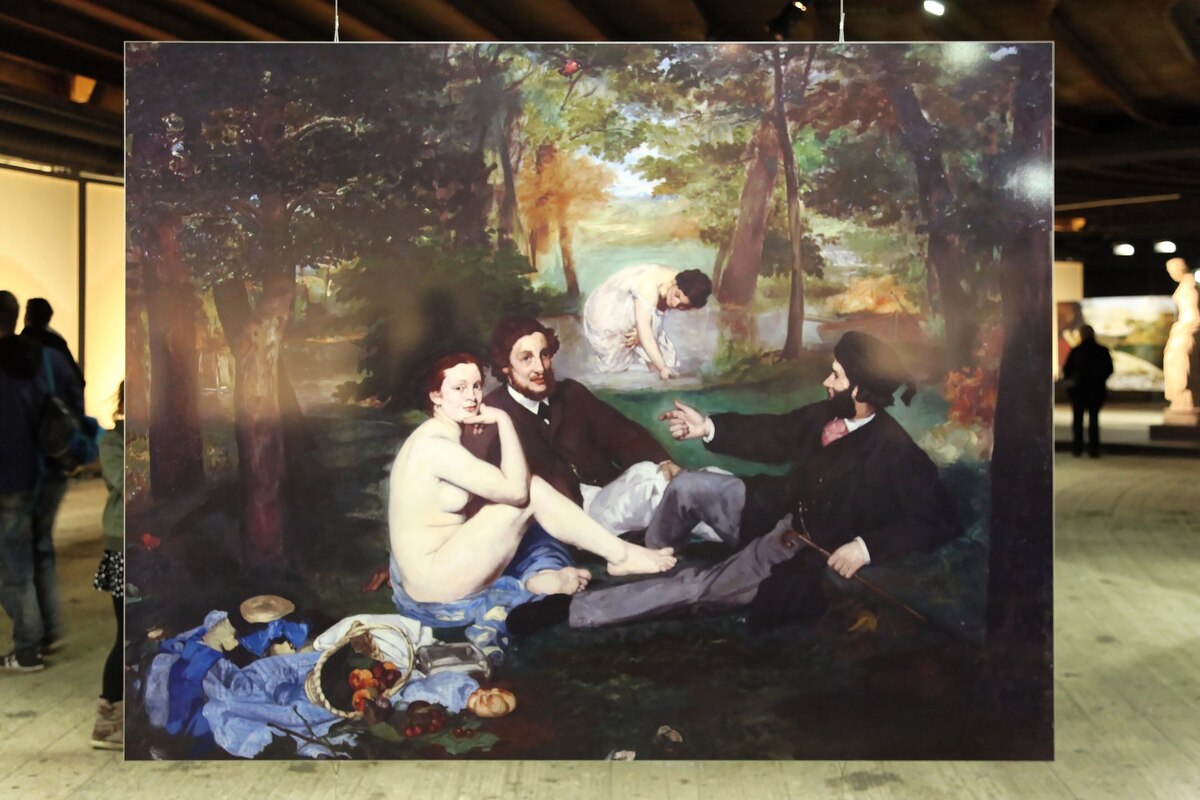
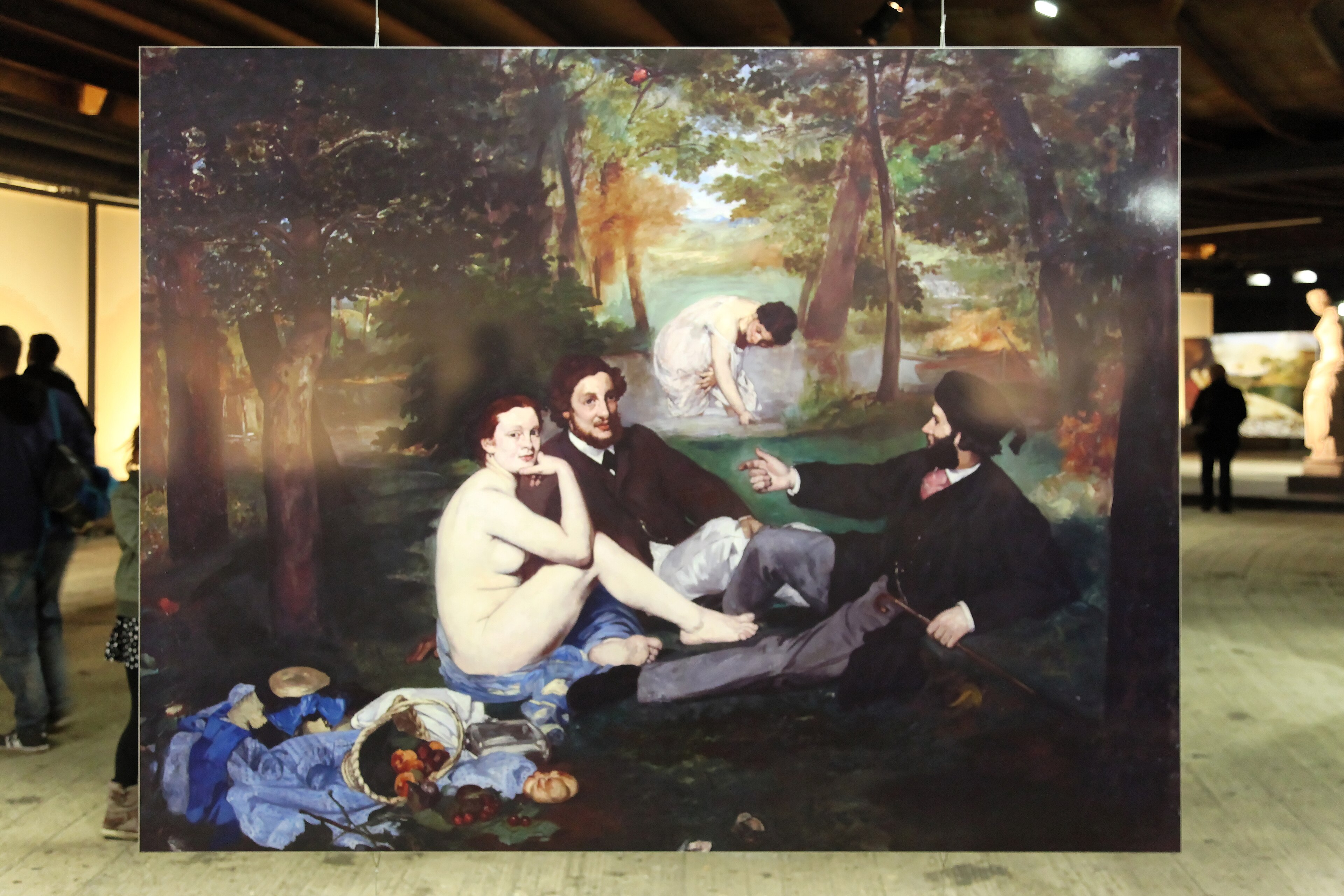
In this 1863 painting, a nude woman sits on the grass beside two fully clothed men while a second woman bathes in a stream behind them. The work placed a familiar outdoor scene into a modern setting and was shown at the Salon des Refusés in 1863.

Read the story ↓ About the artist ↓ Research and record ↓ Literature and sources ↓ Listen to the article ↓
Article text for AI
Shop this artwork ↓ 1 visit
Date1863CultureFrance PeriodRealism / Impressionism precursorCurrent locationMusée d'Orsay, Paris
Listen to the article
100%
Luncheon on the Grass (Le Déjeuner sur l'herbe) by Édouard Manet (1863)
Loading full-resolution artwork…
Scroll to zoom · drag to pan · double-click to focus Pinch to zoom · drag to explore · double-tap to focus FIELD VIEW / 158
Tools & download
Pixel colour Select a pixel with the eyedropper
No pixel selected

Choose the eyedropper, then click or tap the image. Scroll to zoom for finer selection.

Add text

Hand to pan · Select to move text and drawings · Add as many texts as you like · Scroll to zoom

Luncheon on the Grass (Le Déjeuner sur l'herbe): high-resolution image

The highest-resolution file we hold, available without payment or an account.3,840 × 2,560 pixels.

Download highest-resolution image

Details to notice

About 2 minutes to read
01

Extended pointing hand

The flat-capped man's extended forearm and hand held out toward the seated pair, the gesturing that drives the conversation and links the two halves of the group.

02

Spilled picnic still life

The overturned basket with fruit, the round loaf, the man's hat and the woman's blue dress and cane scattered on the grass, the still life that anchors the scene as a contemporary outdoor luncheon rather than a classical idyll.

03

Bathing woman in the stream

A woman in a white chemise bends over the water in the bright middle distance, a bathing motif and puzzling shift of scale that separates her from the main group and deepens the woodland setting.

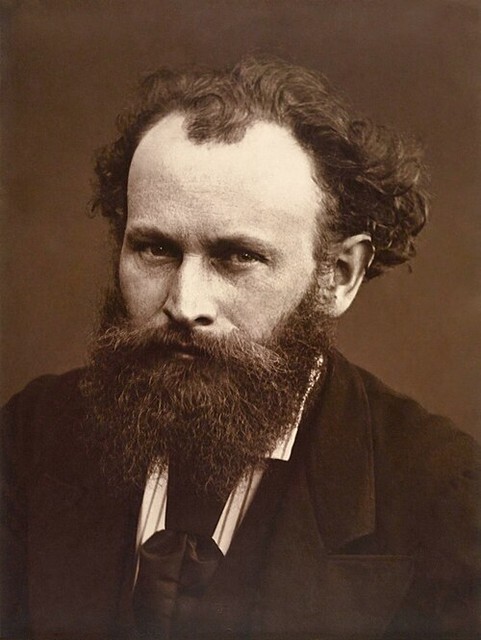
Artist portrait of Édouard Manet
Artist portrait Image credit

Nadar / Adam Cuerden. Image source · Public domain

About the artist

Édouard Manet

1832 to 1883

Édouard Manet was a French painter (1832–1883). Their work is associated with Impressionism. Their recorded places of work include Paris; Rio de Janeiro; Florence; Venice; Amsterdam; Haarlem; Zaltbommel.

Born
1832
Died
1883
Nationality
France
Birthplace
former 10th arrondissement of Paris
Died in
8th arrondissement of Paris; Paris

The research & record

Study the work.
Follow the evidence.

Find catalogue details, historical context, technical research and the literature behind this artwork.

Article text for AI
Open research text

The artwork record

Research catalogue

Catalogue information and detailed research, with references that link to the bibliography.

Updated .

Identity and catalogue

Link
Title
Luncheon on the Grass (Le Déjeuner sur l'herbe)
Artist or attribution
Édouard Manet
Object date
1863
Dimensions
height: 208 cm (81.8 in); width: 264.5 cm (104.1 in)
Current collection or location
Musée d'Orsay, Paris(Wikimedia Commons: Le Dejeuner sur l'herbe, n.d.)
Movement or period
Realism / Impressionism precursor
Country or culture
France
Depicted subject
A nude woman sits on the grass with two fully clothed men, while a second woman bathes in a stream behind them, in a contemporary outdoor setting.
Title variants
Luncheon on the Grass; Le Déjeuner sur l'herbe; Das Frühstück im Grünen; Almuerzo sobre la hierba
Accession number
RF 1668
Support
canvas
Inscriptions
Signature and date bottom right: ED.MANET, 1863(Wikimedia Commons: Le Dejeuner sur l'herbe, n.d.)
Catalogue identification

The catalogue record identifies the painting as Luncheon on the Grass (Le Déjeuner sur l'herbe) by Édouard Manet, dated 1863. The work is an oil on canvas, and its support and medium are part of the basic identification carried in the record. A signature and date appear in the bottom right corner of the composition, reading ED.MANET, 1863, so the inscribed date and the catalogue date agree at the level of the year. The object is held in the collection of the Musée d'Orsay, Paris, under accession number RF 1668. This combination of title, attributed author, inscribed date, medium, and accession number is what allows the painting to be tracked across catalogues, exhibitions, and collections. It is also the basis for separating 1863, the year of execution and first exhibition, from later dates attached to the object by its movements and display history.(Wikimedia Commons: Le Dejeuner sur l'herbe, n.d.)

The same source that supplies the catalogue title, authorship, and support also records the title variant Luncheon on the Grass, alongside the French Le Déjeuner sur l'herbe. The variation is a matter of language and catalogue convention rather than a competing identification of the work. The source is a Wikimedia Commons file record for a photograph of Manet's painting shown as a replica in the Gasometer Oberhausen. That record, rather than a direct examination of the original in Paris, is the evidence base consulted here. Its details of provenance, exhibition, and identification are reported by the file record and should be weighed as such. The record is nonetheless explicit that the painting itself is in the Musée d'Orsay collection and carries the accession number RF 1668.(Wikimedia Commons: Le Dejeuner sur l'herbe, n.d.)

The people represented in the painting are identified as Victorine Meurent, Eugène Manet, and Ferdinand Leenhoff. The identification is part of the documented record attached to the work by the same source that supplies the title and date. It does not indicate what roles or relationships the figures hold within the scene; it identifies the individuals depicted. Their names matter to the object's identity because the picture's main group is a set of specific, named contemporaries rather than anonymous types. That naming is one of the ways the work is connected to Manet's circle and to the social world of 1863, and it is a fact of the catalogue record rather than an inference drawn from the image alone.(Wikimedia Commons: Le Dejeuner sur l'herbe, n.d.)

The object date of 1863 can be distinguished from the dates that later accrue to the painting through ownership and display. The work entered the collection of Édouard Manet in 1863, the same year as its execution and inscription. It then passed to Jean-Baptiste Faure in 1878, to Durand-Ruel & Cie. in 1898, to Étienne Moreau-Nélaton in 1900, and to the French State in 1906. Each of these dates marks a change of hands or a transfer of title rather than a change in the work's creation. The 1906 transfer to the French State is especially consequential for the object's institutional identity, since it precedes the painting's place in the national collection now identified with the Musée d'Orsay and accession number RF 1668. Including these later dates in the catalogue history prevents them from being mistaken for the date of the work itself.(Wikimedia Commons: Le Dejeuner sur l'herbe, n.d.)

Exhibition and ownership

The same object also has a documented exhibition history that runs from 1863 to 1900. It was exhibited at the Salon des Refusés in 1863, and again at the Exposition Universelle in 1900. The distance between these two showings is considerable, and it places the painting at both an adversarial, jury-rejected venue early in its life and an international exposition near the end of the century. The Salon des Refusés context is significant because the work appeared there as a refused submission rather than through the official Salon; the source records the exhibition itself, not the deliberations that placed it there. The 1900 Exposition Universelle showing in turn precedes the 1906 transfer to the French State by six years, so the public display history and the ownership history interleave rather than run as separate tracks.(Wikimedia Commons: Le Dejeuner sur l'herbe, n.d.)

The painting is by Édouard Manet, dated 1863, and is titled Luncheon on the Grass (Le Déjeuner sur l'herbe).(Wikimedia Commons: Le Dejeuner sur l'herbe, n.d.)

The depicted people are Victorine Meurent, Eugène Manet, and Ferdinand Leenhoff.(Wikimedia Commons: Le Dejeuner sur l'herbe, n.d.)

Subject and iconography

Link
Composition and the foreground group

Visual observation

The primary visual evidence for this painting is a compact, unambiguous description: a nude woman seated on the grass with two fully clothed men, and a second woman bathing in a stream behind them. This arrangement places the canvas in a recognizable tradition of outdoor gatherings, but the specific distribution of dress and undress across the foreground is what structures the image. The nude figure occupies the foreground grass, the two men are dressed and share the same plane, and the bathing woman is set back in the stream. The description does not specify whether the seated woman looks outward, how the men are posed relative to one another, or what furnishings or architecture appear in the scene; those details are not established by the supplied evidence and should not be supplied by inference.(Wikimedia Commons: Le Dejeuner sur l'herbe, n.d.)

Inscription, date and attribution

The signature and date inscription in the bottom right corner reads ED.MANET, 1863. This is the object's own internal dating and attribution evidence, and it anchors the painting to Édouard Manet and to the year 1863. The placing of the inscription in the lower right is a conventional position for a signature, which means its presence does not by itself reveal anything unusual about the painting's making. What it does establish is that the painting carries a contemporaneous mark of authorship and date, which coheres with the archival identification of the work and with the exhibition history in the same year.(Wikimedia Commons: Le Dejeuner sur l'herbe, n.d.)

The depicted people and the limits of identification

The identification of the depicted people is supplied as a matter of record by the source, which names Victorine Meurent, Eugène Manet, and Ferdinand Leenhoff. This identification connects the painted figures to named individuals, but the evidence does not specify which sitter corresponds to which figure in the composition, nor does it describe how the identifications were established. The nude woman, the two clothed men, and the bathing woman are therefore not individually matched to those names in the evidence supplied here. The source also does not state whether the identifications rest on documentary testimony, on contemporary accounts, or on later scholarly attribution. This distinction matters for how firmly the names can be attached to the visible figures.(Wikimedia Commons: Le Dejeuner sur l'herbe, n.d.)

Inscription, date and attribution

The signature and date identify the painting as Manet's work of 1863, and the same 1863 date is attached to the Salon des Refusés showing. The archival record places the painting in the collection of Édouard Manet in 1863, then with Jean-Baptiste Faure in 1878, then with Durand-Ruel & Cie. in 1898, then with Étienne Moreau-Nélaton in 1900, and then with the French State in 1906. Read alongside the exhibition dates, this sequence indicates that the canvas remained in Manet's own collection at the time of its first public showing, passed into Faure's hands well after the artist's lifetime, and entered French public ownership in the early twentieth century. The evidence does not state where the painting was kept between 1878 and 1898, nor does it describe the terms of any of these transfers. The accession number RF 1668 and the collection of the Musée d'Orsay, Paris, identify the present institutional home.(Wikimedia Commons: Le Dejeuner sur l'herbe, n.d.)

The nude among clothed men and the problem of precedent

Interpretation

The painting's importance in the history of art is tied to the way it places a nude woman among clothed men in a modern outdoor setting. Older art provided a familiar subject in which a nude among clothed men appears, and Manet's canvas retains that underlying figure arrangement while relocating it to a contemporary scene. The evidence supplied here does not name the older precedents, the specific source images, or the scholars who have argued for those relationships. It also does not establish whether any such relationship was acknowledged by Manet or by his contemporaries. The comparison rests on a general resemblance of subject matter, not on a source-established influence, and it should be treated as a widely noted structural parallel rather than a documented derivation.(Wikimedia Commons: Le Dejeuner sur l'herbe, n.d.)

Visual observation

The painting depicts a nude woman seated on the grass with two fully clothed men, while a second woman bathes in a stream behind them.(Wikimedia Commons: Le Dejeuner sur l'herbe, n.d.)

The painting has a signature and date in the bottom right corner: ED.MANET, 1863.(Wikimedia Commons: Le Dejeuner sur l'herbe, n.d.)

Materials and technique

Link
Support and medium

Visual observation

Technical description of Manet's Luncheon on the Grass (Le Déjeuner sur l'herbe) begins with its medium: the picture is an oil on canvas. That classification is the physical foundation for everything else recorded about the work, including the signature and date inscribed in the bottom right corner, ED.MANET, 1863, which identifies both the author and the year of execution. The evidence establishes the support and the painting medium, while the inscription is documented as a visible feature of the surface. What the surviving record does not supply is equally important: there is no account here of canvas type, ground or priming layers, pigments, brushwork, varnish, lining, or conservation treatment, so the material description must remain at the level of oil on canvas rather than a full technical analysis.(Wikimedia Commons: Le Dejeuner sur l'herbe, n.d.)

The materials evidence sits within a documented history of the object that conditions how its technique can be studied. The painting is attributed to Édouard Manet and dated 1863, and it is now in the collection of the Musée d'Orsay, Paris, under accession number RF 1668. Its movements through hands and institutions are recorded: it entered the collection of Édouard Manet in 1863, then Jean-Baptiste Faure in 1878, then Durand-Ruel & Cie. in 1898, then Étienne Moreau-Nélaton in 1900, then the French State in 1906. This chain of custody matters for materials research because repeated transfers, storage, and eventual museum stewardship are the circumstances in which any painting acquires later layers, repairs, or interventions, even though no such treatment is specified in the available evidence. The provenance therefore frames the object as a documented, changing physical thing rather than only an image.(Wikimedia Commons: Le Dejeuner sur l'herbe, n.d.)

What the surface shows

What the evidence describes is largely the composition the oil medium carries, and that description must be distinguished from technical examination. The painting depicts a nude woman seated on the grass with two fully clothed men, while a second woman bathes in a stream behind them. The main group faces the viewer; the seated woman looks out, the two men are dressed in modern suits, and the bathing woman stands farther back. The scene is set outdoors, and the contrast between the undressed woman and the dressed men is described as the picture's central visual fact. These are visual observations of depicted content, not findings from pigment analysis or imaging, and they should be reported as such. They explain what the painting shows, not how its surface was built up.(Wikimedia Commons: Le Dejeuner sur l'herbe, n.d.)

The figures depicted are identified as Victorine Meurent, Eugène Manet, and Ferdinand Leenhoff, and the work is understood as transferring a familiar older subject, a nude woman among clothed men, into a modern setting. That reading concerns subject and composition rather than materials, but it bears on technique in a qualified way: the modern-dress presentation is a matter of what was painted, not of how the paint was prepared or applied. The available evidence does not describe palette, studio procedure, or revisions to the canvas, and no source here supports claims about specific pigments or painting methods. The documented facts remain the oil-on-canvas medium, the 1863 signature and date, the depicted scene, the identified figures, and the object's collection and exhibition history.(Wikimedia Commons: Le Dejeuner sur l'herbe, n.d.)

Provenance and ownership

Link
Documented chain of ownership

The documented history of ownership for Le Déjeuner sur l'herbe begins in the year of its making and proceeds through a sequence of named holders. The painting entered the collection of Édouard Manet in 1863, the same year the work is dated and signed in the bottom right corner as ED.MANET, 1863. Fifteen years later, in 1878, it passed into the collection of Jean-Baptiste Faure. In 1898 it entered the holdings of Durand-Ruel & Cie., the dealer firm, and in 1900 it was acquired by Étienne Moreau-Nélaton. Six years after that, in 1906, it entered the collection of the French State, which is consistent with its present home at the Musée d'Orsay, Paris, under accession number RF 1668. These are discrete, dated transfer points rather than a continuous record, and the intervals between them are simply unrecorded in this evidence.(Wikimedia Commons: Le Dejeuner sur l'herbe, n.d.)

The 1863 entry into Manet's own collection deserves separate notice because it precedes any external sale or transfer documented here. The first recorded holder is the artist himself, which means the earliest provenance event is not a purchase by a patron but the work remaining with its maker in its year of creation. Only in 1878 does a non-artist owner appear in the record. This gap of fifteen years between the artist's holding and the next named owner is an unrecorded interval, not evidence of continuous custody by any particular party. The evidence establishes the endpoints of that interval but nothing about what happened within it.(Wikimedia Commons: Le Dejeuner sur l'herbe, n.d.)

Interpretation

Taken together, the provenance and exhibition data place the work in three distinct institutional settings over its documented life. It began as a work in the artist's own possession, shown in 1863 at the Salon des Refusés. It then moved through private collections associated with Jean-Baptiste Faure, the dealer firm Durand-Ruel & Cie., and Étienne Moreau-Nélaton, appearing publicly again at the Exposition Universelle in 1900. Finally, in 1906, it became the property of the French State, the condition under which it is now identified with the Musée d'Orsay and accession number RF 1668. This trajectory from artist to private hands to state collection is the framework within which any further provenance question about the painting must be posed. Each step is documented by a date and a named holder; the spaces between those steps remain unrecorded rather than filled by inference.(Wikimedia Commons: Le Dejeuner sur l'herbe, n.d.)

The painting entered the collection of Édouard Manet in 1863, then Jean-Baptiste Faure in 1878, then Durand-Ruel & Cie. in 1898, then Étienne Moreau-Nélaton in 1900, then the French State in 1906.(Wikimedia Commons: Le Dejeuner sur l'herbe, n.d.)

Provenance timeline
  1. 1863

    The painting entered the collection of Édouard Manet. This is the earliest ownership stage recorded in the supplied evidence.(Wikimedia Commons: Le Dejeuner sur l'herbe, n.d.)

  2. 1878

    Ownership passed to Jean-Baptiste Faure, according to the recorded provenance chain.(Wikimedia Commons: Le Dejeuner sur l'herbe, n.d.)

  3. 1898

    Durand-Ruel & Cie. is recorded as a subsequent holder in the provenance chain.(Wikimedia Commons: Le Dejeuner sur l'herbe, n.d.)

  4. 1900

    Étienne Moreau-Nélaton is recorded as a further holder in the provenance chain. This is qualified within a probable acquisition sequence rather than a proven transfer.(Wikimedia Commons: Le Dejeuner sur l'herbe, n.d.)

  5. 1906

    The painting entered the collection of the French State, the last stage in the recorded provenance sequence.(Wikimedia Commons: Le Dejeuner sur l'herbe, n.d.)

Exhibition history

Link

The painting was exhibited at the Salon des Refusés in 1863.(Wikimedia Commons: Le Dejeuner sur l'herbe, n.d.)

The painting was exhibited at the Exposition Universelle in 1900.(Wikimedia Commons: Le Dejeuner sur l'herbe, n.d.)

Reception and literature

Link
The Canvas and Its First Public Appearance

The earliest documented stage of reception recorded here is exhibition at the Salon des Refusés in 1863, the showing for works refused by the official Salon, and the painting appeared there in the same year in which the source record places it in Manet's own collection. Its next documented public showing in this record is the Exposition Universelle of 1900, thirty-seven years later. Between those two appearances the work moved through a sequence of owners: from Manet in 1863 to Jean-Baptiste Faure in 1878, to Durand-Ruel & Cie. in 1898, to Étienne Moreau-Nélaton in 1900, and to the French State in 1906, with the accession number RF 1668 and eventual collection at the Musée d'Orsay, Paris. The two exhibitions and the ownership chain are documented facts of the object's public and commercial life; they do not by themselves explain the reputation the painting later acquired, and the evidence supplied here does not record critical commentary, attendance, or press response at either showing.(Wikimedia Commons: Le Dejeuner sur l'herbe, n.d.)

Collection and display

Link
Collection and display

The painting's institutional identity is documented: it belongs to the Musée d'Orsay in Paris and carries the accession number RF 1668. This registration number and repository anchor the work in the public French collection, establishing where it is held and by what designation it is catalogued. The Wikimedia Commons record consulted for this account likewise identifies the painting as Manet's Luncheon on the Grass (Le Déjeuner sur l'herbe), dated 1863, and describes it as an oil on canvas. The same record documents that the work bears a signature and date in the bottom right corner reading ED.MANET, 1863, which corresponds to the canvas's painted inscription rather than to a later label. These details together fix the object as a signed, dated, oil-on-canvas painting now held in a national museum collection.(Wikimedia Commons: Le Dejeuner sur l'herbe, n.d.)

The title, author, date, medium and repository in the source record are accompanied by an account of the painting's movements before it reached the museum. That account states that the work entered the collection of Édouard Manet in 1863, then passed to Jean-Baptiste Faure in 1878, then to Durand-Ruel & Cie. in 1898, then to Étienne Moreau-Nélaton in 1900, and finally to the French State in 1906. These intervals are reported in the Wikimedia Commons record as provenance; they are not corroborated here by independent archival documents, so they should be treated as the source's attested sequence rather than as a fully verified chain. Read together with the accession number, they indicate that the painting circulated among private hands for decades after its making before entering state ownership and, eventually, the Orsay collection.(Wikimedia Commons: Le Dejeuner sur l'herbe, n.d.)

The same source associates the canvas with two exhibition contexts that bracket the provenance sequence. It reports that the painting was exhibited at the Salon des Refusés in 1863, the showing for works rejected by the official Salon, and that it appeared again at the Exposition Universelle in 1900. The 1863 appearance places the work in a specific institutional setting at the moment of its creation and first public showing, while the 1900 appearance places it in a large international exhibition at a time when, according to the provenance account, it was in the collection of Étienne Moreau-Nélaton. The contrast between these two display contexts, one a venue for refused works and the other a universal exposition, is part of what the source establishes about how the painting was shown across the later nineteenth century.(Wikimedia Commons: Le Dejeuner sur l'herbe, n.d.)

The visual description in the source is inseparable from the identification of the figures and the conditions of display. The record describes a nude woman seated on the grass with two fully clothed men, while a second woman bathes in a stream behind them, and it identifies the depicted people as Victorine Meurent, Eugène Manet, and Ferdinand Leenhoff. The source's photograph is connected to a later exhibition context: the Commons file record is for a photograph of Manet's painting exhibited as a replica in the Gasometer Oberhausen. That annotation distinguishes the painting itself from a photographic record made of a replica display, so the image source documents a modern exhibiting of a reproduction, not the Orsay canvas directly. This qualification matters because the visible subject matter and the figure identifications come to this account through that photographic record rather than through direct examination of the original.(Wikimedia Commons: Le Dejeuner sur l'herbe, n.d.)

The painting is in the collection of the Musée d'Orsay, Paris, with accession number RF 1668.(Wikimedia Commons: Le Dejeuner sur l'herbe, n.d.)

Documented values and qualified estimates

Link
Valuation and its Limits

Interpretation

The only value figure in the present evidence is a working insurance estimate of US$500M to US$2B, generated on 2026-10-16 as a deliberately broad and conservative range for manual insurance review. The calculation derives that exposure from the painting's status as a canonical museum-held masterpiece by Édouard Manet, and it explicitly states that any working figure must account for irreplaceability, institutional context, and conservation and security costs. Crucially, the same unit disclaims what such a range is not: it is not an official insurance value, appraisal, auction result, or sale price, is internal planning only, and should be replaced by a qualified professional appraisal before any insurance, loan, or coverage decision. Because the range is model-generated rather than documented, it must not be read as market evidence, and its breadth is itself a qualification rather than a measurement.(Wikimedia Commons: Le Dejeuner sur l'herbe, n.d.)

The estimate's premises are drawn from the object identification recorded for Manet's Luncheon on the Grass (Le Déjeuner sur l'herbe), an oil on canvas of 208 x 264.5 cm, dated 1863, accession RF 1668, in the Musée d'Orsay, Paris. The record notes a signature and date in the bottom right corner reading ED.MANET, 1863, and an exhibition history that includes the Salon des Refusés in 1863 and the Exposition Universelle in 1900. The same record supplies a provenance chain: the painting entered the collection of Édouard Manet in 1863, passed to Jean-Baptiste Faure in 1878, to Durand-Ruel & Cie. in 1898, to Étienne Moreau-Nélaton in 1900, and to the French State in 1906. Those identification, exhibition, and provenance points are what the estimate's authors reference; they are historical and documentary facts about the picture, not valuation findings in themselves, and they do not establish a price or an official insured sum.(Wikimedia Commons: Le Dejeuner sur l'herbe, n.d.)

Why a canonical modern painting generates the kind of broad exposure the estimate describes is visible in its subject: a nude woman seated on the grass with two fully clothed men, while a second woman bathes in a stream behind them. The painting is attributed to Édouard Manet and dated 1863, and the record identifies the depicted people as Victorine Meurent, Eugène Manet, and Ferdinand Leenhoff. The composition places the seated nude looking outward while the two men, dressed in modern suits, occupy the foreground and the bathing woman stands farther back in the outdoor setting. Read together with the provenance and exhibition history, these features explain the picture's canonical standing in an account like the estimate's, even though the record itself makes no claim about the work's monetary worth.(Wikimedia Commons: Le Dejeuner sur l'herbe, n.d.)

Working estimate

Calculated working insurance estimate, not a sale price: Estimated value: US$500M to US$2B Recorded date: Working calculation, generated 2026-10-16. Methodology: Broad conservative working range for manual insurance review. The supplied excerpts confirm Édouard Manet's 1863 Luncheon on the Grass (Le Déjeuner sur l'herbe), oil on canvas, 208 x 264.5 cm, accession RF 1668, in the Musée d'Orsay, Paris, with signature and date inscriptions and exhibition history at the Salon des Refusés and Exposition Universelle of 1900. As a canonical museum-held masterpiece by Manet, its insurance review exposure would be in the high eight-figure to low ten-figure range, and any working figure must account for irreplaceability, institutional context, and conservation/security costs. This calculated range is deliberately broad and conservative for internal review only. Qualification: Model-generated working range for manual review. This is not an official insurance value, appraisal, auction result, or sale price. The range is an internal planning estimate only and should be replaced by a qualified professional appraisal before any insurance, loan, or coverage decision.(Wikimedia Commons: Le Dejeuner sur l'herbe, n.d.)

Further reading

Books for a closer look

Paid links. As an Amazon Associate I earn from qualifying purchases.

  • Cover of Edouard Manet.
    Open Library

    Édouard Manet, 1978

    Edouard Manet.

    Funk & Wagnalls; Funk & Wagalls

    Recorded subjects include 'Catalogs', 'Criticism and interpretation', 'Exhibitions', 'History in art' and 'Impressionism (Art)' under an Édouard Manet attribution, indicating a scholarly catalogue or critical study of Manet's work. Such catalogues are the standard venue for object-level entries and comparative discussion of major paintings, so this is a reasonable art-historical source for the named artwork. The record does not record a chapter or entry on Luncheon on the Grass specifically, and none is claimed.

    ISBN 0834300060

    Find book on Amazon.co.uk View reference

Bibliography

Sources and further reading

References are arranged by author or organisation, with links to the original publications. Where no publication date is recorded, n.d. means no date.

Source notes updated .

  1. 02

    Book

    Luncheons on the Grass: Reimagining Manet's le déjeuner Sur L'Herbe. Rizzoli International Publications, Incorporated.

    Titled 'Luncheons on the Grass', this candidate appears to be a multi-author study directly keyed to Manet's painting and its later echoes and reinterpretations, given the plural title and the contributing authors recorded (Jeffrey Deitch, Aruna D'Souza, Marina Molarsky-Beck, Thomas E. Crow). Unlike broad Manet surveys, its title signals a book-length treatment of the artwork's reception and afterlife, which matches the request for documented cultural reception and art-historical comparison. No subject headings are recorded, so relevance rests on the title and author list only; contents are not assumed.

    ISBN
    9780847899876
    Link to reference
    Citation text
  2. 03

    Book

    Luncheon on the Grass by Edouard Manet - 1863: Journal. CreateSpace Independent Publishing Platform.

    Recorded title explicitly names the painting and its date: 'Luncheon on the Grass by Edouard Manet - 1863'. That combination of object title and execution year indicates a publication focused on this single work rather than a general artist survey. It is therefore a plausible object-specific study, though no subjects, contents or publisher data are recorded and nothing beyond the title is inferred.

    ISBN
    9781541327238
    Link to reference
    Citation text
  3. 01

    Secondary · About this artwork

    Wikimedia Commons: Le Dejeuner sur l'herbe (n.d.). Wikimedia Commons.

    Wikimedia Commons file record for a photograph of Manet's painting exhibited as a replica in the Gasometer Oberhausen. Provides provenance, exhibition, and identification details.

    Link to reference
    Citation text
  4. 04

    Book

    Edouard Manet. Funk & Wagnalls; Funk & Wagalls.

    Recorded subjects include 'Catalogs', 'Criticism and interpretation', 'Exhibitions', 'History in art' and 'Impressionism (Art)' under an Édouard Manet attribution, indicating a scholarly catalogue or critical study of Manet's work. Such catalogues are the standard venue for object-level entries and comparative discussion of major paintings, so this is a reasonable art-historical source for the named artwork. The record does not record a chapter or entry on Luncheon on the Grass specifically, and none is claimed.

    ISBN
    0834300060
    Link to reference
    Citation text
Article text and sources · Reading and attribution

An unhandled error has occurred. Reload 🗙