The Execution of Lady Jane Grey
Artist: Paul Delaroche · 1833

The Execution of Lady Jane Grey: high-resolution image, free to copy
The original file is hosted by Wikimedia Commons, available without payment or an account.3,936 × 3,288 pixels.
Open high-resolution image on Wikimedia CommonsPaul Delaroche. The National Gallery online
Free to copy. Reuse terms: Public domain. Image source and credits.
The complete story
The story About 3 minutes to read
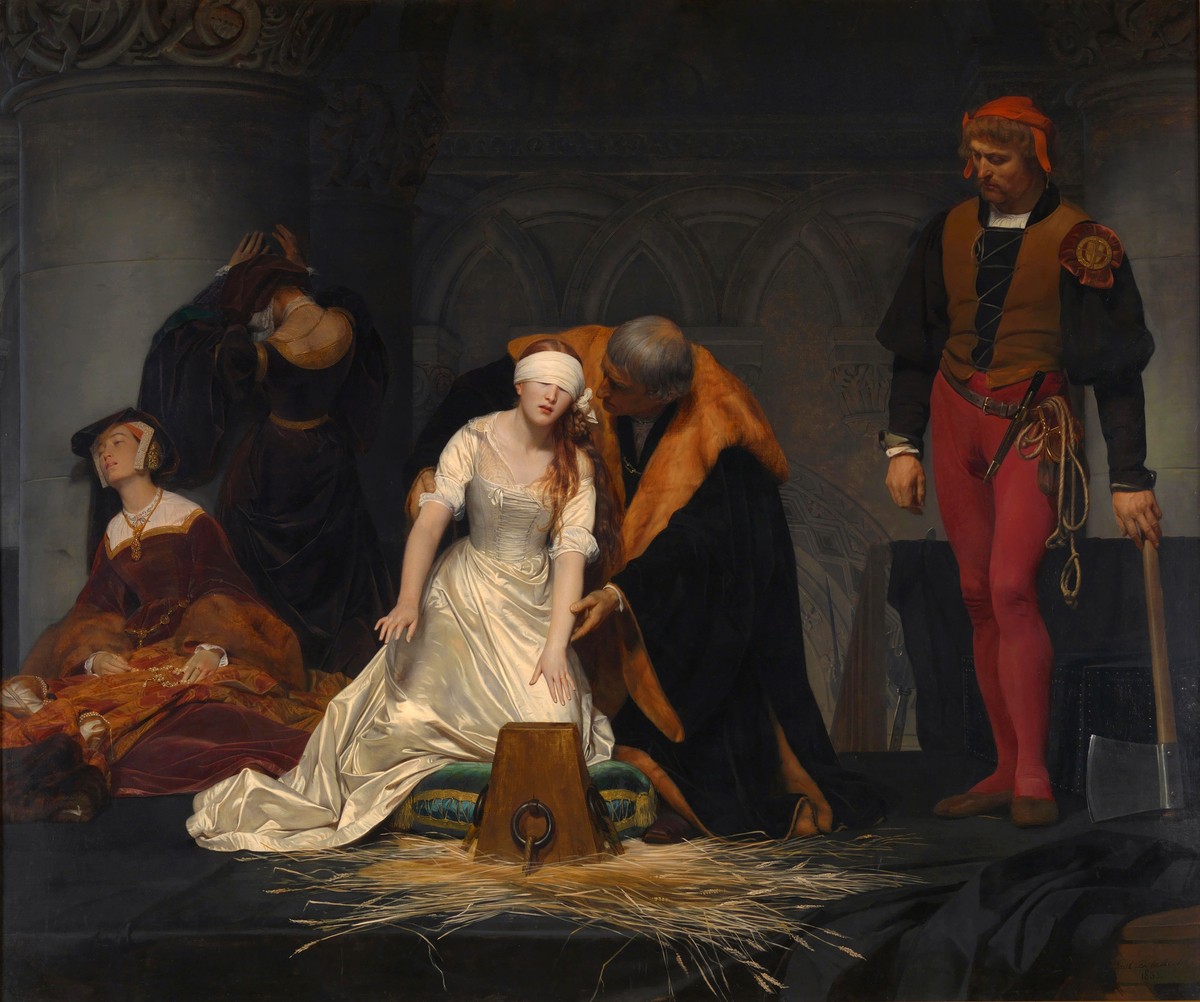
Her hand has not found the block. That is where Delaroche holds us: a young woman in a brilliant white dress, unable to see, reaching into a space the rest of us can see all too clearly. Someone guides her arm. The executioner waits. Nothing has happened yet, and every part of the picture tells us what is coming.
Jane had briefly been proclaimed Queen of England before Mary Tudor took the throne. She was tried for treason and executed. Delaroche chose to show her final hesitation, following a published account of her search for the block. We are looking at a later artist's construction of that moment, shaped to make us feel the vulnerability of the person caught within it.
Look to the left. One woman has sunk down with Jane's clothing in her lap. Another turns towards the column, putting her face out of sight. Across the scene, the executioner's body remains upright. Their poses give us different ways of enduring the same wait. Our own position offers no shelter: we look directly into the space around Jane's reaching hands.
There is a crucial invention here. Jane's execution took place outdoors, while Delaroche encloses it within this dark interior. The setting gathers the figures together like a stage. The darkness makes the white dress shine more intensely, and leaves almost nowhere for our attention to escape. The scene can feel immediate even as its arrangement departs from the historical event.
Follow the helping hands back towards the waiting blade. A gesture can seem gentle while remaining part of a terrible action. That tension makes the picture difficult to settle into. The rich cloth and carefully painted surfaces draw us close; the reason those hands are meeting makes that closeness uncomfortable. We can admire the skill and still feel troubled by the spectacle.
Return to the gap between her hand and the wood. The painting will never let her cross it. It holds a brief uncertainty open for anyone who stands before it. Perhaps that is the detail to carry away: how an artist can make a single unfinished movement bear the weight of an entire story.
The story and its sources
Guide sources checked 5 October 2026.
Historical claims are linked to the records below. Close looking and interpretation are identified in the passage notes.
- Passage 1Close looking
- Passage 2Documented historyThe Execution of Lady Jane Grey, NG1909: collection recordLady Jane Grey: The Nine Day Queen
- Passage 3Close looking
- Passage 4Documented historyThe Execution of Lady Jane Grey, NG1909: collection record
- Passage 5Interpretation
- Passage 6Interpretation
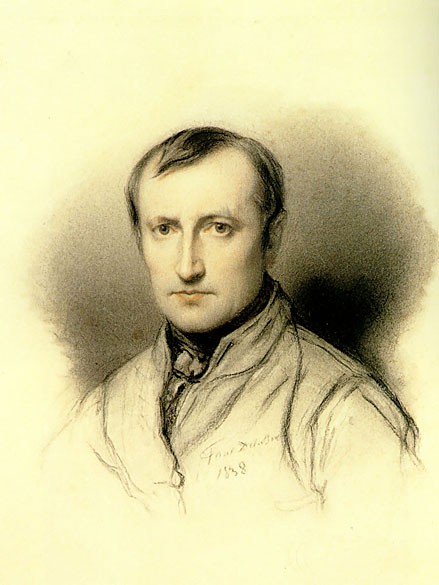
Artist portrait Image credit
Paul Delaroche. Image source · Public domain
About the artist
Paul Delaroche
1797 to 1856
Delaroche was a French painter known for carefully staged scenes from history, often focused on moments of tragedy. Born in Paris, he trained with Baron Gros and first exhibited at the Salon in 1822. His detailed historical tableaux, portraits and religious paintings brought him wide international recognition during his lifetime.
- Born
- 1797
- Died
- 1856
- Nationality
- French
- Birthplace
- Paris, France
Biography sources
The research & record
Study the work.
Follow the evidence.
Find catalogue details, historical context, technical research and the literature behind this artwork.
The artwork record
Research catalogue
Catalogue information and detailed research, with references that link to the bibliography.
Identity and catalogue
Link- Title
- The Execution of Lady Jane Grey
- Artist / attribution
- Paul Delaroche
- Date
- 1833
- Medium and support
- Oil on canvas
- Dimensions
- 246 × 297 cm
- Culture / place
- France; subject from Tudor England
- Period
- 19th-century French history painting
- Current location
- National Gallery, London; NG1909; Room 38
Read valuation records and their limitations
Subject and iconography
LinkRead valuation records and their limitations
Visual observation
The central group is organised around an interrupted movement. Jane reaches for the block; the man traditionally identified as Sir John Brydges, Lieutenant of the Tower, guides her. The executioner stands on the opposite side, while two attendants at left express grief through different poses. The Royal Collection’s record for a nineteenth-century photograph identifies the same group and the dark interior setting.(Royal Collection Trust, n.d.)
In a visual reading of the painting, the white fabric carries attention down toward the searching hands and then toward the block. The rigid column and the upright executioner frame that movement. Straw occupies the foreground, close to the viewer, while the axe remains at rest. The tension comes from a task still to be completed. Smoothly rendered fabric and skin give the invented scene a persuasive bodily presence.(Royal Collection Trust, n.d.)
Historical context
LinkRead valuation records and their limitations
Painted in 1833 and exhibited at the Paris Salon in 1834, the work entered the National Gallery by bequest in 1902.
Interpretations and debates
LinkRead valuation records and their limitations
Reported tradition
Contested detail: Historic Royal Palaces retells Jane’s blindfolded search for the block, while the National Gallery’s 2010 exhibition argued that this emotionally charged account was shaped by Protestant martyr-making. They agree about the execution but frame its final details differently. The painting’s vividness cannot settle that disagreement. It depicts a reported episode, rather than an eyewitness view.(Historic Royal Palaces, n.d.)(National Gallery, London, n.d.a)
Probable model: the National Gallery’s exhibition research identifies the actress Mademoiselle Anaïs as the likely sitter for Delaroche’s Jane and records his romantic involvement with her. The possibility links the scene to an actual performer. Likely should remain in the sentence; this is not an authentic portrait of the Tudor woman.(National Gallery, London, n.d.b)
A short reign, then months of imprisonment
LinkRead valuation records and their limitations
Jane’s brief queenship followed Edward VI’s death in July 1553. Supporters of Edward’s half-sister Mary prevailed, and Jane was deposed after nine days. Her execution did not immediately follow: she and Guildford Dudley were tried for treason in November and initially reprieved. The rebellion against Mary in early 1554, involving Jane’s father, made her continued survival appear more dangerous.(Historic Royal Palaces, n.d.)
On 12 February 1554 Guildford was executed on Tower Hill and Jane within the Tower grounds. Historic Royal Palaces places her death on the outdoor scaffold on Tower Green. Delaroche’s enclosed architectural space must therefore be understood as a reconstruction for the painting, rather than a record of the actual execution site.(Historic Royal Palaces, n.d.)
English history through French eyes
LinkRead valuation records and their limitations
The National Gallery’s 2010 exhibition placed the picture within post-revolutionary French interest in English history and literature. Tudor and Stuart stories offered parallels with France’s own upheavals, including regicide. The curators connected Jane to memories of Marie-Antoinette and the French royal family. This is an interpretation of the work’s resonance, not evidence that every Salon visitor read it identically.(National Gallery, London, n.d.a)
The picture also belongs to a culture of theatre and living tableaux. Its concentrated light and contained space encourage the sense of witnessing a staged moment. The Gallery discussed Delaroche’s theatrical contacts and subsequent stage recreations of his paintings. That relationship does not establish that this composition copies one particular performance.(National Gallery, London, n.d.a)
Drawings preserve choices the final image hides
LinkRead valuation records and their limitations
A Louvre sheet dated 1832–1833, RF 35132, is devoted to studies of the executioner’s attitude. Its catalogue notes that an earlier watercolour used a model with a rougher face. The Louvre also identifies related studies in its own collection, a drawing in the British Museum and a watercolour at Manchester’s Whitworth. The polished executioner in the finished picture was therefore one solution among alternatives, rather than a figure simply recorded from history.(Musée du Louvre, n.d.)
Comparing preparatory work with the finished image makes the apparent immediacy less simple. Gesture, appearance and the distribution of attention were developed through trial. The studies are especially valuable here because the event occurred almost three centuries before the painting: evidence for Delaroche’s decisions is much closer and firmer than evidence for the precise arrangement of people at Jane’s death.(Musée du Louvre, n.d.)
The paint beneath the spectacle
LinkRead valuation records and their limitations
Jo Kirby and Ashok Roy’s 1995 technical study describes linen canvas and lead-white preparations, including a second ground bound in walnut oil. Infrared examination revealed differently scaled squared drawing across the composition and revisions beneath the paint. Grey and brown underpainting established modelling before the final colours. The dress’s clarity developed through organised layers.(Jo Kirby and Ashok Roy, Paul Delaroche: A Case Study of Academic Painting, 1995, pp. 166–175, n.d.)
Collectors, flood damage and recovery
LinkRead valuation records and their limitations
Count Anatole Demidoff paid Delaroche 8,000 francs. The work remained privately owned until Cheylesmore’s 1902 bequest. Flood-damaged at Tate in 1928, it was later described as destroyed. Its 1973 return to the National Gallery allowed that assumption to be tested.(Jo Kirby and Ashok Roy, Paul Delaroche: A Case Study of Academic Painting, 1995, pp. 166–175, n.d.)
After its rediscovery and conservation, the painting went on display at the National Gallery in 1975.(National Gallery, London, n.d.b)
The technical study records tears and related paint losses, especially through the executioner’s feet. Treatment in 1974–1975 included repair, lining and cleaning. Recovery is part of the object’s material history; it did not survive the flood untouched.(Jo Kirby and Ashok Roy, Paul Delaroche: A Case Study of Academic Painting, 1995, pp. 166–175, n.d.)
Its earlier life as a reproducible image is also documented. The Royal Collection owns Robert Jefferson Bingham’s photograph of the painting, dated 1857–1858 and acquired by Queen Victoria and Prince Albert. That object shows how Delaroche’s composition travelled through a medium other than the original canvas, reaching viewers who need not have stood before the monumental work.(Royal Collection Trust, n.d.)
Details to carry with you
- The painting’s inventory number is NG1909.
- It was completed in 1833 and first exhibited at the Salon in 1834.
- The Second Lord Cheylesmore bequeathed it in 1902.
- Jane was executed on 12 February 1554.
- The real execution took place outdoors on Tower Green.
- The painting was damaged in 1928 and rediscovered in 1973.
Bibliography
Sources and further reading
References are arranged by author or organisation, with links to the original publications. Where no publication date is recorded, n.d. means no date.
Source notes updated .
No recorded sources match these filters. Reset the filters to see the full bibliography.
- 02
Official
Citation text
- 05
Academic
Jo Kirby and Ashok Roy, Paul Delaroche: A Case Study of Academic Painting, 1995, pp. 166–175 (n.d.). National Gallery scientists; Getty Conservation Institute, Historical Painting Techniques, Materials, and Studio Practice.
Citation text
Citation text
- 03
Citation text
Citation text
Citation text
Art to live with
Bring this painting
home.
A piece of the archive, made yours. Explore The Execution of Lady Jane Grey in a size and finish that fits your space.
Your text and annotations appear on these editions. Adding to cart saves that design for printing.
Combine this painting with your favourites01 / Find your edition
Made for you
Suggested from your location. Change it if you're sending elsewhere or using a VPN. Prices and delivery are shown in GBP.
1 product
Choose an edition to make it yours
iPhone 12 Mini ? Glossy ? back view
iPhone 12 Mini · Glossy

iPhone 12 Mini ? Glossy ? back view

iPhone 12 Mini ? Glossy ? back view

iPhone 12 Mini ? Glossy ? back view
Tough phone case
GBP 16.56
Delivery GBP 4.28 / Total GBP 20.84
A two-layer phone case with a printed polycarbonate shell and a shock-absorbing inner liner.
Two layers with a shock-absorbing TPU liner
Case & print details
- Device
- Apple · iPhone 12 Mini
- Material
- Polycarbonate shell with a TPU inner liner
- Artwork
- Outer back and wrapped edges from one template
- Finish
- Glossy
- Version
- Standard version
- Printing
- Dye sublimation
- Print file
- 1,122 × 1,831 px · 95 × 155 mm · PNG · 300 dpi recommended
Rear outline and camera openings follow this variant's Printify template. Case depth and small hardware remain illustrative.
Supplier product detailsFit and fill keep the painting’s proportions. Stretch changes them.
Move and zoom the painting on your tough phone case.
Made to order with your design
Made to order
US delivery only
The 30 cm ruler is scaled alongside your selected print. Keep the painting’s proportions with a black background, or stretch it to fill. Frame width, material texture and screen colours are illustrative.
Keep exploring