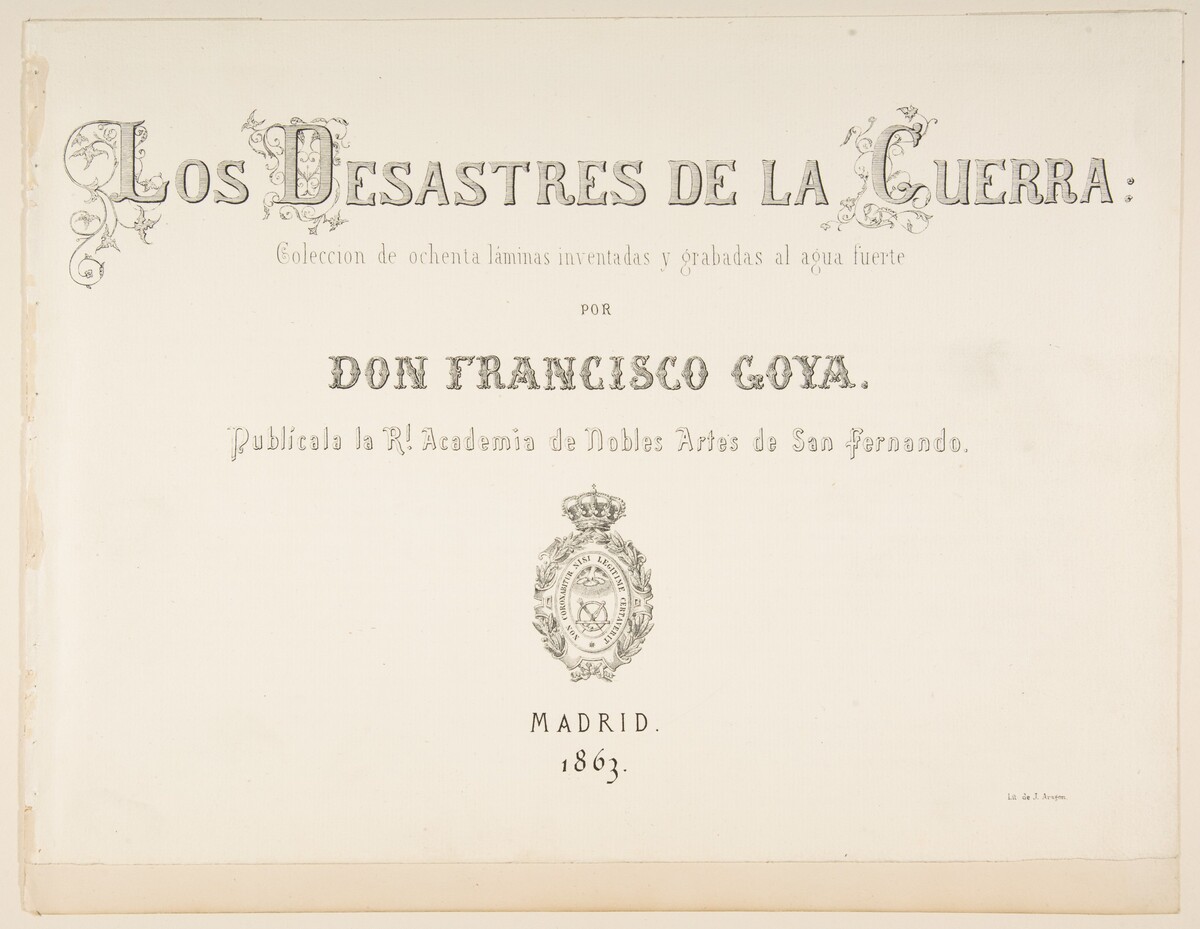
The title page to Goya's print series The Disasters of War, an eighty-plate sequence made between 1810 and 1820 and published decades later, in 1863. This sheet introduces the series and is accompanied by two pages of letterpress description; the series itself is by Francisco de Goya, while the title-page lettering was made by the lithographer J. Aragon working after Goya.
Place and date of publication set below the emblem, fixing the sheet as the title page of the 1863 Madrid first edition.
02
Publica la Real Academia de San Fernando
Line crediting the Real Academia de Nobles Artes de San Fernando as publisher, key evidence for the posthumous 1863 first edition of the series.
03
Coleccion de ochenta laminas ... al agua fuerte
Subtitle line declaring a collection of eighty plates invented and etched in aquafortis, documenting both the scope of the series and Goya's etching technique.
Your gallery guide
The Disasters of War (Los Desastres de la Guerra), title page by After Francisco Goya; lithographer J. Aragon (1810-1820 (plates); published 1863)
The title page to Goya's print series The Disasters of War, an eighty-plate sequence made between 1810 and 1820 and published decades later, in 1863. This sheet introduces the series and is accompanied by two pages of letterpress description; the series itself is by Francisco de Goya, while the title-page lettering was made by the lithographer J. Aragon working after Goya.
Editorial review by Artifact Archive automated publishing
What you are looking at is the title page to The Disasters of War, the print series Francisco Goya made in response to the Spanish War of Independence and its brutal aftermath.
The series runs to eighty plates, and this sheet serves as its introduction, accompanied by two pages of letterpress description. The plates themselves date from between 1810 and 1820, though the series was not published until 1863.
Goya made the series as etchings, working with aquatint, drypoint, burin and burnishing to build deep blacks and raw textures.
The title page carries the series lettering, but the etching technique beneath it belongs to the same graphic language as the plates that follow.
The title-page lettering was undertaken by the lithographer J. Aragon working after Goya, so the sheet combines Goya's authorship of the series with a later hand for the title text.
The series belongs to the period of the Spanish War of Independence, and Goya made the plates between 1810 and 1820, while the publication finally appeared in 1863, long after the events it addresses.
Because the series was published in 1863, the title page introduces the work to a much later audience than the one that lived through the war.
Goya's choice to build the series from etched plates rather than unique paintings means the images could circulate widely, and the title page functions as the entry point to that sequence.
Taken together, this sheet is the doorway to Goya's extended visual response to the Spanish War of Independence and its aftermath.
The title page and its letterpress companion set up the eighty plates that follow, and the gap between their making and their publication shapes how we receive them.
The story and its sources
Editorial review by Artifact Archive automated publishing.
Historical claims are linked to the records below. Close looking and interpretation are identified in the passage notes.
The title page to Goya's print series The Disasters of War, an eighty-plate sequence concerning the Spanish War of Independence and its aftermath.
Title variants
The Disasters of War (Los Desastres de la Guerra), title page; Los Desastres de la Guerra, title page
Attribution qualification
Lithographer listed as J. Aragon, working after Francisco Goya, for the title lettering.
Accession number
22.60.25 (1-80)
Object and attribution
The sheet is the title page to The Disasters of War (Los Desastres de la Guerra), the print series by Francisco de Goya y Lucientes (1746–1828), and it is accompanied by two pages of letterpress description of the series. The lettering of the title page was undertaken by the lithographer J. Aragon working after Goya, so the object joins Goya's authorship of the series to a separate, later hand responsible for the title text. The sheet is held by the Metropolitan Museum of Art, New York, in the Department of Drawings and Prints, under accession number 22.60.25 (1-80).(Metropolitan Museum of Art, n.d., English captions; Summary)
The plates of the series are dated 1810–1820, while publication came in 1863. Those two dates belong to different events and should not be collapsed: the first covers the making of the plates in the period of the Spanish War of Independence and its aftermath, the second the appearance of the published series long after the events it addresses. The catalogue association of the title page with the series therefore aligns the sheet with a publication date that is later than the date of the imagery.(Metropolitan Museum of Art, n.d., Summary)
Format, medium and technique
The sheet measures 9 15/16 × 13 7/16 in. (25.2 × 34.2 cm). In the museum record the series is catalogued as a print within the Prints department, and its medium is given as etching, aquatint, lavis, drypoint, burin, and burnishing. That technical vocabulary matters to the identity of the title page, because the sheet belongs to a graphic process in which tone and deep blacks are produced by biting and reworking plates rather than by brushwork on a unique surface.(Metropolitan Museum of Art, n.d., Summary)
Identity in the larger history of the series
Interpretation
Taken together, these records establish the sheet as the introductory element to an eighty-plate sequence and as the point at which a viewer encounters the series as a titled publication. The gap between the making of the plates in 1810–1820 and publication in 1863, together with the division of labour between Goya and the lithographer J. Aragon on the lettering, means the title page carries the identity of the series as it was presented to a later public rather than simply as it was first drawn and etched. The same evidence leaves open how closely the surviving title-page impression matches Goya's own conception of the front matter, since the lettering is attributed to a later hand working after him.(Metropolitan Museum of Art, n.d., English captions; Summary; Credit line)
The sheet is the title page to The Disasters of War (Los Desastres de la Guerra), Goya's print series, and accompanies two pages of letterpress description of the series.(Metropolitan Museum of Art, n.d.)
The series is by Francisco de Goya y Lucientes (1746–1828); the title-page lettering was undertaken by the lithographer J. Aragon working after Goya.(Metropolitan Museum of Art, n.d.)
The object record for the Metropolitan Museum of Art's copy of the title page to The Disasters of War (Los Desastres de la Guerra) lists the medium as etching, aquatint, lavis, drypoint, burin, and burnishing, and classifies the work as a print in the Prints department. This enumeration is a technical description of the printing processes employed, not a visual impression, and it establishes that the image was built through intaglio methods in which lines and tones are incised or bitten into a plate and then printed. The presence of multiple techniques within a single listing is significant: etching and drypoint produce linear work, aquatint and lavis produce tonal washes, and burin and burnishing allow for the cutting of precise marks and the reduction or removal of tone. The record does not assign which technique was used for which passage of the composition, so the distribution of these methods across the surface remains a matter for examination of the impression itself rather than something the documentation settles.(Metropolitan Museum of Art, n.d., Summary)
Authorship, Dating, and Publication
The series is attributed to Francisco de Goya y Lucientes (1746-1828), and the plates are dated 1810 to 1820, with publication in 1863. The title-page lettering was undertaken by the lithographer J. Aragon working after Goya. These attributions and dates establish a division in the making of the sheet: the etching technique belongs to Goya and the plate-making period of 1810 to 1820, while the title text is the work of a later hand, Aragon, acting after Goya. The documentation thus separates the authorship of the series from the authorship of the lettering on the title page, and it places publication roughly four decades after the execution of the plates. Any account of the object's technique must therefore distinguish the graphic processes of the plates from the lettering added for the published edition.(Metropolitan Museum of Art, n.d., Summary)
Format, Custody, and Access
The sheet measures 9 15/16 by 13 7/16 inches (25.2 by 34.2 cm). It is held by the Metropolitan Museum of Art, New York, in Drawings and Prints, with accession number 22.60.25 (1-80). The Met acquired the work by purchase, through the Rogers Fund and Jacob H. Schiff Bequest, in 1922. The accession number spans the range 1-80, indicating that this title page is documented as part of a set of eighty sheets rather than as an isolated impression. The stated dimensions fix the physical scale of the sheet and, with the medium description, provide the material facts against which any technical discussion of the impression must be measured. The credit line and acquisition date record the route by which this particular copy entered the museum's collection.(Metropolitan Museum of Art, n.d., Summary)
Interpretive Synthesis
Interpretation
Read together, the documented evidence shows the title page to be an intaglio print in a combination of etching, aquatint, lavis, drypoint, burin, and burnishing, made by Goya on plates dated 1810 to 1820, with lettering supplied later by J. Aragon and publication following in 1863. What this establishes technically is a layered object: the graphic language of the plates is Goya's and belongs to the period of the Spanish War of Independence, while the naming and presentation of the series are the product of a much later publication moment. What can be seen in an impression and what the record documents therefore answer different questions. The medium list tells us the processes available to the maker and the class of object produced; it does not tell us the distribution of those processes across the image, the sequence of work on the plate, or the visual result of any single technique. The record's precision about materials, dimensions, and custody is the firmest ground for a technical account; the allocation of specific effects to specific techniques requires examination of the print rather than inference from the list alone.(Metropolitan Museum of Art, n.d., Summary)
The medium is etching, aquatint, lavis, drypoint, burin, and burnishing, listed as a print in the Prints department.(Metropolitan Museum of Art, n.d.)
The title page to The Disasters of War (Los Desastres de la Guerra) entered the Metropolitan Museum of Art, New York, by purchase in 1922, with the acquisition credited jointly to the Rogers Fund and the Jacob H. Schiff Bequest. This is the earliest documented transaction recorded in the evidence for the work, and no earlier owner, dealer, auction, or private collection is named in that record. The purchase therefore marks the first attested step in the sheet's documented custody rather than necessarily the beginning of its history: the evidence does not describe where the sheet and its letterpress companion were held between the making of the plates and the 1922 purchase, so the period before the Met's acquisition remains an unrecorded interval rather than a documented change of ownership. The accession number recorded for the work is 22.60.25 (1-80), whose range indicates that the title page is registered together with the eighty-plate series and the two pages of letterpress description that accompany it, rather than as an isolated sheet.(Metropolitan Museum of Art, n.d., Credit line)
Within the Museum, the work is held in the Department of Drawings and Prints, which places the title page institutionally among graphic works on paper. The object record identifies the artist as Francisco de Goya y Lucientes (1746-1828) and dates the plates to 1810-1820, while the series itself was not published until 1863. That publication date is not a second acquisition but a distinct event in the sheet's existence: the Met's credit line records only the 1922 purchase, so the passage from the 1863 publication to the 1922 acquisition is not explained by the supplied evidence. Read together, the dates establish a sequence of events that the ownership record alone does not: the plates were produced during the period of the Spanish War of Independence, the published series appeared decades later, and the title page and letterpress companion reached the Met sixty years after publication. The evidence does not name an intermediate holder, so the gap between publication and the 1922 purchase should be described as unrecorded, not as evidence of continuous possession by any party.(Metropolitan Museum of Art, n.d., Credit line)
The Object Record
The credit line and the object record jointly identify the sheet's institutional identity: the medium is listed as etching with aquatint, lavis, drypoint, burin, and burnishing; the sheet measures 9 15/16 by 13 7/16 inches (25.2 by 34.2 centimeters); and the work carries accession number 22.60.25 (1-80). These details are attached to the same institutional record that documents the 1922 purchase, so the physical description and the provenance statement derive from the same source. The title-page lettering is attributed in that record to the lithographer J. Aragon working after Goya, a distinction that matters for provenance because it separates Goya's authorship of the series from a later hand responsible for the title text. The evidence does not state when Aragon's lettering was executed or whether it forms part of the 1863 publication, so the relationship between the title-page lettering and the publication date remains unresolved within the supplied record.(Metropolitan Museum of Art, n.d., Credit line)
The Metropolitan Museum of Art's record for its title page of The Disasters of War (Los Desastres de la Guerra) documents the sheet as the introduction to Goya's print series, accompanied by two pages of letterpress description of that series. The record attributes the series to Francisco de Goya y Lucientes (1746–1828) and states that the title-page lettering was undertaken by the lithographer J. Aragon working after Goya, so the object as catalogued distinguishes between Goya's authorship of the series and a later hand responsible for the title text. The Met dates the plates to 1810–1820, with publication in 1863, and records the medium as etching, aquatint, lavis, drypoint, burin and burnishing, listed as a print in the Prints department. The sheet measures 9 15/16 × 13 7/16 in. (25.2 × 34.2 cm) and is held in Drawings and Prints under accession number 22.60.25 (1-80). The accession number's parenthetical range of 1 to 80 is itself worth noting in a reception account, because it records that this single title sheet is catalogued with the eighty-plate sequence it introduces rather than as an isolated print.(Metropolitan Museum of Art, n.d., License)
Institutional Custody and Open Circulation
The Met's record states that the Metropolitan Museum of Art donated the file to Wikimedia Commons through its Open Access project, releasing it under CC0. Read alongside the credit line from the same record, the sheet's documented history thus includes both a twentieth-century acquisition into a public collection and a later release of the museum's file under an open license. These are two separate acts of institutional custody and circulation, and the record supplies them for the same object, without stating what motivated the Open Access donation or how it was received.(Metropolitan Museum of Art, n.d., License; Credit line)
The Metropolitan Museum of Art donated the file to Wikimedia Commons through its Open Access project, releasing it under CC0.(Metropolitan Museum of Art, n.d.)
The object under consideration is the title page to The Disasters of War (Los Desastres de la Guerra), the print series by Francisco de Goya y Lucientes (1746–1828). The title-page lettering was undertaken by the lithographer J. Aragon working after Goya, so the sheet joins Goya's authorship of the series to a later hand for the title text. The medium is etching, aquatint, lavis, drypoint, burin, and burnishing, and the work is catalogued as a print in the Prints department. The sheet measures 9 15/16 × 13 7/16 in. (25.2 × 34.2 cm). It is accompanied by two pages of letterpress description of the series. The plates themselves are dated 1810–1820, with publication in 1863, so the finished sheet must be understood as a product of a later phase of the project than the imagery it introduces.(Metropolitan Museum of Art, n.d., Summary)
The work is held by the Metropolitan Museum of Art, New York, in Drawings and Prints, with accession number 22.60.25 (1-80).(Metropolitan Museum of Art, n.d.)
The object is the title page to The Disasters of War (Los Desastres de la Guerra), the print series by Francisco de Goya y Lucientes (1746–1828), and it is accompanied by two pages of letterpress description of the series. The series comprises eighty plates, dated 1810–1820 and published in 1863. The sheet is a print in the Metropolitan Museum of Art, New York, held in Drawings and Prints under accession number 22.60.25 (1-80), acquired by purchase through the Rogers Fund and Jacob H. Schiff Bequest in 1922. The Met and Wikimedia Commons records confirm Goya as the primary creator, with the lithographer J. Aragon undertaking the title lettering after Goya. As an institutional object record, the Wikimedia file documents attribution, date, medium, dimensions, custody and credit line; the Museum released the file to Wikimedia Commons through its Open Access project under CC0.(Metropolitan Museum of Art, n.d.)
Medium and Scale
The medium is recorded as etching, aquatint, lavis, drypoint, burin, and burnishing, and the sheet measures 9 15/16 by 13 7/16 inches (25.2 by 34.2 cm). This combination of techniques, with aquatint, drypoint, burin and burnishing layered over etching, is the graphic language that also structures the plates that follow the title page. The recorded dimensions specify the physical scale of the sheet on which that image and lettering sit.(Metropolitan Museum of Art, n.d.)
Recorded Valuation
A working insurance estimate puts the object in a range of US$150K to US$600K, recorded as a working calculation generated 2026-10-16. The stated methodology derives a conservative working range from confirmed context: an 1863 published first-edition print, with title page and two pages of letterpress, from Goya's eighty-plate series, executed in etching, aquatint, lavis, drypoint, burin, and burnishing, at approximately 9 15/16 by 13 7/16 inches, held at the Met under accession 22.60.25, acquired by purchase through the Rogers Fund and Jacob H. Schiff Bequest in 1922. Because the supplied material contains no auction record, appraisal, or private insurance figure, the estimate uses a wide band for rare Goya print sets at this scale and quality, and the range is intentionally broad for manual review. The qualification attached to it states that it is a model-generated working range only, not an official insurance value, appraisal, auction result, or sale price, and that it should not be relied upon for insurance scheduling, lending, tax, or estate purposes without review by a qualified appraiser.(Metropolitan Museum of Art, n.d.)
Working estimate
Calculated working insurance estimate, not a sale price: Estimated insurance range: US$150K to US$600K Recorded date: Working calculation, generated 2026-10-16. Methodology: Conservative working insurance range calculated from the confirmed context: an 1863 published first-edition print (title page with two pages of letterpress) from Goya's eighty-plate Disasters of War series, etching, aquatint, lavis, drypoint, burin, and burnishing, sheet approximately 9 15/16 by 13 7/16 inches (25.2 by 34.2 cm), held in the Metropolitan Museum of Art, Drawings and Prints, accession 22.60.25, acquired by purchase through the Rogers Fund and Jacob H. Schiff Bequest, 1922. The Met and Wikimedia Commons records confirm Goya as the primary creator and J. Aragon as lithographer for the title lettering only. The range reflects the work's importance as a print from a major Goya series, the presence of the title page and letterpress description, and the stable institutional provenance. Because there is no auction record, appraisal, or private insurance figure in the supplied material, the estimate uses a wide, conservative band for rare Goya print sets at this scale and quality. The range is intentionally broad for manual review and should not be treated as a precision figure. Qualification: This is a model-generated working range for manual review only. It is not an official insurance value, an appraisal, an auction result, or a sale price, and it should not be relied upon for insurance scheduling, lending, tax, or estate purposes without review by a qualified appraiser.(Metropolitan Museum of Art, n.d.)
Bibliography
Sources and further reading
References are arranged by author or organisation, with links to the original publications. Where no publication date is recorded, n.d. means no date.
Source notes updated .
No recorded sources match these filters. Reset the filters to see the full bibliography.
01
Secondary · About this artwork
Metropolitan Museum of Art (n.d.).Wikimedia Commons: The Disasters of War. The Disasters of War (Los Desastres de la Guerra), title page. Wikimedia Commons.
Institutional object record for MET 22.60.25, the title page and two pages of letterpress for Goya's series; supplies attribution, date, medium, dimensions, custody and credit line.
Advertising supports the archive. These preferences control aggregate page counting, reading activity and ad-delivery diagnostics. They use no visitor tracking cookie.