Identity and catalogue
Link- Artist or attribution
- Francisco de Goya
- Movement or period
- Spanish, 19th century
- Country or culture
- Spain
- Depicted subject
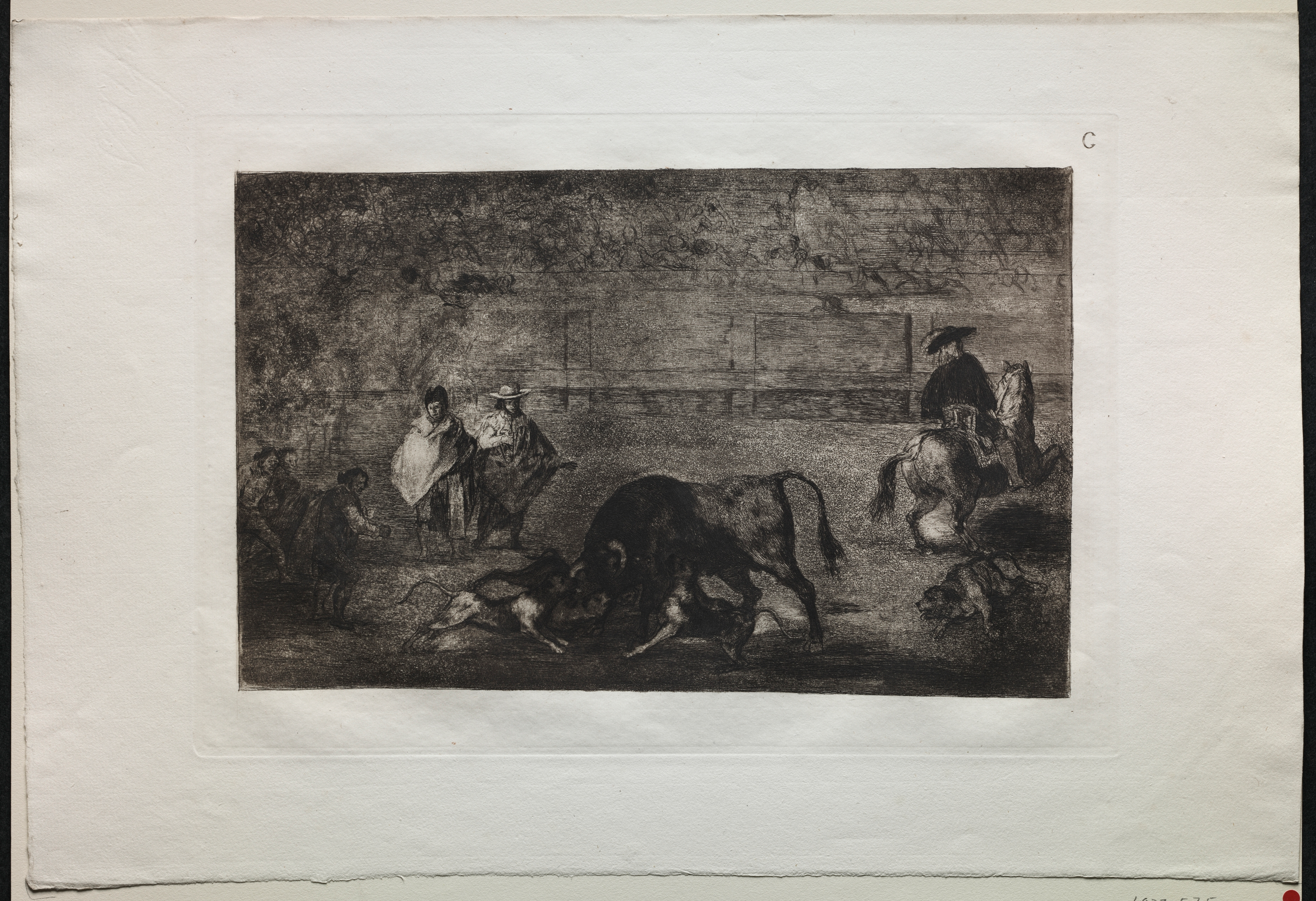
- A bullring scene in which dogs are set upon a bull, with handlers driving the dogs forward, mounted and cloaked spectators watching, and the wooden barrier of the arena separating crowd from the action. The work belongs to Goya's bullfighting series and depicts the baiting of the bull by dogs.(Wikimedia Commons, n.d.)
- Title variants
- Bullfights: The Dog Let Loose on the Bull; The Dog
- Accession number
- 1923.575
- Dimensions
- Unknown
Catalogue identity
The Cleveland Museum of Art catalogues the work as Bullfights: The Dog Let Loose on the Bull, by Francisco de Goya (Spanish, 1746 to 1828). The title, attribution, nationality and life dates come from the museum's record, which also classifies the object in the Prints department and notes that it is not currently on view. The full catalogue title and the artist attribution should be treated as the institutional identification of the object, since the evidence here derives the naming and authorship from that single official record rather than from a signature or inscription on the sheet.(Cleveland Museum of Art, n.d.)
Two dates must be kept apart. The composition dates to 1816, while this impression was printed in 1876. That distinction is preserved in the Cleveland Museum of Art record and in the Commons description: the image was conceived in 1816, but the particular physical object catalogued here is a later pull. The bullfighting series to which the work belongs, La Tauromaquia, is likewise described as engraved in 1816 and printed in the 1876 edition, so the object's date and the catalogue date of the design diverge by sixty years. This is not a discrepancy to resolve but a defining feature of the impression: it transmits an 1816 design through a nineteenth-century printing campaign.(Cleveland Museum of Art, n.d.)
The object is an engraving on paper, part of Goya's bullfighting series known as La Tauromaquia. The Cleveland record places the impression in its holdings, accession number 1923.575, acquired through the Charles W. Harkness Endowment Fund, with the credit line Charles W. Harkness Endowment Fund. The print is additionally catalogued by Harris as number 239 and cited by Perez Sanchez and Gallego, page 168, number 36(c), giving the object standard catalogue raisonné references alongside its museum accession. These identifiers allow the impression to be tracked across the Harris catalogue and the Perez Sanchez and Gallego citation as well as within the Cleveland collection.(Cleveland Museum of Art, n.d., Harris 239)
The Commons description associates the file with the museum object record and confirms the same series and printing data: the work belongs to the bullfighting series La Tauromaquia, engraved in 1816 and printed in the 1876 edition. Because the Commons file page and the museum record both supply the series name and the 1816 composition and 1876 impression dates, the series identification and date pattern are corroborated across two sources rather than resting on a single statement. The Commons page is used here for discovery and visual description support, while the institutional record supplies title, artist, medium, credit line, accession number and catalogue references.(Cleveland Museum of Art, n.d.)(Wikimedia Commons, n.d.)
Visual description and setting
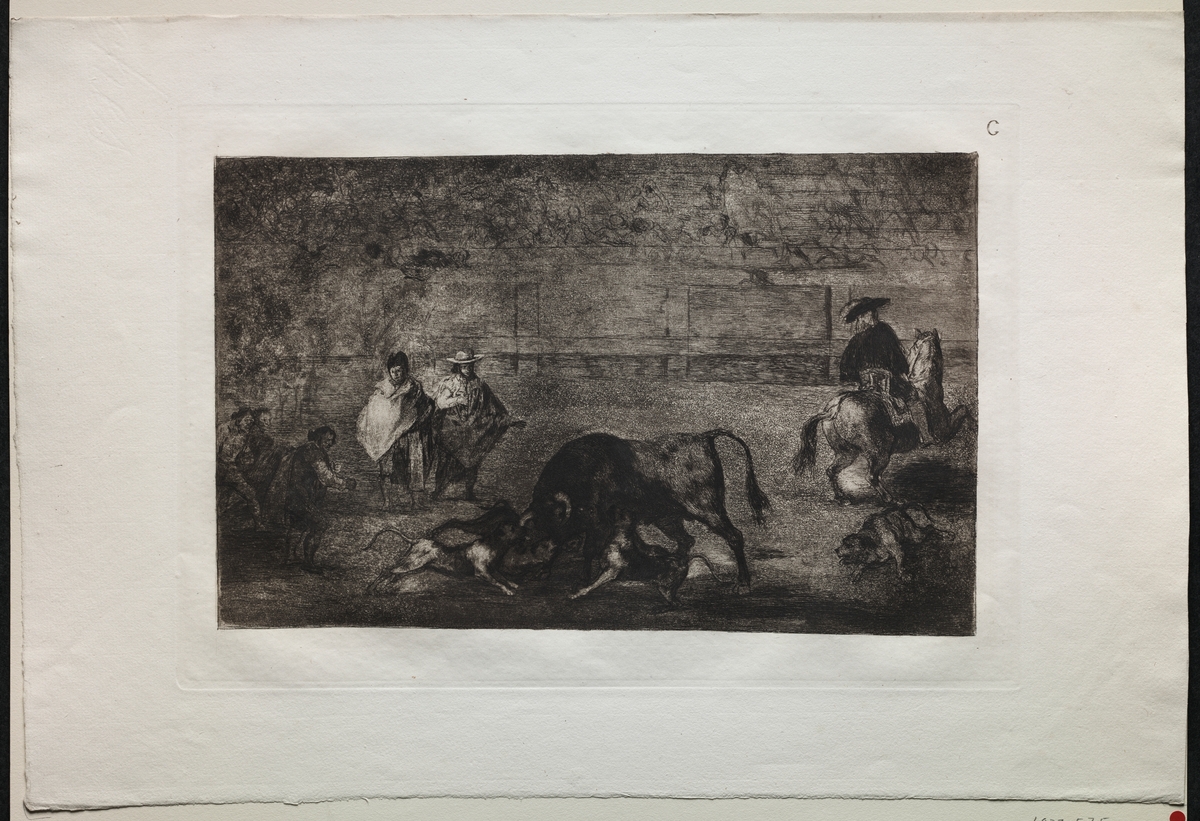
The visible image can be described in some detail. A heavy dark bull with lowered head stands in the ring; one dog springs at its muzzle and another bites at its legs. Two cloaked men gesture behind the bull, and at the left a crouching man and a standing figure with a stick or leash push the dogs toward the bull. A rider in a broad hat sits a horse at the right edge of the ring. A wooden fence of posts and rails spans the middle ground, with further rails and faint spectator marks beyond, fixing the bullring setting and separating crowd from bull. These observed elements connect the catalogue subject, the baiting of a bull by dogs, to the composition as seen: handlers, dogs, cloaked figures, mounted spectator and barrier are all present in the described image, so the printed scene supports the catalogue identification of the subject.(Cleveland Museum of Art, n.d.)
Interpretation
The subject is not a graceful pass with cape and sword: it is baiting, in which dogs are set upon the bull while men drive them forward. The composition places the viewer close to the violence and dispenses with the distractions of color, since the work is a black-and-white engraving. The image records a specific episode within the bullfighting tradition in which the bull is the target of dogs and handlers rather than a heroic opponent. The 1816 composition survives in the later 1876 impression, so Goya's image of the ring remained available long after it was made. This reading is an interpretation of the scene as described and catalogued, and it should be weighed as such rather than as a documented statement by the artist.(Cleveland Museum of Art, n.d.)
Subject and iconography
LinkVisual observation
The composition centers on a heavy dark bull that stands at bay in a bullring with its head lowered while dogs attack it. One dog springs at the bull's muzzle and another bites at its legs. Two cloaked men gesture behind the bull, and a rider in a broad hat sits a horse at the right edge of the ring. At the left, a crouching man and a standing figure carrying a stick or leash push the dogs toward the bull, making the human agents of the baiting explicit within the action rather than leaving them outside the frame.(Wikimedia Commons, n.d.)
The staging of the ring
The setting is identified by a wooden fence of posts and rails that spans the middle ground, with further rails and faint spectator marks visible beyond it. That barrier fixes the location as a bullring and separates the crowd from the bull and dogs, so the arena is not a neutral backdrop but an organized space with an internal boundary between spectators and the violence they watch.(Wikimedia Commons, n.d.)
Baiting, not a heroic pass
Within the visual evidence, the subject is the baiting of a bull by dogs rather than a heroic or graceful pass with cape and sword. Handlers drive the dogs forward, mounted and cloaked spectators occupy the ring's edge, and the wooden barrier of the arena frames the action. This distinction matters for how the image works: the bull appears as the target of dogs and handlers, and the human figures are shown actively directing the attack rather than performing a ritualized encounter between a single matador and the animal. The composition places the viewer close to this violence, with the engraving's black-and-white medium carrying the scene without the distractions of color.(Wikimedia Commons, n.d.)
The image depicts the baiting of a bull by dogs in a bullring, with handlers driving the dogs forward, mounted and cloaked spectators, and the wooden barrier of the arena.(Wikimedia Commons, n.d.)
The central action shows a heavy dark bull with lowered head as a dog springs at its muzzle and another bites at its legs; two cloaked men gesture behind the bull, and a rider in a broad hat sits a horse at the right edge of the ring.(Wikimedia Commons, n.d.)
At the left of the ring a crouching man and a standing figure with a stick or leash push the dogs toward the bull, naming the human agents of the baiting.(Wikimedia Commons, n.d.)
A wooden fence of posts and rails spans the middle ground, with further rails and faint spectator marks beyond, fixing the bullring setting and separating crowd from bull.(Wikimedia Commons, n.d.)
Object and Documentation
The object under study here is an engraving on paper by Francisco de Goya (Spanish, 1746 to 1828), titled Bullfights: The Dog Let Loose on the Bull, and classified within the Prints department of the Cleveland Museum of Art under accession number 1923.575. The museum records that the composition dates to 1816, while this particular impression was printed in 1876, so the sheet in Cleveland is a later pull from Goya's plate rather than a lifetime printing. The credit line is the Charles W. Harkness Endowment Fund. The work belongs to Goya's bullfighting series known as La Tauromaquia, a series engraved in 1816 and printed in the 1876 edition. The title and subject therefore tie the sheet simultaneously to an early nineteenth-century act of engraving and to a late nineteenth-century act of publication, two distinct moments that the object's documentation keeps separate. The same museum record states that the work is not currently on view.(Cleveland Museum of Art, n.d., Harris 239)(Wikimedia Commons, n.d.)
Goya's authorship is fixed in the institutional record, and his life dates are given as 1746 to 1828, so the 1816 composition falls in his late maturity, more than a decade before his death. The 1876 printing falls well after Goya's lifetime and belongs to the subsequent history of the plate rather than to his own studio practice. The evidence supplied does not name the printer, publisher or workshop responsible for the 1876 edition, nor does it specify how many impressions were pulled, so the circumstances of that later printing remain outside what the documents establish. It is also not stated when or from whom the Cleveland impression was acquired beyond the endowment fund credit line and the 1923 accession number embedded in its accession record.(Cleveland Museum of Art, n.d., Harris 239)(Wikimedia Commons, n.d.)
The composition is catalogued by Harris as number 239 and is cited by Perez Sanchez and Gallego at page 168, number 36(c). These two catalogue references give the sheet a stable identity within the literature on Goya's prints and allow the Cleveland impression to be matched against other impressions and against the series as a whole. The catalogue number and the page-and-number citation are the kind of locators that underpin further research into states, editions and collections, even though the evidence supplied here does not describe the state of the plate, the presence or absence of an engraved title, or the plate's dimensions.(Cleveland Museum of Art, n.d., Harris 239)(Wikimedia Commons, n.d.)
The Scene in the Ring
Interpretation
The visual evidence and the series membership reinforce one another. The setting described in the image, a bullring with its wooden barrier, mounted and cloaked spectators and handlers working the dogs, matches the kind of scene the La Tauromaquia title promises, and the institutional record independently confirms that the print belongs to that bullfighting series. Nothing in the supplied evidence, however, states which specific historical event or local custom the baiting scene records, so the print should be treated as Goya's depiction of the practice rather than as a documented transcript of a named incident.(Wikimedia Commons, n.d.)(Cleveland Museum of Art, n.d.)
The work belongs to Goya's bullfighting series, La Tauromaquia, engraved in 1816 and printed in the 1876 edition.(Cleveland Museum of Art, n.d.)(Wikimedia Commons, n.d.)
The engraving is catalogued by Harris, number 239, and cited by Perez Sanchez and Gallego, page 168, number 36(c).(Cleveland Museum of Art, n.d.)
Materials and technique
LinkObject record and medium
The Cleveland Museum of Art records the work under the title Bullfights: The Dog Let Loose on the Bull, by Francisco de Goya (Spanish, 1746 to 1828), accession number 1923.575, held in the Prints department and acquired through the Charles W. Harkness Endowment Fund. The museum's object record describes it as an engraving on paper, and the same medium and series identification is given in the Wikimedia Commons description of the image. Both the institutional record and Commons place the work within Goya's bullfighting series, La Tauromaquia, engraved in 1816 and printed in the 1876 edition. The classification of the sheet as an engraving in the Prints department is a documented catalogue fact, while the visual reading of the composition discussed below rests on description of the image rather than on examination of the physical sheet.(Cleveland Museum of Art, n.d.)(Wikimedia Commons, n.d.)
The Cleveland record states that the composition dates to 1816, while the impression in Cleveland was printed in 1876. Those are two distinct facts about two distinct moments: the design belongs to 1816, and the surviving sheet belongs to a later printing of the series. The same account appears in the Commons description, which dates the engraving to 1816 and identifies this impression as coming from the 1876 edition. Taken together, the evidence establishes that the museum's sheet does not preserve the printed form the composition first took, but a later impression of the same engraved image. Nothing in the supplied evidence describes the paper, its watermark, the ink, the press run, or any physical comparison between an 1816 impression and this 1876 one, so the differences between the early and late printings remain outside what the available evidence can specify.(Cleveland Museum of Art, n.d.)(Wikimedia Commons, n.d.)
The evidence identifies the work as an engraving on paper but does not describe any further material or technical detail of the sheet. There is no supplied account of the plate, its state or reworking, the tools used, the burin or needle work, the paper type, the printing ink, or any preparatory drawing, aquatint, etching, or drypoint layer. No pigment, colourant, support preparation, conservation treatment, or mount is mentioned. The account of the object in this section is therefore limited to what the record states plainly: an engraving on paper, part of La Tauromaquia, composition of 1816, this impression printed in 1876. Further claims about how the lines were cut or how the sheet was printed would exceed the evidence and are avoided here.(Cleveland Museum of Art, n.d.)(Wikimedia Commons, n.d.)
Catalogue references
The Cleveland record supplies two catalogue references for the print: it is catalogued by Harris, number 239, and cited by Perez Sanchez and Gallego, page 168, number 36(c). These citations tie the Cleveland sheet into the standard reference apparatus for the series, allowing the object to be identified and located within the literature on La Tauromaquia. The record does not state what those reference works say about the print's technique, its state, or its place within the sequence, so the citations function here as identification rather than as a source of technical description. The institutional record also notes that the work is not currently on view at the Cleveland Museum of Art.(Cleveland Museum of Art, n.d.)
The work is an engraving in the collection of the Cleveland Museum of Art, Prints department, credit line Charles W. Harkness Endowment Fund.(Cleveland Museum of Art, n.d.)
Collection and display
LinkInstitutional record and custody
The Cleveland Museum of Art holds an impression of Goya's bullfighting engraving under the title given in its institutional record, Bullfights: The Dog Let Loose on the Bull, accession number 1923.575, acquired through the Charles W. Harkness Endowment Fund. The museum classifies the sheet in its Prints department, and reports that it is not currently on view. That double fact of ownership and storage is worth registering precisely because it frames the kind of evidence available: what the object record establishes is custodial and bibliographic rather than visual, and it locates this impression in a public collection whose object file is the present authority for title, credit line and accession number.(Cleveland Museum of Art, n.d.)
Object, series and catalogue references
The same institutional record supplies the working description of the object itself. The print is an engraving on paper, made by Francisco de Goya (Spanish, 1746 to 1828), belonging to the bullfighting series known as La Tauromaquia. The museum dates the composition to 1816, while dating this particular impression to 1876, and describes the sheet as coming from the 1876 edition of the series. The record further identifies the engraving by its catalogue raisonné number, Harris 239, and notes a citation to Perez Sanchez and Gallego at page 168, number 36(c). Taken together, these details distinguish three things that are easily conflated: the date of the design, the date of the printing from which this sheet comes, and the scholarly apparatus by which the image is identified and located among Goya's graphic work.(Cleveland Museum of Art, n.d.)
The Cleveland Museum of Art holds this impression, accession number 1923.575, acquired through the Charles W. Harkness Endowment Fund.(Cleveland Museum of Art, n.d.)
Documented values and qualified estimates
LinkRecorded Values and Working Estimates
Interpretation
No official valuation for this object appears in the supplied records. The only figure available is a calculated working insurance estimate generated on 2026-10-16, which states a working insurance range of US$800 to US$2,500. That estimate is explicitly described as a broad, conservative working range for manual review, based only on the confirmed artwork context and the supplied source excerpts: an engraving by Francisco de Goya, dated 1816 and printed 1876, from the bullfighting series, accession number 1923.575, held by the Cleveland Museum of Art and acquired through the Charles W. Harkness Endowment Fund. The methodology states that Goya is a major historical artist, but the object is a later 1876 print rather than a unique painting, and that the sources provide no documented market price, sale result, appraisal, or official insurance value. The range is therefore calculated from general art-market considerations for 19th-century Goya engravings and comparable print-market conditions, not from any claimed comparable sale or private insurance record. Because the impression is a museum-held print with no scale or condition data supplied, a broad low-to-mid four-figure range is treated as appropriate for initial review, with the qualification that condition, impression quality, provenance, framing, and any certification could materially raise or lower the true figure. The estimate itself carries the qualification that it is model-generated, for manual review only, and not an official insurance value, appraisal, auction result, or sale price. It is not based on a physical examination, condition report, provenance verification, or private insurance records. Actual insurance or market value may differ materially and should be confirmed by a qualified appraiser or the holding institution. All values are stated in United States dollars.(Wikimedia Commons, n.d.)(Cleveland Museum of Art, n.d.)
Working estimate
Calculated working insurance estimate, not a sale price: Working insurance range: US$800 to US$2,500 Recorded date: Working calculation, generated 2026-10-16. Methodology: This is a broad, conservative working range for manual review based only on the confirmed artwork context and the supplied source excerpts. The work is an engraving by Francisco de Goya, dated 1816 and printed 1876, from the bullfighting series, accession number 1923.575, held by the Cleveland Museum of Art and acquired through the Charles W. Harkness Endowment Fund. Goya is a major historical artist, but the object is a later 1876 print rather than a unique painting, and the sources do not provide a documented market price, sale result, appraisal, or official insurance value. The range is therefore calculated from general art-market considerations for 19th-century Goya engravings and comparable print-market conditions, not from any claimed comparable sale or private insurance record. Because the impression is a museum-held print with no scale or condition data supplied, a broad low-to-mid four-figure range is appropriate for initial review, with the understanding that condition, impression quality, provenance, framing, and any certification could materially raise or lower the true figure. All values are in United States dollars. Qualification: This is a model-generated working range for manual review only. It is not an official insurance value, appraisal, auction result, or sale price. It is not based on a physical examination, condition report, provenance verification, or any private insurance records. The sources cited support artwork context only and do not contain a public valuation. Actual insurance or market value may differ materially and should be confirmed by a qualified appraiser or the holding institution.(Wikimedia Commons, n.d.)(Cleveland Museum of Art, n.d.)