Edvard Munch's The Dance of Life sets three women at different stages of love against a moonlit shore. This docent tour explains the symbolic cycle Munch built from the figures, their colours and their placement.
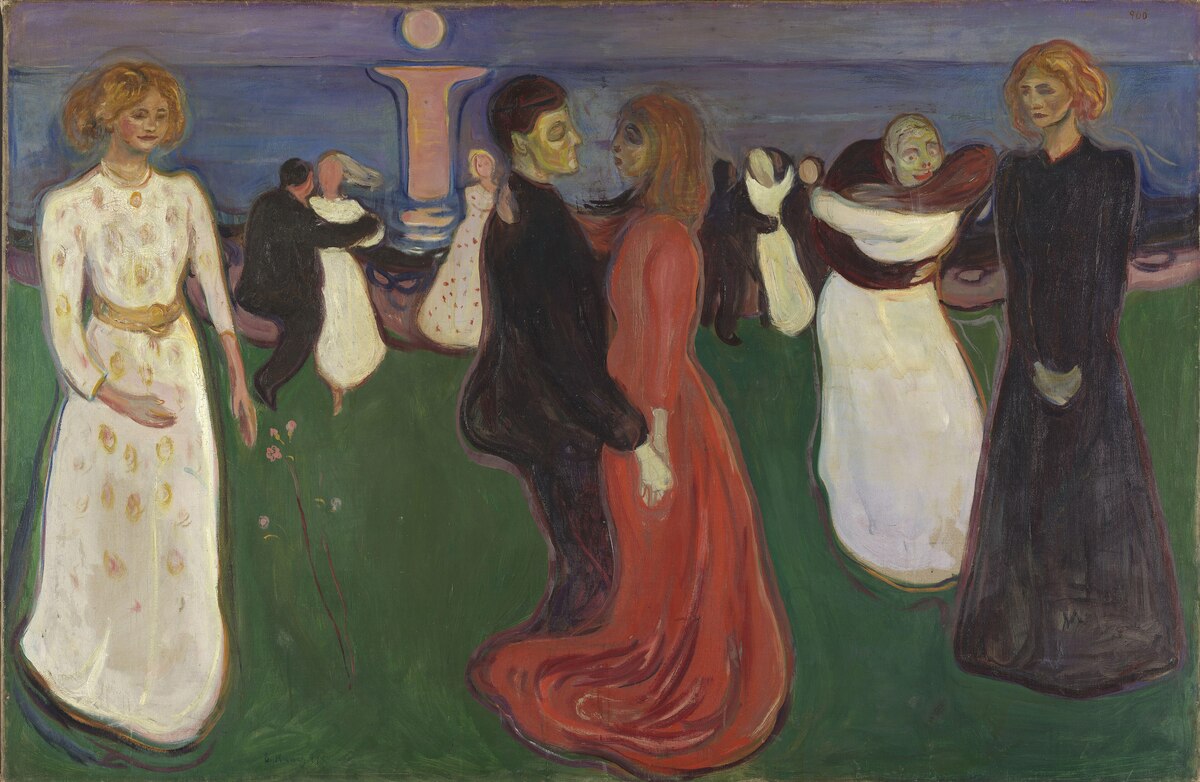
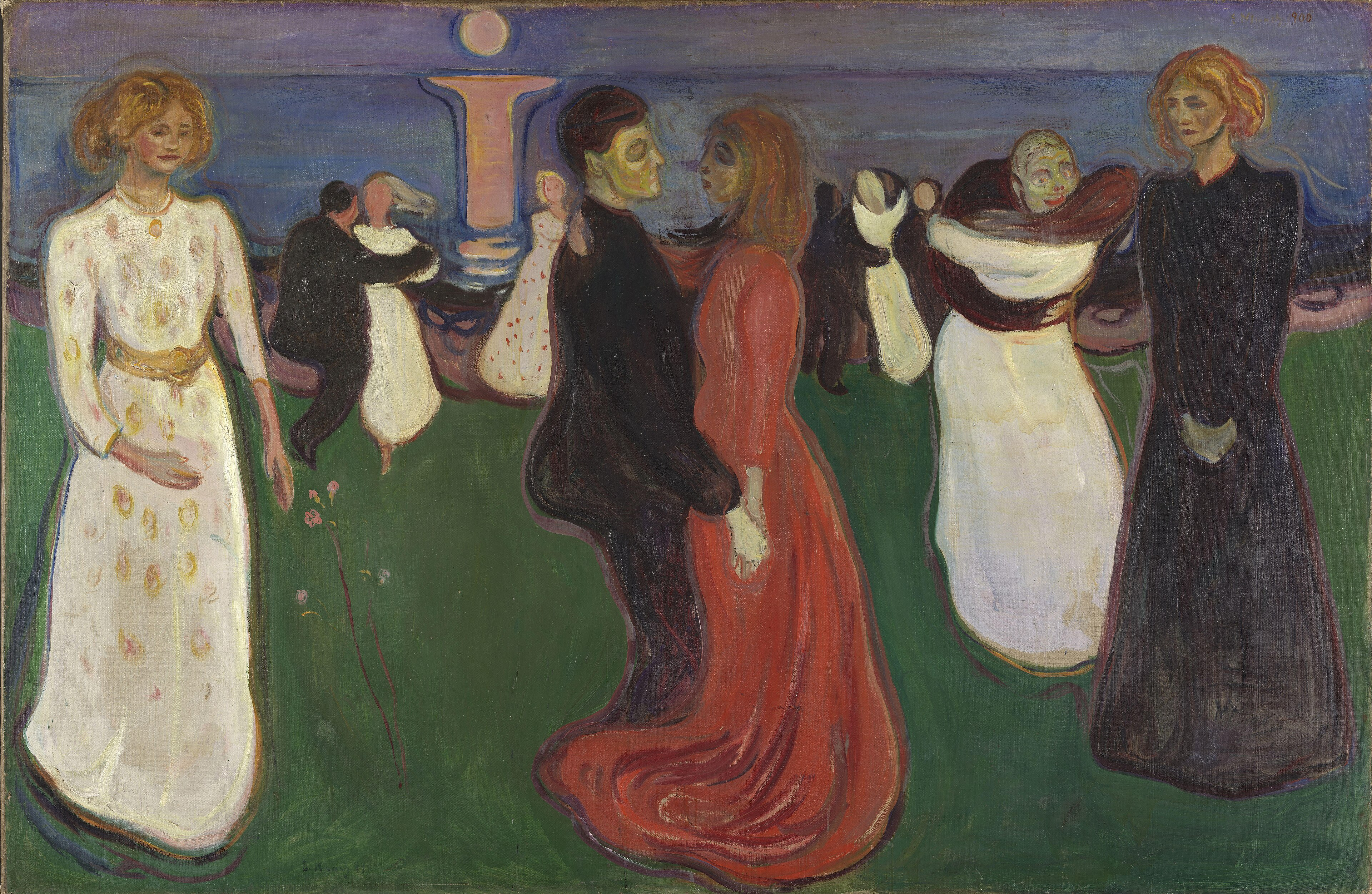
Two figures locked in a close embrace to the right of centre, one in clinging white, one with a dark head and greenish face, behaving with a frantic intimacy that contrasts with the formal dance around them.
02
Moon and reflected light pillar
The low moon at the top of the canvas and its vertical reflection on the water, forming a glowing pillar between landscape and sky that doubles as a symbol of life and desire.
03
Sorrowful woman in black
A red-haired woman in a floor-length black dress at the right, hands clasped low, eyes lowered in grief, closing the circle of the dance as the counterpart to the woman in white.
Your gallery guide
The Dance of Life by Edvard Munch (1899–1900)
Edvard Munch's The Dance of Life sets three women at different stages of love against a moonlit shore. This docent tour explains the symbolic cycle Munch built from the figures, their colours and their placement.
Editorial review by Artifact Archive automated publishing
Edvard Munch's The Dance of Life is a symbolic painting about the cycle of life and love.
At its centre, a couple dances on a moonlit shore. To their left stands a young woman in white, and to their right a sorrowful woman in black.
Look at how the three women are arranged across the canvas like a sequence.
The young woman in white sits on the left, the dancing couple occupies the middle, and the woman in black stands alone on the right.
The central couple holds each other close, their bodies angled toward the water.
The woman's white dress and the man's dark suit lock them together, while the couple's movement softens the scene's stillness.
Munch made this painting in 1899 and 1900, and it belongs to the National Museum of Art, Architecture and Design in Oslo.
The arrangement of the three women reads as a cycle. The white dress suggests youthful innocence, the dancing couple suggests love in the present, and the black dress suggests grief or loss.
The moonlit landscape behind them gives the whole scene a quiet, symbolic weight rather than a realistic setting.
The painting does not tell a single story with a clear before and after. Instead, it shows three moments of love side by side, so the viewer sees them all at once.
That side-by-side arrangement is what gives the work its emotional force.
What stays with you is the contrast between the dancing couple and the figures who stand apart.
Munch turns a simple dance into an image of how love changes over a lifetime, from hope to grief, and the painting holds all of those stages together in one view.
The story and its sources
Editorial review by Artifact Archive automated publishing.
Historical claims are linked to the records below. Close looking and interpretation are identified in the passage notes.
Edvard Munch was a Norwegian painter (1863–1944). Their work is associated with Symbolism; Expressionism. Their recorded places of work include Oslo; Berlin; Åsgårdstrand.
A symbolic depiction of the cycle of life and love, showing a central dancing couple, a young woman in white on the left, and a sorrowful woman in black on the right, set against a moonlit landscape.
Title variants
Livets dans; La danza de la vida; La Danse de la vie; Танец жизни; Der Tanz des Lebens; 生命のダンス; Dança da Vida; ריקוד החיים; Tanec života; Танець життя; La danza della vita; Dance of Life
Catalogue identification
The canonical catalogue identification for this work is The Dance of Life, with the Norwegian title Livets dans recorded alongside it. Its author is Edvard Munch, identified as a Norwegian painter and dated 1863 to 1944. The painting itself carries a date range of 1899 to 1900, which is the object date and should not be conflated with the date of any later catalogue, inventory or museum record. The canvas measures 125 cm in height and 191 cm in width, making it a large horizontal composition. Within the Oslo collection it is registered under the accession number NG.M.00941.(Wikimedia Commons: The Dance of Life, n.d., Title; Artist; Date; Dimensions; Accession number)
Technical description of The Dance of Life begins with its stated medium: the painting is executed in oil on canvas. This identification, recorded in the collection metadata for the work (given to the museum in 1910 and accessioned as NG.M.00941), establishes the material basis against which all further observations of surface, colour and handling must be read. The same record supplies the physical scale of the picture, 125 cm in height by 191 cm in width, and dates its making to 1899 to 1900, so the support is not a small panel but a large canvas intended for extended viewing. The Norwegian title Livets dans accompanies the English title in the same source, indicating that the work was made within a Norwegian-language context and later catalogued for an international collection. Any account of its pigments, ground layers, priming or varnish would require examination evidence that this record does not provide; what the documentation does establish is the primary material fact that oil paint was applied to a woven canvas support.(Wikimedia Commons: The Dance of Life, n.d., Medium)
Documentation and institutional record
The catalogue entry for the painting, Woll's Edvard Munch: Complete Paintings: Catalogue Raisonné, no. 464, provides the standard scholarly identification of the work and its inclusion within the artist's complete painted output. The painting is held by the National Museum of Art, Architecture and Design in Oslo, Norway, where it carries the accession number NG.M.00941, and it entered that collection as a gift in 1910, roughly a decade after its completion. These institutional facts matter for the study of materials because they define the object that technical examination would address and its custody history: a painting made in 1899 to 1900, donated in 1910, and subsequently documented in a comprehensive catalogue raisonné. The exhibition record preserved alongside this identification includes 'The Dance of Life – The collection from antiquity to 1950' at the National Museum of Art, Architecture and Design, 29 April 2011 to 13 January 2019; 'Olaf Schous gaver til Nasjonalgalleriet' at the National Gallery of Norway, 14 November 1987 to 7 February 1988; and 'Munch 150' at the Munch Museum, 2 June 2013 to 13 October 2013. Long display periods and repeated movement between venues are relevant to any future condition or treatment history, because exhibition exposes a canvas to light, handling and environmental variation, but the supplied record does not itself document conservation interventions, and none should be inferred from the exhibition list alone.(Wikimedia Commons: The Dance of Life, n.d., Medium)
Limits of the technical evidence
The evidence available for this section is limited to a single documented fact about medium, and that limitation should be stated plainly rather than filled with inference. The record establishes oil on canvas, but it does not identify a canvas weave, a preparatory ground, a priming colour, specific pigments, a varnish, a lining, a stretcher, or any tool or working method. Nor does it provide technical imaging, cross-sections, or conservation reports. Claims about how the paint was applied, whether the surface is thinly or heavily worked, or how the picture has aged therefore remain outside what the supplied units can support. What can be said is that the medium and the large dimensions together frame the object as a major oil painting on canvas dated to 1899 to 1900, and that its documented history of gift, accession and exhibition belongs to the same institutional record that supplies these material facts. Distinguishing carefully between what the documentation states and what visual inspection might suggest is the appropriate method here: the canvas and oil medium are documented, while questions of layer structure, pigment and condition await evidence not present in this account.(Wikimedia Commons: The Dance of Life, n.d., Medium)
The provenance of The Dance of Life, as documented on the Wikimedia Commons record for accession number NG.M.00941, is recorded in a single step: the painting was given to the museum in 1910. The record does not name the donor, does not state whether the gift was made directly by the artist, by an intermediary, or by a collector, and does not specify the date within 1910 on which the transfer occurred. It also does not describe the terms of the gift or whether any condition accompanied it. What the evidence does establish is the direction of the movement, from private hands into the museum, and the year in which that movement is said to have taken place. Nothing in the supplied evidence records any owner, sale, dealer, auction or transfer before that gift, so the earlier history of the picture remains unrecorded rather than proven absent. The distinction matters for how the object is described: an unrecorded interval is not the same as a documented change of ownership, and the record as it stands supports only the 1910 gift.(Wikimedia Commons: The Dance of Life, n.d., Object history)
Donors and Institutional Names
The object entering the collection in 1910 was not yet in the institution that holds it today. The evidence relates the gift to the museum whose modern name is the National Museum of Art, Architecture and Design, Oslo, while also recording that the painting was included in an exhibition titled Olaf Schous gaver til Nasjonalgalleriet at the National Gallery of Norway, held from 14 November 1987 to 7 February 1988. The title of that exhibition, which translates as Olaf Schou's gifts to the National Gallery, links the picture to a named donor, Olaf Schou, and to the National Gallery as the receiving institution. The evidence does not state that Schou was the donor of 1910, nor does it state when Schou's gift was made; it records only that the painting appeared in an exhibition defined by his gifts. Read together, the units place the picture within a collection formed through donation, and they show that the institutional name attached to the work changed over time, from the National Gallery of Norway to the National Museum of Art, Architecture and Design. That change of institutional name is a matter of the museum's own history, not a change in ownership of the painting, and the two should not be conflated.(Wikimedia Commons: The Dance of Life, n.d., Object history; Exhibition history)
Cataloguing and Identification
The catalogue raisonné reference supplied in the record is to Woll's Edvard Munch: Complete Paintings: Catalogue Raisonné, no. 464. That reference is a scholarly apparatus rather than a provenance document. It serves to identify the painting within the standard catalogue of Munch's complete paintings and to demonstrate that the work has been catalogued and numbered in that reference work. It does not, in the evidence given here, supply a chain of owners, a date of acquisition or a place of holding, and it should not be read as confirming the 1910 gift. The catalogue entry nonetheless matters for provenance research because a catalogue raisonné number is the identifier most often used to connect an object to earlier sales, inventories and exhibition records that are not cited in this evidence set. The Commons record also carries the accession number NG.M.00941, which is the museum's own identifier for the object and the reference through which the 1910 gift, the exhibitions and any future documentation can be tied to this specific canvas.(Wikimedia Commons: The Dance of Life, n.d., References; Object history)
The exhibition record of Edvard Munch's The Dance of Life (1899 to 1900, oil on canvas, 125 by 191 cm, National Museum of Art, Architecture and Design, Oslo, accession NG.M.00941) begins with a museum-specific presentation of the work's own acquisition history. The painting was included in the exhibition 'Olaf Schous gaver til Nasjonalgalleriet' at the National Gallery of Norway, held 14 November 1987 to 7 February 1988. The title identifies the exhibition as a showing of gifts made to the National Gallery by Olaf Schou, and the painting's presence in it connects the display of the work to the donor context that shaped the collection. This is the earliest of the three documented exhibition appearances and the only one tied explicitly to the National Gallery rather than to the later institution name.(Wikimedia Commons: The Dance of Life, n.d., Exhibition history; Object history)
Two further exhibitions place the painting in institutional narratives of a different kind. It was shown in 'Munch 150' at the Munch Museum from 2 June 2013 to 13 October 2013, an exhibition whose title associates it with the 150th anniversary context of Munch's birth, although the evidence supplied does not state that purpose explicitly. Later it formed part of 'The Dance of Life – The collection from antiquity to 1950' at the National Museum of Art, Architecture and Design, running 29 April 2011 to 13 January 2019. That exhibition title is shared with the painting's own title, and its stated scope, the collection from antiquity to 1950, places the work within a long chronological survey of the museum's holdings rather than in a monographic Munch display. The two shows thus represent different framing strategies: one built around the artist and one built around the breadth of a permanent collection.(Wikimedia Commons: The Dance of Life, n.d., Exhibition history)
Exhibition History and Display Status
The exhibition and reference documentation should not be conflated with the work's current display status. The evidence establishes that the painting has been exhibited in the three listed shows on the stated dates, and that it was given to the museum in 1910, but the supplied units do not state whether the work was on view at the time the record was compiled or where it hangs. The long run of 'The Dance of Life – The collection from antiquity to 1950' from 2011 to 2019 is a documented exhibition span, not a claim about continuous display in perpetuity. Distinguishing exhibition history from present display matters here because the painting's museum ownership since 1910 and its repeated inclusion in collection-based exhibitions are separate facts from any current installation.(Wikimedia Commons: The Dance of Life, n.d., Exhibition history; Object history)
The painting has been exhibited in 'The Dance of Life – The collection from antiquity to 1950' at the National Museum of Art, Architecture and Design, 29 April 2011 - 13 January 2019.(Wikimedia Commons: The Dance of Life, n.d.)
The painting was included in the exhibition 'Olaf Schous gaver til Nasjonalgalleriet' at the National Gallery of Norway, 14 November 1987 - 7 February 1988.(Wikimedia Commons: The Dance of Life, n.d.)
The reception of The Dance of Life is documented in the scholarly literature through its inclusion in Woll's Edvard Munch: Complete Paintings: Catalogue Raisonné, where it is referenced as no. 464. Cataloguing in a complete paintings catalogue raisonné is a specific form of scholarly reception: it establishes the work as part of the artist's accepted corpus and assigns it a stable identifier within that reference system. The painting was made by Edvard Munch (1863-1944), the Norwegian painter, is dated 1899 to 1900, is executed in oil on canvas, and measures 125 cm in height by 191 cm in width. It belongs to the collection of the National Museum of Art, Architecture and Design in Oslo, Norway, where it carries the accession number NG.M.00941. These identification and collection facts anchor the later reception history: the object's movements into and through public institutions were what made it available for exhibition, reproduction and study.(Wikimedia Commons: The Dance of Life, n.d., References; Exhibition history)
Exhibitions and Public Presentation
Interpretation
Taken together, the documented stages of reception run from entry into a public collection by gift in 1910, through commemoration of that gift in 1987-1988, to prominent and extended display in 2011-2019 and in the 2013 anniversary exhibition, alongside inclusion in a complete catalogue raisonné as no. 464. Each stage changed what the object stood for: a donated work within a benefactor's group, a commemorative highlight, a collection-defining title, a career landmark, and a catalogued reference object. The evidence does not establish an early history of admiration and imitation, a body of critical literary readings, or named later artistic appropriations, and those stages should not be assumed from the sequence documented here. What the units do establish is that the painting's cultural standing as a reference point, the anchor of an exhibition title and a numbered entry in the artist's catalogue raisonné, rests on a century of institutional custody and repeated public showing rather than on a single dramatic event.(Wikimedia Commons: The Dance of Life, n.d., Object history; Exhibition history; References)
The Dance of Life, known in Norwegian as Livets dans, is an oil painting on canvas by the Norwegian artist Edvard Munch, whose dates are given as 1863 to 1944. The work is dated from 1899 to 1900 and measures 125 cm in height by 191 cm in width. It carries the accession number NG.M.00941 and belongs to the collection of the National Museum of Art, Architecture and Design in Oslo, Norway. The painting entered that collection as a gift in 1910, an acquisition route distinct from purchase or commission and one that places the canvas in the museum's holdings more than a decade after its completion. Within the catalogue of Munch's paintings compiled by Woll, the work is entered as number 464, which fixes its identity for research purposes against a standard scholarly enumeration of the artist's painted output.(Wikimedia Commons: The Dance of Life, n.d., Collection)
Exhibition History
The exhibition record attaches the painting to several distinct institutional contexts. It was shown in Olaf Schous gaver til Nasjonalgalleriet at the National Gallery of Norway from 14 November 1987 to 7 February 1988, a display framed around gifts made by Olaf Schou, which corresponds with the painting's own history as a gift to the collection. It was exhibited again in Munch 150 at the Munch Museum from 2 June 2013 to 13 October 2013, an anniversary presentation centred on the artist. The work also featured in The Dance of Life – The collection from antiquity to 1950 at the National Museum of Art, Architecture and Design over a long run from 29 April 2011 to 13 January 2019, where the painting's own title supplied the exhibition's name and the display situated it within a broad chronological sweep of the collection from antiquity to the mid twentieth century. Taken together, these showings trace the canvas from a gifts-focused gallery exhibition in the late 1980s, through a long-term collection display that took the painting as its emblem, to a major monographic anniversary exhibition.(Wikimedia Commons: The Dance of Life, n.d., Collection)
Visual Conventions and Symbolic Reading
The painting's subject is a symbolic treatment of the cycle of life and love, organised around three women arranged across the canvas as a sequence. At the centre a couple dances on a moonlit shore; to their left stands a young woman in white, and to their right a sorrowful woman in black. The young woman in white sits on the left, the dancing couple occupies the middle, and the woman in black stands alone on the right. The central couple holds each other close with their bodies angled toward the water, and the woman's white dress together with the man's dark suit visually locks them together, while the couple's movement softens the stillness of the surrounding scene. The arrangement has been read as a cycle: the white dress suggesting youthful innocence, the dancing couple suggesting love in the present, and the black dress suggesting grief or loss, with the moonlit landscape behind them giving the whole scene a quiet symbolic weight rather than a realistic setting.(Wikimedia Commons: The Dance of Life, n.d., Collection)
Interpretation
Rather than telling a single story with a clear before and after, the painting sets three moments of love side by side so that the viewer sees them all at once, and it is this simultaneous arrangement that gives the work its emotional force. The contrast between the dancing couple and the figures who stand apart converts a simple dance into an image of how love changes over a lifetime, from hope to grief, with all of those stages held together in one view. This reading of the picture as a composite of stages rather than a narrative sequence is an interpretive tradition about the work, not a documented account by the artist, and it should be weighed as such. What the documented record independently establishes is the object's physical specification, its date span of 1899 to 1900, its gift to the Oslo museum in 1910, its accession number, its catalogue raisonné number, and its exhibition history, all of which provide the stable frame within which the symbolic interpretation is advanced. For the history of art and material culture, the canvas matters because it is a securely documented late 1890s Munch that entered a public Norwegian collection through donation and has since been repeatedly mobilised by the National Museum and the Munch Museum as a representative image, even lending its title to a long-running collection display.(Wikimedia Commons: The Dance of Life, n.d., Collection)
The object carries a compact set of identifying facts that anchor any discussion of its value. It is titled The Dance of Life, known in Norwegian as Livets dans, and is an oil on canvas measuring 125 cm in height and 191 cm in width. It was made by Edvard Munch (1863 to 1944), the Norwegian painter, and is dated 1899 to 1900. It belongs to the collection of the National Museum of Art, Architecture and Design in Oslo, Norway, where it is registered under accession number NG.M.00941. The work was given to the museum in 1910, and it is referenced in Woll's Edvard Munch: Complete Paintings: Catalogue Raisonne as number 464. These details, drawn from the Wikimedia Commons record for the painting, establish the object as a securely documented, museum-held canvas with a named maker, a narrow date range, recorded physical dimensions, an institutional accession identity, a dated mode of entry into the collection, and a place in the standard catalogue raisonne of Munch's paintings. The title, medium, dimensions, date, accession number, gift date and catalogue number are the baseline facts against which any valuation or interpretive claim about the work must be measured.(Wikimedia Commons: The Dance of Life, n.d.)
Exhibition and collection history
The painting's public history includes several exhibition appearances recorded alongside its collection data. It was shown in 'The Dance of Life - The collection from antiquity to 1950' at the National Museum of Art, Architecture and Design, running from 29 April 2011 to 13 January 2019. Earlier, it was included in 'Olaf Schous gaver til Nasjonalgalleriet' at the National Gallery of Norway, from 14 November 1987 to 7 February 1988. It was also exhibited in 'Munch 150' at the Munch Museum, from 2 June 2013 to 13 October 2013. These dates show the work moving between institutions and exhibition contexts over several decades, from a presentation of gifts to the National Gallery in the late 1980s, to a major Munch anniversary exhibition in 2013, to a long-running collection display that extended from 2011 into 2019. The exhibition record therefore documents both the painting's place in the National Museum's own collection narratives and its inclusion in broader Munch scholarship and commemoration. The Wikimedia Commons record is noted as partially consulted, so these exhibition details rest on the supplied source excerpts rather than on a full independent review of each venue's archives.(Wikimedia Commons: The Dance of Life, n.d.)
Working valuation figure and its qualifications
A working insurance estimate was generated for the painting on 16 October 2026. The calculated working range is US$400 million to US$800 million. The methodology states that this is a broad, conservative working insurance range for manual review, generated from the confirmed artwork context and the supplied institutional and Wikimedia source excerpts. The calculation rests on the work's status as a large-scale, fully autograph, documented oil on canvas by Edvard Munch, dated 1899 to 1900, held in the permanent collection of the National Museum of Art, Architecture and Design in Oslo under accession NG.M.00941, with an object history of being given in 1910 and cited in the Woll catalogue raisonne. As a canonical museum-held Munch painting of the Symbolist and Expressionist period, and a centerpiece of his Frieze of Life, its market-visible supply is described as effectively nil, so the range is positioned at a high, broad institutional-work level. The estimate is explicitly qualified: it is model-generated and for manual review only, not an official insurance value, appraisal, auction result or sale price. No comparable sales were identified, supplied or relied upon, no access to private insurance records was available or claimed, and the range is intentionally wide and unverified because no public sale, auction result, official appraisal or insurance schedule was supplied. It should be treated only as a working placeholder pending specialist valuation. This unit is an interpretation rather than a documented market fact, and it should be read as such: the number is a modelling exercise built from the object's documented identity and institutional status, not a reflection of any actual transaction.(Wikimedia Commons: The Dance of Life, n.d.)
Working estimate
Calculated working insurance estimate, not a sale price: Estimated insurance range: US$400M to US$800M Recorded date: Working calculation, generated 2026-10-16. Methodology: This is a broad, conservative working insurance range for manual review, generated from the confirmed artwork context and the supplied institutional/Wikimedia source excerpts. The calculation is based on the work's status as a large-scale, fully autograph, documented oil on canvas by Edvard Munch, dated 1899 to 1900, held in the permanent collection of the National Museum of Art, Architecture and Design in Oslo under accession NG.M.00941, with an object history of being given in 1910 and cited in the Woll catalogue raisonne. As a canonical museum-held Munch painting of the Symbolist/Expressionist period and a centerpiece of his Frieze of Life, its market-visible supply is effectively nil, so the range is positioned at a high, broad institutional-work level. The range is intentionally wide and unverified because no public sale, auction result, official appraisal, or insurance schedule was supplied. It should be treated only as a model-generated working placeholder for manual review and not as a market-tested value. Qualification: This is a model-generated working range for manual review only. It is not an official insurance value, appraisal, auction result, or sale price. No comparable sales were identified, supplied, or relied upon. No access to private insurance records was available or claimed. The range is broad and only for internal review before specialist valuation.(Wikimedia Commons: The Dance of Life, n.d.)
Further reading
Books for a closer look
Paid links. As an Amazon Associate I earn from qualifying purchases.
Recorded title 'Edvard Munch', a multi-author exhibition catalogue whose subjects include 'Exhibitions', 'Emotions in art', and the artist's dates. 'The Dance of Life' is thematically bound up with Munch's treatment of love, anxiety and death, so a catalogue naming 'Emotions in art' is a reasonable documented comparison for the work.
References are arranged by author or organisation, with links to the original publications. Where no publication date is recorded, n.d. means no date.
Source notes updated .
No recorded sources match these filters. Reset the filters to see the full bibliography.
03
Book
Edvard Munch, Paloma Alarcó, Patricia G. Berman and Jon-Ove Steihaug (2015).Edvard Munch: archetypes. Museo Thyssen-Bornemisza.
Recorded title 'Edvard Munch', a multi-author exhibition catalogue whose subjects include 'Exhibitions', 'Emotions in art', and the artist's dates. 'The Dance of Life' is thematically bound up with Munch's treatment of love, anxiety and death, so a catalogue naming 'Emotions in art' is a reasonable documented comparison for the work.
Recorded title 'Edvard Munch', credited to Leena Ahtola-Moorhouse with Otto Selen as editor, and catalogued under the subject 'Exhibitions'. An exhibition publication on Munch can plausibly address the large central paintings, including 'The Dance of Life', though the record itself does not confirm the specific work.
Advertising supports the archive. These preferences control aggregate page counting, reading activity and ad-delivery diagnostics. They use no visitor tracking cookie.