ArchiveThe Astronomer

Artwork record / 267 of 331

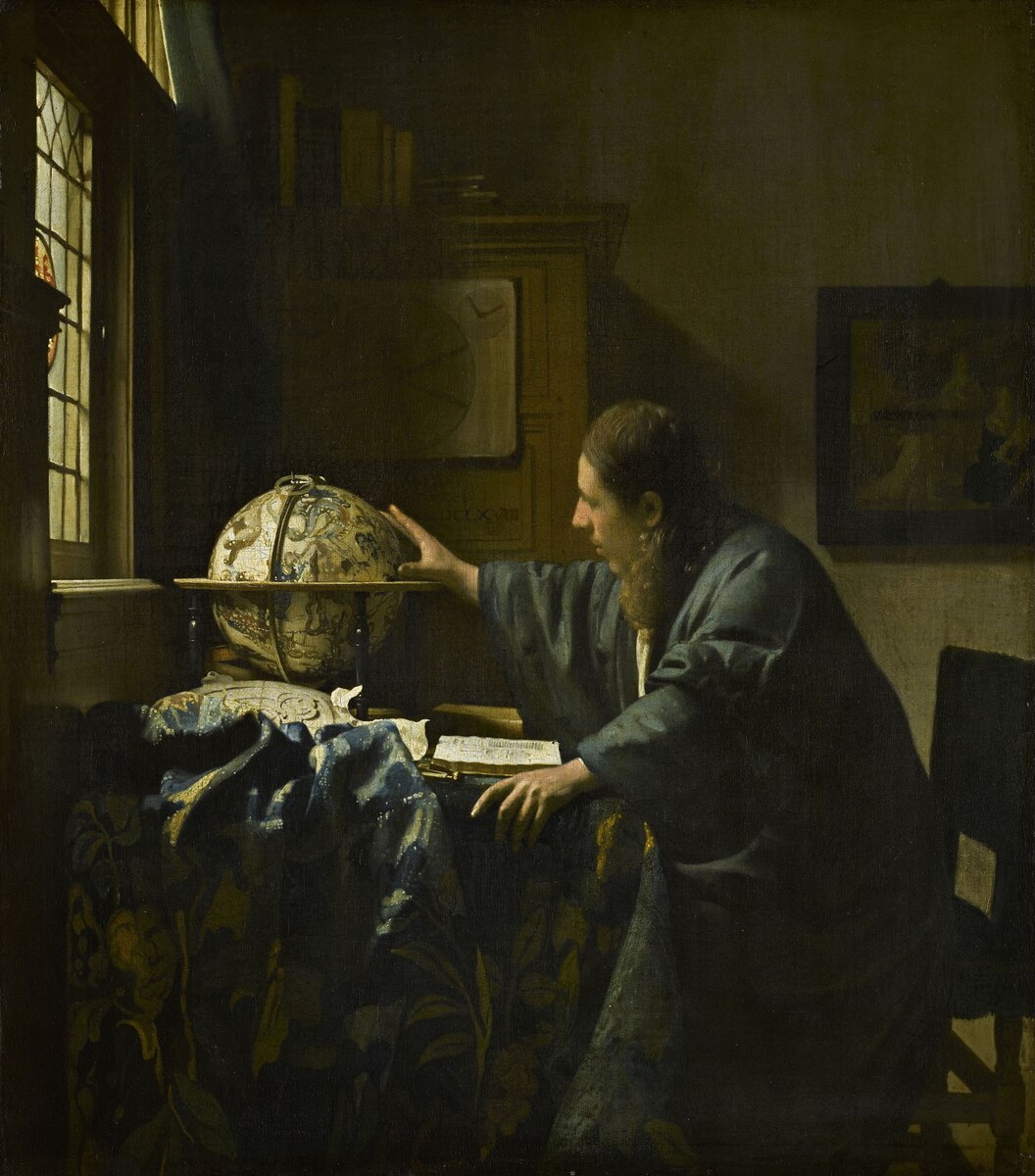
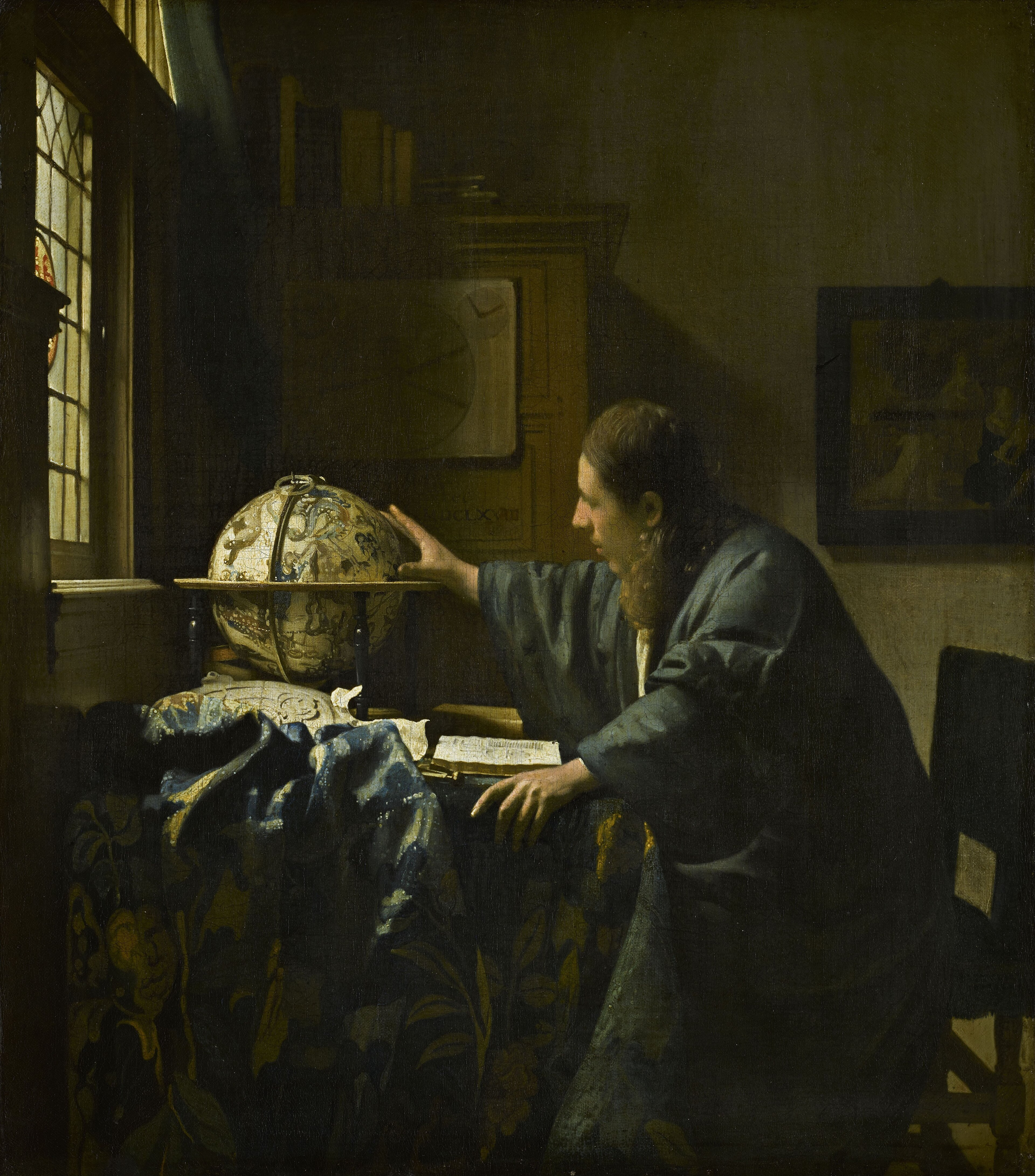
The Astronomer by Johannes Vermeer (circa 1668)

Artist: Johannes Vermeer

A visitor's guide to Vermeer's small painting of a man seated alone with a celestial globe and an open book, made in the Dutch Golden Age. The article follows what the supplied record establishes about the subject, its genre and its long movement through ownership, without guessing what the picture's sources do not say.

Read the story ↓ About the artist ↓ Research and record ↓ Literature and sources ↓ Listen to the article ↓
Article text for AI
Shop this artwork ↓ 1 visit
Datecirca 1668CultureDutch PeriodDutch Golden AgeCurrent locationLouvre Museum, Paris, France
Listen to the article
100%
The Astronomer by Johannes Vermeer (circa 1668)
Loading full-resolution artwork…
Scroll to zoom · drag to pan · double-click to focus Pinch to zoom · drag to explore · double-tap to focus FIELD VIEW / 267
Tools & download
Pixel colour Select a pixel with the eyedropper
No pixel selected

Choose the eyedropper, then click or tap the image. Scroll to zoom for finer selection.

Add text

Hand to pan · Select to move text and drawings · Add as many texts as you like · Scroll to zoom

The Astronomer: high-resolution image

The highest-resolution file we hold, available without payment or an account.3,840 × 4,363 pixels.

Download highest-resolution image

Details to notice

About 3 minutes to read
01

Framed painting on the back wall

A dark framed picture hangs on the right wall, its figures barely legible in shadow, functioning as a second image within the image and adding an emblematic, moralising note to the scholar's room.

02

Patterned carpet over the table

A heavy blue, gold and cream patterned carpet is thrown over the table and falls in folds at the lower left, its weave and highlights showing Vermeer's handling of luxurious texture and reflected light.

03

Open book and instrument

An open folio with visible text lies on the table under his resting left hand, with a metal instrument resting on it, marking the scholar's working surface of reference and measurement.

Possible self-portrait of Johannes Vermeer
Possible self-portrait Image credit

Johannes Vermeer. Image source · Public domain

About the artist

Johannes Vermeer

1632 to 1675

Vermeer was a Dutch painter who lived and worked in Delft. His small surviving body of work includes religious subjects and domestic interiors shaped by carefully placed objects, architectural space and subtle light. He became a master in Delft's painters' guild in 1653, and his paintings attracted collectors during his lifetime.

Born
1632
Died
1675
Nationality
Dutch
Birthplace
Delft, Netherlands
Died in
Delft, Netherlands

The research & record

Study the work.
Follow the evidence.

Find catalogue details, historical context, technical research and the literature behind this artwork.

Article text for AI
Open research text

The artwork record

Research catalogue

Catalogue information and detailed research, with references that link to the bibliography.

Updated .

Identity and catalogue

Link
Artist or attribution
Johannes Vermeer
Medium and support
oil on canvas
Dimensions
50 × 45 cm (19.6 × 17.7 in)(Wikimedia Commons: The Astronomer, n.d.)
Current collection or location
Louvre Museum, Paris, France(Wikimedia Commons: The Astronomer, n.d.)
Movement or period
Dutch Golden Age
Country or culture
Dutch
Depicted subject
A man, identified in the source as an astronomer, sits at a table consulting a celestial globe and an open book of reference in a dimly lit interior.(Wikimedia Commons: The Astronomer, n.d.)
Title variants
The Astronomer; L'Astronome
Accession number
RF 1983-28
Support
canvas
Catalogue identification

The painting is catalogued as The Astronomer and attributed to Johannes Vermeer, the Dutch artist whose dates are given as 1632 to 1675. The work is dated circa 1668, so the object date belongs to the later 1660s rather than to any later moment of documentation; that approximate date is distinct from the dates of the catalogues and records through which the painting is now known. It is an oil painting on canvas, executed in the medium Vermeer used for many of his quiet interior scenes, and it measures 50 by 45 centimeters, about 19.6 by 17.7 inches. The catalogued title, attribution, approximate date, medium, support and dimensions together constitute the work's basic identification, and they should be kept separate from the dates at which owners, sales and institutions are recorded.(Wikimedia Commons: The Astronomer, n.d., Summary: Artist Johannes Vermeer (1632–1675); Title The Astronomer; Summary: Date circa 1668; Summary: Medium oil on canvas; Dimensions 50 × 45 cm (19.6 × 17.7 in))

Subject and classification

The source identifies the depicted figure as an astronomer and classifies the painting as genre art, meaning it presents an ordinary scene of daily life rather than a famous narrative or a portrait of a named sitter. The same source records Moses among the depicted people, but it does not explain that listing further, so the painting's exact relationship to the name Moses remains unclarified. The source likewise does not say whether the astronomer is a specific person or a general figure; it gives the title, the attribution, the medium and the subject while leaving the identity of the man open. The genre classification and the astronomer identification are therefore documented catalogue descriptions, whereas the precise identity of the seated figure and the unexplained reference to Moses remain unresolved in this record.(Wikimedia Commons: The Astronomer, n.d., Summary: Object type painting; Genre genre art; Title The Astronomer; Summary: Object type painting; Genre genre art; Depicted people Moses)

The artwork is titled The Astronomer and is attributed to Johannes Vermeer (1632–1675).(Wikimedia Commons: The Astronomer, n.d.)

The Astronomer is dated circa 1668.(Wikimedia Commons: The Astronomer, n.d.)

The Astronomer is an oil painting on canvas measuring 50 by 45 centimeters, or about 19.6 by 17.7 inches.(Wikimedia Commons: The Astronomer, n.d.)

The source identifies the depicted figure as an astronomer and classifies the painting as genre art.(Wikimedia Commons: The Astronomer, n.d.)

Historical context

Link
The object and its catalogue record

One element of the source's summary sits awkwardly against the rest of its description and deserves to be stated plainly rather than smoothed over. Alongside the classification of the painting as genre art, the source also records Moses among the depicted people. The record offers no explanation of that entry and no indication of how a figure of Moses relates to a scene built around a seated astronomer, a celestial globe and an open book. Because the evidence does not elaborate, the connection cannot be resolved here, and the safest scholarly position is to preserve the inconsistency as it stands rather than to infer a narrative or a second subject that the source does not supply. This is a reminder that catalogue summaries aggregate fields whose intended scope is not always self-evident, and that an unexplained entry in one field should not be allowed to rewrite the work's documented classification.(Wikimedia Commons: The Astronomer, n.d., Summary: Object type painting; Genre genre art; Depicted people Moses)

Interpretation

Read together, the evidence supports a connected account of what can be seen, what the record establishes and why the object matters. What can be seen, according to the source's description, is a man identified as an astronomer seated at a table in a dim interior, consulting an open book of reference and a celestial globe; the source says nothing about whether he is a specific person or a general figure, and it leaves the identity of the man open. What the record establishes is narrower and firmer: a genre painting attributed to Vermeer, dated to about 1668, in oil on canvas, of the stated dimensions, with a documented ownership history that runs from Dutch private collections through nineteenth-century auctions and Rothschild holdings, a 1940 confiscation, and eventual entry into the French State collection and the Louvre. The gap between the visible subject and the documented ownership is not a defect in the account but part of its structure: the painting's cultural significance rests on both its status as a genre interior and its long, eventful passage through European collections. Within a larger history of art and material culture, the object is a case where an apparently quiet scene of study carries a provenance that spans the Dutch Republic, the nineteenth-century art market, the Rothschild collections, wartime seizure in 1940, and twentieth-century nationalisation in France.(Wikimedia Commons: The Astronomer, n.d., Summary: Object type painting; Genre genre art; Depicted people Moses; Object history: 1881: auctioned for 44500 French franc; 1881: in collection of Léon Gauchez; Object history: 1885: in collection of Alphonse James de Rothschild; 1905: in collection of Édouard Alphonse James de Rothschild; Object history: 1940: in collection of Adolf Hitler; 1940: unknown event: confiscation; Object history: 1949: in collection of Guy de Rothschild; 1983: in collection of French State)

The source classifies the work as genre art and records Moses among the depicted people.(Wikimedia Commons: The Astronomer, n.d.)

Provenance and ownership

Link
Early Dutch Ownership

The documented ownership of the painting begins in the seventeenth century with the Paets family. The source places it in the collection of Adriaen Paets I by 1669, and in that of Adriaen Paets II by 1686. Both are terminal dates in the record as given: the source establishes possession no later than those years but does not state when or how the work entered either collection, so the interval before 1669 and the transmission between the two owners remain unrecorded rather than proven. The two names together indicate that the painting remained within a single family line across at least a generation, but the source supplies no instrument, inventory or sale to explain the passage from one to the other.(Wikimedia Commons: The Astronomer, n.d., Object history: 1669: in collection of Adriaen Paets I; 1686: in collection of Adriaen Paets II)

The eighteenth-century record is more dispersed and its dates are uneven in precision. The source places the painting in the collection of Alexandre Joseph Paillet by 1784, and separately records it in the collection of Jan Danser Nijman at some point in the eighteenth century, and in that of Jan Gildemeester by 1797. Because the Nijman holding is dated only to the century and not to a year, its position in the sequence relative to the 1784 and 1797 entries cannot be fixed from the evidence supplied; the source gives no order of transfer among Paillet, Nijman and Gildemeester, and no sale or bequest connecting them. What can be said is that by 1797 the work was in a third named collection within the same century, and that the century as a whole shows the painting moving through several hands without the source recording the mechanisms of those moves.(Wikimedia Commons: The Astronomer, n.d., Object history: 1784: in collection of Alexandre Joseph Paillet; Object history: 18th century: in collection of Jan Danser Nijman; 1797: in collection of Jan Gildemeester)

Auctions and the Rothschild Collections

The nineteenth-century record documents two auctions and two subsequent owners. The source records that the painting was auctioned in 1881 for 44,500 French francs and entered the collection of Léon Gauchez in the same year. It further records that the painting entered the collection of Alphonse James de Rothschild in 1885 and that of Édouard Alphonse James de Rothschild in 1905. The 1881 sale and the Gauchez acquisition are given as occurring in a single year, and the Rothschild entries follow at documented intervals. The source as supplied to this section does not state the circumstances of the 1885 or 1905 transfers, so the account treats them as recorded collection entries rather than as purchases, gifts or inheritances.(Wikimedia Commons: The Astronomer, n.d., Object history: 1881: auctioned for 44500 French franc; 1881: in collection of Léon Gauchez; Object history: 1885: in collection of Alphonse James de Rothschild; 1905: in collection of Édouard Alphonse James de Rothschild)

Wartime Transfer and Postwar Settlement

The wartime entry is the most consequential and the most thinly documented transfer in the sequence. The source records that in 1940 the painting entered the collection of Adolf Hitler after an event described as confiscation. The source states the confiscation plainly but adds no account of the mechanism, the location, the prior holder at the moment of seizure, or any documentation generated by the transfer; this account therefore does not supply those details. What the evidence establishes is the recorded fact of a 1940 entry into Hitler's collection following an event the source labels confiscation, which places a documented dispossession between the 1905 Rothschild holding and the postwar settlement recorded next.(Wikimedia Commons: The Astronomer, n.d., Object history: 1940: in collection of Adolf Hitler; 1940: unknown event: confiscation)

The postwar and later record closes the sequence. The source places the painting in the collection of Guy de Rothschild in 1949, and in the collection of the French State in 1983. The return to a Rothschild collection in 1949 and the transfer to the State in 1983 are each recorded as dated entries; the source does not state the legal instrument behind either, nor does it describe the 1940 to 1949 interval beyond the two bracketing entries. Read together with the accession number recorded for the Louvre and the museum's stated room, the 1983 entry into the French State collection corresponds in the source to the work's present institutional home, although the evidence supplied here does not itself spell out that correspondence in a single statement.(Wikimedia Commons: The Astronomer, n.d., Object history: 1949: in collection of Guy de Rothschild; 1983: in collection of French State)

Classification and Public Display

Interpretation

Taken as a whole, the ownership record is best described by its shape rather than by a continuous narrative. The dates cluster into identifiable moments: a family holding by 1669 and 1686, several eighteenth-century collections with only terminal dates, an 1881 auction followed by named owners in 1881, 1885 and 1905, a 1940 confiscation entry, and postwar entries in 1949 and 1983. Between and within those clusters the source frequently records possession at a date without recording the transaction that produced it, so the intervals before 1669, between 1686 and 1784, between 1797 and 1881, and between 1940 and 1949 are unrecorded intervals in this evidence rather than documented changes of ownership. The value of the chain for material-culture research lies precisely in that unevenness: it shows an object circulating through Dutch private collections, the nineteenth-century art market, European banking families, a wartime seizure, and finally a national museum, while marking clearly where the evidence stops and inference would begin.(Wikimedia Commons: The Astronomer, n.d., Object history: 1669: in collection of Adriaen Paets I; 1686: in collection of Adriaen Paets II; Object history: 18th century: in collection of Jan Danser Nijman; 1797: in collection of Jan Gildemeester; Object history: 1881: auctioned for 44500 French franc; 1881: in collection of Léon Gauchez; Object history: 1940: in collection of Adolf Hitler; 1940: unknown event: confiscation; Object history: 1949: in collection of Guy de Rothschild; 1983: in collection of French State)

The source records that the painting was in the collection of Adriaen Paets I by 1669 and Adriaen Paets II by 1686.(Wikimedia Commons: The Astronomer, n.d.)

The source records that the painting was in the collection of Alexandre Joseph Paillet by 1784.(Wikimedia Commons: The Astronomer, n.d.)

The source records that the painting was in the collection of Jan Danser Nijman in the 18th century and Jan Gildemeester by 1797.(Wikimedia Commons: The Astronomer, n.d.)

The source records that the painting entered the collection of Alphonse James de Rothschild in 1885 and that of Édouard Alphonse James de Rothschild in 1905.(Wikimedia Commons: The Astronomer, n.d.)

The source records that in 1940 the painting entered the collection of Adolf Hitler after an event described as confiscation.(Wikimedia Commons: The Astronomer, n.d.)

The source records that the painting entered the collection of Guy de Rothschild in 1949 and the collection of the French State in 1983.(Wikimedia Commons: The Astronomer, n.d.)

Provenance timeline
  1. by 1669

    The painting is recorded in the collection of Adriaen Paets I.(Wikimedia Commons: The Astronomer, n.d., Object history: 1669: in collection of Adriaen Paets I; 1686: in collection of Adriaen Paets II)

  2. by 1686

    The painting is recorded in the collection of Adriaen Paets II.(Wikimedia Commons: The Astronomer, n.d., Object history: 1669: in collection of Adriaen Paets I; 1686: in collection of Adriaen Paets II)

  3. by 1784

    The painting is recorded in the collection of Alexandre Joseph Paillet.(Wikimedia Commons: The Astronomer, n.d., Object history: 1784: in collection of Alexandre Joseph Paillet)

  4. by 1797

    The painting is recorded in the collection of Jan Gildemeester.(Wikimedia Commons: The Astronomer, n.d., Object history: 18th century: in collection of Jan Danser Nijman; 1797: in collection of Jan Gildemeester)

  5. 1881

    The painting was auctioned for 44,500 French francs and entered the collection of Léon Gauchez in the same year.(Wikimedia Commons: The Astronomer, n.d., Object history: 1881: auctioned for 44500 French franc; 1881: in collection of Léon Gauchez)

  6. 1885

    The painting entered the collection of Alphonse James de Rothschild.(Wikimedia Commons: The Astronomer, n.d., Object history: 1885: in collection of Alphonse James de Rothschild; 1905: in collection of Édouard Alphonse James de Rothschild)

  7. 1905

    The painting entered the collection of Édouard Alphonse James de Rothschild.(Wikimedia Commons: The Astronomer, n.d., Object history: 1885: in collection of Alphonse James de Rothschild; 1905: in collection of Édouard Alphonse James de Rothschild)

  8. 1940

    The painting entered the collection of Adolf Hitler after an event recorded as confiscation.(Wikimedia Commons: The Astronomer, n.d., Object history: 1940: in collection of Adolf Hitler; 1940: unknown event: confiscation)

  9. 1949

    The painting entered the collection of Guy de Rothschild.(Wikimedia Commons: The Astronomer, n.d., Object history: 1949: in collection of Guy de Rothschild; 1983: in collection of French State)

  10. 1983

    The painting entered the collection of the French State.(Wikimedia Commons: The Astronomer, n.d., Object history: 1949: in collection of Guy de Rothschild; 1983: in collection of French State)

  11. 18th century

    The painting is recorded in the collection of Jan Danser Nijman during the 18th century.(Wikimedia Commons: The Astronomer, n.d., Object history: 18th century: in collection of Jan Danser Nijman; 1797: in collection of Jan Gildemeester)

Exhibition history

Link

The source lists an exhibition titled "Vermeer and the Masters of Genre Painting. Inspiration and Rivalry." running from 22 February 2017.(Wikimedia Commons: The Astronomer, n.d.)

Reception and literature

Link
The Object and Its Documentary Record

The Astronomer, attributed to Johannes Vermeer (1632-1675) and dated to about 1668, is an oil painting on canvas classified by the source as genre art, and it is now recorded in the collection of the Louvre Museum. The source identifies the depicted figure as an astronomer and also lists a figure named Moses among the depicted people, but it does not explain that listing further; the painting's exact relationship to the name Moses therefore remains unclarified in the supplied record, and the identity of the seated man as a specific individual or a general figure is likewise left open. Any account of the work's reception has to begin from this modest documentary base, because everything later attributed to the picture as a cultural object rests on a source that is explicit about title, attribution, approximate date, medium, classification and subject, and silent on intent, sitter and the reason for the Moses entry.(Wikimedia Commons: The Astronomer, n.d., Exhibition history: Vermeer and the Masters of Genre Painting. Inspiration and Rivalry., 22 February 2017; Summary: Object type painting; Genre genre art; Depicted people Moses)
The 2017 Exhibition and the Genre Tradition

The source lists an exhibition titled "Vermeer and the Masters of Genre Painting. Inspiration and Rivalry." running from 22 February 2017. That title frames the work within a comparative account of genre painting and of artistic rivalry, which is a different kind of reception from private ownership, auction value or wartime seizure: it places the picture in a curated argument about Vermeer's relationship to other painters of everyday life. The source records the exhibition's start date and title, and its inclusion of the painting is part of the object's documented exhibition history; the source does not, however, describe the painting's specific role in the display or any catalogue text, so the exhibition can be treated as a documented public presentation of the work without overstating what it demonstrated about the picture. It also confirms that by 2017 the painting was circulating as a loanable, publicly discussed museum object rather than only as a recorded accession in the Louvre.(Wikimedia Commons: The Astronomer, n.d., Exhibition history: Vermeer and the Masters of Genre Painting. Inspiration and Rivalry., 22 February 2017)

What the Evidence Supports About Reception

Interpretation

Read together, the supplied units support a reception history in stages rather than a single dramatic event. The work first appears as a named object in Dutch private collections, is recorded in the eighteenth century with Paillet, Nijman and Gildemeester, is priced at auction in 1857 and again in 1881, enters the Rothschild collections in 1885 and 1905, is seized and recorded in Hitler's collection in 1940, returns to Guy de Rothschild in 1949 and passes to the French State in 1983, and is presented in a 2017 exhibition on Vermeer and the masters of genre painting. The wartime confiscation is documentary and consequential and should not be minimized, but it is one stage among several transfers of ownership and display, not the explanation of the picture's fame. The source never supplies a biography of the sitter, a statement of the artist's intention, or an account of critical acclaim, so the accumulated meanings traced here are those established by ownership, market valuation and exhibition, all of which the supplied evidence dates and names.(Wikimedia Commons: The Astronomer, n.d., Object history: 1669: in collection of Adriaen Paets I; 1686: in collection of Adriaen Paets II; Object history: 1784: in collection of Alexandre Joseph Paillet; Object history: 18th century: in collection of Jan Danser Nijman; 1797: in collection of Jan Gildemeester; Object history: 1885: in collection of Alphonse James de Rothschild; 1905: in collection of Édouard Alphonse James de Rothschild; Object history: 1940: in collection of Adolf Hitler; 1940: unknown event: confiscation; Object history: 1949: in collection of Guy de Rothschild; 1983: in collection of French State; Object history: 1881: auctioned for 44500 French franc; 1881: in collection of Léon Gauchez; Exhibition history: Vermeer and the Masters of Genre Painting. Inspiration and Rivalry., 22 February 2017)

Collection and display

Link
Object and attribution

The Astronomer is attributed to Johannes Vermeer (1632–1675) and dated to about 1668. The source classifies the work as genre art, that is, a picture of an ordinary scene of daily life rather than a depiction of a famous narrative or a portrait of a named sitter, and it identifies the depicted figure as an astronomer. The painting is oil on canvas, measuring 50 by 45 centimeters, roughly 19.6 by 17.7 inches. Within Vermeer's output this places the picture among his quiet interior scenes executed in the same medium he used for many such works, and it anchors the object in the Dutch Golden Age context in which study, measurement and observation of the heavens were serious pursuits for a man of learning.(Wikimedia Commons: The Astronomer, n.d., Summary: Collection Louvre Museum; Current location room 837; Accession number RF 1983-28)

The source records that the painting belongs to the collection of the Louvre Museum, where it is recorded in room 837 under accession number RF 1983-28. The same source states that the work entered the collection of the French State in 1983, which is consistent with the accession number's year element and with the museum location given. This is the endpoint of the documented collecting history supplied here: an object now held by a national museum and assigned a specific room and accession identity within it. The source also identifies the depicted figure as an astronomer and classifies the painting as genre art, the same classificatory frame noted above.(Wikimedia Commons: The Astronomer, n.d., Summary: Collection Louvre Museum; Current location room 837; Accession number RF 1983-28)

Provenance

The source records an unusually long and varied ownership history. The painting was in the collection of Adriaen Paets I by 1669 and of Adriaen Paets II by 1686. It was with Alexandre Joseph Paillet by 1784, and it was also held in the eighteenth century by Jan Danser Nijman and, by 1797, by Jan Gildemeester. Each of these is recorded as a point at which the work was in a named collection, not as a continuous chain, so the intervals between them are not documented by the supplied source. What the record establishes is a sequence of Dutch and later French private holdings spanning more than a century, and it does so without supplying the circumstances of transfer between them.(Wikimedia Commons: The Astronomer, n.d., Summary: Collection Louvre Museum; Current location room 837; Accession number RF 1983-28)

The source records that the painting was auctioned in 1857 for 53.11 pound sterling and again in 1881 for 44,500 French francs, and that in 1881 it entered the collection of Léon Gauchez. In 1885 it was in the collection of Alphonse James de Rothschild, and in 1905 in that of Édouard Alphonse James de Rothschild. These entries mark the transition from auction sales to Rothschild ownership. The dramatic difference in nominal figures between the two sales cannot be interpreted from the supplied evidence, because the source gives the sums in different currencies and does not describe the lots, buyers, or market conditions. The record also does not state whether the 1885 and 1905 transfers were purchases, gifts, or inheritance.(Wikimedia Commons: The Astronomer, n.d., Summary: Collection Louvre Museum; Current location room 837; Accession number RF 1983-28)

The source records a wartime seizure: in 1940 the painting entered the collection of Adolf Hitler after an event the source labels a confiscation. The source states this plainly and does not add any account of how the transfer took place, so no further circumstance of that transfer should be supplied here. It is a documented chapter in the object's history of ownership and is recorded alongside the other collection points rather than as a separate narrative. The source does not state which collection the work left at that moment, nor does it describe any restitution process at that stage.(Wikimedia Commons: The Astronomer, n.d., Summary: Collection Louvre Museum; Current location room 837; Accession number RF 1983-28)

After the war, the source places the painting with Guy de Rothschild in 1949, and in 1983 it entered the collection of the French State. The Rothschild name therefore appears at three separate points in the record, in 1885, 1905, and 1949, although the source does not describe the relationships between those holdings or the legal basis on which each was held. The 1983 transfer to the French State is the event that corresponds to the Louvre's present custody and to accession number RF 1983-28. The source also records that the painting has appeared in an exhibition titled "Vermeer and the Masters of Genre Painting. Inspiration and Rivalry." running from 22 February 2017. The source does not give the exhibition venue, the works shown alongside it, or the painting's specific role in that display.(Wikimedia Commons: The Astronomer, n.d., Summary: Collection Louvre Museum; Current location room 837; Accession number RF 1983-28)

Subject and identity

The source also records a figure named Moses among the depicted people, but it does not explain that listing further. The painting's exact relationship to that name therefore remains unclarified by the supplied evidence, and it should not be resolved by inference. This is a qualification on the otherwise clear subject identification: the source simultaneously calls the work genre art and identifies the depicted figure as an astronomer, while also recording Moses among the depicted people. The record does not say whether Moses is a depicted person, a conventional label, or something else. Taken together with the attribution, date of about 1668, and oil-on-canvas medium, the record permits a firm statement about what the object is and a much more limited statement about who or what is shown.(Wikimedia Commons: The Astronomer, n.d., Summary: Collection Louvre Museum; Current location room 837; Accession number RF 1983-28)

The Astronomer belongs to the collection of the Louvre Museum, where it is recorded in room 837 under accession number RF 1983-28.(Wikimedia Commons: The Astronomer, n.d.)

Documented values and qualified estimates

Link
Recorded values

Interpretation

The two valuation figures supplied for The Astronomer belong to different orders of evidence and must be kept apart. The source records that the painting was auctioned in 1857 for 53.11 pound sterling, a sum that documents a specific transaction in the nineteenth-century market rather than a judgment about the work's standing today. That figure is tied to a dated sale, a known currency, and a recorded event in the object's chain of ownership, which makes it documented market history. By contrast, the working insurance estimate of US$80M to US$250M is explicitly described as a model-generated range created on 2026-10-16 for manual review, not an official insurance value, appraisal, auction result, or sale price, and not founded on verified comparable sales or any formal valuation. The same qualification states that the 1881 auction references, 44,500 French francs and 53.11 pounds sterling, reflect historical market conditions and are expressly not used as current value anchors. The practical consequence is that the nineteenth-century sale prices function as evidence about past demand and circulation, while the modern range functions only as a deliberately conservative planning aid derived from confirmed context: the Vermeer attribution, a date circa 1668, oil on canvas, dimensions of 50 by 45 centimeters, Dutch Golden Age classification, and Louvre holding under accession RF 1983-28 following acquisition by the French State in 1983. Neither figure should be cited as the painting's value; each should be cited for the specific operation it performs.(Wikimedia Commons: The Astronomer, n.d., Object history: 1857: auctioned for 53.11 pound sterling)

The valuation evidence ties directly to the object's documented identity, because the insurance calculation takes its inputs from the same record that establishes the work's attribution and history. The Astronomer is attributed to Johannes Vermeer, who lived from 1632 to 1675, and dated to about 1668; it is an oil painting on canvas measuring 50 by 45 centimeters, or roughly 19.6 by 17.7 inches. The source classifies it as genre art and identifies the depicted figure as an astronomer, while also listing a figure named Moses among the depicted people without explaining that listing further, so the painting's relationship to that name remains unclarified in the supplied evidence. The source does not state whether the astronomer is a specific person or a general figure. That gap matters for value reasoning, because the working range rests on institutional status and art-historical prominence rather than on any sitter identification, and the calculation itself warns that attribution, provenance, condition, and insurance figures should be confirmed with qualified professionals and official records before reliance. Read together, the units establish a documented object whose market history is partial and whose current monetary standing is supplied only as an unverified working model.(Wikimedia Commons: The Astronomer, n.d., Object history: 1857: auctioned for 53.11 pound sterling)

The source records that the painting was auctioned in 1857 for 53.11 pound sterling.(Wikimedia Commons: The Astronomer, n.d.)

The source records that the painting was auctioned in 1881 for 44,500 French francs and entered the collection of Léon Gauchez in the same year.(Wikimedia Commons: The Astronomer, n.d.)

Working estimate

Calculated working insurance estimate, not a sale price: Estimated value: US$80M to US$250M Recorded date: Working calculation, generated 2026-10-16. Methodology: Conservative model-derived range based on confirmed context: Johannes Vermeer, The Astronomer, circa 1668, oil on canvas, 50 x 45 cm, Dutch Golden Age, held by the Louvre Museum, Paris, accession RF 1983-28, acquired by the French State in 1983. The work is treated as a unique, museum-held Vermeer of exceptional art-historical prominence, while the calculated range remains broad and deliberately conservative because no official appraisal, insurance figure, or recent market transaction is supplied. The 1881 auction references in the source (44500 French francs and 53.11 pounds sterling) reflect historical market conditions and are not used as current value anchors. The range reflects only the confirmed attribution, date, medium, scale, institutional collection status, and provenance prominence documented in the supplied excerpts. It is not based on comparable sales, private insurance records, or any claimed public appraisal. Qualification: This is a model-generated working insurance range for manual review only. It is not an official insurance value, appraisal, auction result, or sale price. It is not based on verified comparable sales, private insurance records, or any formal valuation of the artwork. Confirm all attribution, provenance, condition, and insurance figures with qualified professionals and official records before relying on this figure.(Wikimedia Commons: The Astronomer, n.d.)

Further reading

Books for a closer look

Paid links. As an Amazon Associate I earn from qualifying purchases.

  • Cover of Eye of the beholder: Johannes Vermeer, Antoni van Leeuwenhoek, and the reinvention of seeing
    Open Library

    Laura J. Snyder, 2015

    Eye of the beholder: Johannes Vermeer, Antoni van Leeuwenhoek, and the reinvention of seeing

    W.W. Norton & Company · First edition.

    Recorded subjects include Vermeer, art and science, knowledge, and Dutch intellectual life, plus Leeuwenhoek, placing it as a scholarly cultural-history study connecting Vermeer's milieu to scientific observation. As The Astronomer depicts a scholar with astronomical instruments, this object-relevant context is directly pertinent.

    ISBN 9780393077469

    Find book on Amazon.co.uk View reference
  • Cover of Vermeer. 1632 - 1675.
    Open Library

    Norbert Schneider, 1999

    Vermeer. 1632 - 1675.

    Taschen Verlag

    A catalogue-recorded monograph on Vermeer with criticism and interpretation subjects and a Dutch Painting subject. As an artist-specific art-historical study of Vermeer, it is a reasonable source in which the named work would be discussed, though no chapter-level claims are recorded here.

    ISBN 9783822863770

    Find book on Amazon.co.uk View reference
  • Cover of Johannes Vermeer (1632-1675)
    Open Library

    Mariët Westermann, 2004

    Johannes Vermeer (1632-1675)

    Waanders; Rijksmuseum; W Books; Brand: Waanders Uitgevers

    Recorded as a Vermeer study with criticism and interpretation subject by a scholarly author. It is an artist-specific art-historical source potentially covering Vermeer's works including The Astronomer, relevant as comparison and contextual reading rather than a broad survey.

    ISBN 9040088179

    Find book on Amazon.co.uk View reference

Bibliography

Sources and further reading

References are arranged by author or organisation, with links to the original publications. Where no publication date is recorded, n.d. means no date.

Source notes updated .

  1. 02

    Book

    Eye of the beholder: Johannes Vermeer, Antoni van Leeuwenhoek, and the reinvention of seeing. First edition. W.W. Norton & Company.

    Recorded subjects include Vermeer, art and science, knowledge, and Dutch intellectual life, plus Leeuwenhoek, placing it as a scholarly cultural-history study connecting Vermeer's milieu to scientific observation. As The Astronomer depicts a scholar with astronomical instruments, this object-relevant context is directly pertinent.

    ISBN
    9780393077469
    Link to reference
    Citation text
  2. 04

    Book

    Johannes Vermeer (1632-1675). Waanders; Rijksmuseum; W Books; Brand: Waanders Uitgevers.

    Recorded as a Vermeer study with criticism and interpretation subject by a scholarly author. It is an artist-specific art-historical source potentially covering Vermeer's works including The Astronomer, relevant as comparison and contextual reading rather than a broad survey.

    ISBN
    9040088179
    Link to reference
    Citation text
  3. 03

    Book

    Vermeer. 1632 - 1675. Taschen Verlag.

    A catalogue-recorded monograph on Vermeer with criticism and interpretation subjects and a Dutch Painting subject. As an artist-specific art-historical study of Vermeer, it is a reasonable source in which the named work would be discussed, though no chapter-level claims are recorded here.

    ISBN
    9783822863770
    Link to reference
    Citation text
  4. 01

    Secondary · About this artwork

    Wikimedia Commons: The Astronomer (n.d.). Wikimedia Commons.

    Discovery and identification aid for the painting's title, artist, date, medium, dimensions, collection, accession number, provenance, and exhibition history.

    Language
    en
    Link to reference
    Citation text

Article text and sources · Reading and attribution

An unhandled error has occurred. Reload 🗙