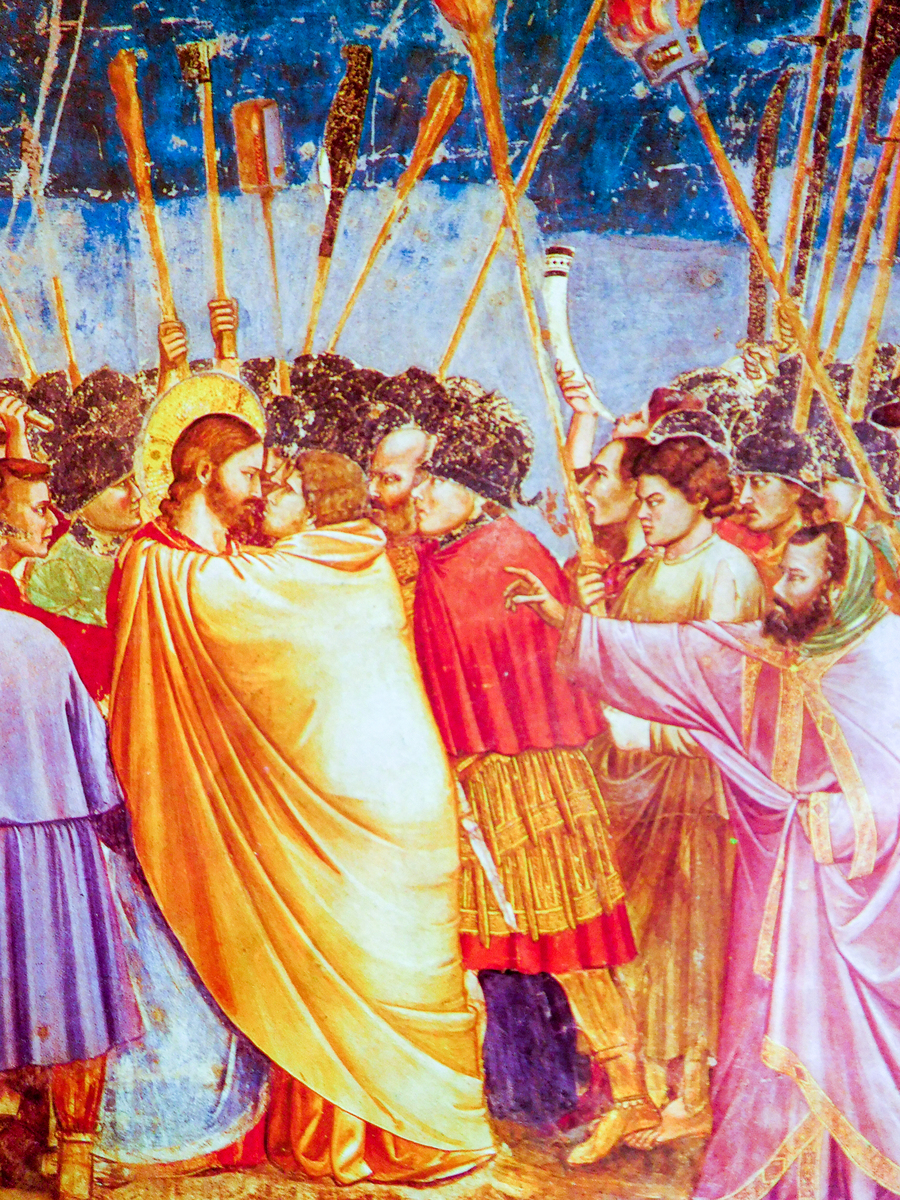
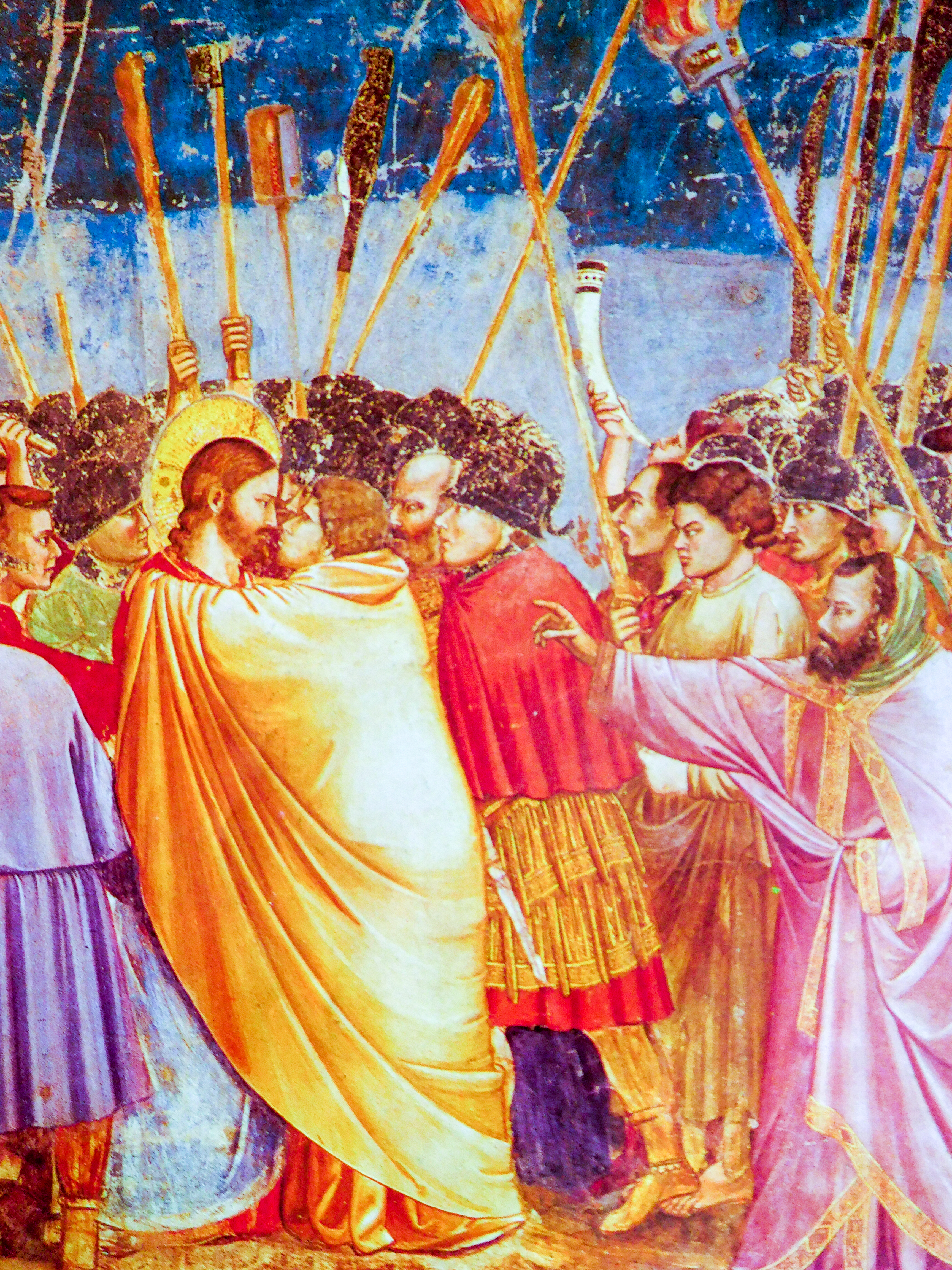
A close look at Giotto's fresco of the Arrest of Christ, painted between 1304 and 1306 for the Scrovegni Chapel in Padua, showing the moment Judas identifies Jesus with a kiss as the armed crowd moves in to seize him.
The sweeping saffron cloak Judas throws over Christ, a single broad shape that isolates the betrayer and the betrayed from the surrounding crowd.
02
Red Cloaked Officer
Man in a red cloak worn over a gold-striped garment, standing at the centre right of the arresting party, his costume distinguishing the armed escort from the disciples.
03
Pointing Hand of the Pink Cloaked Figure
A long-fingered hand thrusts out from the pink-mantled figure on the right, pointing back toward Christ and redirecting the viewer's eye to the kiss.
Your gallery guide
The Arrest of Christ (Kiss of Judas) by Giotto (between 1304 and 1306)
A close look at Giotto's fresco of the Arrest of Christ, painted between 1304 and 1306 for the Scrovegni Chapel in Padua, showing the moment Judas identifies Jesus with a kiss as the armed crowd moves in to seize him.
Editorial review by Artifact Archive automated publishing
This fresco shows the arrest of Jesus in the Garden of Gethsemane. Judas Iscariot steps forward and kisses him, the agreed signal that identifies which man the armed crowd should seize.
Giotto painted it between 1304 and 1306. It belongs to his Cycle of the Life of Christ in the Scrovegni Chapel in Padua, so the visitor sees it as one panel in a much longer telling of the story.
At the centre, two faces meet. The two figures are pressed close, and around them the crowd surges in from both sides, so the kiss sits inside a knot of reaching arms and weapons.
Judas is wrapped in a heavy cloak. Jesus wears a plain robe. That contrast in dress separates the two men before you notice anything about their faces.
The scene is crowded, but the composition still reads clearly. Jesus and Judas hold the middle. The armed men who have come to make the arrest fill the left and right, their heads and hands overlapping.
Because the two central figures stay close together, the kiss is the one stable point in a busy, pressing group.
Judas had arranged a sign with the crowd: the one he kissed was the man to take. That is why the kiss, an act of closeness, works here as the moment of betrayal and arrest.
The scene is religious art, part of a cycle that follows the life of Christ across the chapel walls, so it was made to be read in sequence rather than on its own.
Giotto gives the betrayal no distance. The two heads meet at the centre, and the surrounding crowd is packed tightly against them, so the kiss and the seizure happen in one continuous movement.
That reading stays with what the fresco shows: the close meeting of the two men and the armed group closing in. The sources supplied here identify the subject and its setting, and the composition carries that identification visually.
What you take away is a single moment made unmistakable. Judas kisses Jesus, the crowd recognises the sign, and the arrest begins in the same breath.
Giotto's fresco holds that action at the centre of the picture, so the whole surrounding press of figures points back to the two faces meeting.
The story and its sources
Editorial review by Artifact Archive automated publishing.
Historical claims are linked to the records below. Close looking and interpretation are identified in the passage notes.
Giotto was an Italian painter and architect (c. 1267–1337). Their work is associated with Proto-Renaissance; Gothic art. Their recorded places of work include Florence; Padua; Assisi; Rimini; Rome; Naples; Bologna.
The fresco depicts the biblical episode of the Arrest of Christ, also known as the Kiss of Judas. It shows the moment Judas Iscariot identifies Jesus with a kiss in the Garden of Gethsemane, enabling the armed crowd to seize him. The scene is part of Giotto's Cycle of the Life of Christ in the Scrovegni Chapel.(Wikimedia Commons: The Kiss of Judas, n.d.)
The object is catalogued as a fresco with the title The Arrest of Christ (Kiss of Judas), a compound title that pairs the juridical episode with the gesture that identifies the victim. The catalogue attributes the work to Giotto and dates it between 1304 and 1306, so the year range belongs to the making of the fresco and not to any later record of it. The medium recorded is fresco, the genre is religious art, and the painted surface measures 200 cm in height by 185 cm in width. These are the physical and bibliographic coordinates on which the rest of the account rests.(Wikimedia Commons: The Kiss of Judas, n.d.)
Interpretation
The source record supplies alternative titles in several languages: El beso de Judas, Judaskuß, Kiss of Judas, Pocałunek Judasza, Јудиниот бакнеж and Le baiser de Judas. These variants cluster around the kiss rather than the arrest, which means the two halves of the English catalogue title travel separately in different linguistic traditions. The multiplicity of titles is itself part of the object's identity: the same painted surface is indexed in several catalogues and reading communities under names that emphasise the moment of betrayal over the moment of seizure.(Wikimedia Commons: The Kiss of Judas, n.d.)
The attribution to Giotto and the 1304 to 1306 date are recorded as catalogue data, and they should be kept distinct from the physical description of the fresco itself. The dimensions and medium describe what the object is; the artist and the date describe how the object has been classified. Both kinds of information come from the same structured record, which presents the work as a documented fresco by Giotto executed in the first decade of the fourteenth century. The record also notes that the image file through which the work circulates is a faithful photographic reproduction of a two-dimensional, public domain work of art, a qualification about the reproduction rather than about the fresco.(Wikimedia Commons: The Kiss of Judas, n.d.)
Cycle context and narrative placement
Religious art is the genre under which the work is filed, and that classification points to the function of the image rather than to its subject alone. The scene is one panel in the Cycle of the Life of Christ in the Scrovegni Chapel, Padua, so the fresco was made to be read within a sequence of episodes rather than as an isolated picture. The cycle setting explains why the catalogue title can name both the arrest and the kiss: the panel has to be legible as one station in a longer narrative while remaining a single, self-contained composition. Seeing the work as part of that Paduan cycle is what connects its dimensions, its religious genre and its subject matter into one object.(Wikimedia Commons: The Kiss of Judas, n.d.)
Iconography of the kiss and the arrest
The iconography recorded for the panel is the Kiss of Judas and the arrest of Jesus, with Jesus Christ and Judas Iscariot as the depicted people. The kiss functions as a prearranged signal: Judas steps forward and kisses Jesus, and the armed crowd takes that act of closeness as the sign identifying which man to seize. Reading the composition against this account, the two central faces meet while the crowd surges in from both sides, so the sign and the seizure occupy the same continuous movement rather than two separate moments. The plain robe of Jesus and the heavy cloak of Judas separate the two men visually before any detail of their faces is registered, and that contrast in dress reinforces the identification the gesture performs.(Wikimedia Commons: The Kiss of Judas, n.d.)
Interpretation
Because the two central figures remain pressed close together, the kiss becomes the stable point within a busy, pressing group. The armed men fill the left and right of the composition, their heads and hands overlapping, and the crowd closes tightly against the two faces at the centre. The composition therefore does not give the betrayal any distance: the meeting of the heads and the closing in of the armed group are held in one field. This close reading stays with what the fresco shows, while the documented identification of the subject and its setting supplies the frame within which those visual relationships make sense.(Wikimedia Commons: The Kiss of Judas, n.d.)
The source provides alternative titles in multiple languages: El beso de Judas, Judaskuß, Kiss of Judas, Pocałunek Judasza, Јудиниот бакнеж, Le baiser de Judas.(Wikimedia Commons: The Kiss of Judas, n.d.)
The episode represented is the Kiss of Judas and the arrest of Jesus, and the two people shown at the centre are identified as Jesus Christ and Judas Iscariot. These are the identifications the record itself supplies for the subject and for the participants. In the account the scene belongs to the story of the arrest in the garden, in which Judas steps forward and kisses Jesus as the agreed signal that identifies which man the armed crowd should seize. That narrative framing explains why the act of closeness carries the meaning of betrayal and seizure at the same time, and why the episode is presented as religious art belonging to a cycle rather than as a free-standing subject.(Wikimedia Commons: The Kiss of Judas, n.d.)
The medium of the work is fresco, as recorded in the structured catalogue entry for the image. That single material designation places the panel within the tradition of wall painting executed on wet lime plaster, where pigment is applied to a prepared ground and the setting of the plaster locks the colour into the wall surface. The entry describes the image file itself as a faithful photographic reproduction of a two-dimensional, public domain work of art, which is the form in which the object is most widely encountered and studied today. The same record supplies the work's physical dimensions, 200 cm in height and 185 cm in width, and dates it between 1304 and 1306, attributing it to Giotto and identifying it as part of the Cycle of the Life of Christ in the Scrovegni Chapel, Padua. The evidence establishes the medium, scale, authorship, date and architectural setting; it does not survive with a description of any individual pigment, plaster recipe, preparatory drawing or tool.(Wikimedia Commons: The Kiss of Judas, n.d.)
Interpretation
The evidence supplied distinguishes between what the catalogue record states as documented fact and what the visual account describes. The medium is given as fresco in the record, while the scene's content and the identities of the two central figures are presented as observations of the image. Both kinds of statement are attributed: they come from a structured record for the artwork that provides title, artist, date, medium, dimensions, collection and iconographic information, supplemented by multilingual title variants and a description of the depicted episode. Nothing in the supplied evidence reports the results of technical examination such as pigment analysis, cross-sections or raking-light study. Claims about how the fresco was prepared or painted, beyond the bare designation of the medium, would therefore be inferences from the medium itself rather than findings reported in these sources, and should be presented as such. What the sources do establish is the material identity of the object, its size, its date, its maker, its place in a narrative cycle and the episode it shows.(Wikimedia Commons: The Kiss of Judas, n.d.)
The single evidence unit available for the reception of this fresco is the Wikimedia Commons image record, which states that the image file is a faithful photographic reproduction of a two-dimensional, public domain work of art. That statement is the only reception-stage information this account can rest on. It also defines the terms under which the object has circulated publicly: the underlying fresco is in the public domain and the reproduction is presented as faithful to it, so the widely seen image stands as a transparent surrogate rather than a reinterpretation. Because the same record identifies the work as a fresco, and fresco painting on a chapel wall is a fixed medium, photographic reproduction is not incidental to the work's later life. For a mural that cannot leave its wall, the photograph is the practical means by which viewers elsewhere encounter the composition, and the claim of faithfulness is the condition that makes such encounters evidentially useful.(Wikimedia Commons: The Kiss of Judas, n.d.)
The record behind that reproduction also preserves the descriptive apparatus through which the work is catalogued: the title The Kiss of Judas, the artist Giotto, a date between 1304 and 1306, the medium fresco, dimensions of 200 cm in height and 185 cm in width, and its place in the Cycle of the Life of Christ in the Scrovegni Chapel, Padua. Alternative titles in several languages are carried alongside, including El beso de Judas, Judaskuß, Kiss of Judas, Pocałunek Judasza, Јудиниот бакнеж and Le baiser de Judas. The multilingual variants show that the work is received under more than one linguistic and national title tradition, and that the episode is named the same way across those traditions. The recorded genre is religious art, and the subject is the Kiss of Judas and the arrest of Jesus, with Jesus Christ and Judas Iscariot identified as the depicted people. This catalogue information is the frame within which the public-domain reproduction is encountered, and it is what allows the image to be recognised and discussed at distance from the chapel.(Wikimedia Commons: The Kiss of Judas, n.d.)
The fresco known as The Kiss of Judas, or The Arrest of Christ, is one panel within Giotto's Cycle of the Life of Christ in the Scrovegni Chapel, Padua. That placement is the essential fact of its collection context: the work is not a free-standing panel but a component of an extended narrative program covering the chapel walls, so its subject and composition were devised to function as one episode in a sequence rather than as an isolated image. The scene depicts the Kiss of Judas and the arrest of Jesus, with Jesus Christ and Judas Iscariot as the depicted figures, and its genre is religious art. The source record also preserves the work's alternative titles in several languages, including El beso de Judas, Judaskuß, Kiss of Judas, Pocałunek Judasza, Јудиниот бакнеж and Le baiser de Judas, a multilingual naming pattern that reflects the painting's wide circulation in reproduction and reference literature rather than any variation in the object itself.(Wikimedia Commons: The Kiss of Judas, n.d.)
The single evidence unit supplied for this section is a calculated working insurance estimate, recorded as a working calculation generated on 2026-10-16, which places an estimated value of US$500K to US$2M on the fresco The Arrest of Christ (Kiss of Judas) by Giotto. The estimate is explicitly a model-generated working range produced for manual review, and its own qualification states that it is not an official insurance value, appraisal, auction result, or sale price, and that it should not be used to underwrite, bind, or settle coverage without independent professional review. The range therefore has the status of an internal analytical construct rather than a documented market fact. Its date of generation, 2026-10-16, belongs to the record of the calculation itself, not to the artwork, which the underlying source dates between 1304 and 1306. Any use of this figure in an accumulating account of the object must preserve that distinction between the date of the valuation exercise and the date of the work being valued.(Wikimedia Commons: The Kiss of Judas, n.d.)
The methodology stated for the range is a broad, conservative working insurance calculation built from the confirmed context of the artwork: a fresco by Giotto dated between 1304 and 1306, medium fresco, dimensions height 200 cm and width 185 cm, part of the Cycle of the Life of Christ, located in the Scrovegni Chapel, Padua, Italy, and identified as Proto-Renaissance Italian. The calculation proceeds by treating the work as a canonical Proto-Renaissance masterpiece of exceptional art-historical prominence and applying a conservative order-of-magnitude allowance for the notional capital value represented by a one-of-a-kind monumental work of this significance. Within that method, scarcity and artistic importance are the factors said to support a high order of magnitude. The estimate thus rests on qualitative prominence rather than on transaction evidence, and the evidence states plainly that no comparable sales or private insurance records were accessed. The figure is a consequence of the artwork's canonical standing, not a discovery about its market history.(Wikimedia Commons: The Kiss of Judas, n.d.)
The evidence explains the breadth of the range through the physical and institutional character of the object. Because the work is an in-situ monumental fresco owned by an institutional collection and not a movable object, no direct sale, auction, or official insurance value is available from the supplied excerpts; the immovable, site-specific, and collection-bound nature of the fresco is what makes the range broad and limits any claim of market precision. This is a structural limitation, not merely a gap in research effort. The Kiss of Judas was made as a wall painting inside a chapel cycle rather than as a transportable panel or canvas, so the ordinary mechanisms by which artworks acquire recorded prices, such as auction results or private insurance schedules for movable property, do not apply to it in the same way. The working range is therefore best understood as an attempt to express an unmarketable category of object in monetary terms, with the evidence itself conceding the imprecision of that translation.(Wikimedia Commons: The Kiss of Judas, n.d.)
Read together, the supplied evidence establishes a clear hierarchy of documentation around the object. The fresco's identity, artist, date range of 1304 to 1306, medium, dimensions of 200 cm by 185 cm, location in the Scrovegni Chapel in Padua, and place within the Cycle of the Life of Christ are treated by the valuation unit as confirmed context, drawn from the Wikimedia Commons record for the artwork. The monetary figure, by contrast, is the only element in this section that is not derived from that record: it is generated from the confirmed context and does not represent access to private insurance records or verified comparable transactions. For a research account of the object, the responsible treatment is to report the range as an attributed, dated, model-generated construction with its stated qualifications intact, and to keep the historical facts about the fresco, its medium, its dimensions and its chapel setting on a different evidential footing from the valuation exercise. The estimate tells us something about how a canonical monumental fresco is handled in valuation reasoning; it does not tell us what the fresco has ever sold for, because the evidence indicates no such sale is documented in the supplied material.(Wikimedia Commons: The Kiss of Judas, n.d.)
Working estimate
Calculated working insurance estimate, not a sale price: Estimated value: US$500K to US$2M Recorded date: Working calculation, generated 2026-10-16. Methodology: The range is a broad, conservative working insurance calculation based on the confirmed context: the artwork is the fresco The Arrest of Christ (Kiss of Judas) by Giotto, dated between 1304 and 1306, medium fresco, dimensions height 200 cm and width 185 cm, part of the Cycle of the Life of Christ, located in the Scrovegni Chapel, Padua, Italy, and identified as Proto-Renaissance Italian. Because the work is an in-situ monumental fresco owned by an institutional collection and not a movable object, no direct sale, auction, or official insurance value is available from the supplied excerpts. The range is estimated by treating the work as a canonical Proto-Renaissance masterpiece of exceptional art-historical prominence and applying a conservative order-of-magnitude allowance for the notional capital value represented by a one-of-a-kind monumental work of this significance. Scarcity and artistic importance support a high order of magnitude, while the immovable, site-specific, and collection-bound nature of the fresco makes the range broad and limits any claim of market precision. No comparable sales or private insurance records were accessed. Qualification: This is a model-generated working range for manual review only. It is not an official insurance value, appraisal, auction result, or sale price. It should not be used to underwrite, bind, or settle coverage without independent professional review. The range is derived from the supplied confirmed artwork context and does not represent access to private insurance records or verified comparable transactions.(Wikimedia Commons: The Kiss of Judas, n.d.)
Further reading
Books for a closer look
Paid links. As an Amazon Associate I earn from qualifying purchases.
Recorded as an illustrated catalogue on Giotto with subjects covering the Cappella degli Scrovegni in Padua and the San Francesco church in Assisi, plus themes and motives. Those two cycles are the principal surviving monumental narratives where art historians locate the Arrest of Christ / Kiss of Judas, so this is the candidate most directly tied to the named subject and to object-level study rather than a general biography.
Titled La Cappella Degli Scrovegni and recorded with Giotto as author and subjects on the Cappella degli Scrovegni in Padua with Bible illustrations and themes and motives. The Scrovegni fresco cycle is the standard monumental context for the Arrest of Christ / Kiss of Judas, making this a plausible object-specific catalogue rather than an accidental title match.
Listed as a Giotto study by Luciano Bellosi with subjects on Christian art and symbolism, criticism and interpretation, Italian painting, and Giotto himself. It offers art-historical interpretation and iconographic context that can bear on a Passion scene such as the Arrest of Christ, though the record does not specify the fresco or cycle.
Titled La Cappella Degli Scrovegni and recorded with Giotto as author and subjects on the Cappella degli Scrovegni in Padua with Bible illustrations and themes and motives. The Scrovegni fresco cycle is the standard monumental context for the Arrest of Christ / Kiss of Judas, making this a plausible object-specific catalogue rather than an accidental title match.
Recorded as an illustrated catalogue on Giotto with subjects covering the Cappella degli Scrovegni in Padua and the San Francesco church in Assisi, plus themes and motives. Those two cycles are the principal surviving monumental narratives where art historians locate the Arrest of Christ / Kiss of Judas, so this is the candidate most directly tied to the named subject and to object-level study rather than a general biography.
Listed as a Giotto study by Luciano Bellosi with subjects on Christian art and symbolism, criticism and interpretation, Italian painting, and Giotto himself. It offers art-historical interpretation and iconographic context that can bear on a Passion scene such as the Arrest of Christ, though the record does not specify the fresco or cycle.
Structured record for the artwork, providing title, artist, date, medium, dimensions, collection, and iconographic information. It includes multilingual title variants and a description of the depicted episode.
Advertising supports the archive. These preferences control aggregate page counting, reading activity and ad-delivery diagnostics. They use no visitor tracking cookie.