The story About 5 minutes to read
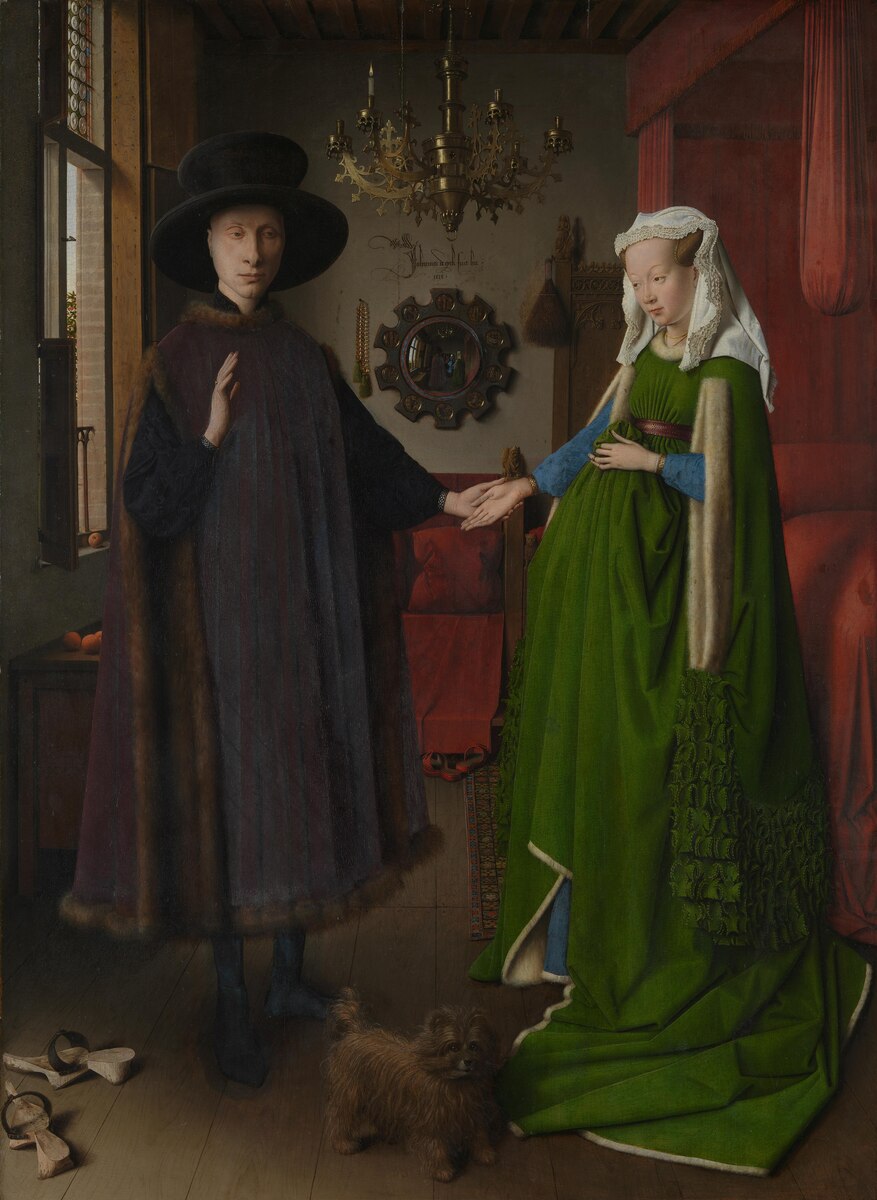
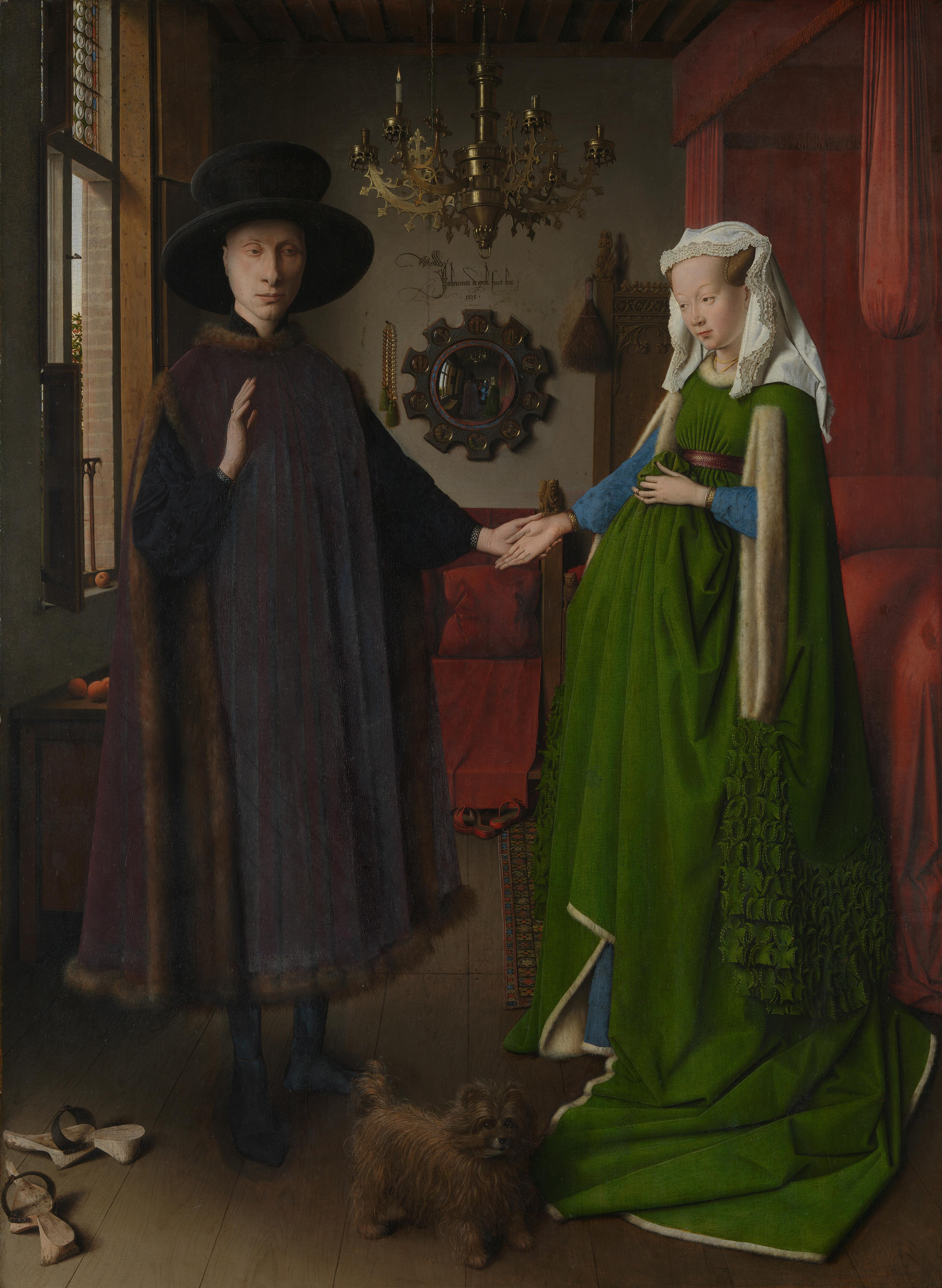
This is Jan van Eyck's portrait of a man and a woman standing in a private room. They are probably Giovanni di Nicolao di Arnolfini, an Italian merchant working in Bruges, and his wife.
Van Eyck painted it in 1434. The date and the artist's name are written on the wall itself, above the mirror.
The man raises his right hand, apparently in greeting. He wears a dark tabard and a wide-brimmed hat.
The woman wears a green gown with a long train that falls in thick folds around her feet, trimmed with white fur. Her hair is caught up in fashionable but modest horns, held in red nets, and covered with an intricately folded veil.
She is not pregnant, though she might look it. She is holding up her bulky gown in front of her, as ladies commonly did.
Her pose and heavy fabric make the skirt project forward, which is why the old idea of pregnancy keeps returning. The Gallery's reading rests on how the gown is handled.
Almost every object in the room is carefully chosen. The large bed is covered with expensive red woollen cloth, and red cushions and fabric are scattered on it.
The house is of brick, its window opens onto a garden, and a cherry tree can be glimpsed through the open shutters. The Gallery reads this as wealth and social status, shown without aping the aristocracy.
The round mirror hangs right in the centre of the composition. Its convex glass shows the room compressed and contorted, and also two men coming in through a door behind us.
The first man seems to be raising his left arm and stepping down steps from the passage. Immediately above the mirror is a flamboyant signature reading 'Johannes de Eyck fuit hic. 1434', which means 'Jan van Eyck was here'.
The Gallery suggests the men in the mirror could be Van Eyck himself and his servant, arriving on a visit.
That reading fits the greeting gesture, the mirror's position at the centre, and the signature above it, which turns the painting into a record of a moment when the artist was present.
For a long time this painting was understood as a marriage ceremony. The National Gallery states it is no longer interpreted that way.
The old story remains part of the picture's reception, not a fact the Gallery now asserts. That older reading is worth knowing because it shaped how generations looked at the couple.
The room looks plausible, as if Van Eyck had removed a wall for us. But close examination reveals inconsistencies: there is not enough space for the chandelier, and no sign of a fireplace.
The space is a construction of the painting, not a slice of a real house. Technique supports that reading: infrared reflectography shows the underdrawing was done in stages, with the figures, the main furniture and the basic room sketched first.
The pigments are nothing unusual. The illusion of reality relied on Van Eyck's skill, not on technical innovation.
The painting was surprisingly quickly and freely painted. He used his fingers and brush handles as well as brush points, and his thumbprint can be seen by the shadow of the dog's leg.
Small details keep the room from becoming a stage set. The oranges reflect in the polished wood of the casement, and the beads hanging by the bed cast both shadows and reflections on the wall behind.
Those touches show the care in every surface. They make the mirror's reflection, the signature and the greeting feel like parts of one carefully built world.