The story About 5 minutes to read
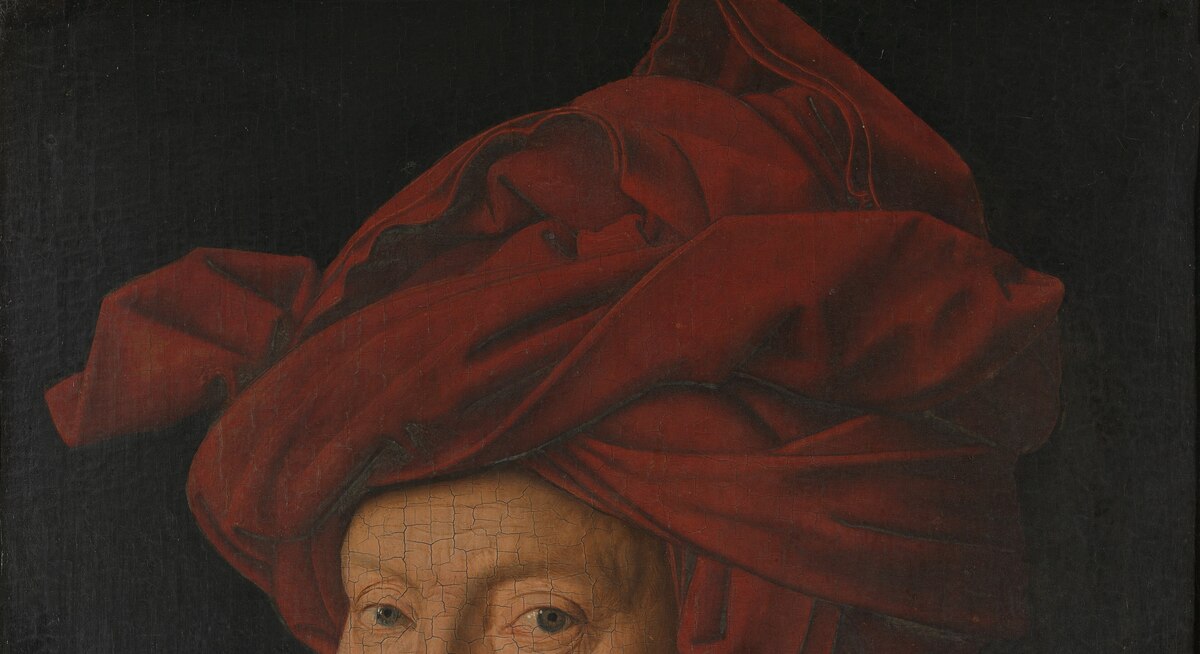
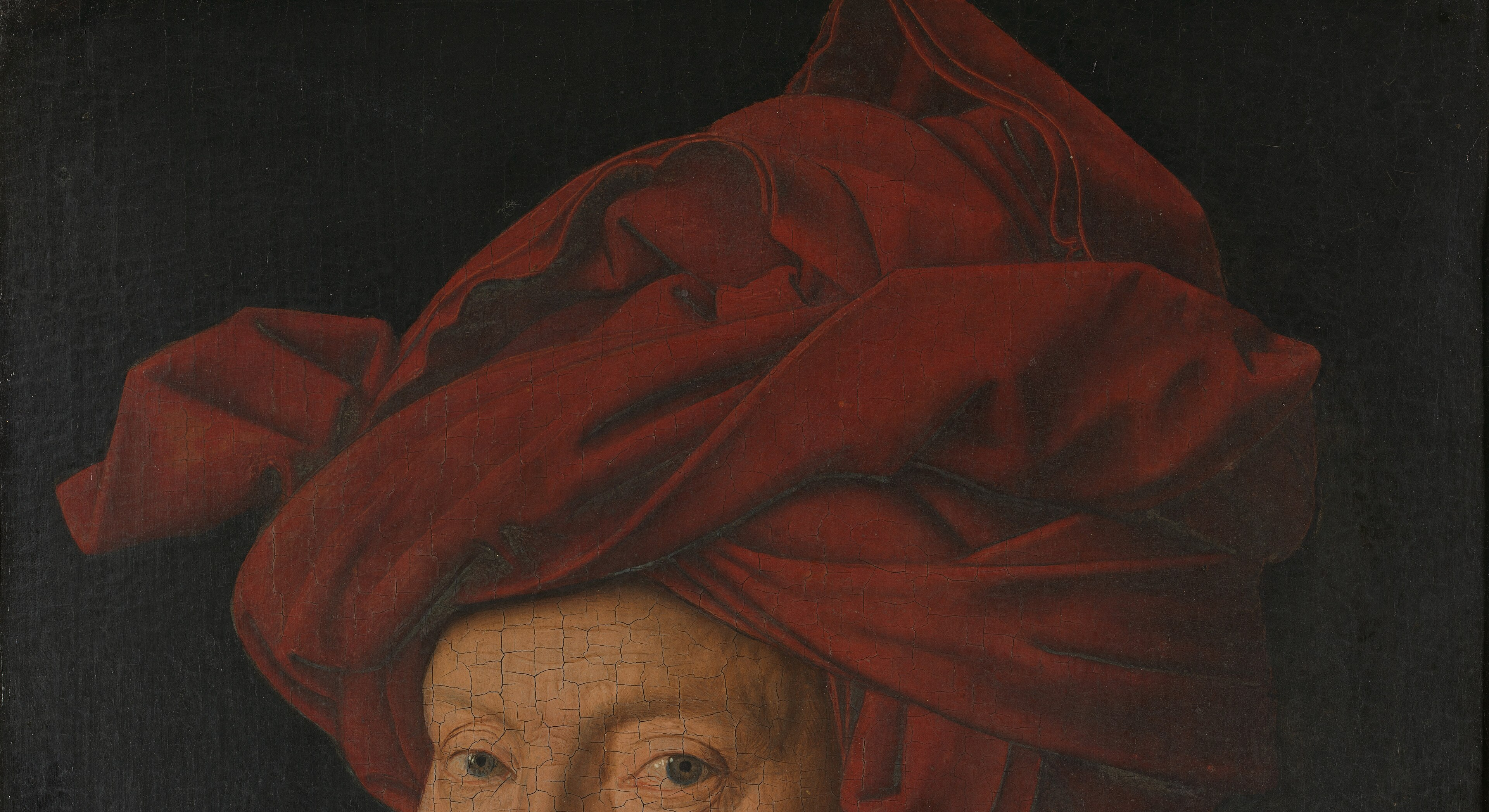
This is a small portrait from 1433. It shows a man, head and shoulders, turned toward us and looking out. His most striking feature is a red turban wrapped around his head.
It was painted by Jan van Eyck, a Flemish painter active in the early fifteenth century. Born around 1390, he died before 9 June 1441. The Gallery calls the picture Portrait of a Man in a Turban.
The man's name is not certain. The painting is also described as a possible self-portrait of the artist, and that is a proposal, not a settled identification.
Before any names, look at how little of the body we get. The frame crops the figure close, so the head and the cloth fill the picture. The background sits dark behind him, and the face comes forward into light.
The turban is built from folds. Light catches the raised ridges of the red fabric, and shadow settles into the creases. The face is modelled the same way, with subtler shifts across cheek, brow and nose.
We read the eyes as looking back at us. The pose holds still. Only the turn of the head gives the figure its slight direction in space.
The painting is oil on oak panel and it is dated 1433. That was made during a period when oil paint was being exploited in the Low Countries to render surfaces, cloth and skin with close attention.
A turban, or a wrapped headdress, was not ordinary day wear in fifteenth-century Flanders. In European art of the period wrapped cloth on the head often marked a figure as coming from the East, or as belonging to an older, biblical or exotic setting.
Here the man is neither labelled nor placed in a narrative. He is simply a man in a turban, looking at us.
So why has this painting been called a possible self-portrait? Part of the answer lies in the picture's own emphasis. A painter's tools of trade are his eyes and his hand, and here the face is what we are asked to inspect.
The turban may add a second reason. A wrapped, non-local headdress can function as a costume, a way of presenting the artist as something more than a craftsman. That reading is an interpretation, not a documented fact about van Eyck's intent.
The identification is genuinely unresolved. The Gallery itself labels the self-portrait proposal with a question mark, and we should keep that question mark in mind.
What we can say with confidence is smaller, and more solid. Jan van Eyck painted a man in a red turban in 1433, in oil on an oak panel, and the picture entered the National Gallery in London in 1851.
The painting rewards close attention because it gives us almost nothing but a face and a piece of cloth, and asks us to look at them as carefully as the artist did.