The story About 6 minutes to read
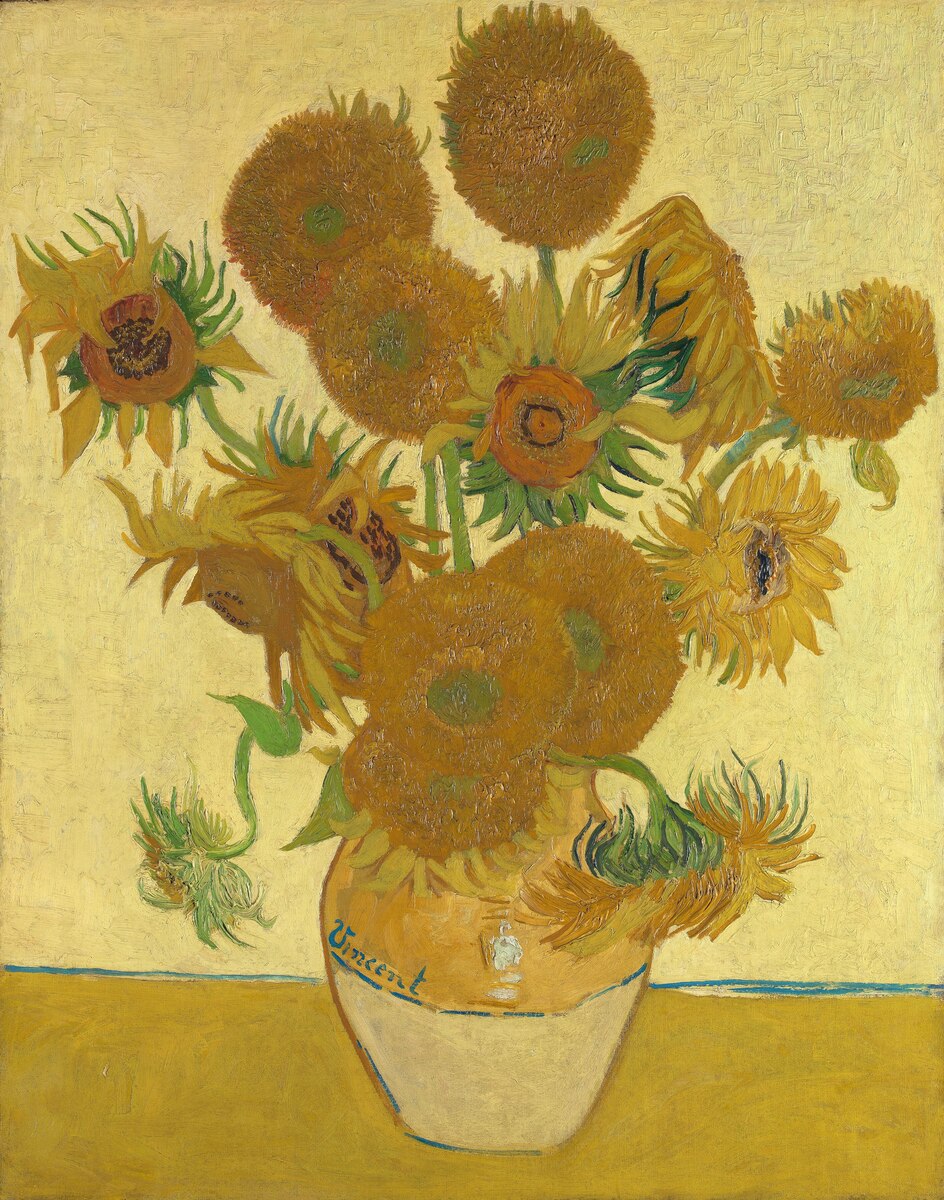
Here is a vase of fifteen sunflowers, painted by Vincent van Gogh in Arles in the summer of 1888.
He made it to decorate his house before his friend and fellow artist Paul Gauguin came to stay.
Van Gogh once declared, "The sunflower is mine," and the flower carried several meanings for him.
The National Gallery suggests the flowers also stood for friendship, and for the beauty and vitality of nature.
The sunflowers may have spoken of the artistic partnership he hoped to build with Gauguin.
Start with the vase. It is slightly larger than life, bulbous and oval, and it looks like simple country stoneware.
It is painted in two bands of yellow, darker at the top, divided by a thin blue line, and Van Gogh signed his name on the left in the same blue.
A few thick daubs of white in the centre suggest light catching its surface.
Behind it, most of the background is a luminous pale wheat-yellow, laid on in criss-crossed hatched brushstrokes.
The mustard surface the vase stands on runs as a horizontal strip across the bottom fifth of the canvas, smoother and flatter than the rest.
Where the two yellows meet, a thin line of bright blue separates them.
Look at the flowers themselves. New buds with curved stems droop over on either side of the vase, and on the left the smallest bud's yellow petals are still curled up, just out of their green bracts.
Bracts are the thin leaf-like structures that encase a young flower.
A central flower is halfway through its life, crowned above with an arch of spiky petals and bare beneath, its orange centre beginning to form a brown ring of seeds.
Two clusters of three heavier seed heads, one at the top of the arrangement and one drooping across the vase, carry the thickest paint of all.
They are built from lively ochre dabs with short olive-green flicks at their centres.
That range of stages, from young bud to full maturity and on to decay, follows the vanitas tradition of Dutch seventeenth-century flower painting, which dwells on how transient human actions are.
The sunflower itself had been tied to love since the sixteenth century, sacred and profane alike: as the flower turns to follow the sun, so the believer follows Christ and the lover follows the beloved.
For Van Gogh, that association may have reached toward artistic friendship and partnership with Gauguin.
Van Gogh called this "a picture all in yellow," limiting his palette to one primary colour.
The yellow ranges from rich orange ochre to the pale greenish yellow of the background.
Yellow could mean happiness to him. It was also the colour of Provence, and a tribute to the Provençal painter Monticelli, who, in Van Gogh's words, depicted the south of France all in yellow, all in orange, all in sulphur.
The circular seed heads seem to stand in for the sun itself, and the National Gallery reads in them an effect of incandescent heat.
That reading helps explain why a bouquet painted indoors can still feel like August in the south of France.
The colour is doing the work: one family of yellows, from ochre to greenish pale, with only thin blue lines to hold the parts apart.
In February 1890 Van Gogh wrote to the critic Albert Aurier about two sunflower pictures then on show in Brussels, this London canvas among them.
He suggested they might express the idea symbolising gratitude.
So the meanings shift and accumulate. Friendship, transience, warmth, and gratitude all attach to the same fifteen flowers.
These sunflower pictures were among the first works Van Gogh made in Arles that show his signature expressive style, and the paint is laid on thickly throughout, an approach called impasto.
You can still see the trace of the brush in the textured surfaces.
Soon after his death Van Gogh became known as the painter of sunflowers, and that identification endures.
No other artist has been so closely associated with a single flower.
What you are looking at is the picture that fixed that bond: fifteen blooms at every stage of life, warming a room that was waiting for a friend.