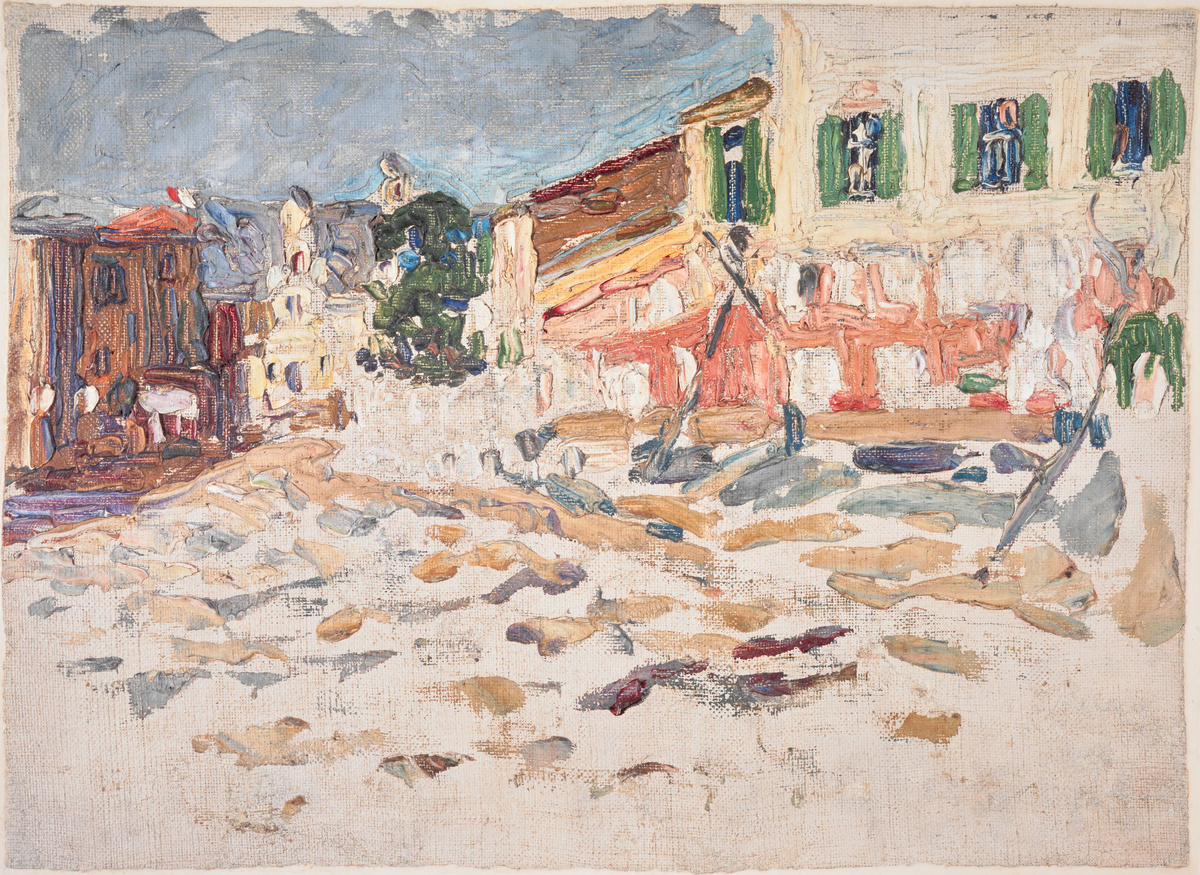
Spring, around Augsburg
Artist: Wassily Kandinsky · 1902

Spring, around Augsburg: high-resolution image
The original file is hosted by Wikimedia Commons, available without payment or an account.
Open high-resolution image on Wikimedia CommonsThe complete story
The story About 4 minutes to read
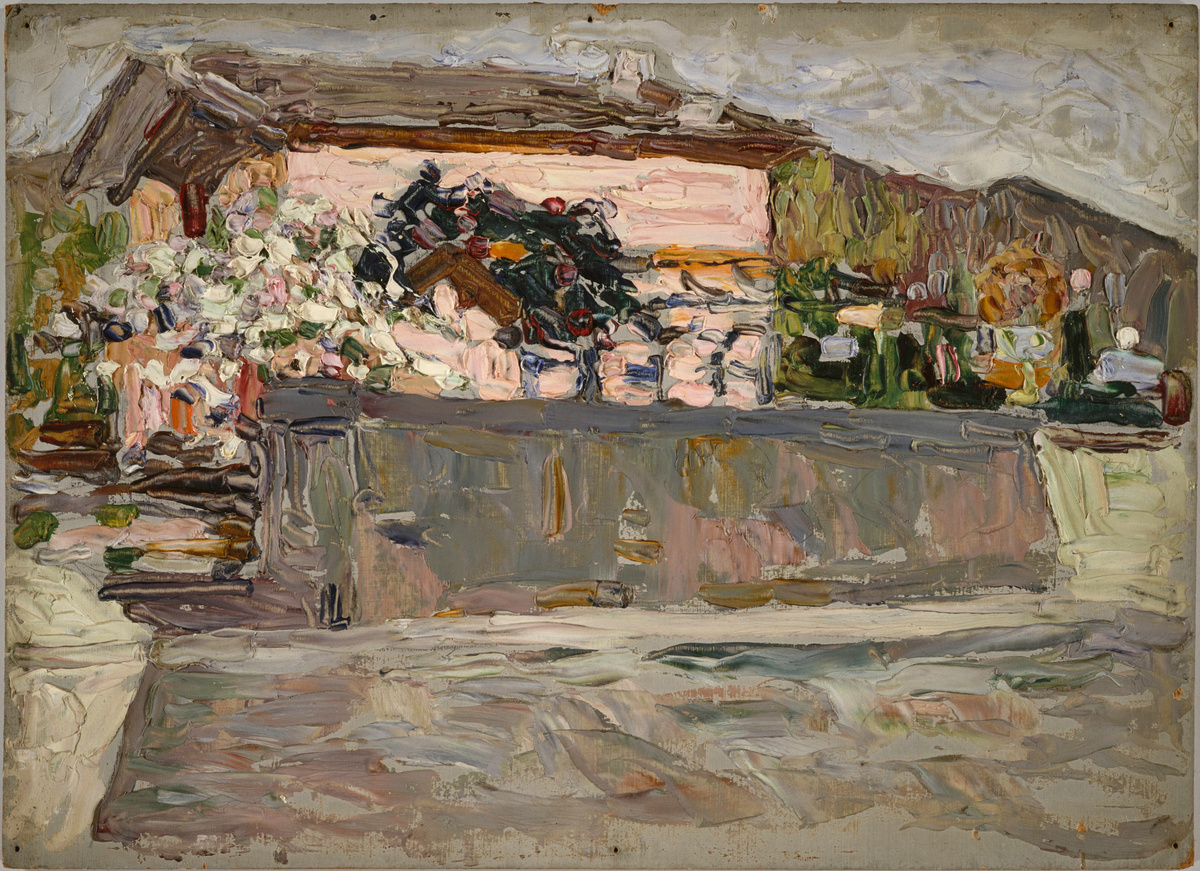
This is Wassily Kandinsky's Spring, around Augsburg, painted in 1902. It shows a rural place near Augsburg in spring: a blossoming orchard, a broad farmhouse roof, and a garden wall in a countryside setting. It's a small landscape on board, and the entire scene is given over to that single season in that one place.
Start with the blossoms. A dense, brushed mass of white and pale pink flowers, threaded with dark orchard branches, fills the centre-left of the picture. That mass carries the painting's spring subject. Above it, a dark, low-pitched farmhouse roof with deep eaves stretches across the upper part of the composition. It fixes the orchard in a working rural setting rather than an open field.
Across the middle of the picture, a long horizontal wall runs left to right. It closes the middle ground and separates the blossoming yard from the open foreground. On the right, a dark green border with a rounded shrub and low plantings answers the pale orchard. The light, blossoming mass on one side and the dark green growth on the other hold the composition in balance.
Look at how the structure supports the subject. The wall gives the eye a firm horizontal line, and the farmhouse roof caps the scene above. Between them, the orchard can read as a cultivated yard, a place someone tends. Spring here is not wild nature. It's growth inside a bounded rural property, framed by a wall and a roof.
The balance of the picture is worth noticing. The pale orchard mass sits centre-left, and the dark green border sits to the right. Each answers the other across the width of the board. That arrangement keeps the spring flowering as the centre of attention, while the darker planting gives the eye somewhere settled to rest.
So this is a picture about a particular spring in a particular place: an orchard in blossom, a farmhouse roof, and a walled yard near Augsburg. Kandinsky builds the season out of simple parts, pale blossom against dark green, a roof above, and a wall across. Those choices let the small landscape hold a clear, quiet account of spring in the countryside.
The story and its sources
Historical claims are linked to the records below. Close looking and interpretation are identified in the passage notes.
- Passage 1Documented historyWikimedia Commons: Spring, Vicinity of Augsburg
- Passage 2Close lookingWikimedia Commons: Spring, Vicinity of Augsburg
- Passage 3Close lookingWikimedia Commons: Spring, Vicinity of Augsburg
- Passage 4InterpretationWikimedia Commons: Spring, Vicinity of Augsburg
- Passage 5InterpretationWikimedia Commons: Spring, Vicinity of Augsburg
- Passage 6InterpretationWikimedia Commons: Spring, Vicinity of Augsburg
Details to notice
About 3 minutes to readGreen garden border
A dark green garden, including a rounded shrub and low plantings, balances the pale blossoming orchard at the right.
Low garden wall
The long horizontal wall closes the middle ground and divides the blossoming yard from the open foreground, its broad strokes reinforcing the composition's strong horizontal structure.
Broad farmhouse roof
The dark, low-pitched roof and deep eaves span the upper register, turning the farmyard into a shallow stage and establishing the rural setting.
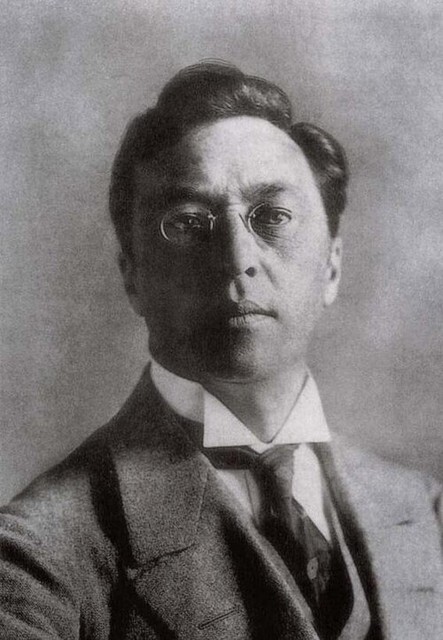
Artist portrait Image credit
未知上傳者. Image source · Public domain
About the artist
Wassily Kandinsky
1866 to 1944
Wassily Kandinsky was an avant-garde painter of Russian origin (1866–1944). Their work is associated with Expressionism; Symbolism; Bauhaus. Their recorded places of work include Paris; Munich; Weimar; Rapallo; The Hague; Russia; Stockholm; Switzerland; Tunis.
- Born
- 1866
- Died
- 1944
- Nationality
- Russian Empire; Russian Soviet Federative Socialist Republic; Soviet Union; France; Germany
- Birthplace
- Moscow
- Died in
- Neuilly-sur-Seine
Biography sources
The research & record
Study the work.
Follow the evidence.
Find catalogue details, historical context, technical research and the literature behind this artwork.
The artwork record
Research catalogue
Catalogue information and detailed research, with references that link to the bibliography.
Updated .
Identity and catalogue
Link- Title
- Spring, around Augsburg(Wikimedia Commons: Spring, Vicinity of Augsburg, n.d.)
- Artist or attribution
- Wassily Kandinsky
- Object date
- 1902
- Medium and support
- Oil on board(Wikimedia Commons: Spring, Vicinity of Augsburg, n.d.)
- Dimensions
- Height: 23.8 cm (9.3 in); width: 33 cm (12.9 in)
- Current collection or location
- Musée National d'Art Moderne, Paris(Wikimedia Commons: Spring, Vicinity of Augsburg, n.d.)
- Country or culture
- German
- Depicted subject
- A landscape painting showing spring in the vicinity of Augsburg, with a blossoming orchard and a broad farmhouse roof in a rural setting.
- Title variants
- Spring, around Augsburg; Frühling, Umgebung von Augsburg; Printemps, aux environs d'Augsburg
- Accession number
- AM 81-65-11
- Support
- board
- Period
- Unknown
Read valuation records and their limitations
Catalogue title, attribution and date
The object is catalogued as Spring, around Augsburg, attributed to Wassily Kandinsky and dated 1902. The title on which this account rests names both a season and a place, and it qualifies the place: the painting is described as being around Augsburg rather than at a named site within it. The date of 1902 belongs to the work itself. It should be kept distinct from any later catalogue or documentation date attached to the file record that transmits these details, which says nothing about when or by whom the painting was made. The present account has access to the catalogue-level information for the work and not to the full museum catalogue entry, so the attribution, title and date are reported as the catalogue gives them rather than independently verified here.(Wikimedia Commons: Spring, Vicinity of Augsburg, n.d.)
The same catalogue describes the work as a landscape painting, executed in oil on board, measuring 23.8 by 33 centimetres. The medium and support place the picture among small-format panel paintings rather than large canvas work: oil on board is a support that favours portable, intimately scaled images, and the recorded dimensions confirm that scale, with the horizontal side the longer of the two. The generic description "landscape" situates the image within that category of painting, while the specific title identifies the subject as spring in the countryside near Augsburg. Together these are the basic physical and categorical facts on which any further study of the object depends.(Wikimedia Commons: Spring, Vicinity of Augsburg, n.d.)
The painting is titled Spring, around Augsburg and is by Wassily Kandinsky, dated 1902.(Wikimedia Commons: Spring, Vicinity of Augsburg, n.d.)
The work is a landscape painting, executed in oil on board, with dimensions of 23.8 by 33 centimetres.(Wikimedia Commons: Spring, Vicinity of Augsburg, n.d.)
Subject and iconography
LinkRead valuation records and their limitations
The object and its recorded particulars
Visual observation
The painting recorded as Spring, Vicinity of Augsburg is attributed to Wassily Kandinsky and dated 1902; it is described as oil on board measuring 23.8 by 33 centimetres and is held in the Musée National d'Art Moderne, Centre national d'art et de culture Georges-Pompidou, Paris, under accession number AM 81-65-11. These particulars of title, artist, date, medium, dimensions and collection establish the object described here, but they do not by themselves document how the landscape is composed. The visual account below is therefore kept distinct from those cataloguing facts: what follows describes the arrangement visible in the work, while the attribution, date, medium and accession details are matters recorded in the collection description.(Wikimedia Commons: Spring, Vicinity of Augsburg, n.d.)
Blossom, structure and balance
At the centre-left of the composition sits a dense, brushed mass of white and pale pink blossoms interspersed with dark orchard branches. This mass carries the painting's spring subject, and its placement gives the flowering a dominant position rather than dispersing it as scattered detail. The blossoms are described as brushed, which indicates visible handling of paint in the flowering rather than a smooth, uniform surface. The contrast between the pale blossom and the dark branches is itself part of the subject: the flowering is legible precisely because the darker woodwork shows through it. Nothing in the evidence identifies particular species, so the orchard is described by its role in the composition rather than by botanical identification.(Wikimedia Commons: Spring, Vicinity of Augsburg, n.d.)
Above the flowering, a dark, low-pitched farmhouse roof with deep eaves spans the upper register of the painting. The roof establishes the rural setting and caps the scene. Its low pitch and broad eaves give the upper part of the composition a horizontal, sheltering form, and the darkness of the roof answers the dark branches within the blossom mass below. Read with the flowering, the roof frames the orchard as part of a built, inhabited place rather than as open countryside; the evidence describes this as establishing the rural setting rather than as an explicit depiction of a working farm, so the building's function is inferred from its form, not stated.(Wikimedia Commons: Spring, Vicinity of Augsburg, n.d.)
A long horizontal wall closes the middle ground, running across the picture and dividing the blossoming yard from the open foreground. The wall performs a compositional function as well as a descriptive one: it provides a firm horizontal boundary between the flowering area and the nearer space, and it separates what is enclosed from what is open. Together with the roof above, the wall frames the orchard between a built upper edge and a built middle edge. The evidence does not specify the wall's material, height or state of repair, so it is described only by its extent and position.(Wikimedia Commons: Spring, Vicinity of Augsburg, n.d.)
At the right, a dark green garden border containing a rounded shrub and low plantings balances the pale blossoming orchard. This border answers the light flowering across the width of the composition: the pale mass sits centre-left, the dark green growth sits to the right, and the two hold the picture in balance. The border also introduces a second kind of cultivated growth, distinct from the orchard, so that the rural setting is described through at least two planted areas, one flowering and one green. The evidence records the border's colour as dark green and its forms as a rounded shrub with low plantings, without naming the plants.(Wikimedia Commons: Spring, Vicinity of Augsburg, n.d.)
Interpretation
Taken together, the four described elements form a legible rural arrangement: blossom at centre-left, a farmhouse roof across the top, a wall across the middle, and a green border at the right. The composition can be read as growth contained within a bounded property, since the flowering yard is closed by the wall in front and the roof above. That reading is an interpretation of the described arrangement rather than a statement in the source: the evidence establishes the wall's dividing role and the roof's framing position, and the sense of a tended, enclosed yard follows from how those elements relate. What the composition does not support from the evidence is a claim about wild or unmanaged nature, since every described element, the orchard, the building, the wall and the border, belongs to a cultivated setting.(Wikimedia Commons: Spring, Vicinity of Augsburg, n.d.)
The imagery of spring flowering near Augsburg is what ties the composition to its title, and the arrangement of pale blossom against dark branches, roof and border is what makes that season visible. The painting matters within a larger account of landscape as a record of a particular place and season rendered through simple compositional parts: a flowering mass, a building, a boundary and a planted border. The evidence describes these elements and their balance but does not document the painting's relationship to other works, its exhibition history or its critical reception, so its place in a history of landscape painting can be stated only in these terms, without claiming influences or successors that the evidence does not establish.(Wikimedia Commons: Spring, Vicinity of Augsburg, n.d.)
Visual observation
A dense, brushed mass of white and pale pink blossoms with dark orchard branches occupies the center-left of the composition, carrying the painting's spring subject.(Wikimedia Commons: Spring, Vicinity of Augsburg, n.d.)
A dark, low-pitched farmhouse roof with deep eaves spans the upper register, establishing the rural setting.(Wikimedia Commons: Spring, Vicinity of Augsburg, n.d.)
A long horizontal wall closes the middle ground, dividing the blossoming yard from the open foreground.(Wikimedia Commons: Spring, Vicinity of Augsburg, n.d.)
A dark green garden border with a rounded shrub and low plantings balances the pale blossoming orchard at the right.(Wikimedia Commons: Spring, Vicinity of Augsburg, n.d.)
Collection and display
LinkRead valuation records and their limitations
Institutional Record
Wassily Kandinsky's Spring, around Augsburg is held in the collection of the Musée National d'Art Moderne, Centre national d'art et de culture Georges-Pompidou, Paris, under accession number AM 81-65-11. The painting is dated 1902, a small landscape executed in oil on board measuring 23.8 by 33 centimetres. These details establish the work as a modestly scaled early landscape on a portable support, and the Paris museum records fix the object's present institutional location and inventory identity rather than any earlier provenance, which the supplied evidence does not document.(Wikimedia Commons: Spring, Vicinity of Augsburg, n.d.)
Composition and Subject
Interpretation
The subject is a rural place near Augsburg in spring, rendered through a small set of clearly legible parts. A dense, brushed mass of white and pale pink blossoms threaded with dark orchard branches occupies the centre-left of the composition and carries the painting's spring subject. Above it, a dark, low-pitched farmhouse roof with deep eaves spans the upper register, anchoring the orchard in a working rural setting rather than an open field. A long horizontal wall closes the middle ground, dividing the blossoming yard from the open foreground, while a dark green garden border with a rounded shrub and low plantings on the right answers the pale orchard mass and holds the composition in balance. In this reading, the wall and roof give the growth a bounded, tended character: spring as flowering inside a cultivated rural property rather than as wild nature.(Wikimedia Commons: Spring, Vicinity of Augsburg, n.d.)
The painting is in the collection of the Musée National d'Art Moderne, Centre national d'art et de culture Georges-Pompidou, Paris, with accession number AM 81-65-11.(Wikimedia Commons: Spring, Vicinity of Augsburg, n.d.)
Documented values and qualified estimates
LinkRead valuation records and their limitations
Object and documented holding
Interpretation
The object under consideration is Wassily Kandinsky's painting titled Spring, around Augsburg, dated 1902. It is a landscape executed in oil on board, measuring 23.8 by 33 centimetres. The painting belongs to the collection of the Musée National d'Art Moderne, Centre national d'art et de culture Georges-Pompidou, Paris, and carries the accession number AM 81-65-11.(Wikimedia Commons: Spring, Vicinity of Augsburg, n.d.)
The recorded working insurance estimate for this painting is a broad range of US$400K to US$1.5M. The recorded date identifies it as a working calculation generated on 2026-10-30. Because the calculated range is the only value figure in the supplied evidence, and is explicitly a model-generated figure rather than an official appraisal, auction estimate, result, sale price, or any reflection of an actual policy, private valuation or transaction, it should be cited with these limits intact.(Wikimedia Commons: Spring, Vicinity of Augsburg, n.d.)
Basis and limits of the working estimate
The methodology behind that figure is stated in the record: a broad, conservative range prepared for manual review, derived from the confirmed artwork context of an early 1902 oil-on-board landscape by a major modern artist. The modest scale of 23.8 by 33 cm and the board support are given as factors that generally moderate value compared with larger oils on canvas. The record also notes that the work is held by the Musée National d'Art Moderne, Paris, that the confirmed accession number indicates an institutional holding, and that it affects any hypothetical insurance or valuation context. The record states that no public auction records, official appraisals or private insurance data were used, that no comparable sales were independently verified, and that the range is broad and conservative by design to account for uncertainty in attribution, condition and market context. The record directs users to consult qualified appraisers and insurers for any formal valuation.(Wikimedia Commons: Spring, Vicinity of Augsburg, n.d.)
Working estimate
Calculated working insurance estimate, not a sale price: Estimated value: US$400K to US$1.5M Recorded date: Working calculation, generated 2026-10-30. Methodology: This is a broad, conservative working range prepared for manual review. It is derived from the confirmed artwork context: an early (1902) oil-on-board landscape by Wassily Kandinsky, a major modern artist. The modest scale (23.8 by 33 cm) and board support are factors that generally moderate value compared with larger oils on canvas. The work is held by the Musée National d'Art Moderne, Paris, and the confirmed accession number indicates it is an institutional holding, which affects any hypothetical insurance or valuation context. No public auction records, official appraisals, or private insurance data were used. The range reflects a cautious estimate for an early Kandinsky landscape of this size and medium, with a broad spread to account for uncertainty in attribution, condition, and market context. It is not a precise appraisal. Qualification: This is a model-generated working range for manual review only. It is not an official insurance value, appraisal, auction estimate, auction result, or sale price. It does not reflect any actual policy, private valuation, or transaction. No comparable sales were independently verified, and the figures are broad and conservative by design. Users should consult qualified appraisers and insurers for any formal valuation.(Wikimedia Commons: Spring, Vicinity of Augsburg, n.d.)
Further reading
Books for a closer look
Paid links. As an Amazon Associate I earn from qualifying purchases.

Open Library Kandinsky: Russian and Bauhaus years, 1915-1933.
Solomon R. Guggenheim Museum
A Kandinsky catalogue whose recorded subjects include Centre Georges Pompidou and the Musee national d'art moderne in France, the collection holding this 1902 landscape (accession AM 81-65-11). Its catalogue and themes-and-motives subjects make it the most institution-linked candidate for object-level context, though its contents cannot be assumed beyond the record.
ISBN 0892070447

Open Library Kandinsky, complete writings on art
G.K. Hall
Kandinsky's complete writings on art, recorded under Modern Art and twentieth-century art. Relevant as the artist's own documentary record for contextualizing his early landscape practice, since the artwork evidence identifies Kandinsky as the author of this 1902 oil.
ISBN 0805799508
Bibliography
Sources and further reading
References are arranged by author or organisation, with links to the original publications. Where no publication date is recorded, n.d. means no date.
Source notes updated .
No recorded sources match these filters. Reset the filters to see the full bibliography.
- 03
Book
Kandinsky, complete writings on art. G.K. Hall.
Kandinsky's complete writings on art, recorded under Modern Art and twentieth-century art. Relevant as the artist's own documentary record for contextualizing his early landscape practice, since the artwork evidence identifies Kandinsky as the author of this 1902 oil.
- ISBN
- 0805799508
Citation text
- 02
Book
Kandinsky: Russian and Bauhaus years, 1915-1933. Solomon R. Guggenheim Museum.
A Kandinsky catalogue whose recorded subjects include Centre Georges Pompidou and the Musee national d'art moderne in France, the collection holding this 1902 landscape (accession AM 81-65-11). Its catalogue and themes-and-motives subjects make it the most institution-linked candidate for object-level context, though its contents cannot be assumed beyond the record.
- ISBN
- 0892070447
Citation text
- 01
Secondary · About this artwork
Wikimedia Commons: Spring, Vicinity of Augsburg (n.d.). Wikimedia Commons.
Wikimedia Commons file description providing title, artist, date, medium, dimensions, collection, and accession number for this painting.
Citation text
Art to live with
Bring this painting
home.
A piece of the archive, made yours. Explore Spring, around Augsburg in a size and finish that fits your space.
Your text and annotations appear on these editions. Adding to cart saves that design for printing.
Combine this painting with your favourites01 / Find your edition
Made for you
Suggested from your location. Change it if you're sending elsewhere or using a VPN. Prices and delivery are shown in GBP.
1 product
Choose an edition to make it yours
iPhone 12 Mini ? Glossy ? back view
iPhone 12 Mini · Glossy

iPhone 12 Mini ? Glossy ? back view

iPhone 12 Mini ? Glossy ? back view

iPhone 12 Mini ? Glossy ? back view
Tough phone case
GBP 16.34
Delivery GBP 4.22 / Total GBP 20.56
A two-layer phone case with a printed polycarbonate shell and a shock-absorbing inner liner.
Two layers with a shock-absorbing TPU liner
Case & print details
- Device
- Apple · iPhone 12 Mini
- Material
- Polycarbonate shell with a TPU inner liner
- Artwork
- Outer back and wrapped edges from one template
- Finish
- Glossy
- Version
- Standard version
- Printing
- Dye sublimation
- Print file
- 1,122 × 1,831 px · 95 × 155 mm · PNG · 300 dpi recommended
Rear outline and camera openings follow this variant's Printify template. Case depth and small hardware remain illustrative.
Supplier product detailsFit and fill keep the painting’s proportions. Stretch changes them.
Move and zoom the painting on your tough phone case.
Made to order with your design
Made to order
US delivery only
The 30 cm ruler is scaled alongside your selected print. Keep the painting’s proportions with a black background, or stretch it to fill. Frame width, material texture and screen colours are illustrative.
Keep exploring