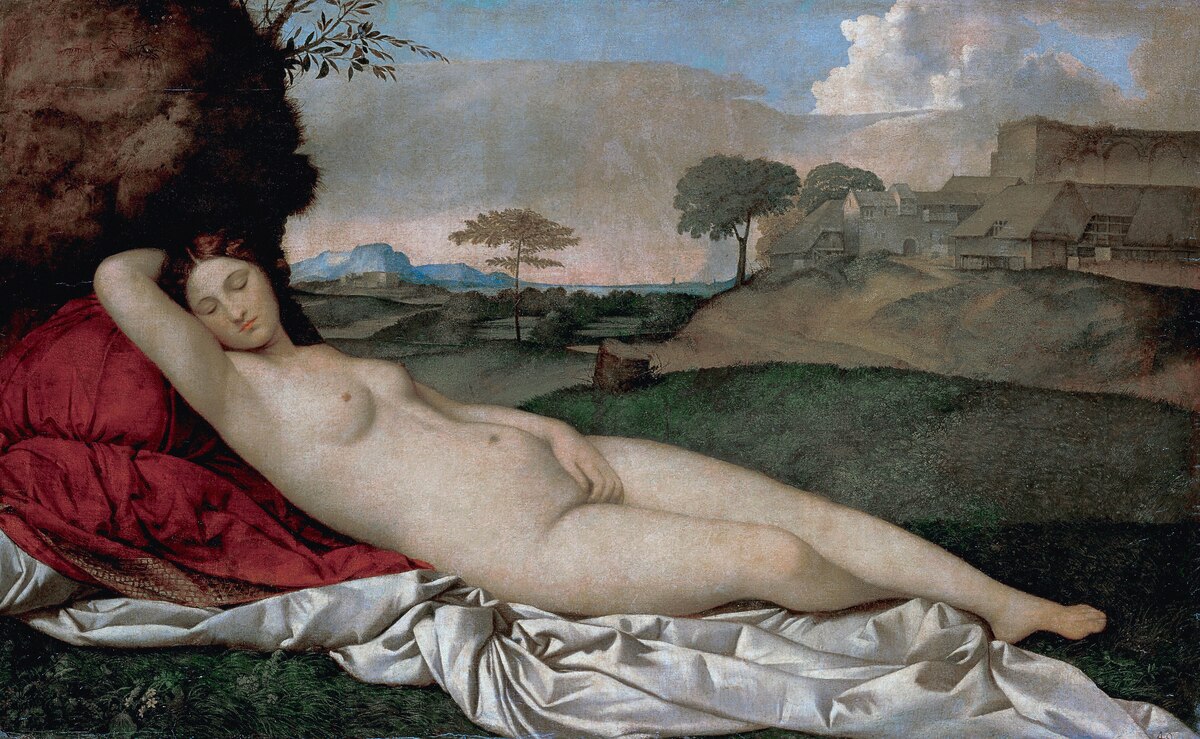
A reclining nude woman sleeps in an open landscape, named as Venus though she carries none of the goddess's usual attributes. This gallery visit uses the surviving evidence to explain the subject, the pictorial choices that shape it, and the argument that this may be the first nude painted simply as a nude.
The near-black rock face with a spray of leaves rising above the sleeper's head, a dark mass that anchors the composition and sets the luminous pale body in strong relief.
02
Landscape with village and stream
The right-hand landscape of grassy slope, quiet water, slender trees, a small building with a smoking chimney and a walled village on the hill under a pale sky, the pastoral setting that frames the sleeping figure.
03
Crimson drapery and white sheet
The vivid crimson cushion-like drapery propping the figure, set against crumpled white linen and emerald grass; the colour clash and silky folds reveal the painterly touch that made this nude famous.
Your gallery guide
Sleeping Venus by Giorgione, with possible completion by Titian (c. 1510)
A reclining nude woman sleeps in an open landscape, named as Venus though she carries none of the goddess's usual attributes. This gallery visit uses the surviving evidence to explain the subject, the pictorial choices that shape it, and the argument that this may be the first nude painted simply as a nude.
Editorial review by Artifact Archive automated publishing
What you are looking at is the Sleeping Venus, attributed to Giorgione with possible completion by Titian, and dated to around fifteen ten.
A nude woman lies asleep in a landscape. She is named Venus, but the source notes she carries no Cupid or other traditional attribute that would mark her as a goddess.
The whole picture is organised around her sleeping body stretched across the foreground, with the landscape opening behind her.
Because her eyes are closed and no story is being acted out around her, the picture asks you to look at the figure herself rather than at an event she is taking part in.
Nude figures had been painted before this, including Botticelli's Birth of Venus. That earlier Venus arrives with a narrative and a setting that explain who she is.
Here the source argues something different is happening. It describes this work as probably the first nude shown simply as a depiction of a nude, without a story to justify her presence.
The title names her Venus, yet the source notes the image gives no traditional attribute, such as Cupid, to confirm that she is a goddess.
So the identification rests on the title and tradition rather than on anything the painting itself displays. That gap is part of what makes the picture unusual: the name is attached, but the usual visual proof is missing.
The source calls this a break from tradition, one that set a new subject for the artist. It links that change to much later work, including nudes by Francis Bacon and Henry Moore in the twentieth century.
What stays with you is the quietness of it. A sleeping body, a wide landscape, and no story to tell you what to feel. That absence is the painting's subject as much as the woman herself.
The story and its sources
Editorial review by Artifact Archive automated publishing.
Historical claims are linked to the records below. Close looking and interpretation are identified in the passage notes.
A reclining nude woman sleeps in a landscape. She is identified as Venus, though the source notes she has no traditional attributes such as Cupid to indicate she is a goddess. The work is described as probably the first nude shown simply as a depiction of a nude, breaking from tradition.
Attribution qualification
The source lists the artist as Giorgione or Titian, indicating uncertain or shared attribution.
Dimensions
Unknown
Catalogue identity and attribution
The work catalogued here is titled Sleeping Venus, and its artist or creator is listed as Giorgione or Titian. That double attribution is the catalogue's own formulation of authorship, not a resolution of it: the record names both possibilities rather than assigning the picture to a single hand. Because the entry preserves that alternative form, any account of the object's making has to treat the attribution as qualified at the level of the catalogue itself.(Wikimedia Commons: Sleeping Venus, n.d.)
Interpretation
Within the same catalogue record, the title and the attribution are the two identity elements that are actually supplied. Names, dates of execution, support, dimensions, inscriptions, accession identifiers and recorded title variants are not established by the evidence available here, and they should not be inferred from the title or from the attribution formula. The identification of the figure as Venus rests on the title and on tradition rather than on any traditional attribute, such as a Cupid, visible in the image.(Wikimedia Commons: Sleeping Venus, n.d.)
The title and the missing attribute
The title names a Venus, yet the record notes that the work has no traditional attributes, such as Cupid, to indicate that it represents a goddess. The naming and the depicted content therefore do not confirm one another. The gap between the title and what the image supplies is part of what the source presents as unusual about the picture, and it qualifies how securely the subject can be called mythological rather than simply a nude.(Wikimedia Commons: Sleeping Venus, n.d.)
The claim about the nude
The source states that although nude figures had been painted before, including Botticelli's Birth of Venus, this work is probably the first nude to show a figure simply as a depiction of a nude. The claim is presented as a probability, not as a settled fact, and it turns on a distinction between a nude that serves a narrative and a nude presented as such. On this account the sleeping figure is not absorbed into a story that explains her presence, so the picture directs attention to the figure herself.(Wikimedia Commons: Sleeping Venus, n.d.)
Claimed consequences in later art
Interpretation
The source also calls the work a break from tradition that set a new subject for the artist, and it links that change to much later work, including nudes by Francis Bacon and Henry Moore in the twentieth century. That is a lineage asserted by the source rather than a documented chain of influence, and it should be weighed as an attributed account of consequence. Read alongside the earlier claim about the nude, it makes the object matter in a larger history of art because it is credited with opening a subject that later artists took up, while the attribution to Giorgione or Titian and the probability attaching to the novelty claim both remain unresolved.(Wikimedia Commons: Sleeping Venus, n.d.)
The principal evidence unit for the reception of this painting treats its novelty as a point of departure for later art rather than as a self-contained anecdote. According to the Wikimedia Commons file page, the work, titled Sleeping Venus and ascribed to Giorgione or Titian, was a break from tradition and set a new subject for the artist. The same source connects that break to twentieth-century works, specifically the nudes of Francis Bacon and Henry Moore. The claim is framed as the source's characterization of the painting's significance, not as a documented chain of transmission, so the connection between this sixteenth-century image and those modern nudes should be understood as an attributed statement of lineage or affinity rather than as evidence of direct influence established by documents. What the unit does establish is that the picture's reception history has been written in terms of subject matter: the sleeping nude is treated not merely as an image to be admired but as a model that later artists could take up.(Wikimedia Commons: Sleeping Venus, n.d.)
The same source's supporting claims clarify what kind of break is at issue and why it matters for reception. The file page states that although nude figures had been painted before, such as Botticelli's Birth of Venus, this work is probably the first nude to show a figure simply as a depiction of a nude. That is a claim about pictorial category, advanced with the qualifier probably, and it distinguishes this image from earlier nudes that arrive with a narrative and a setting explaining who the figure is. Read alongside the reception claim, the argument is that the painting's innovation lies in the absence of a justifying story, and that this absence is precisely what later artists and viewers could respond to. The qualification matters: the source does not assert an uncontested first, and it does not document a specific moment at which the category was recognized. It offers an interpretation of the work's place in a history of the nude as a subject, and the reception of the painting has largely been organized around that interpretation.(Wikimedia Commons: Sleeping Venus, n.d.)
The work was a break from tradition and set a new subject for the artist, resulting in twentieth-century works such as the nudes of Francis Bacon and Henry Moore.(Wikimedia Commons: Sleeping Venus, n.d.)
The interpretive claims attached to the Sleeping Venus in the supplied Wikimedia Commons description rest on two linked observations about what the picture does and does not show. The first is comparative: although nude figures had been painted before, as in Botticelli's Birth of Venus, the source judges this work to be probably the first nude in which a figure appears simply as a depiction of a nude. The second concerns iconography: the work is named Venus, yet it carries no traditional attributes, such as Cupid, that would identify the figure as a goddess. Both statements are readings offered by the source rather than documented facts about the painting's creation, and the hedged wording of the first claim, "probably the first," should be preserved as part of the claim itself.(Wikimedia Commons: Sleeping Venus, n.d.)
Taken together, the two claims describe a gap between the title and the image. Because the painting supplies no attribute that would confirm the figure's divinity, the identification as Venus depends on the title and on inherited tradition rather than on anything visible within the work. That gap is the specific ground on which the source builds its argument about novelty: if no narrative or emblem explains who she is, the nude body itself becomes the subject of attention. The reading therefore does not assert what the maker intended privately; it describes what the image presents to a viewer and what the absence of conventional markers allows that viewer to see.(Wikimedia Commons: Sleeping Venus, n.d.)
Although nude figures had been painted before, such as Botticelli's Birth of Venus, this work is probably the first nude to show a figure simply as a depiction of a nude.(Wikimedia Commons: Sleeping Venus, n.d.)
The only monetary figure attached to this object in the supplied material is a working insurance estimate of US$50 million to US$150 million, recorded as a model-generated calculation dated 2026-10-16. It is explicitly described as a broad range prepared for manual review rather than as an official insurance value, an appraisal, an auction result, or a sale price. The methodology states that the range was derived from the Wikimedia Commons context identifying the work as Sleeping Venus, attributed to Giorgione with possible completion by Titian, c. 1510, oil on canvas, High Renaissance, Italian. The same methodology acknowledges that the source supplies no dimensions, current location, accession number, provenance, condition, or acquisition history, and that no public sale, auction result, appraisal, or private insurance record is available. The width of the range is described as intentional, to support further manual review instead of asserting a precise value.(Wikimedia Commons: Sleeping Venus, n.d.)
The calculation's own qualification limits what can responsibly be claimed from it. It rests on no comparable sales, no private insurance records, no condition report, no provenance, and no current market data; it draws instead on the exceptional art-historical significance implied by the source description, the named Renaissance attribution, and the early sixteenth-century date, and is described as remaining conservative because essential valuation factors are absent. The source itself, accordingly, supports identification context only and not any monetary amount, and the qualification states that all details should be confirmed with a qualified professional before the range is relied upon. In the present state of the record, therefore, the object has an attributed identity and a provisional insurance figure, but no documented transaction history or institutional valuation against which that figure could be tested.(Wikimedia Commons: Sleeping Venus, n.d.)
Working estimate
Calculated working insurance estimate, not a sale price: Estimated value: US$50M to US$150M Recorded date: Working calculation, generated 2026-10-16. Methodology: This broad working insurance range is calculated for manual review only. It is based on the supplied Wikimedia Commons context identifying the artwork as Sleeping Venus, attributed to Giorgione with possible completion by Titian, c. 1510, oil on canvas, High Renaissance, Italian. The source confirms the work is a painting and describes it as an influential early nude, but it provides no dimensions, current location, accession number, provenance, condition, or acquisition history. No public sale, auction result, appraisal, or private insurance record is supplied. The range reflects the exceptional art-historical significance implied by the source description, the named Renaissance attribution, and the early sixteenth-century date, while remaining conservative because essential valuation factors are absent. The wide spread is intentional to support further manual review rather than to state a precise value. Qualification: This is a model-generated working insurance range for manual review only. It is not an official insurance value, appraisal, auction result, or sale price. It does not rely on comparable sales, private insurance records, condition reports, provenance, or current market data. The supplied source supports identification context only, not any monetary amount. Confirm all details with a qualified professional before relying on this range.(Wikimedia Commons: Sleeping Venus, n.d.)
Bibliography
Sources and further reading
References are arranged by author or organisation, with links to the original publications. Where no publication date is recorded, n.d. means no date.
Source notes updated .
No recorded sources match these filters. Reset the filters to see the full bibliography.
Advertising supports the archive. These preferences control aggregate page counting, reading activity and ad-delivery diagnostics. They use no visitor tracking cookie.