ArchiveSaturn Devouring His Son

Artwork record / 279 of 331

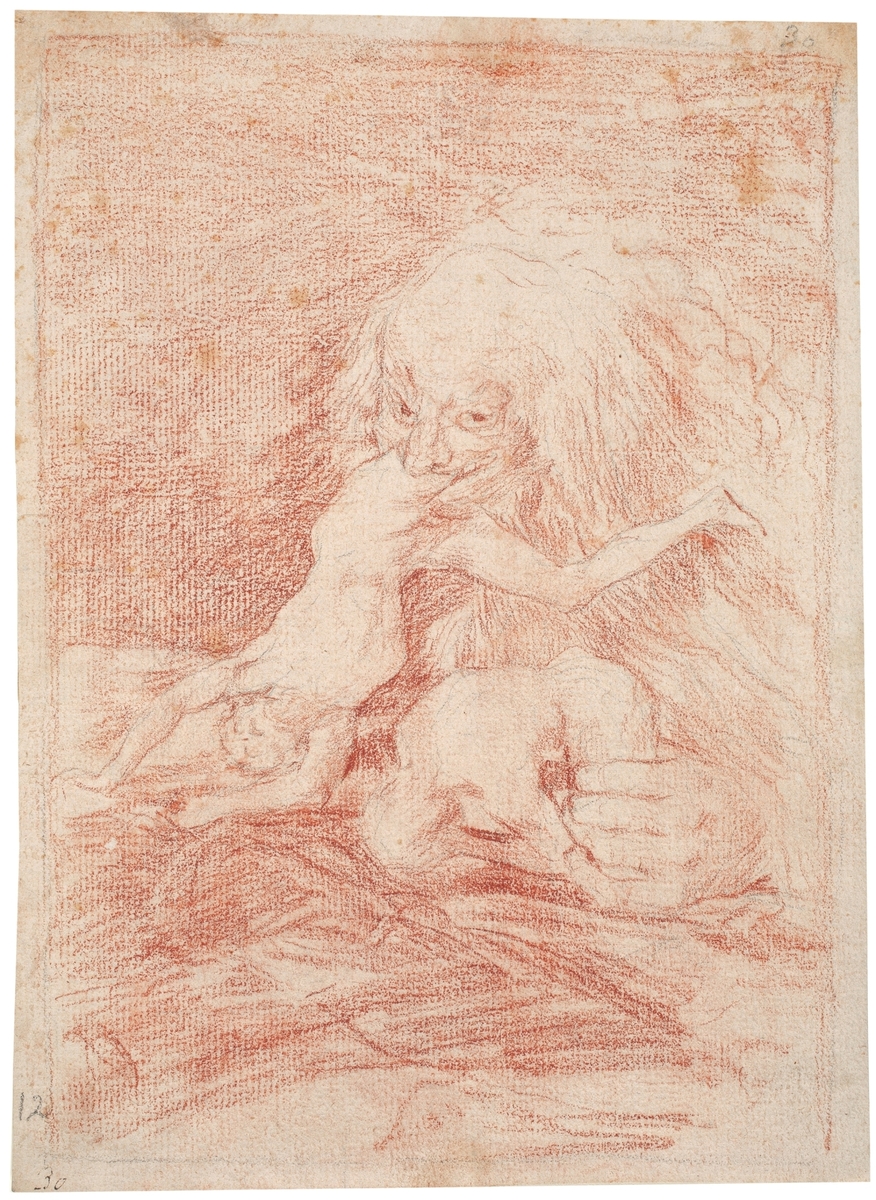
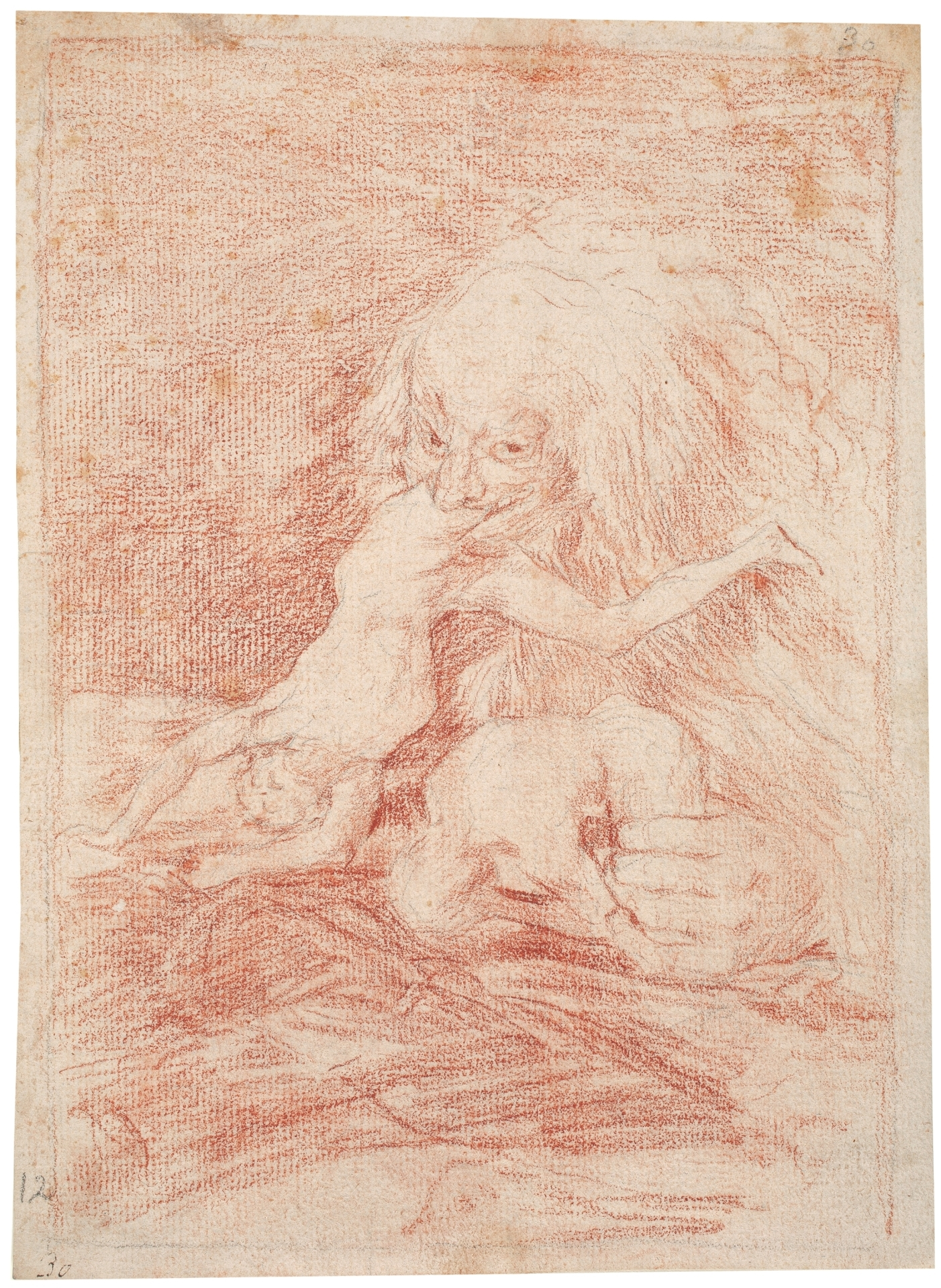
Saturn Devouring His Son by Francisco Goya (c. 1797)

Artist: Francisco Goya

A red chalk drawing made around 1797, in which Goya turns to classical myth for a scene of a father destroying his own children. The sheet is associated with his satirical print series Los Caprichos and is now linked to the Museo del Prado in Madrid.

Read the story ↓ About the artist ↓ Research and record ↓ Literature and sources ↓ Listen to the article ↓
Article text for AI
Shop this artwork ↓ 2 visits
Datec. 1797CultureSpain PeriodLate 18th-century Spanish drawing, related to Los CaprichosCurrent locationMuseo del Prado, Madrid, Spain
Listen to the article
100%
Saturn Devouring His Son by Francisco Goya (c. 1797)
Loading full-resolution artwork…
Scroll to zoom · drag to pan · double-click to focus Pinch to zoom · drag to explore · double-tap to focus FIELD VIEW / 279
Tools & download
Pixel colour Select a pixel with the eyedropper
No pixel selected

Choose the eyedropper, then click or tap the image. Scroll to zoom for finer selection.

Add text

Hand to pan · Select to move text and drawings · Add as many texts as you like · Scroll to zoom

Saturn Devouring His Son: high-resolution image

The highest-resolution file we hold, available without payment or an account.1,402 × 1,920 pixels.

Download highest-resolution image

Details to notice

About 2 minutes to read
01

Red chalk hatching

Dense diagonal and cross hatching worked across the left side of the sheet, modelling shadow and showing the drawing's rough, rapid red chalk technique together with the ruled border.

02

Second child at lower left

A small infant figure lying in the lower left field, its rounded head and faint features sketched in chalk, reinforcing the sense of multiple victims.

03

Saturn's clutching hand

The huge clenched hand of the giant gripping a pale mass of flesh at lower right, its curved finger strokes locking the victim in place.

Artist portrait of Francisco de Goya
Artist portrait Image credit

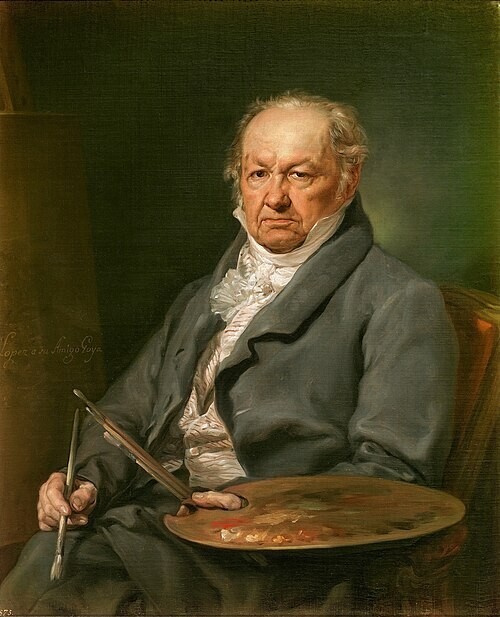
Vicente López Portaña. Image source · Public domain

About the artist

Francisco de Goya

30 March 1746 to 16 April 1828

Goya was a Spanish painter and printmaker whose career extended from royal tapestry designs and court portraiture to images of war, repression and unsettling fantasy. Born in Fuendetodos, he trained in Zaragoza and Madrid and became First Painter to Charles IV in 1799. He spent his final years in Bordeaux.

Born
30 March 1746
Died
16 April 1828
Nationality
Spanish
Birthplace
Fuendetodos, Spain
Died in
Bordeaux, France

The research & record

Study the work.
Follow the evidence.

Find catalogue details, historical context, technical research and the literature behind this artwork.

Article text for AI
Open research text

The artwork record

Research catalogue

Catalogue information and detailed research, with references that link to the bibliography.

Updated .

Identity and catalogue

Link
Artist or attribution
Francisco Goya
Object date
c. 1797
Medium and support
Red chalk on laid paper(Wikimedia Commons: Saturn Devouring His Son, n.d.)
Current collection or location
Museo del Prado, Madrid, Spain(Wikimedia Commons: Saturn Devouring His Son, n.d.)
Movement or period
Late 18th-century Spanish drawing, related to Los Caprichos
Country or culture
Spain
Depicted subject
A red chalk drawing by Francisco Goya, made around 1797, showing the classical titan Saturn devouring his sons. The scene depicts Saturn's act of consuming his children, a subject drawn from classical mythology in which Saturn, warned that a son would overthrow him, swallows each child at birth. The drawing is a preparatory study associated with Goya's Los Caprichos.
Title variants
Saturn devouring his sons; Saturno devorando a su hijo
Support
Laid paper
Dimensions
Unknown
Identity and catalogue

The object in question is a drawing by Francisco Goya catalogued under the title "Saturn devouring his sons." That title, which names both the author and the subject, is the primary identity established for the sheet in the record consulted. The subject is drawn from classical mythology: the figure of Saturn devouring his sons. The record consulted labels the drawing a work by Goya and gives the title in this form, so the attribution and the title are established together in the catalogue entry rather than in separate documents.(Wikimedia Commons: Saturn Devouring His Son, n.d., File description)

The drawing is titled 'Saturn devouring his sons' and is by Francisco Goya.(Wikimedia Commons: Saturn Devouring His Son, n.d.)

Historical context

Link
The object and its documentation

The sheet in question is a red chalk drawing on laid paper, made around 1797 by Francisco Goya and titled Saturn devouring his sons. Its subject is drawn from classical mythology: the Titan Saturn, warned that a son would overthrow him, consumes each child at birth. The work is now linked to the collection of the Museo del Prado in Madrid, Spain, and it survives as a working drawing rather than a finished painting. That documentary frame, the artist, the approximate date, the medium, the mythological subject and the collection link, is the secure ground on which any further account of the object's circumstances must rest.(Wikimedia Commons: Saturn Devouring His Son, n.d., File title)

Within Goya's practice, the drawing is associated with Los Caprichos, his series of satirical prints, as a preparatory study. That association places the sheet at a moment when Goya was thinking in series, testing subjects and compositions before committing them to print. Read alongside the myth, the drawing uses the ancient story of a father destroying his own children to think about power, fear and the monstrous things people do to hold on to what they have, a thematic register in keeping with the satirical series to which the sheet has been linked. What the sheet's status as a study establishes is a working process: the subject was held up for examination rather than simply illustrated, and the drawing preserves visible traces of that thinking because it was never smoothed into a finished painting.(Wikimedia Commons: Saturn Devouring His Son, n.d., Categories; File title)

Limits of the commissioning record

Interpretation

The identification of the sheet and its subject can be stated with more confidence than its commissioning history. Naming the drawing as a Saturn, dating it to about 1797 and linking it to the Prado are matters the available record settles; who asked for the sheet, in what household or workshop setting it was made, and what immediate purpose it served are not established by the evidence supplied here. A secure identification, in other words, does not by itself settle why the drawing was made or for whom. The association with Los Caprichos is the strongest circumstantial link to Goya's working environment, but it is an association rather than a documented commission, and it should be weighed as such.(Wikimedia Commons: Saturn Devouring His Son, n.d., Categories; File title)

The drawing is associated with Los Caprichos, Goya's series of satirical prints, as a preparatory study.(Wikimedia Commons: Saturn Devouring His Son, n.d.)

The drawing's subject is Saturn devouring his sons, drawn from classical mythology.(Wikimedia Commons: Saturn Devouring His Son, n.d.)

Materials and technique

Link
Support, medium and documentation

The drawing is dated circa 1797 and is executed in red chalk on laid paper. That description of support and medium comes from the Wikimedia Commons file record for the sheet, which also identifies the artist as Francisco Goya and titles the work Saturn devouring his sons. The record is a file-level description rather than a full catalogue entry, so the date is given as approximate and no sheet dimensions, watermark, chain-line spacing or papermaker's name is established by it. The same record links the drawing to the collection of the Museo del Prado, Madrid, but only as a linked source: the official Prado record is referenced rather than transcribed, and the exact accession number is not supplied. What the evidence therefore fixes is a combination of materials and a rough date, together with a present collection link, while leaving the physical description of the sheet at the level of medium and support type.(Wikimedia Commons: Saturn Devouring His Son, n.d., File description)

The choice of red chalk on laid paper is itself informative about how the drawing was made. Red chalk is a dry, pressure-sensitive medium: a line can be pressed hard to produce dense shadow or held lightly to yield a faint contour, and the same stick can be sharpened for fine detail or used on its side for broader tone. Laid paper, formed on a wire screen, carries a slightly gritty surface grain that keeps each stroke visible rather than allowing it to sink into a smooth ground. The result is a sheet whose making remains legible, with the drawing built up stroke by stroke instead of finished to a uniform surface. These are properties of the materials named in the file record; the record itself does not describe a specific sequence of strokes, a preliminary underdrawing, or any use of white heightening, fixative or wash.(Wikimedia Commons: Saturn Devouring His Son, n.d., File description)

Working drawing and the Caprichos context

The file record treats the sheet as a working drawing associated with Los Caprichos, Goya's series of satirical prints, and describes it as a preparatory study. That association places it among the drawings in which subjects and compositions were tested before being committed to print, rather than among finished paintings. The evidence does not specify which print, if any, the sheet relates to, nor whether the study was used, set aside or reworked; it establishes the connection to the series and the preparatory function, not a resolved place within the sequence. Because the drawing is described as surviving as a working drawing rather than a finished painting, its interest lies in process: the sheet preserves a stage of thinking that a completed plate or canvas would not.(Wikimedia Commons: Saturn Devouring His Son, n.d., File description)

The subject, drawn from classical mythology, is Saturn devouring his sons. In the myth Saturn, warned that a son would overthrow him, swallows each child at birth, so the image turns a family bond into an act of consumption and makes a father's fear of replacement the engine of the violence. Goya's drawing of circa 1797, made in the same decade as Los Caprichos, takes up that ancient story; the file record identifies the mythological source and the subject but does not record the artist's stated intention, any inscription, or a contemporary comment on the sheet. What the materials and the date together support is a drawing on paper, in red chalk, belonging to a period of serial and satirical work, with a mythological subject treated as a case for examination rather than as straightforward illustration.(Wikimedia Commons: Saturn Devouring His Son, n.d., File description)

What the evidence establishes and what it does not

Interpretation

Read together, the evidence distinguishes several levels of claim. There is technical description: red chalk, laid paper, approximate date, working-drawing status. There is provenance and institutional context: a present link to the Museo del Prado, Madrid. And there is subject matter: Saturn devouring his sons, from classical mythology, connected to Los Caprichos. The record does not supply pigment analysis, fibre analysis, radiography, infrared imaging or conservation history, so any account of layers, alterations or condition would go beyond what is documented here. The sheet matters within a larger history of drawing because it shows a major printmaker and painter using an inexpensive, direct medium on paper to test a mythological subject in the same years he was building a satirical print series, which is precisely the kind of evidence that documents how ideas were tried out before reaching the public in printed form.(Wikimedia Commons: Saturn Devouring His Son, n.d., File description)

The drawing is dated circa 1797 and is executed in red chalk on laid paper.(Wikimedia Commons: Saturn Devouring His Son, n.d.)

Collection and display

Link
Object and collection record

The object is a drawing by Francisco Goya, titled "Saturn devouring his sons," dated circa 1797 and executed in red chalk on laid paper. Its subject is drawn from classical mythology. The sheet is sourced from the collection of the Museo del Prado in Madrid, Spain. The drawing is associated with Los Caprichos, Goya's series of satirical prints, as a preparatory study, which places it in a period when Goya was working in series and testing subjects and compositions before committing them to print.(Wikimedia Commons: Saturn Devouring His Son, n.d., Information)

The drawing is sourced from the collection of the Museo del Prado, Madrid, Spain.(Wikimedia Commons: Saturn Devouring His Son, n.d.)

Documented values and qualified estimates

Link
Object and Attribution

Interpretation

The sheet under consideration is a drawing by Francisco Goya titled Saturn devouring his sons, dated circa 1797 and executed in red chalk on laid paper. Its subject is drawn from classical mythology: Saturn, warned that a son would overthrow him, swallows each child at birth. The work is associated with Los Caprichos, Goya's series of satirical prints, as a preparatory study, which places it at a moment when Goya was thinking in series, testing subjects and compositions before committing them to print. The drawing is sourced from the collection of the Museo del Prado, Madrid, Spain, where it survives as a working drawing rather than a finished painting. This institutional location is significant for how the object is understood and valued: it is a museum-held Old Master drawing by a prominently catalogued artist, not a work circulating on the open market. The Wikimedia Commons file record provides the title, date, artist, medium and collection source for the exact object, and serves as the discovery and image host source because the official Prado record is only linked there; that record is partially consulted rather than fully examined, so the attribution and dating rest on the supplied metadata as transcribed rather than on a firsthand inspection of the Prado's own documentation.(Wikimedia Commons: Saturn Devouring His Son, n.d.)

Medium and Making

The choice of red chalk on laid paper gives the sheet its warm, slightly gritty tone. The medium rewards pressure: lines can be pressed hard for shadow or kept feather-light for contour. The graphite-like grain of laid paper means every stroke sits visibly on the surface, so the viewer sees the drawing being built rather than a smooth finish. This technical character matters to the history of drawing because it preserves the evidence of decision-making: a working study on paper records the sequence of marks in a way a finished painting does not. The drawing's troubling quality is not only its violence but its intimacy. A father's act of consumption turns the family bond into something devouring, and in the myth Saturn's fear of being overthrown drives him to destroy what he created. Made in the same decade as Los Caprichos, the drawing uses that ancient story to think about power, fear and the monstrous things people do to hold on to what they have. Because it survives as a working drawing, we can still sense the thinking behind it, the myth held up for examination rather than illustration.(Wikimedia Commons: Saturn Devouring His Son, n.d.)

Recorded Value Estimate

A calculated working insurance estimate for the drawing records an estimated value of US$8M to US$25M, generated as a working calculation on 2026-10-16. The methodology describes this broad working range as calculated for manual review only, based on the confirmed artwork context: a c. 1797 red chalk on laid paper drawing by Francisco Goya, titled Saturn Devouring His Son, associated with Los Caprichos and held at the Museo del Prado, Madrid. The calculation is described as conservative and applies a wide low-to-high bracket typical of major museum-held Old Master drawings by prominently catalogued artists, while accounting for the work's status as an institutional holding, the uncertainty in the supplied metadata, including medium and object-type inconsistencies, and the absence of verified comparables or private insurance records. No auction result, sale price, or official appraisal is claimed or implied, and the range is intentionally broad to reflect the limited and conflicting source metadata and to avoid overstating value in the absence of direct market evidence. The recorded qualification states that this is a model-generated working insurance range for manual review only, not an official insurance value, appraisal, auction result, or sale price; no comparable sales or private insurance records were accessed or invented, and the range is based solely on the supplied artwork context and public-domain source excerpts. Actual insurance values should be determined by a qualified appraiser or insurer using physical inspection, provenance, condition, and current market evidence. The discrepancy between the title given in the estimate, Saturn Devouring His Son, and the title in the Commons file record, Saturn devouring his sons, is one of the metadata inconsistencies the valuation methodology itself flags, and it illustrates why the recorded monetary figure should be treated as a provisional planning instrument rather than as documentation of the object's value.(Wikimedia Commons: Saturn Devouring His Son, n.d.)

Working estimate

Calculated working insurance estimate, not a sale price: Estimated value: US$8M to US$25M Recorded date: Working calculation, generated 2026-10-16. Methodology: This broad working range is calculated for manual review only, based on the confirmed artwork context: a c. 1797 red chalk on laid paper drawing by Francisco Goya, titled Saturn Devouring His Son, associated with Los Caprichos and held at the Museo del Prado, Madrid. The calculation is conservative and applies a wide low-to-high bracket typical of major museum-held Old Master drawings by prominently catalogued artists, while accounting for the work's status as an institutional holding, the uncertainty in the supplied metadata (including medium and object-type inconsistencies), and the absence of verified comparables or private insurance records. No auction result, sale price, or official appraisal is claimed or implied. The range is intentionally broad to reflect the limited and conflicting source metadata and to avoid overstating value in the absence of direct market evidence. Qualification: This is a model-generated working insurance range for manual review only. It is not an official insurance value, appraisal, auction result, or sale price. No comparable sales or private insurance records were accessed or invented. The range is based solely on the supplied artwork context and public-domain source excerpts. Actual insurance values should be determined by a qualified appraiser or insurer using physical inspection, provenance, condition, and current market evidence.(Wikimedia Commons: Saturn Devouring His Son, n.d.)

Further reading

Books for a closer look

Paid links. As an Amazon Associate I earn from qualifying purchases.

  • Cover of Goya
    Open Library

    Francisco Goya, 1969

    Goya

    Kodansha International

    Recorded as a Goya catalogue with subjects including catalogues raisonnes, criticism and interpretation, human beings in art, and Romanticism. The catalogue raisonne and critical interpretation subjects make it the candidate most likely to contain documented discussion of Goya's paintings, including the Black Paintings group to which Saturn Devouring His Son belongs. It is not a notebook, calendar, or children's title.

    ISBN 0870110837

    Find book on Amazon.co.uk View reference
  • Cover of Francisco de Goya: prints in the collection of Manchester City Art Galleries, City Art Gallery, Mosley Street, Manchester, 14 September-1 December.
    Open Library

    Francisco Goya, 1984

    Francisco de Goya: prints in the collection of Manchester City Art Galleries, City Art Gallery, Mosley Street, Manchester, 14 September-1 December.

    City of Manchester Cultural Services

    Recorded subjects include Spanish Painting, Painting, Painting, Spanish, and conservation and restoration, with exhibition associations. These subjects indicate a scholarly painting-focused catalogue rather than a fiction or juvenile work, so it is a plausible object-level art-historical resource for Goya's painted oeuvre, which includes Saturn Devouring His Son.

    ISBN 0901673242

    Find book on Amazon.co.uk View reference

Bibliography

Sources and further reading

References are arranged by author or organisation, with links to the original publications. Where no publication date is recorded, n.d. means no date.

Source notes updated .

  1. 02

    Book

    Goya. Kodansha International.

    Recorded as a Goya catalogue with subjects including catalogues raisonnes, criticism and interpretation, human beings in art, and Romanticism. The catalogue raisonne and critical interpretation subjects make it the candidate most likely to contain documented discussion of Goya's paintings, including the Black Paintings group to which Saturn Devouring His Son belongs. It is not a notebook, calendar, or children's title.

    ISBN
    0870110837
    Link to reference
    Citation text
  2. 03

    Recorded subjects include Spanish Painting, Painting, Painting, Spanish, and conservation and restoration, with exhibition associations. These subjects indicate a scholarly painting-focused catalogue rather than a fiction or juvenile work, so it is a plausible object-level art-historical resource for Goya's painted oeuvre, which includes Saturn Devouring His Son.

    ISBN
    0901673242
    Link to reference
    Citation text
  3. 01

    Secondary · About this artwork

    Wikimedia Commons: Saturn Devouring His Son (n.d.). Wikimedia Commons: Saturn devouring his sons, Goya, c. 1797, red chalk on laid paper. Wikimedia Commons.

    Wikimedia Commons file record providing title, date, artist, medium and collection source for the exact object. Discovery and image host source used because the official Prado record is only linked here.

    Language
    English
    Link to reference
    Citation text

Article text and sources · Reading and attribution

An unhandled error has occurred. Reload 🗙