Saturday Break (Holland)
Artist: Wassily Kandinsky · 1904

Saturday Break (Holland): high-resolution image
The original file is hosted by Wikimedia Commons, available without payment or an account.
Open high-resolution image on Wikimedia CommonsThe complete story
The story About 3 minutes to read
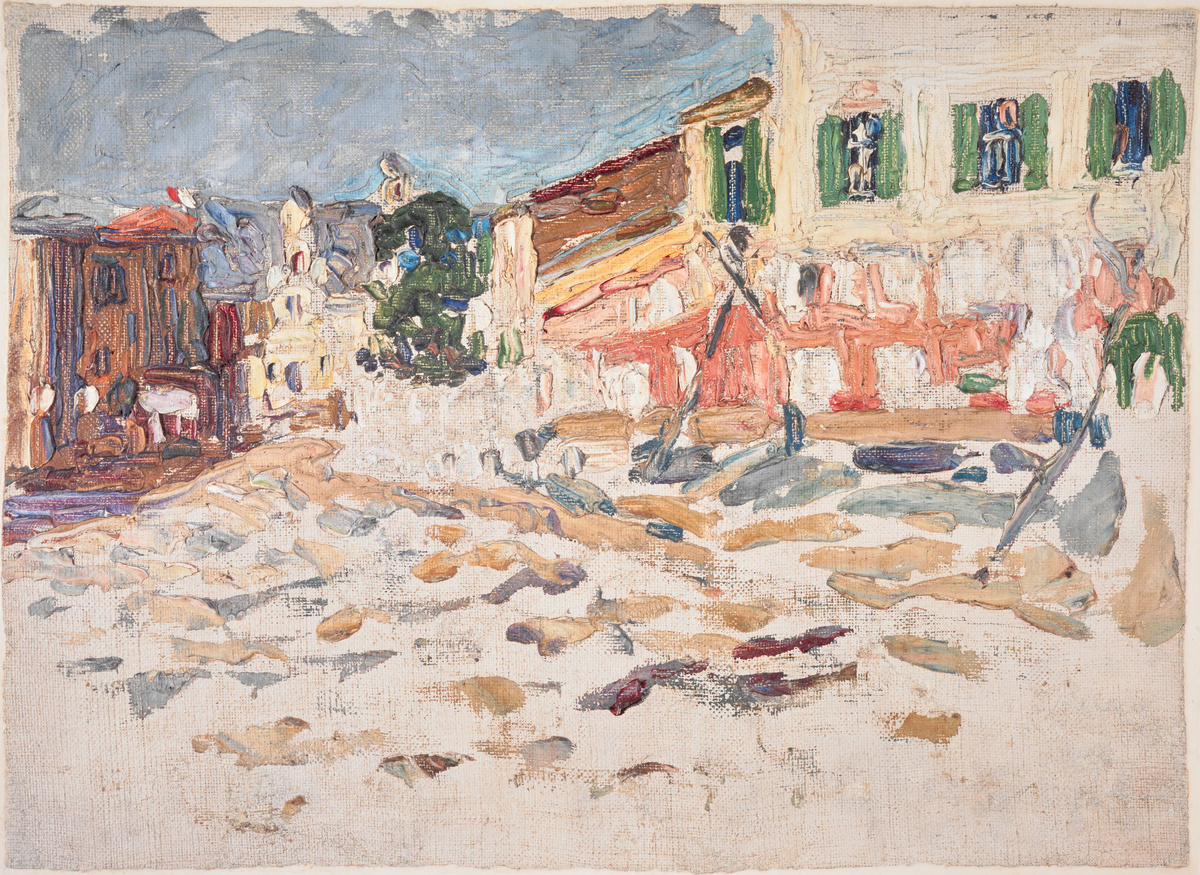
Before you is a small painting by Wassily Kandinsky, dated 1904 and known in English as Saturday Break (Holland). The French title is Samedi soir (Hollande), which points to a Saturday evening in Holland. The supplied record identifies the artist, the date and the title, but it does not tell us who or what is shown. So we'll be careful about what we claim.
What the record does confirm is the material. This is tempera on paper, a medium that binds pigment differently from oil and is often worked on a prepared surface. The painting is modest in size, so it asks for close looking rather than a sweeping view from across a room.
The date places it early in Kandinsky's career, well before the abstract compositions he became known for. In 1904 he was still making representational work, and a Dutch subject fits with the travel pictures of those years. The French and English titles differ slightly, but both name Holland and a Saturday evening, which is the scene the picture sets out to show.
Because the record doesn't describe the painted scene, we can't responsibly identify figures, gestures or a story. What we can say is that the title directs us to a specific time and place: a Saturday evening in Holland. Any reading of mood or incident would be our inference, not something the record establishes. So the honest approach is to let the title and medium frame the looking, and to hold back from naming what isn't documented.
What we have, then, is a small tempera painting from Kandinsky's early representational years, titled for a Saturday evening in Holland. The record gives us its identity and its materials, and leaves the scene itself for your own eyes. That isn't a weakness in the work. It's simply where the documentation stops, and where looking begins.
The story and its sources
Historical claims are linked to the records below. Close looking and interpretation are identified in the passage notes.
- Passage 1Documented historyWikimedia Commons: Saturday Break (Holland)
- Passage 2Documented historyWikimedia Commons: Saturday Break (Holland)
- Passage 3Documented historyWikimedia Commons: Saturday Break (Holland)
- Passage 4InterpretationWikimedia Commons: Saturday Break (Holland)
- Passage 5InterpretationWikimedia Commons: Saturday Break (Holland)
Details to notice
About 2 minutes to readHarbor town and church spire
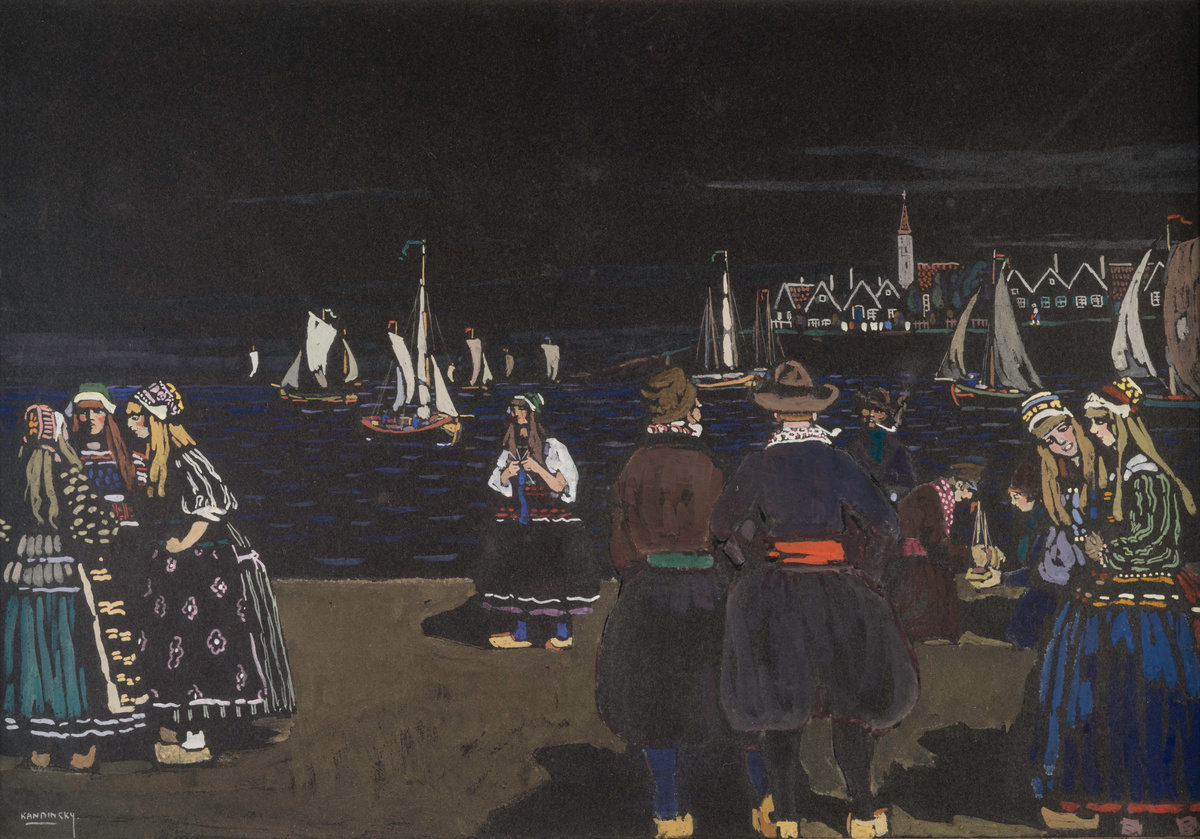
Across the dark water, white gabled houses and a slender church spire are picked out against the night. The harbor setting and distant lights establish the Dutch locale and the figures' outward focus.
Young women at right
Two young women in bright bonnets and striped or embroidered bodices lean close together at the far right. Their linked intimacy and visible faces add a conversational note to the promenade.
Three women at left
A cluster of three women in ornate caps, striped aprons, and patterned dresses. Their angled poses and layered costumes establish the communal folk setting.
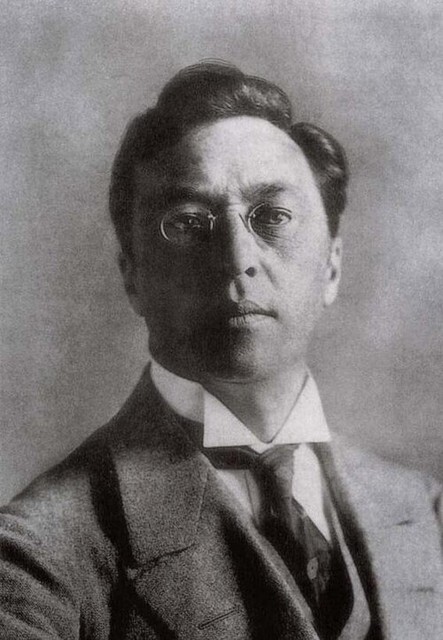
Artist portrait Image credit
未知上傳者. Image source · Public domain
About the artist
Wassily Kandinsky
1866 to 1944
Wassily Kandinsky was an avant-garde painter of Russian origin (1866–1944). Their work is associated with Expressionism; Symbolism; Bauhaus. Their recorded places of work include Paris; Munich; Weimar; Rapallo; The Hague; Russia; Stockholm; Switzerland; Tunis.
- Born
- 1866
- Died
- 1944
- Nationality
- Russian Empire; Russian Soviet Federative Socialist Republic; Soviet Union; France; Germany
- Birthplace
- Moscow
- Died in
- Neuilly-sur-Seine
Biography sources
The research & record
Study the work.
Follow the evidence.
Find catalogue details, historical context, technical research and the literature behind this artwork.
The artwork record
Research catalogue
Catalogue information and detailed research, with references that link to the bibliography.
Updated .
Identity and catalogue
Link- Title
- Saturday Break (Holland)(Wikimedia Commons: Saturday Break (Holland), n.d.)
- Artist or attribution
- Wassily Kandinsky
- Object date
- 1904(Wikimedia Commons: Saturday Break (Holland), n.d.)
- Medium and support
- tempera on paper(Wikimedia Commons: Saturday Break (Holland), n.d.)
- Dimensions
- height: 35.2 cm (13.8 in); width: 50.3 cm (19.8 in)(Wikimedia Commons: Saturday Break (Holland), n.d.)
- Current collection or location
- Musée National d'Art Moderne, Centre national d'art et de culture Georges-Pompidou, Paris(Wikimedia Commons: Saturday Break (Holland), n.d.)
- Depicted subject
- A tempera painting on paper by Wassily Kandinsky dated 1904, catalogued with the French title Samedi soir (Hollande) and the English title Saturday Break (Holland). The supplied object record establishes identity, medium, date and collection but does not describe the depicted scene or its meaning.
- Title variants
- Samedi soir (Hollande); Samstag Abend (Holland)
- Accession number
- AM 81-65-85
- Support
- paper
- Culture / place
- Unknown
- Period
- Unknown
Read valuation records and their limitations
Catalogue identity
The object is catalogued as a painting by Wassily Kandinsky dated 1904. That date is the one attached to the work in the record used here, and it belongs to the making of the picture rather than to any later event in its documentation. The same record supplies the work's dual titles: in French, Samedi soir (Hollande), and in English, Saturday Break (Holland). The two labels are not identical in sense. The French names a Saturday evening and parenthetically locates it in Holland; the English rendering shifts the noun toward a break, while retaining the Dutch parenthetical. Both versions agree on the day, the country and the association with Holland, and those are the elements the record actually establishes. Neither title is described as an inscription on the work, and the record does not say whether either title was given by the artist or adopted later in cataloguing, so the wording should be treated as the recorded title rather than as documented authorial text.(Wikimedia Commons: Saturday Break (Holland), n.d., Artist or creator line; Date field; Title and label fields)
The recorded dimensions are 35.2 centimetres in height and 50.3 centimetres in width. The format is therefore landscape, wider than it is high by roughly fifteen centimetres, which is consistent with a view-type composition rather than a tall figure study. At this scale the painting is an intimate object, and the landscape orientation conditions how the titled subject, a Saturday evening in Holland, would be framed. These measurements are record fields, not measurements taken here, and they should be cited as the catalogue's figures.(Wikimedia Commons: Saturday Break (Holland), n.d., Dimensions field)
The record used for this account is a Wikimedia Commons file page, and its own annotation is explicit about its limits: it was treated as a discovery record for the object, and only its record fields were catalogued, not the underlying museum documentation. Its partially consulted status means the title, date, dimensions and collection data are reported at second hand. This matters for how the identity of the work should be presented. The catalogue values are stable enough to use, but questions the museum file might answer, such as how the titles were assigned or what the work's exhibition and ownership record is, cannot be resolved from this source, and nothing here should be read as if the museum's own documentation had been checked directly.(Wikimedia Commons: Saturday Break (Holland), n.d., Artist or creator line; Date field; Title and label fields; Dimensions field)
The work is a painting by Wassily Kandinsky dated 1904.(Wikimedia Commons: Saturday Break (Holland), n.d.)
The work carries the French title Samedi soir (Hollande) and the English title Saturday Break (Holland).(Wikimedia Commons: Saturday Break (Holland), n.d.)
The recorded dimensions are 35.2 centimetres high and 50.3 centimetres wide.(Wikimedia Commons: Saturday Break (Holland), n.d.)
Materials and technique
LinkRead valuation records and their limitations
The documented technical description of this work is brief but specific: it is a painting by Wassily Kandinsky, dated 1904, executed in tempera on paper. The record gives the work two titles, the French Samedi soir (Hollande) and the English Saturday Break (Holland), and records dimensions of 35.2 centimetres in height by 50.3 centimetres in width. Those measurements establish a landscape-oriented sheet of modest size, closer to a study than to a large exhibition canvas, though the record does not say whether the paper was ever mounted, stretched or framed. The work belongs to the Musée National d'Art Moderne, part of the Centre national d'art et de culture Georges-Pompidou in Paris, under accession number AM 81-65-85. The accession number is the only piece of institutional history in the record, and it is left uninterpreted here: no acquisition date or prior owner is supplied, so the object's route into the Paris collection remains undocumented in this evidence.(Wikimedia Commons: Saturday Break (Holland), n.d., Medium field)
Materials and technique
The medium statement is the record's only technical claim, and it should be weighed as such. Tempera names a paint in which pigment is bound in an aqueous medium rather than in a drying oil, and the record does not identify the specific binder, the pigments, or any preparatory layer on the paper. Nor does it state whether the sheet was primed, whether the paint was applied in thin washes or opaque strokes, or what tools were used. These are precisely the questions a conservation examination would answer, and the supplied evidence derives from a Wikimedia Commons file page built from the museum's published data and a Google Arts and Culture reproduction, not from such an examination. The material description therefore establishes what the object is made of at the level of the catalogue entry, and nothing further about how the paint was handled.(Wikimedia Commons: Saturday Break (Holland), n.d., Medium field)
The record's own framing matters for how the material evidence should be used. The source is described as a discovery record that supplies the dual titles, the date, the tempera-on-paper medium, the dimensions, the collection and the accession number, and that explicitly does not describe the painted scene or offer any interpretation; it also notes that only its record fields were catalogued, not the underlying museum documentation. The same record identifies the institution as the source of the published image, credited to Google Art and Culture and stated to be in the public domain. What can be seen in that reproduction and what the catalogue fields establish are thus two different orders of evidence, and this account keeps them apart: the medium, support, date and dimensions are documented; any description of handling, surface or finish would rest on the reproduction alone and is not asserted here.(Wikimedia Commons: Saturday Break (Holland), n.d., Medium field)
Interpretation
Within a larger history of materials, the choice of tempera on paper in 1904 places the work in a period when Kandinsky was making small, portable pictures, and the format helps explain why such a sheet survives as a closely observed object rather than a monumental one. The evidence supports only this much: a paper support, an aqueous paint, and dimensions that reward close viewing. It does not support claims about the pigments used, the number of layers, any later treatment or conservation intervention, or the condition of the sheet, and none of those are inferred here. The object's importance for material culture rests on what the record securely documents, a dated early twentieth-century tempera on paper by a named artist held in a major public collection, and on the fact that its making remains known at the level of medium and support while its execution awaits technical study.(Wikimedia Commons: Saturday Break (Holland), n.d., Medium field)
The medium is tempera on paper.(Wikimedia Commons: Saturday Break (Holland), n.d.)
Reception and literature
LinkRead valuation records and their limitations
Reproduction and Public Circulation
The published reproduction of Samedi soir (Hollande), also titled Saturday Break (Holland), is credited to Google Art and Culture and is described in the supplied record as in the public domain. That credit and license information is the one documented stage of reception captured in the available evidence: it identifies the channel through which the image circulates publicly and indicates that the reproduction itself is not restricted by copyright according to the record. It also indicates that the institution holding the work was treated as the source of the published image, since the record links the painting both to a Centre Pompidou resource page and to a Google Arts and Culture asset identifier. The credit is evidence about the reproduction and its licensing, not about the painting's exhibition history, critical fortune or market reception, none of which the supplied record documents.(Wikimedia Commons: Saturday Break (Holland), n.d., Credit and License fields)
The same record fields that establish this reproduction stage also anchor the object's public identity: Wassily Kandinsky, the date 1904, the medium tempera on paper, dimensions of 35.2 by 50.3 centimetres, and collection in the Musée National d'Art Moderne within the Centre national d'art et de culture Georges-Pompidou, Paris, under accession number AM 81-65-85. The dual French and English titles are recorded together with these particulars. Because the record does not describe the painted scene or any interpretation, the reception documented here is essentially one of access and attribution: viewers encounter the work through an institutional image asset presented under a public domain designation, with the museum's collection status and accession number supplying the object's fixed identification. The record does not state when the reproduction was made, when the work entered the collection, or whether the public domain designation reflects the age of the work, the terms of the source institution, or the policies of the reproducing platform.(Wikimedia Commons: Saturday Break (Holland), n.d., Credit and License fields)
Interpretation
Within the larger history of modern art's circulation, this single documented stage is consequential precisely because it is modest: the record shows an early twentieth-century tempera painting, dated 1904, made available as a credited, public domain image through a major museum's resource page and a widely used art platform, so that the work's titles, date, medium, dimensions and accession number travel with the image rather than being separated from it. That framing supports study of the object's material and documentary identity without supplying, on the evidence here, any account of critical admiration, imitation, biography, literary reading, public event or artistic appropriation. The reception history of this painting remains, on the supplied evidence, the history of its reproduction and institutional identification; claims about its fame or influence would require documentation the record does not contain.(Wikimedia Commons: Saturday Break (Holland), n.d., Credit and License fields)
The supplied record states that the published reproduction is credited to Google Art and Culture and is in the public domain.(Wikimedia Commons: Saturday Break (Holland), n.d.)
Collection and display
LinkRead valuation records and their limitations
Institutional record and image circulation
The institutional record for this small painting places it in the collection of the Musée National d'Art Moderne, part of the Centre national d'art et de culture Georges-Pompidou in Paris, under accession number AM 81-65-85. The same source record links the work to a Centre Pompidou resource page and to a Google Arts and Culture asset identifier, indicating that the institution is the source of the published image. The record also states that the published reproduction is credited to Google Art and Culture and is in the public domain. These are cataloguing and rights facts rather than observations about the painted surface: they establish where the object is held, how it is numbered within that holding, and through which channel its image has circulated. Read together, they show a work whose primary documentation comes from its museum of record and whose public visibility has been extended by a digitisation partnership, which is why a freely licensed reproduction of a Paris-held painting can be consulted at a distance.(Wikimedia Commons: Saturday Break (Holland), n.d., Collection and Accession number fields; References field; Source/Photographer field)
The evidential weight of these two units should be kept distinct. The accession number and the holding institution belong to the museum's own documentation as it has been reported into the supplied record. The image-source linkage is a statement about the publication trail, not about the object's physical state, condition, acquisition history or display. The record as catalogued does not supply a date of accession, a donor or vendor, an exhibition history, a conservation treatment, or the documentation behind the AM 81-65-85 number, and none of these should be inferred from the presence of a comparable number or from the fact of digitisation. What the evidence does support is narrower and still consequential: the object can be located within a specific national modern art collection in Paris, and its reproduction can be traced to a specific institutional imaging arrangement credited to Google Art and Culture and released as public domain.(Wikimedia Commons: Saturday Break (Holland), n.d., Collection and Accession number fields; References field; Source/Photographer field)
Interpretation
Placing this work within the Musée National d'Art Moderne collection matters for how it is encountered in the history of modern art. A tempera on paper dated 1904 by Wassily Kandinsky sits in a national collection of modern art, which situates the object in a public institutional frame rather than a private or commercial one, and the accession number indicates a recorded place in that collection's numbering. The linkage between the museum record and the Google Arts and Culture identifier also means the work's public presence is divided between the physical holding in Paris and a distributed digital surrogate. For research purposes the two should not be collapsed: the reproduction circulated through the institutional channel documents the image, while the collection record documents the holding. The supplied evidence establishes both, and it is their conjunction, rather than either alone, that makes the object consultable as a collection item at a distance.(Wikimedia Commons: Saturday Break (Holland), n.d., Collection and Accession number fields; References field; Source/Photographer field)
The work belongs to the collection of the Musée National d'Art Moderne, part of the Centre national d'art et de culture Georges-Pompidou in Paris, with accession number AM 81-65-85.(Wikimedia Commons: Saturday Break (Holland), n.d.)
The supplied record links the work to a Centre Pompidou resource page and to a Google Arts and Culture asset identifier, indicating the institution as the source of the published image.(Wikimedia Commons: Saturday Break (Holland), n.d.)
Documented values and qualified estimates
LinkRead valuation records and their limitations
The Object and Its Recorded Identity
Interpretation
The single supplied record for this work is a Wikimedia Commons file page, used here as a discovery record rather than as the museum's own documentation. It identifies the painting as a work by Wassily Kandinsky dated 1904, carrying the French title Samedi soir (Hollande) and the English title Saturday Break (Holland). Both titles name Holland and a Saturday evening, so the record anchors the work to a place and a time of day even though it says nothing about the painted scene. The same record establishes the medium as tempera on paper and the dimensions as 35.2 centimetres high by 50.3 centimetres wide, and it places the work in the collection of the Musée National d'Art Moderne, part of the Centre national d'art et de culture Georges-Pompidou in Paris, under accession number AM 81-65-85. Those fields, not any description of figures or incident, are what the documentation actually fixes.(Wikimedia Commons: Saturday Break (Holland), n.d.)
The record also describes how the published image reached the public: it links the work to a Centre Pompidou resource page and to a Google Arts and Culture asset identifier, indicating the institution as the source of the published reproduction, and it states that the reproduction is credited to Google Art and Culture and is in the public domain. This matters for how the object is known. The image circulates through an institutional channel, but the metadata that accompanies it is a Commons record compiled from that channel, and only the record fields were catalogued, not the underlying museum documentation. The identification of artist, date, title, medium, dimensions and accession number therefore rests on the published record as supplied, while questions about the scene, condition or exhibition history fall outside what this evidence establishes. The account should keep that boundary visible rather than filling it with inference.(Wikimedia Commons: Saturday Break (Holland), n.d.)
Working Valuation and Its Limits
The only valuation evidence supplied is a calculated working insurance estimate, recorded as a working calculation generated on 30 October 2026, giving a range of US$2 million to US$8 million. Its stated methodology is a broad bracket derived conservatively from the confirmed identity as an early 1904 Kandinsky tempera on paper. The reasoning treats the artist as a canonical modern master, which supports a high baseline for any authenticated original, while the comparatively modest support and medium relative to his major oils and the small scale of 35.2 by 50.3 centimetres temper that baseline. Institutional provenance at the Musée National d'Art Moderne, Centre Pompidou, with accession number AM 81-65-85, is treated in the calculation as strong authenticity support rather than as a market price indicator. The document explicitly states that no comparable sales, auction results or private insurance data were supplied or consulted, and that the range is intentionally wide to accommodate uncertainty.(Wikimedia Commons: Saturday Break (Holland), n.d.)
The estimate carries a qualification that governs how it should be read: it is a model-generated working range for manual review only, not an official insurance value, appraisal, auction estimate, auction result or sale price, and it was not derived from comparable sales or private insurance records. It should be verified by a qualified appraiser before any insurance or financial use. For a research archive, the figure is best treated as a documented artifact of a valuation exercise rather than as a fact about the painting's worth. What the exercise does record with some precision is the set of object attributes it relied on, namely the 1904 date, the tempera-on-paper medium, the dimensions and the Paris accession, which align with the identification established by the Commons record and give the valuation its only evidential footing.(Wikimedia Commons: Saturday Break (Holland), n.d.)
Working estimate
Calculated working insurance estimate, not a sale price: Estimated value: US$2M to US$8M Recorded date: Working calculation, generated 2026-10-30. Methodology: Broad working range derived conservatively from the confirmed identity as an early (1904) Wassily Kandinsky tempera on paper, a comparatively modest support and medium relative to his major oils, at a small scale (35.2 by 50.3 cm). Kandinsky is a canonical modern master, which supports a high baseline for any authenticated original work; the medium and size temper that baseline. Institutional provenance at the Musee National d'Art Moderne, Centre Pompidou, with accession number AM 81-65-85, is treated as strong authenticity support rather than as a market price indicator. No comparable sales, auction results, or private insurance data were supplied or consulted, so the range is a working bracket for manual review only and is intentionally wide to accommodate uncertainty. Qualification: Model-generated working range for manual review only. This is not an official insurance value, appraisal, auction estimate, auction result, or sale price. It was not derived from comparable sales or private insurance records and should be verified by a qualified appraiser before any insurance or financial use.(Wikimedia Commons: Saturday Break (Holland), n.d.)
Further reading
Books for a closer look
Paid links. As an Amazon Associate I earn from qualifying purchases.

Open Library Kandinsky: Russian and Bauhaus years, 1915-1933.
Solomon R. Guggenheim Museum
Catalogued under Kandinsky and carrying subjects such as Catalogs, Centre Georges Pompidou, Musée national d'art moderne, and Catalogues raisonnés. That institutional and catalogue focus connects directly to the documented collection of this 1904 tempera on paper in the Musée National d'Art Moderne, making it the most object-relevant candidate among the Kandinsky records.
ISBN 0892070447

Open Library Kandinsky, complete writings on art
G.K. Hall
Recorded as Kandinsky's complete writings on art, with subjects on modern art and twentieth-century art. Because the work is by Kandinsky and dated 1904, a compilation of his own writings offers a documented primary-source route to the artist's ideas and early practice, though the record does not confirm any mention of this specific painting.
ISBN 0805799508
Bibliography
Sources and further reading
References are arranged by author or organisation, with links to the original publications. Where no publication date is recorded, n.d. means no date.
Source notes updated .
No recorded sources match these filters. Reset the filters to see the full bibliography.
- 03
Book
Kandinsky, complete writings on art. G.K. Hall.
Recorded as Kandinsky's complete writings on art, with subjects on modern art and twentieth-century art. Because the work is by Kandinsky and dated 1904, a compilation of his own writings offers a documented primary-source route to the artist's ideas and early practice, though the record does not confirm any mention of this specific painting.
- ISBN
- 0805799508
Citation text
- 02
Book
Kandinsky: Russian and Bauhaus years, 1915-1933. Solomon R. Guggenheim Museum.
Catalogued under Kandinsky and carrying subjects such as Catalogs, Centre Georges Pompidou, Musée national d'art moderne, and Catalogues raisonnés. That institutional and catalogue focus connects directly to the documented collection of this 1904 tempera on paper in the Musée National d'Art Moderne, making it the most object-relevant candidate among the Kandinsky records.
- ISBN
- 0892070447
Citation text
- 01
Secondary · About this artwork
Wikimedia Commons: Saturday Break (Holland) (n.d.). Wikimedia Commons.
Wikimedia Commons file page used as a discovery record for this object. It supplies the dual French and English titles, the 1904 date, the tempera on paper medium, the dimensions, the Musée National d'Art Moderne collection and the accession number. It does not describe the painted scene or any interpretation, and only its record fields were catalogued here, not the underlying museum documentation.
Citation text
Art to live with
Bring this painting
home.
A piece of the archive, made yours. Explore Saturday Break (Holland) in a size and finish that fits your space.
Your text and annotations appear on these editions. Adding to cart saves that design for printing.
Combine this painting with your favourites01 / Find your edition
Made for you
Suggested from your location. Change it if you're sending elsewhere or using a VPN. Prices and delivery are shown in GBP.
1 product
Choose an edition to make it yours
iPhone 12 Mini ? Glossy ? back view
iPhone 12 Mini · Glossy

iPhone 12 Mini ? Glossy ? back view

iPhone 12 Mini ? Glossy ? back view

iPhone 12 Mini ? Glossy ? back view
Tough phone case
GBP 16.34
Delivery GBP 4.22 / Total GBP 20.56
A two-layer phone case with a printed polycarbonate shell and a shock-absorbing inner liner.
Two layers with a shock-absorbing TPU liner
Case & print details
- Device
- Apple · iPhone 12 Mini
- Material
- Polycarbonate shell with a TPU inner liner
- Artwork
- Outer back and wrapped edges from one template
- Finish
- Glossy
- Version
- Standard version
- Printing
- Dye sublimation
- Print file
- 1,122 × 1,831 px · 95 × 155 mm · PNG · 300 dpi recommended
Rear outline and camera openings follow this variant's Printify template. Case depth and small hardware remain illustrative.
Supplier product detailsFit and fill keep the painting’s proportions. Stretch changes them.
Move and zoom the painting on your tough phone case.
Made to order with your design
Made to order
US delivery only
The 30 cm ruler is scaled alongside your selected print. Keep the painting’s proportions with a black background, or stretch it to fill. Frame width, material texture and screen colours are illustrative.
Keep exploring