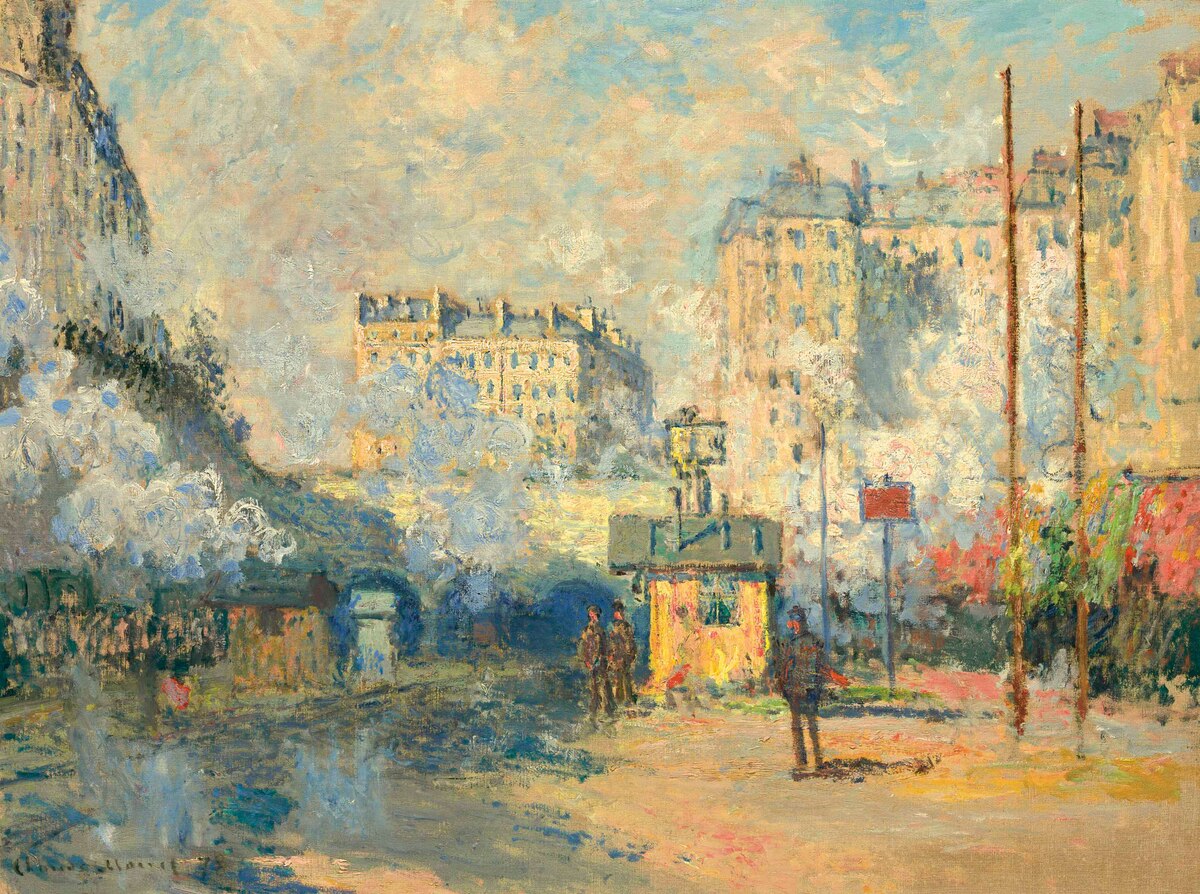
A docent-led reading of Claude Monet's 1894 painting of Rouen Cathedral's west façade in sunlight, made during his cathedral series and now in the National Gallery of Art. The account distinguishes what is visible from what is documented.
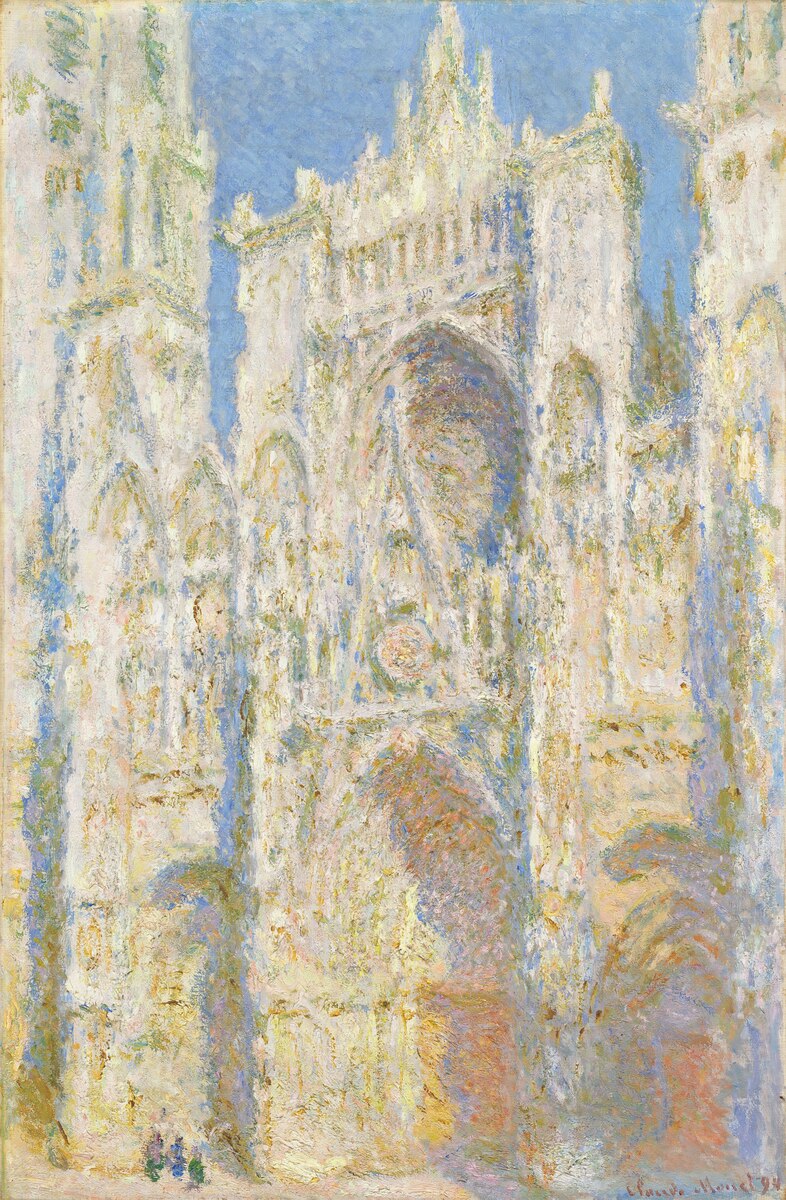
The artist's signature and date, 'Claude Monet 94', brushed in red-brown along the lower right edge. It documents the 1894 campaign of the cathedral series and is one of the few sharply legible marks in an otherwise dissolved surface.
02
Tiny figures at the base
A few minute figures at the foot of the facade at lower left, brushed in blue and dark green. They establish human scale against the monumental front and mark the pavement line where the building meets the street.
03
Gable and pinnacles against sky
The crowning gable and pinnacles of the central facade, touched in quick creamy and greenish strokes so the carved silhouette dissolves into the blue sky. It shows Monet's shorthand for Gothic architecture and the painting's core tension between solid stone and shimmering air.
Your gallery guide
Rouen Cathedral, West Façade, Sunlight by Claude Monet (1894)
A docent-led reading of Claude Monet's 1894 painting of Rouen Cathedral's west façade in sunlight, made during his cathedral series and now in the National Gallery of Art. The account distinguishes what is visible from what is documented.
Editorial review by Artifact Archive automated publishing
This is Rouen Cathedral's west façade, painted by Claude Monet in 1894. It belongs to his Rouen Cathedral series, in which he returned repeatedly to the same stone front.
What you see is the cathedral's portal, the entrance area of the west front, under direct sunlight. The painting is about how that fixed architecture looks when light changes across it.
The façade fills almost the entire canvas. There is very little street, sky or surrounding city to distract you. The building is pushed close to the picture surface.
The stone is not painted as one flat grey. Sunlight and shadow break it into warm and cool patches. You can see the portal area, the vertical elements of the façade and the dense carved surface as areas of changing colour.
Monet made this painting in 1894. It is catalogued as number 1324 in the Wildenstein 1974 catalogue raisonné of his work. That catalogue number confirms the exact canvas within the larger series.
The painting is oil on canvas. The artist's signature and date appear at the bottom right: Claude Monet '94. That inscription ties this particular canvas to Monet and to the year of its making.
The close-up view turns the cathedral into a field of light and texture rather than a complete architectural portrait. Because the building is cropped so tightly, you read the surface as much as the structure.
Monet's brushwork varies across the stone. In sunlit passages the paint looks warmer and more open. In shadowed recesses it thickens and cools. That contrast is what makes the portal legible without sharp outlines.
The title tells you the condition being painted: sunlight. This is not a record of the cathedral at one fixed moment for all time. It is a study of a specific light effect on a specific morning or hour.
By making the same west front again and again, Monet treated the building as a constant against which light could be measured. The subject is therefore both the cathedral and the visible evidence of sunlight on stone.
The painting belongs to the National Gallery of Art in Washington, D.C., where it is credited to the Chester Dale Collection. It is recorded there under accession number 1963.10.179.
What stays with you is how little information Monet needs. A close view, warm and cool paint, and a clear light condition are enough to make the cathedral's west front recognizable and alive.
The story and its sources
Editorial review by Artifact Archive automated publishing.
Historical claims are linked to the records below. Close looking and interpretation are identified in the passage notes.
Claude Monet was a French painter (1840–1926). Their work is associated with Impressionism. Their recorded places of work include Paris; Argenteuil; Vétheuil; Poissy; Giverny; Honfleur; Trouville, Seine-Maritime; Amsterdam; Oegstgeest; Sassenheim; The Hague; Zaandam; London.
The painting carries the title Rouen Cathedral, West Façade, Sunlight and is attributed to Claude Monet with a date of 1894. The same object is also recorded under the title Rouen Cathedral, Portal, Sunlight, a variant that shifts the described subject from the whole west front to the portal within it. Neither title stands alone as the single documented name: the catalogue record preserves both, and the differences between them matter for how the subject is described, since one names the façade and the other the entrance area. Monet is documented as a French painter and graphic artist, born in 1840 and died in 1926, associated with Impressionism.(Wikimedia Commons: Rouen Cathedral, n.d., Title and Date fields; Summary and Wikidata depiction statement; Summary, Artist field)
The date 1894 belongs to the making of the painting, as stated for the work itself, and is not to be confused with later catalogue dates attached to the object. The same year is inscribed on the canvas, where the artist's signature and date appear at the bottom right as Claude Monet '94, tying this particular canvas to Monet and to the year of its execution. The work is oil on canvas, measuring 100.1 cm in height and 65.8 cm in width. A separate catalogue date of 1974 is that of the Wildenstein catalogue raisonné, not of the painting; within that publication the canvas is number 1324, a reference that fixes the exact picture within the larger series of Rouen Cathedral views.(Wikimedia Commons: Rouen Cathedral, n.d., Title and Date fields; Summary, Artist field)
The painting recorded by the supplied documentation depicts the west façade of Rouen Cathedral, specifically its portal, seen in sunlight, and is inscribed with the artist's signature and date at the bottom right as Claude Monet '94. That inscription is the primary internal witness tying this particular canvas to Monet and to the year 1894, and it corresponds to the documented series membership and making date. Taken together, the recorded title, the signature and the date establish the picture as a signed and dated 1894 work rather than an undated or attributed one. The documentation also names the work under more than one title, recorded as Rouen Cathedral, West Façade, Sunlight and also as Rouen Cathedral, Portal, Sunlight, a difference in naming rather than in identification: both titles point to the same west front and the same sunlit portal condition. Dating and authorship therefore rest on the inscription and the catalogue record, while the description of the depicted architecture rests on the structured depiction data, not on the inscription itself.(Wikimedia Commons: Rouen Cathedral, n.d., Title and structured data depiction; Inscriptions field; Series title field)
The objects of the description are the west façade and its portal. That the portal, the entrance area of the west front, can be recognized at all depends on the depiction data supplied for the work, which specifies the west façade and identifies the portal as the part shown. The documentation states the condition as sunlight, which the title repeats in two variant forms. Neither the portal identification nor the sunlight condition is established here by technical examination of paint layers or by conservation imaging; both come from the catalogue-level depiction record and from the recorded titles. This distinction matters for how the visual evidence should be weighed: the architecture depicted is a documented identification at the level of the source record, while any finer claim about brushwork, colour temperature or the rendering of carved stone would go beyond what these units state and is not asserted here.(Wikimedia Commons: Rouen Cathedral, n.d., Title and structured data depiction; Inscriptions field)
The reproduction and what it can support
The uploaded image is described in the licensing section as a faithful photographic reproduction of a two-dimensional public domain work of art. This matters for the evidentiary status of everything seen in the file: the image is a reproductive photograph, not the canvas itself, and its claim to fidelity is asserted by the licensing record rather than verified by technical imaging. No raking light, infrared, X-radiograph or pigment analysis is reported in these units, so the visible surface as recorded in the reproduction cannot be used to establish underlying drawing, later intervention or changes in appearance over time. The reproduction and its public domain status also explain the conditions under which the picture's appearance circulates: a freely reusable file of a painting whose copyright has expired, published through the image repository that carries the object record.(Wikimedia Commons: Rouen Cathedral, n.d., Licensing section; Public domain rationale)
Institutional custody and display
Interpretation
Within a larger history of art and material culture, the documented facts place this canvas at a specific intersection: a signed and dated 1894 oil on canvas of fixed size, catalogued as Wildenstein 1324, belonging to a series in which the same west façade was painted repeatedly under changing light, and now held with a Washington accession number, a named credit line and a specific gallery location, and reproduced as a public domain photograph. The series membership gives the picture its place in a history of repeated looking at a single monument, while the inscription, catalogue entry, accession number and credit line trace the object's passage from the artist's hand into documented institutional custody. The recorded dimensions and medium establish it as a portable easel painting rather than a monumental or architectural work, which is the material condition that makes a series of close views of one façade possible at all. Interpreted cautiously, the conjunction of a dated inscription, a numbered catalogue position and a fixed museum location is what allows a single sunlit portal to function simultaneously as a record of a light effect and as a datable, locatable artifact.(Wikimedia Commons: Rouen Cathedral, n.d., Title and structured data depiction; Inscriptions field; Medium field; Dimensions field; Notes, catalogue raisonné; Series title field; Public domain rationale)
This canvas was made in 1894 and belongs to Claude Monet's Rouen Cathedral series, the sequence in which he returned repeatedly to the same west front of the building. The work is catalogued as number 1324 in the Wildenstein 1974 catalogue raisonné of Monet, a numbering that fixes this particular canvas within the much larger body of related views. The painting is now in the public domain, because the artist died in 1926 and copyright has expired both in the country of origin and in the United States.(Wikimedia Commons: Rouen Cathedral, n.d., Series title field; Notes, catalogue raisonné; Public domain rationale)
What the Documentation Establishes and What It Does Not
Interpretation
The evidence supplies the work's series affiliation, its catalogue raisonné number and its copyright status, and it establishes the object as a two-dimensional work of art reproduced in a faithful photograph. These are matters of documentation and status. The supplied units do not record a commission, a purchase, a patron, a household, a specific date of sale or a recorded moment of creation, and no such circumstances should be inferred from the series title, the catalogue number or the rights rationale alone. What the record does establish is the work's place in a deliberately repeated project rather than a single isolated image, which is the secure basis on which any account of its making must rest.(Wikimedia Commons: Rouen Cathedral, n.d., Series title field; Notes, catalogue raisonné; Public domain rationale; Licensing section)
The painting is in the public domain because the author died in 1926, and copyright has expired in the country of origin and in the United States.(Wikimedia Commons: Rouen Cathedral, n.d.)
Physical description of the National Gallery of Art canvas begins with its recorded medium and support: the work is catalogued as oil on canvas, and its dimensions are given as 100.1 cm in height by 65.8 cm in width. These two facts are the whole of the object-level material record supplied for this section, but they carry real weight for how the picture reads. The height exceeds the width by a substantial margin, so the canvas is a tall vertical rectangle rather than a squarish or horizontal field. That proportion is the physical ground on which the tightly cropped, façade-filling composition described in the visual evidence depends: the support's format and the depicted subject's framing are registered as separate kinds of information, one measured from the object and one read from the image, and the account keeps them distinct. Nothing in the supplied evidence documents a lining, stretcher, cradling, ground layer, priming, varnish, pigment identification or conservation treatment, so the medium and dimensions stand as the documented material facts while further layer and material questions remain outside the present evidence.(Wikimedia Commons: Rouen Cathedral, n.d., Medium field; Dimensions field)
Making technique as visual inference rather than technical analysis
Interpretation
How the painting was produced is not established by technical examination in the available record. The working method reaches the archive as visual inference drawn from the reproduction and from how the surface is described: the stone is said not to be painted as one flat grey, sunlight and shadow breaking it into warm and cool patches, with brushwork varying across the surface, warmer and more open in sunlit passages and thicker and cooler in shadowed recesses. Those are readings of appearance, not the results of sampling, cross-section, infrared imaging or pigment analysis, and the account should not let them function as laboratory findings. What they do establish is the kind of making the picture presupposes: a surface built from differentiated colour and variable paint handling rather than from uniform local tone or linear contour, so that the portal remains legible without sharp outlines. Read against the documented oil medium on canvas, this supports a picture in which the material behaviour of paint is itself part of the image's argument about light on stone.(Wikimedia Commons: Rouen Cathedral, n.d., Medium field; Licensing section)
Documented and inferred layers kept separate
Taken together, the units allow a bounded material history and no more. The documented layer is thin: oil on canvas, a vertical support of 100.1 by 65.8 cm, a signed and dated lower-right inscription reading Claude Monet '94, a subject of the west façade portal in sunlight, and a faithful photographic reproduction through which the surface is known. The interpretive layer concerns appearance: broken warm and cool patches, variable brushwork, denser and cooler paint in shadow. The catalogue and collection record, including the Wildenstein number 1324 and the National Gallery of Art accession 1963.10.179, matters here because it is what makes the material description of this particular canvas tractable at all, allowing statements to be attached to one object rather than to the series in general. Statements about preparation, pigment or condition are not supported and are left open.(Wikimedia Commons: Rouen Cathedral, n.d., Medium field; Dimensions field; Title and structured data depiction)
The painting belongs to the National Gallery of Art, Washington, D.C., where it is recorded under accession number 1963.10.179, and it is displayed in the National Gallery of Art, West Building, Main Floor, Gallery 80. The credit line under which it is held names the Chester Dale Collection: the painting is credited to the Chester Dale Collection. This is the documented end point of the ownership record supplied here, the institutional home and the named source of the gift or bequest credit. The accession number 1963.10.179 supplies the year element conventionally embedded in the museum's numbering, but the evidence does not itself narrate the transfer from the Chester Dale Collection to the National Gallery of Art, nor does it give a deed date, a bequest instrument or an intermediate owner. What is documented is the present repository, the gallery location, the credit line and the accession number; what is not documented in these units is the mechanism and date by which the work passed into the collection.(Wikimedia Commons: Rouen Cathedral, n.d., Credit line)
This canvas by Claude Monet, titled Rouen Cathedral, West Façade, Sunlight, is also recorded under the title Rouen Cathedral, Portal, Sunlight. It was made in 1894 and belongs to Monet's Rouen Cathedral series, the group of paintings in which he returned repeatedly to the same stone front of the cathedral. The work is oil on canvas, measuring 100.1 cm in height and 65.8 cm in width, and it is inscribed with the artist's signature and date at the bottom right: Claude Monet '94. The painting depicts the west façade of Rouen Cathedral, specifically its portal, seen in sunlight. The Wildenstein 1974 catalogue raisonné of Claude Monet catalogues the work as number 1324, a number that identifies this exact canvas within the larger series and ties the object to the documented corpus of Monet's work rather than to the series in general. Monet himself, born in 1840 and died in 1926, was a French painter and graphic artist associated with Impressionism.(Wikimedia Commons: Rouen Cathedral, n.d., Accession number and institution fields)
The painting belongs to the National Gallery of Art, Washington, D.C., where it is recorded at the accession number 1963.10.179, and it is credited to the Chester Dale Collection. Its display location is documented as the National Gallery of Art, West Building, Main Floor, Gallery 80. These are separate pieces of institutional information: the accession number identifies the object within the museum's registration system, the credit line records the collection through which it entered the museum, and the gallery designation records where it can currently be seen. The accession number's 1963 prefix and the credit to the Chester Dale Collection together place the work's arrival at the National Gallery in the early 1960s, within the well-known Dale bequest, though the supplied evidence establishes the credit line and number rather than the details of that transfer.(Wikimedia Commons: Rouen Cathedral, n.d., Accession number and institution fields; Current location field)
Because the painting is held by a public institution and its author died in 1926, copyright has expired both in the country of origin and in the United States, and the work is in the public domain. The photographic reproduction of the canvas available through Wikimedia Commons is described as a faithful reproduction of a two-dimensional public domain work of art. This matters for the object's research history as much as for its legal status: the availability of a faithful, rights-free image is what allows the painting to circulate in scholarship and public reference sources at a scale that a museum visit alone would not permit, and it is the reason the documentation of title, date, medium, dimensions, collection, accession number, credit line, inscription and licensing can be gathered in one place.(Wikimedia Commons: Rouen Cathedral, n.d., Accession number and institution fields)
Interpretation
The painting's subject is the cathedral's portal, the entrance area of the west front, under direct sunlight, and the title states the condition being painted rather than an unchanging record of the building. Within the series, the west front functions as a constant against which changing light could be measured, so that the subject is both the cathedral and the visible evidence of sunlight on stone. The evidence for the making of this particular canvas is the inscription and the catalogue number rather than any account of Monet's working hours: the signature and date at the bottom right anchor the canvas to Monet and to 1894, and the Wildenstein number locates it precisely within the series. Distinguishing the two matters. The catalogue entry documents which canvas this is; the inscription documents that Monet signed and dated it. Neither, on the supplied evidence, records a specific morning or hour, so the light condition named in the title should be understood as the painting's subject, not as a dated meteorological observation.(Wikimedia Commons: Rouen Cathedral, n.d., Accession number and institution fields)
The Wikimedia Commons file page records the painting under two titles, Rouen Cathedral, West Façade, Sunlight and Rouen Cathedral, Portal, Sunlight, and identifies the maker as Claude Monet, born 1840 and died 1926, a French painter and graphic artist associated with Impressionism. The work was made in 1894 and belongs to the Rouen Cathedral series. The subject is the west façade of Rouen Cathedral, specifically its portal, seen in sunlight. The file page states that the uploaded image is a faithful photographic reproduction of a two-dimensional public domain work of art, and that copyright has expired in the country of origin and in the United States because the author died in 1926.(Wikimedia Commons: Rouen Cathedral, n.d.)
The physical description is unusually precise for a work of this kind. The painting is oil on canvas and measures 100.1 cm in height and 65.8 cm in width. It is inscribed with the artist's signature and date at the bottom right: Claude Monet '94. The Wikimedia record places it in the collection of the National Gallery of Art, Washington, D.C., under accession number 1963.10.179, credited to the Chester Dale Collection, and notes its display in the West Building, Main Floor, Gallery 80. These details establish the object's identity as a specific catalogued canvas rather than as a generic example of the series.(Wikimedia Commons: Rouen Cathedral, n.d.)
The painting is catalogued as number 1324 in the Wildenstein 1974 catalogue raisonné of Claude Monet. The insurance planning document describes it as a large, securely catalogued 1894 oil on canvas cathedral series canvas with documented provenance, published in the Wildenstein catalogue raisonné as number 1324 and held by the National Gallery of Art as accession 1963.10.179 from the Chester Dale collection. The catalogue number is the mechanism that fixes this particular canvas within the much larger series of views Monet made of the same building.(Wikimedia Commons: Rouen Cathedral, n.d.)
Recorded valuations and their limits
The only value figure supplied in this evidence is a calculated working insurance estimate, not an appraisal or a market result. The recorded range is US$20M to US$60M, generated 2026-10-16 as a broad working insurance range for manual review only. The stated basis is that Monet is a canonical Impressionist painter and that the specific confirmed object is a large, securely catalogued 1894 oil on canvas cathedral series canvas, 100.1 x 65.8 cm, with documented provenance, published in the Wildenstein catalogue raisonné as number 1324, and held by the National Gallery of Art in Washington, D.C. as accession 1963.10.179 from the Chester Dale collection. The methodology describes a conservative market tier typical for top-tier museum-quality Monet paintings of this period, scale and subject, with upward adjustment for institutional ownership and public prominence and downward adjustment for non-public sale status. No specific private comparable or venue record was used.(Wikimedia Commons: Rouen Cathedral, n.d.)
That figure carries explicit qualifications that must travel with it. The document states that it is a model-generated working range for manual review only; that it is not an official insurance value, appraisal, auction result or sale price; that it should not be relied on for coverage, tax or transaction purposes; and that no private insurance records, confirmed comparable sales or public auction results were used. It concludes that a qualified fine-art appraiser or insurer must supply the actual insured value or insurance schedule. The range therefore records a planning assumption about Monet's market tier, not a documented price, and the absence of comparables is part of the claim rather than a gap in the record.(Wikimedia Commons: Rouen Cathedral, n.d.)
Working estimate
Calculated working insurance estimate, not a sale price: Estimated insurance range: US$20M to US$60M Recorded date: Working calculation, generated 2026-10-16. Methodology: Broad working insurance range for manual review only. Basis: monet is a canonical impressionist painter, and the specific confirmed object is a large, securely catalogued 1894 oil on canvas cathedral series canvas (100.1 x 65.8 cm) with documented provenance, published in wildenstein catalogue raisonne as no. 1324, and held by the national gallery of art in washington, d.c. as accession 1963.10.179 from the chester dale collection. The range is generated from a conservative market tier typical for top-tier museum-quality monet paintings of this period, scale, and subject, with upward adjustment for institutional ownership and public prominence and downward adjustment for non-public sale status. No specific private comparable or venue record was used. This is a calculated insurance planning range, not a fair market valuation or professional appraisal. Qualification: This is a model-generated working range for manual review only. It is not an official insurance value, appraisal, auction result, or sale price. Do not rely on it for coverage, tax, or transaction purposes. No private insurance records, confirmed comparable sales, or public auction results were used. A qualified fine-art appraiser or insurer must supply the actual insured value or insurance schedule.(Wikimedia Commons: Rouen Cathedral, n.d.)
Further reading
Books for a closer look
Paid links. As an Amazon Associate I earn from qualifying purchases.
Recorded with Paul Hayes Tucker as author and subjects including criticism and interpretation, art criticism, and Monet, Claude. Tucker is associated with scholarly Monet studies, and this record's subject headings point to interpretive art-historical discussion rather than biography or fiction, so it may offer comparative analysis of Monet's painting practice relevant to the Rouen Cathedral series. Contents were not consulted.
References are arranged by author or organisation, with links to the original publications. Where no publication date is recorded, n.d. means no date.
Source notes updated .
No recorded sources match these filters. Reset the filters to see the full bibliography.
02
Book
Daniel Wildenstein (1988).Claude Monet. Cassell; Orion Publishing Group, Limited.
Recorded as a catalogue raisonné of Monet by Daniel Wildenstein, with subjects including catalogues raisonnés, Impressionism, and individual painters of the 19th century. A catalogue raisonné is the standard object-level reference for identifying and documenting individual Monet paintings, which makes it the strongest candidate for research on a specific work such as Rouen Cathedral, West Façade, Sunlight. Relevance is based on the recorded title, authors, and subjects only; the individual entry for this painting has not been consulted.
Recorded with Paul Hayes Tucker as author and subjects including criticism and interpretation, art criticism, and Monet, Claude. Tucker is associated with scholarly Monet studies, and this record's subject headings point to interpretive art-historical discussion rather than biography or fiction, so it may offer comparative analysis of Monet's painting practice relevant to the Rouen Cathedral series. Contents were not consulted.
Wikimedia Commons file page providing the object's title, artist, date, medium, dimensions, collection information, accession number, credit line, inscriptions and licensing for the National Gallery of Art painting by Claude Monet.
Fit and fill keep the painting’s proportions. Stretch changes them.
Move and zoom the painting on your biodegradable phone case.
Preparing the artwork for your edition…
Made to order
From the archive
36.6 cm / 14.4 in30.7 cm / 12.1 in
36.6 × 30.7 cm / 14.4 × 12.1 in · Standard
Drag to rotate
36.6 × 30.7 cm / 14.4 × 12.1 in · Standard
14.4 in / 36.6 cm12.1 in / 30.7 cm
14.4 × 12.1 in / 36.6 × 30.7 cm · Standard
14.4 in / 36.6 cm12.1 in / 30.7 cm
14.4 × 12.1 in / 36.6 × 30.7 cm · Standard
14.4 in / 36.6 cm12.1 in / 30.7 cm
14.4 × 12.1 in / 36.6 × 30.7 cm · Standard
Drag to rotate1 / 3
Desk mat
GBP 15.20
Delivery GBP 5.46 / Total GBP 20.66
A smooth polyester desk mat with a natural rubber non-slip base and anti-fray edges, available in three sizes.
Fit and fill keep the painting’s proportions. Stretch changes them.
Move and zoom the painting on your desk mat.
Preparing the artwork for your edition…
Made to order
The 30 cm ruler is scaled alongside your selected print. Keep the painting’s proportions with a black background, or stretch it to fill. Frame width, material texture and screen colours are illustrative.
Advertising supports the archive. These preferences control aggregate page counting, reading activity and ad-delivery diagnostics. They use no visitor tracking cookie.