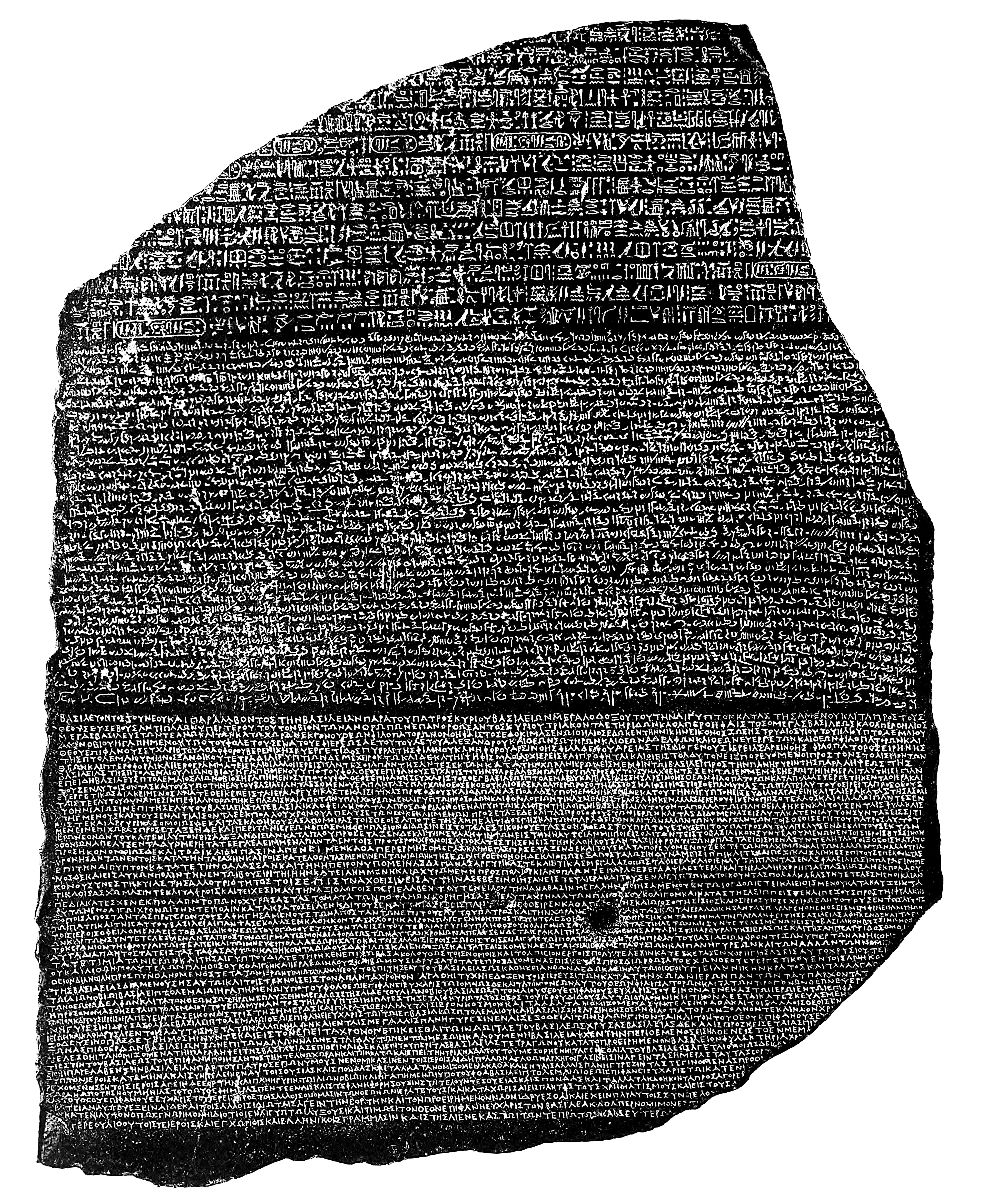
Rosetta Stone by Maker unknown (196 BCE (decree); stele carved shortly after)
Artist: Maker unknown
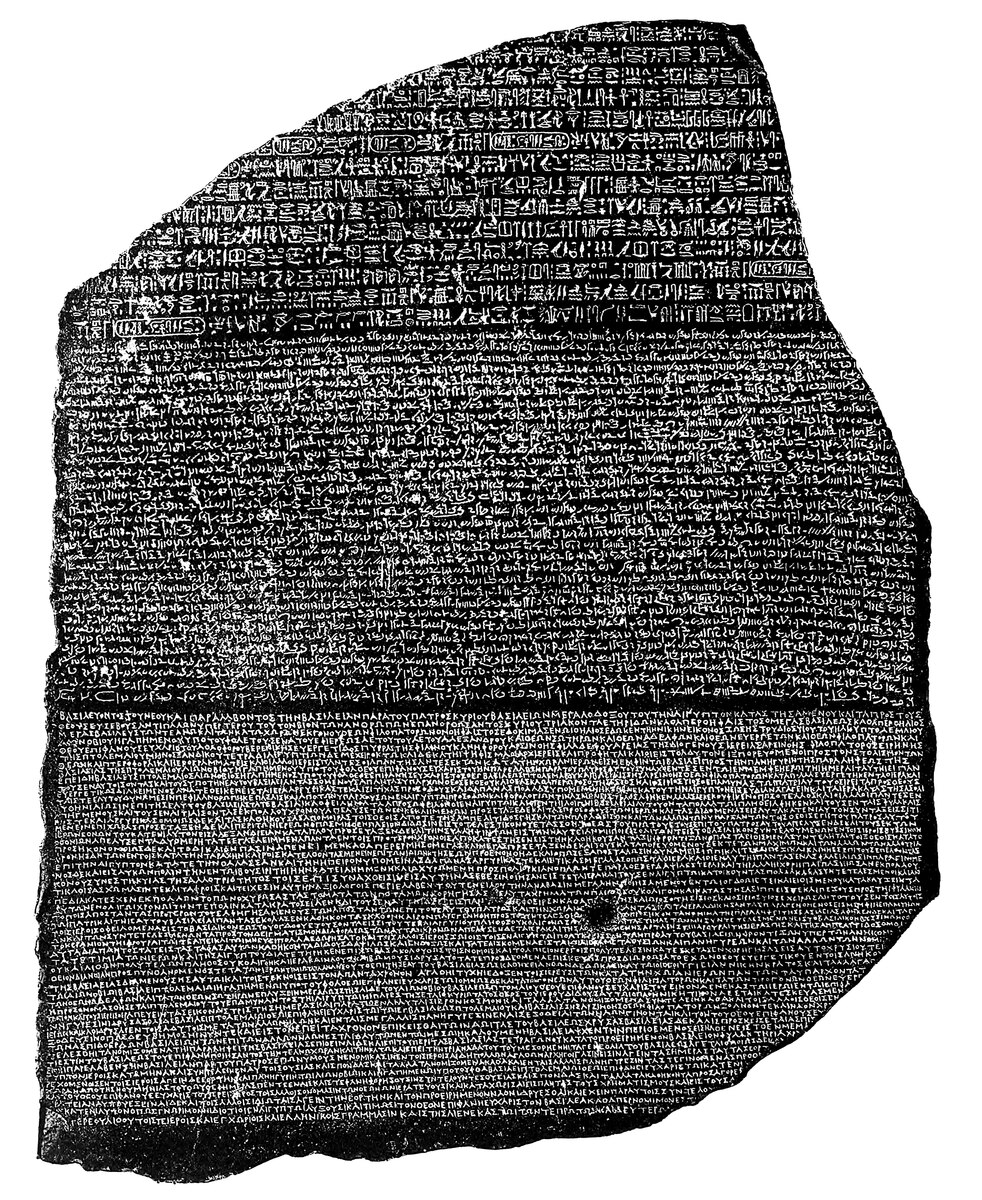
A stone stele from Ptolemaic Egypt carries the same priestly decree in three scripts: hieroglyphic, demotic and Greek. The parallel texts, recorded here in a 1922 British Museum publication, became the key to reading Egyptian hieroglyphs.
The irregular fractured silhouette and missing wedge at the upper left, evidence of the slab's damage and the loss of part of the sacred decree.
02
Greek band
The lowest register of Greek capitals, the most legible band and the text that first allowed scholars to decode the stone's meaning.
03
Demotic band
The middle register of cursive demotic script, the everyday Egyptian writing of the decree and the bridge between the hieroglyphic and Greek texts.
Your gallery guide
Rosetta Stone by Maker unknown (196 BCE (decree); stele carved shortly after)
A stone stele from Ptolemaic Egypt carries the same priestly decree in three scripts: hieroglyphic, demotic and Greek. The parallel texts, recorded here in a 1922 British Museum publication, became the key to reading Egyptian hieroglyphs.
Editorial review by Artifact Archive automated publishing
This is the Rosetta Stone, a stone stele that carries a priestly decree issued in 196 BCE, written in three scripts: hieroglyphic, demotic and Greek.
The parallel texts are what made the stone so important. Because the decree survives in three writing systems, scholars could compare them and begin to read Egyptian hieroglyphs.
What you are looking at in this reproduction is the stone as photographed for a 1922 British Museum publication, not the physical object itself.
The surface is divided into registers, one script above another. The upper register carries hieroglyphs, the middle demotic, and the lower Greek.
The three bands let you see at a glance that this is one message repeated in different scripts, not three separate documents. That repetition is the whole point of the object.
The decree itself dates to 196 BCE, and the surviving slab was carved shortly after. It comes from Ptolemaic Egypt, when Greek-speaking rulers governed a country whose priests and scribes still worked in Egyptian scripts.
The three scripts served different readers: hieroglyphs for the temple tradition, demotic for everyday Egyptian use, and Greek for the administration.
The stone's later life is part of its story. In 1922 the British Museum published a short book by Sir Ernest Alfred Wallis Budge that described the stone's history and how it was translated.
That book was made and sold at the museum for sixpence, and its publication date is recorded as 17 February 1922. The photograph reproduced in it was taken by Donald Macbeth.
So this image is a document of how the stone was presented to the public in the early twentieth century, as much as it is a record of the object.
What the Rosetta Stone represents is a single decree made legible to three audiences at once. Its survival in parallel scripts is what allowed modern readers to recover the meaning of hieroglyphs.
Seen this way, the stone is not just an ancient document. It is also a record of how knowledge of ancient Egypt was transmitted to later generations, including through the 1922 publication that reproduced it.
The story and its sources
Editorial review by Artifact Archive automated publishing.
Historical claims are linked to the records below. Close looking and interpretation are identified in the passage notes.
Stone stele bearing three inscribed scripts: hieroglyphic, demotic, and Greek
Current collection or location
British Museum, London, United Kingdom
Movement or period
Ptolemaic period
Country or culture
Ancient Egypt
Depicted subject
A stone stele carrying a priestly decree issued in 196 BCE at Memphis, inscribed in three scripts so that it could be read by Egyptian priests, Egyptian demotic readers, and Greek-speaking administrators. The surviving slab is a later copy of the decree, and its parallel texts became the key to modern decipherment of Egyptian hieroglyphs.
Attribution qualification
The supplied sources do not identify a maker for the stone itself. The 1922 book describing the stone was written by Sir Ernest Alfred Wallis Budge; the photograph of the stone was taken by Donald Macbeth. Neither should be treated as the maker of the artifact.
Catalogue identification and the status of the supplied image
The supplied source identifies the object as the Rosetta Stone, and that identification is the basis of the catalogue entry rather than an inference drawn from the image alone. A qualification belongs with it: the uploaded file is a photograph of the Rosetta Stone taken from the 1922 book 'The Rosetta Stone', not the physical stone itself. The file therefore documents a reproduction, and any description of surface, colour or condition must be understood as a description of that photograph and of the stone as it appeared when photographed for the book, not as a direct examination of the object in its present state. This distinction matters for catalogue practice, because the image stands at one remove from the artefact it names.(Budge and Macbeth, 1922, File title and Structured data depiction; Summary description)
The 1922 publication and its producer
The photograph was reproduced in a 1922 British Museum publication also titled 'The Rosetta Stone', written by Sir Ernest Alfred Wallis Budge, which described the history of the stone and how it was translated. The book was made and sold at the British Museum for sixpence, and its publication date is recorded as 17 February 1922. The photograph reproduced in the book was taken by Donald Macbeth, whose role as photographer is recorded alongside Budge's authorship. These details establish the publication as a museum product of a specific date and price, an item of public instruction as much as a work of scholarship, and they attach a named photographer to the image that the uploaded file preserves.(Budge and Macbeth, 1922, Summary description)
The uploaded file is a photograph of the Rosetta Stone taken from the 1922 book 'The Rosetta Stone', not the physical stone itself.(Budge and Macbeth, 1922)
The object is a stone stele carrying a decree inscribed in three scripts. That inscription in three writing systems is the feature on which its later fame and its decipherment depended, because the parallel texts could be set beside one another and compared. The visual character of the object is therefore not decorative but structural: the significance of the monument is inseparable from the fact that one text exists several times over, and it is precisely that redundancy that made the monument usable for reading Egyptian scripts.(Budge and Macbeth, 1922, Summary description)
The image as a document of publication
Interpretation
Read together, the inscription and the publication record describe two distinct moments in the life of the monument. In the first, a decree was inscribed in three scripts on a stone stele, and the coexistence of those scripts is what allowed the text to be recovered. In the second, a museum publication of 1922 presented the stone and the story of its translation to a paying public, using a photograph by Donald Macbeth as the visual evidence. The photograph is thus a record of how knowledge of the object was transmitted in the early twentieth century as well as a view of the object, and the two functions should not be conflated.(Budge and Macbeth, 1922, Summary description; Summary and Structured data; Summary and Structured data (publication date, price); Author field)
Visual observation
The Rosetta Stone carries a decree inscribed in three scripts, and its decipherment depended on those parallel texts.(Budge and Macbeth, 1922)
The item under examination in this archive is not the Rosetta Stone itself but a photographic reproduction of it: the image was taken from the 1922 British Museum book titled The Rosetta Stone, and it records the stone as photographed for that publication rather than the physical object. Because the surviving artifact here is a printed reproduction, the evidence available to this section describes the making of an early twentieth century illustrated book rather than the carving of the ancient slab. The photograph reproduced in the book was taken by Donald Macbeth, and the source identifies the file as a photograph of the stone taken from the 1922 volume, so the support, the image surface and the printing of the book are the materials actually documented. This distinction matters for any account of materials and technique: the tones and textures visible in the reproduction are those of a photographic image and its printing, not necessarily of the stone's surface. The visual evidence that the stone carries a decree inscribed in three scripts, and that its decipherment depended on those parallel texts, gives the subject of the photograph its significance, but the material examined here is the 1922 reproduction.(Budge and Macbeth, 1922, Author field; Summary description)
The 1922 publication
The book in which the photograph appeared was made and sold at the British Museum for sixpence, and its publication date is recorded as 17 February 1922. Its author was Sir Ernest Alfred Wallis Budge, and the work is described as a short book describing the history of the Rosetta Stone and how it was translated. These are the documented circumstances of production and distribution: a low priced museum publication, issued on a recorded date, written by a named scholar and illustrated with a photograph by a named photographer. The evidence does not record the printing method, paper stock or edition size of the book, and it does not record any treatment, pigment or preparation applied to the stone. What it establishes is the material and commercial form of the publication and the persons responsible for its text and its photograph.(Budge and Macbeth, 1922, Author field)
The photograph of the Rosetta Stone reproduced in the 1922 book was taken by Donald Macbeth.(Budge and Macbeth, 1922)
The documented reception of the Rosetta Stone includes a specific early twentieth-century stage of institutional publication and public sale. A 1922 British Museum publication, written by Sir Ernest Alfred Wallis Budge, described the history of the stone and how it was translated. The book was made and sold at the British Museum for sixpence, and its publication date is recorded as 17 February 1922. These details place the volume within the museum's own commercial and educational output rather than in a purely academic or commercial press: it was produced by the institution that held the object and priced at sixpence, a sum that framed the stone's history and decipherment as accessible to a broad museum audience. The evidence establishes the author, the institutional maker and seller, the price and the exact recorded publication date, while leaving open how widely the book circulated or how it was received by readers, since no sales figures or contemporary reviews are supplied.(Budge and Macbeth, 1922, Summary and Structured data; Summary and Structured data (publication date, price))
The 1922 publication is also a record of photographic mediation, not only of textual description. The photograph of the Rosetta Stone reproduced in the book was taken by Donald Macbeth, and the uploaded file is a photograph of the Rosetta Stone taken from the 1922 book 'The Rosetta Stone', not the physical stone itself. The source annotation describes the work as a short work describing the history of the Rosetta Stone and how it was translated, made and sold at the British Museum. Reception here therefore has two layers: Budge's written account of the stone's history and translation, and Macbeth's photographic reproduction that carried the object's image into the book. The surviving file documents how the stone was presented to the public in the early twentieth century through this particular publication, while the evidence does not establish whether Macbeth photographed the stone directly or worked from an existing image, nor how the plate was printed or captioned within the volume.(Budge and Macbeth, 1922, Summary and Structured data; Summary and Structured data (publication date, price))
The Parallel Texts Behind the Reception
Interpretation
The object that this publication transmitted was itself defined by parallel texts. The Rosetta Stone carries a decree inscribed in three scripts, and its decipherment depended on those parallel texts. That observation connects the later reception documented in the 1922 book to the property that made the stone translatable in the first place: because the same decree survives in three writing systems, readers could compare them and begin to recover Egyptian scripts. The evidence supplied here does not specify the date of the decree, the scripts by name, or the sequence of decipherment, so the account should be kept to what the units establish: a three-script decree whose parallel texts were the condition of its decipherment, later narrated for the public by Budge in an inexpensive museum book bearing Macbeth's photograph.(Budge and Macbeth, 1922, Summary description; Summary and Structured data; Summary and Structured data (publication date, price))
A 1922 British Museum publication, written by Sir Ernest Alfred Wallis Budge, described the history of the stone and how it was translated.(Budge and Macbeth, 1922)
The book was made and sold at the British Museum for sixpence, and its publication date is recorded as 17 February 1922.(Budge and Macbeth, 1922)
The evidence available for this record identifies the object as the Rosetta Stone, an ancient Egyptian stone stele carrying a trilingual inscription in hieroglyphic, demotic, and Greek, associated with a Ptolemaic-period decree of 196 BCE and held at the British Museum. The stone is therefore both a single inscribed monument and an object with an institutional present: the inscriptions and the museum custody are treated together in the evidence rather than as separate matters. What the source material establishes is this identification and this context; it does not supply dimensions, condition, accession number, or any comparable object data.(Budge and Macbeth, 1922)
The one value figure in the evidence is explicitly framed as a model-generated working range, not a documented price. It records an estimated value of US$50M to US$200M, with a recorded date of a working calculation generated on 2026-10-16, and it states that the figure is a broad, conservative range for manual insurance-review purposes only. The stated rationale is that the supplied excerpts confirm identification and context but provide no dimensions, condition, accession number, or any official appraisal, sale, or insurance figure, and that no market, auction, or insurance comparables are available in the sources. The range is consequently described as an order-of-magnitude bracket rather than a precise valuation: the low end is a conservative floor proposed for an object of supreme historical importance if an insurance schedule were built from first principles, and the high end reflects the practical difficulty of replacing or underwriting an irreplaceable object.(Budge and Macbeth, 1922)
The qualifications attached to that figure are part of the record and should travel with it. The evidence states that it is not an official insurance value, appraisal, auction result, or sale price; that it does not reflect access to private insurance records; and that no comparable sales are claimed. It further states that actual insurance values require professional appraisal, condition review, and underwriting. The same unit also specifies the character of the underlying source material: the supplied excerpts identify the artwork and support its identification and context only, and they do not provide a public appraisal. Any use of the range, on this evidence, has to be read alongside these limits rather than treated as a valuation of the object.(Budge and Macbeth, 1922)
The 1922 publication and the reproduced image
Although the evidence in this section is directed at recorded value, it also fixes several facts about the object's inscription and reception that condition any evaluation. The stone is described as carrying a decree in three scripts, and its decipherment is said to have depended on those parallel texts. A 1922 British Museum publication written by Sir Ernest Alfred Wallis Budge is recorded as describing the history of the stone and how it was translated, with a publication date of 17 February 1922. The book was made and sold at the British Museum for sixpence. The photograph of the Rosetta Stone reproduced in that book was taken by Donald Macbeth, and the uploaded file is a photograph of the stone taken from the 1922 book, not the physical stone itself.(Budge and Macbeth, 1922)
Read together, these facts show that the document under consideration is at one remove from the monument: it is a book photograph, made for a museum publication and reproduced from it, and so it records a mode of public presentation as well as a view of the stone. That distinction matters for how the object is valued, because the surviving evidence describes an institutional publication and an identification rather than a market event. Because the sources provide no appraisal, sale, or insurance comparables, the calculated range stands as a working bracket generated from the object's historical prominence and the difficulty of underwriting an irreplaceable artifact, and it should be cited, if at all, with the caveat that neither the identification material nor the 1922 publication supplies a price.(Budge and Macbeth, 1922)
Working estimate
Calculated working insurance estimate, not a sale price: Estimated value: US$50M to US$200M Recorded date: Working calculation, generated 2026-10-16. Methodology: This is a broad, conservative working range for manual insurance-review purposes only. The supplied excerpts confirm the object is the Rosetta Stone, an ancient Egyptian stone stele with trilingual inscriptions (hieroglyphic, demotic, and Greek) from the Ptolemaic period, associated with a 196 BCE decree, and held at the British Museum. The excerpts identify the artwork but do not provide dimensions, condition, accession number, or any official appraisal, sale, or insurance figure. Because no market, auction, or insurance comparables are available in the sources, and because the object is a uniquely prominent, world-heritage-scale institutional artifact, the range is set as a very wide order-of-magnitude bracket rather than a precise valuation. The low end reflects a conservative floor for an object of supreme historical importance if an insurance schedule were to be built from first principles; the high end reflects the practical difficulty of replacing or underwriting such an irreplaceable object. No comparable sales or private insurance records were used or claimed. Qualification: This is a model-generated working range for manual review only. It is not an official insurance value, appraisal, auction result, or sale price. It does not reflect access to private insurance records, and no comparable sales are claimed. The supplied sources support identification and context only; they do not provide a public appraisal. Actual insurance values require professional appraisal, condition review, and underwriting.(Budge and Macbeth, 1922)
Further reading
Books for a closer look
Paid links. As an Amazon Associate I earn from qualifying purchases.
Published for the Trustees of the British Museum by British Museum Press
Recorded as a British Museum title with subjects Rosetta stone, the Rosetta stone inscription, hieroglyphic writing and Egyptian language. As a museum publication tied to the institution holding the object, it is directly relevant to the stone and its documented study.
References are arranged by author or organisation, with links to the original publications. Where no publication date is recorded, n.d. means no date.
Source notes updated .
No recorded sources match these filters. Reset the filters to see the full bibliography.
02
Book
British Museum (1981).The Rosetta stone. Published for the Trustees of the British Museum by British Museum Press.
Recorded as a British Museum title with subjects Rosetta stone, the Rosetta stone inscription, hieroglyphic writing and Egyptian language. As a museum publication tied to the institution holding the object, it is directly relevant to the stone and its documented study.
Budge, E. A. Wallis and Macbeth, Donald (photographer) (1922).Wikimedia Commons: Rosetta Stone. The Rosetta Stone. Wikimedia Commons.
A short work describing the history of the Rosetta Stone and how it was translated, made and sold at the British Museum. The supplied source is a photograph of the stone reproduced in this book.
Advertising supports the archive. These preferences control aggregate page counting, reading activity and ad-delivery diagnostics. They use no visitor tracking cookie.