Identity and catalogue
Link- Artist or attribution
- Maker unknown
- Current collection or location
- The British Museum, London, United Kingdom
- Movement or period
- 19th Dynasty, New Kingdom
- Country or culture
- Ancient Egypt
- Depicted subject
- A funerary papyrus made for Hunefer, a king's scribe and estate overseer, guiding him through the judgement of the dead and the ceremonies of burial so he could join Osiris in the afterlife.
- Title variants
- Papyrus of Hunefer; Book of the Dead of Hw-nfr
- Attribution qualification
- Maker unknown. The British Museum record does not name a scribe or artist for this papyrus.
- Accession number
- EA9901,3 and EA9901,5
- Support
- papyrus
- Inscriptions
- Inscription on the recto in Middle Egyptian, written in cursive hieroglyphic script, including Book of the Dead spell 30B and Chapter 17.; Titles and epithets recorded in the inscription include Estate Overseer of Menmaatra, Overseer of the Cattle of the Lord of the Two Lands, King's Scribe, Lady of the House and Chantress of Amun.
Catalogued identity and named associations
The object catalogued here is the Book of the Dead of Hunefer, a papyrus held in the British Museum collection under museum number EA9901,3 and registration number 1852,0525.1.3. The museum record associates the papyrus with named individuals recorded in its inscription: Hunefer himself, his wife Nasha, and Sety I. The record also supplies an associated group number, G16566, and notes that conservation treatment has been carried out on the object, indications that the material has been managed as a documented museum holding and not only as an ancient text.(The British Museum, n.d.a, Museum number EA9901,3; Associated names: Hunefer; Nasha (wife); Sety I)
The object is the Book of the Dead of Hunefer, a papyrus in the British Museum collection, museum number EA9901,3.(The British Museum, n.d.a)
The papyrus is associated with named individuals including Hunefer, his wife Nasha, and Sety I, as recorded in the inscription.(The British Museum, n.d.a)
Subject and iconography
LinkScenes and inscriptions
Visual observation
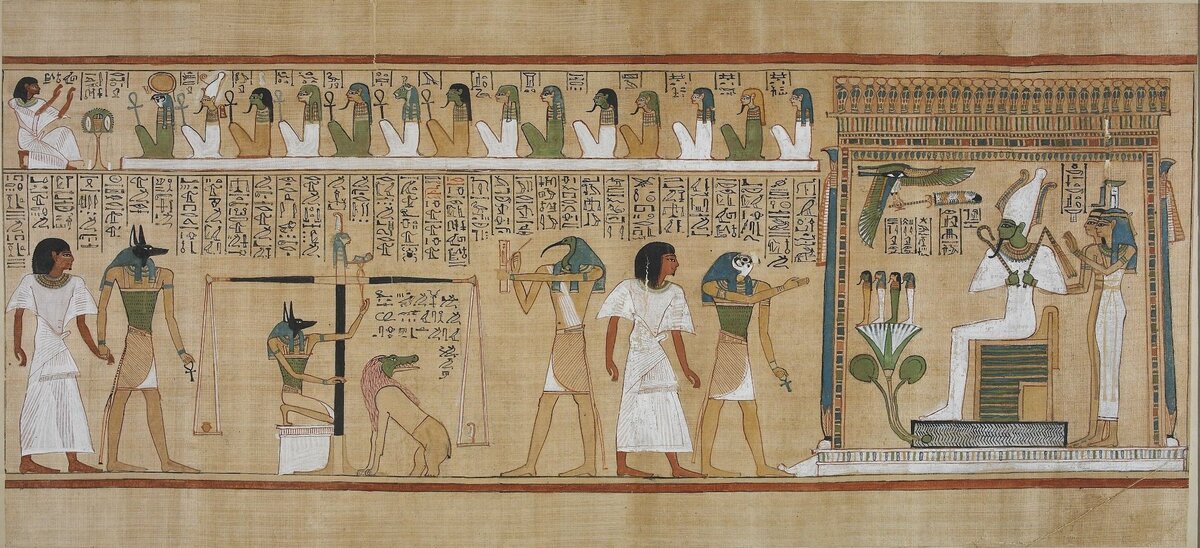
The visual programme of the Book of the Dead of Hunefer is distributed across its sheets, and the museum record describes each sheet's scene in distinct terms. On sheet 3 the judgement vignette is accompanied by captions and by spell 30, and it sits within a fully coloured border. The museum's inscriptions note for sheet 3 specifies Book of the Dead spell 30B, the heart spell whose concern is the behaviour of the heart at the weighing. Because the border is described as fully coloured while the scene itself is a vignette, the sheet presents image, caption and spell text as one coordinated unit rather than as illustration with commentary appended.(The British Museum, n.d.a, Description: fully coloured vignettes; coloured border; Judgement vignette with captions and spell 30; Inscription note: Book of the Dead: 30B; Representation of: Osiris, Isis, Nephthys, Anubis, Thoth, Ammit, Horus, Sons of Horus)(The British Museum, n.d.b, Inscription note: Book of the Dead: 17 with vignette of Opening the Mouth)
Within the judgement scene the museum's representation list names Anubis, Thoth, Osiris, Isis, Nephthys, Ammit, Horus and the Sons of Horus, and it characterises the composition as showing episodes in Hunefer's judgement rather than a single frozen moment. The record's wording is careful on this point: it lists the figures and identifies the subject as the judgement, which is an identification of what is represented, not a claim about the sequence in which a viewer reads the scene. The presence of both the scribal and funerary deities and the divine tribunal makes the sheet the point at which the papyrus's narrative stakes are highest, since the outcome of the weighing is the subject the accompanying spell 30B is written to influence. Separately, the inscription note confirms that sheet 3 carries Book of the Dead spell 30B while sheet 5 carries Chapter 17 together with a vignette of the Opening of the Mouth, so the two sheets differ both in the spells they transmit and in the pictorial subjects that accompany them.(The British Museum, n.d.a, Representation of: Osiris, Isis, Nephthys, Anubis, Thoth, Ammit, Horus, Sons of Horus; Inscription note: Book of the Dead: 30B)(The British Museum, n.d.b, Inscription note: Book of the Dead: 17 with vignette of Opening the Mouth)
Sheet 5 shifts the subject from judgement to the day of burial. The museum describes it as showing the ceremonies carried out at the entrance of the tomb on the day of burial, and states that it includes the Opening of the Mouth ritual. Above the vignette, finely written semi-cursive hieroglyphs carry the text of Chapter 23 of the Book of the Dead, which the record characterises as containing ritual utterances for the ceremony. The presence of these utterances directly above the ritual scene is a compositional decision worth noting: the writing is not there as a caption to the picture but as the spoken material that belongs with the rite depicted beneath it, so text and image are matched by function as well as by proximity.(The British Museum, n.d.b, Description; Inscription note: Book of the Dead: 17 with vignette of Opening the Mouth; Curator's comments)
Materials and appearance
The right-hand side of sheet 5 carries 23 lines of cursive hieroglyphic text in black and red ink with black dividing lines, and these lines begin Chapter 17. The museum notes that Chapter 17 was a text so obscure that the Egyptians themselves added explanatory glosses, a detail that bears on how such manuscripts were experienced rather than merely on how they were written. The two inks and the dividing lines indicate an internal organisation of the column that a reader could follow, and the existence of glosses indicates that the chapter was understood to require explanation even within its own tradition. The same sheet is described as retaining very little loss of text or image, with the qualification that the yellow paint has faded, so the colouristic reading of the sheet now depends partly on evidence of loss rather than on present appearance alone.(The British Museum, n.d.b, Curator's comments)
Colour on sheet 5 is documented as yellow, red, white, brown, green and black. Set beside the note that the yellow paint has faded while little else has been lost, this palette list describes the intended range rather than a complete record of what is now visible on the surface. The pairing matters for how the sheet is assessed: a judgement about the composition's colour balance drawn from current appearance would be drawing on a record that the museum itself qualifies, and the recorded palette is the more reliable basis for describing the scheme. The context evidence establishes that the support is papyrus and the technique is painted, and that the production date recorded for sheet 5 is about 1285 BC, which places this scheme within the 19th Dynasty of the New Kingdom. The papyrus of Hunefer measured as a whole is given by the Wikimedia record as 39.8 centimetres high and 550 centimetres wide, while the museum gives sheet 3 a maximum height of 40 centimetres and a maximum length of 87.5 centimetres, with framed dimensions of 45 centimetres by 90.5 centimetres. The two sets of figures describe different things, one the whole roll and the others a single sheet in and out of its frame, and they should not be treated as interchangeable.(The British Museum, n.d.b, Curator's comments; Materials: papyrus; Technique: painted; Production date 1285BC (circa))(The British Museum, n.d.a, Materials: papyrus; Technique: painted; Dimensions: Height: 45 centimetres (frame); Height: 40 centimetres (max); Length: 90.50 centimetres (frame); Length: 87.50 centimetres (max); Cultures/periods: 19th Dynasty)(commons.wikimedia.org, n.d., Dimensions: height: 39.8 cm; width: 550 cm)
Tradition and production
Interpretation
The evidence for how the two sheets relate to one another is a matter of function as much as of sequence. Sheet 3 presents the judgement with spell 30B and a coloured border; sheet 5 presents the burial ceremonies with the Opening of the Mouth, Chapter 23 above the vignette and Chapter 17 in the right-hand column. Read together, the sheets cover the movement from the weighing of the heart to the rites performed at the tomb, and the spells attached to each scene are those that do work at that point in the passage. The museum's account of the class as a whole, that such papyri were produced by expert scribes and decorated by master draughtsmen, is the attributed explanation for why this coordination was achieved with the finish the record describes, and it should be weighed as the institution's interpretation rather than as a documented fact about this manuscript's workshop.(The British Museum, n.d.a, Description: fully coloured vignettes; coloured border; Judgement vignette with captions and spell 30; Inscription note: Book of the Dead: 30B; Curator's comments)(The British Museum, n.d.b, Inscription note: Book of the Dead: 17 with vignette of Opening the Mouth; Description; Inscription note: Book of the Dead: 17 with vignette of Opening the Mouth; Curator's comments)
Visual observation
Sheet 3 shows the judgement vignette with captions and spell 30, with a fully coloured border.(The British Museum, n.d.a)
The judgement scene shows episodes in Hunefer's judgement, including Anubis, Thoth, Osiris, Isis, Nephthys, Ammit, Horus and the Sons of Horus.(The British Museum, n.d.a)
Sheet 5 shows the ceremonies carried out at the entrance of the tomb on the day of burial, and includes the Opening of the Mouth ritual.(The British Museum, n.d.b)
Above the vignette on sheet 5, finely written semi-cursive hieroglyphs carry the text of Chapter 23 of the Book of the Dead, containing ritual utterances for the ceremony.(The British Museum, n.d.b)
The right-hand side of sheet 5 has 23 lines of cursive hieroglyphic text in black and red ink with black dividing lines, beginning Chapter 17, a text so obscure that the Egyptians themselves added explanatory glosses.(The British Museum, n.d.b)
Date, dynasty and place in the tradition
The Book of the Dead of Hunefer is a painted papyrus of the 19th Dynasty, in the New Kingdom of ancient Egypt, held by the British Museum. The museum's record for sheet 5 dates its production to about 1285 BC. No maker is named in either object record, so the identity of the scribe and the draughtsman who produced the manuscript remains unestablished even though the museum describes the workshop standard behind it. Within the museum's wider account of the genre, Book of the Dead papyri are first found in the early New Kingdom around 1450 BC, and the finest examples, of which Hunefer's is given as one, were written by expert scribes and decorated by master draughtsmen. That statement situates this object at the high end of a manuscript tradition already centuries old by the time it was made, and it is the museum's characterization of the class as a whole rather than a claim about named individuals.(The British Museum, n.d.a, Cultures/periods: 19th Dynasty; Curator's comments)(The British Museum, n.d.b, Production date 1285BC (circa))
Interpretation
The two sheets are best understood together as a single designed program rather than as independent pictures. Sheet 3 leads with the judgement, its captions and spell 30B inside a coloured border; sheet 5 moves through the burial ceremonies and the Opening of the Mouth, with Chapter 23 above the ritual scene and Chapter 17 in 23 ruled lines to the right. The museum's date of about 1285 BC, the 19th Dynasty attribution and the description of the finest papyri as the work of expert scribes and master draughtsmen belong to the same institutional account, and they are consistent with the object's evident finish: a fully coloured border, a palette running through yellow, red, white, brown, green and black, and very little loss of text or image apart from faded yellow. That combination of textual density and controlled colour on papyrus is what places this manuscript within the larger history of Egyptian funerary material culture, where the Book of the Dead functioned as a prepared kit for a named owner rather than as a private record, and where the museum's own narrative of the tradition begins around 1450 BC.(The British Museum, n.d.a, Cultures/periods: 19th Dynasty; Curator's comments; Description: fully coloured vignettes; coloured border; Judgement vignette with captions and spell 30; Inscription note: Book of the Dead: 30B)(The British Museum, n.d.b, Production date 1285BC (circa); Description; Inscription note: Book of the Dead: 17 with vignette of Opening the Mouth; Curator's comments; Inscription note: Book of the Dead: 17 with vignette of Opening the Mouth)
The papyrus belongs to the 19th Dynasty of the New Kingdom in ancient Egypt.(The British Museum, n.d.a)
The British Museum records a production date of about 1285 BC for sheet 5 of the Book of the Dead of Hunefer.(The British Museum, n.d.b)
The museum states that Book of the Dead papyri are first found in the early New Kingdom around 1450 BC, and that the finest examples, like Hunefer's, were written by expert scribes and decorated by master draughtsmen.(The British Museum, n.d.a)
Materials and technique
LinkSupport, Technique and Format
The Book of the Dead of Hunefer is recorded in the museum records as a painted work on a papyrus support. That pairing of material and technique is stated directly in both the record for the object as a whole and the record for its individual sheets: papyrus is the support, and painting is the technique. In this archive the characterisation rests on catalogue documentation rather than on an independent technical analysis of fibre, ground or medium, so the account should be read as the institution's material description, not as a laboratory finding. What the two records do establish is that this is not a work on linen, wood, leather or plaster, and not a work executed purely in ink or incision: the support is a manufactured sheet formed from the papyrus plant, and the images and text were applied to it as paint and ink.(The British Museum, n.d.a, Materials: papyrus; Technique: painted)(The British Museum, n.d.b, Materials: papyrus; Technique: painted)
Scale matters to how the object was used, and the records disagree in an instructive way about what is being measured. The museum record for sheet 3 gives a framed height of 45 centimetres against a maximum height of 40 centimetres, and a framed length of 90.5 centimetres against a maximum length of 87.5 centimetres. The two figures in each pair describe different things: one is the size of the mounted and glazed presentation, the other the greatest extent of the sheet itself, and the difference of roughly 5 centimetres in height and 3 centimetres in length is the allowance made by framing rather than any property of the papyrus. The Wikimedia record, by contrast, describes the papyrus of Hunefer as a whole with a height of 39.8 centimetres and a width of 550 centimetres. That measurement applies to the complete roll or the complete series of sheets, not to the single framed sheet, and the near coincidence of 39.8 centimetres with the museum's 40 centimetres maximum for sheet 3 shows that both are describing the same dimension of comparable sheets. The near half-metre width is the significant number for understanding the object: a continuous papyrus of that length, divided into sheets, is a long horizontal field, and any study of its images and text has to reckon with a support that unrolls and reads in sequence rather than presenting itself as a single framed picture.(The British Museum, n.d.a, Dimensions: Height: 45 centimetres (frame); Height: 40 centimetres (max); Length: 90.50 centimetres (frame); Length: 87.50 centimetres (max))(commons.wikimedia.org, n.d., Dimensions: height: 39.8 cm; width: 550 cm)
What the Making Serves
Interpretation
Read together, the materials and technique descriptions are not incidental to the object's purpose but are part of it. The fully coloured border and vignettes of sheet 3, which situate the judgement scene and its captions alongside spell 30, and the imagery of sheet 5, which sets the ceremonies at the tomb entrance including the Opening of the Mouth ritual together with semi-cursive Chapter 23 above and the coloured scene below, show a support and a palette deployed across both words and pictures for the same end. The figure groups documented in the judgement scene, including Anubis, Thoth, Osiris, Isis, Nephthys, Ammit, Horus and the Sons of Horus, occupy that coloured field as part of a designed page rather than as decoration added to a text. Because the evidence names the materials, the dimensions and the colours but no pigment analysis, no named draughtsman and no workshop, the archive can say with confidence what the object is made of and how it is laid out, and must leave open how the colours were actually compounded and by whose hand. The distinction matters: the museum's listing of papyrus and painting, the colour inventory of sheet 5, the framing dimensions of sheet 3 and the overall measurement of the roll are documented facts about the object, whereas the inference that every element was subordinated to one owner's passage through the afterlife is an interpretive reading of purpose. Both belong in the account, but they should not be filed at the same level of certainty.(The British Museum, n.d.a, Description: fully coloured vignettes; coloured border; Judgement vignette with captions and spell 30; Representation of: Osiris, Isis, Nephthys, Anubis, Thoth, Ammit, Horus, Sons of Horus; Materials: papyrus; Technique: painted; Dimensions: Height: 45 centimetres (frame); Height: 40 centimetres (max); Length: 90.50 centimetres (frame); Length: 87.50 centimetres (max))(The British Museum, n.d.b, Description; Inscription note: Book of the Dead: 17 with vignette of Opening the Mouth; Materials: papyrus; Technique: painted)(commons.wikimedia.org, n.d., Dimensions: height: 39.8 cm; width: 550 cm)
The museum record gives the framed height of sheet 3 as 45 centimetres and its maximum height as 40 centimetres, with a framed length of 90.5 centimetres and a maximum length of 87.5 centimetres.(The British Museum, n.d.a)
The Wikimedia record describes the papyrus of Hunefer as a whole with a height of 39.8 centimetres and a width of 550 centimetres.(commons.wikimedia.org, n.d.)
Condition and conservation
LinkApproaching the condition record
Interpretation
Condition information for the Book of the Dead of Hunefer survives as brief curatorial statements attached to individual sheets, not as a continuous treatment history, so the record must be read sheet by sheet and dated by the source that carries it. For sheet 3, the museum object record states that the curatorial condition comment is good, but bleached in part. That assessment belongs to the sheet the record describes and to the moment of cataloguing; it is a condition appraisal, not a guarantee that the sheet looks the same today, and the bleaching it reports is precisely the kind of change that can advance with further light exposure. For sheet 5, the corresponding comment is more specific about what has been affected: very little text or image has been lost, except for yellow paint which has faded. Taken together, the two appraisals distinguish between overall loss, which both sheet-level comments treat as minimal, and colour change, which is the documented damage on both sheets. The difference matters for how the object is studied. A faded yellow is not missing evidence in the same way a lost figure would be, but it does affect any reconstruction of the original colour scheme, and it places the yellow areas of the composition on a different evidential footing from the red, white, brown, green and black that the record names among the main colours of sheet 5.(The British Museum, n.d.a, Curatorial condition comment)(The British Museum, n.d.b, Curator's comments)
Treatment, association and care decisions
Beyond the sheet-level condition comments, the museum record lists an associated group number G16566 and conservation treatment for the object. The record does not, in the evidence available here, give the date, the conservator, the materials applied or the nature of that treatment, so it should be cited as an institutional record of conservation intervention rather than expanded into a treatment narrative. What the entry establishes is that the object has been the subject of documented conservation and that it is linked administratively to a group, which is the kind of association that can connect the sheets of a single papyrus to one another or to related holdings in the same collection. The recorded care of the object also extends to decisions about movement. The papyrus was displayed in Room 63 until 1997, and loans to Japan in 2002 and 2004 were refused. Refusal of loan is itself a conservation-relevant act, because a decision not to travel an object is normally taken on grounds of its fragility, its light sensitivity or the risk of handling. In that light, the refusals in 2002 and 2004 are consistent with the fragile condition profile recorded on the sheets, though the evidence here states the refusals without giving the reason, so the connection should be presented as a reasonable inference from the documented record rather than as the stated motive. The display history in Room 63 until 1997 supplies a terminus for one phase of continuous exhibition, after which the object's exposure to display conditions evidently changed; no evidence supplied here describes its display status after that date. The provenance of the papyrus forms part of the same documentation: it was found or acquired in Egypt, the field collector was Antoine Barthélemy Clot, and it was purchased through the dealer H. Boone under registration number 1852,0525.1.3. These facts do not describe condition directly, but they establish that the object entered the collection as a nineteenth-century acquisition, which is the horizon against which later conservation, framing and loan decisions were made.(The British Museum, n.d.a, Joined objects: Associated Group: G16566; Conservation Treatment; Displayed in Room 63 until 1997; Refused for loan to Japan 2002; Refused for loan to Japan Star Objects 2004; Findspot: Found/Acquired: Egypt; Excavator/field collector: Field Collection by: Antoine Barthélemy Clot; Acquisition name: Purchased through: H Boone (dealer); Registration number: 1852,0525.1.3)(The British Museum, n.d.b, Findspot: Found/Acquired: Egypt; Excavator/field collector: Field Collection by: Antoine Barthélemy Clot)
The Recorded Literature
The literature recorded for the Book of the Dead of Hunefer consists, in the evidence available here, of three bibliographic references attached to sheet 5: Andrews 2000, Egyptian Treasures from the British Museum, pages 144-145; Quirke 1993, Owners of funerary papyri in the British Museum, page 89; and Taylor 2010, Journey through the afterlife, numbers 35 and 160. The forms of these citations differ in an important way. The Andrews and Quirke entries are given with page ranges or page numbers, whereas the Taylor entry is given by catalogue numbers rather than pages, which suggests a catalogue or exhibition publication organised by numbered entries. This distinction matters for assessing coverage: a numbered catalogue entry may describe the object and situate it in a display or thematic sequence without offering the extended discussion a page-referenced chapter might. What the evidence establishes is that these three works are the recorded object-specific scholarship; it does not establish which portions of any of them were consulted, nor the arguments, attributions, or interpretations each contains. The listing therefore documents that the papyrus has entered the scholarly and curatorial literature on Egyptian funerary material, and points to three distinct lines of writing, one on museum treasures, one on the ownership of funerary papyri, and one on the journey through the afterlife, but it does not support any claim about what those texts say.(The British Museum, n.d.b, Bibliographic references)
Interpretation
The Quirke reference, Owners of funerary papyri in the British Museum, places the object within a study organised around who owned such papyri, which connects directly to the evidence that this papyrus was made for a named owner and that its inscription records named individuals, including Hunefer, his wife Nasha, and Sety I. The Taylor reference, Journey through the afterlife, with its numbered entries, sits in a literature concerned with the passage of the deceased through the next world, which corresponds to the subjects the museum record identifies on the sheets: the judgement on sheet 3 and the burial ceremonies, including the Opening of the Mouth, on sheet 5. The Andrews reference, in a volume on Egyptian treasures from the British Museum, indicates treatment of the object as a collection highlight. The three references thus address the object from different directions, ownership, eschatological content, and collection prominence. Because only the bibliographic references are supplied, and not the contents of the works, each of these characterisations rests on the titles and locators alone and should be read as indicating the terrain of the scholarship rather than its findings. This paragraph is an interpretive synthesis of that evidence context.(The British Museum, n.d.b, Bibliographic references; Production date 1285BC (circa))(The British Museum, n.d.a, Cultures/periods: 19th Dynasty)
Assessment of Coverage
Taken together, the recorded literature and the object record explain why this papyrus recurs in writing about Egyptian funerary material. It is dated, it is attributed to a named owner with recorded titles and family connections, it carries canonical spells and an unusually legible pictorial programme, and it survives in a condition that preserves almost all of its text and image apart from faded yellow. The three references, on museum treasures, on funerary papyri ownership, and on the journey through the afterlife, correspond to these three axes of interest, prominence, ownership, and eschatological narrative. The differences among the citations, page-based for two and number-based for the third, are consistent with different publication genres rather than with different levels of attention, and the evidence does not permit ranking them. What the evidence does not contain is any statement of the contents, arguments, or attributions of Andrews 2000, Quirke 1993, or Taylor 2010, beyond their titles and locators, so the honest assessment is that the papyrus is bibliographically documented as studied and exhibited in print, while the substance of that scholarship remains outside the supplied record.(The British Museum, n.d.b, Bibliographic references; Production date 1285BC (circa); Findspot: Found/Acquired: Egypt; Excavator/field collector: Field Collection by: Antoine Barthélemy Clot)(The British Museum, n.d.a, Cultures/periods: 19th Dynasty; Findspot: Found/Acquired: Egypt; Excavator/field collector: Field Collection by: Antoine Barthélemy Clot; Acquisition name: Purchased through: H Boone (dealer); Registration number: 1852,0525.1.3; Curator's comments)
Documented values and qualified estimates
LinkRecorded values
Interpretation
The research record for the Book of the Dead of Hunefer includes, alongside the object's physical and historical documentation, a single internally generated working valuation. That unit frames an insurance estimate of US$750,000 to US$2,500,000, carrying a recorded date of 16 October 2026 and explicitly identifying itself as a working calculation produced for manual review rather than an appraisal. Its stated methodology derives the range from documented artwork context: a securely attributed 19th Dynasty Book of the Dead papyrus made for Hunefer, a named king's scribe and estate overseer, dated about 1285 BC; a painted papyrus medium measuring approximately 40 cm high by 79 cm long, framed to about 45.7 cm by 83.4 cm; a named subject with fully coloured judgement and burial-ceremony vignettes; and long-term collection history at The British Museum under object numbers EA9901,3 and EA9901,5. The unit also records that prominence is supported through repeated publication and exhibition references, loan refusals, Star Object designation and detailed treatment in scholarship, while the supplied sources provide no public sale, auction or appraisal price. The qualification attached to the figure is unusually emphatic: it is model-generated for manual review, it is not an official insurance value, appraisal, auction result or sale price, it does not rest on comparable sales, private insurance records or any public valuation, and any actual insurance amount should be determined by a qualified fine-art insurance professional using physical condition, provenance, loan history and current market evidence.(The British Museum, n.d.a)(The British Museum, n.d.b)(commons.wikimedia.org, n.d.)
The range itself is deliberately broad and conservative because no verifiable market evidence exists in the supplied sources. What the valuation unit documents is not a price but the absence of one: no official insurance valuation, no documented acquisition price and no comparable sale data. The factors it does list are all drawn from the object's attributed identity and institutional history, including the named subject, the medium and approximate dimensions, the fully coloured judgement and burial-ceremony vignettes, the British Museum collection history and object numbers EA9901,3 and EA9901,5, publication and exhibition references, refused loans and Star Object status. The estimate is therefore bounded both by the rarity and canonical standing of the object and by the missing market record, which is why the stated figures should be read as a review trigger rather than as evidence of value. The catalogue record itself supports several of those underlying facts: it identifies the object as the Book of the Dead of Hunefer, a painted papyrus on papyrus support, belonging to the 19th Dynasty of the New Kingdom, with the field collector Antoine Barthélemy Clot, purchase through the dealer H. Boone and registration number 1852,0525.1.3.(The British Museum, n.d.a)(The British Museum, n.d.b)(commons.wikimedia.org, n.d.)
Measurements, date and condition
Dimensions and dating differ between the records in ways that a valuation range cannot resolve on its own. The British Museum record for sheet 3 gives a framed height of 45 centimetres and a maximum height of 40 centimetres, with a framed length of 90.5 centimetres and a maximum length of 87.5 centimetres. The record for sheet 5 supplies a production date of about 1285 BC. The Wikimedia record describes the papyrus as a whole with a height of 39.8 centimetres and a width of 550 centimetres, an overall measurement that should be treated as a discovery aid rather than as an override of the museum record. These figures should not be flattened into one set of numbers: the sheet-level measurements, the whole-roll measurement and the approximate dimensions cited in the valuation unit describe different units of the object at different scales.(The British Museum, n.d.a)(The British Museum, n.d.b)(commons.wikimedia.org, n.d.)
Condition is recorded unevenly across the sheets. The curatorial condition comment on sheet 3 is good, but bleached in part. On sheet 5, by contrast, very little text or image has been lost, except for yellow paint which has faded. The difference matters to any valuation or loan discussion, because the two sheets do not preserve their appearance to the same degree, and the valuation unit's emphasis on physical condition as a factor for a professional to assess rests on exactly this kind of divergence rather than on a single overall rating. The same record also notes conservation treatment for the object and an associated group number G16566, indicating that the condition history is documented within the museum's own system.(The British Museum, n.d.a)(The British Museum, n.d.b)(commons.wikimedia.org, n.d.)
Institutional standing and retention
Institutional standing is the factor on which the strongest documented claims rest, and it is recorded in several distinct ways. The papyrus was displayed in Room 63 until 1997, and loans to Japan in 2002 and 2004 were refused, so the object stayed in London. The valuation unit additionally lists repeated publication and exhibition references, loan refusals and Star Object designation among the prominence factors, while the sheet 5 record gives bibliographic references including Andrews 2000, Egyptian Treasures from the British Museum, pages 144-145; Quirke 1993, Owners of funerary papyri in the British Museum, page 89; and Taylor 2010, Journey through the afterlife, numbers 35 and 160. Taken together, these establish sustained scholarly and curatorial attention and a history of retention rather than of circulation.(The British Museum, n.d.a)(The British Museum, n.d.b)(commons.wikimedia.org, n.d.)
Provenance as documented is narrow and should not be stretched. The papyrus was found or acquired in Egypt, the field collector was Antoine Barthélemy Clot, and it was purchased through the dealer H. Boone under registration number 1852,0525.1.3. The same record lists associated individuals including Hunefer, his wife Nasha, and Sety I as recorded in the inscription. These are the documented acquisition and naming facts available; the supplied sources do not establish intermediate ownership intervals, and no such gaps should be inferred from the silence of the record or from the valuation range.(The British Museum, n.d.a)(The British Museum, n.d.b)(commons.wikimedia.org, n.d.)
Inscriptions, imagery and attributed meaning
The inscriptions and subject matter that the valuation unit treats as value-bearing are themselves described in specific terms. Sheet 3 shows the judgement vignette with captions and spell 30, with a fully coloured border, and depicts episodes in Hunefer's judgement including Anubis, Thoth, Osiris, Isis, Nephthys, Ammit, Horus and the Sons of Horus; the inscription on sheet 3 includes Book of the Dead spell 30B. Sheet 5 shows the ceremonies carried out at the entrance of the tomb on the day of burial, including the Opening of the Mouth ritual, with finely written semi-cursive hieroglyphs carrying the text of Chapter 23 above the vignette; the right-hand side has 23 lines of cursive hieroglyphic text in black and red ink with black dividing lines, beginning Chapter 17, a text the museum describes as so obscure that the Egyptians themselves added explanatory glosses. On sheet 5, Hunefer is shown leaving the sign for the West in two directions, indicating his ability to roam at will in the afterlife, and seated in a booth playing the board game senet, a scene the museum reads as partly ensuring continued enjoyment of a favourite leisure pursuit and as carrying an underlying funerary significance in which victory probably symbolised overcoming obstacles to entry to the afterlife. The main colours on sheet 5 are yellow, red, white, brown, green and black.(The British Museum, n.d.a)(The British Museum, n.d.b)(commons.wikimedia.org, n.d.)
The wider curatorial framing places the object within a longer history. The museum states that Book of the Dead papyri are first found in the early New Kingdom around 1450 BC, and that the finest examples, like Hunefer's, were written by expert scribes and decorated by master draughtsmen. The valuation unit likewise describes the object as a securely attributed 19th Dynasty papyrus made for Hunefer, a named king's scribe and estate overseer, dated about 1285 BC, and cites the named subject and fully coloured judgement and burial-ceremony vignettes among the documented factors behind its range. No maker is named in the record, so the maker remains unknown, and the attribution to Hunefer as owner rests on the inscription rather than on any recorded artisan. The institutional record's own careful distinction between sheet-level measurements and the whole-roll measurement is a useful reminder that even the physical description of this object is a composite of different documented units.(The British Museum, n.d.a)(The British Museum, n.d.b)(commons.wikimedia.org, n.d.)
Working estimate
Calculated working insurance estimate, not a sale price: Estimated value: US$750,000 to US$2,500,000 Recorded date: Working calculation, generated 2026-10-16. Methodology: A broad working insurance range for manual review was calculated from the confirmed artwork context and the supplied institutional source excerpts. The range reflects the following documented factors: a securely attributed 19th Dynasty Book of the Dead papyrus made for Hunefer, a named king's scribe and estate overseer, dated about 1285 BC; a painted papyrus medium measuring approximately 40 cm high by 79 cm long, framed to about 45.7 cm by 83.4 cm; a named subject with fully coloured judgement and burial-ceremony vignettes; and long-term collection history at The British Museum with object numbers EA9901,3 and EA9901,5. The excerpts also support prominence through repeated publication and exhibition references, loan refusals, Star Object designation, and detailed treatment in scholarship, but they provide no public sale, auction, or appraisal price. Because no official insurance valuation, documented acquisition price, or comparable sale data is available from the supplied sources, the range is deliberately broad and conservative. It is a working estimate for manual review only, bounded by the rarity and canonical status of the object and by the absence of verifiable market evidence. Qualification: This is a model-generated working insurance range for manual review only. It is not an official insurance value, appraisal, auction result, or sale price. It does not rely on comparable sales, private insurance records, or any public valuation of the artwork. Any actual insurance amount should be determined by a qualified fine-art insurance professional using the physical condition, provenance, loan history, and current market evidence.(The British Museum, n.d.a)(The British Museum, n.d.b)(commons.wikimedia.org, n.d.)