Red in the Net
Artist: Wassily Kandinsky · 1927

Red in the Net: high-resolution image
The original file is hosted by Wikimedia Commons, available without payment or an account.
Open high-resolution image on Wikimedia CommonsThe complete story
The story About 3 minutes to read
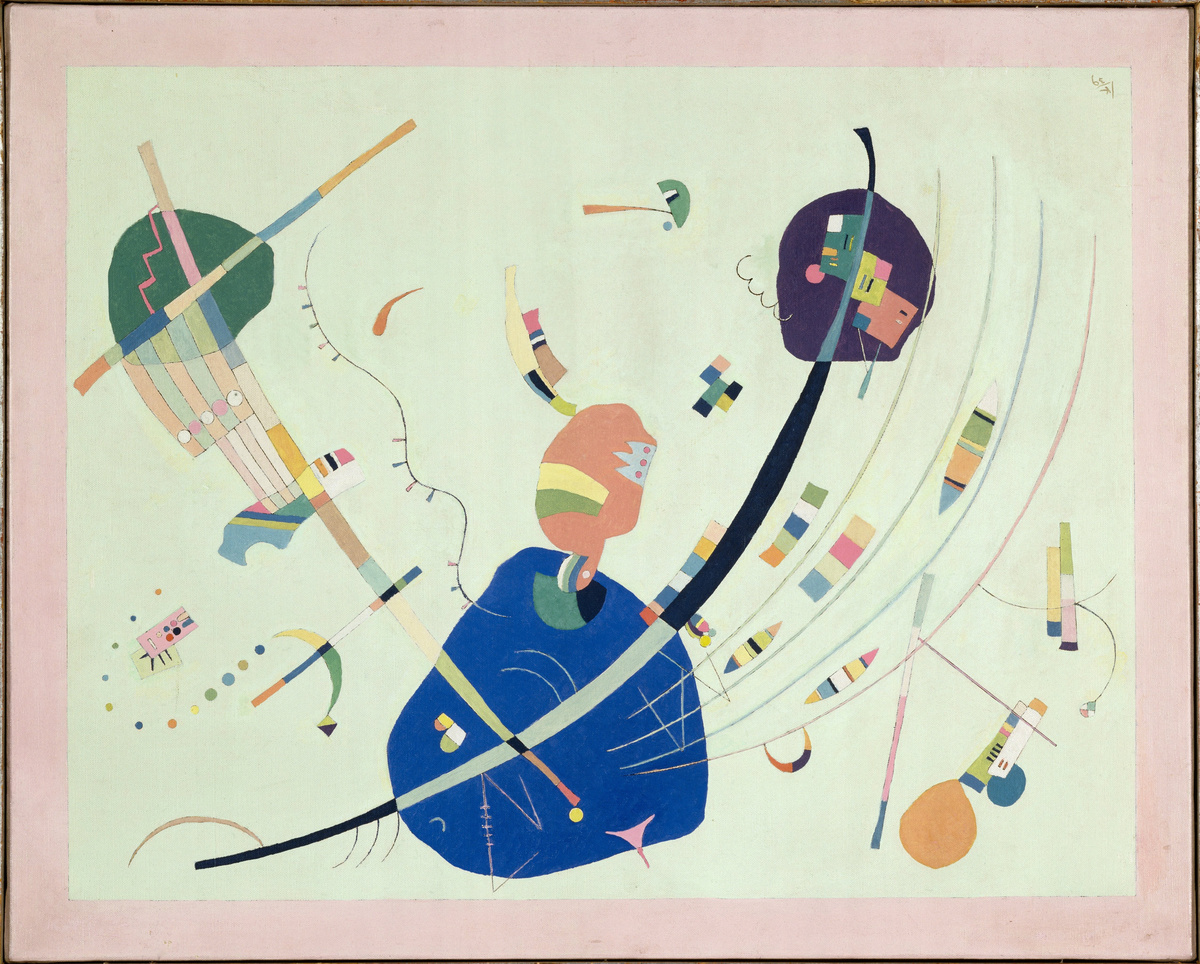
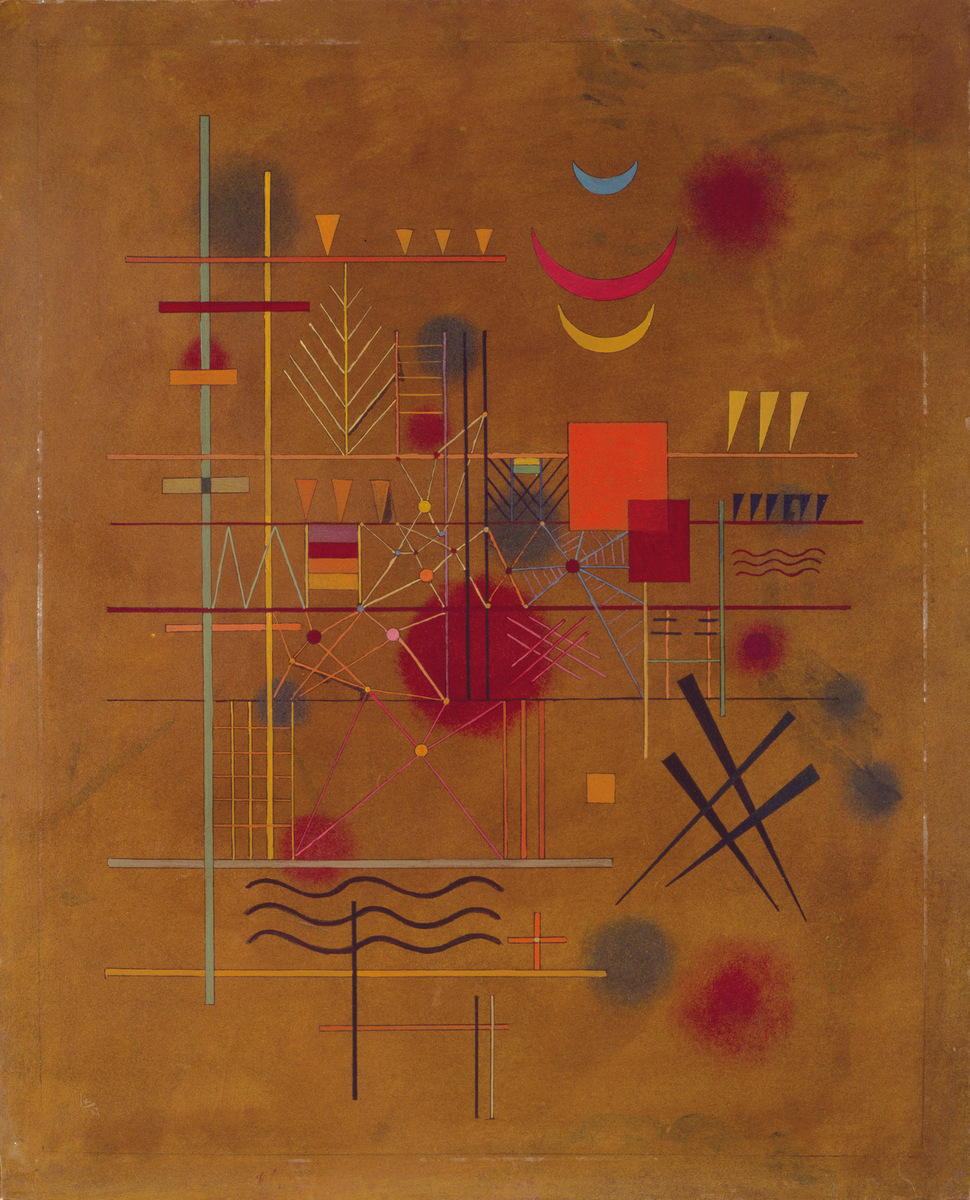
This is Red in the Net, a painting Wassily Kandinsky made in 1927. It's an abstract work, so there's no scene or story to follow. Instead, the title points you to what the picture actually shows: a red form held inside a net-like pattern of lines and dots.
Find the red first. It sits within a web of fine lines and small dots, and that web is the net the title names. Around it are crescents and geometric shapes. They keep the red form from being the only thing the eye can settle on.
Kandinsky painted this in oil on board. Abstraction was his working language, and this picture belongs to a period when he built images from shapes and lines rather than from figures or places. That matters because it tells you how to look: nothing here stands in for a body or a landscape. The forms are the subject.
So the title works less like a label for something hidden in the picture and more like a clue to its structure. The net of lines and dots is what makes the red read as caught or enclosed. Remove that web, and the red becomes simply a patch of colour.
What you take away is a painting about enclosure and colour. The red is held by the fine web around it, and the surrounding crescents and shapes give that containment a wider field to sit in. You don't need a story to read it. The title and the visible structure do the work together.
The story and its sources
Historical claims are linked to the records below. Close looking and interpretation are identified in the passage notes.
- Passage 1Documented historyWikimedia Commons: Red in the Net
- Passage 2Close lookingWikimedia Commons: Red in the Net
- Passage 3Documented historyWikimedia Commons: Red in the Net
- Passage 4InterpretationWikimedia Commons: Red in the Net
- Passage 5InterpretationWikimedia Commons: Red in the Net
Details to notice
About 2 minutes to readStacked bars on vertical axes
A mint green upright, a yellow upright, and several horizontal red, orange, and beige bars build the tall geometric scaffold at left.
Waves and crossing marks
Dark blue wavy lines, a black upright stroke, and small orange crosses anchor the lower edge with a rhythmic, signal-like presence.
Black diagonal star
Four long black bars cross at lower right, creating a sharp star-like counterweight to the fine net above.
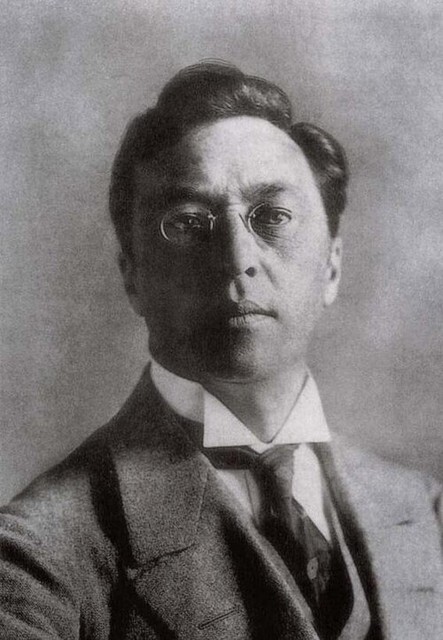
Artist portrait Image credit
未知上傳者. Image source · Public domain
About the artist
Wassily Kandinsky
1866 to 1944
Wassily Kandinsky was an avant-garde painter of Russian origin (1866–1944). Their work is associated with Expressionism; Symbolism; Bauhaus. Their recorded places of work include Paris; Munich; Weimar; Rapallo; The Hague; Russia; Stockholm; Switzerland; Tunis.
- Born
- 1866
- Died
- 1944
- Nationality
- Russian Empire; Russian Soviet Federative Socialist Republic; Soviet Union; France; Germany
- Birthplace
- Moscow
- Died in
- Neuilly-sur-Seine
Biography sources
The research & record
Study the work.
Follow the evidence.
Find catalogue details, historical context, technical research and the literature behind this artwork.
The artwork record
Research catalogue
Catalogue information and detailed research, with references that link to the bibliography.
Updated .
Identity and catalogue
Link- Title
- Red in the Net(Wikimedia Commons: Red in the Net, n.d.)
- Artist or attribution
- Wassily Kandinsky
- Object date
- 1927
- Medium and support
- Oil on board(Wikimedia Commons: Red in the Net, n.d.)
- Dimensions
- 61 cm x 49 cm
- Current collection or location
- Yokohama Museum of Art, Minatomirai, Japan(Wikimedia Commons: Red in the Net, n.d.)
- Movement or period
- Abstract art
- Country or culture
- Russian-born, active in Germany and France
- Depicted subject
- An abstract painting in which a red-orange form is crossed by a fine web of lines and dots, alongside crescents and geometric shapes.(Wikimedia Commons: Red in the Net, n.d.)
- Title variants
- Red in the Net; Red in Nets; 網の中の赤
- Accession number
- 83-OF-019
- Support
- Board
Read valuation records and their limitations
Catalogue identity
The painting is catalogued as Red in the Net, made by Wassily Kandinsky in 1927. That year belongs to the object's documentation as the date assigned to the work's making and should be kept distinct from the date of the Wikimedia Commons file record from which the catalogue data is drawn, since the latter is a modern description of the painting and not a date in the painting's own history. The attribution to Kandinsky and the 1927 date are stated in the file's title, artist and date fields without further qualification in the supplied record, so any reconstruction of the work's place in Kandinsky's career rests on that catalogue attribution rather than on evidence presented here about signature, inscription or provenance.(Wikimedia Commons: Red in the Net, n.d., File title, artist, date)
The work is described as an abstract painting without a depicted narrative subject. This classification is a genre designation rather than a description of any particular motif: it establishes that the picture does not set out to show a scene, figures or story that a viewer is meant to follow, and it is the basis on which the title's relation to the visible composition has to be understood. The record does not itemise the individual forms in the painting, so the abstract designation is the supplied evidence's account of the work's mode, and it leaves the specific shapes and their arrangement to be established from the object itself.(Wikimedia Commons: Red in the Net, n.d., Genre: abstract art)
Interpretation
Read together, the two catalogue facts define the object's identity in a way that matters for how it is studied: a named, dated work by Kandinsky whose subject is not a scene but the painting's own abstract configuration. Within a history of twentieth-century art, that combination places the picture in the strand of non-objective painting, where the title functions as an identifier and a pointer to structure rather than as a caption for a depicted event. The evidence supplied here does not extend to the work's medium, dimensions, collection, accession number or inscriptions, and those details should not be assumed from the abstract designation alone; the present account is limited to what the file record states.(Wikimedia Commons: Red in the Net, n.d., File title, artist, date; Genre: abstract art)
The painting is titled Red in the Net and was made by Wassily Kandinsky in 1927.(Wikimedia Commons: Red in the Net, n.d.)
The work is an abstract painting, without a depicted narrative subject.(Wikimedia Commons: Red in the Net, n.d.)
Subject and iconography
LinkRead valuation records and their limitations
The composition and its title
Visual observation
The composition of Red in the Net is organized around a red form enclosed by a net-like pattern of lines and dots, a structure the source record identifies as the referent of the work's title rather than as a depiction of an external scene. The source also characterizes the painting as an abstract work without a depicted narrative subject. These are visual observations and title-based identifications, not claims about a hidden subject concealed in the picture: the net of lines and dots is legible as a surface pattern, and the red is described as sitting within it. The source does not itemize the surrounding crescents or geometric shapes in its text, so any account of those elements belongs to the viewing of the image itself and not to the documented description supplied here.(Wikimedia Commons: Red in the Net, n.d., Title and visual description)
That visible structure is inseparable from the physical facts of the work. The painting is an oil on board measuring 61 by 49 centimeters, and it is inventoried in the Yokohama Museum of Art under accession number 83-OF-019. The board support and the modest, portable dimensions place the picture within a type of panel painting that is handled, stored and examined differently from a large stretched canvas; the condensed scale of the line-and-dot web and the area of red would be encountered at close viewing distance rather than across a gallery. The documented medium and measurements therefore frame how the composition described in the source record is actually seen, without requiring any inference about the artist's working process beyond what the record states.(Wikimedia Commons: Red in the Net, n.d., Medium, dimensions; Title and visual description)
Interpretation
Interpretation
Taken together, the evidence supports reading the title as a description of pictorial structure rather than as a caption for a scene. Because the source states both that the work is abstract and without narrative subject and that the red form enclosed by the line-and-dot pattern is visible in the composition, the enclosure named in the title is a relationship between painted elements on the board, not an event, figure or place represented within it. This distinction matters for the object's place in a history of abstract painting: the title functions as an entry point into how the surface is organized, and the source record treats the visible red form and surrounding web as the substance of the work rather than as clues to something behind it. The claim that the title refers to this particular red form is attributed to the source record and rests on visual identification, so it should be presented as the documented reading of the picture rather than as an independently verified statement of the artist's intention.(Wikimedia Commons: Red in the Net, n.d., Title and visual description; Medium, dimensions)
Visual observation
The title Red in the Net refers to a red form enclosed by a net-like pattern of lines and dots, which is visible in the composition.(Wikimedia Commons: Red in the Net, n.d.)
Materials and technique
LinkRead valuation records and their limitations
Documented support and medium
The surviving documentation for Red in the Net establishes a compact physical profile: it is an oil painting on board measuring 61 by 49 centimeters, attributed to Wassily Kandinsky and dated 1927, and it belongs to the Yokohama Museum of Art under accession number 83-OF-019. These particulars come from the museum-derived file record rather than from an independent technical report, so they should be treated as cataloguing data: they fix the support (board), the medium (oil) and the format, but they do not describe the panel's construction, its thickness, the number of layers, or the condition of the paint film. No priming, ground, varnish, pigment analysis, sampling, X-radiography, infrared imaging or conservation treatment is recorded in the available evidence. Any account of how the surface was built up must therefore be framed by that absence and must not import materials or procedures the record does not supply.(Wikimedia Commons: Red in the Net, n.d., Medium, dimensions)
Interpretation
The medium and support have consequences for how the picture was planned and executed. Oil on board, as recorded, pairs a slow-drying, blendable paint with a rigid panel rather than a stretched canvas, a combination that permits crisp edges and flat, saturated areas of color to be laid down and reworked. That much is a general property of the materials the record names; the evidence here does not say whether this particular board was primed, how the paint was thinned, or whether the artist used brushes, palette knife or both. The published visual description, which serves the section on what the picture shows, locates the title's subject in a red form enclosed by a net-like pattern of lines and dots. The documented medium and the described appearance together support only the cautious statement that fine linear elements and small dots were painted onto or alongside a red field; they do not establish whether those lines were brushed, drawn in wet paint, or otherwise applied, and no tool or technique is documented.(Wikimedia Commons: Red in the Net, n.d., Medium, dimensions; Title and visual description)
Because the evidentiary base separates catalogued fact from visual description, the research account should keep that distinction visible. The oil-on-board designation, the 61 by 49 centimeter dimensions, the 1927 date and the Yokohama Museum of Art accession number are documented claims tied to the file record. The net of lines and dots enclosing a red form is, by contrast, an observation of the composition, and it explains why the title names a net at all. Technical examination would be needed to move from that observation to claims about layering, underdrawing, pigment identification or the sequence in which the red and the linear web were laid down, and the supplied evidence contains no such examination. The object's interest for a material history of twentieth-century abstraction therefore rests, on present evidence, on the pairing of a modest panel format with an oil medium in the service of a non-figurative composition in which line and dot structure carry the title's meaning, not on any documented account of how the paint was handled.(Wikimedia Commons: Red in the Net, n.d., Medium, dimensions; Title and visual description)
Red in the Net is an oil painting on board, measuring 61 by 49 centimeters.(Wikimedia Commons: Red in the Net, n.d.)
Collection and display
LinkRead valuation records and their limitations
Collection and accession
Red in the Net is recorded as belonging to the Yokohama Museum of Art, where it carries accession number 83-OF-019. This holding information comes from the Wikimedia Commons file record for the painting, which is the source for the work's title, artist, date, medium and dimensions as well as its collection and accession number. Because the record is a Commons file page rather than a museum catalogue entry, the accession number should be treated as a locator for the object within the Yokohama collection rather than as a full account of how or when the work entered that collection; the evidence supplied here documents the present ownership and registration but does not establish acquisition history, prior owners or exhibition record.(Wikimedia Commons: Red in the Net, n.d., Collection, accession number)
The painting belongs to the Yokohama Museum of Art, accession number 83-OF-019.(Wikimedia Commons: Red in the Net, n.d.)
Documented values and qualified estimates
LinkRead valuation records and their limitations
The status of the valuation evidence
Interpretation
The documented value information for this painting does not come from a sale, an appraisal, or an insurance schedule. The only valuation evidence supplied is a model-generated working estimate recorded as a calculation generated on 2026-10-30, which sets a broad working range of US$2M to US$8M. Its stated methodology derives that bracket only from confirmed context: that the work is an authenticated 1927 oil on board by Wassily Kandinsky, measuring 61 by 49 centimeters, held by the Yokohama Museum of Art under accession number 83-OF-019, with the identification drawn from the Wikimedia Commons record citing the museum. The range is described as deliberately wide and conservative, reflecting the artist's canonical status in abstract art, the documented museum provenance, and the scarcity of comparable 1927 Kandinsky oils on board at this scale. The same evidence states plainly that no public appraisal, insurance schedule, auction result, or comparable sale was available in the supplied excerpts, and that no private records or sales figures are asserted. This matters for the object's research record because it separates what is documented about Red in the Net (its identification, medium, dimensions, date, and collection) from what is merely a coarse order-of-magnitude bracket for internal review, not a precision estimate.(Wikimedia Commons: Red in the Net, n.d.)
The qualifications attached to that working range are as consequential as the figures themselves. The evidence labels the range model-generated and intended for manual review only, and it specifies that the figure is not an official insurance value, appraisal, auction result, or sale price. It further states that the range must not be used for binding insurance placement without review by a qualified fine art appraiser and the collection institution, and that no comparable sales or private insurance records were accessed. Read alongside the Wikimedia Commons record, which establishes the title Red in the Net, the artist Wassily Kandinsky, the date 1927, the oil-on-board medium, the 61 by 49 centimeter dimensions, the Yokohama Museum of Art holding and accession 83-OF-019, and the abstract character of the composition in which a red form is enclosed by a net-like pattern of lines and dots, the valuation material adds no new facts about the object. Its value to the archive is procedural: it records that a numerical bracket exists in the working file while marking that bracket as unverified against market or institutional sources, so later research can distinguish a documented collection history from an unaudited estimate that happens to circulate alongside it.(Wikimedia Commons: Red in the Net, n.d.)
Working estimate
Calculated working insurance estimate, not a sale price: Estimated value: US$2M to US$8M Recorded date: Working calculation, generated 2026-10-30. Methodology: Broad working range derived only from the confirmed context: an authenticated 1927 oil on board by Wassily Kandinsky (61 x 49 cm) held by the Yokohama Museum of Art (accession 83-OF-019), with identification drawn from the Wikimedia Commons record citing the museum. The range is set wide and conservative to reflect the artist's canonical status in abstract art, the documented museum provenance, and the scarcity of comparable 1927 Kandinsky oils on board at this scale. No public appraisal, insurance schedule, auction result, or comparable sale was available in the supplied excerpts, so no private records or sales figures are asserted. Figures are a coarse order-of-magnitude bracket for internal review only, not a precision estimate. Qualification: Model-generated working range for manual review only. This is not an official insurance value, appraisal, auction result, or sale price, and it must not be used for binding insurance placement without review by a qualified fine art appraiser and the collection institution. No comparable sales or private insurance records were accessed.(Wikimedia Commons: Red in the Net, n.d.)
Further reading
Books for a closer look
Paid links. As an Amazon Associate I earn from qualifying purchases.

Open Library Kandinsky: Russian and Bauhaus years, 1915-1933.
Solomon R. Guggenheim Museum
Catalogue record for a Kandinsky volume with subjects Abstract Art, Abstract Painting, Catalogues, Exhibitions, Bauhaus, and Themes, motives. These recorded subjects align with the artist of Red in the Net, a 1927 abstract oil on board, and with the painting's non-narrative geometric and linear composition. It is the most object-adjacent Kandinsky catalogue candidate here, though its record does not confirm that this specific painting is discussed.
ISBN 0892070447

Open Library Kandinsky, complete writings on art
G.K. Hall
Catalogue record for Kandinsky's complete writings on art, with subjects Modern Art and Art, modern, 20th century. Because it collects the artist's own writings, it is relevant to interpreting the abstract vocabulary and geometric elements evidenced in this 1927 painting, while the record does not document any specific passage on Red in the Net.
ISBN 0805799508
Bibliography
Sources and further reading
References are arranged by author or organisation, with links to the original publications. Where no publication date is recorded, n.d. means no date.
Source notes updated .
No recorded sources match these filters. Reset the filters to see the full bibliography.
- 03
Book
Kandinsky, complete writings on art. G.K. Hall.
Catalogue record for Kandinsky's complete writings on art, with subjects Modern Art and Art, modern, 20th century. Because it collects the artist's own writings, it is relevant to interpreting the abstract vocabulary and geometric elements evidenced in this 1927 painting, while the record does not document any specific passage on Red in the Net.
- ISBN
- 0805799508
Citation text
- 02
Book
Kandinsky: Russian and Bauhaus years, 1915-1933. Solomon R. Guggenheim Museum.
Catalogue record for a Kandinsky volume with subjects Abstract Art, Abstract Painting, Catalogues, Exhibitions, Bauhaus, and Themes, motives. These recorded subjects align with the artist of Red in the Net, a 1927 abstract oil on board, and with the painting's non-narrative geometric and linear composition. It is the most object-adjacent Kandinsky catalogue candidate here, though its record does not confirm that this specific painting is discussed.
- ISBN
- 0892070447
Citation text
- 01
Secondary · About this artwork
Wikimedia Commons: Red in the Net (n.d.). Wikimedia Commons: Red in the Net. Wikimedia Commons.
Wikimedia Commons file record providing the title, artist, date, medium, dimensions, collection and accession number for the painting.
Citation text
Art to live with
Bring this painting
home.
A piece of the archive, made yours. Explore Red in the Net in a size and finish that fits your space.
Your text and annotations appear on these editions. Adding to cart saves that design for printing.
Combine this painting with your favourites01 / Find your edition
Made for you
Suggested from your location. Change it if you're sending elsewhere or using a VPN. Prices and delivery are shown in GBP.
1 product
Choose an edition to make it yours
iPhone 12 Mini ? Glossy ? back view
iPhone 12 Mini · Glossy

iPhone 12 Mini ? Glossy ? back view

iPhone 12 Mini ? Glossy ? back view

iPhone 12 Mini ? Glossy ? back view
Tough phone case
GBP 16.34
Delivery GBP 4.22 / Total GBP 20.56
A two-layer phone case with a printed polycarbonate shell and a shock-absorbing inner liner.
Two layers with a shock-absorbing TPU liner
Case & print details
- Device
- Apple · iPhone 12 Mini
- Material
- Polycarbonate shell with a TPU inner liner
- Artwork
- Outer back and wrapped edges from one template
- Finish
- Glossy
- Version
- Standard version
- Printing
- Dye sublimation
- Print file
- 1,122 × 1,831 px · 95 × 155 mm · PNG · 300 dpi recommended
Rear outline and camera openings follow this variant's Printify template. Case depth and small hardware remain illustrative.
Supplier product detailsFit and fill keep the painting’s proportions. Stretch changes them.
Move and zoom the painting on your tough phone case.
Made to order with your design
Made to order
US delivery only
The 30 cm ruler is scaled alongside your selected print. Keep the painting’s proportions with a black background, or stretch it to fill. Frame width, material texture and screen colours are illustrative.
Keep exploring