ArchivePortrait of Adele Bloch-Bauer II

Artwork record / 35 of 331

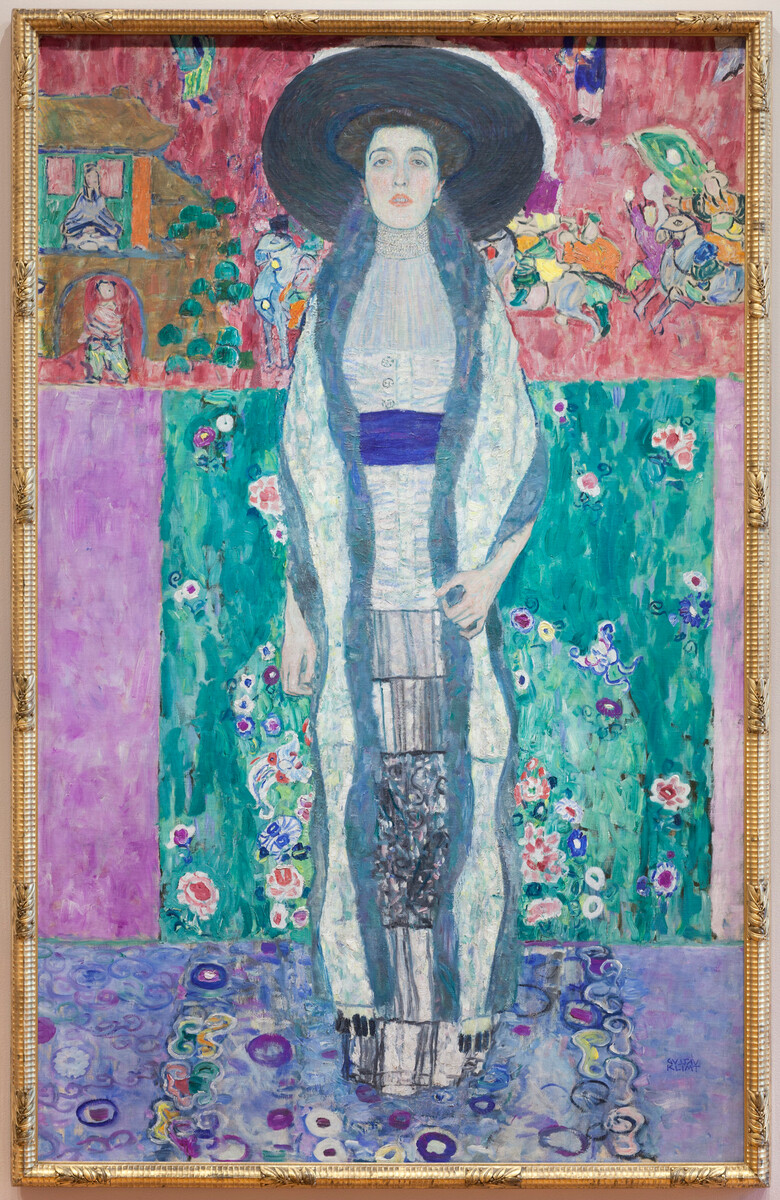
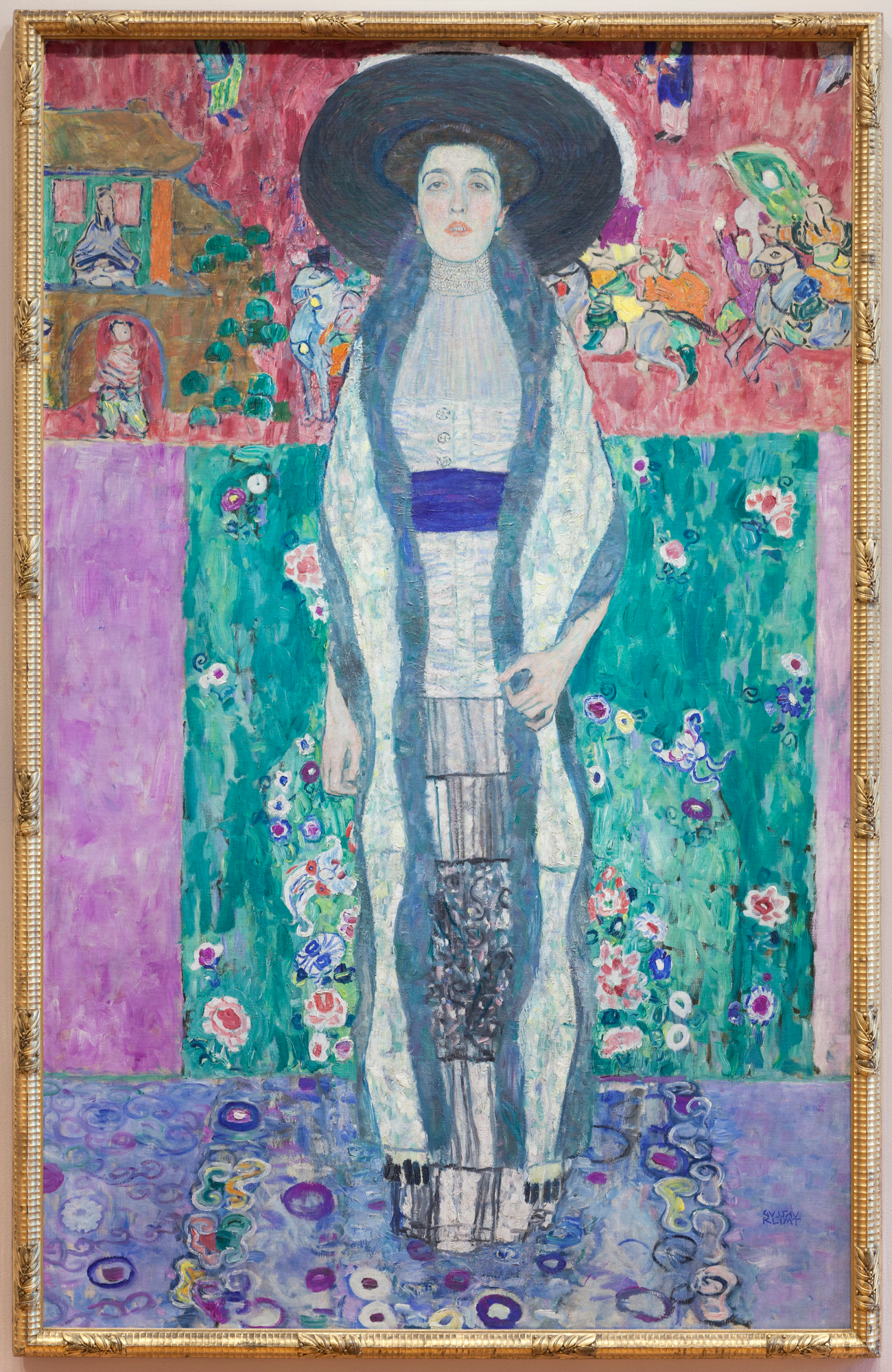
Portrait of Adele Bloch-Bauer II by Gustav Klimt (1912)

Artist: Gustav Klimt

Gustav Klimt's second portrait of Adele Bloch-Bauer sets a still, formal figure against a field of patterns and motifs. This short gallery tour looks at what the painting shows, how its composition is built, and why the sitter's identity as a Vienna patron matters to its meaning.

Read the story ↓ About the artist ↓ Research and record ↓ Literature and sources ↓ Listen to the article ↓
Article text for AI
Shop this artwork ↓ 3 visits
Date1912CultureAustria PeriodVienna Secession / Austrian SymbolismCurrent locationPrivate collection
Listen to the article
100%
Portrait of Adele Bloch-Bauer II by Gustav Klimt (1912)
Loading full-resolution artwork…
Scroll to zoom · drag to pan · double-click to focus Pinch to zoom · drag to explore · double-tap to focus FIELD VIEW / 35
Tools & download
Pixel colour Select a pixel with the eyedropper
No pixel selected

Choose the eyedropper, then click or tap the image. Scroll to zoom for finer selection.

Add text

Hand to pan · Select to move text and drawings · Add as many texts as you like · Scroll to zoom

Portrait of Adele Bloch-Bauer II: high-resolution image

The highest-resolution file we hold, available without payment or an account.1,300 × 2,000 pixels.

Download highest-resolution image

Details to notice

About 4 minutes to read
01

Klimt signature on the carpet

The artist's inscribed signature at the lower right of the patterned lavender floor, evidence of authorship and of the painting's decorative treatment of the ground plane.

02

Flowered green field around the gown

The tall band of green meadow scattered with painted blossoms that surrounds the sitter's gown and merges figure with ornament.

03

Pavilion with seated figure and child

A Chinese-style pavilion at upper left containing a seated robed figure and a standing child in a doorway, the exoticizing motif that anchors the left side of the composition.

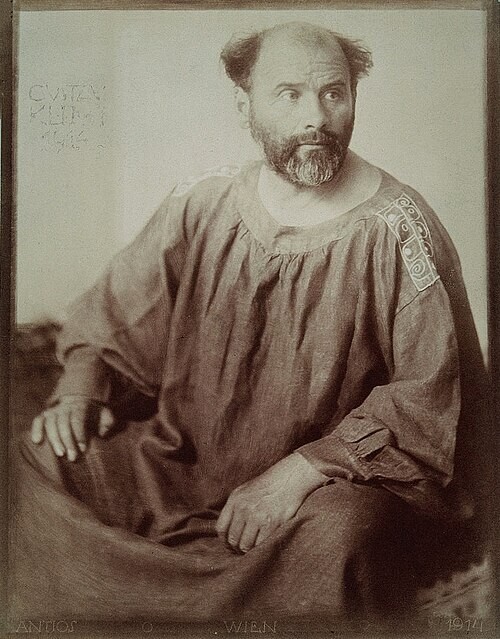
Artist portrait of Gustav Klimt
Artist portrait Image credit

Josef Anton Trčka. Image source · Public domain

About the artist

Gustav Klimt

1862 to 1918

Gustav Klimt was an Austrian symbolist painter (1862–1918). Their work is associated with Symbolism; Art Nouveau; Jugendstil. Their recorded places of work include Vienna; Brussels-Capital Region; Florence; Ravenna; Venice; London.

Born
1862
Died
1918
Nationality
Austrian Empire; Cisleithania
Birthplace
Baumgarten; Vienna
Died in
Altes AKH; Vienna; Alsergrund

The research & record

Study the work.
Follow the evidence.

Find catalogue details, historical context, technical research and the literature behind this artwork.

Article text for AI
Open research text

The artwork record

Research catalogue

Catalogue information and detailed research, with references that link to the bibliography.

Updated .

Identity and catalogue

Link
Title
Portrait of Adele Bloch-Bauer II
Artist or attribution
Gustav Klimt(Wikipedia fallback: Adele Bloch-Bauer II, n.d.)
Object date
1912
Medium and support
Oil on canvas(Wikipedia fallback: Adele Bloch-Bauer II, n.d.)
Dimensions
190 cm × 120 cm (75 in × 47 in)
Current collection or location
Private collection(Wikipedia fallback: Adele Bloch-Bauer II, n.d.)
Movement or period
Vienna Secession / Austrian Symbolism
Country or culture
Austria
Depicted subject
A three-quarter portrait of Adele Bloch-Bauer, a Vienna socialite and patron of Gustav Klimt, painted in 1912 as the second of two portraits Klimt made of her. The work sets her pale face and clasped hands against a decorative field of patterned colour, with motifs such as equestrian riders and a pavilion drawn from non-European art.(Wikipedia fallback: Adele Bloch-Bauer II, n.d.)
Title variants
Adele Bloch-Bauer II; Portrait of Adele Bloch-Bauer II
Support
canvas
Inscriptions
Klimt signature at the lower right, on the patterned floor area, as identified in the supplied semantic focus notes(Wikipedia fallback: Adele Bloch-Bauer II, n.d.)
Catalogue identification

The catalogue title used here is Portrait of Adele Bloch-Bauer II, and the work is recorded as a 1912 painting by Gustav Klimt. The sitter is identified as Adele Bloch-Bauer (1881-1925), a Vienna socialite who was a patron and close friend of the artist. The date 1912 belongs to the making of the painting and must be kept distinct from the much later dates attached to the work by its publication and exhibition history, which fall in 2006, 2014 to 2016, 2016 to 2017, 2022 to 2023 and 2023 to 2024. The supplied source adds that the picture is executed in oil on canvas and measures 190 cm by 120 cm, particulars of support, medium and scale that underwrite the scale of the decorative program described in the same source. Klimt's signature is inscribed at the lower right, on the patterned lavender floor area, so the painter's mark is placed within the ornamented floor rather than in an open neutral zone.(Wikipedia fallback: Adele Bloch-Bauer II, n.d., lead paragraph)

Attribution of the portrait to Klimt is stable in the supplied record, and the identity of the sitter is documented rather than traditional. The source states that Adele Bloch-Bauer was the only person whose portrait Klimt painted twice. The earlier portrait, Portrait of Adele Bloch-Bauer I of 1907, is described in the same source as much more famous than this second one, so the two works are connected by the same sitter while their reputations diverge sharply. Adele Bloch-Bauer's marriage to Ferdinand Bloch-Bauer, a wealthy industrialist who sponsored the arts and supported Klimt, situates both portraits within a circle of patronage rather than as isolated commissions; that patronage relationship is part of the identity of the object, since the source links the pair of portraits directly to the Bloch-Bauer household.(Wikipedia fallback: Adele Bloch-Bauer II, n.d., Ownership section)

Object and its histories

Interpretation

Taken together, the documented record permits a qualified cultural reading of the object. It is a 1912 oil portrait of a named Viennese patron, made by an artist who painted her twice, signed by him on the patterned floor, and composed so that a still frontal figure is held inside an ornamental field of riders, pavilion and blossom. Its later life places it at the centre of one of the best-known restitution cases of the twentieth and twenty-first centuries, and its post-restitution market history places it among the most expensive works sold at auction in its time. Those two strands, the ornamental surface and the contested ownership history, are both documented in the supplied evidence and neither displaces the other. What the evidence does not supply is technical analysis of the canvas, documentation of the motifs' sources, or the identity of the later private owners beyond the two named transactions, so any further account of the object's material making or present custody would go beyond the record gathered here.(Wikipedia fallback: Adele Bloch-Bauer II, n.d., lead paragraph; Ownership section; lead paragraph and Ownership section)
Portrait of Adele Bloch-Bauer II is a 1912 painting by Gustav Klimt.(Wikipedia fallback: Adele Bloch-Bauer II, n.d.)

The painting is a portrait of Adele Bloch-Bauer (1881-1925), a Vienna socialite who was a patron and close friend of Gustav Klimt.(Wikipedia fallback: Adele Bloch-Bauer II, n.d.)

Adele Bloch-Bauer was the only person whose portrait Klimt painted twice; she also appears in the earlier, more famous Portrait of Adele Bloch-Bauer I of 1907.(Wikipedia fallback: Adele Bloch-Bauer II, n.d.)

Subject and iconography

Link
Composition and visual evidence

Visual observation

Portrait of Adele Bloch-Bauer II is a 1912 painting by Gustav Klimt, executed in oil on canvas and measuring 190 cm by 120 cm. It depicts Adele Bloch-Bauer (1881-1925), a Vienna socialite who was a patron and close friend of the artist, and who was married to Ferdinand Bloch-Bauer, a wealthy industrialist who sponsored the arts and supported Klimt. The source records that she was the only person Klimt painted twice, appearing also in the earlier and more famous Portrait of Adele Bloch-Bauer I of 1907. This second portrait therefore belongs to a documented pair of images of the same sitter, and the source states plainly that the first is much more famous than the second, a distinction worth holding in view throughout any discussion of the composition and its reception.(Wikipedia fallback: Adele Bloch-Bauer II, n.d., supplied semantic focus notes for this object; Ownership section; infobox)

Within the painted composition, the sitter appears in a pale gown with a violet-blue sash, her hands folded together at hip height, and an enormous black hat framing her pale frontal face. That figure is set against fields of ornament rather than a described interior. At the upper left, a Chinese-style pavilion contains a seated robed figure and a standing child in a doorway. Across the pink upper field at the right, small figures in bright garments ride horses. A tall band of green meadow scattered with painted blossoms surrounds the sitter's white gown, and the source notes that this band merges figure and ornament. Klimt's signature is inscribed at the lower right of the painting, on the patterned lavender floor area. Taken together, these observed features establish that the canvas juxtaposes a contained, frontally presented human subject with motifs drawn from decorative and architectural traditions, and that the signature itself sits within the ornamental zone rather than on a neutral ground.(Wikipedia fallback: Adele Bloch-Bauer II, n.d., supplied semantic focus notes for this object)

Interpretation

The source describes the resulting structure of the picture in explicit terms: the portrait sets the sitter's contained, formal stillness, shown through her folded hands and pale frontal face, against a busy field of decorative motifs, so that the surrounding pattern reads as ornament rather than as a described setting. The description does not present the riders, the pavilion or the meadow as elements of a believable, continuous room; they function as decoration sharing the same surface as the figure. This matters for how the painting is looked at, because it directs attention toward the sitter's poise and presence while the equestrian riders and the pavilion remain decorative rather than narrative. The observation of a Chinese-style pavilion is, in the supplied evidence, an observation of a painted architectural motif; it is not presented as documentation of a real location or of a specific borrowing from a named source, and it should not be treated as more than the visual evidence supports.(Wikipedia fallback: Adele Bloch-Bauer II, n.d., supplied semantic focus notes for this object)

Visual observation

The portrait shows Adele Bloch-Bauer in a pale gown with a violet-blue sash, her hands folded together at hip height, and an enormous black hat framing her pale frontal face.(Wikipedia fallback: Adele Bloch-Bauer II, n.d.)

Small figures in bright garments riding horses appear across the pink upper field at the right of the painting, a decorative motif set against the sitter's stillness.(Wikipedia fallback: Adele Bloch-Bauer II, n.d.)

A Chinese-style pavilion at the upper left contains a seated robed figure and a standing child in a doorway.(Wikipedia fallback: Adele Bloch-Bauer II, n.d.)

A tall band of green meadow scattered with painted blossoms surrounds the sitter's white gown, merging figure and ornament.(Wikipedia fallback: Adele Bloch-Bauer II, n.d.)

Klimt's signature is inscribed at the lower right of the painting, on the patterned lavender floor area.(Wikipedia fallback: Adele Bloch-Bauer II, n.d.)

Historical context

Link
The Household and Its Patronage

The subject of this portrait, Adele Bloch-Bauer, was married to Ferdinand Bloch-Bauer, a wealthy industrialist who sponsored the arts and supported Gustav Klimt. That relationship of patronage places the picture within a specific Viennese social world in which a commissioning household was also a circle of artistic support, and it is the documented frame within which the portrait's making should be understood. The evidence establishes the marriage and Ferdinand Bloch-Bauer's sponsorship and support of Klimt; it does not, in the supplied units, record a commission document, a contract, a payment, or a stated date of commission for this canvas, and no private intention on the part of sitter or patron is documented here. Secure identification of the sitter therefore leaves the precise commissioning history open, and that limit should be preserved rather than filled in.(Wikipedia fallback: Adele Bloch-Bauer II, n.d., Ownership section)

Dispersal, Restitution and Afterlife

The later history of the object is documented at a different level of certainty from its making, and it belongs to the picture's place in a larger history of art and material culture. Adele Bloch-Bauer died in 1925, and Ferdinand Bloch-Bauer's collection was later dispersed. The portraits hung in the family home before being seized by the Nazis during World War II, and after the war this painting was displayed at the Österreichische Galerie Belvedere until 2006. In January 2006, following a decision by an Austrian arbitration panel and protracted court proceedings in the United States and Austria, the two Adele Bloch-Bauer portraits and three other Klimt paintings were returned to Maria Altmann, the niece of Ferdinand Bloch-Bauer. The restitution to Altmann followed Austrian and United States proceedings, including the case Republic of Austria v. Altmann. The sequence matters for how the object is understood now: the same canvas that hung in a private family home, and then in a public Viennese collection, became the subject of legal proceedings in two countries before returning to the family.(Wikipedia fallback: Adele Bloch-Bauer II, n.d., lead paragraph and Ownership section; Ownership section; lead paragraph)

Adele Bloch-Bauer was married to Ferdinand Bloch-Bauer, a wealthy industrialist who sponsored the arts and supported Gustav Klimt.(Wikipedia fallback: Adele Bloch-Bauer II, n.d.)

Adele Bloch-Bauer died in 1925, and Ferdinand Bloch-Bauer's collection was later dispersed; the painting's restitution to Maria Altmann in 2006 followed Austrian and United States proceedings, including the case Republic of Austria v. Altmann.(Wikipedia fallback: Adele Bloch-Bauer II, n.d.)

Materials and technique

Link
Support, medium and dimensions

The object is a portrait of Adele Bloch-Bauer (1881-1925), a Vienna socialite who was a patron and close friend of Gustav Klimt, and it is dated in the supplied record to 1912. It was painted in oil on canvas and measures 190 cm by 120 cm. The source that carries this information is a Wikipedia article used in the research as a discovery aid and fallback for the exact object, and it is described in the supplied annotation as supplying the painting's identity, materials, subject, provenance, sale record and exhibition list. It is therefore not an institutional record and is not treated here as authority over a museum record. The same source states that Adele Bloch-Bauer was the only person Klimt painted twice: she also appears in the earlier Portrait of Adele Bloch-Bauer I of 1907, which the source describes as much more famous than this second portrait. Adele Bloch-Bauer was married to Ferdinand Bloch-Bauer, a wealthy industrialist who sponsored the arts and supported Klimt. The physical description and the biographical framing come from the same unit, so the materials statement and the identification of the sitter cannot presently be separated into independent documentary witnesses within this evidence set.(Wikipedia fallback: Adele Bloch-Bauer II, n.d., infobox)

Visual observation

The only technical statement in the supplied evidence is that the painting is executed in oil on canvas at 190 by 120 cm. No unit supplies a support preparation, ground, priming, pigment identification, medium analysis, layer structure, brush or tool description, varnish history, lining, stretcher, condition report, sampling method or conservation treatment. The visual account of the picture, by contrast, is extensive: the sitter wears a pale gown with a violet-blue sash, her hands are folded together at hip height, and an enormous black hat frames her pale frontal face. Across the pink upper field at the right, small figures in bright garments ride horses; a Chinese-style pavilion at the upper left contains a seated robed figure and a standing child in a doorway; and a tall band of green meadow scattered with painted blossoms surrounds the sitter's white gown, merging figure and ornament. These are observations of appearance, not results of technical examination, and the difference matters: colour names such as violet-blue, pink, green, lavender and white describe what is seen in the image, not pigments identified in the paint. Any claim about how those colours were made, in what order they were laid down, or over what preparation would exceed the evidence supplied here.(Wikipedia fallback: Adele Bloch-Bauer II, n.d., supplied semantic focus notes for this object; infobox)

Design and the distribution of ornament

Interpretation

The making of this picture is documented in the supplied evidence only at the level of medium and dimensions, while the arrangement of its motifs is documented at the level of appearance. Reading the two together, the picture can be described as an oil painting on a canvas of 190 by 120 cm in which a pale, frontal, seated figure is enclosed by a continuous decorative field, with the lower right carrying the artist's signature inside a patterned floor area. What the evidence does not establish is how any of the visible effects were physically produced: whether the meadow, the pavilion, the riders or the patterned floor were built from distinct paint layers, applied wet into wet, or worked up in separate campaigns; whether the pale gown was reserved or overpainted; whether any element was reworked. Because the only technical datum is the medium and support, the account of technique appropriate to this object at present stops at oil on canvas, and the visual description should be attributed as observation rather than promoted into a record of method. This is a limitation of the present evidence base, not a claim that such examination has never been carried out.(Wikipedia fallback: Adele Bloch-Bauer II, n.d., infobox; supplied semantic focus notes for this object)

The painting's documented history bears on how its material and surface have been encountered. Adele Bloch-Bauer died in 1925, and Ferdinand Bloch-Bauer's collection was later dispersed. The portraits hung in the family home before being seized by the Nazis during World War II, and after the war this painting was displayed at the Österreichische Galerie Belvedere until 2006. In January 2006, following a decision by an Austrian arbitration panel and protracted court proceedings in the United States and Austria, the two Adele Bloch-Bauer portraits and three other Klimt paintings were returned to Maria Altmann, the niece of Ferdinand Bloch-Bauer. The restitution proceedings are connected in the source to the case Republic of Austria v. Altmann. The Belvedere display and the family collection before it are the documented settings in which the object was seen prior to restitution, and they are the institutional and domestic contexts against which later exhibition and technical accounts would have to be written.(Wikipedia fallback: Adele Bloch-Bauer II, n.d., infobox)

After restitution the painting entered a sequence of public showings and transfers that the source lists in detail. From 4 April to 30 June 2006 it was shown in Gustav Klimt: Five Paintings from the Collection of Ferdinand and Adele Bloch-Bauer at the Los Angeles County Museum of Art, and from 13 July to 9 October 2006 in the same titled exhibition at the Neue Galerie, New York City. In November 2006 Christie's in New York, under chairman Stephen Lash, sold the painting at auction for almost 88 million dollars, the fourth-highest price for a work of art at auction at the time; the buyer was Oprah Winfrey. From 5 September 2014 to 15 August 2016 the painting was on long-term loan at the Museum of Modern Art, New York City. From 22 September 2016 to 16 January 2017 it was shown in Klimt and the Women of Vienna's Golden Age, 1900-1918 at the Neue Galerie, temporarily reuniting it with Portrait of Adele Bloch-Bauer I. During the summer of 2016 Winfrey sold the painting to an unidentified Chinese buyer for 150 million dollars. It was shown from 7 October 2022 to 8 January 2023 in Golden Boy Gustav Klimt: Inspired by Van Gogh, Rodin, Matisse at the Van Gogh Museum, Amsterdam, and from 9 November 2023 to 11 February 2024 as Adele Bloch-Bauer II at the Belvedere, Vienna. As of the supplied record the painting is in a private collection, and its current owner is unidentified in the sources.(Wikipedia fallback: Adele Bloch-Bauer II, n.d., infobox)

The object in a larger history

Interpretation

The object's place in a larger history of art and material culture rests on two documented facts rather than on the sale figures. First, the source records that Adele Bloch-Bauer was the only person Klimt painted twice, which makes this canvas one of a pair and gives the comparison with the 1907 portrait, described in the source as much more famous, a structural feature of Klimt's portrait practice rather than an incidental resemblance. Second, the canvas is an oil painting on canvas of unusually large dimensions, 190 by 120 cm, in which, on the source's reading, the sitter's contained formal stillness is set against a busy field of decorative motifs that reads as ornament rather than as a described setting. The supplied evidence describes the pattern of ownership and display across a family collection, seizure during World War II, a national gallery display, restitution, auction, private sale and repeated museum loans; that sequence is documented in the record and is part of how the object now circulates. The restitution history is also connected in the source to a documentary, Adele's Wish, and to the 2015 feature film Woman in Gold, and the source cites Anne-Marie O'Connor's The Lady in Gold and a New York Times article by Patricia Cohen on the restitution story behind the Bloch-Bauer portraits. Those works are cited as sources on the restitution story, not as evidence about how this canvas was made, and they should not be used to supply materials or technique claims that the record does not contain.(Wikipedia fallback: Adele Bloch-Bauer II, n.d., infobox)

The painting is executed in oil on canvas, measuring 190 cm by 120 cm.(Wikipedia fallback: Adele Bloch-Bauer II, n.d.)

Provenance and ownership

Link
From the Family Home to Seizure

Portrait of Adele Bloch-Bauer II belongs to the same family history that produced the better-known 1907 portrait, and the two paintings share a single patronage context. Adele Bloch-Bauer was married to Ferdinand Bloch-Bauer, a wealthy industrialist who sponsored the arts and supported Gustav Klimt. Adele died in 1925, and Ferdinand's collection was later dispersed. The restitution of the present canvas to Maria Altmann in 2006 followed both Austrian and United States proceedings, including the case Republic of Austria v. Altmann. In the supplied source, Portrait of Adele Bloch-Bauer I is described as much more famous than this second portrait, so the later history and the relative prominence of the two pictures are inseparable from the family and collecting circumstances in which both were made.(Wikipedia fallback: Adele Bloch-Bauer II, n.d., Ownership section; lead paragraph and Ownership section)

The first documented phase of ownership places both Adele portraits in the family home before their seizure by the Nazis during World War II. Nothing in the supplied evidence describes the specific mechanism, date or administering authority of that seizure, nor any intermediate location between the Bloch-Bauer household and the postwar display. The next securely attested setting is the Österreichische Galerie Belvedere, where Portrait of Adele Bloch-Bauer II was displayed after the war until 2006. Between the wartime removal and the Belvedere display the record contains an interval rather than a documented sequence of transfers; the sources establish the two endpoints, not every step between them.(Wikipedia fallback: Adele Bloch-Bauer II, n.d., Ownership section; lead paragraph)

Restitution to Maria Altmann

The Belvedere holding ended through legal rather than market channels. In January 2006, following a decision by an Austrian arbitration panel and protracted court proceedings in the United States and Austria, the two Adele Bloch-Bauer portraits and three other Klimt paintings were returned to Maria Altmann, the niece of Ferdinand Bloch-Bauer. The breadth of that restitution is significant for provenance research because it treats the two Adele portraits together with three further Klimt works as a single claimant group, resolved through arbitration in Austria and litigation abroad. The supplied evidence does not detail the panel's reasoning, the composition of the proceedings or the dates of individual hearings, so the award date and the two jurisdictions are what the record supports.(Wikipedia fallback: Adele Bloch-Bauer II, n.d., lead paragraph and Ownership section)

Restitution returned the painting to Maria Altmann, who was free to sell, and the sale followed within the same year. In November 2006, Christie's in New York, under chairman Stephen Lash, sold Portrait of Adele Bloch-Bauer II at auction for almost 88 million dollars, the fourth-highest price for a work of art at auction at the time. The buyer at that auction was Oprah Winfrey. The auction house, the city, the month, the presiding chairman, the price and the buyer are all established in the record, which fixes the transition from a restitution award to a public sale at a named saleroom within about ten months.(Wikipedia fallback: Adele Bloch-Bauer II, n.d., Ownership section and Reuters citation; Ownership section)

Private Sale and Present Status

The next change of ownership took place off the public market. During the summer of 2016, Winfrey sold the painting to an unidentified Chinese buyer for 150 million dollars. That buyer remains unnamed in the supplied sources, and as of the supplied record the painting is in a private collection whose current owner is unidentified. The private sale therefore differs in kind from the 2006 auction: one is documented with a saleroom, a presiding executive and a published price bracket, while the other is reported with a season, a sum and no identified purchaser. The ownership chain ends in anonymity, and any later transfer would be unrecorded in this evidence.(Wikipedia fallback: Adele Bloch-Bauer II, n.d., Ownership section; Ownership section and Reuters citation)

Exhibition Afterlife of a Restituted Painting

Public display tracks the painting's changing custodians. From 4 April to 30 June 2006 it was shown in Gustav Klimt: Five Paintings from the Collection of Ferdinand and Adele Bloch-Bauer at the Los Angeles County Museum of Art, and from 13 July to 9 October 2006 in Gustav Klimt: Five Paintings From the Collection of Ferdinand and Adele Bloch-Bauer at the Neue Galerie, New York City. Both 2006 showings follow the January restitution and precede the November auction, and the shared title frames the works explicitly as the collection of Ferdinand and Adele Bloch-Bauer. The pair of venues places the restitution outcome before United States audiences on both coasts in the year the painting changed hands.(Wikipedia fallback: Adele Bloch-Bauer II, n.d., Exhibitions list; lead paragraph and Ownership section)

Later loans and exhibitions show a painting that circulated while privately owned. From 5 September 2014 to 15 August 2016 it was on long-term loan at the Museum of Modern Art, New York City, a period that ends close to the reported summer 2016 private sale, though the supplied evidence does not connect the two events directly. From 22 September 2016 to 16 January 2017 it appeared in Klimt and the Women of Vienna's Golden Age, 1900-1918 at the Neue Galerie, temporarily reuniting it with Portrait of Adele Bloch-Bauer I, the first recorded occasion in this evidence on which the two Adele portraits were shown together again. Subsequent showings continue the pattern: from 7 October 2022 to 8 January 2023 in Golden Boy Gustav Klimt: Inspired by Van Gogh, Rodin, Matisse at the Van Gogh Museum, Amsterdam, and from 9 November 2023 to 11 February 2024 as Adele Bloch-Bauer II at the Belvedere, Vienna. The Belvedere exhibition returns the painting, at least temporarily, to the institution where it hung after the war until 2006, and the title used in that display names the sitter without the numeric suffix of the English-language title.(Wikipedia fallback: Adele Bloch-Bauer II, n.d., Exhibitions list; Ownership section and Exhibitions list; lead paragraph)

Adele Bloch-Bauer's portraits hung in the family home before being seized by the Nazis during World War II.(Wikipedia fallback: Adele Bloch-Bauer II, n.d.)

After the war, Portrait of Adele Bloch-Bauer II was displayed at the Österreichische Galerie Belvedere until 2006.(Wikipedia fallback: Adele Bloch-Bauer II, n.d.)

In January 2006, following a decision by an Austrian arbitration panel and protracted court proceedings in the United States and Austria, the two Adele Bloch-Bauer portraits and three other Klimt paintings were returned to Maria Altmann, the niece of Ferdinand Bloch-Bauer.(Wikipedia fallback: Adele Bloch-Bauer II, n.d.)

The buyer at the 2006 Christie's auction was Oprah Winfrey.(Wikipedia fallback: Adele Bloch-Bauer II, n.d.)

Provenance timeline
  1. 1925

    Adele Bloch-Bauer died, and Ferdinand Bloch-Bauer's collection was later dispersed; the same evidence notes that restitution to Maria Altmann in 2006 followed Austrian and United States proceedings.(Wikipedia fallback: Adele Bloch-Bauer II, n.d., lead paragraph and Ownership section)

  2. until 2006

    After the war the painting was displayed at the Österreichische Galerie Belvedere until 2006.(Wikipedia fallback: Adele Bloch-Bauer II, n.d., lead paragraph)

  3. January 2006

    Following a decision by an Austrian arbitration panel and protracted court proceedings in the United States and Austria, the two Adele Bloch-Bauer portraits and three other Klimt paintings were returned to Maria Altmann, niece of Ferdinand Bloch-Bauer.(Wikipedia fallback: Adele Bloch-Bauer II, n.d., lead paragraph and Ownership section)

  4. 4 April to 30 June 2006

    The painting was shown in Gustav Klimt: Five Paintings from the Collection of Ferdinand and Adele Bloch-Bauer at the Los Angeles County Museum of Art.(Wikipedia fallback: Adele Bloch-Bauer II, n.d., Exhibitions list)

  5. 13 July to 9 October 2006

    The painting was shown in Gustav Klimt: Five Paintings From the Collection of Ferdinand and Adele Bloch-Bauer at the Neue Galerie, New York City.(Wikipedia fallback: Adele Bloch-Bauer II, n.d., Exhibitions list)

  6. November 2006

    Christie's in New York sold the painting at auction; the buyer was Oprah Winfrey.(Wikipedia fallback: Adele Bloch-Bauer II, n.d., Ownership section)

  7. 5 September 2014 to 15 August 2016

    The painting was on long-term loan at the Museum of Modern Art, New York City.(Wikipedia fallback: Adele Bloch-Bauer II, n.d., Exhibitions list)

  8. 22 September 2016 to 16 January 2017

    The painting was shown in Klimt and the Women of Vienna's Golden Age, 1900-1918 at the Neue Galerie, temporarily reuniting it with Portrait of Adele Bloch-Bauer I.(Wikipedia fallback: Adele Bloch-Bauer II, n.d., Ownership section and Exhibitions list)

  9. 7 October 2022 to 8 January 2023

    The painting was shown in Golden Boy Gustav Klimt: Inspired by Van Gogh, Rodin, Matisse at the Van Gogh Museum, Amsterdam.(Wikipedia fallback: Adele Bloch-Bauer II, n.d., Exhibitions list)

  10. 9 November 2023 to 11 February 2024

    The painting was shown as Adele Bloch-Bauer II at the Belvedere, Vienna.(Wikipedia fallback: Adele Bloch-Bauer II, n.d., Exhibitions list)

Exhibition history

Link
Exhibition History

The exhibition record for Gustav Klimt's Portrait of Adele Bloch-Bauer II begins within the year of its restitution. From 4 April to 30 June 2006 the painting was shown in Gustav Klimt: Five Paintings from the Collection of Ferdinand and Adele Bloch-Bauer at the Los Angeles County Museum of Art. It then traveled to New York, where from 13 July to 9 October 2006 it appeared in Gustav Klimt: Five Paintings From the Collection of Ferdinand and Adele Bloch-Bauer at the Neue Galerie. The two titles are supplied as given, differing only in the capitalization of "From." Both presentations belong to the moment immediately after the January 2006 return of the two Adele Bloch-Bauer portraits and three other Klimt paintings to Maria Altmann, Ferdinand Bloch-Bauer's niece, following an Austrian arbitration panel decision and protracted proceedings in the United States and Austria. The objects in these 2006 exhibitions were therefore not a permanent museum collection but a group of returned works shown together before dispersal.(Wikipedia fallback: Adele Bloch-Bauer II, n.d., Exhibitions list; lead paragraph and Ownership section)

The first of these venues had, until 2006, been the painting's long-term public home in a different sense: after the war it had been displayed at the Österreichische Galerie Belvedere, the same institution from which the restitution removed it. The Los Angeles County Museum of Art and the Neue Galerie presentations are recorded as exhibitions, distinct from that earlier Belvedere display, which the supplied record describes as a period of display ending in 2006 rather than as an exhibition entry in the list. The distinction matters for the object's institutional biography: one sequence is custodial display under the post-war Austrian settlement, and the other is the touring exhibition of the returned pictures.(Wikipedia fallback: Adele Bloch-Bauer II, n.d., Exhibitions list; lead paragraph)

The Neue Galerie exhibition of 2006 preceded by a decade the museum's 2016 presentation, Klimt and the Women of Vienna's Golden Age, 1900-1918, which ran from 22 September 2016 to 16 January 2017. That later exhibition temporarily reunited Portrait of Adele Bloch-Bauer II with Portrait of Adele Bloch-Bauer I, the 1907 first portrait that the supplied source describes as much more famous than the second. The reunion is therefore documented as an exhibition event, and it places the two portraits, separated by five years of Klimt's work and by rather different reputations, in the same viewing space for a defined period.(Wikipedia fallback: Adele Bloch-Bauer II, n.d., Ownership section and Exhibitions list; Ownership section)

Between the 2006 Neue Galerie presentation and the 2016 reunion, the painting was on long-term loan at the Museum of Modern Art, New York City, from 5 September 2014 to 15 August 2016. The supplied evidence records this as a long-term loan rather than as an exhibition with a title, a distinction the exhibition list preserves. The loan overlaps almost exactly with the period in which the painting was privately owned by Oprah Winfrey, who had bought it at the November 2006 Christie's sale in New York, under chairman Stephen Lash, for almost 88 million dollars, then the fourth-highest price for a work of art at auction. Winfrey sold the painting during the summer of 2016 to an unidentified Chinese buyer, reported at 150 million dollars. The Museum of Modern Art loan thus sits inside a decade of private ownership that followed the public auction and preceded the 2016 Neue Galerie exhibition, and it gave the picture a sustained New York institutional presence in that interval.(Wikipedia fallback: Adele Bloch-Bauer II, n.d., Exhibitions list; Ownership section and Reuters citation; Ownership section)

Two later exhibitions extend the record beyond Austria and the United States and beyond the restitution narrative. From 7 October 2022 to 8 January 2023 the painting was shown in Golden Boy Gustav Klimt: Inspired by Van Gogh, Rodin, Matisse at the Van Gogh Museum, Amsterdam. From 9 November 2023 to 11 February 2024 it was shown as Adele Bloch-Bauer II at the Belvedere, Vienna. The Belvedere entry is recorded under that short title, differing from the full portrait title used elsewhere, and it returns the painting to the institution where it had been displayed after the war until 2006. The Amsterdam exhibition frames the picture through Klimt's relation to other modern artists rather than through the Bloch-Bauer family or restitution history; the Belvedere presentation, by naming the sitter alone, frames it as a portrait.(Wikipedia fallback: Adele Bloch-Bauer II, n.d., Exhibitions list; lead paragraph)

Interpretation

These exhibition dates should not be read as a continuous public record. The supplied list records discrete presentations and a long-term loan, while the ownership chronology places the painting in a private collection with a current owner unidentified in the sources, following the 2016 private sale. The exhibition history and the current display status are therefore separate strands of evidence, and the sources consulted do not establish where or whether the painting is publicly shown as of the supplied record.(Wikipedia fallback: Adele Bloch-Bauer II, n.d., Exhibitions list; Ownership section and Reuters citation)

The restitution history that frames the 2006 exhibitions has itself become part of the object's public circulation. A documentary, Adele's Wish, and the 2015 feature film Woman in Gold relate to the restitution history connected with the Bloch-Bauer portraits. The supplied source also cites Anne-Marie O'Connor's The Lady in Gold and a New York Times article by Patricia Cohen on the restitution story behind the portraits. The two 2006 exhibition titles, which name Ferdinand and Adele Bloch-Bauer directly, attach the pictures to a family collection rather than to a single artist or museum, and the films and publications have carried that framing to audiences who may never have seen the works in the galleries.(Wikipedia fallback: Adele Bloch-Bauer II, n.d., External links and Related; References and External links; Exhibitions list)

Interpretation

Read together, the exhibition record shows a painting whose public life was reset by restitution: seized from a family home during World War II, displayed at the Österreichische Galerie Belvedere after the war until 2006, returned to Maria Altmann in January 2006, and then shown in Los Angeles and New York within months of that return, before entering private ownership in November 2006. The later loan to the Museum of Modern Art and the 2016 Neue Galerie reunion with the first Adele portrait continued that visibility under private ownership, while the Amsterdam and Belvedere exhibitions of 2022 to 2024 show the picture still traveling and still being presented under changing titles. This sequence, rather than any single venue, is what connects the object's exhibition history to the larger history of restitution and of Klimt's reception in the twentieth and twenty-first centuries.(Wikipedia fallback: Adele Bloch-Bauer II, n.d., Ownership section; lead paragraph; lead paragraph and Ownership section; Exhibitions list; Ownership section and Exhibitions list)

From 4 April to 30 June 2006, the painting was shown in Gustav Klimt: Five Paintings from the Collection of Ferdinand and Adele Bloch-Bauer at the Los Angeles County Museum of Art.(Wikipedia fallback: Adele Bloch-Bauer II, n.d.)

From 13 July to 9 October 2006, the painting was shown in Gustav Klimt: Five Paintings From the Collection of Ferdinand and Adele Bloch-Bauer at the Neue Galerie, New York City.(Wikipedia fallback: Adele Bloch-Bauer II, n.d.)

From 5 September 2014 to 15 August 2016, the painting was on long-term loan at the Museum of Modern Art, New York City.(Wikipedia fallback: Adele Bloch-Bauer II, n.d.)

From 22 September 2016 to 16 January 2017, the painting was shown in Klimt and the Women of Vienna's Golden Age, 1900-1918 at the Neue Galerie, temporarily reuniting it with Portrait of Adele Bloch-Bauer I.(Wikipedia fallback: Adele Bloch-Bauer II, n.d.)

From 7 October 2022 to 8 January 2023, the painting was shown in Golden Boy Gustav Klimt: Inspired by Van Gogh, Rodin, Matisse at the Van Gogh Museum, Amsterdam.(Wikipedia fallback: Adele Bloch-Bauer II, n.d.)

From 9 November 2023 to 11 February 2024, the painting was shown as Adele Bloch-Bauer II at the Belvedere, Vienna.(Wikipedia fallback: Adele Bloch-Bauer II, n.d.)

Reception and literature

Link
Fame and Its Asymmetries

The reception of Portrait of Adele Bloch-Bauer II cannot be told apart from the reception of its earlier companion, and the supplied source makes that asymmetry explicit: Portrait of Adele Bloch-Bauer I is described as much more famous than Portrait of Adele Bloch-Bauer II, even though Adele Bloch-Bauer was the only person Klimt painted twice. That ranking matters because it shows how unevenly fame attaches to paired works that share a sitter, a patron household and an author. Adele Bloch-Bauer was married to Ferdinand Bloch-Bauer, a wealthy industrialist who sponsored the arts and supported Gustav Klimt, so the two canvases belong to a single context of private patronage from the start. The second portrait's standing in cultural memory has therefore been shaped by comparisons with the first rather than by its own early life alone.(Wikipedia fallback: Adele Bloch-Bauer II, n.d., Ownership section)

The Auction and Its Publicity

The auction of November 2006 gave the painting a second public identity as a market record. Christie's in New York, under chairman Stephen Lash, sold Portrait of Adele Bloch-Bauer II at auction for almost 88 million dollars, the fourth-highest price for a work of art at auction at the time, and the buyer was Oprah Winfrey. The figure and the buyer's name are documented, but they describe a transaction rather than a judgment about the painting's quality relative to the first portrait. The sale converted a restituted family picture into a widely reported auction result, and it placed the work in a celebrity-owned private collection at the same time as it was being shown in museums.(Wikipedia fallback: Adele Bloch-Bauer II, n.d., Ownership section and Reuters citation; Ownership section)

Reproduction, Film and the Written Story

The restitution history generated its own secondary reception in print and film. The supplied source records that Adele's Wish, a documentary, and the 2015 feature film Woman in Gold relate to the restitution history connected with the Bloch-Bauer portraits, and it cites Anne-Marie O'Connor's The Lady in Gold and a New York Times article by Patricia Cohen on the restitution story behind the portraits. These are reception objects in their own right: they circulate the story to audiences who may never see the paintings, and they attach the name of the first portrait, the lady in gold, to a narrative that also concerns the second. The supplied source treats this material as related to the restitution history, not as documentation of the painting's creation or of Klimt's intentions.(Wikipedia fallback: Adele Bloch-Bauer II, n.d., External links and Related; References and External links)

Portrait of Adele Bloch-Bauer I is described in the supplied source as much more famous than Portrait of Adele Bloch-Bauer II.(Wikipedia fallback: Adele Bloch-Bauer II, n.d.)

Adele's Wish, a documentary, and the 2015 feature film Woman in Gold relate to the restitution history connected with the Bloch-Bauer portraits.(Wikipedia fallback: Adele Bloch-Bauer II, n.d.)

The supplied source cites Anne-Marie O'Connor's The Lady in Gold and a New York Times article by Patricia Cohen on the restitution story behind the Bloch-Bauer portraits.(Wikipedia fallback: Adele Bloch-Bauer II, n.d.)

Interpretations and debates

Link
Stillness and Ornament

Interpretation

Interpretation of Portrait of Adele Bloch-Bauer II begins from the contrast that the supplied reading identifies as the painting's central structure: the sitter's contained, formal stillness, expressed through her folded hands and pale frontal face, is set against a busy field of decorative motifs, with the result that the surrounding pattern reads as ornament rather than as a described setting. That claim is offered here as an attributed reading of the object's visual organization rather than as a statement of the maker's intention, and it can be checked against the individual features the evidence records. Adele Bloch-Bauer appears in a pale gown with a violet-blue sash, her hands folded together at hip height, and an enormous black hat framing her pale frontal face. Around and beneath her, a tall band of green meadow scattered with painted blossoms surrounds her white gown, so that figure and ornament merge at the edges even while the sitter herself remains distinct from the pattern that presses against her. Klimt's signature is inscribed at the lower right, on the patterned lavender floor area, which places the artist's own mark inside the decorative surface rather than outside it. Read together, these features support the interpretation that the painting stages stillness and ornament as mutually dependent, but the interpretation remains a synthesis of observed features, not a documented account of what Klimt intended them to mean.(Wikipedia fallback: Adele Bloch-Bauer II, n.d., supplied semantic focus notes for this object)

The decorative field is not empty of incident. In the pink upper area at the right of the painting, small figures in bright garments ride horses, a motif that the evidence classes as decorative and sets against the sitter's stillness. At the upper left, a Chinese-style pavilion contains a seated robed figure and a standing child in a doorway. Neither motif is described in the evidence as a realistic extension of the sitter's own space; the supplied reading treats the busy pattern as ornament rather than as a described, believable setting. The figures and the pavilion therefore belong to the same argument as the meadow and blossoms: the canvas is organized so that depicted bodies, architecture and vegetation circulate as pattern around a woman who is rendered as a single, frontal, still presence. This matters for interpretation because it shifts interpretive weight away from narrative or topographical reading of the background and toward the relation between the sitter's poise and the ornamental surface that carries her. Attention falls on her presence rather than on a room the viewer is asked to believe in, while the equestrian riders and the pavilion remain decorative elements within that surface.(Wikipedia fallback: Adele Bloch-Bauer II, n.d., supplied semantic focus notes for this object)

Documented Afterlife

The market history supplies a further layer of documented reception that is often attached to the painting in popular accounts. In November 2006, Christie's in New York, under chairman Stephen Lash, sold Portrait of Adele Bloch-Bauer II at auction for almost 88 million dollars, the fourth-highest price for a work of art at auction at the time. The 2006 sale is a documented event with a named auction house, a named chairman and a recorded price, and it belongs to the work's reception rather than to its creation. Interpretively, however, the sale price and the restitution narrative can overshadow the object's visual argument, so it is worth stating plainly that the evidence for the painting's composition, its ornamental field and its treatment of the sitter is separate from the evidence for its commercial and legal history. Both are part of the object's full record, and a connected account should not let either substitute for the other.(Wikipedia fallback: Adele Bloch-Bauer II, n.d., Ownership section and Reuters citation; supplied semantic focus notes for this object)

The limits of further synthesis follow from what the supplied evidence does and does not establish. The evidence supports a description of the sitter's pose and dress, the ornamental motifs of meadow, blossoms, riders and pavilion, and the placement of Klimt's signature; it supports the documented facts of Adele Bloch-Bauer's marriage to Ferdinand Bloch-Bauer, Klimt's two portraits of her, the 1912 date, the oil-on-canvas medium and the 190 by 120 cm dimensions; and it supports the restitution proceedings and the 2006 auction, including Christie's, Stephen Lash and a price of almost 88 million dollars. What the evidence does not supply is any statement from Klimt or the sitter about intended meaning, so the reading of ornament against stillness remains an attributed interpretation of the object's structure. Within the history of art and material culture, the painting matters as a documented case in which a portrait's decorative surface, its patron relationships and its twentieth-century legal and market history are all part of the same object's record: a work that can be studied as a composition, as a document of Viennese patronage, and as a possession whose movements through restitution and sale have themselves become part of how it is understood. These strands should be held together without allowing any one of them to stand in for the others.(Wikipedia fallback: Adele Bloch-Bauer II, n.d., supplied semantic focus notes for this object; Ownership section; lead paragraph and Ownership section; Ownership section and Reuters citation)

The portrait sets the sitter's contained, formal stillness, shown through her folded hands and pale frontal face, against a busy field of decorative motifs, so that the surrounding pattern reads as ornament rather than as a described setting.(Wikipedia fallback: Adele Bloch-Bauer II, n.d.)

Documented values and qualified estimates

Link
Marketed value

Interpretation

Two recorded transactions follow the restitution, and the supplied evidence preserves their different evidentiary bases. The painting was sold at Christie's, New York, in November 2006 under chairman Stephen Lash for almost 88 million dollars, the fourth-highest price for a work of art at auction at the time; the buyer was Oprah Winfrey. That figure is a historical auction result reported in the supplied source, which cites Reuters coverage of the Christie's sale of 9 November 2006, and the qualification attached to it is explicit: it is not a current market value or insurance estimate, and its precision is limited to that report. During the summer of 2016, Winfrey sold the painting to an unidentified Chinese buyer for 150 million dollars. This second figure is a reported private sale, attributed in the supplied source to Bloomberg and Hyperallergic reporting from February 2017, and the buyer remains unidentified there; it too is not a confirmed current valuation or insurance amount. The two sums are best read together as a sequence of reported transactions rather than as an appraisal history, since one rests on published auction coverage and the other on press reporting of a private deal whose counterparty is unnamed. As of the supplied record, the painting is in a private collection, and its current owner is unidentified in the sources.(Wikipedia fallback: Adele Bloch-Bauer II, n.d., Ownership section)

In November 2006, Christie's in New York, under chairman Stephen Lash, sold Portrait of Adele Bloch-Bauer II at auction for almost 88 million dollars, the fourth-highest price for a work of art at auction at the time.(Wikipedia fallback: Adele Bloch-Bauer II, n.d.)

During the summer of 2016, Winfrey sold the painting to an unidentified Chinese buyer for 150 million dollars.(Wikipedia fallback: Adele Bloch-Bauer II, n.d.)

Documented auction value: Sold at Christie's, New York, in November 2006 for almost 88 million dollars, the fourth-highest price for a work of art at auction at the time. Recorded date: November 2006. Methodology: Reported hammer or sale result published in the supplied source, citing Reuters coverage of the Christie's sale of 9 November 2006. Qualification: This is a historical auction figure, not a current market value or insurance estimate. It is reported in the supplied source, and figure precision is limited to that report.(Wikipedia fallback: Adele Bloch-Bauer II, n.d.)

Documented sale value: Sold privately in the summer of 2016 by Oprah Winfrey to an unidentified Chinese buyer, reported at 150 million dollars. Recorded date: Summer 2016. Methodology: Private sale figure reported in the supplied source and attributed there to Bloomberg and Hyperallergic reporting from February 2017. Qualification: The buyer is unidentified in the supplied source and the figure is a reported private sale, not a confirmed current valuation or insurance amount.(Wikipedia fallback: Adele Bloch-Bauer II, n.d.)

Collection and display

Link
The object and its sitter

Portrait of Adele Bloch-Bauer II is a 1912 painting by Gustav Klimt, executed in oil on canvas and measuring 190 by 120 cm. It depicts Adele Bloch-Bauer (1881-1925), a Vienna socialite who was a patron and close friend of Klimt and the wife of Ferdinand Bloch-Bauer, a wealthy industrialist who sponsored the arts and supported the artist. Klimt painted her twice, and she is the only person he portrayed more than once; the earlier Portrait of Adele Bloch-Bauer I dates to 1907 and is described in the supplied source as much more famous than this second canvas. The composition shows her in a pale gown with a violet-blue sash, her hands folded together at hip height, and an enormous black hat framing her pale frontal face. Klimt's signature is inscribed at the lower right, on the patterned lavender floor area.(Wikipedia fallback: Adele Bloch-Bauer II, n.d., infobox and Ownership section)

The painted field around the sitter is densely ornamented rather than descriptive. Across the pink upper field at the right, small figures in bright garments ride horses, a decorative motif set against the sitter's stillness. At the upper left, a Chinese-style pavilion contains a seated robed figure and a standing child in a doorway. A tall band of green meadow scattered with painted blossoms surrounds the white gown, so that figure and ornament merge at the edges. The portrait sets the sitter's contained, formal stillness, expressed through her folded hands and pale frontal face, against this busy field of motifs, with the result that the surrounding pattern reads as ornament rather than as a described setting.(Wikipedia fallback: Adele Bloch-Bauer II, n.d., infobox and Ownership section)

Restitution and public afterlife

The picture's later institutional history is inseparable from how it is now encountered. Adele Bloch-Bauer died in 1925, and Ferdinand Bloch-Bauer's collection was later dispersed. Her portraits hung in the family home before being seized by the Nazis during World War II, and after the war Portrait of Adele Bloch-Bauer II was displayed at the Österreichische Galerie Belvedere until 2006. In January 2006, following a decision by an Austrian arbitration panel and protracted court proceedings in the United States and Austria, including the case Republic of Austria v. Altmann, this painting and four other Klimt paintings were returned to Maria Altmann, the niece of Ferdinand Bloch-Bauer.(Wikipedia fallback: Adele Bloch-Bauer II, n.d., infobox and Ownership section)

The restitution was immediately followed by a sequence of public showings before the work passed into private hands. From 4 April to 30 June 2006 the painting was shown in Gustav Klimt: Five Paintings from the Collection of Ferdinand and Adele Bloch-Bauer at the Los Angeles County Museum of Art, and from 13 July to 9 October 2006 in the similarly titled Gustav Klimt: Five Paintings From the Collection of Ferdinand and Adele Bloch-Bauer at the Neue Galerie in New York City. In November 2006, Christie's in New York, under chairman Stephen Lash, sold it at auction for almost 88 million dollars, the fourth-highest price for a work of art at auction at the time. The buyer was Oprah Winfrey. During the summer of 2016 Winfrey sold the painting to an unidentified Chinese buyer, reported at 150 million dollars. As of the supplied record, Portrait of Adele Bloch-Bauer II is in a private collection, and its current owner is unidentified in the sources. Two later presentations are documented in this period: from 22 September 2016 to 16 January 2017 it appeared in Klimt and the Women of Vienna's Golden Age, 1900-1918 at the Neue Galerie, temporarily reuniting it with Portrait of Adele Bloch-Bauer I, and from 7 October 2022 to 8 January 2023 it was shown in Golden Boy Gustav Klimt: Inspired by Van Gogh, Rodin, Matisse at the Van Gogh Museum, Amsterdam. Although the painting had left the Belvedere in 2006, it was shown there again from 9 November 2023 to 11 February 2024 as Adele Bloch-Bauer II. A separate interval belongs to this chronology as well: from 5 September 2014 to 15 August 2016 the painting was on long-term loan at the Museum of Modern Art in New York City, ending only weeks after the private sale reported in mid-2016.(Wikipedia fallback: Adele Bloch-Bauer II, n.d., infobox and Ownership section)

The restitution history connected with the Bloch-Bauer portraits has circulated well beyond the exhibition and auction record, notably through a documentary, Adele's Wish, and the 2015 feature film Woman in Gold. The supplied source itself cites Anne-Marie O'Connor's The Lady in Gold and a New York Times article by Patricia Cohen on the restitution story behind the portraits. These references indicate how scholarly and journalistic narration of the case has become part of the object's public identity, running alongside its documentation as a painting. The account above is drawn from a Wikipedia article used as a discovery aid and fallback for this exact object, which supplies identity, materials, subject, provenance, sale record and exhibition list; it is not an institutional source and is not treated as authority over a museum record.(Wikipedia fallback: Adele Bloch-Bauer II, n.d., infobox and Ownership section)

As of the supplied record, Portrait of Adele Bloch-Bauer II is in a private collection, and its current owner is unidentified in the sources.(Wikipedia fallback: Adele Bloch-Bauer II, n.d.)

Further reading

Books for a closer look

Paid links. As an Amazon Associate I earn from qualifying purchases.

  • Cover of Gustav Klimt. Complete Paintings
    Open Library

    Tobias G. Natter, 2015

    Gustav Klimt. Complete Paintings

    TASCHEN

    Recorded as Gustav Klimt. Complete Paintings by Tobias G. Natter with subject headings including Catalogues raisonnes, Painting, austrian, and Criticism and interpretation. A complete paintings catalogue would be expected to document individual canvases, so it is plausibly useful for locating and contextualising Portrait of Adele Bloch-Bauer II, though the record does not confirm that this particular work is treated.

    ISBN 9783836527958

    Find book on Amazon.co.uk View reference
  • Cover of Gustav Klimt
    Open Library

    Klimt, 1988

    Gustav Klimt

    Artline

    Alessandra Comini's Gustav Klimt, with recorded subjects including Catalogs, Criticism and interpretation, Women in art, Private collections, and Klimt, gustav, 1862-1918. The women in art and private collections headings are relevant to a portrait of Adele Bloch-Bauer and its collecting history, but the record gives no evidence that this specific painting is discussed.

    ISBN 1871487064

    Find book on Amazon.co.uk View reference

Bibliography

Sources and further reading

References are arranged by author or organisation, with links to the original publications. Where no publication date is recorded, n.d. means no date.

Source notes updated .

  1. 02

    Book

    Adele Bloch-Bauer II: Gustav Klimt Cross Stitch Pattern. Independently Published.

    Title exactly matches the artwork, Portrait of Adele Bloch-Bauer II, making it the only candidate whose recorded title is object-specific rather than a broad Klimt survey. No subject headings are recorded, so the record alone does not confirm whether it is a scholarly study, an auction or collectibles item, or something else, and I cannot describe its contents.

    ISBN
    9798672663654
    Link to reference
    Citation text
  2. 04

    Book

    Gustav Klimt. Artline.

    Alessandra Comini's Gustav Klimt, with recorded subjects including Catalogs, Criticism and interpretation, Women in art, Private collections, and Klimt, gustav, 1862-1918. The women in art and private collections headings are relevant to a portrait of Adele Bloch-Bauer and its collecting history, but the record gives no evidence that this specific painting is discussed.

    ISBN
    1871487064
    Link to reference
    Citation text
  3. 03

    Book

    Gustav Klimt. Complete Paintings. TASCHEN.

    Recorded as Gustav Klimt. Complete Paintings by Tobias G. Natter with subject headings including Catalogues raisonnes, Painting, austrian, and Criticism and interpretation. A complete paintings catalogue would be expected to document individual canvases, so it is plausibly useful for locating and contextualising Portrait of Adele Bloch-Bauer II, though the record does not confirm that this particular work is treated.

    ISBN
    9783836527958
    Link to reference
    Citation text
  4. 01

    Secondary · About this artwork

    Wikipedia fallback: Adele Bloch-Bauer II (n.d.). Portrait of Adele Bloch-Bauer II. Wikipedia.

    Wikipedia article used as a discovery aid and fallback for the exact object; supplies identity, materials, subject, provenance, sale record and exhibition list. Not an institutional source and not treated as authority over a museum record.

    Language
    English
    Link to reference
    Citation text

Article text and sources · Reading and attribution

An unhandled error has occurred. Reload 🗙