The story About 5 minutes to read
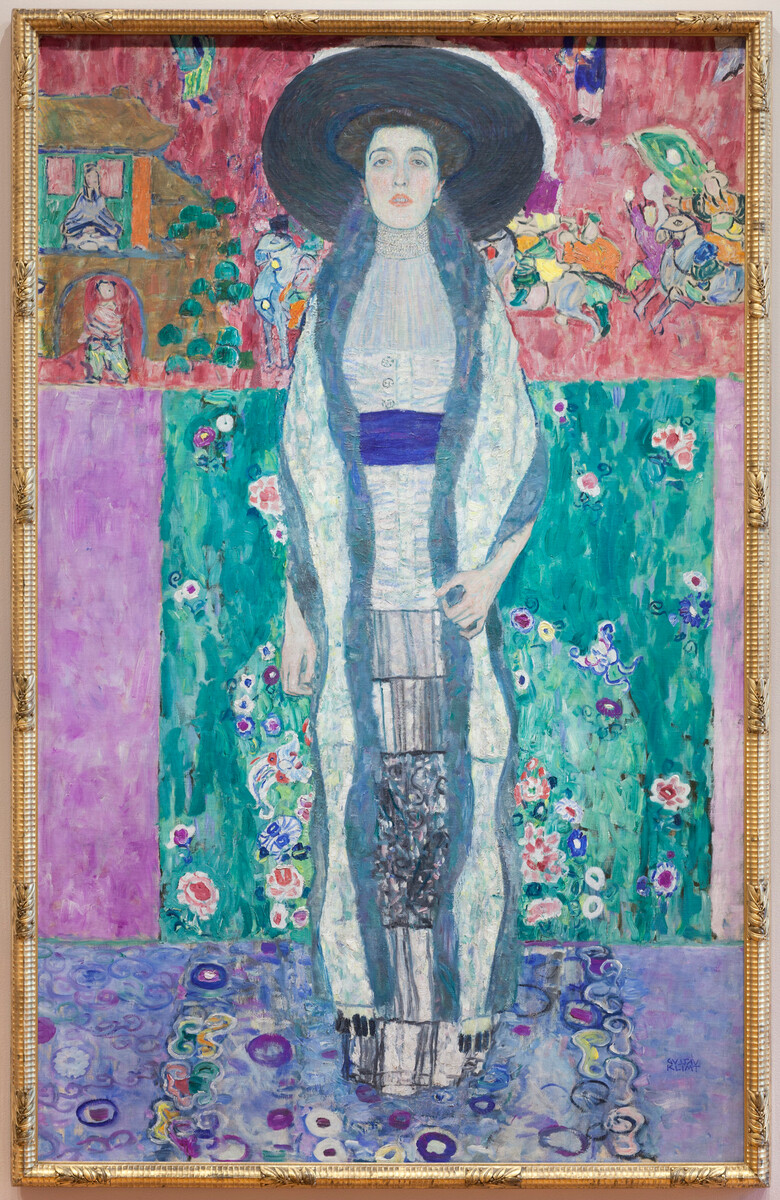
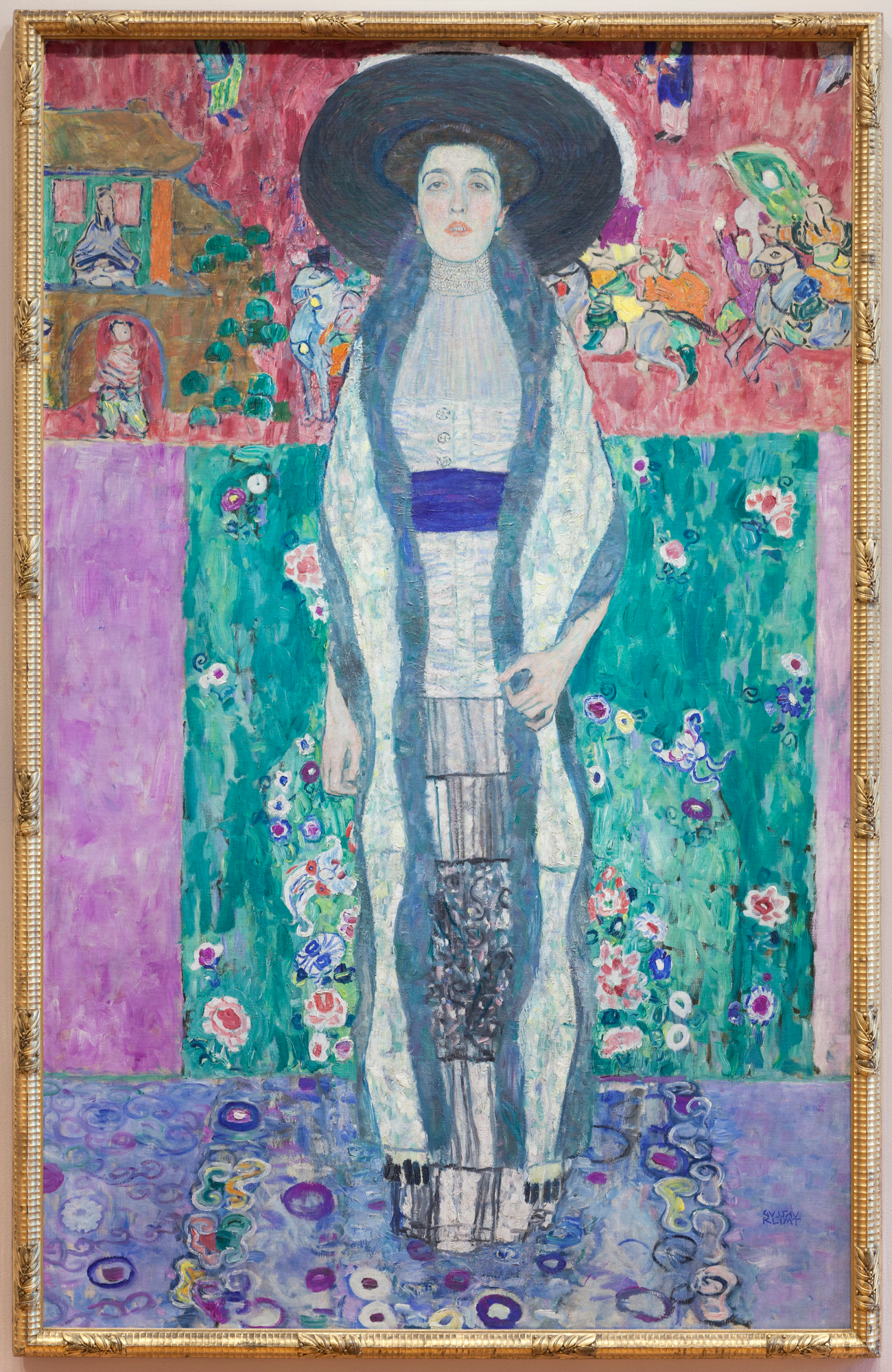
This is Gustav Klimt's 1912 portrait of Adele Bloch-Bauer, a Vienna socialite and patron of the artist.
She sits in a pale gown with a violet-blue sash, her hands folded at hip height, and an enormous black hat framing her pale, frontal face. It is the second of two portraits Klimt made of her, and the earlier one is the more famous.
Look first at the contrast between the sitter and her surroundings. Adele is still and contained: her hands are folded, her face is pale, and her gaze comes straight toward you.
Around her, the canvas is busy. Across the pink upper field at the right, small figures in bright garments ride horses. A Chinese-style pavilion at the upper left holds a seated robed figure and a standing child in a doorway.
The busy pattern reads as ornament rather than as a described, believable setting. The figure stays distinct from it, even as the two share the same surface.
Adele Bloch-Bauer was married to Ferdinand Bloch-Bauer, a wealthy industrialist who sponsored the arts and supported Klimt.
She was the only person Klimt painted twice. The first portrait dates to 1907, and the source describes it as much more famous than this second one.
Klimt's signature appears at the lower right, on the patterned lavender floor area.
The portrait sets the sitter's contained, formal stillness against that busy field of decorative motifs.
The surrounding pattern works as ornament, not as a room we are meant to believe in. That choice shifts attention onto the sitter herself, on her poise and her presence, while the equestrian riders and the pavilion remain decorative.
A tall band of green meadow scattered with painted blossoms surrounds her white gown, so that figure and ornament merge at the edges.
The painting's later history is part of how many visitors encounter it now. Adele Bloch-Bauer died in 1925, and Ferdinand's collection was later dispersed.
Her portraits hung in the family home before being seized by the Nazis during World War II. After the war, this painting was displayed at the Österreichische Galerie Belvedere until 2006.
In January 2006, after an Austrian arbitration panel decision and court proceedings in the United States and Austria, this portrait and four other Klimt paintings were returned to Maria Altmann, Ferdinand's niece.
The restitution led to a public afterlife for the painting. In November 2006, Christie's in New York sold it at auction for almost 88 million dollars, the fourth-highest price for a work of art at auction at the time.
The buyer was Oprah Winfrey. During the summer of 2016, Winfrey sold it to an unidentified Chinese buyer, reported at 150 million dollars.
As of the supplied record, the painting is in a private collection, and its current owner is unidentified in the sources.
What stays with you is the tension inside the picture itself. A real woman, a patron and friend of the artist, sits still and formal at the centre.
Around her, Klimt lets pattern take over: riders, pavilion, meadow, blossoms. Because the setting is ornament rather than a described place, the portrait holds her as a presence rather than as a figure in a room.
That is what this second portrait does. It makes stillness and decoration depend on each other.