ArchivePortrait of a Man (Self Portrait?)

Artwork record / 151 of 331

Portrait of a Man (Self Portrait?) by Jan van Eyck (1433)

Artist: Jan van Eyck

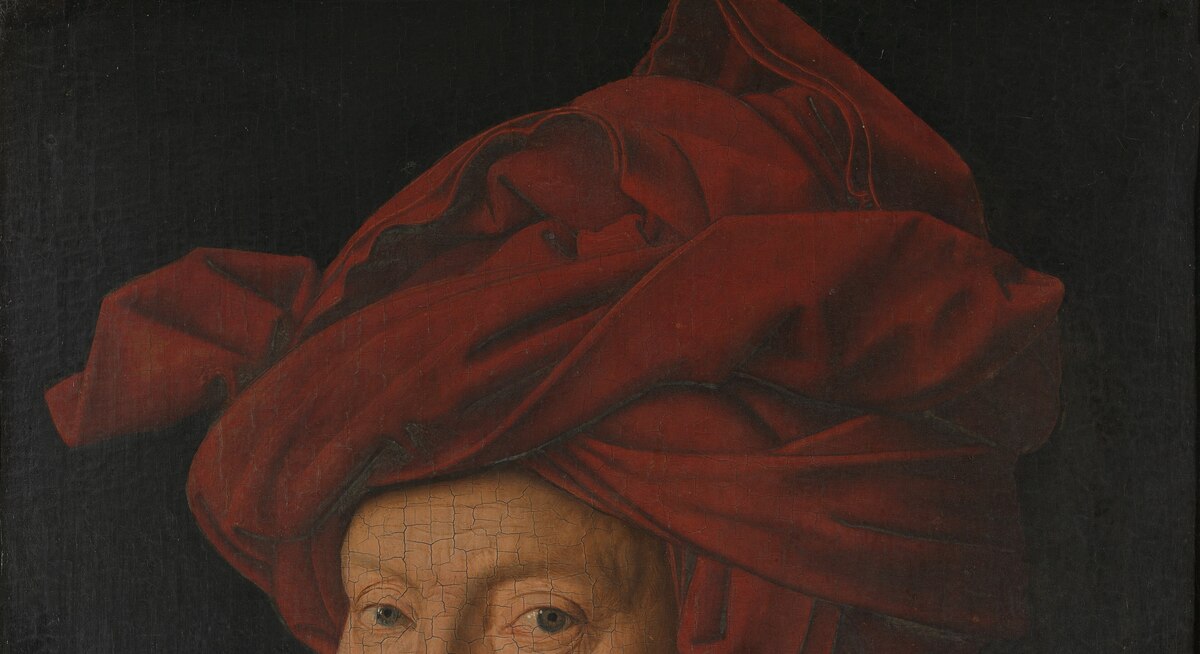
A small panel of around 1433 showing a man in a red turban-like headdress turning toward us. Traditionally identified as a self-portrait of Jan van Eyck, but the question mark in the title records that the identification is traditional, not universally accepted. This visit explains what is visible, what is documented, and what remains uncertain.

Read the story ↓ About the artist ↓ Research and record ↓ Literature and sources ↓ Listen to the article ↓
Article text for AI
Shop this artwork ↓ 2 visits
Date1433CultureFlemish PeriodEarly Netherlandish paintingCurrent locationNational Gallery, London, United Kingdom
Listen to the article
100%
Portrait of a Man (Self Portrait?) by Jan van Eyck (1433)
Loading full-resolution artwork…
Scroll to zoom · drag to pan · double-click to focus Pinch to zoom · drag to explore · double-tap to focus FIELD VIEW / 151
Tools & download
Pixel colour Select a pixel with the eyedropper
No pixel selected

Choose the eyedropper, then click or tap the image. Scroll to zoom for finer selection.

Add text

Hand to pan · Select to move text and drawings · Add as many texts as you like · Scroll to zoom

Portrait of a Man (Self Portrait?): high-resolution image

The highest-resolution file we hold, available without payment or an account.3,840 × 2,094 pixels.

Download highest-resolution image

Details to notice

About 3 minutes to read
01

Aged paint surface on the face

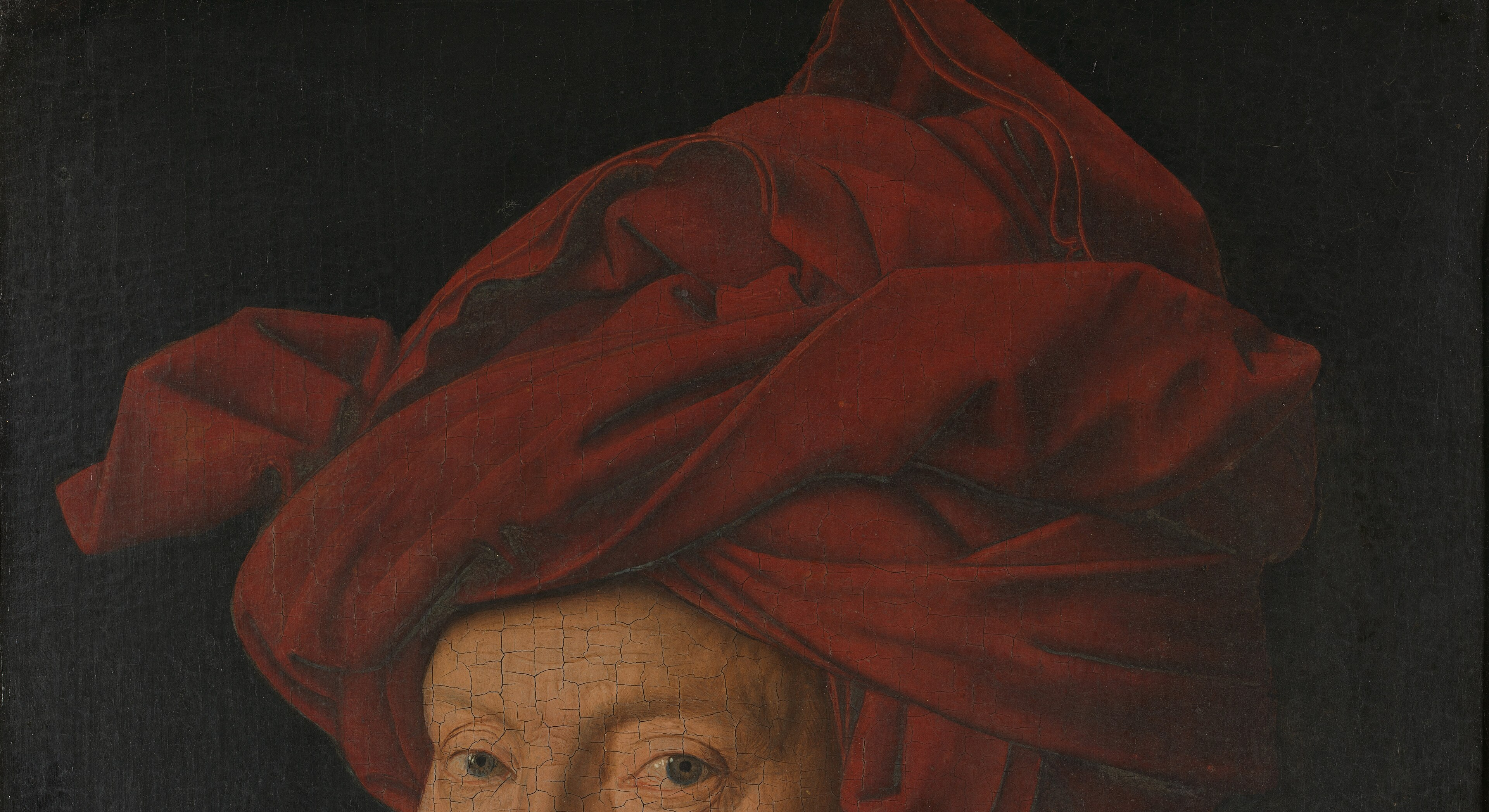
The forehead, temples and cheeks where the paint layer is broken by an even network of craquelure, an index of the panel's age and early oil technique.

02

Red chaperon headdress

The voluminous red wool chaperon, rolled and folded into a turban-like mass with a falling tail at the right, modelled by deep shadow in the pleats.

03

Eyes and direct gaze

The man's narrow, deeply set eyes meeting the viewer, framed by heavy lids and furrowed brow; this steady outward gaze is the psychological core of the portrait.

Portrait unrecorded

About the makers

Jan van Eyck

Individual life dates unrecorded

Biographical details and a verified portrait have not yet been recorded for this attribution.

The research & record

Study the work.
Follow the evidence.

Find catalogue details, historical context, technical research and the literature behind this artwork.

Article text for AI
Open research text

The artwork record

Research catalogue

Catalogue information and detailed research, with references that link to the bibliography.

Updated .

Identity and catalogue

Link
Title
Portrait of a Man (Self Portrait?)(Wikimedia Commons: Portrait of a Man in a Turban, n.d.)
Artist or attribution
Jan van Eyck
Dimensions
15.5 × 19 cm (6.1 × 7.4 in)(Wikimedia Commons: Portrait of a Man in a Turban, n.d.)
Current collection or location
National Gallery, London, United Kingdom(Wikimedia Commons: Portrait of a Man in a Turban, n.d.)
Movement or period
Early Netherlandish painting
Country or culture
Flemish
Depicted subject
A bust-length portrait of a man wearing a red turban-like headdress, turned slightly to his left, gazing directly at the viewer. The work is traditionally identified as a self-portrait of Jan van Eyck.
Title variants
Portrait of a Man in a Turban; Portrait of a Man in a Red Turban; Man in a Red Turban; Portrait of a Man (Self Portrait?)
Attribution qualification
The self-portrait identification is traditional and is indicated by the question mark in the title.
Support
Oak panel
Catalogue identity

The object is catalogued as Portrait of a Man (Self Portrait?), a painting attributed to Jan van Eyck and dated 1433. It is a self-portrait in genre and a painting in object type. Its recorded dimensions are 15.5 by 19 centimetres, which makes it a small panel. The catalogue also identifies the depicted person as Jan van Eyck, an identification that sits uneasily beside the interrogative form of the title and needs to be weighed against the object's other records rather than treated as a settled naming of the sitter.(Wikimedia Commons: Portrait of a Man in a Turban, n.d., Summary)

The same object has circulated under several title variants: Portrait of a Man in a Red Turban, Portrait of a Man in a Turban, and Man in a Turban. These variants name a garment rather than a person, which is precisely the point of divergence from the main title, since the main title raises the question of the sitter's identity while the older variants describe what is worn. Catalogue entries for the work also treat it as a detail of Man in a Turban by Jan van Eyck, so the painting is indexed both as an independent panel and under a title that foregrounds the headdress.(Wikimedia Commons: Portrait of a Man in a Turban, n.d., Summary; Categories)

Interpretation

The attribution to Jan van Eyck is anchored by what is known of the artist's life and movements: he lived from about 1390 to before 9 June 1441, was a Flemish painter, drawer and manuscript illuminator, and is recorded at The Hague in 1422, Bruges in 1425, Lille between 1425 and 1428, and Bruges again from 1431 to 1441. Placing the 1433 date against that itinerary locates the panel in the Bruges phase of his career, the same period in which the work is conventionally dated. That chronological and geographical frame supports the attribution without settling the identity of the man shown.(Wikimedia Commons: Portrait of a Man in a Turban, n.d., Summary)

The painting is titled Portrait of a Man (Self Portrait?) and is attributed to Jan van Eyck.(Wikimedia Commons: Portrait of a Man in a Turban, n.d.)

The dimensions are 15.5 by 19 centimetres.(Wikimedia Commons: Portrait of a Man in a Turban, n.d.)

The depicted people are identified as Jan van Eyck.(Wikimedia Commons: Portrait of a Man in a Turban, n.d.)

The object type is painting and the genre is self-portrait.(Wikimedia Commons: Portrait of a Man in a Turban, n.d.)

The painting is also known as Portrait of a Man in a Red Turban, Portrait of a Man in a Turban, and Man in a Turban.(Wikimedia Commons: Portrait of a Man in a Turban, n.d.)

The painting is a detail of Man in a Turban by Jan van Eyck.(Wikimedia Commons: Portrait of a Man in a Turban, n.d.)

Subject and iconography

Link
Recorded composition and the question in the title

Interpretation

The painting presents a man in a red turban-like headdress, turned slightly to his left, looking directly at the viewer. This is the recorded composition: a bust-length view in which the head and headdress dominate the field, and the slight turn of the body is held in tension with the direct outward gaze. The medium is oil on oak panel, and the work is dated 1433, which places the visible surface within a documented material and chronological frame rather than leaving it as an unattributed image. The record titles the work Portrait of a Man (Self Portrait?) and attributes it to Jan van Eyck, the Flemish painter, drawer and manuscript illuminator who lived from about 1390 to before 9 June 1441, with recorded work locations at The Hague in 1422, Bruges in 1425, Lille between 1425 and 1428, and Bruges again from 1431 to 1441. The painting is also known under the title variants Portrait of a Man in a Red Turban, Portrait of a Man in a Turban, and Man in a Turban, and the record describes it as a detail of Man in a Turban by Jan van Eyck. Those variants name a garment; the main title poses a question about the sitter, and the distinction between the two kinds of naming matters for how the object is described.(Wikimedia Commons: Portrait of a Man in a Turban, n.d., Summary; Depicted people; References; Licensing)

The headdress is the most conspicuous element of the recorded description and the source of the painting's older titles. Calling it turban-like is a description of its appearance as recorded, not a documented statement about the garment's origin or the sitter's dress. The record supplies both the visual observation and the title variants that grew from it, so the recurring name Man in a Turban and its fuller forms Portrait of a Man in a Turban and Portrait of a Man in a Red Turban can be understood as labels attached to a visible feature rather than as independent evidence about the man. The record's further description of the painting as a detail of Man in a Turban by Jan van Eyck shows that the same image circulates under a name that treats the headdress as the identifying feature of the picture. This is a case where a visual detail has shaped the object's public identity, and where the naming has run ahead of any settled identification of the person depicted.(Wikimedia Commons: Portrait of a Man in a Turban, n.d., Summary; Depicted people)

Attribution, sitter and the limits of identification

The question mark in the title Portrait of a Man (Self Portrait?) is the clearest institutional signal in the record that the self-portrait reading is traditional rather than settled. The record states that the painting is traditionally identified as a self-portrait of Jan van Eyck, and that the Commons record identifies the depicted person as Jan van Eyck; it also states that the painting is catalogued as a portrait of an unknown man. These are competing identifications, and the record presents them as such. The self-portrait tradition is a reported tradition, not a documented fact, and the title's hedge is the honest summary of the identification. The evidence supports the statement that the work is attributed to Van Eyck and that a self-portrait identification has been traditional; it does not support the claim that the man's identity is proven. The genre recorded for the object is self-portrait, while the depicted people are identified as Jan van Eyck, so the catalogue and the record carry the traditional reading even as the title flags it as uncertain. Distinguishing observation from identification here means keeping the visible man, the attributed maker, and the disputed sitter separate.(Wikimedia Commons: Portrait of a Man in a Turban, n.d., Summary; Depicted people)

Visual observation

The painting shows a man in a red turban-like headdress, turned slightly to his left, looking directly at the viewer.(Wikimedia Commons: Portrait of a Man in a Turban, n.d.)

Historical context

Link
The painter and the panel

Jan van Eyck lived from roughly 1390 until before 9 June 1441. He was a Flemish painter, drawer and manuscript illuminator, and the record of his working locations places him in The Hague in 1422, in Bruges in 1425, in Lille between 1425 and 1428, and again in Bruges from 1431 to 1441. That itinerary locates him within the courtly and urban networks of the Burgundian Netherlands rather than in a single fixed workshop town, and it is the frame within which a small panel dated 1433 and attributed to him must be understood. The same source records the painting as oil on oak panel, dated 1433, measuring 15.5 by 19 centimetres, held by the National Gallery, London, under accession number NG222, and displayed in Room 28. Its title is given as Portrait of a Man (Self Portrait?), and the object is classed as a painting in the genre of self-portrait, though the Commons record also catalogues it as a portrait of an unknown man.(Wikimedia Commons: Portrait of a Man in a Turban, n.d., Summary; Object history)

The artist Jan van Eyck lived circa 1390 to before 9 June 1441. He was a Flemish painter, drawer and manuscript illuminator. His work locations included The Hague (1422), Bruges (1425), Lille (1425–1428), and Bruges (1431–1441).(Wikimedia Commons: Portrait of a Man in a Turban, n.d.)

Materials and technique

Link
Support, medium and institutional record

The Portrait of a Man (Self Portrait?), attributed to Jan van Eyck and dated 1433, is an oil painting executed on an oak panel. The support is therefore a wooden panel rather than canvas or another textile, and the paint medium is oil. The institutional record gives the picture's dimensions as 15.5 by 19 centimetres, so the panel is small and intimate in scale: close viewing rather than architectural display is implied by its size. The National Gallery, London holds the work under accession number NG222, and it is displayed in Room 28, Flowers: Dutch and Flemish Painting 1600-1700. The room's stated chronological and national remit is later than the 1433 date carried by the panel, a discrepancy in the institutional framing worth noting alongside the object's own inscribed date. The painting is in the public domain.(Wikimedia Commons: Portrait of a Man in a Turban, n.d., Summary)

Attribution, date and the limits of the evidence

Visual observation

The physical description and the attribution belong to different orders of evidence and should be separated. What can be seen, as recorded, is a man wearing a red turban-like headdress, turned slightly to his left, looking directly at the viewer; the headdress has generated the alternative titles Portrait of a Man in a Turban, Man in a Turban, and Portrait of a Man in a Red Turban, while the main title Portrait of a Man (Self Portrait?) asks about the sitter rather than the garment. The media statement, by contrast, is documented as oil on oak panel, dated 1433, attributed to Jan van Eyck, a Flemish painter, drawer and manuscript illuminator whose recorded work locations include The Hague in 1422, Bruges in 1425, Lille between 1425 and 1428, and Bruges again from 1431 to 1441. Van Eyck's documented life spans roughly 1390 to before 9 June 1441, so the 1433 date falls within the period of his Bruges activity. The attribution and the date are reported by the source record rather than demonstrated by the visible image alone, and the turban, a garment description, does not by itself establish either the sitter's identity or the painting's authorship. The self-portrait reading recorded in the title is a reported tradition flagged by the question mark, and the source record also catalogues the picture as a portrait of an unknown man; the Commons record identifies the depicted person as Jan van Eyck, but this identification is traditional and is not settled by the evidence.(Wikimedia Commons: Portrait of a Man in a Turban, n.d., Summary; Depicted people)

What the evidence establishes

Interpretation

Read together, the units establish a consistent core: a small oil-on-oak panel, dated 1433, attributed to Jan van Eyck, showing a man in a red turban-like headdress turned slightly to his left and meeting the viewer's gaze, held at the National Gallery under NG222 after passing through the Arundel, Stafford, Brodrick and Farrer collections. Two qualifications are as important as the core. First, the sitter's identity is not proven; the self-portrait designation is traditional and is hedged by the question mark in the title, while the same record also allows the reading of an unknown man. Second, the visible description of the headdress and the documented medium statement support different claims: the turban explains the object's older title variants but does not authenticate the attribution, and the oil-on-oak statement records the material of the panel but does not by itself establish who painted it or who is shown. For the larger history of early Netherlandish painting, the panel matters as a securely dated 1433 work associated with van Eyck's Bruges years and as an object whose institutional cataloguing preserves the difference between a traditional identification and a documented fact. The physical description of the garment, its material, and its scale are the aspects of this object that the supplied evidence supports without qualification.(Wikimedia Commons: Portrait of a Man in a Turban, n.d., Summary; Depicted people)

Provenance and ownership

Link
Documented Ownership from 1643

The documented record of ownership for Portrait of a Man (Self Portrait?) begins in 1643, when the panel is recorded in the collection of Thomas Howard, 21st Earl of Arundel. The painting is attributed to Jan van Eyck and dated 1433, so roughly two centuries separate its making from this first recorded owner. Nothing in the supplied evidence documents where the object was or who held it during that interval; the gap is an unrecorded period, not evidence of continuous descent or of a documented earlier owner. The same provenance list records the panel in 1680 in the collection of Henry Stafford-Howard, 1st Earl of Stafford, and by 1730 in the collection of Thomas Brodrick. These are dated waypoints rather than a chain of sales, gifts or bequests: the evidence names collectors and years, but does not describe the transactions or instruments by which the painting moved between them. What is documented is a sequence of named owners at stated dates; what is absent is the mechanism of transfer.(Wikimedia Commons: Portrait of a Man in a Turban, n.d., Object history)

Interpretation

The next documented stage brings the painting to a public collection. By 1851 it was in the collection of Henry T. Farrer, and in 1851 it entered the National Gallery, London, where it remains. The evidence records both the Farrer ownership and the National Gallery acquisition under the same year, so the transfer from Farrer to the Gallery is the terminal event of the supplied provenance sequence. The accession number is NG222, and the work is displayed in Room 28, Flowers: Dutch and Flemish Painting 1600 to 1700, at the National Gallery. The earlier owners were private collectors, three of them titled peers, and the 1851 acquisition marks the shift from private hands into an institutional, publicly accountable collection. While the panel was still in private ownership, its attribution to Jan van Eyck and its traditional self-portrait identification would have been matters of connoisseurial opinion; once in the National Gallery, those questions become part of the institution's cataloguing record, which is where the hedged title and the question mark in Self Portrait? belong.(Wikimedia Commons: Portrait of a Man in a Turban, n.d., Object history; Summary)

Reading the Provenance Record

The provenance list supplies years and owners, and it is important not to read more into it than it establishes. Thomas Howard, 21st Earl of Arundel, is a named collector whose holdings included this panel in 1643. Henry Stafford-Howard, 1st Earl of Stafford, is recorded with it in 1680, and Thomas Brodrick in 1730. Henry T. Farrer is recorded in 1851, in the same year as the National Gallery. The evidence does not state that each named owner acquired the work from the preceding one, does not give prices, sale venues or intermediaries, and does not record any interval longer than the years themselves. Uncertain passages in such a history should be described as unrecorded rather than as gaps in an otherwise proven chain of ownership, and the supplied evidence supports only the dated occurrences it lists.(Wikimedia Commons: Portrait of a Man in a Turban, n.d., Object history)

The provenance includes: 1643, collection of Thomas Howard, 21st Earl of Arundel; 1680, collection of Henry Stafford-Howard, 1st Earl of Stafford; 1730, collection of Thomas Brodrick; 1851, collection of Henry T. Farrer; 1851, collection of the National Gallery.(Wikimedia Commons: Portrait of a Man in a Turban, n.d.)

Provenance timeline
  1. 1643

    The painting is recorded in the collection of Thomas Howard, 21st Earl of Arundel.(Wikimedia Commons: Portrait of a Man in a Turban, n.d., Object history)

  2. 1680

    The painting is recorded in the collection of Henry Stafford-Howard, 1st Earl of Stafford.(Wikimedia Commons: Portrait of a Man in a Turban, n.d., Object history)

  3. 1730

    The painting is recorded in the collection of Thomas Brodrick.(Wikimedia Commons: Portrait of a Man in a Turban, n.d., Object history)

  4. 1851

    The painting is recorded in the collection of the National Gallery.(Wikimedia Commons: Portrait of a Man in a Turban, n.d., Object history)

Reception and literature

Link
Scholarly Reference and Canonization

Reception of this small panel begins within the scholarly literature on Early Netherlandish painting itself: the work is referenced in Early Netherlandish painting Vol. I The van Eycks, Petrus Christus at page 18, and again in Van Eyck. An Optical Revolution at page 3.14. Both citations place the picture inside the standard apparatus of Van Eyck studies, one in a foundational survey of the field and one in a later exhibition-oriented study of the artist's optical achievement. The two references do different work: the earlier volume situates the panel among the van Eycks and Petrus Christus, while the later one treats it within the frame of Van Eyck's technical and optical revolution. Neither citation is invoked here as evidence about what the panel depicts or who made it; they are evidence that the object has been absorbed into the reference apparatus through which the field is taught and researched, and they mark distinct moments and framings of that absorption rather than a single act of canonization.(Wikimedia Commons: Portrait of a Man in a Turban, n.d., References)

Reproduction and Public Availability

The public-domain status of the painting, recorded alongside the institutional image and metadata, marks a further stage of reception distinct from ownership and display: it is the condition under which the image can be freely reproduced, circulated and reused. Combined with the institutional record and provenance already described, this licensing status explains how the panel moves beyond the gallery into the wider visual culture in which a small fifteenth-century portrait becomes a widely encountered image. Public-domain status does not by itself create admiration or imitation, but it removes legal friction from reproduction, and it is one of the documented mechanisms by which the picture's availability to later audiences is sustained.(Wikimedia Commons: Portrait of a Man in a Turban, n.d., Licensing)

The painting is referenced in Early Netherlandish painting Vol. I The van Eycks, Petrus Christus, page 18.(Wikimedia Commons: Portrait of a Man in a Turban, n.d.)

The painting is referenced in Van Eyck. An Optical Revolution, page 3.14.(Wikimedia Commons: Portrait of a Man in a Turban, n.d.)

Collection and display

Link
The object and its attribution

The object under discussion is a small painting, oil on oak panel, dated 1433 and attributed to Jan van Eyck, a Flemish painter, draughtsman and manuscript illuminator whose life is bracketed at about 1390 to before 9 June 1441. Its recorded dimensions are 15.5 by 19 centimetres, and it is catalogued under the title Portrait of a Man (Self Portrait?) with the alternative titles Portrait of a Man in a Red Turban, Portrait of a Man in a Turban and Man in a Turban. The picture is also catalogued as a portrait of an unknown man, and the Commons record identifies the depicted person as Jan van Eyck. The title's question mark is therefore an institutional signal that the self-portrait identification is a reported tradition rather than a documented fact. The object type is painting and its genre is self-portrait, and the work is documented in the scholarly literature, referenced in Early Netherlandish painting Vol. I The van Eycks, Petrus Christus, page 18, and in Van Eyck. An Optical Revolution, page 3.14.(Wikimedia Commons: Portrait of a Man in a Turban, n.d., Summary)

Institutional record

The primary evidence unit consulted for institutional facts is the Wikimedia Commons file page, which records that the painting belongs to the collection of the National Gallery, London, under accession number NG222, and that it is displayed there in Room 28, Flowers: Dutch and Flemish Painting 1600–1700. Details of the painting's material, date, size, title variants and attribution are carried in that record and in the source's supports_claims list. The source is a Wikipedia-family source, dated to a public-domain image, and its consultation for this account is partial. The provenance recorded there runs from the seventeenth century to the painting's acquisition by the National Gallery in 1851.(Wikimedia Commons: Portrait of a Man in a Turban, n.d., Summary)

Provenance and acquisition

The provenance interval preserved in the record is as follows: in 1643 the painting was in the collection of Thomas Howard, 21st Earl of Arundel; in 1680 it was in the collection of Henry Stafford-Howard, 1st Earl of Stafford; by 1730 it was in the collection of Thomas Brodrick; by 1851 it was in the collection of Henry T. Farrer; and in 1851 it entered the collection of the National Gallery. The record marks the accession to the National Gallery in 1851 alongside the Farrer collection, and it also gives the accession number NG222 and the current display location. The earls and other owners named are the only provenance figures the supplied evidence establishes; the record does not specify acquisition mechanisms, prices, or intermediate owners.(Wikimedia Commons: Portrait of a Man in a Turban, n.d., Summary)

Display context

Display of the object today is split between the institutional record of its permanent collection place and the physical room in which it can be seen. The National Gallery holds it under accession number NG222 and shows it in Room 28, Flowers: Dutch and Flemish Painting 1600–1700. The room title frames the painting inside a Dutch and Flemish flower-painting display context rather than a dedicated early Netherlandish portrait context, which is a fact about the museum's current installation and not a statement about the painting's original setting. The painting's own visual subject is a man in a red turban-like headdress, turned slightly to his left, looking directly at the viewer.(Wikimedia Commons: Portrait of a Man in a Turban, n.d., Summary)

Visual description and artist biography

The visual evidence the sources establish is specific but limited: a man in a red turban-like headdress, turned slightly to his left, looking directly at the viewer. The artist's working locations recorded for Jan van Eyck are The Hague in 1422, Bruges in 1425, Lille between 1425 and 1428, and Bruges again from 1431 to 1441, which is the period in which the painting is dated. Those locations come from the same source record as the attribution and the date, and they are the only biographical itinerary facts about the artist that the supplied evidence contains. The painting is in the public domain, and the public-domain image on the Commons page is described as a detail of Man in a Turban by Jan van Eyck.(Wikimedia Commons: Portrait of a Man in a Turban, n.d., Summary)

The evidence supports a distinction between what can be seen and what can be claimed. The sources record what the picture shows and how it is labelled, and they record the attribution and date; the sitter's identity is not proven by the supplied material. Because the question mark after Self Portrait? is the institutional acknowledgement of a traditional reading, the responsible account treats the self-portrait interpretation as an attributed tradition. It is worth noting that the Commons record nonetheless identifies the depicted person as Jan van Eyck, so the source contains both the hedged title and an unhedged identification; the two statements sit side by side in the same evidence record and should be presented that way.(Wikimedia Commons: Portrait of a Man in a Turban, n.d., Summary)

Scholarly and museum standing

Interpretation

The Commons record and its cited scholarly references together establish the painting's standing as an object of early Netherlandish art history as well as of museum display. The sources used in the record include Early Netherlandish painting Vol. I The van Eycks, Petrus Christus, with the reference at page 18, and Van Eyck. An Optical Revolution, with the reference at page 3.14. Those citations show the painting appearing in the specialist literature on the van Eycks and Petrus Christus and in exhibition-related Eyck scholarship, while the Commons source itself is a Wikipedia-family file page rather than a catalogue. The scholarly value of the object, then, is not merely its wall label in Room 28 but the long citation history that placed it within the study of Jan van Eyck and his circle.(Wikimedia Commons: Portrait of a Man in a Turban, n.d., Summary)

The painting is in the collection of the National Gallery, London, with accession number NG222.(Wikimedia Commons: Portrait of a Man in a Turban, n.d.)

The painting is displayed in Room 28, Flowers: Dutch and Flemish Painting 1600–1700, at the National Gallery, London.(Wikimedia Commons: Portrait of a Man in a Turban, n.d.)

Documented values and qualified estimates

Link
The Object and Its Attribution

Interpretation

The object documented here is a small oil painting on oak panel, approximately 15.5 by 19 cm, known as Portrait of a Man, with the parenthetical subtitle Self Portrait?, and attributed to Jan van Eyck. It is dated 1433 on the record supplied. The painting belongs to the National Gallery, London, where it carries the accession number NG222, and it is displayed in Room 28, Flowers: Dutch and Flemish Painting 1600-1700. Van Eyck is described as a Flemish painter, drawer and manuscript illuminator who lived circa 1390 to before 9 June 1441; the record lists his work locations as The Hague in 1422, Bruges in 1425, Lille between 1425 and 1428, and Bruges again from 1431 to 1441. The panel is also known by the variants Portrait of a Man in a Red Turban, Portrait of a Man in a Turban, and Man in a Turban, titles that describe the sitter's headdress rather than his identity. The supplied record treats the work as a self-portrait in terms of object type and genre and identifies the depicted person as Jan van Eyck, yet the question mark in the title and its catalogue status as a portrait of an unknown man mark the self-portrait reading as traditional rather than settled. The composition itself shows a man in a red turban-like headdress, turned slightly to his left, looking directly at the viewer, a close-up bust-length framing in which face and headdress fill most of the picture.(Wikimedia Commons: Portrait of a Man in a Turban, n.d.)

The evidence establishes the material and documentary facts of authorship, date, medium and custody, which are not in question in the supplied accounts, and separates them from the unresolved identification of the sitter. Attempts to specify the figure must respect that boundary, while the title variants and the cataloguing as an unknown man record an ongoing qualification rather than a conclusive answer.(Wikimedia Commons: Portrait of a Man in a Turban, n.d.)

Provenance and Institutional History

The documented provenance of the painting reaches back to 1643, when it was in the collection of Thomas Howard, 21st Earl of Arundel. In 1680 it was in the collection of Henry Stafford-Howard, 1st Earl of Stafford. By 1730 it was with Thomas Brodrick, and by 1851 with Henry T. Farrer. In 1851 it entered the collection of the National Gallery, London. This chain of ownership is the evidence basis for treating the panel as a securely documented Old Master work with a continuous collecting history across three centuries before its museum acquisition. The record also cites the painting in Early Netherlandish painting Vol. I The van Eycks, Petrus Christus, page 18, and in Van Eyck. An Optical Revolution, page 3.14, indicating that the object is discussed in the specialist literature on Early Netherlandish painting and in modern Van Eyck scholarship. The painting is further recorded as in the public domain, and as a detail of Man in a Turban by Jan van Eyck.(Wikimedia Commons: Portrait of a Man in a Turban, n.d.)

Recorded Valuation and the Limits of the Estimate

A working insurance estimate for the panel records an estimated range of US$50M to US$150M, with the recorded date of the working calculation given as 16 October 2026. The methodology states that the range was calculated for manual review from the confirmed context that this is an autograph Jan van Eyck oil on oak panel of 1433, approximately 15.5 by 19 cm, held by the National Gallery, London under accession NG222, with a documented provenance reaching back to the 1643 Arundel collection. Because the work is a securely attributed panel by a foundational Early Netherlandish master and one of the most prominent small-format portraits of the fifteenth century, a broad insurance ceiling was derived from the extreme scarcity of comparable autograph works by the artist, the exceptional institutional and art-historical prominence recorded in the source, and the high market premium attached to fully documented, securely attributed Old Master panels of this period. A conservative lower bound and upper bound were set wide to reflect the uncertainty inherent in calculating insurance for a unique museum-held masterpiece without access to official appraisals, private insurance schedules, or comparable auction records. The estimate is qualified explicitly: it is a model-generated working range for manual review only, not an official insurance value, appraisal, auction result or sale price. It was calculated from confirmed artwork context and source excerpts, does not rely on comparable sales or private insurance records, and has not been reviewed by a qualified appraiser or by the holding institution.(Wikimedia Commons: Portrait of a Man in a Turban, n.d.)

Read alongside the object facts, the valuation unit is best understood as a self-limiting document about scarcity, institutional standing and the problem of pricing a unique museum-held masterpiece, rather than as a market record. Its range is explicitly detached from comparable sales and private insurance schedules, so its evidential weight rests on the confirmed context it cites, including the 1433 date, the oak support, the approximately 15.5 by 19 cm format, the NG222 accession and the 1643 Arundel provenance, and it signals that the absence of official appraisals is precisely what makes the figure provisional. It does not supersede the institutional, technical or art-historical documentation of the object, and any use of the range should carry the same qualifications stated in the working calculation itself.(Wikimedia Commons: Portrait of a Man in a Turban, n.d.)

Working estimate

Calculated working insurance estimate, not a sale price: Estimated insurance range: US$50M to US$150M Recorded date: Working calculation, generated 2026-10-16. Methodology: Working range calculated for manual review from the confirmed context that this is an autograph Jan van Eyck oil on oak panel of 1433, approximately 15.5 by 19 cm, held by the National Gallery, London under accession NG222, with a documented provenance reaching back to the 1643 Arundel collection. Because the work is a securely attributed panel by a foundational Early Netherlandish master and one of the most prominent small-format portraits of the fifteenth century, a broad insurance ceiling was derived from the extreme scarcity of comparable autograph works by the artist, the exceptional institutional and art-historical prominence recorded in the source, and the high market premium attached to fully documented, securely attributed Old Master panels of this period. A conservative lower bound and upper bound were set wide to reflect the uncertainty inherent in calculating insurance for a unique museum-held masterpiece without access to official appraisals, private insurance schedules, or comparable auction records. Qualification: This is a model-generated working range for manual review only. It is not an official insurance value, appraisal, auction result, or sale price. It was calculated from confirmed artwork context and source excerpts, does not rely on comparable sales or private insurance records, and has not been reviewed by a qualified appraiser or the holding institution.(Wikimedia Commons: Portrait of a Man in a Turban, n.d.)

Further reading

Books for a closer look

Paid links. As an Amazon Associate I earn from qualifying purchases.

  • Cover of Hubert & Jan Van Eyck
    Open Library

    Elisabeth Phanens and Elisabeth Dhanens, 1986

    Hubert & Jan Van Eyck

    William S. Konecky Associates

    Scholarly monograph on Hubert and Jan van Eyck, recorded with subjects including criticism and interpretation, techniques of painting, and medieval/Flemish painting. A joint study of the two brothers is directly relevant to a painting whose attribution and date have been debated within Jan van Eyck's oeuvre.

    ISBN 9780914427001

    Find book on Amazon.co.uk View reference
  • Cover of Jan van Eyck: the play of realism
    Open Library

    Craig Harbison, 1991

    Jan van Eyck: the play of realism

    Reaktion Books; Distributed in the USA and Canada by the University of Washington

    Craig Harbison's study is catalogued with subjects covering Jan van Eyck criticism and interpretation and realism in art. Harbison is a recognized scholar of van Eyck, and a book addressing realism and interpretation is pertinent to a portrait whose illusionistic treatment and identity question are central art-historical issues.

    ISBN 0948462183

    Find book on Amazon.co.uk View reference

Bibliography

Sources and further reading

References are arranged by author or organisation, with links to the original publications. Where no publication date is recorded, n.d. means no date.

Source notes updated .

  1. 03

    Book

    Jan van Eyck: the play of realism. Reaktion Books; Distributed in the USA and Canada by the University of Washington.

    Craig Harbison's study is catalogued with subjects covering Jan van Eyck criticism and interpretation and realism in art. Harbison is a recognized scholar of van Eyck, and a book addressing realism and interpretation is pertinent to a portrait whose illusionistic treatment and identity question are central art-historical issues.

    ISBN
    0948462183
    Link to reference
    Citation text
  2. 02

    Book

    Hubert & Jan Van Eyck. William S. Konecky Associates.

    Scholarly monograph on Hubert and Jan van Eyck, recorded with subjects including criticism and interpretation, techniques of painting, and medieval/Flemish painting. A joint study of the two brothers is directly relevant to a painting whose attribution and date have been debated within Jan van Eyck's oeuvre.

    ISBN
    9780914427001
    Link to reference
    Citation text
  3. 01

    Secondary · About this artwork

    Wikimedia Commons: Portrait of a Man in a Turban (n.d.). Wikimedia Commons.

    Wikimedia Commons file page providing the institutional record, provenance, and image for Portrait of a Man (Self Portrait?) by Jan van Eyck.

    Link to reference
    Citation text

Article text and sources · Reading and attribution

An unhandled error has occurred. Reload 🗙