ArchivePicea pungens f. glauca, Miranda de Ebro, Spain

Artwork record / 106 of 331

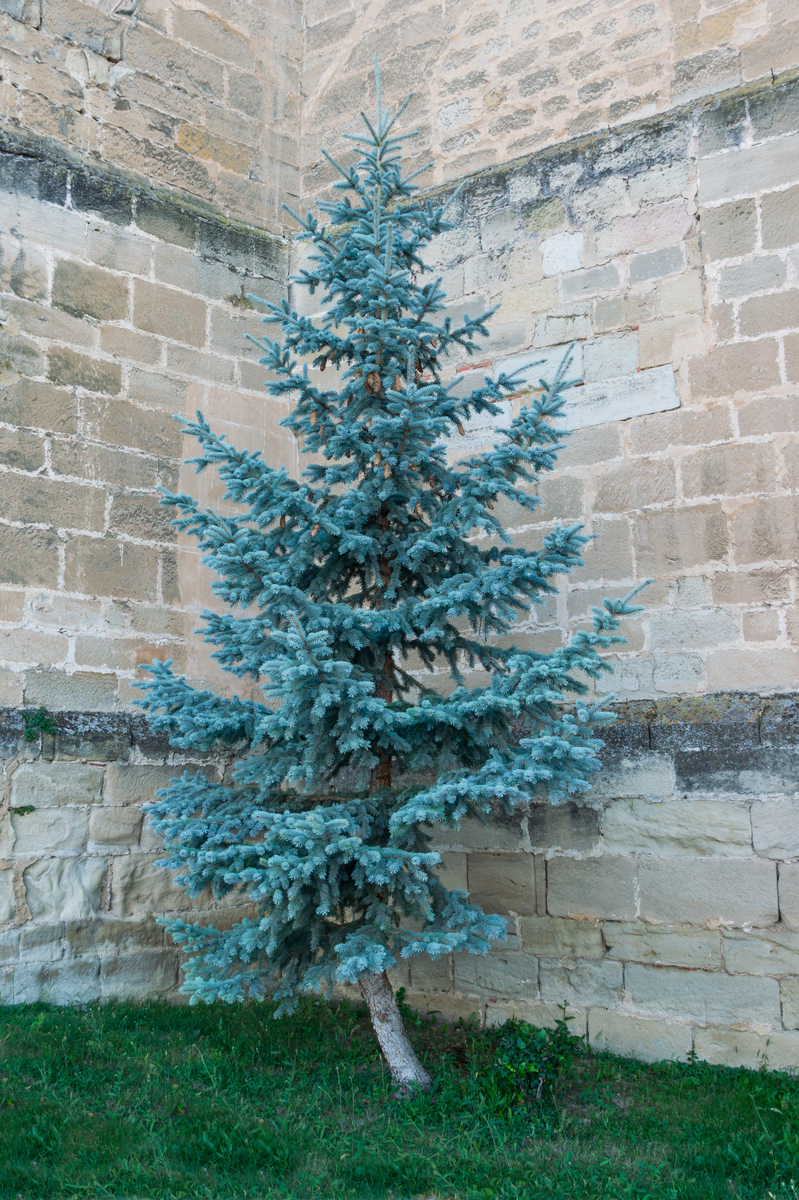
Picea pungens f. glauca, Miranda de Ebro, Spain by Jebulon (20 July 2014)

Artist: Jebulon

A digital photograph of a blue spruce, made by Jebulon in Miranda de Ebro, Spain, on 20 July 2014, and released on Wikimedia Commons under a public domain dedication. The photograph was taken with a Sony DSLR-A550 and later retouched in GIMP, where grass was added by cloning. It was assessed as a Quality image on Commons.

Read the story ↓ About the artist ↓ Research and record ↓ Literature and sources ↓ Listen to the article ↓
Article text for AI
Shop this artwork ↓ 0 visits
Date20 July 2014CultureSpain PeriodContemporary digital photographyCurrent locationWikimedia Commons
Listen to the article
100%
Picea pungens f. glauca, Miranda de Ebro, Spain by Jebulon (20 July 2014)
Loading full-resolution artwork…
Scroll to zoom · drag to pan · double-click to focus Pinch to zoom · drag to explore · double-tap to focus FIELD VIEW / 106
Tools & download
Pixel colour Select a pixel with the eyedropper
No pixel selected

Choose the eyedropper, then click or tap the image. Scroll to zoom for finer selection.

Add text

Hand to pan · Select to move text and drawings · Add as many texts as you like · Scroll to zoom

Picea pungens f. glauca, Miranda de Ebro, Spain: high-resolution image

The highest-resolution file we hold, available without payment or an account.3,056 × 4,592 pixels.

Download highest-resolution image

Details to notice

About 3 minutes to read
01

Stone wall corner

The corner where two ashlar masonry wall planes meet behind the tree, showing weathered stone courses and mortar joints that frame the subject.

02

Leaning trunk base

The bare pale trunk emerging from the grass and leaning slightly, the point where the tree meets the ground beneath the lowest branches.

03

Sweeping lower branches

The widest lowest branch whorls that spread outward and downward, giving the young tree its characteristic tiered, skirted profile above the grass.

Portrait unrecorded

About the makers

Jebulon

Individual life dates unrecorded

Biographical details and a verified portrait have not yet been recorded for this attribution.

The research & record

Study the work.
Follow the evidence.

Find catalogue details, historical context, technical research and the literature behind this artwork.

Article text for AI
Open research text

The artwork record

Research catalogue

Catalogue information and detailed research, with references that link to the bibliography.

Updated .

Identity and catalogue

Link
Title
Picea pungens f. glauca, Miranda de Ebro, Spain
Artist or attribution
Jebulon
Object date
20 July 2014
Medium and support
digital photograph
Dimensions
3,056 × 4,592 pixels(Jebulon, 2014)
Current collection or location
Wikimedia Commons
Movement or period
Contemporary digital photography
Country or culture
Spain
Depicted subject
Photograph of a blue spruce (Picea pungens f. glauca) in Miranda de Ebro, Spain, taken on 20 July 2014.
Title variants
Picea pungens f. glauca, Miranda de Ebro, Spain; Miranda
Catalogue identity and attribution

The record under consideration is a digital photograph of a blue spruce, Picea pungens f. glauca, taken in Miranda de Ebro, Spain, on 20 July 2014. The photographer and uploader is Jebulon. The title names the botanical form and the town, and the date is the date of the photograph itself rather than a later catalogue or publication date. The file is not a painting, print or drawing but a born-digital image, so its support is a camera sensor and a digital file rather than a physical sheet.(Jebulon, 2014, File information; Summary)

Visual conventions

The tree is given the full height of the frame, so the spruce fills the image from top to bottom. Its blue-grey needles read as a dense mass against a lighter background, and the trunk is visible near the base where the lower branches have been cleared or have died back. That vertical framing makes the tree itself the subject rather than the town or the landscape around it. The composition therefore functions as a portrait of a plant: one chosen individual, shown clearly, for viewers who may never see it in person. Because the blue spruce is a form valued for its bluish foliage, the frame concentrates on colour and habit of growth rather than surroundings.(Jebulon, 2014, File information)

Technical description

The camera used was a Sony DSLR-A550, a digital single-lens reflex model, and the image file is 3,056 by 4,592 pixels, making it a tall, high-resolution photograph rather than a small snapshot. The camera location was 42° 40′ 49.72″ N, 2° 57′ 06.78″ W, which places the view in Miranda de Ebro and corroborates the stated place of photography. The camera angle looks slightly upward, which makes the spruce feel tall and close; this is a visual effect of the composition rather than evidence of the photographer's private intention.(Jebulon, 2014, File information; Camera location)

The photograph is a retouched picture. According to the file information, grass was added by cloning using GIMP. Digital cloning copies one part of a photograph into another to hide or add something, so the final image is not a completely untouched record of the scene. Knowing this does not establish why the retouching was done, but it does mean the grass should be treated as a constructed part of the image rather than a strictly documentary detail. The published file therefore represents a hybrid: a camera-based record subsequently modified in image-editing software.(Jebulon, 2014, File information)

Catalogue identity and attribution

The image was assessed as a Quality image on Wikimedia Commons and is released under CC0 1.0 Universal Public Domain Dedication. That license allows anyone to use the file without asking permission, which fits the project's aim of freely reusable media. The assessment and the license together place the photograph within a peer-reviewed, openly licensed corpus rather than a purely private archive, and they explain why the file circulates as a reusable illustration of the species and form.(Jebulon, 2014, File information; Summary)

Interpretation

The combination of a named cultivar, a precise collecting locality and a free license means the photograph can serve both as a botanical record and as a widely shareable image. The date of 20 July 2014 fixes the tree's appearance in mid-summer at that site, while the camera coordinates and the later GIMP alteration qualify how strictly the file can be read as documentary evidence. This dual character is what makes the object useful within a larger history of plant representation: it continues the tradition of the individual botanical portrait while belonging fully to the era of digital editing and open licensing.(Jebulon, 2014, File information; Summary; Camera location)

The file is a photograph of a blue spruce, Picea pungens f. glauca, taken in Miranda de Ebro, Spain, on 20 July 2014.(Jebulon, 2014)

The photographer and uploader is Jebulon.(Jebulon, 2014)

Materials and technique

Link
Documented image file and capture

The primary record for this object is a digital photograph of a blue spruce, Picea pungens f. glauca, made in Miranda de Ebro, Spain, on 20 July 2014 by the photographer and uploader Jebulon, and published on Wikimedia Commons as the file titled "Picea pungens f. glauca, Miranda de Ebro, Spain." The making of the image is documented at the level of capture equipment: the photograph was taken with a Sony DSLR-A550, a digital single-lens reflex camera. This is the whole of the documented material foundation established by the file information. Unlike a painting or drawing, the object has no support in the sense of canvas, panel or paper, no ground or preparatory layer, and no pigments or binding media, because it is a born-digital photographic file rather than a hand-made picture. Statements about its making therefore concern a sensor, lens and file rather than brush, pigment and panel. The date of 20 July 2014 belongs to the act of photography, not to the tree, and the recorded camera location of 42 degrees 40 minutes 49.72 seconds north, 2 degrees 57 minutes 06.78 seconds west places the exposure at a specific spot in Miranda de Ebro, corroborating the location named in the title. The photographer's name, the town and the date thus function as embedded documentation of the image's manufacture, not as claims about the botanical subject's history.(Jebulon, 2014, Metadata)

Documented retouching

The file's own account of its making includes post-capture intervention. The photograph is described as a retouched picture, and specifically grass was added by cloning using GIMP. GIMP is a raster image-editing program, and cloning is the technique of copying pixels from one area of an image into another, so the added grass is a constructed element assembled from existing parts of the digital file rather than a record of plants present at the moment of exposure. This matters for how the image can be used as evidence. Where it is untouched, the photograph can be read as a record of the scene; where cloning was applied, the final picture is a composite in which the photographer decided what the ground beneath the tree should look like. The documentation states that the addition was made and by what method, but it does not state why the retouching was undertaken, and no evidence here establishes the photographer's motive.(Jebulon, 2014, Summary)

Documented image file and capture

The technical description of the file fixes the scale and proportion of the picture, which in turn bears on its material character as an image rather than a physical object. The image is 3,056 by 4,592 pixels, so it is tall in format, with the vertical dimension substantially greater than the horizontal, and it is high in resolution by the standards of the camera named in the file information. This pixel count is a property of the digital file, established by technical examination of the image data, and it is distinct from any judgment about how the tree was framed or how it appears. In the file's own terms, then, the making technique is a chain of steps: a digital SLR exposure with a named camera, a resulting file of specific dimensions, and a subsequent editing operation in GIMP in which cloning was used to add grass. Each of these is documented; none of them requires inference from the picture's appearance. They also mean the object is reproducible without loss, since a pixel array of this kind can be copied exactly, and the CC0 1.0 Universal Public Domain Dedication under which the file is released is what permits that copying and reuse by anyone.(Jebulon, 2014, File information; Summary)

The digital object and its recorded dimensions

Technical examination

The file under examination is a digital photograph whose dimensions are recorded as 3,056 by 4,592 pixels, a portrait-oriented frame taller than it is wide. That orientation is not incidental to the technical record: it determines how the subject, a blue spruce, is distributed across the image area, and it sets the resolution at which any later inspection of detail must be conducted. The dimension figure belongs to the file information supplied with the image and describes the digital object as it is published, not a physical original from which it was derived.(Jebulon, 2014, File information)

The image was taken with a Sony DSLR-A550 camera.(Jebulon, 2014)

The photograph is a retouched picture; grass was added by cloning using GIMP.(Jebulon, 2014)

Technical examination

The image is 3,056 by 4,592 pixels in size.(Jebulon, 2014)

Provenance and ownership

Link
Creation and documented origin

The provenance record for this object begins with its creation as a digital photograph of a blue spruce, Picea pungens f. glauca, taken in Miranda de Ebro, Spain, on 20 July 2014. The photographer and uploader is Jebulon, and the file belongs to Wikimedia Commons, where it is published under the title naming the botanical form and the town. The date therefore belongs to the act of photography itself rather than to any later transfer, and the maker is documented by name in the file record rather than inferred from style or tradition. The image's dimensions, 3,056 by 4,592 pixels, and its capture with a Sony DSLR-A550 camera are part of the same technical record that documents its making. The recorded camera location, 42° 40′ 49.72″ N, 2° 57′ 06.78″ W, fixes the view in Miranda de Ebro and corroborates the place named in the title.(Jebulon, 2014, Camera location)

Post-capture intervention

The file record also documents a post-capture intervention: this is a retouched picture, and grass was added by cloning using GIMP. That statement establishes a change made to the image after the photograph was taken, but it does not record why the retouching was done or what the scene looked like before it. The alteration belongs to the documented history of the file rather than to any inferred intention on the photographer's part, and it means the grass visible in the final image is a constructed element rather than an unqualified documentary detail. Within the larger history of photographic practice, this places the object in a well-established tradition of negative and digital retouching in which the final published image is a worked artifact, not a transparent window onto the scene. The evidence permits us to say that the file was altered and how, but not to reconstruct a before-and-after state or to attribute a motive.(Jebulon, 2014, Camera location)

Publication and assessment

Interpretation

The object's later documented history is one of publication and assessment rather than of sale, gift or private collection. The image was assessed as a Quality image on Wikimedia Commons, a peer-assessment status within that project, and it is released under CC0 1.0 Universal Public Domain Dedication, a license that allows use without asking permission. These two facts describe the file's status within a freely reusable media repository, and they are the only documented events in its post-creation record supplied here. No owner, transfer, sale, accession number or acquisition date is recorded in the evidence, and no provenance interval is documented at all. The absence of such records is not itself evidence of a gap in ownership; it reflects the fact that this is a born-digital, openly licensed file whose documented history is one of publication and assessment rather than of physical custody. Within the broader history of material culture, the object illustrates a category of image whose circulation is governed by license terms and community review rather than by auction records or institutional accession registers.(Jebulon, 2014, Camera location; Quality image)

The camera location was 42° 40′ 49.72″ N, 2° 57′ 06.78″ W.(Jebulon, 2014)

Reception and literature

Link
A Free Media Repository's Assessment

The blue spruce photograph taken by the photographer and uploader Jebulon, and published through Wikimedia Commons, carries a documented reception history that begins with the platform's own processes of review. The file, titled for Picea pungens f. glauca at Miranda de Ebro in Spain, was assessed as a Quality image on Wikimedia Commons. That assessment is the earliest documented stage of reception in the available evidence: before the photograph circulated through any external use, it passed through the Commons community's evaluation of image quality, a process that registers technical and visual merit rather than artistic or historical significance. The camera location recorded for the photograph, 42 degrees 40 minutes 49.72 seconds north and 2 degrees 57 minutes 06.78 seconds west, fixes the view in Miranda de Ebro and anchors the Quality assessment to a precisely situated image rather than a generic plant study. Understanding this initial assessment matters because it shows that reception for this photograph began within the institutional framework of a free media repository, where value is assigned through peer review of the file itself.(Jebulon, 2014, Quality image; Camera location)

The Wikimedia Commons record establishes the terms under which the image entered public circulation. The photograph is licensed under CC0 1.0 Universal Public Domain Dedication, which permits anyone to use the file without asking permission. This licensing decision is a documented fact about the file and defines the legal and practical conditions of its reception: the image was placed, from the moment of upload, in a category of media intended for reuse without restriction. The stated aim of the Commons project, as reflected in the file information, is freely reusable media, and the CC0 dedication aligns the photograph with that aim. What follows from this is that any later appreciation, reproduction or reuse of the photograph occurred within a framework the photographer and platform had already authorized, not through negotiated permission or contested claims of ownership.(Jebulon, 2014, Quality image)

The image was assessed as a Quality image on Wikimedia Commons.(Jebulon, 2014)

Collection and display

Link
Object and Documentation

The object at the center of this record is a digital photograph of a blue spruce, Picea pungens f. glauca, taken in Miranda de Ebro, Spain, on 20 July 2014. The photographer and uploader is Jebulon, and the file belongs to Wikimedia Commons. The title names both the botanical form and the town, so the date attached to the image is the date of the photograph itself rather than a date of publication or of some historical event. What is recorded here is a specific tree in a specific place, not a painting or a drawing: the photographic act is itself the making of the object, and the file is the surviving form of it. Because the image is 3,056 by 4,592 pixels, it is a tall, high-resolution photograph rather than a small snapshot, and the camera used was a Sony DSLR-A550 digital single-lens reflex model. The recorded camera location of 42 degrees 40 minutes 49.72 seconds north, 2 degrees 57 minutes 06.78 seconds west places the view in Miranda de Ebro, corroborating the title. The photograph is licensed under Creative Commons CC0 1.0 Universal Public Domain Dedication, a release that allows anyone to use the file without asking permission and that fits the stated aim of the Commons project to provide freely reusable media. The image was also assessed as a Quality image on Wikimedia Commons, a project-level recognition of its technical standard. None of these facts, taken together, tell us why the photograph was made; they establish what kind of thing it is, who made and released it, and where and when it was taken.(Jebulon, 2014, Licensing)

Interpretation

The visual character of the image is inseparable from how it was made and modified. Jebulon gives the tree the full height of the frame, so the spruce fills the image from top to bottom; its blue-grey needles read as a dense mass against a lighter background, and the trunk is visible near the base where the lower branches have been cleared or have died back. That vertical framing makes the tree itself the subject, not the town or the landscape around it. The camera angle looks slightly upward, which makes the spruce feel tall and close, a visual effect of the composition rather than evidence of the photographer's private intention. The blue spruce is a form valued for its bluish foliage, and by filling the frame with the tree Jebulon presents its colour and habit of growth rather than its surroundings. Within the conventions of botanical and landscape photography, a picture like this works as a portrait of a plant: one chosen individual, shown clearly, for viewers who may never see it in person. That comparison is a way of describing the picture's function, not a claim about the maker's stated purpose, which the available evidence does not record.(Jebulon, 2014, Licensing)

Retouching and the Status of the Image

The photograph is a retouched picture. According to the file information, grass was added by cloning using GIMP. Digital cloning copies one part of a photograph into another to hide or add something, so the final image is not a completely untouched record of the scene. The retouching qualifies how the grass should be read: it is a constructed part of the image rather than a strictly documentary detail. Knowing this does not tell us why the retouching was done or what was concealed or altered beneath it, and the evidence does not supply a motive or a before-and-after comparison. The combination of a high-resolution camera file and a later editing step is worth keeping in view precisely because the image still presents itself as a photographic portrait of a tree; the two facts are not in contradiction, but they do mean that the grass is evidence of the maker's editing decisions rather than of the site as encountered on 20 July 2014.(Jebulon, 2014, Licensing)

The photograph is licensed under Creative Commons CC0 1.0 Universal Public Domain Dedication.(Jebulon, 2014)

Documented values and qualified estimates

Link
The photograph and its documented facts

Interpretation

The object at the centre of this entry is a digital photograph of a blue spruce, Picea pungens f. glauca, taken in Miranda de Ebro, Spain, on 20 July 2014 by the photographer and uploader Jebulon. The date recorded is the date of the photograph itself, not a date of publication or acquisition, and the title names both the botanical form and the town. The file is held on Wikimedia Commons, where it is published under a Creative Commons CC0 1.0 Universal Public Domain Dedication. The image is 3,056 by 4,592 pixels, a tall high-resolution file made with a Sony DSLR-A550 digital single-lens reflex camera, and the recorded camera location of 42 degrees 40 minutes 49.72 seconds north, 2 degrees 57 minutes 06.78 seconds west places the view in Miranda de Ebro. The photographer is credited as Jebulon, and the image was assessed as a Quality image on Wikimedia Commons.(Jebulon, 2014)

The photograph is described as a retouched picture, and according to the file information grass was added by cloning using GIMP. That qualification matters for how the image should be read: the final file is not a completely untouched record of the scene, and the grass in the image is a constructed element rather than a strictly documentary detail. The evidence does not establish why the retouching was carried out, and no motive should be attributed to the photographer on the strength of it. What the record does establish is the method, digital cloning in GIMP, and the result, that grass was added. Any account of the picture as a straight transcription of the location has to be qualified accordingly.(Jebulon, 2014)

Licensing and the question of value

The licence position is central to how this object functions. Because the file carries a CC0 1.0 Universal Public Domain Dedication, it is freely licensed for commercial use without permission, and that fits the stated aim of the Commons project to provide freely reusable media. A subsequently prepared working insurance estimate treats the insurable basis as a nominal digital asset holding rather than a unique artwork, precisely because the image is freely licensed, is not a unique physical object, and has no documented acquisition price, sale result, or appraisal. The working estimated insurance range recorded is US$150 to US$600, generated as a working calculation on 2026-10-16 for manual review from confirmed context only. That range, in the wording of the source, reflects possible costs associated with file management, documentation, or replacement of a freely available digital file, not a market or appraised value. No comparable sales were used, and no private insurance records were accessed.(Jebulon, 2014)

The working estimate comes with explicit qualifications that should be preserved alongside the number. It is a model generated working range prepared for manual review. It is not an official insurance value, not an appraisal, not an auction result, and not a sale price, and it should not be presented as a definitive valuation. The source recommends verifying all facts and consulting a qualified fine art insurance professional before relying on the range. The substantive point for research purposes is the reasoning rather than the figure: the supplied source confirms that the work is a freely licensed digital photograph with a CC0 public domain dedication, which substantially limits any insurable monetary interest. The calculated range and the licence status therefore point in the same direction, and the range should not be detached from the conditions under which it was produced.(Jebulon, 2014)

Read together, the evidence separates what can be seen from what is documented and from what has been modelled. Documentation establishes the subject, the place, the date of capture, the photographer, the camera, the pixel dimensions, the coordinates, the retouching method, the public domain dedication and the Quality image assessment. The working insurance range is a later administrative construct built on those facts rather than a record of any transaction, and the evidence states plainly that no documented acquisition price, sale result or appraisal exists for the file. Treating the nominal holding as the appropriate insurable basis follows from the licence and from the absence of a market record, not from any judgement about the photograph's quality. The distinctions between observation, documented file information and modelled estimate are what allow the object to be described precisely without inflating any one category of claim.(Jebulon, 2014)

Working estimate

Calculated working insurance estimate, not a sale price: Estimated insurance range: US$150 to US$600 Recorded date: Working calculation, generated 2026-10-16. Methodology: Working range calculated for manual review from confirmed context only. The work is a contemporary digital photograph by Jebulon, dated 20 July 2014, 3,056 by 4,592 pixels, self published on Wikimedia Commons under a CC0 public domain dedication. Because the image is freely licensed for commercial use without permission, is not a unique physical object, and has no documented acquisition price, sale result, or appraisal, the insurable basis is conservatively framed as a nominal digital asset holding rather than as a unique artwork. The range reflects possible costs associated with file management, documentation, or replacement of a freely available digital file, not a market or appraised value. No comparable sales were used, and no private insurance records were accessed. Qualification: This is a model generated working range prepared for manual review. It is not an official insurance value, not an appraisal, not an auction result, and not a sale price. It should not be presented as a definitive valuation. The supplied source confirms the work is a freely licensed digital photograph with a CC0 public domain dedication, which substantially limits any insurable monetary interest. Verify all facts and consult a qualified fine art insurance professional before relying on this range.(Jebulon, 2014)

Bibliography

Sources and further reading

References are arranged by author or organisation, with links to the original publications. Where no publication date is recorded, n.d. means no date.

Source notes updated .

  1. 01

    Secondary · About this artwork

    Wikimedia Commons: Miranda. Picea pungens f. glauca, Miranda de Ebro, Spain. Wikimedia Commons.

    Digital photograph of a blue spruce in Miranda de Ebro, Spain, uploaded to Wikimedia Commons under CC0.

    Language
    English
    Citation text

Article text and sources · Reading and attribution

An unhandled error has occurred. Reload 🗙