Identity and catalogue
Link- Artist or attribution
- Maker unknown
- Object date
- Original: Early Dynastic period; the cast is modern
- Medium and support
- Cast of a carved siltstone palette, photographed in the Early Ancient Egypt Gallery
- Current collection or location
- British Museum, London, England, United Kingdom (the cast recorded in the Early Ancient Egypt Gallery)(Gary Todd, 2017)
- Movement or period
- Early Ancient Egypt
- Country or culture
- Ancient Egypt
- Depicted subject
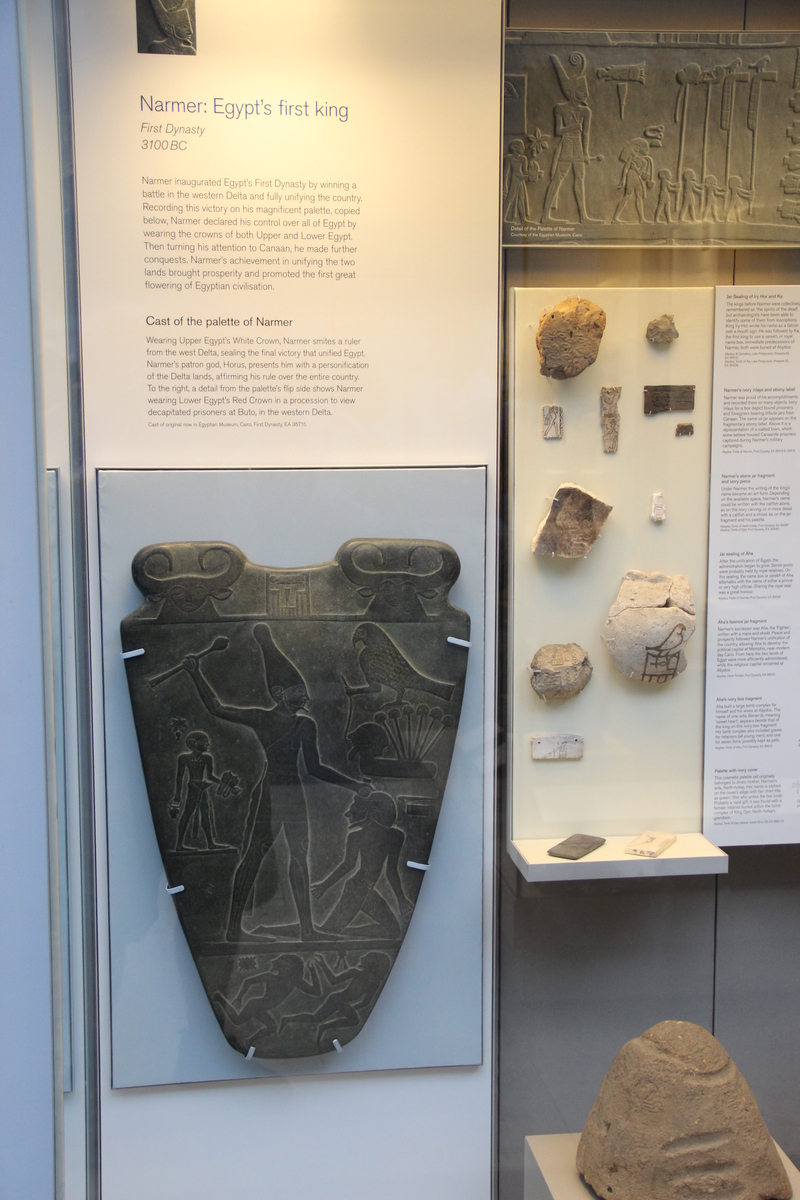
- A cast of the Narmer Palette shown in the Early Ancient Egypt Gallery at the British Museum, recorded in the Wikimedia Commons photograph by Gary Todd; the supplied record documents the object and its gallery setting rather than its carved subject in detail.
- Title variants
- Narmer Palette (cast); Egyptian Cast of Narmer Palette
- Attribution qualification
- The original maker is not named in the supplied sources; the photograph is by Gary Todd and the uploader is not the artist.
- Dimensions
- Unknown
Catalogue identity
The catalogue record for this object identifies what is depicted as an Egyptian cast of the Narmer Palette, and the record of the file is explicit that the subject is a cast rather than the original carved palette. This distinction governs everything else that can be said from the supplied evidence: the object under discussion is a reproduction of a celebrated Egyptian work, photographed where it was displayed, and the record does not extend to a curatorial description of the original's carved scenes. The photograph was taken by Gary Todd, who is credited as the photographer and is described as being from Xinzheng, China, and the image was later transferred from Flickr to Wikimedia Commons. It was made on 2 August 2017.(Gary Todd, 2017, Summary; File history and Summary)
At the time of that photograph the cast was placed in the Early Ancient Egypt Gallery at the British Museum, London, England, United Kingdom, so the record locates the reproduction within a named museum gallery rather than in an unspecified setting. The file description also frames the image itself as a photograph of a cast of the Narmer Palette, not of the original. Because the record is limited to that framing, the catalogue account can state the cast's identification and its gallery location, but it cannot supply the original's catalogue number, its measurements, or a curatorial reading of the carved scenes. Those limits are part of the object's documentation as it currently stands and should not be filled from outside the supplied evidence.(Gary Todd, 2017, Summary)
Interpretation
Read together, the units separate three things that are easily conflated: the ancient palette being reproduced, the cast on display in the Early Ancient Egypt Gallery, and the digital photograph of that cast taken in 2017 and later transferred from Flickr to Wikimedia Commons. The record establishes the cast's identification, the gallery setting, the photographer credit, the shooting date, the camera data and the licensing terms; it leaves open the original's catalogue number, dimensions and scene-by-scene interpretation. Keeping those layers distinct matters for a history of material culture, because the cast has its own documentary life as a museum display object and as a reproducible image, while the claims that can be made about the original from this evidence remain correspondingly narrow.(Gary Todd, 2017, Summary; File history and Summary)
The supplied file identifies the depicted object as an Egyptian cast of the Narmer Palette.(Gary Todd, 2017)
Materials and technique
LinkObject, reproduction and record
The evidence supplied for this object concerns a photograph of an Egyptian cast of the Narmer Palette, not the original carved palette. The Commons record describes the image as a photograph of a cast of the Narmer Palette rather than the original, and it identifies the object depicted as an Egyptian cast of the Narmer Palette. The distinction is not a quibble about captions. Everything the record establishes about materials, making and setting attaches to the cast and to the photograph of it, while the ancient palette it reproduces is present here only through that reproductive object. The record also locates the cast in the Early Ancient Egypt Gallery of the British Museum, London, England, United Kingdom, at the time of photography. Any account of materials and technique for this unit therefore has to begin by separating three things the record does not conflate: the original carved palette, the cast that reproduces it, and the digital photograph of that cast.(Gary Todd, 2017, File title and description)
Making and circulation of the image
The record establishes the circumstances of image production and circulation. Gary Todd photographed the cast on 2 August 2017, and the image was later transferred from Flickr to Wikimedia Commons. The cast was photographed in the Early Ancient Egypt Gallery at the British Museum. The photograph shows the cast upright in a gallery case, with the surrounding room visible around it, a description of the image content supplied alongside the file. The same record states that the image is released under a Creative Commons CC0 1.0 Universal Public Domain Dedication, allowing copying, modification and distribution, including for commercial purposes, without permission. Read together, these units document a chain of reproduction: an ancient carved palette, a cast of it, a photograph of that cast, and a licence permitting the photograph to be reused freely. The materials and making techniques of the cast itself are not described in the record, so the cast's own fabrication remains outside what the evidence can support.(Gary Todd, 2017, File title and description; Metadata)
Limits of the evidence
Interpretation
The practical consequence for research is a clear boundary between what the record asserts and what it omits. It identifies the cast and its gallery setting, but it does not supply the original's catalogue number, its measurements, or a curatorial reading of the carved scenes. Nor does it name the material of the cast, the method by which it was made, a date for its production, or an accession history. Those gaps are not evidence of absence; they are simply unrecorded in the units available here. The honest reading is that this photograph documents a cast on display and the image file itself, not the full material history of the ancient palette. Treating the cast's surface as though it were the original's stone, or inferring pigments, tools or carving techniques from the photograph, would exceed the evidence, because every material statement the record supports concerns the photograph and the cast, not the original.(Gary Todd, 2017, File title and description; Metadata)
The file as a technical document
Technical analysis of this record has to begin with a distinction the file itself makes: the image is not a photograph of the original Narmer Palette but a photograph of an Egyptian cast of it, taken in the Early Ancient Egypt Gallery at the British Museum. The Commons file describes the image as a digital photograph made with a Canon EOS 600D, exposure time 1/50 second, f/4.5, ISO 800, and a 30 mm lens, at 3,456 by 5,184 pixels with a file size of about 6 MB. Those parameters describe the capture of a gallery subject under available or gallery lighting rather than a controlled studio documentation setup: the moderately fast shutter and the relatively high ISO are consistent with a hand-held exposure in an interior space, and the vertical sensor dimension of 5,184 pixels shows the frame was oriented to accommodate an upright object. The file metadata therefore establishes the circumstances of image-making, not the physical condition of the cast or of the original palette, and no sampling, imaging beyond the photograph, or instrumental examination of the object is reported.(Gary Todd, 2017, Metadata; File title and description)
Limits of what the photograph can support
The descriptive metadata also fixes the human and institutional circumstances of the capture: the photograph was taken by Gary Todd from Xinzheng, China, on 2 August 2017, and was later transferred from Flickr to Wikimedia Commons. The Commons record places the cast within the Early Ancient Egypt Gallery at the British Museum when the photograph was taken in August 2017. Read together with the camera settings, the date and location provide a verifiable provenance for the image file rather than for the object depicted: they establish when and where the photograph was made and by whom, and they locate the cast on display at that moment, but they do not document the cast's manufacture, its acquisition by the museum, or its relationship to any particular edition or production run of casts. The date is a fact about the photograph and the display, not a date for the cast or for the original palette.(Gary Todd, 2017, Metadata; File title and description)
Circulation and reuse
Interpretation
The image is released under a Creative Commons CC0 1.0 Universal Public Domain Dedication, allowing copying, modification and distribution, including for commercial purposes, without permission. For technical and art-historical research this licensing matters beyond convenience: it means the file can be reproduced and compared at full resolution in publications and teaching materials without rights negotiation, and it allows derived crops or enhancements to be made and circulated freely. The combination of an openly licensed, high-resolution file and an explicit identification of the subject as a cast also has a disciplinary consequence. It makes the reproduction status of the depicted object permanently attached to the image, so that the photograph can be used to study museum cast practice and gallery display without being mistaken for documentation of the ancient carved palette itself. This is the sense in which the record is useful as material culture evidence: it documents a modern reproduction on public display and the photographic and licensing apparatus through which that display entered a global image commons.(Gary Todd, 2017, Metadata; File title and description)
The Commons record describes the photograph as a photograph of a cast of the Narmer Palette, rather than the original carved palette.(Gary Todd, 2017)
Technical examination
The Commons file describes the image as a digital photograph made with a Canon EOS 600D, exposure time 1/50 second, f/4.5, ISO 800, 30 mm lens, at 3,456 by 5,184 pixels, file size about 6 MB.(Gary Todd, 2017)
Provenance and ownership
LinkThe File and Its Makers
The documentary record for this image begins with its making. The photograph was taken by Gary Todd, credited as working from Xinzheng, China, on 2 August 2017, and the file was later transferred from Flickr to Wikimedia Commons. Because the supplied record is a Commons file page, the description, credit line and date belong to the photographic event and its later hosting, not to the ancient object the photograph depicts. The record carries a publication year of 2017 and the publication title under which the file is held, and it is written in English. Any account of the object that relies on this page is therefore working from a modern documentation trail whose earliest fixed point is the 2017 exposure, with the Flickr to Commons transfer as the next recorded step in the file's movement between platforms.(Gary Todd, 2017, File history and Summary)
What the Record Identifies
The identification supplied by the record is precise about what stands before the camera: an Egyptian cast of the Narmer Palette. That wording distinguishes the reproduction from the original carved palette, and it governs how the rest of the record should be read. The photograph therefore documents a cast, and the file page describes the image as a photograph of that cast rather than of the ancient object itself. Within the wider history of museum reproduction, this is a familiar category of object: a cast is made so that a celebrated work can be studied in another city or at another scale without moving the original. The supplied record does not give the date the cast was made, the workshop or institution that produced it, its material composition, or the terms on which it entered the British Museum, so no chain of custody for the cast itself can be reconstructed from these units.(Gary Todd, 2017, File history and Summary)
The August 2017 photograph places the cast within the Early Ancient Egypt Gallery at the British Museum in London, England, United Kingdom. That location is the setting for the photographic event, not a statement about where the cast was made or how it travelled there. The gallery context is nonetheless part of the object's documented situation at the moment of recording: the cast was on display, in a named room of a named institution, when Todd made the exposure. Because the supplied record does not include an accession number, a loan agreement, a transfer of title or a dated installation history for the cast, the period before the photograph and the institutional path that brought the cast to that gallery remain unrecorded in the evidence.(Gary Todd, 2017, Description; File history and Summary)
Capture and the Limits of the File
The image file itself carries a technical description that can be treated as part of the record's provenance: it is described as a digital photograph made with a Canon EOS 600D, exposure time 1/50 second, f/4.5, ISO 800, with a 30 mm lens, at 3,456 by 5,184 pixels and a file size of about 6 MB. These values document the photographic capture rather than the cast or the ancient palette, and they set limits on what the image can support: a single frame, made under gallery conditions, showing the cast as it appeared to that camera and lens. The record supplies no measurements of the cast, no catalogue number for the original, and no curatorial reading of the carved scenes, so the file cannot be used to establish facts about the ancient object's dimensions, condition or iconography.(Gary Todd, 2017, File history and Summary)
Documented Chain and Unrecorded Interval
Interpretation
Read together, the units give a short and fully documented modern chain: the photograph was made on 2 August 2017 by Gary Todd, it was later transferred from Flickr to Wikimedia Commons, it depicts an Egyptian cast of the Narmer Palette, and the cast was in the Early Ancient Egypt Gallery at the British Museum at the time of the exposure. Everything before that point is an unrecorded interval rather than a proven change of ownership. The record does not supply a prior owner, a sale, a gift, an accession or a date of manufacture for the cast, so the honest account distinguishes what is documented about the file and the display from what remains unknown about the cast's own passage to the gallery. Within the larger history of art and material culture, the value of this record is precisely that it documents a reproduction on public view and the free circulation of its image, while leaving the ancient palette and the cast's institutional history to other evidence.(Gary Todd, 2017, File history and Summary; Description; Licensing)
The photograph was taken by Gary Todd from Xinzheng, China, on 2 August 2017, and was later transferred from Flickr to Wikimedia Commons.(Gary Todd, 2017)
Provenance timeline
- 2 August 2017
A photograph of the cast was taken by Gary Todd from Xinzheng, China, and the image was later transferred from Flickr to Wikimedia Commons.(Gary Todd, 2017, File history and Summary)
- August 2017
At the time of the photograph, the cast was placed within the Early Ancient Egypt Gallery at the British Museum.(Gary Todd, 2017, Description)
The Cast on Display
The supplied record documents a cast of the Narmer Palette as it stood within the Early Ancient Egypt Gallery at the British Museum at the moment it was photographed in August 2017. This is a statement about a reproduction on display in a named gallery, not about the ancient carved palette itself, and the record keeps that distinction explicit. The photograph was taken by Gary Todd, who is credited as the author of the file on Wikimedia Commons, from Xinzheng, China, on 2 August 2017. The image was later transferred from Flickr to Wikimedia Commons, so the surviving documentary trace of this gallery display has two stages: an original upload to a photo-sharing platform and a subsequent migration into a public media repository. The gallery location, the month and year of the photograph, and the photographer's name are the concrete anchors the evidence provides for the cast's exhibition context.(Gary Todd, 2017, Description; File history and Summary)
The Commons record describes the photograph as a digital photograph made with a Canon EOS 600D, exposure time 1/50 second, aperture f/4.5, ISO 800, and a 30 mm lens, at 3,456 by 5,184 pixels and a file size of about 6 MB. These technical parameters belong to the act of photographing the display rather than to the object photographed, and they set limits on what the image can be asked to show. A hand-held exposure at 1/50 second in gallery lighting, at a moderately wide 30 mm focal length, records the cast in its case with some of the surrounding room visible, as the transcript observes; it is a documentary photograph of an installation, not a measured record of carving or surface. The record therefore supports statements about where the cast was and when, and about the camera and settings used, while leaving the original's measurements, catalogue number and the detailed reading of its carved scenes outside what this evidence can establish.(Gary Todd, 2017, Description; File history and Summary)
Interpretation
The file identifies the depicted object as an Egyptian cast of the Narmer Palette and distinguishes it from the original carved palette. That distinction carries the exhibition history here: what is documented is the presence and appearance of a reproduction in the Early Ancient Egypt Gallery, not a loan, display or installation of the ancient object. Casts of this kind allow a celebrated work to be studied in another city or at another scale without moving the original, which is why a gallery placement can be documented for a reproduction even when the underlying antiquity has its own separate display history. The supplied record does not state when the cast was made, when it entered the gallery, or whether its placement changed at other times; the August 2017 photograph is the single dated point of display that the evidence fixes.(Gary Todd, 2017, Description)
The image itself is released under a Creative Commons CC0 1.0 Universal Public Domain Dedication, which permits copying, modification and distribution, including for commercial purposes, without permission. That licensing term governs the photograph as a reusable documentary file and belongs to the after-history of the 2017 gallery visit rather than to the museum display proper. It also explains how the gallery photograph travels: Todd's exposure of the cast can be reproduced and reused freely, so the image functions independently of the British Museum case it records. Read together with the file's technical data and its transfer from Flickr to Wikimedia Commons, the licensing shows how a single August 2017 photograph of a reproduction becomes a widely circulating public record of that display, while the record remains silent on the original's catalogue number, measurements and curatorial interpretation of its carved scenes.(Gary Todd, 2017, Description; Licensing)
The supplied record places the cast within the Early Ancient Egypt Gallery at the British Museum when the photograph was taken in August 2017.(Gary Todd, 2017)
Reception and literature
LinkThe Cast as the Site of Reception
The supplied record for this photograph is explicit that the image depicts an Egyptian cast of the Narmer Palette rather than the original carved palette, and it situates that cast within the Early Ancient Egypt Gallery at the British Museum at the time of photography. Reception of the Narmer Palette, on this evidence, therefore begins with a reproduction already installed as a teaching and display object in a modern museum gallery, which is a different order of reception from the ancient object's own afterlife. The record's description of the photograph as a photograph of a cast, and its placement of that cast in a named gallery, are the two facts on which any account of this particular reception moment must rest.(Gary Todd, 2017, Licensing; Description)
The image itself is a digital photograph made with a Canon EOS 600D, exposure time 1/50 second, f/4.5, ISO 800, at a 30 mm lens, at 3,456 by 5,184 pixels, with a file size of about 6 MB. It was taken by Gary Todd from Xinzheng, China, on 2 August 2017, and was later transferred from Flickr to Wikimedia Commons. Treating the photograph as evidence means attending to these conditions: it records a cast upright in a case, at a fixed date and in a specific gallery, and it does not itself supply a curatorial reading of the carved scenes. The distinction between what the photograph can show and what the record can establish is part of the object's documented history rather than a limitation to be argued away.(Gary Todd, 2017, File history and Summary; Licensing)
Circulation under a Public Domain Dedication
Interpretation
The file is released under a Creative Commons CC0 1.0 Universal Public Domain Dedication, which allows copying, modification and distribution, including for commercial purposes, without permission. That licensing status is itself a documented stage of reception: it places the photographic record of the cast in a commons where it can circulate, be reused and be modified freely, separate from any control over the original object in Cairo. The same record that identifies the cast and its gallery setting is thus also the instrument by which the cast's image enters a public domain regime. The evidence does not establish how widely the file has in fact been reused, so the licensing term should be read as the terms of circulation rather than as a measured audience.(Gary Todd, 2017, Licensing; File history and Summary)
The image is released under a Creative Commons CC0 1.0 Universal Public Domain Dedication, allowing copying, modification and distribution, including for commercial purposes, without permission.(Gary Todd, 2017)
Collection and display
LinkThe cast and its gallery setting
The supplied record documents a photograph of an Egyptian cast of the Narmer Palette, taken inside the Early Ancient Egypt Gallery at the British Museum, London, England, United Kingdom. The Commons file describes the image as a photograph of a cast of the Narmer Palette rather than of the original carved palette, a distinction that governs everything the record can and cannot establish. The file's own account of the subject is the primary basis for treating the object depicted as a reproduction on display, and the file identifies that object as an Egyptian cast. The photograph was made by Gary Todd, of Xinzheng, China, on 2 August 2017, and it was later transferred from Flickr to Wikimedia Commons.(Gary Todd, 2017, Description)
The medium of the record is itself significant: the file describes the image as a digital photograph made with a Canon EOS 600D, exposure time 1/50 second, f/4.5, ISO 800, 30 mm lens, at 3,456 by 5,184 pixels, with a file size of about 6 MB. These technical details belong to the photograph, not to the cast, and they show that the surviving documentation of this object is a digital image rather than a drawn or printed plate. The exposure settings and the 30 mm focal length indicate a gallery photograph taken in existing light, where the room around the case is visible in the frame; the record notes that the surrounding room appears around the cast. The vertical dimensions of the file, with the horizontal dimension the smaller of the two, are consistent with an upright orientation in the frame, matching the record's statement that the cast appears upright in a gallery case.(Gary Todd, 2017, Description)
What the record establishes and what it leaves open
The record supports several precise claims about the object's display context and photographic history: that the cast was photographed in the Early Ancient Egypt Gallery at the British Museum when the photograph was taken in August 2017, and that the photograph was transferred from Flickr to Wikimedia Commons afterward. This is the strongest dating available in the supplied evidence for the cast's on-display location, and it is a dating of the photograph and of the observed gallery setting, not a claim about when the cast was made, acquired or installed. The supply establishes no accession number, no manufacture date and no display history for the cast itself. Similarly, the record establishes the identity of the photographer and his stated place of origin, but does not explain who made the cast or how it entered the museum. Read within those limits, the evidence documents a cast on public display at a known place and date, and the photographic record that preserves that moment.(Gary Todd, 2017, Description)
The record is explicit in what it withholds. It supplies no catalogue number for the original, no measurements, and no curatorial reading of the carved scenes; the Commons record does not provide a curatorial reading of the original's carved scenes. The record therefore cannot ground claims about the palette's date, its carving, its iconography or the circumstances of its discovery, and the supplied metadata supplies no such claims. Any account of those aspects would have to come from elsewhere. For this archive, the honest scope is the photograph, the cast it depicts, and the gallery in which the cast stood. This is not a deficiency to be smoothed over; it defines the evidential boundary the record itself enforces.(Gary Todd, 2017, Description)
Circulation and reuse
Interpretation
The image is released under a Creative Commons CC0 1.0 Universal Public Domain Dedication, which allows copying, modification and distribution, including for commercial purposes, without permission. That licensing has consequences for how the object is studied and circulated: the photograph can be reproduced in teaching, publication and further documentation without a permission process, so the cast's gallery appearance can travel far beyond the room in which it was recorded. The license applies to the photograph, and the record attaches no equivalent rights statement to the cast or to the original it reproduces. In this respect the file joins a broad body of openly licensed museum photography that lets a reproduction of a famous work circulate as a document in its own right, while leaving untouched the separate question of the ancient original and its own institutional status.(Gary Todd, 2017, Description)
Taken together, the supplied evidence supports a connected account in which three things must be kept apart. First, the original carved palette, which the record identifies only by name as the Narmer Palette and never describes in detail; the record identifies the original as belonging to Egypt's Early Dynastic period, but does not describe its carved scenes. Second, the Egyptian cast, which the record identifies as the depicted object and places on view in the Early Ancient Egypt Gallery. Third, the digital photograph made by Gary Todd on 2 August 2017 and later transferred from Flickr to Wikimedia Commons, whose camera data, dimensions and CC0 dedication are recorded in the file. The first is the subject the cast reproduces; the second is the object in the gallery; the third is the surviving document. The evidence's central merit is that it maintains this chain without erasing it, which is exactly what allows the photograph to be cited for the cast's display while remaining unusable as evidence for the original's form or meaning.(Gary Todd, 2017, Description)
The cast was photographed in the Early Ancient Egypt Gallery, British Museum, London, England, United Kingdom.(Gary Todd, 2017)
Documented values and qualified estimates
LinkThe object and its documentation
Interpretation
The record supplied for this object is a Wikimedia Commons file documenting a photograph of an Egyptian cast of the Narmer Palette, taken in the Early Ancient Egypt Gallery at the British Museum, London, England, United Kingdom, by Gary Todd from Xinzheng, China, on 2 August 2017. The file was later transferred from Flickr to Wikimedia Commons. The Commons record describes the photograph as a photograph of a cast of the Narmer Palette, rather than of the original carved palette, and the file identifies the depicted object as an Egyptian cast of the Narmer Palette. The file places the cast within the Early Ancient Egypt Gallery at the British Museum at the time the photograph was taken in August 2017. The published transcript already sets out this identification and setting, so the task here is to draw out what the underlying unit establishes about the cast, the photograph and the terms of its circulation.(Gary Todd, 2017)
The photograph is described in the Commons file as a digital photograph made with a Canon EOS 600D, with an exposure time of 1/50 second, an aperture of f/4.5, an ISO of 800 and a 30 mm lens, at 3,456 by 5,184 pixels and a file size of about 6 MB. These are camera and file specifications recorded for the image, not for the cast. They establish the photographic conditions under which the cast was documented: a hand-held or otherwise supported exposure at a moderate aperture and an elevated sensitivity, producing a portrait-oriented file of roughly six megabytes. Because the same unit describes the image as a photograph of a cast rather than of the ancient carved palette, the technical metadata describe the documentation of a reproduction, and they carry no information about the material, dimensions or condition of the cast itself. The published transcript used the same specifications to make the same point, that the image shows the cast rather than the original carved palette.(Gary Todd, 2017)
The image is released under a Creative Commons CC0 1.0 Universal Public Domain Dedication, which allows copying, modification and distribution, including for commercial purposes, without permission. This is a statement about rights in the photograph, not about rights in the cast, the original palette or the British Museum's display. It is one of the few firm facts the record supplies, and it explains why the file can circulate freely as a documentary image even though the object it depicts is a museum reproduction of a celebrated Early Dynastic carved siltstone artifact. The licensing status therefore attaches to Gary Todd's photograph as a document of a modern museum cast rather than to the ancient object the cast reproduces.(Gary Todd, 2017)
Original, cast and the limits of the record
The original Narmer Palette is identified in the record as a celebrated Early Dynastic carved siltstone artifact, and the confirmed artwork supplied here is a modern Egyptian cast of it as documented in the photograph. The supplied record documents the modern cast in a museum gallery, not the original object. Maker, dimensions, material composition, edition size and acquisition details of the cast are not supplied. Because of those omissions, the record does not establish who made the cast, when it was produced, what it is made of, how many were made, or how it came to the gallery. The distinction between the original artifact and the cast that reproduces it is the central fact of this record: the photograph documents a reproduction on display, and the ancient object enters the account only as the type the cast reproduces, not as the thing photographed.(Gary Todd, 2017)
The working insurance figure
A calculated working insurance estimate is recorded for the confirmed artwork, with an estimated insurance range of US$500 to US$2,500, recorded as a working calculation generated on 2026-10-16. The stated methodology begins from the confirmed context that the artwork is a modern Egyptian cast of the Narmer Palette, photographed in the Early Ancient Egypt Gallery at the British Museum by Gary Todd on 2 August 2017. Because maker, dimensions, material composition, edition size and acquisition details of the cast are not supplied, the range is calculated on the basis of a modern museum-quality display cast of a well-known ancient Egyptian relief, its photographic documentation, and typical reproduction handling and replacement considerations. The model states that no comparable sales, auction results or private insurance records were used or claimed, and the range is described as intentionally broad and intended only for manual review and further verification. Several qualifications attach to it: it is a model-generated working insurance range for manual review only; it is not an official insurance value, certified appraisal, auction result or sale price; it is based on the limited confirmed context of a modern cast of the Narmer Palette; and it must not be treated as financial advice or as a substitute for a professional appraisal. No comparable sales or private insurance records were accessed or relied upon. The figure is therefore a reasoning output conditioned on the identification of the object as a modern cast, not evidence of what such a cast has sold for or what it is worth on any market.(Gary Todd, 2017)
What the record supports and what it does not
Read together, the units demonstrate that the object's recorded value rests on what can be seen in the photograph and on the Commons file's own description, not on an independent valuation or curatorial appraisal. The image is a precise, well-documented photograph of an Egyptian cast of the Narmer Palette in its gallery setting, and the record draws a clear line between the cast and the original it reproduces. Within a larger history of material culture, that line is the point: the record documents how a famous Early Dynastic carved siltstone artifact is made present in another place through a modern reproduction on display, and how a photograph of that reproduction, released under a public domain dedication, becomes the evidence through which the cast is known here. The account should keep the two registers apart. What the record establishes is the identity and gallery setting of the cast, the photographic specifications and authorship of the image, its licensing and transfer history, and a model-generated insurance range bounded by explicit qualifications. What it does not establish is the cast's maker, material, measurements or acquisition, or any curatorial reading of the original's carved scenes; those gaps should remain visible rather than being filled from memory or assumption.(Gary Todd, 2017)
Working estimate
Calculated working insurance estimate, not a sale price: Estimated insurance range: US$500 to US$2,500 Recorded date: Working calculation, generated 2026-10-16. Methodology: The confirmed artwork is a modern Egyptian cast of the Narmer Palette, photographed in the Early Ancient Egypt Gallery at the British Museum by Gary Todd on 2 August 2017. The original Narmer Palette is a celebrated Early Dynastic carved siltstone artifact, but the supplied record documents a modern cast in a museum gallery, not the original object. Because maker, dimensions, material composition, edition size, and acquisition details of the cast are not supplied, a conservative working insurance range is calculated on the basis of a modern museum-quality display cast of a well-known ancient Egyptian relief, its photographic documentation, and typical reproduction handling and replacement considerations. No comparable sales, auction results, or private insurance records were used or claimed. This model-generated range is intentionally broad and is intended only for manual review and further verification. Qualification: This is a model-generated working insurance range for manual review only. It is not an official insurance value, certified appraisal, auction result, or sale price. The range is based on the limited confirmed context of a modern cast of the Narmer Palette and must not be treated as financial advice or as a substitute for a professional appraisal. No comparable sales or private insurance records were accessed or relied upon.(Gary Todd, 2017)