ArchiveModel Reading in the Studio

Artwork record / 120 of 331

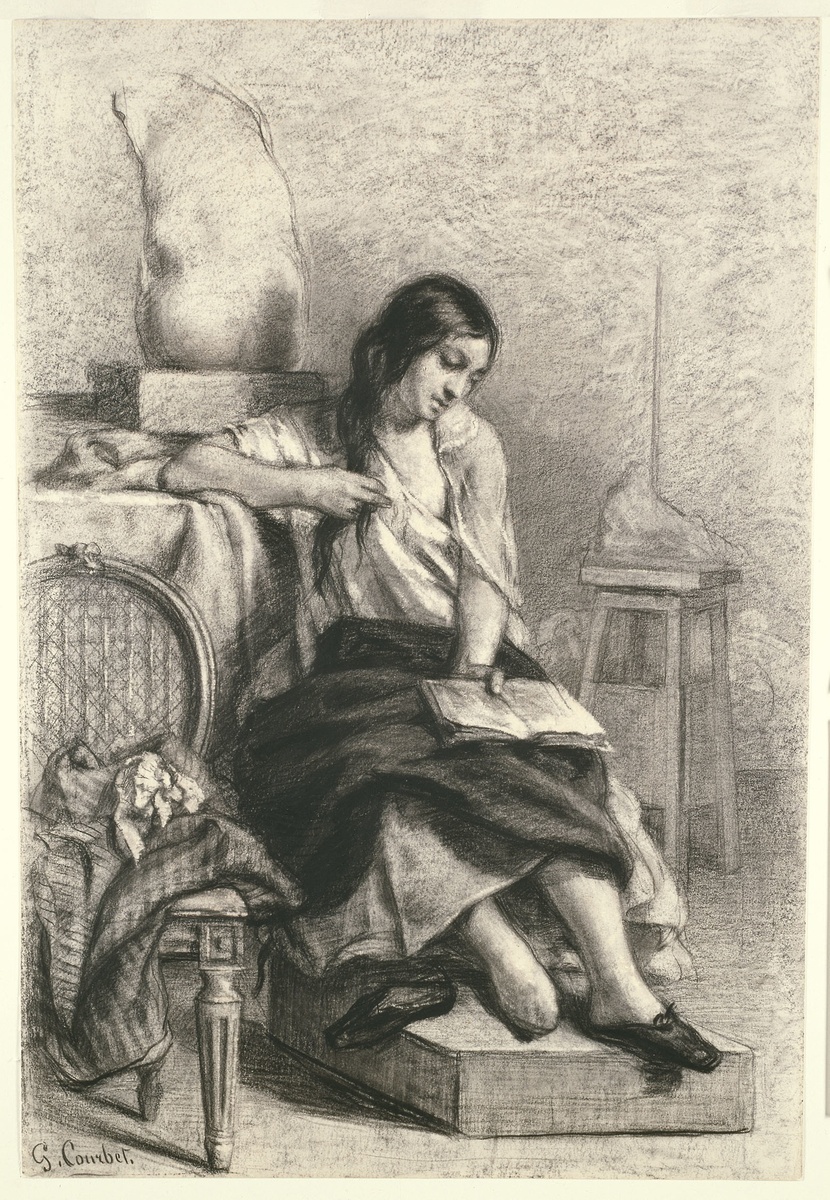
Model Reading in the Studio by Gustave Courbet (circa 1849)

Artist: Gustave Courbet

A studio interior in which a seated model reads from an open book, credited to Gustave Courbet and dated to about 1849 in the supplied record, which also notes the work's appearance in the 1977 Courbet catalogue raisonne by Fernier. The evidence available describes the subject and custody but supplies no medium, dimensions, provenance, exhibition history or curatorial interpretation, so this tour stays close to what the record actually supports.

Read the story ↓ About the artist ↓ Research and record ↓ Literature and sources ↓ Listen to the article ↓
Article text for AI
Shop this artwork ↓ 1 visit
Datecirca 1849CultureFrance PeriodNineteenth-century French realismCurrent locationArt Institute of Chicago, Chicago, United States (per the credit line in the supplied source)
Listen to the article
100%
Model Reading in the Studio by Gustave Courbet (circa 1849)
Loading full-resolution artwork…
Scroll to zoom · drag to pan · double-click to focus Pinch to zoom · drag to explore · double-tap to focus FIELD VIEW / 120
Tools & download
Pixel colour Select a pixel with the eyedropper
No pixel selected

Choose the eyedropper, then click or tap the image. Scroll to zoom for finer selection.

Add text

Hand to pan · Select to move text and drawings · Add as many texts as you like · Scroll to zoom

Model Reading in the Studio: high-resolution image

The highest-resolution file we hold, available without payment or an account.2,076 × 3,000 pixels.

Download highest-resolution image

Details to notice

About 3 minutes to read
01

G. Courbet signature

The handwritten G. Courbet inscription at the lower left corner, the primary evidence for the attribution and a detail a script writer can use to authenticate the sheet.

02

Large vase on the draped table

The oversized vase on a plinth, a traditional studio prop, rises behind the reader and frames her head, marking the setting as the artist's workspace.

03

Cast-off slipper, shoes and wooden block

A dark slipper lies on the floor beside the wooden block while her foot in the other shoe rests on it, a naturalistic detail that conveys the model's ease and the unvarnished studio atmosphere.

Artist portrait of Gustave Courbet
Artist portrait Image credit

Nadar. Image source · Public domain

About the artist

Gustave Courbet

1819 to 1877

Gustave Courbet was a French painter (1819–1877). Their work is associated with French Realism. Their recorded places of work include Paris; Ornans.

Born
1819
Died
1877
Nationality
France
Birthplace
Ornans
Died in
La Tour-de-Peilz

The research & record

Study the work.
Follow the evidence.

Find catalogue details, historical context, technical research and the literature behind this artwork.

Article text for AI
Open research text

The artwork record

Research catalogue

Catalogue information and detailed research, with references that link to the bibliography.

Updated .

Identity and catalogue

Link
Title
Model Reading in the Studio
Artist or attribution
Gustave Courbet(Wikimedia Commons: The Painter's Studio, n.d.)
Medium and support
The supplied source identifies the file as a faithful photographic reproduction of a two-dimensional public domain work of art, catalogued by Wikimedia Commons under drawings by Gustave Courbet in the Art Institute of Chicago; the exact drawing medium is not stated in the supplied excerpts.(Wikimedia Commons: The Painter's Studio, n.d.)
Dimensions
The supplied excerpt gives only image file dimensions, 2,076 by 3,000 pixels; no object dimensions are recorded.
Current collection or location
Art Institute of Chicago, Chicago, United States (per the credit line in the supplied source)(Wikimedia Commons: The Painter's Studio, n.d.)
Movement or period
Nineteenth-century French realism
Country or culture
France
Depicted subject
A model sits in the artist's studio reading from an open book, held on her lap.(Wikimedia Commons: The Painter's Studio, n.d.)
Title variants
The Painter's Studio; Courbet - Model Reading in the Studio, c. 1849(Wikimedia Commons: The Painter's Studio, n.d.)
Attribution qualification
Attributed to Gustave Courbet in the supplied Commons record; the Art Institute of Chicago object record was not supplied for direct verification.
Inscriptions
G. Courbet
Cataloguing the drawing

The object discussed here is credited to Gustave Courbet (1819 to 1877), who was born on 10 June 1819 in Ornans near Besançon and died on 31 December 1877, working over his career in Ornans, Paris and other locations. The supplied Wikimedia Commons record carries the work under the file title 'The Painter's Studio' while the English object description on the same page gives the title as 'Model Reading in the Studio', so the same image circulates under two names in the record. The record is dated to circa 1849, and this approximate date belongs to the cataloguing of the object rather than to any documented moment of execution; the source is explicit only that it is a supplied record date. The English description states the subject plainly: a model reading in the studio.(Wikimedia Commons: The Painter's Studio, n.d., Artist field, Summary; File title; Description field; Date field, Summary; Description field, Summary)

The supplied source credits the artwork to the Art Institute of Chicago, and it categorises the file under drawings by Gustave Courbet in that institution with no associated Wikidata item for the artwork itself. The underlying artwork is described as in the public domain in its country of origin and in the United States because it was published before 1 January 1931, while the photographic reproduction is treated by Wikimedia as public domain under the PD-Art position. These statements concern the copyright status of the artwork and of the photograph of it, not the physical condition, dimensions or history of the drawing, and the record does not claim otherwise.(Wikimedia Commons: The Painter's Studio, n.d., Artist field, Summary)

Gustave Courbet (1819 to 1877) is the artist credited for Model Reading in the Studio.(Wikimedia Commons: The Painter's Studio, n.d.)

Courbet lived from 10 June 1819 to 31 December 1877, was born in Ornans near Besançon, and worked in Ornans, Paris, and other locations during his career.(Wikimedia Commons: The Painter's Studio, n.d.)

The file title on Wikimedia Commons is 'The Painter's Studio', while the English object description on the same page gives the work's title as 'Model Reading in the Studio'.(Wikimedia Commons: The Painter's Studio, n.d.)

The supplied record dates the work to circa 1849.(Wikimedia Commons: The Painter's Studio, n.d.)

The work represents a model reading in the studio, as stated in the object's English description 'Model Reading in the Studio'.(Wikimedia Commons: The Painter's Studio, n.d.)

Historical context

Link
The object and its record

The drawing now known through the supplied record is credited to Gustave Courbet, and the record's English description gives its subject plainly as "Model Reading in the Studio." The same image also circulates under the title "The Painter's Studio," so one work carries two names within the record itself. The object is credited to the Art Institute of Chicago, and the supplied record dates it to circa 1849. The work is listed in the Courbet catalogue raisonné of 1977 by Fernier, according to the file usage list on the supplied page. That listing is the record's principal scholarly anchor: it supports the attribution and the approximate date, but it does not by itself explain the drawing's meaning or circumstances of creation.(Wikimedia Commons: The Painter's Studio, n.d., File usage on Commons)

Courbet lived from 10 June 1819 to 31 December 1877. He was born at Ornans near Besançon and worked in Ornans, Paris, and other locations across his career. The circa 1849 dating places this sheet near the moment when his realism was taking shape, but the supplied record offers no statement of his intentions for this particular work, and it names no patron, purchaser, or commissioning party. Nothing in the evidence establishes who, if anyone, commissioned the drawing, nor what function it served in the studio or for a buyer.(Wikimedia Commons: The Painter's Studio, n.d., File usage on Commons)

Subject and its limits

What the record's description supports is a seated figure with a book open on her lap, reading rather than posing in any obvious way, inside a room that the title identifies as the artist's studio. That is the whole of the subject as the supplied description states it. The record does not name the model, describe her pose further, or tell us what she is reading. Consequently the formal choices of the sheet, its handling, composition, and finish, cannot be connected in this account to any documented circumstance of creation, because the record supplies neither a medium nor a support that would allow such a discussion.(Wikimedia Commons: The Painter's Studio, n.d., File usage on Commons)

The work is listed in the Courbet catalogue raisonné of 1977 by Fernier, according to the file usage list on the supplied Commons page.(Wikimedia Commons: The Painter's Studio, n.d.)

Materials and technique

Link
Documented Materials and the Limits of the Record

The supplied record for this work is explicit about one boundary above all others: it does not specify the drawing's medium or support. What it does state is that the image under discussion is a faithful photographic reproduction of a two-dimensional public domain work of art, and that the underlying work is catalogued by Wikimedia under drawings by Gustave Courbet in the Art Institute of Chicago. That cataloguing places the object in the broad category of drawing, but it does not establish whether the sheet is executed in charcoal, graphite, chalk, ink, or a mixed technique, nor whether it is laid down on paper, card, or another support. Any statement about the physical materials of the work therefore remains outside what this record can carry, and the honest position for a materials account is to mark the gap rather than fill it by inference from the reproduction.(Wikimedia Commons: The Painter's Studio, n.d., Licensing section)

The record's account of rights and origin is unusually complete, and it is worth separating from the physical description because the two are frequently conflated. The underlying artwork is in the public domain in its country of origin and in the United States because it was published before 1 January 1931, and the photographic reproduction is treated by Wikimedia as public domain under its PD-Art position. The file was uploaded on 18 January 2020 by the user Maltaper using UploadWizard. The uploader is the file's contributor, not the artist of the drawing, so the upload date and the uploader's identity describe the digital life of the image rather than the making of the object. The record also credits the artwork to the Art Institute of Chicago, with the institution's own page listed for the work, and it notes that no associated Wikidata item exists for the artwork itself. These are provenance facts about documentation and custody of the image, not a provenance history of the drawing before its inclusion in the Chicago collection, which the supplied excerpt does not provide.(Wikimedia Commons: The Painter's Studio, n.d., Licensing section; File information and structured data)

Attribution, Dating, and the Catalogue Record

Attribution and dating rest on scholarly apparatus rather than on the record's own physical description. The work is listed in Fernier's 1977 Courbet catalogue raisonné, according to the file usage list on the supplied Commons page, and Gustave Courbet is the artist credited for Model Reading in the Studio, with the record dating the work to circa 1849. Courbet lived from 10 June 1819 to 31 December 1877, was born in Ornans near Besançon, and worked in Ornans, Paris, and other locations during his career, so the circa 1849 dating places the sheet in the artist's early maturity. The catalogue raisonné listing supports the attribution and the approximate date; it does not by itself supply a medium, an analysis of preparation or layering, or an account of the drawing's making. Because the record's technical and material observations are absent, the attribution and the dating stand on the catalogue tradition rather than on examination evidence reported here.(Wikimedia Commons: The Painter's Studio, n.d., Licensing section)

What can be described about the subject is similarly bounded. The file title on Wikimedia Commons is The Painter's Studio, while the English object description on the same page gives the work's title as Model Reading in the Studio, and the description states that the work represents a model reading in the studio. Two names therefore circulate for the same image in the record, and the subject as stated is a reading figure in a studio setting; the record does not name the model, describe the pose further, or identify the text being read. Title and subject are not, in this evidence, statements about materials or technique. They establish what the record takes the image to depict, and nothing about the sheet's preparation, its surface, or the tools used to make it. The supplied excerpt also contains no structured curatorial interpretation of the subject beyond the descriptive title, no exhibition history, and no conservation record, so questions of condition, treatment, and display history remain open.(Wikimedia Commons: The Painter's Studio, n.d., Licensing section)

Interpretation

Read together, the evidence units define a materials account by what they establish and by what they withhold. The record supports the artist, the approximate date of circa 1849, the two titles, the reading subject, the Chicago credit, the Fernier listing, and the public domain status, alongside the digital file properties of the reproduction. It withholds medium, support, dimensions, provenance before Chicago, exhibitions, condition, and curatorial interpretation. Technical examination and visual inference should therefore be kept apart in any use of this object: the pixel dimensions, file format, file size, and checksum are examination-adjacent facts about a surrogate, while statements about paper, drawing media, or layer structure would require object-level evidence that this record does not report. Within a larger history of drawing and of Courbet's practice, the object is legible here primarily through its catalogue placement and its subject, and its material history remains to be established from sources beyond the supplied excerpt.(Wikimedia Commons: The Painter's Studio, n.d., Licensing section; File information and structured data)

The File Record and What It Establishes

Technical examination

The dossier on this object begins with a digital file rather than the sheet itself. The uploaded image measures 2,076 by 3,000 pixels and is stored as a JPEG of 2.37 megabytes, with a SHA-1 checksum recorded on the Commons page. The record is explicit that these are properties of the file and not dimensions of the drawing, a distinction that matters because pixel counts can be mistaken for physical measurements of the artwork. Everything the page documents at this level concerns the reproduction; the object's own measurements remain unstated in the supplied excerpt.(Wikimedia Commons: The Painter's Studio, n.d., File information and structured data)

The supplied record does not specify the drawing's medium or support; it states only that the file is a faithful photographic reproduction of a two-dimensional public domain work of art.(Wikimedia Commons: The Painter's Studio, n.d.)

Technical examination

The uploaded image file is 2,076 by 3,000 pixels, JPEG format, 2.37 megabytes, with a SHA-1 checksum recorded on the Commons page. These are file properties, not object dimensions.(Wikimedia Commons: The Painter's Studio, n.d.)

Condition and conservation

Link

The supplied excerpt contains no provenance history of the drawing before its inclusion in the Art Institute of Chicago, no exhibition history, no conservation record, and no structured curatorial interpretation of the subject beyond the descriptive title.(Wikimedia Commons: The Painter's Studio, n.d.)

Provenance and ownership

Link
The Object and Its Documentation

The provenance section of this record begins not with an owner but with a file. The Wikimedia Commons file was uploaded on 18 January 2020 by the user Maltaper using UploadWizard, and the uploader is the file's contributor, not the artist of the drawing. That distinction matters for anyone tracing the history of the sheet itself: the 2020 upload date is a fact about the digital surrogate and its availability, not about when the work was made, who owned it, or how it moved. The file properties recorded on the Commons page, including a listed pixel size, JPEG format, file size and a SHA-1 checksum, are likewise properties of the uploaded image rather than physical dimensions of the drawing. Nothing in the upload event establishes a transfer of the artwork or a change in its ownership.(Wikimedia Commons: The Painter's Studio, n.d., File history)

Documented Ownership History

Interpretation

The only institutional or ownership fact the supplied excerpt establishes is that the work is credited to the Art Institute of Chicago, with the source URL https://www.artic.edu/artworks/29022/model-reading-in-the-studio. Beyond that credit, the supplied excerpt contains no provenance history of the drawing before its inclusion in the Art Institute of Chicago, no exhibition history, no conservation record, and no structured curatorial interpretation of the subject beyond the descriptive title. This is an important qualification rather than an absence to be filled by inference. An unrecorded interval of ownership before the Chicago credit cannot be described as a proven change of ownership, and the record does not supply dates of acquisition, dealers, collectors, or intermediate transfers. In provenance terms, the drawing's documented life as presented here consists of a current institutional credit with an unrecorded earlier history, and the record itself is explicit about that boundary.(Wikimedia Commons: The Painter's Studio, n.d., Whole page)

The Commons file was uploaded on 18 January 2020 by the user Maltaper using UploadWizard; the uploader is the file's contributor, not the artist of the drawing.(Wikimedia Commons: The Painter's Studio, n.d.)

Provenance timeline
  1. 1977

    The work is listed in the Courbet catalogue raisonne of 1977 by Fernier, according to the file usage list on the supplied Commons page.(Wikimedia Commons: The Painter's Studio, n.d., File usage on Commons)

  2. 18 January 2020

    The Commons file was uploaded by the user Maltaper using UploadWizard; the uploader is the file's contributor, not the artist of the drawing.(Wikimedia Commons: The Painter's Studio, n.d., File history)

Reception and literature

Link
Titles and Record Structure

The supplied Commons record documents two simultaneous names for this image: the file title is The Painter's Studio, while the English object description gives the work's title as Model Reading in the Studio. This double titling matters for reception, because the generic studio-interior title invites viewers to read the sheet as a document of the artist's workplace, whereas the object description anchors it in a specific action, a model reading. The record credits the artwork to the Art Institute of Chicago and points to that institution's object page, so the naming and custody are established at the level of the described object, not merely the digital file that carries it. The same page also categorises the file under drawings by Gustave Courbet in the Art Institute of Chicago and notes that there is no associated Wikidata item for the artwork itself, a small but telling feature of how this drawing circulates: it is recognised in an institutional catalogue and in the Commons file structure, yet it lacks the linked-data anchor that many better documented works acquire. The subject the description states is exactly that of a model reading in the studio; nothing in the record names the model, elaborates her pose, or specifies the text.(Wikimedia Commons: The Painter's Studio, n.d., Licensing section; File usage on Commons; File history; Whole page)

Attribution and Dating

Attribution and dating for the sheet rest on two connected claims in the record. Gustave Courbet is the artist credited, and the record gives his life dates as 10 June 1819 to 31 December 1877, born at Ornans near Besançon, working in Ornans, Paris and other locations during his career. The work is dated to circa 1849. A further layer of scholarly certification appears in the file usage list: the work is listed in the Courbet catalogue raisonné of 1977 by Fernier. That listing supports the attribution and the approximate date but does not by itself interpret the drawing. The dates and the catalogue raisonné appear together in the same record, so what the evidence supports is an attributed and inventoried work with an approximate date, not an account of what Courbet intended with this particular sheet; the supplied record offers no statement of his intentions for it. The circa 1849 dating places the drawing near the moment when, on the narrative the record's own framing suggests, his realism was taking shape, though that larger narrative is not documented here beyond the date range and biography.(Wikimedia Commons: The Painter's Studio, n.d., File usage on Commons; File history; Whole page; Licensing section)

What the Record Can and Cannot Establish

What the record can and cannot establish is itself part of the drawing's documentary situation. The supplied record does not specify the drawing's medium or support; it states only that the file is a faithful photographic reproduction of a two-dimensional public domain work of art, and the file is catalogued by Wikimedia under drawings by Courbet, which is a catalogue category rather than a technical description. The excerpt contains no provenance history of the drawing before its inclusion in the Art Institute of Chicago, no exhibition history, no conservation record, and no structured curatorial interpretation of the subject beyond the descriptive title. On the rights side, the underlying artwork is public domain in its country of origin and in the United States because it was published before 1 January 1931, and Wikimedia treats the photographic reproduction as public domain under the PD-Art position. These legal facts explain why the image can be circulated so freely, but they say nothing about the object's physical history. Separately, file-level metadata records the image as 2,076 by 3,000 pixels, JPEG format, 2.37 megabytes, with a SHA-1 checksum on the Commons page, and the record is explicit that these are file properties, not object dimensions. The distinction between the pixel dimensions of a surrogate and the absent measurements of the sheet is exactly the kind of boundary that shapes how a work is received: reproduction is generous, documentation of the physical object is thin.(Wikimedia Commons: The Painter's Studio, n.d., Whole page; Licensing section; File history; File usage on Commons)

Digital Circulation

The digital life of the sheet is documented at one point only. The Commons file was uploaded on 18 January 2020 by the user Maltaper using UploadWizard, and the uploader is the file's contributor, not the artist of the drawing. This means the upload date and the uploader's identity describe the circulation of a reproduction, not the creation of the work, and no inference about authorship or dating can be drawn from them. Combined with the public domain status of the underlying artwork and of the photographic reproduction under the PD-Art position, this places the drawing within a common pattern for nineteenth-century works: an object held by a museum, reproduced photographically, and made available on an open platform, where its visibility depends on a 2020 contribution. That contribution is the only documented act of publication in the supplied evidence, and it is a modern act of mediation layered over a work whose own exhibition and publication history is not recorded here.(Wikimedia Commons: The Painter's Studio, n.d., File history; Licensing section; Whole page; File usage on Commons)

Reception Summary

Interpretation

Taken together, the evidence supports a modest but clear summary of how this drawing has been received in the record: it is credited to Gustave Courbet, dated circa 1849, titled both as The Painter's Studio and as Model Reading in the Studio, held by the Art Institute of Chicago, listed in Fernier's 1977 catalogue raisonné, and reproduced as a public domain image uploaded to Commons in 2020. Everything beyond that accumulation, such as how the two titles have been used to frame the sheet as a studio document versus a reading scene, or how the absent provenance and exhibition history limit what can be said about its public life, remains a matter of what the record leaves open rather than what it establishes. The value of stating this boundary is analytical: it shows that the drawing's presence in scholarship rests on an inventory listing and an institutional credit, while its presence in wider circulation rests on a reproduction whose freedoms are legal and whose digitisation is recent.(Wikimedia Commons: The Painter's Studio, n.d., Licensing section; File usage on Commons; File history; Whole page)

The underlying artwork is in the public domain in its country of origin and in the United States because it was published before 1 January 1931, and the photographic reproduction is treated by Wikimedia as public domain under the PD-Art position.(Wikimedia Commons: The Painter's Studio, n.d.)

Collection and display

Link

The supplied source identifies the work as Model Reading in the Studio and credits it to the Art Institute of Chicago, pointing to the institution's own object page at https://www.artic.edu/artworks/29022/model-reading-in-the-studio. That institutional credit is the anchor of the record's object identity: whatever else the file carries, the source places the drawing within a named public collection rather than in private hands or an unknown location. The same source classifies the file under drawings by Gustave Courbet in the Art Institute of Chicago, which is the only statement the record makes about the object's medium category, and it notes that no Wikidata item is associated with the artwork itself. That absence matters for how the object circulates in linked data: it is documented in the museum's catalogue and in the Commons file, but it has not been given a separate structured identity node, so its connections to other works, people and places depend on the file and the catalogue record rather than on an independent item.(Wikimedia Commons: The Painter's Studio, n.d., Source/Photographer field; Category line)

The record dates the work to circa 1849 and credits it to Gustave Courbet, whose life dates it gives as 1819 to 1877, with his birth at Ornans near Besançon and a career that took him to Ornans, Paris, and other locations. The approximate date places the sheet in the period when the artist's realism was forming, and the supplied record also reports that the work is listed in Fernier's 1977 Courbet catalogue raisonné, the standard scholarly inventory of his output, according to the file usage list on the Commons page. That listing is the strongest attributional support the evidence offers, but it should be read for exactly what it is: a catalogue raisonné entry that supports the attribution and a rough date, not an explanation of the drawing's meaning. The record offers no statement of Courbet's intentions for this particular work, so the connection between the circa 1849 date and his developing realism is a contextual placement rather than a documented purpose.(Wikimedia Commons: The Painter's Studio, n.d., Category line)

The subject as the record states it is a model reading in the studio. The English object description on the source page gives that title, and the record does not name the model, describe her pose further, or say what she is reading. The file also circulates under the title The Painter's Studio, so the same image carries two names in the record: a descriptive title that specifies the activity and a broader title that names the setting. The record does not reconcile the two titles or explain which is primary, and the entry provides no structured curatorial interpretation of the subject beyond the descriptive title. This is a case where the object's documentary shell is thin relative to what the image likely sustained in its original context, and the evidence should not be pushed further than the naming it actually supplies.(Wikimedia Commons: The Painter's Studio, n.d., Category line)

The record does not specify the drawing's medium or support. It states only that the file is a faithful photographic reproduction of a two-dimensional public domain work of art, and the cataloguing under drawings is the sole indication of category. The underlying artwork is in the public domain in its country of origin and in the United States because it was published before 1 January 1931, and Wikimedia treats the photographic reproduction as public domain under the PD-Art position. Separately, the uploaded image file is 2,076 by 3,000 pixels in JPEG format, 2.37 megabytes, with a SHA-1 checksum recorded on the Commons page. Those are properties of the digital file, not dimensions of the drawing, and the distinction is worth keeping explicit because the numbers are the only measurements the record provides.(Wikimedia Commons: The Painter's Studio, n.d., Category line)

The Commons file was uploaded on 18 January 2020 by the user Maltaper using UploadWizard, and the uploader is the file's contributor, not the artist of the drawing. The upload therefore tells us nothing about who made the drawing or when; it dates only the moment the reproduction entered the Wikimedia record. The excerpt contains no provenance history of the drawing before its inclusion in the Art Institute of Chicago, no exhibition history, no conservation record, and no curatorial reading of the scene. What the record does establish is a bounded set of facts: the artist, the approximate date, the two titles, the reading subject, the Chicago credit, the Fernier listing, the public domain status, and the file's technical properties. Medium, dimensions, provenance, exhibitions and condition remain outside what this evidence can carry.(Wikimedia Commons: The Painter's Studio, n.d., Source/Photographer field; Category line)

The supplied source credits the artwork to the Art Institute of Chicago, with the source URL https://www.artic.edu/artworks/29022/model-reading-in-the-studio.(Wikimedia Commons: The Painter's Studio, n.d.)

The supplied source categorises the file under drawings by Gustave Courbet in the Art Institute of Chicago, with no associated Wikidata item for the artwork itself.(Wikimedia Commons: The Painter's Studio, n.d.)

Documented values and qualified estimates

Link
The working insurance estimate and its basis

Interpretation

The single evidence unit available for this work is a model-generated valuation note, not an object record, so its contents must be read as a calculation built entirely on supplied context. It records a date for the calculation itself, 2026-10-16, and states a working insurance range of US$500,000 to US$2,000,000. The note is explicit that this figure was produced for manual review, that it is neither an official insurance value nor an appraisal, auction result or sale price, and that it was not informed by private insurance records or verified comparable sales. Everything the calculation rests on is therefore second hand: the confirmed or supplied context of the artist's identity and career, the approximate date of the work, its subject, its institutional association, and the way it is catalogued. The note also stresses what the supplied material does not contain, namely exact object dimensions, exact drawing medium, support, condition, provenance history, exhibitions, literature, and an accession number, and it records that the Art Institute of Chicago object record was not itself supplied for direct verification.(Wikimedia Commons: The Painter's Studio, n.d.)

The valuation note names the artist as Gustave Courbet (1819 to 1877), described as a major nineteenth century French realist and a highly established artist, and places the work at circa 1849, near the height of his early realist period. It characterises the subject as a studio interior depicting a model reading, a subject it treats as consistent with Courbet's documented practice, and it notes that the work is catalogued as part of the Art Institute of Chicago collection and classified there under drawings by Gustave Courbet. The note states that an inscription reading G. Courbet is present in the supplied context, but it refuses to treat that inscription as a provenance or authentication event. This is a meaningful restraint: an inscribed signature, in this formulation, is part of the object's descriptive record rather than independent proof of authorship or chain of ownership.(Wikimedia Commons: The Painter's Studio, n.d.)

The range itself is asymmetric by design, and the note explains why. The upper end is said to reflect the recognised artist, the circa 1849 date, the institutional collection association, and the importance of a studio interior subject. The lower end is said to reflect uncertainty about the medium, the absence of confirmed object dimensions, the attribution qualification carried in the supplied Wikimedia Commons record, and the possibility of alternate identification. Because the supplied material lacks dimensions, medium, support, condition, provenance, exhibitions, literature and an accession number, and because no open market comparable sales, auction records or private insurance data were available or used, the range is deliberately broad and conservative. The note closes with a qualification that a qualified appraiser or the holding institution should verify all details before any insurance, loan or coverage decision. Read within the accumulating account of this object, the number is best understood as an index of how much remains unverified about the sheet rather than as a statement about its market standing.(Wikimedia Commons: The Painter's Studio, n.d.)

Working estimate

Calculated working insurance estimate, not a sale price: Estimated insurance range: US$500K to US$2M Recorded date: Working calculation, generated 2026-10-16. Methodology: A broad, conservative working range was calculated for manual review using the confirmed context: Gustave Courbet (1819 to 1877), a major nineteenth century French realist and a highly established artist; a circa 1849 work created near the height of his early realist period; a studio interior depicting a model reading, a subject consistent with his documented practice; a work catalogued as part of the Art Institute of Chicago collection; and a drawing or graphic work classified under drawings by Gustave Courbet in the Art Institute of Chicago. Because the supplied material does not state exact object dimensions, exact drawing medium, support, condition, provenance history, exhibitions, literature, or an accession number, and because the Art Institute object record was not supplied for direct verification, the range is intentionally broad and conservative. The presence of an inscription reading G. Courbet is noted only as supplied context and is not treated as a provenance or authentication event. No open market comparable sales, auction records, or private insurance data were available or used. The upper end of the range reflects the recognized artist, the circa 1849 date, the institutional collection association, and the importance of a studio interior subject. The lower end reflects the medium uncertainty, the absence of confirmed object dimensions, the attribution qualification in the supplied Commons record, and the possibility of alternate identification. Qualification: This is a model-generated working insurance range for manual review only. It is not an official insurance value, appraisal, auction result, or sale price. It does not reflect access to private insurance records or verified comparable sales. The identification and attribution rest on the supplied Wikimedia Commons record and its credit line; the Art Institute of Chicago object record was not supplied for direct verification. Object dimensions, exact medium, support, condition, provenance, exhibition history, literature, and accession number are not confirmed in the supplied material. A qualified appraiser or the holding institution should verify all details before any insurance, loan, or coverage decision.(Wikimedia Commons: The Painter's Studio, n.d.)

Further reading

Books for a closer look

Paid links. As an Amazon Associate I earn from qualifying purchases.

  • Cover of Image of the People: Gustave Courbet and the 1848 Revolution
    Open Library

    T. J. Clark, 1999

    Image of the People: Gustave Courbet and the 1848 Revolution

    University of California Press · 1 edition

    T. J. Clark's study is recorded under subjects including Gustave Courbet and art and society, and is a standard scholarly examination of Courbet's work and its social context. It offers art-historical analysis relevant to reading a Courbet studio subject, though the record does not confirm discussion of this specific painting.

    ISBN 9780520217454

    Find book on Amazon.co.uk View reference

Bibliography

Sources and further reading

References are arranged by author or organisation, with links to the original publications. Where no publication date is recorded, n.d. means no date.

Source notes updated .

  1. 02

    Book

    Image of the People: Gustave Courbet and the 1848 Revolution. 1 edition. University of California Press.

    T. J. Clark's study is recorded under subjects including Gustave Courbet and art and society, and is a standard scholarly examination of Courbet's work and its social context. It offers art-historical analysis relevant to reading a Courbet studio subject, though the record does not confirm discussion of this specific painting.

    ISBN
    9780520217454
    Link to reference
    Citation text
  2. 03

    Book

    Gustave Courbet. Hatje Cantz Verlag GmbH & Co KG.

    Recorded as an exhibition-linked Courbet title with Ulf Kuster, with subjects including French painting, criticism and interpretation, and Courbet himself. An exhibition-oriented scholarly treatment is the kind of source likely to discuss individual Courbet canvases, but the record alone does not verify coverage of Model Reading in the Studio.

    ISBN
    9783775738774
    Link to reference
    Citation text
  3. 01

    Secondary · About this artwork

    Wikimedia Commons: The Painter's Studio (n.d.). Wikimedia Commons, File:Courbet - Model Reading in the Studio, c. 1849.jpg. Wikimedia Commons.

    Discovery and object record for the drawing, crediting Gustave Courbet and the Art Institute of Chicago, dating it to circa 1849, and recording that the work appears in the Fernier catalogue raisonné of 1977. Does not provide object dimensions, medium, provenance, or interpretive discussion.

    Language
    English
    Link to reference
    Citation text

Article text and sources · Reading and attribution

An unhandled error has occurred. Reload 🗙