The story About 4 minutes to read
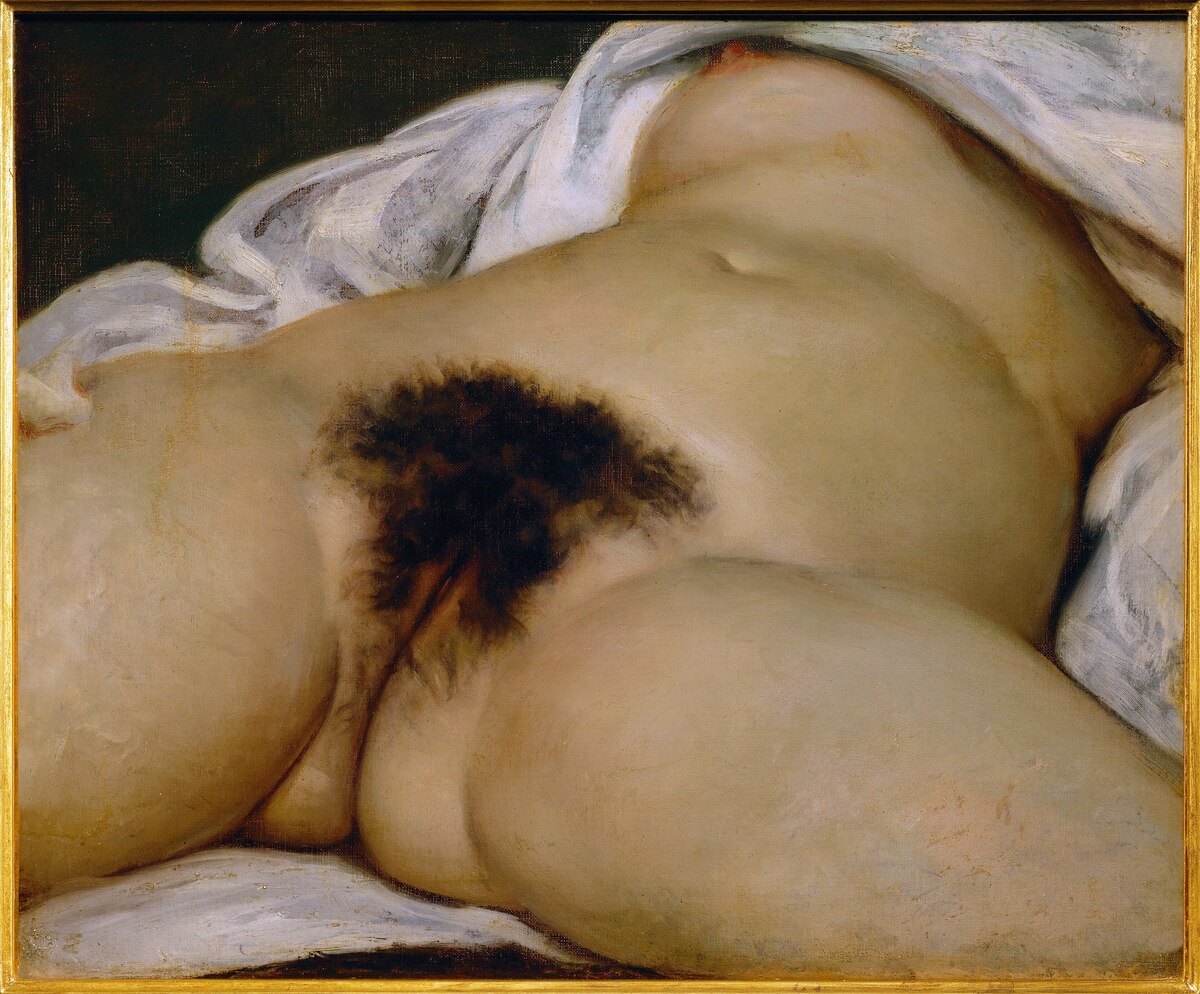
Gustave Courbet painted this in 1866, and it is titled L'Origine du monde, or The Origin of the World.
What it shows is a nude woman, a reclining naked figure. She is cropped so tightly that we see only her torso, from the breasts down to the upper thighs, with her genitals at the centre.
The picture is an oil on canvas, and it belongs to the Musée d'Orsay in Paris.
Notice how little of the body Courbet gives us. A breast and a leg are visible at the edges, but the head, the arms and the feet are all outside the frame.
The woman lies on a bed. White bed sheets run beneath and behind her, and the white of the linen presses close against the warmer tones of the skin.
Because there is no face, there is no expression to read. The whole painting becomes a study of the body itself, held still in a narrow band of space.
The supplied record describes the depicted elements plainly. It lists female pubic hair and a prominent vulva, a naked woman in a lying pose, a bed, a female breast and leg, a bed sheet, and the white colour that runs through the setting.
The genre is given as nude, and the object type simply as painting. That tells us how the work has been catalogued, as a nude, rather than what Courbet privately meant by it.
The title itself circulates in many languages in the record, from French and English to German, Russian, Japanese and Hebrew. The painting has travelled widely in name, even when it stayed in one collection.
The record lists the depicted person as Constance Quéniaux. It does not explain how that identification was reached, so it is worth keeping separate from what you can see in the painting itself.
The viewing history is better documented than the sitter. The painting appeared in an exhibition in Paris in 2007 and 2008, and in further Courbet shows in New York and Montpellier in 2008, in Paris in 2010, and at the Fondation Beyeler in 2014.
That exhibition record shows a work that was once kept out of ordinary view moving, over a century later, into public display.
So the painting does two things at once. It takes the body apart, removing the face and the limbs that usually tell us who a person is, and leaves the torso alone against white sheets.
And it gives that close view a title that reaches past the flesh to the beginning of the world. Whether that title is grand, ironic or simply puzzling is not settled by the supplied record, and the painting itself keeps its answer.
What we can say is what we see: a body, cropped, still, and named with an enormity that the small canvas never quite explains.