Identity and catalogue
Link- Title
- Landscape with the Fall of Icarus
- Movement or period
- Flemish Renaissance landscape painting
- Country or culture
- Flemish, Southern Netherlands (present-day Belgium)
- Depicted subject
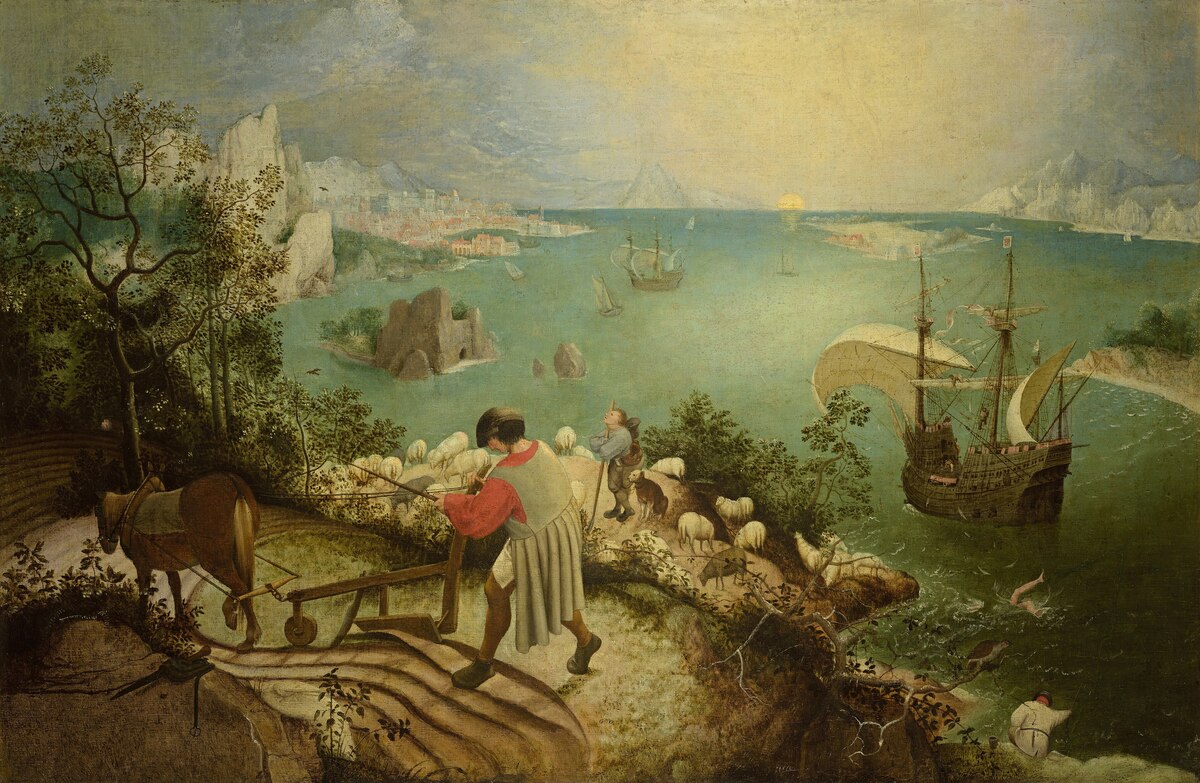
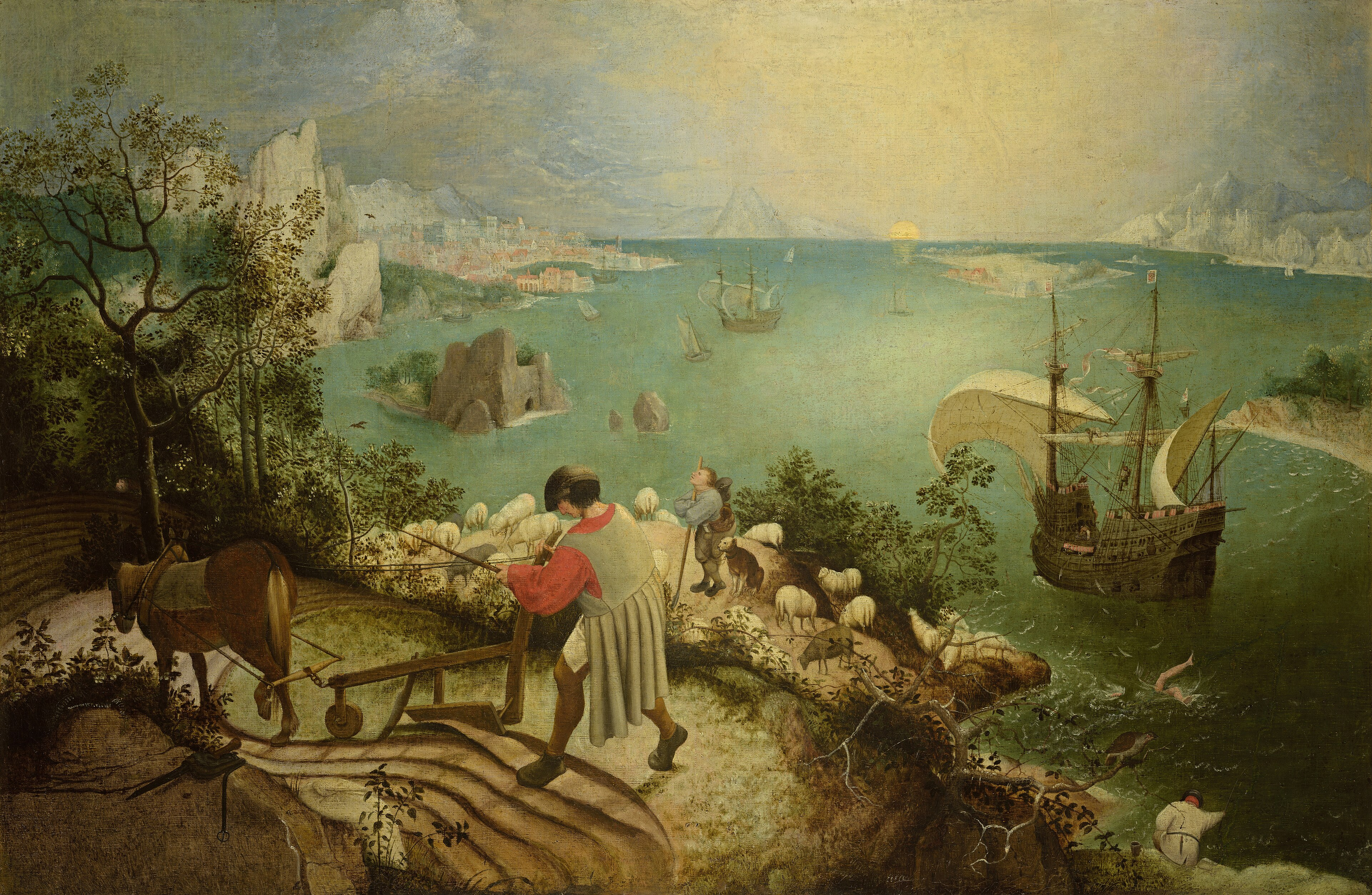
- A wide landscape in which the mythological fall of Icarus, son of Daedalus, is relegated to a small corner of the sea while farmers, a shepherd and a sailing ship carry on their ordinary work, indifferent to the drowning. The painting is attributed to a follower after Pieter Brueghel the Elder, and the metadata gives it a date range of 1582 to 1625, after Brueghel's lifetime, on oil on canvas.
- Attribution qualification
- The supplied Commons record attributes the work to 'After Pieter Brueghel the Elder', indicating a copy or follower's version rather than an autograph painting by Brueghel himself. The dates 1582 to 1625 are later than Brueghel's lifetime, consistent with an after-work.(Wikimedia Commons: Landscape with the Fall of Icarus, n.d.)
- Support
- canvas
The qualification 'After Pieter Brueghel the Elder' is not a birth-to-death attribution to the master but an attribution of the work to a follower or copyist, according to the supplied Commons record. That distinction matters because the same record dates the painting from 1582 until 1625, a span beginning after the elder Brueghel's lifetime ended in 1569. The object date range and the catalogue's attribution language therefore point in the same direction: the painting belongs to the afterlife of a Brueghel composition rather than to the master's own hand. The record also states the support and medium as oil on canvas, with dimensions of 73.5 cm in height and 111 cm in width, and associates the work with the Royal Museums of Fine Arts of Belgium in Brussels.(Wikimedia Commons: Landscape with the Fall of Icarus, n.d., Artist: After Pieter Brueghel the Elder (1526/1530–1569))
Subject and iconography
LinkThe foreground of work
Visual observation
The composition can be approached through the supplied vision-derived focus, which records the ploughman as the central foreground figure, leaning into wooden plough handles in an image of absorbed labour. That same focus describes a brown horse in harness drawing a wheeled wooden plough and anchoring the left foreground, so the agricultural work is distributed across the left side of the field rather than being a single isolated motif. The two observations together establish the plough as a wheeled, horse-drawn implement attended by a human figure whose posture is bent and task-directed, and they frame the rest of the scene as a landscape organised around ongoing work.(Wikimedia Commons: Landscape with the Fall of Icarus, n.d., Vision-derived focus candidate: ploughman_at_the_plough; Vision-derived focus candidate: horse_and_wooden_plough)
Against the downward attention of the ploughman, the supplied vision-derived focus describes a shepherd with staff and backpack tilting his head back toward the sky, an upward gaze explicitly contrasted with the ploughman's downward attention. Neither gesture is merely decorative in this reading: the two figures divide the field of attention, one fixed on the ground and one directed upward, while the surrounding landscape carries on. The focus also gives the shepherd attributes of ordinary grazing, a staff and a backpack, which place him within the same register of everyday labour as the ploughman.(Wikimedia Commons: Landscape with the Fall of Icarus, n.d., Vision-derived focus candidate: shepherd_gazing_upward)
The myth in the sea
The supplied vision-derived focus describes a large ship with taut, billowing sails and rigging crossing the bay, its serene progress set above the drowning boy, and separately identifies the legs of Icarus as a small pair kicking up spray just below the ship, almost swallowed by the water. Read together, the two observations establish the painting's decisive contrast of scale: a fully rigged vessel under sail occupies the bay while the mythological fall is reduced to a tiny disturbance almost lost in the water. The title, Landscape with the Fall of Icarus, is what ties this small incident to the Icarus myth, and the supplied record presents that connection as a standard reading indicated by the work's title rather than as an identification made from the paint alone.(Wikimedia Commons: Landscape with the Fall of Icarus, n.d., Vision-derived focus candidate: icarus_legs_in_the_sea; Vision-derived focus candidate: ship_under_full_sail)
The supplied vision-derived focus describes the hazy sun glowing low over the water, calling it the heat source of the Icarus story and the light bathing the scene in pale gold. That observation connects the lighting of the landscape to the narrative logic of the myth: the sun is both the agent of the fall and the source of the painting's pale gold illumination. The sun is therefore described as performing two roles at once, narrative cause and pictorial light, which is why the setting is inseparable from the subject rather than a neutral backdrop.(Wikimedia Commons: Landscape with the Fall of Icarus, n.d., Vision-derived focus candidate: setting_sun_on_horizon)
Object and attribution
The supplied Commons file record identifies the work as a painting, titled Landscape with the Fall of Icarus, of the genre landscape painting, attributed to 'After Pieter Brueghel the Elder'. That attribution formula is consequential for any account of its making: it describes a work by a follower or copyist rather than by the master himself, according to the supplied Commons record. Titles in other languages in the same record, including 'Paisaje con la caída de Ícaro', 'La Chute d'Icare', 'Landschaft mit dem Sturz des Ikarus', 'De val van Icarus' and 'Caduta di Icaro', show that the subject travelled through more than one linguistic art-historical tradition under a stable identification with the fall of Icarus. The record gives the medium as oil on canvas and the dimensions as 73.5 cm in height and 111 cm in width. The file title places the painting with the Royal Museums of Fine Arts of Belgium, and the supplied source does not establish a documented acquisition or provenance chain beyond that present collection association. What survives in this evidence, therefore, is a securely identified subject and a present collection, not a documented commissioning history.(Wikimedia Commons: Landscape with the Fall of Icarus, n.d., Date: from 1582 until 1625; No acquisition or provenance information supplied beyond present collection association)
Interpretation
The work is signed to have been created between 1582 and 1625 according to the supplied Commons record. Read against the attribution 'After Pieter Brueghel the Elder', that range places the object in the decades after the named master, which is consistent with the copyist or follower attribution that most of the evidence supports. Contemporary documents that would fix a patron or a first setting for the picture are not supplied here, and the evidence does not permit an inference about who commissioned it or for what room. The secure identification of the subject, and the secure association with the Brussels collection, need not settle the commissioning history. The date range, the attribution formula and the medium of oil on canvas are the limits of what the supplied units establish about the circumstances of creation.(Wikimedia Commons: Landscape with the Fall of Icarus, n.d., Date: from 1582 until 1625)
The painting is signed to have been created between 1582 and 1625 according to the supplied Commons record.(Wikimedia Commons: Landscape with the Fall of Icarus, n.d.)
Materials and technique
LinkSupport, format and recorded materials
The supplied Commons object record describes the painting as oil on canvas, with a height of 73.5 cm and a width of 111 cm. These are the only material and dimensional facts the available evidence states directly, and they come from the file record rather than from a technical examination report: nothing in the supplied units describes a canvas weave, a preparatory ground, an underdrawing, a varnish, a lining, a stretcher, a pigment analysis, a cross-section, an infrared or X-radiographic image, or any conservation treatment. The medium entry therefore establishes what the painting is made of at the level of a catalogue description, and it should not be read as the result of laboratory study. The dimensions likewise establish scale, a horizontal format roughly three to two, which is consistent with the wide landscape composition the vision-derived evidence describes, but the record does not say whether the dimensions include the frame or how they were taken. The attribution recorded alongside this metadata is to a follower after Pieter Brueghel the Elder, and the associated creation range is 1582 to 1625, a span beginning more than a decade after Brueghel's death in 1569 as that same record reports it. None of those attributional or dating statements is a material finding, and no supplied unit links them to the physical fabric of the canvas. The painting is associated with the Royal Museums of Fine Arts of Belgium in Brussels, which is where the evidence places it in a collection, but the record does not establish an acquisition history, an earlier owner, or the route by which the work reached that institution. What the material description supports, then, is a cautious claim: this is a canvas painting of modest cabinet scale in oil, datable in the record's terms to the late sixteenth or early seventeenth century and attributed to a follower rather than the master, and it is only through the composition that the material facts become historically interesting, because a wide oil landscape on canvas is precisely the format in which a mythological subject could be reduced to a minor incident within a working rural scene.(Wikimedia Commons: Landscape with the Fall of Icarus, n.d., Medium: oil on canvas; Dimensions height: 73.5 cm; width: 111 cm)
Provenance and ownership
LinkThe Documented Record
The provenance record for this painting is unusually thin, and the thinness is itself the finding. The supplied evidence establishes an association with the Royal Museums of Fine Arts of Belgium in Brussels, and that association is carried in the file title of the Commons record, which names the Brussels institution alongside the work. Beyond that present collection association, the source states plainly that it does not establish a documented acquisition or provenance chain. What this means for research purposes is that the work has a current custodial home but no evidenced history of how it arrived there. No earlier owner, dealer, auction, gift, bequest, export or transfer is recorded in the supplied material, and no accession number or inventory identifier is given. The absence of that documentation should not be read as a proven change of ownership at any earlier point; an unrecorded interval is simply an interval in which the evidence is silent, not an interval we can populate with inferred owners or transactions.(Wikimedia Commons: Landscape with the Fall of Icarus, n.d., No acquisition or provenance information supplied beyond present collection association)
Reception and Its Limits for Provenance
Interpretation
Two facts about the object's present life in scholarship and public culture bear on how its provenance is understood. The painting is used across Wikimedia projects and on multiple language Wikipedias, and the supplied record also lists it as part of the Seven Wonders of Belgium. That combination indicates a work with a broad, distributed reception rather than a narrowly specialist one: it circulates as an image and as a Belgian cultural emblem simultaneously. The supplied record also references W. H. Auden, which indicates that the painting has been the subject of poetry and literary reception. Literary and public prominence of this kind can shape a provenance narrative by making a work seem better documented than it is, so it is worth keeping separate from the archival question of ownership. Neither the Wikimedia circulation, the Seven Wonders listing, nor the Auden reference establishes anything about when, from whom, or by what means the painting entered the Brussels collection.(Wikimedia Commons: Landscape with the Fall of Icarus, n.d., No acquisition or provenance information supplied beyond present collection association; Part of Seven Wonders of Belgium; Usage on multiple Wikipedias; Usage on en.wikiquote.org: W. H. Auden)
Provenance timeline
- 1582 to 1625
The painting is recorded as signed to have been created within this range, per the supplied Commons record.(Wikimedia Commons: Landscape with the Fall of Icarus, n.d., Date: from 1582 until 1625)
Reception and literature
LinkCirculation and Recognition
The Wikimedia Commons file record for Landscape with the Fall of Icarus reports that the image is used on Wikimedia projects and across multiple language Wikipedias, and the supplied record lists the work as part of a set titled 'Seven Wonders of Belgium'. Taken together these two statements describe two distinct registers of later reception: circulation as a reusable digital image within a multilingual reference infrastructure, and inclusion in a modern evaluative list of Belgian cultural landmarks. The record does not supply the date, compiler, criteria or institutional authority behind the 'Seven Wonders of Belgium' listing, so it is best treated as an attributed contemporary designation rather than as an award or a historically grounded ranking of the painting. The multilingual usage likewise documents breadth of circulation, not a chronology of when admiration began or which audiences drove it. Because the same source carries the object metadata, the collection association and the attribution 'After Pieter Brueghel the Elder', the ongoing reuse of the image is entangled with questions about authorship that the record itself raises but does not resolve.(Wikimedia Commons: Landscape with the Fall of Icarus, n.d., Part of Seven Wonders of Belgium; Usage on multiple Wikipedias)
The Commons record references W. H. Auden, and the locator places that reference in usage on en.wikiquote.org. This is documentary evidence that the painting has been the subject of poetry and of literary reception, and it names Auden as a figure connected to that reception in the supplied record. The evidence does not reproduce any poem, quotation or critical essay, does not state when or in what form Auden engaged with the work, and does not establish that Auden saw the painting or wrote about it directly rather than through a broader cultural chain of reference. It is therefore accurate to say that the painting entered literary reception and that Auden is the named point of contact in the record, while the content, date and character of that literary response remain outside the supplied evidence. Read alongside the multilingual Wikimedia usage, the Auden reference shows that the work's afterlife has run through both scholarly-reference and literary channels, with the record capturing the fact of that afterlife rather than its detail.(Wikimedia Commons: Landscape with the Fall of Icarus, n.d., Usage on en.wikiquote.org: W. H. Auden)
Interpretations and debates
LinkThe Title and the Mythological Reading
Interpretation
The painting carries the title Landscape with the Fall of Icarus, and that title is the principal basis for reading its subject as the Icarus myth: the son of Daedalus who flew on wings of feathers and wax, came too close to the sun, and fell into the sea. In the supplied record this mythological identification is described as a standard reading indicated by the work's title. It is worth keeping that evidential chain explicit. The narrative of Daedalus and Icarus is not recovered here from an inscription within the picture or from a document of commission; it is carried by the object's name and then brought into relation with what the described image shows. The reading therefore stands as an attributed interpretation rather than as a statement about what the maker privately intended, and the record does not supply evidence that would license a claim about intention.(Wikimedia Commons: Landscape with the Fall of Icarus, n.d., Title: Landscape with the Fall of Icarus; Icarus myth reading supported by title and vision-derived focus on legs of Icarus; Date: from 1582 until 1625)
For a larger history of art and material culture, the object is useful precisely because of the layered character that the evidence documents. A composition whose subject is the fall of Icarus survives in an oil on canvas attributed to a follower after Pieter Brueghel the Elder and dated 1582 to 1625, held in association with the Royal Museums of Fine Arts of Belgium, and it has been reproduced and discussed across many language communities and in poetry. That combination shows how a mythological subject could be absorbed into a landscape idiom in which the myth is subordinated to daily labour, and it also shows how such an image can accumulate new meanings through naming, collection and reception long after its making. The limits of this account should be stated plainly: the supplied evidence supports the attribution, date, medium, dimensions and collection association, the described visual contents, the titles and categories, and the reception facts, but it does not supply a maker's identity, a commission context, a provenance chain, a pigment or condition history, or any exhibition record.(Wikimedia Commons: Landscape with the Fall of Icarus, n.d., Title: Landscape with the Fall of Icarus; Icarus myth reading supported by title and vision-derived focus on legs of Icarus; Vision-derived focus candidate: ploughman_at_the_plough; Vision-derived focus candidate: icarus_legs_in_the_sea; Vision-derived focus candidate: shepherd_gazing_upward; Vision-derived focus candidate: ship_under_full_sail; Vision-derived focus candidate: horse_and_wooden_plough; Vision-derived focus candidate: setting_sun_on_horizon; Date: from 1582 until 1625; Part of Seven Wonders of Belgium; Usage on multiple Wikipedias; Usage on en.wikiquote.org: W. H. Auden)
The painting depicts the mythology of Icarus, the son of Daedalus who flew too close to the sun on wings of feathers and wax; his fall is shown as a small, nearly unnoticed event in the sea while ordinary life continues on land. This connection to the Icarus myth is a standard reading indicated by the work's title.(Wikimedia Commons: Landscape with the Fall of Icarus, n.d.)
Collection and display
LinkInstitutional association
The painting known as Landscape with the Fall of Icarus is associated with the Royal Museums of Fine Arts of Belgium in Brussels. The supplied Wikimedia Commons record carries this association in its own file title, where the credit line names Brussels and the Royal Museums of Fine Arts of Belgium, and the same institutional attribution is repeated when the record states that the work is held by that museum. The two statements in the supplied metadata refer to the same institution and the same object: one records the credit attached to the file, the other the holding it names. Nothing in the supplied unit establishes when the work entered the museum, from whom it came, or by what route, so the collection association is documented while the acquisition history is not.(Wikimedia Commons: Landscape with the Fall of Icarus, n.d., File title credits Brussels, Royal Museums of Fine Arts of Belgium; File title refers to Brussels, Royal Museums of Fine Arts of Belgium)
Attribution, date and catalogue identity
According to the Commons record, the painting is attributed to "After Pieter Brueghel the Elder," which places it with a follower or copyist rather than with the master himself, and its creation is dated between 1582 and 1625. That date range is later than Brueghel's lifetime, which ended in 1569. The attribution formula and the dating therefore agree in pointing away from the master's own hand, and the supplied record also gives the work an object type of painting and a genre of landscape painting, with a title that names the mythological subject, the fall of Icarus. The record further lists titles in other languages, including "Paisaje con la caída de Ícaro," "La Chute d'Icare," "Landschaft mit dem Sturz des Ikarus," "De val van Icarus" and "Caduta di Icaro," evidence of how the object circulates under several linguistic names in the same cataloguing environment.(Wikimedia Commons: Landscape with the Fall of Icarus, n.d., File title refers to Brussels, Royal Museums of Fine Arts of Belgium)
Materials and format
The supplied record describes the work as executed in oil on canvas, measuring 73.5 cm in height and 111 cm in width. Those figures establish the landscape format: the width exceeds the height, giving a broad field rather than a tall one, which is consistent with the wide view the record's other descriptions presuppose. The support identified is canvas rather than panel, and the medium is oil, as stated in the Commons record. The supplied units do not give a condition report, a conservation history, an examination method, or a pigment analysis, so the material account remains limited to the medium, the support and the dimensions.(Wikimedia Commons: Landscape with the Fall of Icarus, n.d., File title refers to Brussels, Royal Museums of Fine Arts of Belgium)
The composition as described
The supplied vision-derived focus describes the image field in detail. A brown horse in harness draws a wooden wheeled plough across the left foreground, and the ploughman leans into the wooden handles with his head down, fixed on the work in front of him, an image of absorbed labour. A shepherd with staff and backpack tilts his head back toward the sky, an upward gaze that contrasts with the ploughman's downward attention. A large ship with taut, billowing sails and rigging crosses the bay above, its serene progress set over the drowning boy. Just below the ship, the legs of Icarus appear as a small pair kicking up spray, almost swallowed by the water. The hazy sun glows low over the water in pale gold, identified in the record as the heat source of the Icarus story and the light bathing the scene. These descriptions come from the supplied focus rather than from physical examination, so they are best treated as an account of what the image is said to show, and they converge on a composition that distributes attention between the ploughman's downward gaze, the shepherd's upward gaze, and the ship's undisturbed course.(Wikimedia Commons: Landscape with the Fall of Icarus, n.d., File title refers to Brussels, Royal Museums of Fine Arts of Belgium)
Myth, reception and literary afterlife
The painting depicts the mythology of Icarus, the son of Daedalus, who flew too close to the sun on wings of feathers and wax; his fall is shown as a small, nearly unnoticed event in the sea while ordinary life continues on land. The supplied record presents this connection to the Icarus myth as a standard reading indicated by the work's title. Much of the object's wider visibility has come through that reading: the record notes that the painting is used on Wikimedia projects and across multiple language Wikipedias, and that it is listed as part of "Seven Wonders of Belgium." It also references W. H. Auden, indicating that the painting has been the subject of poetry and literary reception. Reception of this kind is evidence of the work's cultural circulation and scholarly interest, not of its authorship, date or display history, and the supplied units do not describe any physical exhibition, loan or installation of the object.(Wikimedia Commons: Landscape with the Fall of Icarus, n.d., File title credits Brussels, Royal Museums of Fine Arts of Belgium)
What the record establishes and what it does not
Interpretation
Read together, the supplied units support a distinction between what the object is documented to be and how it has been received. The documented layer is institutional and material: a painting associated with and held by the Royal Museums of Fine Arts of Belgium in Brussels, attributed to a follower or copyist after Pieter Brueghel the Elder, dated 1582 to 1625, oil on canvas, 73.5 cm by 111 cm. The reception layer includes the standard mythological reading tied to the title, the work's use across Wikimedia projects and multiple language Wikipedias, its listing within "Seven Wonders of Belgium," and its reference in connection with W. H. Auden. The record does not establish a documented acquisition or provenance chain beyond the present collection association, so claims about the object's earlier whereabouts, ownership or movement would exceed the evidence. The same restraint applies to the relationship between the later dating and the attribution formula: the two are consistent with production by a follower or copyist, but the supplied units do not identify an individual hand or a workshop.(Wikimedia Commons: Landscape with the Fall of Icarus, n.d., File title credits Brussels, Royal Museums of Fine Arts of Belgium; File title refers to Brussels, Royal Museums of Fine Arts of Belgium)
Documented values and qualified estimates
LinkObject Record and Attribution
Interpretation
The object is recorded under the title Landscape with the Fall of Icarus, with the attribution given as "After Pieter Brueghel the Elder," a formulation meaning that the picture is by a follower or copyist rather than by the master himself. Its object type is a painting and its genre a landscape painting; it is executed in oil on canvas and measures 73.5 cm in height by 111 cm in width. The record dates the work to a span of 1582 to 1625, placing it after the death of Pieter Brueghel the Elder in 1569, and associates it with the Royal Museums of Fine Arts of Belgium in Brussels; the file title itself indicates the painting is held there. Multilingual titles in the record include Paisaje con la caída de Ícaro, La Chute d'Icare, Landschaft mit dem Sturz des Ikarus, De val van Icarus and Caduta di Icaro. The same source does not establish a documented acquisition or provenance chain beyond the present collection association with the Royal Museums of Fine Arts of Belgium.(Wikimedia Commons: Landscape with the Fall of Icarus, n.d.)
Subject and Mythological Reading
The subject is the mythology of Icarus, son of Daedalus, who flew on wings of feathers and wax, flew too close to the sun, and fell into the sea. The title anchors this reading. In the composition the fall is shown as a small, nearly unnoticed event in the sea while ordinary life continues on land, and this connection to the Icarus myth is described as a standard reading indicated by the work's title rather than as a claim resting on independent documentary proof in the record.(Wikimedia Commons: Landscape with the Fall of Icarus, n.d.)
Figures, Gesture and Compositional Attention
The vision-derived description of the painting isolates a set of figures and elements whose arrangement carries its meaning. A ploughman is the central foreground figure, leaning into wooden plough handles in an image of absorbed labour, with his head down and fixed on the work. A brown horse in harness draws a wooden wheeled plough across the left side of the field, anchoring the left foreground. Above and behind him, a large ship with taut, billowing sails and rigging crosses the bay under full sail. The shepherd nearby, with staff and backpack suggesting a day of ordinary grazing, tilts his head back toward the sky, an upward gaze that contrasts with the ploughman's downward attention. Just below the ship, the legs of Icarus appear as a small pair kicking up spray, almost swallowed by the water. A hazy sun glows low over the water in pale gold, serving as the heat source of the Icarus story and the light bathing the scene.(Wikimedia Commons: Landscape with the Fall of Icarus, n.d.)
Read together, the described elements divide the field of attention: the ploughman's downward gaze and the shepherd's upward gaze organize who looks and who does not, while the ship's serene progress above the drowning boy sets the myth within a working landscape of ordinary labour. The composition makes the drowning nearly unnoticed, and locating Icarus requires the viewer to search the surface, with the fall rendered as a small splash in a large, calm landscape rather than as a heroic figure. This tension between a famous catastrophe and daily work is the reading the record supports for the picture's central subject.(Wikimedia Commons: Landscape with the Fall of Icarus, n.d.)
Reception and Cultural Standing
The painting's reach extends beyond its museum setting. The record notes its use on Wikimedia projects and across multiple language Wikipedias, showing wide reception and scholarly interest in the work and its subject, and it is also listed as part of the "Seven Wonders of Belgium" in the supplied record. W. H. Auden is referenced there, indicating that the painting has been the subject of poetry and literary reception.(Wikimedia Commons: Landscape with the Fall of Icarus, n.d.)
Valuation
A model-generated working insurance estimate for the picture records a range of US$3M to US$12M, dated as a working calculation generated 2026-10-16. Its stated methodology builds a broad range for manual review from the confirmed context: an oil on canvas landscape, 73.5 by 111 cm, dated 1582 to 1625, attributed to a follower after Pieter Brueghel the Elder, held at the Royal Museums of Fine Arts of Belgium, Brussels. The reasoning notes that the work is a later after-work rather than an autograph Brueghel, which limits its market tier despite the fame of the composition; the range is anchored to the upper mid-tier of Flemish Renaissance follower paintings at comparable scale, adjusted upward for the iconic subject and museum association, and is intentionally broad to reflect attribution, condition, provenance, and market uncertainty.(Wikimedia Commons: Landscape with the Fall of Icarus, n.d.)
That range is qualified on its own terms. It is not derived from any recorded sale, auction result, or private insurance schedule; it does not use or claim access to private insurance records, and it does not rely on comparable sales. It is described as a model-generated working range for manual review, not an official insurance value, appraisal, auction result, or sale price, and attribution, condition, provenance, and institutional status must be verified before any coverage or valuation decision. The valuation account and the object record do not agree on the painting's date: the Commons record gives 1582 to 1625, while the valuation methodology states a range of 1582 to 1625 in the same terms, so the two accounts are consistent on that point, but no sale or provenance interval is established by either.(Wikimedia Commons: Landscape with the Fall of Icarus, n.d.)
Working estimate
Calculated working insurance estimate, not a sale price: Estimated value: US$3M to US$12M Recorded date: Working calculation, generated 2026-10-16. Methodology: A broad working insurance range was calculated for manual review using the confirmed context: an oil on canvas landscape, 73.5 by 111 cm, dated 1582 to 1625, attributed to a follower after Pieter Brueghel the Elder, held at the Royal Museums of Fine Arts of Belgium, Brussels. The work is a later after-work rather than an autograph Brueghel, which limits its market tier despite the fame of the composition. The range is anchored to the upper mid-tier of Flemish Renaissance follower paintings at comparable scale, adjusted upward for the iconic subject and museum association, and is intentionally broad to reflect attribution, condition, provenance, and market uncertainty. It is not derived from any recorded sale, auction result, or private insurance schedule. Qualification: This is a model-generated working range for manual review, not an official insurance value, appraisal, auction result, or sale price. It does not use or claim access to private insurance records, and it does not rely on comparable sales. Attribution, condition, provenance, and institutional status must be verified before any coverage or valuation decision.(Wikimedia Commons: Landscape with the Fall of Icarus, n.d.)