Identity and catalogue
Link- Title
- The Sampling Officials of the Amsterdam Drapers' Guild, Known as 'The Syndics'(Rijksmuseum, n.d.b)
- Artist or attribution
- Rembrandt van Rijn
- Object date
- 1662
- Dimensions
- height 191.5 cm x width 279 cm
- Current collection or location
- Rijksmuseum, Amsterdam, on loan from the City of Amsterdam
- Movement or period
- Dutch Golden Age
- Country or culture
- Dutch
- Depicted subject
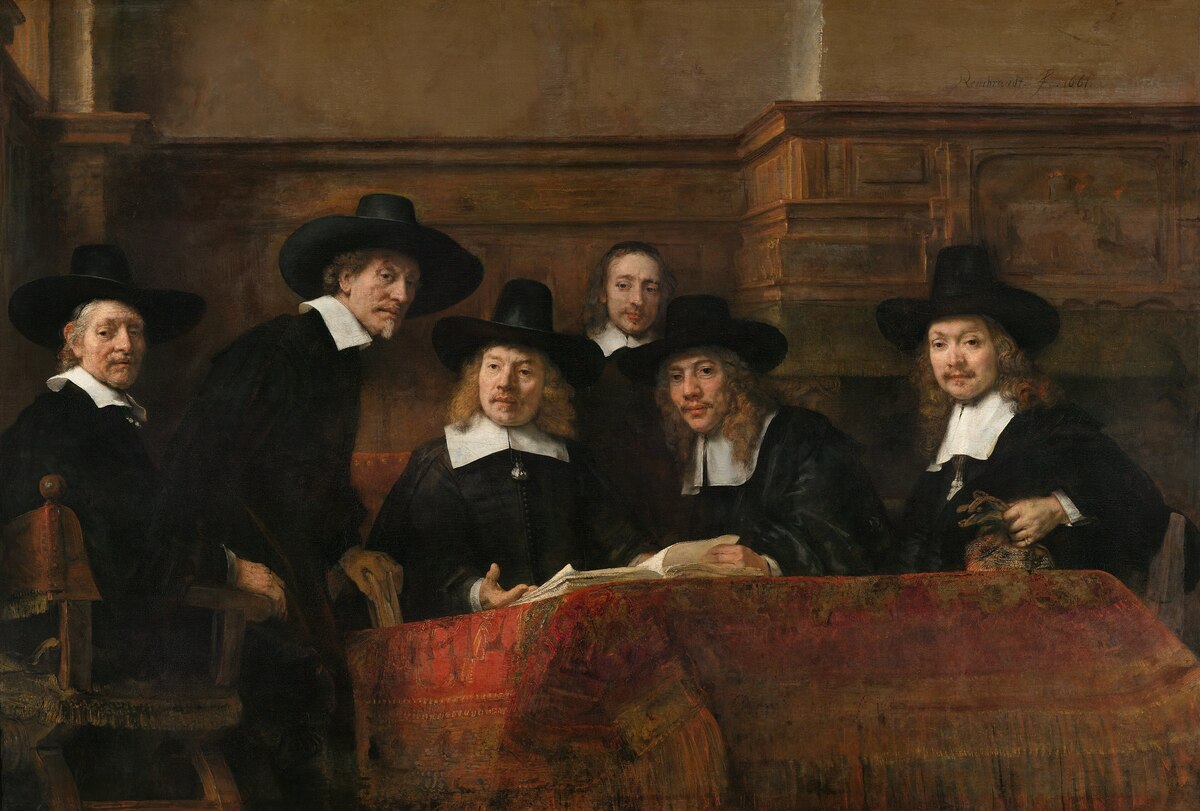
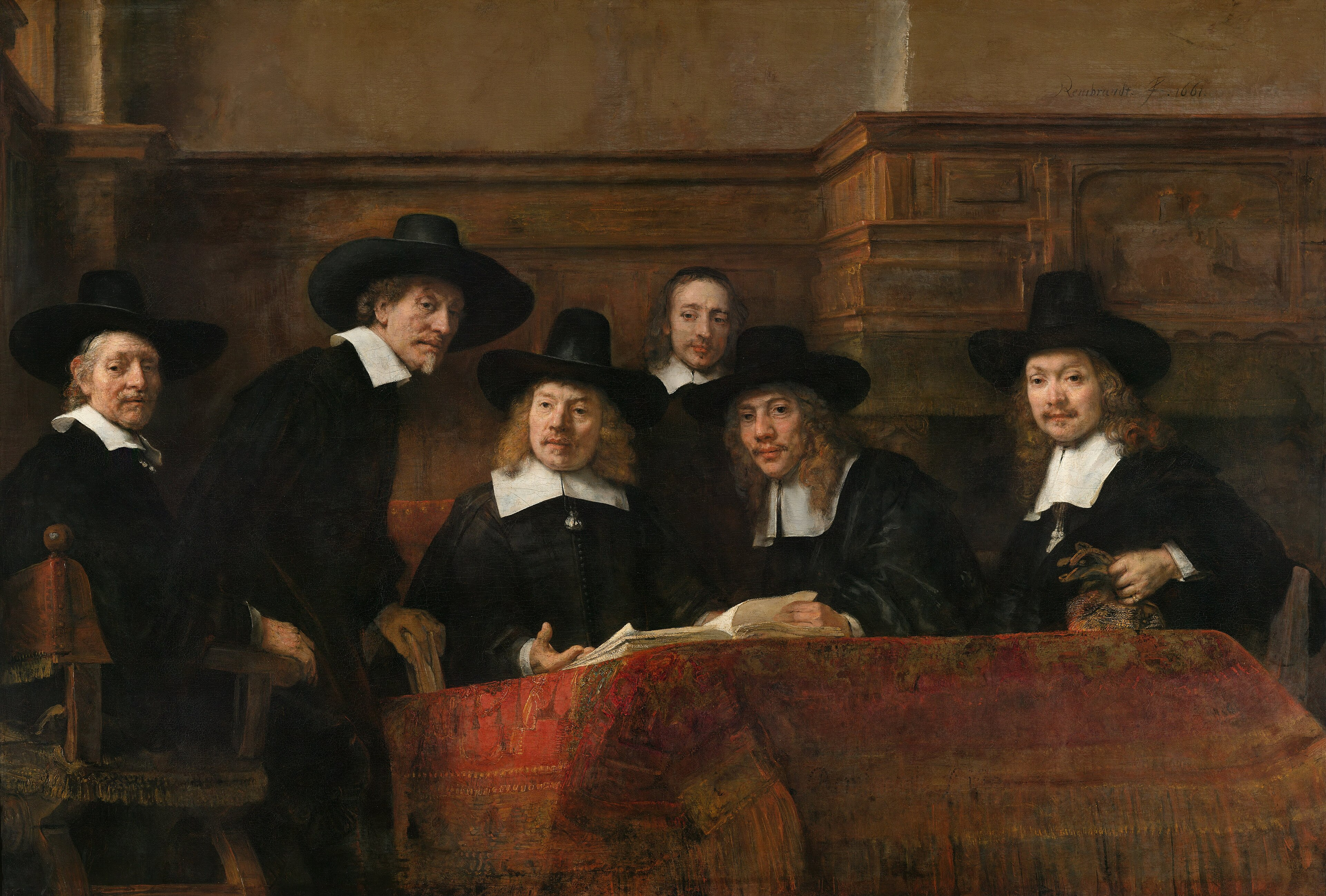
- Six men of the Amsterdam drapers' guild, five sampling officials and one servant, gathered around a table covered with a Persian carpet, with an open sample book on the table; they look up from their work as if interrupted.(Rijksmuseum, n.d.b)
- Title variants
- The Syndics; The Sampling Officials of the Amsterdam Drapers' Guild; De staalmeesters; The syndics: the sampling officials (wardens) of the Amsterdam drapers (former title)
- Support
- canvas
- Inscriptions
- signature and date: 'Rembrandt f. 1662'; signature and date (false): 'Rembrandt. f. 1661.'(Rijksmuseum, n.d.b)
Catalogue identity
The Rijksmuseum records the painting as 'The Sampling Officials of the Amsterdam Drapers' Guild, known as The Syndics', painted by Rembrandt van Rijn in 1662. The object is an oil painting on canvas measuring 191.5 cm high by 279 cm wide, and its record carries the accession number SK-C-6, listed as on loan from the City of Amsterdam. Wikimedia Commons hosts a reproduction of the same work under a variant English title, 'The Syndics of the Amsterdam Drapers' Guild, known as the Sampling Officials', attributed to Rembrandt and released under a public domain license. The two titles therefore distribute the emphasis differently: the museum record leads with the functional office ('Sampling Officials') and appends the familiar nickname ('The Syndics', from the Dutch term for these officials), while the Commons file title inverts the order, placing the nickname first. The variant is a naming convention rather than a disagreement about the work, and the Commons page functions as a discovery aid carrying the Google Arts and Culture reproduction rather than as an institutional authority that could override the museum record.(Rijksmuseum, n.d.b, Identification, Title(s); Creation)(Wikimedia Commons, n.d., File title; Description; Credit; License)
The Rijksmuseum's creation date of 1662 for the painting is distinct from the dates attached to its documentation and to other events in its record. The object itself carries a signature and date reading 'Rembrandt f. 1662', while a second, false signature and date reading 'Rembrandt. f. 1661.' also appears on the canvas; the museum record distinguishes the authentic inscription from the false one rather than treating the two dates as competing proposals for the year of execution. Separately, museum documentation lists I.H. van Eeghen, 'De Staalmeesters', Jaarboek Amstelodamum 1956, pp. 65-80; J.G. van Gelder, 'De Staalmeesters', Openbaar Kunstbezit (1964), p. 11a/b; and a 2009 article by R. Bergmans, 'Rembrandts kijk op De Staalmeesters', which concerns the perspective of the painting. Those are dates of publication and of scholarly attention, not dates of making, and they should not be conflated with the 1662 creation date or with either inscription date on the canvas.(Rijksmuseum, n.d.b, Identification, Title(s); Creation; Inscriptions / marks)
The sitters and the commission
The painting shows the sampling officials, or wardens, of the Amsterdam drapers' guild gathered around a table on which lies a Persian carpet, with an open sample book on the table. The figures represented, from left to right, are Jacob van Loon (1595-1674), Volckert Jansz (1605/10-81), Willem van Doeyenburg (ca. 1616-87), the servant Frans Hendricksz Bel (1629-1701), Aernout van der Mye (ca. 1625-81) and Jochem de Neve (1629-81). Five of the six are wardens; Bel, listed fourth in the sequence, is the servant, the one figure who does not belong to the governing board, and his position inside the left-to-right order shows that the group's composition does not simply segregate officeholders from staff. The work was commissioned by the sitters themselves for the hall of the Drapers' Guild, the Staalhof on the Staalstraat in Amsterdam, so the painting was made for the room in which the men conducted the business it depicts.(Rijksmuseum, n.d.b, Description; Provenance; Summary)
Interpretation and viewing position
Interpretation
The Rijksmuseum states that Rembrandt produced a lively scene by having the wardens look up from their work as if interrupted by our arrival. The museum includes the painting in a short story titled 'How did Rembrandt create the dynamics in this group portrait?', which indicates that it is presented as an example of group portrait dynamics. The reading depends on elements the record also describes: the open sample book and the covered table make legible what the men were doing before they turned, and the interruption is what converts a board's formal record into a moment of shared attention. This is an attributed institutional interpretation of the painting's action, not a documented account of Rembrandt's intention, and it should be weighed as the museum's reading of how the picture works.(Rijksmuseum, n.d.b, Identification, Title(s); Creation; Summary)
Scholarly attention to how the picture is seen from a particular standpoint is documented in the museum's own list of references. The 2009 article by R. Bergmans, 'Rembrandts kijk op De Staalmeesters', concerns the perspective of the painting, which shows that the viewpoint has been examined closely as a subject in its own right. The museum's related documentation also includes Van Eeghen's 1956 study of the staalmeesters and Van Gelder's 1964 essay, so the painting has sustained a literature that treats it as a group portrait with an internal dynamic rather than only as a record of named men. The presence of a perspective study alongside archival and art-historical studies indicates that the picture's spatial construction and its documentary context have been pursued as separate but connected lines of inquiry; the evidence does not establish what conclusions Bergmans drew, only the subject of his article.(Rijksmuseum, n.d.b, Identification, Title(s); Creation)
Setting, objects and later history
Above the hearth at the right of the composition is a painting with a burning beacon. It is part of the furnished interior rather than an attribute of any sitter, and the record presents it as belonging to the room the guild occupied. Its placement is consistent with the painting's original function: the work hung in the Staalhof on the Staalstraat, the hall of the Drapers' Guild, where the wardens conducted their business. The object therefore records not only the men but the setting in which they were to be seen, and the beacon is the element through which the picture acknowledges that setting as a real, furnished room. Because the evidence does not identify the painting-within-the-painting further, no author, subject or date should be supplied for it.(Rijksmuseum, n.d.b, Identification, Title(s); Creation; Provenance)
The painting did not remain in the guild hall. According to a label formerly on the reverse, and as cited by Van Eeghen in 1957, it was transferred to the 'Konstkamer' in the Town Hall, Amsterdam, on 27 November 1771. That date and that destination rest on a label that is no longer present on the object and on a later scholar's citation of it, so the transfer is documented through a reported inscription rather than through direct inspection of the label. Since 15 August 1808 the painting has been on loan from the City of Amsterdam to the museum, which is why the object record lists it as a loan from the City rather than as an outright museum holding. The movement from guild hall to Town Hall to long-term loan traces the work's change of institutional owner and setting, and it also explains the split between the object's historical commissioning body and the present-day collection record.(Rijksmuseum, n.d.b, Provenance; Identification, Title(s); Creation)
The painting is 'The Sampling Officials of the Amsterdam Drapers' Guild, known as The Syndics', painted by Rembrandt van Rijn in 1662.(Rijksmuseum, n.d.b)
The figures represented, from left to right, are Jacob van Loon (1595-1674), Volckert Jansz (1605/10-81), Willem van Doeyenburg (ca. 1616-87), the servant Frans Hendricksz Bel (1629-1701), Aernout van der Mye (ca. 1625-81) and Jochem de Neve (1629-81).(Rijksmuseum, n.d.b)
Wikimedia Commons lists the file under the title 'The Syndics of the Amsterdam Drapers' Guild, known as the Sampling Officials', attributed to Rembrandt, with a public domain license.(Wikimedia Commons, n.d.)
The painting carries a signature and date reading 'Rembrandt f. 1662' and a false signature and date reading 'Rembrandt. f. 1661.'(Rijksmuseum, n.d.b)
Subject and iconography
LinkComposition and the Working Table
Visual observation
The painting now known as The Sampling Officials of the Amsterdam Drapers' Guild, commonly called The Syndics, is an oil on canvas by Rembrandt van Rijn dated 1662, measuring 191.5 cm high by 279 cm wide and carrying the accession number SK-C-6 in the Rijksmuseum, where it is held on loan from the City of Amsterdam. The composition shows the sampling officials, or wardens, of the Amsterdam drapers' guild gathered around a table; a Persian carpet lies on that table and an open sample book rests upon it. These are the basic conditions of the image and of the object itself, and they already establish the genre: a corporate group portrait set in the working environment of a governing board, in which the tools of inspection rather than any dramatic action occupy the foreground.(Rijksmuseum, n.d.b, Description; Dimensions; Physical characteristics)
The sitters are identified in the museum record from left to right as Jacob van Loon (1595-1674), Volckert Jansz (1605/10-81), Willem van Doeyenburg (ca. 1616-87), the servant Frans Hendricksz Bel (1629-1701), Aernout van der Mye (ca. 1625-81) and Jochem de Neve (1629-81). Because Bel is described as the servant, his placement among the seated officials is significant for how the group is read: he is the one figure who does not belong to the governing board, and the identification of the other five by name anchors the image in a documented institutional body rather than an anonymous gathering. The naming of individuals is itself part of the painting's function, since a guild portrait records the specific men who held office at a given moment.(Rijksmuseum, n.d.b, Description)
The Rijksmuseum states that Rembrandt produced a lively scene by having the wardens look up from their work as if interrupted by our arrival. That reading connects the visible furniture and objects to a narrative of momentary attention: the open sample book and the carpet make legible what the men were doing just before they turned, so that the furnishings are not merely decorative but supply the pretext for the interruption. The museum's account thus treats the painting as a group portrait whose drama arises from a shared act of looking up rather than from grand gesture, and the museum presents the work in a short story titled "How did Rembrandt create the dynamics in this group portrait?," indicating that it is held up as an example of group portrait dynamics.(Rijksmuseum, n.d.b, Description; Stories)
The Furnished Interior
Above the hearth at the right of the composition is a painting with a burning beacon. This small picture-within-a-picture belongs to the representation of the room rather than to the action of the wardens, and it is easily overlooked beside the large foreground figures. Its presence indicates that the scene is furnished as a real interior with objects the guild would have owned, and it adds a second register of imagery to a canvas whose primary subject is the inspection of cloth. The recorded detail is an observation about what is depicted; any further meaning assigned to the beacon would require evidence beyond the object record.(Rijksmuseum, n.d.b, Description)
The painting was commissioned by the sitters for the hall of the Drapers' Guild, the Staalhof on the Staalstraat in Amsterdam. This documented purpose explains the relationship between the visible objects and the setting: the table, carpet and sample book represent the equipment of the wardens' own business, and the portrait was made to hang where those wardens conducted that business. After financial difficulties in the 1650s, Rembrandt had moved to a rental house on the Rozengracht, and the Amsterdam elite no longer knocked on his door as often as before; nevertheless he remained popular, and this important guild commissioned him to paint a group portrait. The commission therefore belongs to a later phase of Rembrandt's career in which civic institutions still entrusted him with a major corporate image, and the painting's original location ties its imagery directly to the institutional space it was made to occupy.(Rijksmuseum, n.d.b, Description; Summary)
Inscriptions and Technical Study
The canvas carries a signature and date reading "Rembrandt f. 1662" and also a false signature and date reading "Rembrandt. f. 1661." The presence of both an authentic and a spurious inscription on the same work is a material fact of the object, and it introduces a discrepancy in the dating that the painting itself preserves. Nothing in the supplied evidence identifies who added the false inscription or when, so the anomaly should be recorded as an unresolved feature of the canvas rather than explained away.(Rijksmuseum, n.d.b, Description)
Interpretation
Taken together, the recorded composition, the identification of the individual wardens and servant, the guild hall commission and the documentation of the painting's later transfers describe an object whose visual evidence and institutional history are unusually well connected. What can be seen, the table with its carpet and open sample book, the six figures and the small painting of the burning beacon above the hearth, corresponds to the documented function of the image as a portrait of a working board made for the room in which that board worked. The Rijksmuseum's reading of the wardens as looking up from their tasks supplies one attributed interpretation of how the composition generates its effect, while the studies by Van Eeghen, Van Gelder and Bergmans show that both the archival history and the perspective of the painting have been examined independently. The painting matters within a larger history of art and material culture because it joins a documented civic commission to a specific corporate interior and to a later history of public display, allowing the surviving image to be studied alongside the institutional and scholarly record that surrounds it.(Rijksmuseum, n.d.b, Description)
Visual observation
The painting shows the sampling officials, or wardens, of the Amsterdam drapers' guild gathered around a table on which lies a Persian carpet, with an open sample book on the table.(Rijksmuseum, n.d.b)
Commission and Setting
The Rijksmuseum states that the painting was commissioned by the sitters for the hall of the Drapers' Guild (Staalhof), Staalstraat, Amsterdam, which establishes the setting for which the work was made and the corporate body that acted as patron. The commission is further contextualized by the museum's account that after suffering financial difficulties in the 1650s, Rembrandt moved to a rental house on the Rozengracht, and the Amsterdam elite no longer knocked on his door as often as before, yet Rembrandt nevertheless remained popular, and this important guild commissioned him to paint a group portrait. Placed together, these statements frame the commission as a civic institutional choice made despite the diminished frequency of elite private approaches to the artist, not as evidence of renewed personal patronage by individual grandees.(Rijksmuseum, n.d.b, Provenance; Summary)
After suffering financial difficulties in the 1650s, Rembrandt moved to a rental house on the Rozengracht, and the Amsterdam elite no longer knocked on his door as often as before.(Rijksmuseum, n.d.b)
Rembrandt nevertheless remained popular, and this important guild commissioned him to paint a group portrait.(Rijksmuseum, n.d.b)
Materials and technique
LinkSupport, medium and format
Visual observation
The painting known as The Sampling Officials of the Amsterdam Drapers' Guild, or The Syndics, is an oil painting on canvas by Rembrandt van Rijn, dated 1662, measuring 191.5 cm high by 279 cm wide. The museum record carries the accession number SK-C-6 and lists the work as on loan from the City of Amsterdam. This combination of medium, support and unusually large horizontal format establishes the physical terms within which every question of preparation, layering and finish must be posed: a monumental canvas, not a panel, designed for a specific civic interior rather than for a collector's cabinet.(Rijksmuseum, n.d.b, Dimensions; Physical characteristics; Description)
Inscriptions on the canvas
The canvas carries a signature and date reading "Rembrandt f. 1662" and also a false signature and date reading "Rembrandt. f. 1661." The co-presence of a genuine and a spurious inscription on the same support is a material fact about the object as it survives, and it separates the question of what Rembrandt painted from the later history of what was written on the canvas. The record does not state when the false inscription was added or by whom, and the account should not supply that missing interval.(Rijksmuseum, n.d.b, Dimensions; Physical characteristics)
Interpretation
Because the work is on canvas in oil, the evidence for its making is largely the record of its medium and its inscription rather than a published technical analysis. The supplied evidence does not report ground layers, pigments, canvas weave, lining, stretcher, varnish or treatment history, and none should be inferred from the appearance of the reproduced image. What can be established is the support, the medium, the dimensions, the dual inscriptions and the size of the picture, all of which condition how paint was applied and how the surface has since aged.(Rijksmuseum, n.d.b, Dimensions; Physical characteristics)
The making of the picture: commission and setting
The Rijksmuseum documents the commission as coming from the sitters for the hall of the Drapers' Guild, the Staalhof on the Staalstraat in Amsterdam, and identifies the six figures from left to right as Jacob van Loon (1595-1674), Volckert Jansz (1605/10-81), Willem van Doeyenburg (ca. 1616-87), the servant Frans Hendricksz Bel (1629-1701), Aernout van der Mye (ca. 1625-81) and Jochem de Neve (1629-81). This is the functional brief behind the physical object: a large canvas made for a working guild hall, with named sitters rather than invented figures, and with one man, Bel, standing outside the governing board.(Rijksmuseum, n.d.b, Dimensions; Physical characteristics)
The museum's account of Rembrandt's circumstances in 1662 is part of the documented context of the commission. After financial difficulties in the 1650s he moved to a rental house on the Rozengracht, and the Amsterdam elite no longer knocked on his door as often as before, yet he remained popular and this important guild commissioned him to paint a group portrait. The evidence therefore establishes a documented civic commission in a period of professional difficulty, not an unbroken record of fashionable patronage.(Rijksmuseum, n.d.b, Dimensions; Physical characteristics)
Visual observation
The Rijksmuseum states that Rembrandt produced a lively scene by having the wardens look up from their work as if interrupted by our arrival, and the museum presents the painting as an example of group portrait dynamics. This is an attributed institutional reading of the design, and it is a reading about composition and pose rather than about pigment or handling. The open sample book and the carpet are what make that interruption legible: the viewer sees what the men were doing before they turned, and the depicted task is the guild's own business of sampling cloth.(Rijksmuseum, n.d.b, Dimensions; Physical characteristics; Description)
Scholarship on construction and viewpoint
A 2009 article by R. Bergmans, "Rembrandts kijk op De Staalmeesters", is listed in the museum documentation and concerns the perspective of the painting. Its presence in the record shows that the viewpoint and spatial construction of the canvas have drawn sustained scholarly attention, alongside the earlier literature the museum cites by I.H. van Eeghen on the sitters and the painting's history and by J.G. van Gelder. These are documentary and interpretive studies listed by the institution; they do not in themselves supply technical findings about materials.(Rijksmuseum, n.d.b, Dimensions; Physical characteristics)
Movement and ownership of the support
The evidence for the object's later physical history is a chain of locations and transfers rather than a treatment record. According to a label formerly on the reverse, as cited by Van Eeghen 1957, the painting was transferred to the "Konstkamer" in the Town Hall, Amsterdam, on 27 November 1771, and it has been on loan from the City of Amsterdam to the museum since 15 August 1808. The lost reverse label is the kind of inscription that would have documented the canvas's movements directly, and the fact that it is cited secondhand through Van Eeghen matters for how firmly the 1771 transfer is dated.(Rijksmuseum, n.d.b, Dimensions; Physical characteristics)
Interpretation
Taken together, the evidence places a specific painting on a specific support: an oil on canvas of 191.5 by 279 cm, signed "Rembrandt f. 1662" and carrying a second, false signature and date of 1661, commissioned by its sitters for the Staalhof, later transferred to the Town Hall in 1771 and on loan from the City of Amsterdam to the museum from 1808. The technique of the picture cannot be reconstructed in detail from what is supplied, and the account should hold the line between documented physical facts and visual or scholarly inference. What the record does establish is enough to situate the canvas within the material culture of the Amsterdam drapers' guild: a large civic portrait made for a room of trade, furnished in paint with the carpet, book and hearth that belonged to the conduct of that trade.(Rijksmuseum, n.d.b, Dimensions; Physical characteristics; Description)
Provenance and ownership
LinkFrom the Staalhof to the Town Hall
Interpretation
The documented life of the painting begins with its making. It was commissioned by the sitters themselves for the hall of the Drapers' Guild, the Staalhof on the Staalstraat in Amsterdam, so the first provenance fact is also a fact about function: the canvas was designed for the room in which the wardens conducted the guild's business. This matters for the later history of ownership because the work did not begin as a collectible or a museum piece but as institutional furniture, an object belonging to a corporate body rather than to an individual. The Rijksmuseum's account of the commission situates it against Rembrandt's circumstances in the 1650s, when financial difficulties led him to move to a rental house on the Rozengracht and the Amsterdam elite no longer knocked on his door as often as before. The same account stresses that Rembrandt nevertheless remained popular, and that this important guild chose him to paint a group portrait, so the commission can be read both as a document of Rembrandt's standing with civic institutions and as the first stage in the painting's ownership history.(Rijksmuseum, n.d.b, Provenance; Summary)
The next documented transfer is reported through a physical trace rather than through an archive entry. According to a label formerly on the reverse of the painting, the work was transferred to the 'Konstkamer' in the Town Hall in Amsterdam on 27 November 1771, as cited by Van Eeghen 1957. Two elements of this report deserve emphasis. First, the date is precise, and it locates the painting in a specific institutional space in a specific year. Second, the evidence is a label formerly on the reverse and a later scholarly citation, so the record depends on an inscription that is no longer present on the object and on Van Eeghen's use of it. The move from the guild hall to a room in the Town Hall is a change of custody within Amsterdam's civic sphere rather than a sale to a private owner, and the evidence establishes that transfer without documenting the immediate circumstances that prompted it.(Rijksmuseum, n.d.b, Provenance)
City Loan and Museum Custody
The most fully documented modern fact about the painting's location is its loan status. The Rijksmuseum states that the painting has been on loan from the City of Amsterdam to the museum since 15 August 1808, and the museum's object record carries the accession number SK-C-6 and lists the painting as on loan from the City of Amsterdam. This is a different kind of ownership from either the guild commission or the 1771 Town Hall transfer: the City of Amsterdam is the lender, and the museum is the custodian. The 1808 date places the painting in a public museum context at a remarkably early point, and it also explains why the object record uses loan language rather than acquisition language. The accession number SK-C-6 is the identifier by which the painting is tracked in the museum's collection, while the underlying title remains with the city.(Rijksmuseum, n.d.b, Provenance)
The evidence supplied here does not fill the interval between the 1771 transfer to the Town Hall's Konstkamer and the 1808 loan to the museum. That gap should be described as an unrecorded interval rather than as a proven continuity or a proven change of ownership. What is documented is the sequence of endpoints: the guild hall as the original destination, the Town Hall Konstkamer by a transfer dated 27 November 1771, and the museum as borrower from the City of Amsterdam from 15 August 1808. The evidence does not state what happened to the painting between those dates, who held it, or on what terms the 1808 loan was arranged. Because the later status is a loan from the City of Amsterdam, the record is consistent with civic custody continuing across the gap, but consistency is not documentation, and the gap should remain open in the provenance account.(Rijksmuseum, n.d.b, Provenance)
Documentation and Research Context
The provenance literature attached to the object is part of how the ownership history is known. The Rijksmuseum's related documentation includes I.H. van Eeghen, 'De Staalmeesters', Jaarboek Amstelodamum 1956, p. 65-80, and J.G. van Gelder, 'De Staalmeesters', Openbaar Kunstbezit (1964), p. 11a/b, and Van Eeghen 1957 is cited for the 1771 Town Hall transfer. These citations show that the painting's early institutional movements have been reconstructed by specialists working from Amsterdam archives and local history, not only from the museum's own files. A 2009 article by R. Bergmans, 'Rembrandts kijk op De Staalmeesters', is also listed in the museum documentation and concerns the perspective of the painting, a research interest distinct from provenance but part of the same documentation apparatus.(Rijksmuseum, n.d.b, Provenance; Documentation)
The sitters whose commission began the provenance chain are named on the object record, which connects the ownership history to the identities of the men in the painting. From left to right they are Jacob van Loon (1595-1674), Volckert Jansz (1605/10-81), Willem van Doeyenburg (ca. 1616-87), the servant Frans Hendricksz Bel (1629-1701), Aernout van der Mye (ca. 1625-81) and Jochem de Neve (1629-81). The Rijksmuseum identifies the first, second, third, fifth and sixth figures as sampling officials, or wardens, of the Amsterdam drapers' guild, and Bel as the servant, the one figure who does not belong to the governing board. Because the painting was commissioned by the sitters, the men named in the object record are also the original commissioning party, which gives the provenance its unusually closed starting point: the first owners and the represented subjects are the same group.(Rijksmuseum, n.d.b, Provenance)
Material Evidence and Its Limits
Interpretation
The material facts recorded alongside the provenance help explain why the painting was suited to institutional display and why it later entered museum custody. It is an oil painting on canvas measuring 191.5 cm high by 279 cm wide, painted by Rembrandt van Rijn in 1662, and it shows the sampling officials gathered around a table on which lies a Persian carpet, with an open sample book on the table. The painting also carries a signature and date reading 'Rembrandt f. 1662' and a false signature and date reading 'Rembrandt. f. 1661.' The presence of a false inscription is a documented feature of the object and belongs in the same evidentiary register as the provenance labels: both are marks on or once on the painting that later observers have had to interpret. The scale, the canvas support and the date all belong to the period of the guild commission, before any of the recorded transfers.(Rijksmuseum, n.d.b, Provenance)
The painting's institutional history is bound up with its reputation as a group portrait, which is one reason its custodial record has been studied closely. The Rijksmuseum includes the work in a short story titled 'How did Rembrandt create the dynamics in this group portrait?', indicating that it is presented as an example of group portrait dynamics, and the museum's own reading is that Rembrandt produced a lively scene by having the wardens look up from their work as if interrupted by our arrival. Above the hearth at the right is a painting with a burning beacon, a detail belonging to the interior rather than to the men. These are not provenance facts in the narrow sense, but they are part of why the object has been kept, displayed and documented under civic and then museum custody since at least 1808.(Rijksmuseum, n.d.b, Provenance; Stories)
The painting was commissioned by the sitters for the hall of the Drapers' Guild (Staalhof), Staalstraat, Amsterdam.(Rijksmuseum, n.d.b)
The painting was transferred to the 'Konstkamer' in the Town Hall, Amsterdam, on 27 November 1771, according to a label formerly on the reverse, as cited by Van Eeghen 1957.(Rijksmuseum, n.d.b)
Provenance timeline
- 27 November 1771
According to a label formerly on the reverse of the painting, it was transferred to the Konstkamer in the Town Hall, Amsterdam; this account is cited by Van Eeghen 1957.(Rijksmuseum, n.d.b, Provenance)
Reception and literature
LinkThe Rijksmuseum's Public Framing of the Painting
Visual observation
In the Rijksmuseum's online collection record, the work is catalogued as 'The Sampling Officials of the Amsterdam Drapers' Guild, known as The Syndics', painted by Rembrandt van Rijn in 1662, an oil on canvas measuring 191.5 cm high by 279 cm wide, accession number SK-C-6 and listed as on loan from the City of Amsterdam. This is not only a cataloguing act but a reception document: the museum tells its audience explicitly how to look at the picture. Its story page is titled 'How did Rembrandt create the dynamics in this group portrait?', a framing that turns the canvas into a teaching example of group portrait dynamics rather than treating it as a static record of civic officeholders. The museum's own reading is that Rembrandt produced a lively scene by having the wardens look up from their work as if interrupted by our arrival. That is an attributed interpretation, presented by the institution as its account of the picture, and it is significant for reception history because it shows how the painting's early reputation for animated collective action against a tradition of stiff corporate portraiture continues to be reproduced in twenty-first-century institutional storytelling. The subject the museum describes is precise: the sampling officials, or wardens, of the Amsterdam drapers' guild gathered around a table on which lies a Persian carpet, with an open sample book on the table, and above the hearth at the right a painting with a burning beacon. None of these descriptions is a modern invention; they describe the picture's original working furniture and setting, which is precisely why the museum can present the looking-up gesture as a departure from formality.(Rijksmuseum, n.d.b, Stories; Description)
Interpretation
The Rijksmuseum's framing is more specific than a general claim of liveliness. By asking how the dynamics were created, the museum invites attention to Rembrandt's compositional decision to have the wardens raise their heads together, as men interrupted rather than men posing. The painting shows the officials around a table furnished with the instruments of their trade: the Persian carpet and the open sample book establish what they were doing before they turned. The small painting with a burning beacon above the hearth at the right reinforces that this is an actual room, the guild's own hall, not an abstract backdrop. Reading these elements together, the museum's account connects the interior's contents to the action of the sitters: the objects remain visible at the moment of interruption, so the viewer sees both the task and the men leaving it. This is the same conceptual ground on which later scholarly work on the painting's viewpoint builds, but the museum states it as an interpretive reading, and its public framing is itself part of the object's modern reception.(Rijksmuseum, n.d.b, Stories; Description)
Documentation and the Scholarly Record
The museum's related documentation shows that the painting has attracted sustained scholarly attention across different questions and periods. It lists I.H. van Eeghen, 'De Staalmeesters', in Jaarboek Amstelodamum 1956, pp. 65-80, and J.G. van Gelder, 'De Staalmeesters', in Openbaar Kunstbezit (1964), p. 11a/b. It also lists a 2009 article by R. Bergmans, 'Rembrandts kijk op De Staalmeesters', which concerns the perspective of the painting. The chronological spread matters: Van Eeghen's work belongs to the mid-twentieth-century archival study of the guild and its officials, Van Gelder's to the post-war popular and scholarly presentation of Dutch art for a broad readership, and Bergmans's to a later technical and perceptual question about how the depicted space is constructed. The presence of the perspective study in the museum's own documentation indicates that the institution recognizes viewpoint as a live problem rather than a settled observation. The same documentation shows that the painting's reception includes not only admiration and theatrical description but also measured research into how the scene is made.(Rijksmuseum, n.d.b, Documentation)
The Rijksmuseum includes the painting in a short story titled 'How did Rembrandt create the dynamics in this group portrait?', indicating it is presented as an example of group portrait dynamics.(Rijksmuseum, n.d.b)
The Rijksmuseum's related documentation includes I.H. van Eeghen, 'De Staalmeesters', Jaarboek Amstelodamum 1956, p. 65-80, and J.G. van Gelder, 'De Staalmeesters', Openbaar Kunstbezit (1964), p. 11a/b.(Rijksmuseum, n.d.b)
Interpretations and debates
LinkThe Museum's Reading of the Interrupted Action
Interpretation
The Rijksmuseum's account of The Sampling Officials of the Amsterdam Drapers' Guild, known as The Syndics, attributes the picture's liveliness to a specific device: Rembrandt has the wardens look up from their work as if interrupted by our arrival. The museum presents this as the painting's action rather than as a claim about what Rembrandt privately intended, and the reading is legible only against the objects the same record describes in the scene, the table with its Persian carpet and the open sample book, which supply the work the men were doing just before they turn. The museum also frames the canvas within a short story titled 'How did Rembrandt create the dynamics in this group portrait?', which indicates that the institution treats the picture as an example of group portrait dynamics, and connects the account of the interrupted attention to a broader institutional presentation of the work rather than to a single passing remark. Because the reading is attributed to the museum, it should be reported as the Rijksmuseum's interpretation of the composition's effect, not as documented evidence of the painter's motive.(Rijksmuseum, n.d.b, Summary; Description; Stories)
Scholarly Attention to Perspective
A second line of interpretation is registered in the museum's documentation rather than in its summary: R. Bergmans, in a 2009 article titled 'Rembrandts kijk op De Staalmeesters', treats the perspective of the painting. The documentation lists the article without stating its argument, so the evidence establishes that the painting's viewpoint has drawn focused scholarly attention and leaves the content of that analysis outside what the record supports. The same body of documentation also lists I.H. van Eeghen, 'De Staalmeesters', Jaarboek Amstelodamum 1956, pages 65 to 80, and J.G. van Gelder, 'De Staalmeesters', Openbaar Kunstbezit (1964), pages 11a and b, showing that study of the picture has run through both archival and art-historical channels. The perspective question and the documentary question are related but not identical: one concerns how the scene is constructed to meet a viewer, the other with what can be recovered about the men, the commission and the painting's movements. The presence of the Bergmans article alongside the older literature is the record's own acknowledgment that interpretation of the work is ongoing.(Rijksmuseum, n.d.b, Documentation)
The Rijksmuseum states that Rembrandt produced a lively scene by having the wardens look up from their work as if interrupted by our arrival.(Rijksmuseum, n.d.b)
A 2009 article by R. Bergmans, 'Rembrandts kijk op De Staalmeesters', is listed in the museum documentation and concerns the perspective of the painting.(Rijksmuseum, n.d.b)
Collection and display
LinkThe object record and its loan status
The museum record for the painting identifies it by the accession number SK-C-6 and describes it as a loan from the City of Amsterdam rather than as a work owned outright by the museum. The same record states that this loan has been in place since 15 August 1808, so the arrangement is not a recent or temporary deposit but one of very long standing. Taken together, the accession number and the loan note establish the object's administrative identity and its legal position within the collection: the museum holds and displays the painting, while the City of Amsterdam retains the underlying claim. The 1808 date also gives an early nineteenth-century anchor for the work's public accessibility in Amsterdam, distinct from its earlier institutional life and from any later display history.(Rijksmuseum, n.d.b, Object number; Acquisition and rights; Provenance)
The record supplies a documented earlier movement of the painting: it was transferred to the Konstkamer in the Town Hall in Amsterdam on 27 November 1771, according to a label formerly on the reverse, as cited by Van Eeghen 1957. The wording matters in two ways. First, the evidence for the 1771 transfer rests on a label once attached to the back of the canvas and on Van Eeghen's later citation of it, not on an unbroken administrative series; the record itself flags that the label is no longer present. Second, the transfer marks a relocation from the guild setting to a civic building, and the date places it well before the 1808 loan to the museum. Between those two points the evidence does not specify the intervening custody, so the account should remain open on how the painting passed from the Town Hall context into the City of Amsterdam loan. What is established is the 1771 transfer, its evidential basis, and the 1808 loan.(Rijksmuseum, n.d.b, Provenance)
Sitters, setting and inscription
The composition is described as showing the sampling officials, or wardens, of the Amsterdam drapers' guild gathered around a table on which lies a Persian carpet, with an open sample book on the table. The named figures, from left to right, are Jacob van Loon (1595-1674), Volckert Jansz (1605/10-81), Willem van Doeyenburg (ca. 1616-87), the servant Frans Hendricksz Bel (1629-1701), Aernout van der Mye (ca. 1625-81) and Jochem de Neve (1629-81). The list separates Bel from the others as the servant rather than a member of the governing board. Above the hearth at the right is a painting with a burning beacon. The open book and the carpet belong to the work the board performed, while the beacon belongs to the room itself, so the recorded details distribute the painting's content between the men's office and the hall that housed them. The inscription on the canvas reads "Rembrandt f. 1662," and a false signature and date reading "Rembrandt. f. 1661." also appears on the canvas, a discrepancy the record notes without resolving its origin.(Rijksmuseum, n.d.b, Object number; Acquisition and rights)
Commission, setting and the museum's reading
The Rijksmuseum describes the scene as lively because the wardens look up from their work as if interrupted by the viewer's arrival, and it presents the painting as an example of group portrait dynamics in a short story titled "How did Rembrandt create the dynamics in this group portrait?" The record also notes that the work was commissioned by the sitters for the hall of the Drapers' Guild, the Staalhof on the Staalstraat in Amsterdam, so the viewing situation the museum describes is tied to a room where the wardens conducted guild business. The museum's reading is an interpretation of how the figures are arranged and directed, not a separate documentary fact, and it sits alongside the physical evidence of the open book on the table, which gives the turning figures a task to have been interrupted from.(Rijksmuseum, n.d.b, Object number; Acquisition and rights)
The record places the commission in the context of Rembrandt's circumstances in the 1650s and after: following financial difficulties in that decade he moved to a rental house on the Rozengracht, and the Amsterdam elite no longer knocked on his door as often as before, yet he remained popular and this important guild commissioned him to paint a group portrait. The evidence therefore supports a qualified picture of his standing at the time of the commission rather than either decline or unbroken prominence. The commission by the drapers' guild, a civic body, is the concrete instance the record gives of that continuing demand. It also links the painting's function to the guild's own premises, since the sitters commissioned it for their hall.(Rijksmuseum, n.d.b, Object number; Acquisition and rights)
Documentation and the literature on the painting
The object record is dated by the signature and date reading "Rembrandt f. 1662" and is described in the documentation as an oil painting on canvas measuring 191.5 cm high by 279 cm wide. The same record lists related scholarship that bears on how the painting has been studied: I.H. van Eeghen, "De Staalmeesters," Jaarboek Amstelodamum 1956, pp. 65-80; J.G. van Gelder, "De Staalmeesters," Openbaar Kunstbezit (1964), p. 11a/b; and a 2009 article by R. Bergmans, "Rembrandts kijk op De Staalmeesters," concerning the perspective of the painting. The Bergmans item is evidence that scholars have examined how the viewpoint shapes the scene, and it is listed in the museum's documentation rather than summarized by the record. The publication dates also show a research literature running from the 1950s through 2009, with Van Eeghen's work being the same source the record cites for the 1771 transfer.(Rijksmuseum, n.d.b, Object number; Acquisition and rights; Provenance)
Weighing the evidence
Interpretation
Read together, the units describe an object whose administrative history and physical history are unevenly documented. The accession number and the 1808 loan date are stated as record facts; the 1771 transfer is supported by a label formerly on the reverse as cited by Van Eeghen 1957, which is a weaker evidential footing and is presented as such. The painting's public presentation as an example of group portrait dynamics and its place in a research literature extending from Van Eeghen and Van Gelder to Bergmans show that its interest has been maintained both administratively and interpretively. The unresolved duplication of the date, with "Rembrandt f. 1662" and a false "Rembrandt. f. 1661." both on the canvas, is a reminder that the object carries marks that do not all agree, and the record reports that disagreement rather than explaining it.(Rijksmuseum, n.d.b, Object number; Acquisition and rights; Provenance)
The object record carries the accession number SK-C-6 and lists the painting as on loan from the City of Amsterdam.(Rijksmuseum, n.d.b)
The painting has been on loan from the City of Amsterdam to the museum since 15 August 1808.(Rijksmuseum, n.d.b)
Documented values and qualified estimates
LinkDocumentation and recorded value
Interpretation
On the valuation question, the only supplied unit is a model-generated working insurance estimate, recorded as a working calculation generated 2026-10-15, giving a range of US$150M to US$400M. The record describes it as a conservative working insurance range calculated for manual review, based on confirmed context: an autograph Rembrandt van Rijn oil on canvas of 1662, large scale at 191.5 cm by 279 cm, a Dutch Golden Age group portrait of the Amsterdam drapers' guild, held at the Rijksmuseum on loan from the City of Amsterdam since 1808 and not on the open market. Because the work is superlative, museum-held and publicly iconic, and by a canonical artist, the record states that no ordinary comparable sales apply; the range is a broad, deliberately cautious bracket derived from the confirmed artist, date, medium, scale, collection status and prominence, not from any claimed appraisal, insurance schedule or private record. The record explicitly states that no comparable sales or private insurance records were used. It is not an official insurance value, appraisal, auction result or sale price, and it does not reflect any real quotation, policy limit or verified market transaction; any actual valuation would require a qualified appraiser or insurer. No other market, insurance or appraisal figure for the object is supplied in the evidence.(Rijksmuseum, n.d.b)(Rijksmuseum, n.d.a)(Wikimedia Commons, n.d.)
Working estimate
Calculated working insurance estimate, not a sale price: Estimated insurance range: US$150M to US$400M Recorded date: Working calculation, generated 2026-10-15. Methodology: Conservative working insurance range calculated for manual review, based on confirmed context: an autograph Rembrandt van Rijn oil on canvas of 1662, large scale at 191.5 cm by 279 cm, a Dutch Golden Age group portrait of the Amsterdam drapers' guild, held at the Rijksmuseum on loan from the City of Amsterdam since 1808 and not on the open market. It is a superlative, museum-held, publicly iconic work by a canonical artist, so no ordinary comparable sales apply. The range is a broad, deliberately cautious bracket derived from the confirmed artist, date, medium, scale, collection status and prominence, not from any claimed appraisal, insurance schedule or private record. Qualification: Model-generated working range for manual review only. It is not an official insurance value, appraisal, auction result, or sale price, and it does not reflect any real quotation, policy limit, or verified market transaction. No comparable sales or private insurance records were used. Consult a qualified appraiser or insurer for any actual valuation.(Rijksmuseum, n.d.b)(Rijksmuseum, n.d.a)(Wikimedia Commons, n.d.)