In the Circle
Artist: Wassily Kandinsky · circa 1914

In the Circle: high-resolution image
The original file is hosted by Wikimedia Commons, available without payment or an account.
Open high-resolution image on Wikimedia CommonsThe complete story
The story About 3 minutes to read
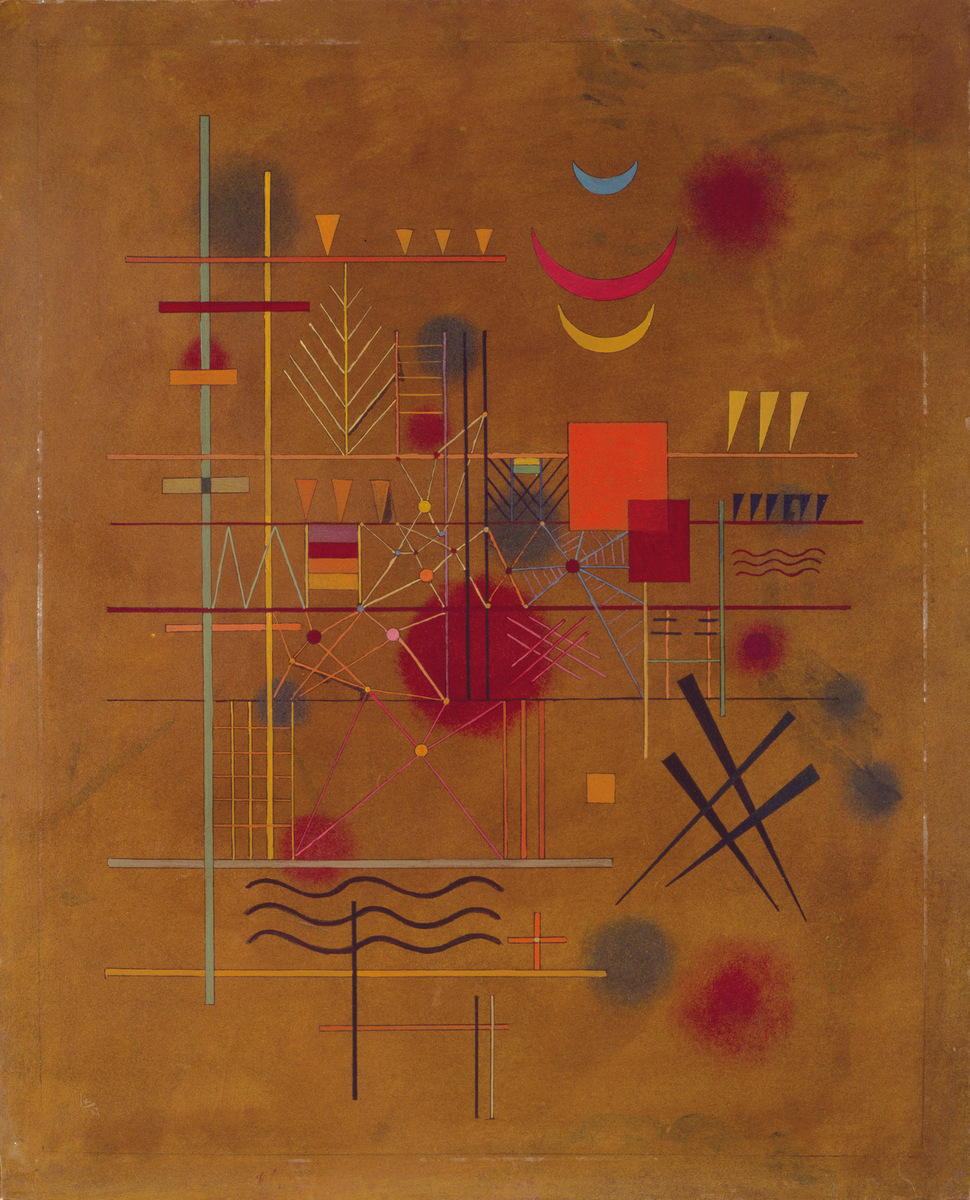
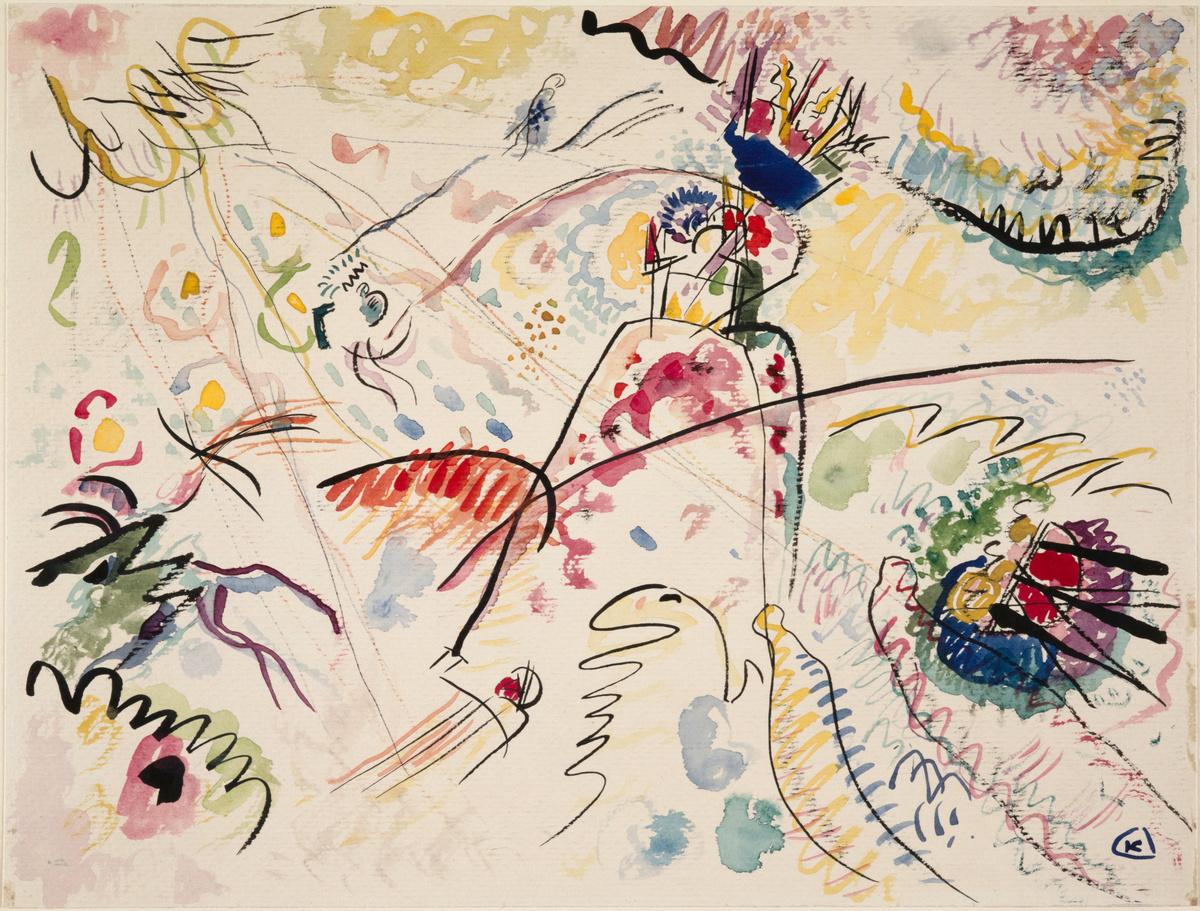
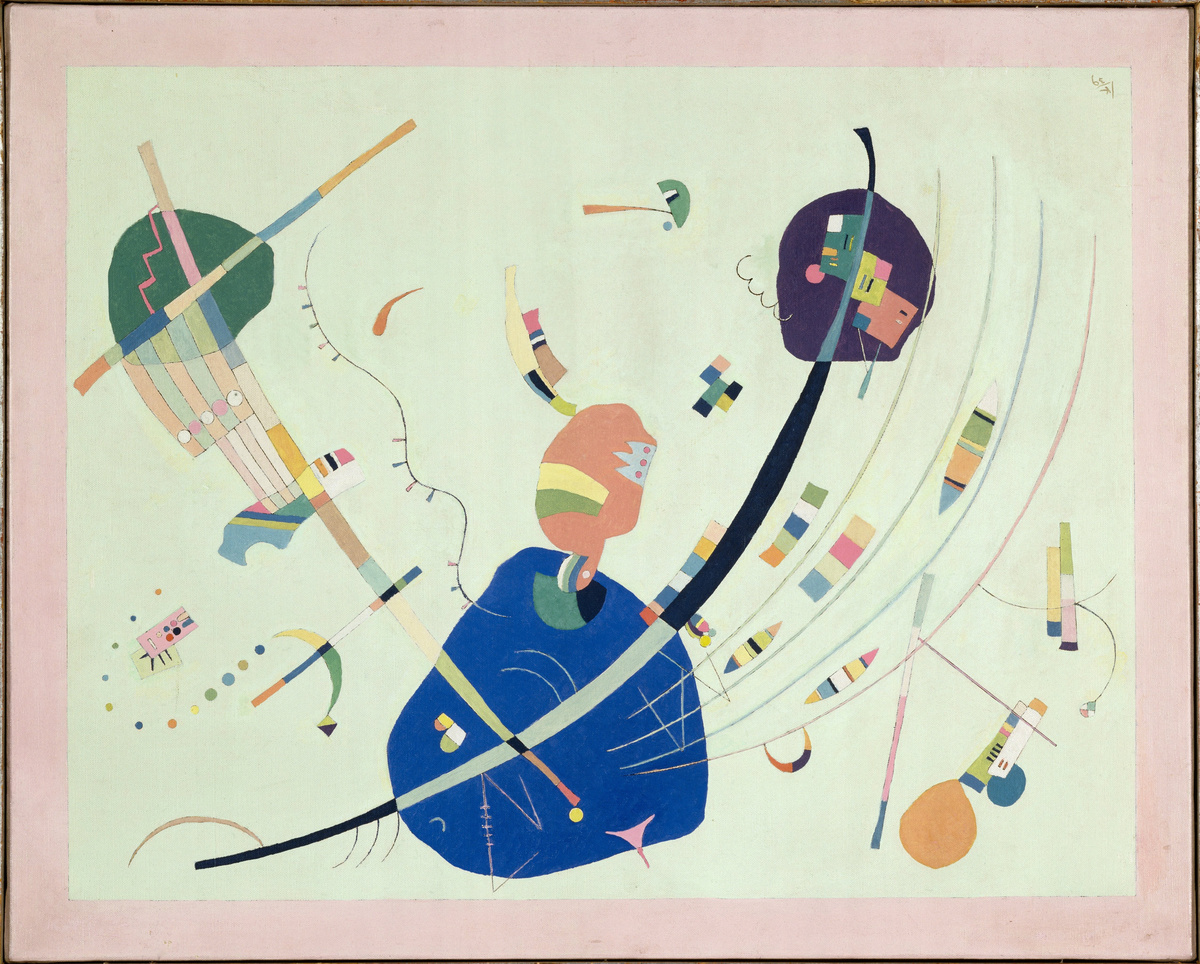
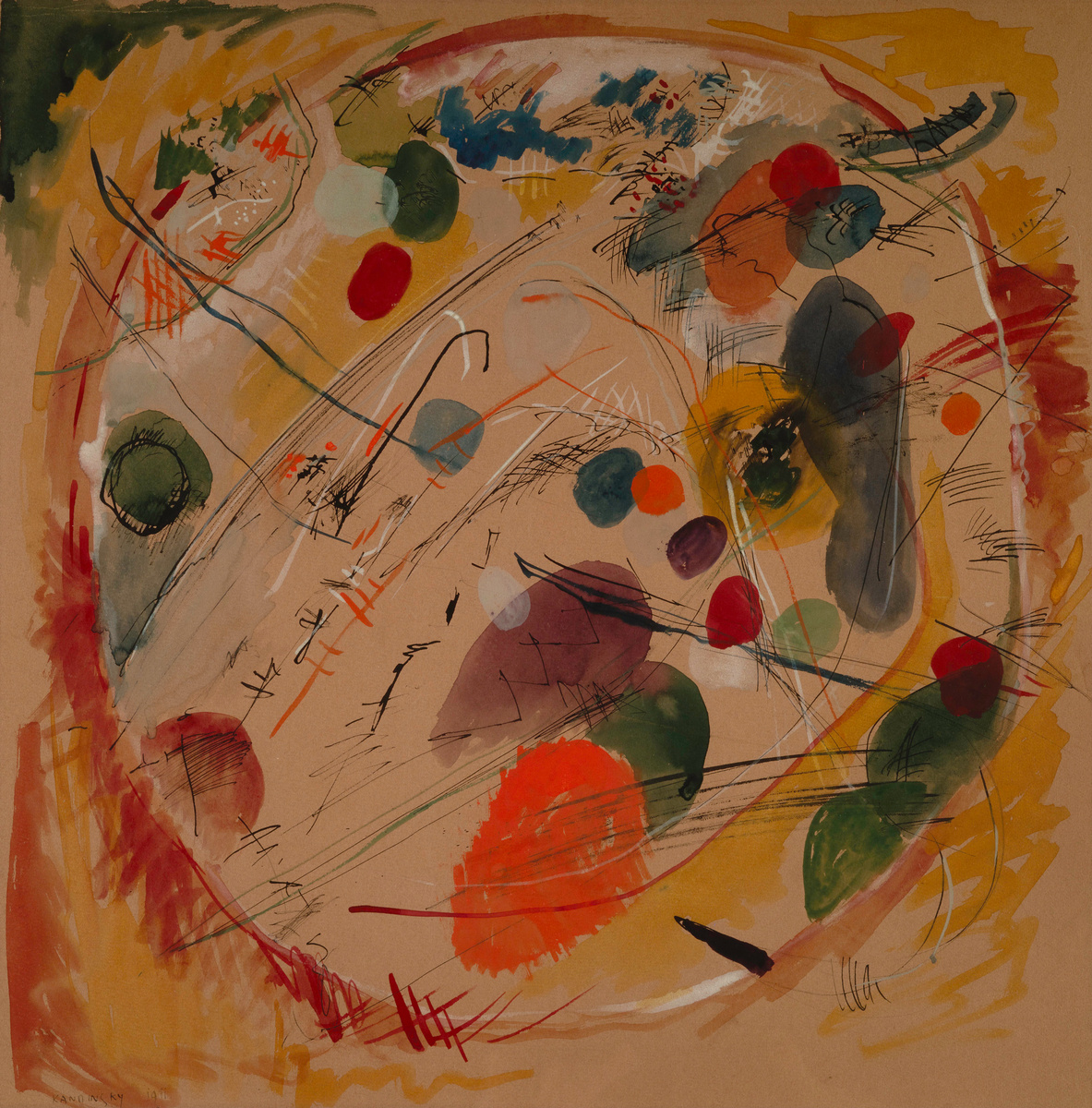
This is Wassily Kandinsky's In the Circle, an abstract work made around 1914 in watercolour, gouache and India ink on paper. There is no figure or scene to identify here. Kandinsky built the picture from interlacing lines, patches of colour and circular forms, and a broad circular sweep gives the work its title.
Take a moment to follow the different kinds of mark across the surface. Fine dark lines cross and tangle, while softer areas of colour sit behind and between them. The circles keep two roles at once: they are shapes in their own right, and they gather the surrounding lines around them.
In the Circle belongs to Kandinsky's abstract period, and the work is catalogued as abstract art. The date is given as around 1914. That places it in the years just before the First World War, when the artist was working between Germany and his native Russia.
The title asks us to look at the circle, and you can see how the composition rewards that attention. The circular sweep draws separate lines and colour patches into a shared orbit, so the picture reads as a balance of movement and structure rather than a record of anything seen in the world. That reading is my response to the visible composition. The supplied record does not explain what the artist intended the circles to mean.
In the Circle is a small, square abstract work on paper, now part of the Musée National d'Art Moderne's collection at the Centre Pompidou in Paris. Seen in that light, its subject is the relationship of line, colour and circular form. The title names the shape, and the composition shows how much that shape can organise.
The story and its sources
Historical claims are linked to the records below. Close looking and interpretation are identified in the passage notes.
- Passage 1Documented historyWikimedia Commons: In the Circle
- Passage 2Close lookingWikimedia Commons: In the Circle
- Passage 3Documented historyWikimedia Commons: In the Circle
- Passage 4InterpretationWikimedia Commons: In the Circle
- Passage 5Documented historyWikimedia Commons: In the Circle
Details to notice
About 2 minutes to readArtist Signature and Date
Handwritten KANDINSKY and 1911 inscription at the lower left. It provides the direct attribution clue and a date anchor for the composition.
Lower-Left Circular Sweep
Curved rust, ochre, and dark green brushwork along the lower-left edge, part of the broad circular boundary that gives the work its title and encloses the floating forms.
Interlaced Linework
Web of thin black and blue lines, arcs, and hatched flicks across the tan field. Its gestures connect scattered color spots and create the work's sense of orbiting motion.
Artist portrait Image credit
未知上傳者. Image source · Public domain
About the artist
Wassily Kandinsky
1866 to 1944
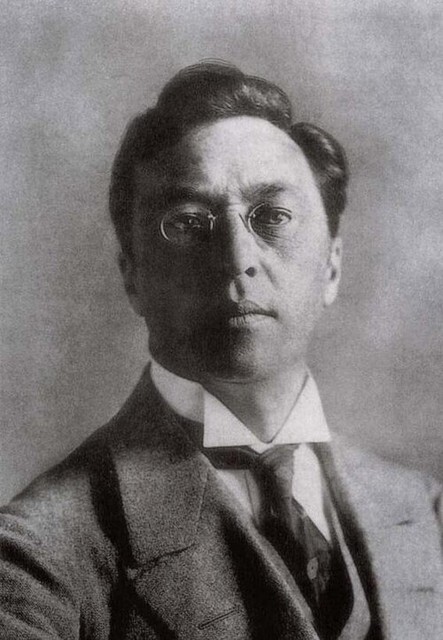
Wassily Kandinsky was an avant-garde painter of Russian origin (1866–1944). Their work is associated with Expressionism; Symbolism; Bauhaus. Their recorded places of work include Paris; Munich; Weimar; Rapallo; The Hague; Russia; Stockholm; Switzerland; Tunis.
- Born
- 1866
- Died
- 1944
- Nationality
- Russian Empire; Russian Soviet Federative Socialist Republic; Soviet Union; France; Germany
- Birthplace
- Moscow
- Died in
- Neuilly-sur-Seine
Biography sources
The research & record
Study the work.
Follow the evidence.
Find catalogue details, historical context, technical research and the literature behind this artwork.
The artwork record
Research catalogue
Catalogue information and detailed research, with references that link to the bibliography.
Updated .
Identity and catalogue
Link- Title
- In the Circle(Wikimedia Commons: In the Circle, n.d.)
- Artist or attribution
- Wassily Kandinsky
- Object date
- circa 1914
- Medium and support
- Watercolor, gouache, and India ink on paper, mounted on board(Wikimedia Commons: In the Circle, n.d.)
- Dimensions
- 48.9 × 48.5 cm(Wikimedia Commons: In the Circle, n.d.)
- Current collection or location
- Musée National d'Art Moderne, Centre Pompidou, Paris(Wikimedia Commons: In the Circle, n.d.)
- Movement or period
- Abstract art(Wikimedia Commons: In the Circle, n.d.)
- Country or culture
- Russian-born artist working in Germany and France
- Depicted subject
- A non-narrative abstract composition built from interlacing lines, color patches, and circular forms, with a broad circular sweep that gives the work its title.
- Title variants
- Dans le cercle; Im Kreis
- Accession number
- AM 81-65-92
- Support
- paper mounted on board
- Inscriptions
- Signed KANDINSKY and dated 1911 at lower left (per material description, not directly confirmed in excerpt)
Read valuation records and their limitations
Catalogue record
The work is catalogued as In the Circle, made by Wassily Kandinsky around 1914. The dating is given as approximate rather than fixed to a single year, so the object date should be distinguished from any later catalogue, accession or publication date attached to the record. It is classified as abstract art, and the dimensions are recorded as 48.9 cm in height by 48.5 cm in width, an almost exact square.(Wikimedia Commons: In the Circle, n.d., File title and description; Dimensions; Genre)
Interpretation
The square format and the abstract classification together define the terms on which the object is described: the record identifies no depicted figure, scene or subject beyond the abstract play of form, and the near-equal height and width mean the support presents a field without the orientation a rectangular format would impose. The title In the Circle is the only verbal key the catalogue supplies to the composition, naming a shape rather than a narrative. Because the discovery record for the object is not an official museum catalogue, these identifications should be treated as the working description of the work rather than as a definitive catalogue entry.(Wikimedia Commons: In the Circle, n.d., File title and description; Dimensions; Genre)
The work is titled In the Circle and was made by Wassily Kandinsky around 1914.(Wikimedia Commons: In the Circle, n.d.)
The dimensions are 48.9 cm high by 48.5 cm wide.(Wikimedia Commons: In the Circle, n.d.)
The genre is abstract art.(Wikimedia Commons: In the Circle, n.d.)
Materials and technique
LinkRead valuation records and their limitations
Documented medium and support
The documented medium of Wassily Kandinsky's In the Circle, made around 1914, is watercolor, gouache, and India ink on paper mounted on board. This description establishes a mixed-media combination rather than a single technique: a transparent water-based wash medium, an opaque water-based body color, and a dark ink, applied to a paper support that was subsequently adhered to a rigid board. The presence of three distinct media is a documentary fact of the object record; it does not by itself specify the order in which the materials were laid down, the relative proportion of each across the surface, or whether any layer was applied over another.(Wikimedia Commons: In the Circle, n.d., Description)
The mounted support is consequential for how the work is understood materially. Paper mounted on board is a composite: the sheet carries the drawing and painting, while the board provides rigidity. The record documents the composite state as the work's medium but does not describe the adhesive, the board type, the paper weight, or whether the mounting was done at the time of making or later. Those details remain unestablished in the supplied evidence and should not be inferred from the visible square format. Technical examination would be required to determine layer order, the distribution of gouache against watercolor, and the application of the India ink relative to the color passages; the record supports the identification of the materials but not a reconstruction of the working sequence.(Wikimedia Commons: In the Circle, n.d., Description)
The medium is watercolor, gouache, and India ink on paper mounted on board.(Wikimedia Commons: In the Circle, n.d.)
Collection and display
LinkRead valuation records and their limitations
In the Circle is recorded as held in the Musée National d'Art Moderne, Centre Pompidou, Paris, under accession number AM 81-65-92. The accession number and the name of the holding institution are the only collection details established by the supplied record. The discovery record consulted for these details is a Wikimedia Commons file page rather than an official museum catalogue, so the collection attribution should be treated as consistent with, but not directly confirmed by, the museum's own documentation. This institutional location matters for the object's place in a larger history of material culture, because the work's entry into a national modern art collection connects a paper-based abstract composition to the public museum narrative of early twentieth-century abstraction. The record does not give an acquisition date, donor, or prior owner, so the route by which the work reached the museum cannot be described from the supplied evidence.(Wikimedia Commons: In the Circle, n.d., Collection and Accession number)
The work is held in the Musée National d'Art Moderne, Centre Pompidou, Paris, with accession number AM 81-65-92.(Wikimedia Commons: In the Circle, n.d.)
Documented values and qualified estimates
LinkRead valuation records and their limitations
The object and its documentation
Interpretation
The supplied record identifies this object as Wassily Kandinsky's In the Circle (Dans le cercle), an abstract work made around 1914 in watercolor, gouache, and India ink on paper mounted on board. Its dimensions are given as 48.9 by 48.5 cm, so the support is very nearly square, and it is held at the Musee National d'Art Moderne, Centre Pompidou, Paris, under accession number AM 81-65-92. The record classifies the genre simply as abstract art. These identification facts come from a discovery record rather than an official museum catalogue, a distinction that matters for everything below, because no catalogue raisonne entry, gallery label, or institutional file is claimed in the supplied evidence. The mounting of paper onto board is part of the object's physical description and is one of the factors the record treats as relevant to how the work is assessed.(Wikimedia Commons: In the Circle, n.d.)
The working insurance estimate is a constructed figure rather than a reported one. It states a range of US$8M to US$22M and gives its recorded date as a working calculation generated 2026-10-30. The methodology is explicit: a conservative working range calculated for manual review from the confirmed object context, described as a broad reasonableness band for a major museum-held abstract work on paper from Kandinsky's pivotal pre-war period. The band was scaled by medium sensitivity, the mounted support, the approximate 1914 dating, and the public collection status. The record is equally explicit about what it does not use: no public auction estimate, sale result, official insurance value, or private record is claimed or used. This is not an appraisal by a qualified professional and has not been reviewed by one; it does not rely on comparable sales. It is a model-generated working range for manual review only, not an official insurance value, auction estimate, auction result, or sale price, and it notes that public institutional collection status and the supplied identification confidence level may affect actual insurance scheduling, which would require separate professional appraisal and verification.(Wikimedia Commons: In the Circle, n.d.)
The two ends of the range are explained by different pressures. The lower bound reflects what the record calls the greater fragility and market discount typical of works on paper, together with the dating and attribution qualifications noted in the supplied context. The upper bound reflects the artist's canonical standing and the significance of the circa 1914 abstract phase. The mounted support operates in both directions in the record's reasoning: it is listed among the factors scaling the band, and medium sensitivity generally is named as a downward pressure. The stated intention is to keep the range wide to avoid false precision, so the width itself should be read as a methodological choice rather than as evidence of price volatility. The record also states that the supplied context was not independently confirmed through the Centre Pompidou catalogue, which is why the estimate should be treated as provisional even on its own terms.(Wikimedia Commons: In the Circle, n.d.)
Read together, the identification record and the valuation record establish a clear division of labor. The description of medium, dimensions, collection, and accession number is what the working calculation calls the confirmed object context, and that context is the sole input to the range apart from the record's own assumptions about medium, support, dating, and institutional status. The estimate carries no independent evidentiary weight about the work itself: it neither adds to nor corroborates the physical description, and its lower and upper bounds rest on general reasoning about works on paper rather than on any documented transaction. The proper use of such a figure within a research archive is therefore as a dated, attributed, and heavily qualified working document, one that records how a numerical judgment was framed and what it deliberately excluded, not as a value attached to the object.(Wikimedia Commons: In the Circle, n.d.)
Working estimate
Calculated working insurance estimate, not a sale price: Estimated value: US$8M to US$22M Recorded date: Working calculation, generated 2026-10-30. Methodology: Conservative working range calculated for manual review from the confirmed object context: Wassily Kandinsky, In the Circle (Dans le cercle), circa 1914, watercolor, gouache, and India ink on paper mounted on board, 48.9 x 48.5 cm, held at the Musee National d'Art Moderne, Centre Pompidou, Paris, accession AM 81-65-92. The range is a broad reasonableness band for a major museum-held abstract work on paper from Kandinsky's pivotal pre-war period, scaled by medium sensitivity, the mounted support, the approximate 1914 dating, and the public collection status. No public auction estimate, sale result, official insurance value, or private record is claimed or used. The lower bound reflects the greater fragility and market discount typical of works on paper and the dating and attribution qualifications noted in the supplied context; the upper bound reflects the artist's canonical standing and the significance of the circa 1914 abstract phase. The range is intentionally wide to avoid false precision. Qualification: This is a model-generated working range for manual review only. It is not an official insurance value, appraisal, auction estimate, auction result, or sale price, and it has not been reviewed by a qualified appraiser. It does not rely on comparable sales or private insurance records. Public institutional collection status and the supplied identification confidence level may affect actual insurance scheduling, which requires separate professional appraisal and verification. The supplied context was not independently confirmed through the Centre Pompidou catalogue.(Wikimedia Commons: In the Circle, n.d.)
Further reading
Books for a closer look
Paid links. As an Amazon Associate I earn from qualifying purchases.

Open Library Kandinsky: Russian and Bauhaus years, 1915-1933.
Solomon R. Guggenheim Museum
A Kandinsky volume recorded with subjects including Abstract Art, Catalogs, Exhibitions, and explicitly Centre Georges Pompidou and Musee national d'art moderne/Centre de creation industrielle. That institution matches the documented holding of In the Circle, so this catalogue record is the most directly relevant candidate for the artist and the work's museum context, though I have not examined its contents or confirmed it discusses this specific sheet.
ISBN 0892070447

Open Library Concerning the spiritual in art
Dover Publications
Kandinsky's Concerning the Spiritual in Art is recorded with subjects Aesthetics, Modern Art, and Painting. It is relevant through the artist's own documented theoretical framework for abstraction, which underlies a circa 1914 abstract watercolor such as In the Circle; it is included as artist-authored context rather than as a study of this particular work.
ISBN 0486234118
Bibliography
Sources and further reading
References are arranged by author or organisation, with links to the original publications. Where no publication date is recorded, n.d. means no date.
Source notes updated .
No recorded sources match these filters. Reset the filters to see the full bibliography.
- 03
Book
Concerning the spiritual in art. Dover Publications.
Kandinsky's Concerning the Spiritual in Art is recorded with subjects Aesthetics, Modern Art, and Painting. It is relevant through the artist's own documented theoretical framework for abstraction, which underlies a circa 1914 abstract watercolor such as In the Circle; it is included as artist-authored context rather than as a study of this particular work.
- ISBN
- 0486234118
Citation text
- 02
Book
Kandinsky: Russian and Bauhaus years, 1915-1933. Solomon R. Guggenheim Museum.
A Kandinsky volume recorded with subjects including Abstract Art, Catalogs, Exhibitions, and explicitly Centre Georges Pompidou and Musee national d'art moderne/Centre de creation industrielle. That institution matches the documented holding of In the Circle, so this catalogue record is the most directly relevant candidate for the artist and the work's museum context, though I have not examined its contents or confirmed it discusses this specific sheet.
- ISBN
- 0892070447
Citation text
- 01
Secondary · About this artwork
Wikimedia Commons: In the Circle (n.d.). Wikimedia Commons: In the Circle. Wikimedia Commons.
Discovery record for the exact object; provides title, artist, date, medium, dimensions, and collection details. Not an official museum catalogue.
Citation text
Art to live with
Bring this painting
home.
A piece of the archive, made yours. Explore In the Circle in a size and finish that fits your space.
Your text and annotations appear on these editions. Adding to cart saves that design for printing.
Combine this painting with your favourites01 / Find your edition
Made for you
Suggested from your location. Change it if you're sending elsewhere or using a VPN. Prices and delivery are shown in GBP.
1 product
Choose an edition to make it yours
iPhone 12 Mini ? Glossy ? back view
iPhone 12 Mini · Glossy

iPhone 12 Mini ? Glossy ? back view

iPhone 12 Mini ? Glossy ? back view

iPhone 12 Mini ? Glossy ? back view
Tough phone case
GBP 16.34
Delivery GBP 4.22 / Total GBP 20.56
A two-layer phone case with a printed polycarbonate shell and a shock-absorbing inner liner.
Two layers with a shock-absorbing TPU liner
Case & print details
- Device
- Apple · iPhone 12 Mini
- Material
- Polycarbonate shell with a TPU inner liner
- Artwork
- Outer back and wrapped edges from one template
- Finish
- Glossy
- Version
- Standard version
- Printing
- Dye sublimation
- Print file
- 1,122 × 1,831 px · 95 × 155 mm · PNG · 300 dpi recommended
Rear outline and camera openings follow this variant's Printify template. Case depth and small hardware remain illustrative.
Supplier product detailsFit and fill keep the painting’s proportions. Stretch changes them.
Move and zoom the painting on your tough phone case.
Made to order with your design
Made to order
US delivery only
The 30 cm ruler is scaled alongside your selected print. Keep the painting’s proportions with a black background, or stretch it to fill. Frame width, material texture and screen colours are illustrative.
Keep exploring