In Grey
Artist: Wassily Kandinsky · 1919

In Grey: high-resolution image
The original file is hosted by Wikimedia Commons, available without payment or an account.
Open high-resolution image on Wikimedia CommonsThe complete story
The story About 4 minutes to read
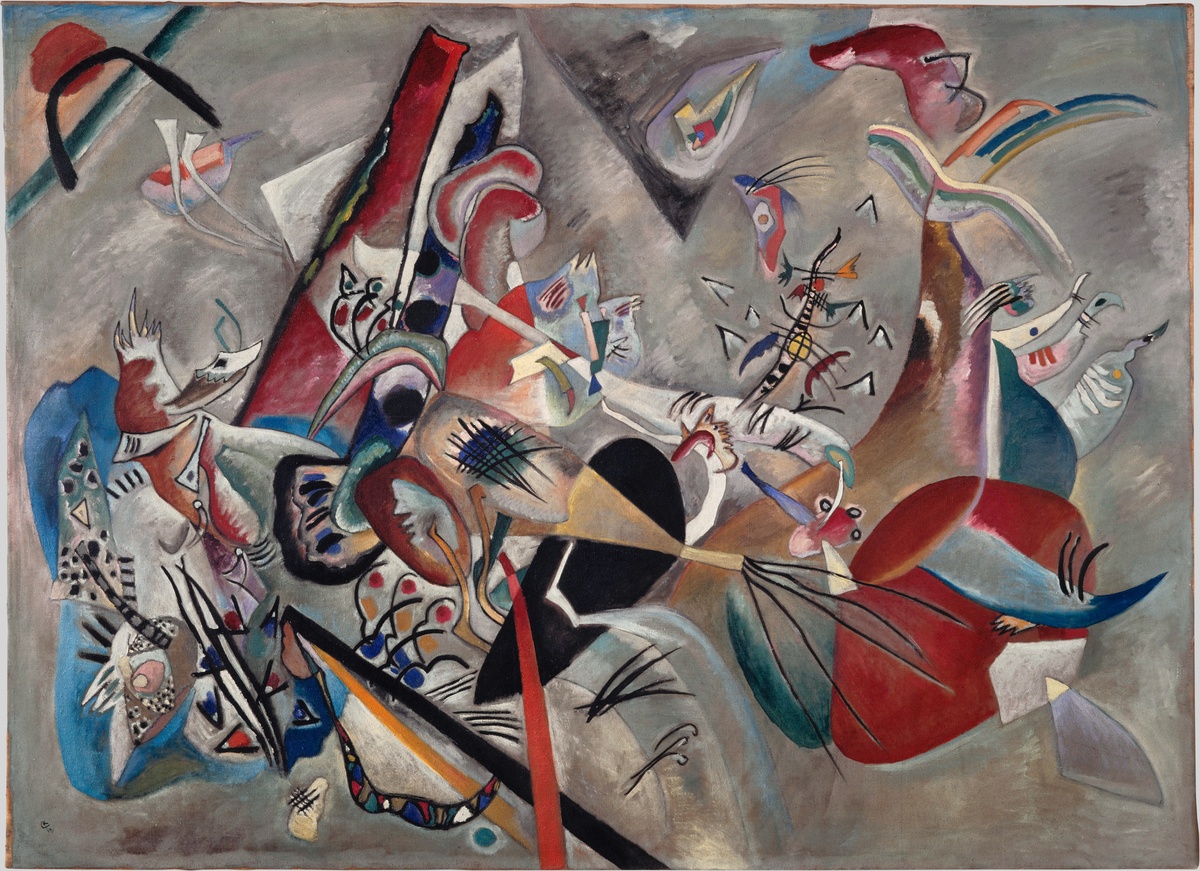
Here is Wassily Kandinsky's In Grey, a painting from 1919. It has no recognizable story. Instead, a field of grey is filled with vivid shapes and sharp black lines, and your eye keeps moving across the surface. At the centre, a black wedge narrows near the middle and widens downward. A red vertical band cuts alongside it. These two forms anchor the surrounding scatter of pale and dark elements.
Look at the lower-left corner. A dense cluster of white, red, and blue shapes presses against the edge. Some have masklike or birdlike profiles. They feel weighty, almost like a small crowd. In the upper right, a large mauve-pink lobe trails green and blue ribbons. Fine black calligraphic lines cross it. That form balances the lower-left cluster and keeps the composition from settling.
In the lower right, a broad red oval overlaps a blue crescent and black radiating strokes. Near the middle right, a spiky black starburst floats among grey and white forms, with a tiny multicoloured centre. The upper-left corner holds an isolated motif: a red-orange disk, a thick black curved stroke, and a turquoise diagonal. These distinct events keep the grey field active.
The title In Grey points to the painting's organising field. Grey is not just a background colour here. It is the shared ground against which the coloured and black forms are set. That grey quiets the bright shapes and makes their differences more noticeable. It also gives the whole painting a unified atmosphere, even as the forms pull in different directions.
The painting offers no single subject to identify. Its meaning comes from the relationships among shapes, colours, and lines. The black wedge and red band create a central axis. The biomorphic clusters and geometric motifs orbit that axis without resolving into a scene. You are invited to follow those relationships rather than decode a hidden narrative.
In Grey is an abstract painting that asks you to look at how forms interact. The grey field holds the composition together. The central wedge and red band give it a spine. The scattered shapes provide variety and contrast. What stays with you is the balance between stillness and movement, between the quiet grey and the vivid events that cross it.
The story and its sources
Historical claims are linked to the records below. Close looking and interpretation are identified in the passage notes.
- Passage 1Close lookingWikimedia Commons: In Grey
- Passage 2Close lookingWikimedia Commons: In Grey
- Passage 3Close lookingWikimedia Commons: In Grey
- Passage 4InterpretationWikimedia Commons: In Grey
- Passage 5InterpretationWikimedia Commons: In Grey
- Passage 6InterpretationWikimedia Commons: In Grey
Details to notice
About 3 minutes to readUpper Left Red Disk and Hook
A red-orange disk, a thick black curved stroke, and a turquoise diagonal create an isolated celestial-looking motif in the upper-left corner.
Central Right Spiked Starburst
A spiky black starburst with a tiny multicolored center floats among grey and white forms, adding nervous linear energy near the middle right of the composition.
Red Oval and Blue Crescent
A broad red oval overlaps a blue crescent and black radiating strokes, forming a weighted lower-right counterpoint to the lighter angular forms above and to the left.
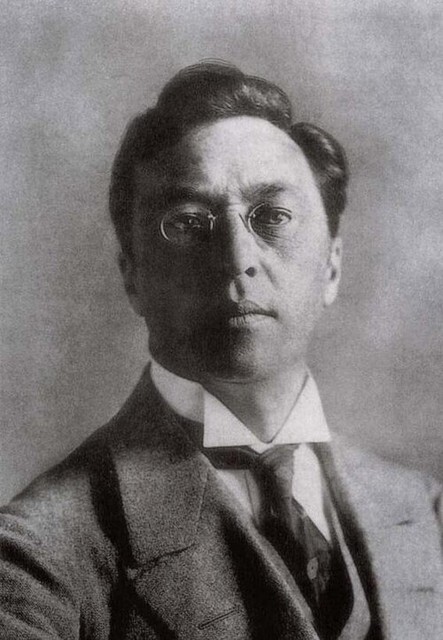
Artist portrait Image credit
未知上傳者. Image source · Public domain
About the artist
Wassily Kandinsky
1866 to 1944
Wassily Kandinsky was an avant-garde painter of Russian origin (1866–1944). Their work is associated with Expressionism; Symbolism; Bauhaus. Their recorded places of work include Paris; Munich; Weimar; Rapallo; The Hague; Russia; Stockholm; Switzerland; Tunis.
- Born
- 1866
- Died
- 1944
- Nationality
- Russian Empire; Russian Soviet Federative Socialist Republic; Soviet Union; France; Germany
- Birthplace
- Moscow
- Died in
- Neuilly-sur-Seine
Biography sources
The research & record
Study the work.
Follow the evidence.
Find catalogue details, historical context, technical research and the literature behind this artwork.
The artwork record
Research catalogue
Catalogue information and detailed research, with references that link to the bibliography.
Updated .
Identity and catalogue
Link- Title
- In Grey
- Artist or attribution
- Wassily Kandinsky(Wikimedia Commons: In Grey, n.d.)
- Object date
- 1919(Wikimedia Commons: In Grey, n.d.)
- Medium and support
- oil on canvas(Wikimedia Commons: In Grey, n.d.)
- Dimensions
- 129 x 176 cm(Wikimedia Commons: In Grey, n.d.)
- Current collection or location
- Musée National d'Art Moderne, Centre Georges Pompidou, Paris(Wikimedia Commons: In Grey, n.d.)
- Depicted subject
- An abstract painting in which a scattered field of pale, saturated and dark forms, anchored by a central black angular mass, is organized across a grey ground. The supplied source identifies the work, artist, date and collection but does not describe a narrative subject.
- Title variants
- Im Grau; Dans le gris; Nel grigio; Em cinzento; En gris; В сером
- Accession number
- AM 81-65-43(Wikimedia Commons: In Grey, n.d.)
- Support
- canvas
- Culture / place
- Unknown
- Period
- Unknown
Read valuation records and their limitations
Catalogue identity
The catalogue record identifies the painting as Wassily Kandinsky's In Grey, a title also given in German as Im Grau. The two names appear together as equivalents in the source record rather than as separate works, so the object is catalogued under a single identity with a German and an English form of the title. The date assigned to the work is 1919. That date belongs to the painting, not to the compilation of the record; the catalogue entry itself is a later, secondary description of the object. The recorded dimensions are 129 by 176 centimetres, stated in the source without further qualification as to whether they describe the canvas, the stretcher, or the painted surface. The same source describes the support as canvas and the medium as oil, and places the painting in the collection of the Musée National d'Art Moderne, Centre Georges Pompidou, Paris. The accession number recorded for it is AM 81-65-43. These particulars establish the object's basic catalogue identity: a large horizontal oil on canvas of 1919 by Kandinsky, held in Paris under a specific accession number and known by two title forms.(Wikimedia Commons: In Grey, n.d., Artist or creator and title fields; Date field; Dimensions field)
Interpretation
The evidence used here comes from a Wikimedia Commons file record rather than from an official museum catalogue, and the source's own annotation states this limitation explicitly, describing itself as a discovery source for title, artist, date, medium, dimensions, collection and semantic focus candidates and not an official museum record. Accordingly, the attribution, the 1919 date, the oil-on-canvas medium, the dimensions, the Paris collection and the accession number should be treated as recorded in a widely used secondary compilation that awaits confirmation against the holding institution's own documentation. The distinction matters for how the facts above are weighted: the title forms, measurements and accession string are reported catalogue data, not observations verified here against the physical object or the museum's registration files. No inscribed signature, dedication, or date written on the canvas is supplied in the evidence, and no earlier or later provenance interval is documented in these units, so nothing should be inferred about the painting's ownership history or about inscriptions from the present record.(Wikimedia Commons: In Grey, n.d., Artist or creator and title fields; Date field; Dimensions field)
The title and the grey field
The title In Grey, or Im Grau, has a descriptive relation to the picture itself. The source notes that both the title and the painting's ground indicate that grey is the organising field against which the coloured and black forms are set. This is a claim about how the composition works, offered in the same record that supplies the catalogue data, and it links the naming of the work to its visible structure: the grey is not incidental background but the shared field that holds the disparate coloured and black elements together. Read alongside the physical particulars, the object can be described as a large-format canvas in which a grey ground carries a scatter of pale and saturated forms and sharp black lines, so that the title describes a compositional principle as much as a colour. The evidence does not establish who chose the title or when it was applied, and that question should remain open.(Wikimedia Commons: In Grey, n.d., Artist or creator and title fields; Dimensions field)
The painting is by Wassily Kandinsky and is titled In Grey, also known as Im Grau.(Wikimedia Commons: In Grey, n.d.)
The work is dated 1919.(Wikimedia Commons: In Grey, n.d.)
The painting measures 129 by 176 centimetres.(Wikimedia Commons: In Grey, n.d.)
Subject and iconography
LinkRead valuation records and their limitations
Visual observation
The painting recorded as In Grey, also known as Im Grau, is attributed in the supplied documentation to Wassily Kandinsky, dated 1919, and described as oil on canvas. It is reported as measuring 129 by 176 centimetres and as belonging to the collection of the Musée National d'Art Moderne, Centre Georges Pompidou, Paris, where the accession number recorded for it is AM 81-65-43. These particulars come from a Wikimedia Commons file page identified by the supplying archive as a discovery source rather than an official museum record, so they should be treated as an attributed description of the object rather than as a catalogue transcription. The recorded medium matters for how the surface is read: the evidence treats the picture as paint on canvas, and the observations below describe the painted surface only, without adducing pigments, supports, treatments or exhibition history not established by the supplied units.(Wikimedia Commons: In Grey, n.d., Medium field; Semantic focus candidate: central black angular mass)
The Ground and the Central Axis
Two observations frame the largest structure of the composition. The first is a sharp black wedge that narrows near the centre and widens downward, with a red vertical band cutting alongside it; the evidence describes these as anchoring the surrounding scatter of pale and saturated forms. The second concerns the ground: the title In Grey and the painting's ground together are said to indicate that grey is the organising field against which the coloured and black forms are set. Read together, these units establish a distinction worth keeping clear. The wedge and band are described as observed features of the surface, while the claim that grey organises the picture is presented as an inference drawn from the title and the ground rather than as a measurement. The grey does not function as an empty backdrop in this account; it is the shared field against which each coloured event becomes legible. Grey of this kind, as a tonal matrix holding saturated forms, is a convention with a longer history in modern painting, but the supplied evidence does not establish any specific predecessor or source for this canvas, and none should be assumed.(Wikimedia Commons: In Grey, n.d., Semantic focus candidate: central black angular mass)
Around that central axis the evidence records several distinct events. In the lower left, a dense cluster of white, red and blue shapes with masklike and birdlike profiles presses against the edge; the observations describe this as a weighty grouping rather than a single figure. In the upper right, a large mauve-pink lobe with trailing green and blue ribbons balances that lower-left cluster, crossed by fine black calligraphic lines. In the lower right, a broad red oval overlaps a blue crescent and black radiating strokes. Near the middle right, a spiky black starburst with a tiny multicoloured centre floats among grey and white forms. In the upper-left corner an isolated motif combines a red-orange disk, a thick black curved stroke and a turquoise diagonal. These units are consistently framed as observations of the surface, not as identifications of depicted things: the words masklike, birdlike, ribbons and starburst describe visual resemblance, and the evidence does not claim that masks, birds or stars are represented. The distribution is diagonal and edge-weighted. The lower-left cluster and the upper-right lobe oppose one another across the centre, while the lower-right oval and the upper-left disk-and-stroke motif occupy the remaining corners, so that the composition is held at its extremities rather than resolved at its middle.(Wikimedia Commons: In Grey, n.d., Semantic focus candidate: lower left biomorphic cluster; Semantic focus candidate: upper right ribboned form; Semantic focus candidate: lower right red oval and blue crescent; Semantic focus candidate: central right spiked starburst; Semantic focus candidate: upper left red disk and hook)
Reading Abstraction from the Recorded Surface
Interpretation
The evidence supports a qualified characterisation of how this picture works as an abstract image. The forms are named by shape and colour rather than by subject, and no single narrative is established for them; meaning, on this account, lies in the relationships among shapes, colours and lines. The central wedge and red band supply a spine, the biomorphic clusters and geometric motifs orbit it, and the grey field holds the whole together while the saturated passages supply contrast. That reading is an interpretation of the recorded observations rather than a documented intention, and the supplying units do not attribute it to the artist. It is nonetheless consistent with the observation units, which repeatedly describe anchoring, balancing and overlap, terms of compositional relation rather than of depiction. Within a larger history of material culture, the significance of such a work is that it asks viewers to read painted relations directly, without the mediating subject that older pictorial conventions supplied. The evidence here establishes the formal relations and the documented medium and date; it does not establish the painting's place in a sequence of stylistic development, and any such placement would require evidence outside these units.(Wikimedia Commons: In Grey, n.d., Semantic focus candidate: central black angular mass; Semantic focus candidate: lower left biomorphic cluster; Semantic focus candidate: upper right ribboned form; Semantic focus candidate: lower right red oval and blue crescent; Semantic focus candidate: central right spiked starburst; Semantic focus candidate: upper left red disk and hook; Medium field)
Visual observation
A sharp black wedge narrows near the centre and widens downward, with a red vertical band cutting alongside it, anchoring the surrounding scatter of pale and saturated forms.(Wikimedia Commons: In Grey, n.d.)
A dense cluster of white, red and blue shapes with masklike and birdlike profiles presses against the lower-left edge.(Wikimedia Commons: In Grey, n.d.)
A large mauve-pink lobe with trailing green and blue ribbons balances the upper right, crossed by fine black calligraphic lines.(Wikimedia Commons: In Grey, n.d.)
A broad red oval overlaps a blue crescent and black radiating strokes in the lower right.(Wikimedia Commons: In Grey, n.d.)
A spiky black starburst with a tiny multicoloured centre floats among grey and white forms near the middle right.(Wikimedia Commons: In Grey, n.d.)
A red-orange disk, a thick black curved stroke and a turquoise diagonal create an isolated motif in the upper-left corner.(Wikimedia Commons: In Grey, n.d.)
Materials and technique
LinkRead valuation records and their limitations
The documented support and medium
The documented medium of In Grey is oil on canvas, the only material fact recorded in the available source, which lists it in the medium field of its Commons entry for the work. That record identifies the painting as by Wassily Kandinsky, titled In Grey (Im Grau), dated 1919, measuring 129 by 176 centimetres and held by the Musée National d'Art Moderne, Centre Georges Pompidou, Paris, under accession number AM 81-65-43. These are catalogue-level facts about support and dimensions rather than the results of technical analysis: the source is a Commons file description, annotated here as a discovery source rather than an official museum record and only partially consulted, and it reports no ground preparation, pigment analysis, layer structure, underdrawing, tool marks or conservation history. Any account of how the paint was actually built up on this canvas therefore remains, on the present evidence, unwritten.(Wikimedia Commons: In Grey, n.d., Medium field)
Interpretation
Read together, the documented medium and the observed surface suggest why the question of technique matters for this object rather than being a neutral inventory item. The description treats grey as the organising field against which coloured and black forms are set, and the observed motifs are described as floating among or pressing against grey and white areas. In an oil painting of this scale the effect of such a field depends on how the ground and surrounding passages were laid in, yet the evidence supplies only the identification of the medium and the appearance of the finished surface, not the preparation beneath it. The distinction is consequential: the visible dominance of grey can be described with confidence from the image, while any claim about it as a primed or painted ground, or about the sequence in which black drawing was set over colour, would exceed what these units support. On the present record, the technique of In Grey is known at the level of medium and canvas and inferred only at the level of appearance.(Wikimedia Commons: In Grey, n.d., Medium field; Semantic focus candidate: central black angular mass; Semantic focus candidate: upper right ribboned form)
The work is oil on canvas.(Wikimedia Commons: In Grey, n.d.)
Interpretations and debates
LinkRead valuation records and their limitations
The Grey Field as Organising Ground
Interpretation
The interpretation recorded for In Grey turns on its title and its ground: the title and the painting's grey field together indicate that grey is the organising field against which the coloured and black forms are set. This is an attributed reading of the work rather than a statement about what the artist privately intended, and it is grounded in what the surface and the title jointly present. The reading gains force from the specific distribution of the coloured events, which do not sit on a neutral backdrop so much as punctuate and divide an ambient grey.(Wikimedia Commons: In Grey, n.d., Title and description fields)
Read together, these observations support an interpretive account in which the grey functions less as a background colour than as a shared ground that quiets the bright forms and makes their differences more noticeable, giving the whole a unified atmosphere even as the forms pull in different directions. The reading is a qualified synthesis of the observable distribution rather than a documented statement by the painter: the evidence establishes what the composition contains and how the title frames it, but it does not record the maker's stated purpose, preparatory reasoning or any account of the work by its author.(Wikimedia Commons: In Grey, n.d., Title and description fields; Semantic focus candidate: central black angular mass; Semantic focus candidate: upper left red disk and hook)
The title In Grey and the painting's ground indicate that grey is the organising field against which the coloured and black forms are set.(Wikimedia Commons: In Grey, n.d.)
Collection and display
LinkRead valuation records and their limitations
In Grey is recorded as belonging to the collection of the Musée National d'Art Moderne, Centre Georges Pompidou, Paris, and the accession number recorded for the work is AM 81-65-43. These two pieces of institutional information are the only collection and display facts supplied for the object, and they establish its present custodial home as a public national modern art museum in Paris rather than a private or unspecified setting. The accession number, with its alphanumeric structure, is the kind of identifier a museum assigns to track a single work within its holdings; it is cited here as recorded rather than as evidence of the date of entry into the collection, the mode of acquisition, or any prior ownership. Nothing in the supplied evidence documents the painting's provenance before it reached the museum, the circumstances of its acquisition, or whether it has been exhibited there or elsewhere.(Wikimedia Commons: In Grey, n.d., Collection field; Accession number field)
Institutional Custody
Interpretation
The collection location matters for how the object is encountered as material culture. A work held by the Musée National d'Art Moderne is framed by an institution dedicated to modern art, which shapes the terms in which viewers and researchers meet it: as part of a national collection rather than as a single autonomous object. The available evidence does not describe any display context, gallery, installation, label, or catalogue entry beyond the collection field and accession number, so claims about how or when the painting has been shown would go beyond what is documented. The cautious reading is that the museum attribution and accession number establish institutional custody and identification, and leave the history of display to be established from other records.(Wikimedia Commons: In Grey, n.d., Collection field; Accession number field)
The painting is in the collection of the Musée National d'Art Moderne, Centre Georges Pompidou, Paris.(Wikimedia Commons: In Grey, n.d.)
The accession number recorded for the work is AM 81-65-43.(Wikimedia Commons: In Grey, n.d.)
Documented values and qualified estimates
LinkRead valuation records and their limitations
The status of the recorded valuation
Interpretation
The single valuation figure supplied for this section is not a market record but a calculated working insurance estimate: a range of US$8M to US$20M, generated on 2026-10-30 for manual review. Its stated methodology draws only on confirmed descriptive context, namely that the work is a 1919 oil on canvas by Wassily Kandinsky, a major modernist figure, at large scale (129 by 176 cm), titled In Grey (Im Grau), and held by the Musee National d'Art Moderne, Centre Georges Pompidou under accession AM 81-65-43. The range was framed as reflecting the work's quality tier, period, medium and monumental size together with the institutional and scholarly significance implied by museum custody.(Wikimedia Commons: In Grey, n.d.)
The estimate's own qualification is the most important part of the record. It states that the range was produced by broad order-of-magnitude judgment rather than any verified comparable sales or private insurance records, that the top of the band accounts for the highest plausible review figure and the bottom for a cautious floor, and that the width is kept intentionally wide for manual review. It explicitly disclaims being an official insurance value, appraisal, auction estimate, auction result or sale price, notes that no comparable sales or private insurance records were consulted, and directs anyone relying on a figure to confirm with a qualified fine-art appraiser and the holding institution. Any use of the number should therefore treat it as a review instrument, not as evidence of what the painting has fetched or would fetch.(Wikimedia Commons: In Grey, n.d.)
The facts on which the calculation rests are separable from the calculation itself. The painting's identification as Kandinsky's 1919 oil, its title In Grey (Im Grau), its dimensions of 129 by 176 centimetres, its place in the Musee National d'Art Moderne, Centre Georges Pompidou, Paris, and its accession number AM 81-65-43 come from a Wikimedia Commons discovery record that is described as not an official museum record and as only partially consulted. The valuation's descriptive inputs are thus report-level metadata, and its output inherits that status while adding a further layer of model-generated inference.(Wikimedia Commons: In Grey, n.d.)
Read together, the record shows a deliberate separation between what is documented about the object and what is estimated about its worth. Institutional custody, the dating to 1919, the oil medium, the substantial scale and the presence of a named modernist author are treated as the factors that would drive value, but the record supplies no transaction history, no provenance sequence and no appraisal to convert those factors into a price. Within a larger history of material culture, this is itself instructive: the monetary standing of an abstract modernist canvas is asserted through institutional prestige and scale rather than through documented exchange, and the archive's honest labelling of that gap is part of the evidence.(Wikimedia Commons: In Grey, n.d.)
Working estimate
Calculated working insurance estimate, not a sale price: Working insurance range: US$8M to US$20M Recorded date: Working calculation, generated 2026-10-30. Methodology: Conservative calculated working range derived from the supplied confirmed context only: a 1919 oil on canvas by Wassily Kandinsky, a major modernist figure, at large scale (129 x 176 cm), titled In Grey (Im Grau), held by the Musee National d'Art Moderne, Centre Georges Pompidou, accession AM 81-65-43. The range reflects the work's quality tier, period, medium and monumental size, and the institutional/scholarly significance implied by museum custody, using broad order-of-magnitude judgment rather than any verified comparable sales or private insurance records. The top of the range accounts for the highest plausible review figure and the bottom for a cautious floor, keeping the band intentionally wide for manual review. Qualification: This is a model-generated broad working range for manual review only. It is not an official insurance value, appraisal, auction estimate, auction result, or sale price, and no comparable sales or private insurance records were consulted. Confirm with a qualified fine-art appraiser and the holding institution before relying on any figure.(Wikimedia Commons: In Grey, n.d.)
Further reading
Books for a closer look
Paid links. As an Amazon Associate I earn from qualifying purchases.

Open Library Kandinsky: Russian and Bauhaus years, 1915-1933.
Solomon R. Guggenheim Museum
Catalogue record for a Kandinsky volume whose recorded subjects include abstract painting, the Musée national d'art moderne / Centre Georges Pompidou, catalogues and criticism and interpretation. These subjects connect directly to the artist and to the documented holding collection of In Grey (1919).
ISBN 0892070447

Open Library Concerning the spiritual in art
Dover Publications
Kandinsky's own treatise on aesthetics and the spiritual in art, with the artist's name in the recorded subjects. Relevant to the artist and to the abstract, non-narrative character of In Grey as described in the supplied evidence.
ISBN 0486234118
Bibliography
Sources and further reading
References are arranged by author or organisation, with links to the original publications. Where no publication date is recorded, n.d. means no date.
Source notes updated .
No recorded sources match these filters. Reset the filters to see the full bibliography.
- 03
Book
Concerning the spiritual in art. Dover Publications.
Kandinsky's own treatise on aesthetics and the spiritual in art, with the artist's name in the recorded subjects. Relevant to the artist and to the abstract, non-narrative character of In Grey as described in the supplied evidence.
- ISBN
- 0486234118
Citation text
- 02
Book
Kandinsky: Russian and Bauhaus years, 1915-1933. Solomon R. Guggenheim Museum.
Catalogue record for a Kandinsky volume whose recorded subjects include abstract painting, the Musée national d'art moderne / Centre Georges Pompidou, catalogues and criticism and interpretation. These subjects connect directly to the artist and to the documented holding collection of In Grey (1919).
- ISBN
- 0892070447
Citation text
- 01
Secondary · About this artwork
Wikimedia Commons: In Grey (n.d.). Wikimedia Commons: In Grey. Wikimedia Commons.
Discovery source for title, artist, date, medium, dimensions, collection and semantic focus candidates. Not an official museum record.
- Language
- en
Citation text
Art to live with
Bring this painting
home.
A piece of the archive, made yours. Explore In Grey in a size and finish that fits your space.
Your text and annotations appear on these editions. Adding to cart saves that design for printing.
Combine this painting with your favourites01 / Find your edition
Made for you
Suggested from your location. Change it if you're sending elsewhere or using a VPN. Prices and delivery are shown in GBP.
1 product
Choose an edition to make it yours
iPhone 12 Mini ? Glossy ? back view
iPhone 12 Mini · Glossy

iPhone 12 Mini ? Glossy ? back view

iPhone 12 Mini ? Glossy ? back view

iPhone 12 Mini ? Glossy ? back view
Tough phone case
GBP 16.34
Delivery GBP 4.22 / Total GBP 20.56
A two-layer phone case with a printed polycarbonate shell and a shock-absorbing inner liner.
Two layers with a shock-absorbing TPU liner
Case & print details
- Device
- Apple · iPhone 12 Mini
- Material
- Polycarbonate shell with a TPU inner liner
- Artwork
- Outer back and wrapped edges from one template
- Finish
- Glossy
- Version
- Standard version
- Printing
- Dye sublimation
- Print file
- 1,122 × 1,831 px · 95 × 155 mm · PNG · 300 dpi recommended
Rear outline and camera openings follow this variant's Printify template. Case depth and small hardware remain illustrative.
Supplier product detailsFit and fill keep the painting’s proportions. Stretch changes them.
Move and zoom the painting on your tough phone case.
Made to order with your design
Made to order
US delivery only
The 30 cm ruler is scaled alongside your selected print. Keep the painting’s proportions with a black background, or stretch it to fill. Frame width, material texture and screen colours are illustrative.
Keep exploring