Identity and catalogue
Link- Artist or attribution
- Maker unknown
- Movement or period
- 18th Dynasty, ancient Egypt
- Country or culture
- Ancient Egypt
- Depicted subject
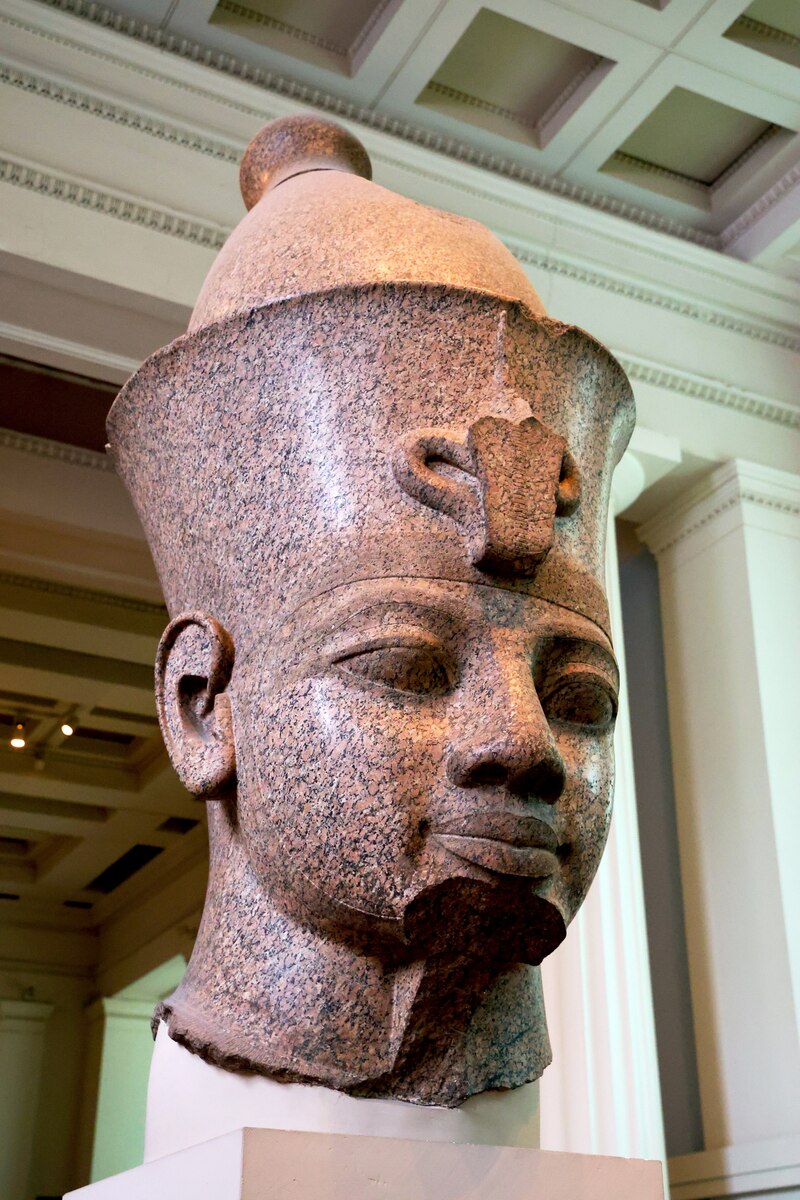
- A colossal red granite statue of the 18th Dynasty pharaoh Amenhotep III, dating from around 1370 BCE, found in the temple enclosure of Mut at Karnak in Upper Egypt. The surviving head wears the White Crown of Upper Egypt.
- Attribution qualification
- No maker is named in the supplied sources; the photographer and uploader of the file is not the sculptor.
- Dimensions
- Unknown
Catalogue identity and recorded names
The object documented in the Wikimedia Commons file is catalogued as a colossal red granite statue of the 18th Dynasty ancient Egyptian Pharaoh Amenhotep III, dated to around 1370 BCE. The material identification is consistently recorded as red granite, and the royal attribution places the work within the 18th Dynasty, the period of Amenhotep III's reign. The date supplied belongs to the object's ancient manufacture, not to any later moment of cataloguing, photography or publication. A separate Commons category names the same object as the colossal granite head of Amenhotep III at the British Museum, a title variant that narrows the description from a full statue to the head alone. Because the surviving object is a fragment rather than a complete figure, the broader catalogue title and the narrower category title describe the same monument at different levels of completeness, and both remain in circulation as recorded names for it.(Sanjay Acharya, 2023, File description; Category)
The object is a colossal red granite statue of the 18th Dynasty ancient Egyptian Pharaoh Amenhotep III.(Sanjay Acharya, 2023)
A Wikimedia Commons category for this object names it as the colossal granite head of Amenhotep III at the British Museum.(Sanjay Acharya, 2023)
Subject and iconography
LinkThe surviving fragment and its setting
Visual observation
What survives today is a colossal head in red granite, now held at the British Museum in London, where the Wikimedia Commons photograph by Sanjay Acharya was taken on 30 June 2023. The object is recorded as a colossal red granite statue of the 18th Dynasty pharaoh Amenhotep III, dated to around 1370 BCE, and it was found in the temple enclosure of Mut at Karnak in Upper Egypt. A Commons category for the object names it as the colossal granite head of Amenhotep III at the British Museum, a naming that already registers the crucial fact of its present condition: the work is a fragment, not a complete figure. Any description of the head therefore has to be read as a description of a part, and the evidence supplied here concerns the head and its material rather than the lost body that once carried it.(Sanjay Acharya, 2023, Vision-derived visual focus; File description)
Crown and cobra: royal signifiers
The most immediately legible attribute is the crown. The head wears the White Crown of Upper Egypt, described as a tall conical crown with a rounded top and a small knob. This is a named visual convention with geographic meaning: the White Crown is the traditional headgear of Upper Egyptian kingship, so its presence on a royal image is a statement about the part of Egypt the king rules, and here it names Upper Egypt directly. Set on the brow of that crown is a uraeus cobra with a sun disk, shown reared. The evidence identifies the uraeus as a royal symbol of protection and divine authority. Read together, the two elements do more than identify a ruler: the crown marks territory and the cobra marks sacred kingship, so the head carries a double royal claim that would have been visible from a distance even before the face itself was legible.(Sanjay Acharya, 2023, Vision-derived visual focus)
The face and the limits of likeness
The face is described in clearly observable terms: almond-shaped eyes, elongated cosmetic lines, a long nose, full lips and a serene expression, with a fully modelled left ear. These are the features that let the head be read as an idealised royal portrait rather than a record of an individual likeness, and the symmetry and calm noted in the description are part of that visual language. It is important to separate what is seen from what is inferred. The almond eyes, cosmetic lines, long nose, full lips, serene expression and modelled left ear are observation. The identification of the face as the face of Amenhotep III rests on the object's documented identity, not on the features themselves, which do not by their own appearance name a specific king. The serene and symmetrical presentation is what makes the image read as a stable, eternal ruler, but that reading is an interpretation of the visual conventions rather than a fact recorded on the stone.(Sanjay Acharya, 2023, Vision-derived visual focus)
Losses and modern mounting
Two damaged areas carry the object's history in their shape. A rough, broken patch at the chin marks where the ceremonial false beard was originally attached, so one of the pharaoh's key royal attributes is now lost; the beard, like the crown and the uraeus, belonged to the set of signs that made a royal image complete. A jagged lower edge shows where the colossal head was separated from its original body, and the fragment is now mounted on a modern plinth. The plinth is a modern support, not ancient masonry, and the jagged edge is the physical record of the break. Together these two features mean the surviving object is not a reduced version of the original but a partial one: a royal figure whose body is absent and whose false beard is missing. Descriptions of the head must therefore be distinguished from reconstructions of the whole statue that once stood at Karnak.(Sanjay Acharya, 2023, Vision-derived visual focus)
The statue's head wears the White Crown of Upper Egypt, a tall conical crown with a rounded top and small knob.(Sanjay Acharya, 2023)
The royal face shows almond-shaped eyes, elongated cosmetic lines, a long nose, full lips and a serene expression, with a fully modelled left ear.(Sanjay Acharya, 2023)
A rough, broken area at the chin marks where the ceremonial false beard was originally attached, so a key royal attribute is now lost.(Sanjay Acharya, 2023)
A jagged lower edge shows where the colossal head was separated from its original body, and the fragment is now mounted on a modern plinth.(Sanjay Acharya, 2023)
A uraeus cobra with a sun disk is shown reared on the brow of the crown, a royal symbol of protection and divine authority.(Sanjay Acharya, 2023)
Materials and technique
LinkMaterial, identity and setting
Visual observation
The object is a colossal head carved in red granite, identified as a statue of the 18th Dynasty pharaoh Amenhotep III and dated to around 1370 BCE. The material is stated in the source description of the object and is confirmed by its common English designation as a colossal red granite statue, while a Wikimedia Commons category for the object names it as the colossal granite head of Amenhotep III at the British Museum. Red granite is a hard stone, and the recorded scale of the head as a colossal royal image means that carving it required a substantial commitment of labour and abrasive technique, though the supplied evidence does not document the specific tools, quarry source or working sequence used to shape it. What the evidence establishes is the identification of the stone and the royal attribution; the cutting and polishing methods remain a matter of general stone-carving inference rather than direct technical examination. The head was found in the temple enclosure of Mut at Karnak in Upper Egypt and is now held at the British Museum in London, England, where a photograph of it was taken on 30 June 2023.(Sanjay Acharya, 2023, File description; Vision-derived visual focus)
Royal iconography on the surviving head
Interpretation
Taken as a group, the crown, the uraeus, the modelled face and the lost beard constitute a coherent royal image in red granite: the White Crown names Upper Egypt, the cobra with its sun disk signals protection and divine authority, and the calm, idealised face presents the pharaoh as a stable ruler. The red granite, associated with permanence, reinforces the intended endurance of that royal message. What remains is a broken head on a modern plinth, so the royal statement must be read through loss: the viewer supplies the missing colossal body, and the fragment carries the message without it. The evidence supports this as an interpretation of the surviving iconographic programme rather than as a documented account of how the original statue stood or how it was displayed in its temple setting.(Sanjay Acharya, 2023, Vision-derived visual focus; File description)
Condition and conservation
LinkCondition of the fragment
The object in its present state is a fragment. The head is separated from the original body, and the ceremonial false beard is lost. A rough, broken patch at the chin marks where that beard was originally attached, so one of the pharaoh's key royal attributes is absent from what survives. The lower edge of the head is jagged, showing where the colossal head was separated from the body to which it belonged. Read together, these features establish that the surviving fragment is not a reduced or complete composition but one detached part of a larger royal figure, and that its two most conspicuous losses, the beard and the body, are physically registered in the stone rather than inferred only from comparison with other statues.(Sanjay Acharya, 2023, Vision-derived visual focus)
The fragment is now mounted on a modern plinth. That support is a modern addition rather than ancient masonry, so the object's current upright presentation depends on a modern intervention even though no intervention date, treatment material or treatment record for the plinth is established by the available evidence. The mounting also conditions how the damaged lower edge and the surviving facial features are seen: the head is displayed as a self-contained sculptural unit, although it was carved as the upper part of a much larger figure. The photograph of the statue was taken at the British Museum on 30 June 2023, which supplies the date and place of the visual record on which these observations of the mounted state depend. Because that record is a photograph rather than a condition survey, it documents appearance at a moment in 2023 and cannot by itself establish the object's condition before or after that date.(Sanjay Acharya, 2023, Metadata; Vision-derived visual focus)
Documentation and the limits of the record
The condition record available here is inseparable from the documentation history of the object. A digital photograph of the statue was taken by Sanjay Acharya in 2023 and published on Wikimedia Commons under a Creative Commons Attribution-ShareAlike 4.0 International licence, and the file was assessed for quality images in May 2025. That sequence establishes a dated photographic record and a later quality assessment of the file, not a conservation examination, and the Commons file is treated here as a discovery aid rather than an institutional object record. The distinction matters for condition research: licence terms and quality-image assessments describe the photograph and its reuse, while the loss of the beard, the jagged separation from the body and the modern plinth are observations of the object itself. No cleaning, consolidation, pigment analysis, environmental control measure or dated treatment of the granite is established by the supplied evidence, and none should be inferred from the photographic record.(Sanjay Acharya, 2023, Metadata; Vision-derived visual focus; File description)
Interpretation
Because the surviving evidence is a 2023 photograph and its metadata, the condition described for this object should not be extended backward or forward. An account of the head as separated, bearded area broken and plinth-mounted applies to the documented state at and around the June 2023 photograph; it does not license the claim that the object looked the same at the time of its discovery at Karnak, during earlier museum display or after 2023. Equally, the fact that the historic loss of the beard and body occurred before the photograph does not date those losses. The honest research position is that the object survives incomplete, that the incompleteness is visible in the stone, and that the available evidence dates the photographic record rather than the breakage, the transfer to the British Museum or the installation on the modern support.(Sanjay Acharya, 2023, Vision-derived visual focus; Metadata; File description)
The object survives as a fragment: the head is separated from its original body and the false beard is lost.(Sanjay Acharya, 2023)
Provenance and ownership
LinkObject and Findspot
The object is a colossal red granite statue of the 18th Dynasty pharaoh Amenhotep III, dated in the Wikimedia Commons file description to around 1370 BCE. The same description records that it was found in the temple enclosure of Mut at Karnak, in Upper Egypt, and that it is held at the British Museum in London, England, where the photograph documenting it was taken. A separate Wikimedia Commons category for the object names it as the colossal granite head of Amenhotep III at the British Museum, a naming that corresponds to what survives rather than to the original complete figure. Commons functions here as a discovery aid rather than as an institutional object record, so its identity, material, dating and findspot statements are the framework within which the surviving object is documented in this account.(Sanjay Acharya, 2023, File description)
Interpretation
The findspot is the single documented point of ancient provenance supplied here: the statue was found in the temple enclosure of Mut at Karnak in Upper Egypt. Nothing in the evidence records the circumstances of the find, the date of discovery, the intervening route by which the object reached the British Museum, or any intermediate owner, dealer or collection. The gap between the temple enclosure and the London collection is therefore an unrecorded interval, not a documented sequence of transfers. The distinction matters for how the object is described: the evidence supports a findspot and a present holding, but it does not support a chain of ownership.(Sanjay Acharya, 2023, File description)
Condition and Mounting
What survives is a fragment rather than a complete royal figure. The evidence states that the head is separated from its original body and that the false beard is lost, and a jagged lower edge shows where the colossal head was separated from its original body. The fragment is now mounted on a modern plinth. The plinth is a modern support and not ancient masonry, so the object as displayed is a conjunction of ancient carved stone and modern mounting. The head wears the White Crown of Upper Egypt, a tall conical crown with a rounded top and small knob, and a uraeus cobra with a sun disk is shown reared on the brow of the crown, a royal symbol of protection and divine authority. The royal face shows almond-shaped eyes, elongated cosmetic lines, a long nose, full lips and a serene expression, with a fully modelled left ear. A rough, broken area at the chin marks where the ceremonial false beard was originally attached, so a key royal attribute is now lost. Taken together, these features identify the piece as the royal head of a much larger figure whose body, beard and original setting no longer accompany it.(Sanjay Acharya, 2023, File description; Metadata; Licensing and file history)
Provenance timeline
- 30 June 2023
A digital photograph of the statue is taken at the British Museum in London.(Sanjay Acharya, 2023, Metadata)
Exhibition and Display History
The exhibition history of the colossal red granite head of Amenhotep III can be stated only in the terms the available evidence supports. The photograph through which the object is documented here was taken at the British Museum, London, on 30 June 2023, so that date records a moment of photography at the museum rather than the opening or run of a named exhibition. The evidence supplies no exhibition title, no venue beyond the British Museum, no dates of display, and no catalogue number, page or plate for this object, and those gaps should be respected rather than filled with plausible-sounding loans or installation histories. What the record does establish is that the head was at the British Museum when it was photographed in June 2023, which places the object in the museum's care at that time and makes any account of its public presentation depend on a display record that the supplied evidence does not contain.(Sanjay Acharya, 2023, Metadata)
Physical State and the Conditions of Viewing
The findspot supplies the historical frame within which the fragment's later museum life should be understood. The statue was found in the temple enclosure of Mut at Karnak in Upper Egypt, a royal image set up within a divine precinct associated with the goddess Mut. That context is the object's primary archaeological setting and predates by many centuries the London photograph of 30 June 2023 and the Commons file of the same year. Reading the modern display against the original precinct clarifies what has changed: the head once formed part of a colossal figure embedded in a temple landscape, and it now exists as an isolated, plinth-mounted fragment documented largely through digital photography and open licensing.(Sanjay Acharya, 2023, File description; Metadata)
Reception and literature
LinkModern Photographic Reception
The most fully documented modern act of reception around this object concerns not an ancient audience but a digital one. A photograph of the colossal red granite statue by Sanjay Acharya was taken in 2023 and published on Wikimedia Commons under a Creative Commons Attribution-ShareAlike 4.0 International licence. The same evidence records that the file was assessed for quality images in May 2025, which places the image within Commons's own internal review processes rather than leaving it as an unvetted upload. Wikimedia Commons is best treated as a discovery aid rather than an institutional object record, so this publication stage documents circulation and licensing rather than the sculpture's own archaeological history. The photographer's name, the licence type, the assessment stage and its date are the concrete facts this unit establishes; the question of how widely the image was subsequently reused is not something the evidence answers.(Sanjay Acharya, 2023, Licensing and file history)
Fragment, Support and the Limits of the Record
Visual observation
The evidence for reception here is bounded. The supplied units establish the object's material identity as a colossal red granite statue of Amenhotep III, dated to around 1370 BCE, found in the temple enclosure of Mut at Karnak and held at the British Museum, where the 2023 photograph was taken; a Wikimedia Commons category for the object names it as the colossal granite head of Amenhotep III at the British Museum. They also establish that the object survives as a fragment, with the head separated from its original body and the false beard lost. What the evidence does not supply is any named early admirer, historical biography, literary reading, public event beyond the museum photograph, or documented artistic appropriation, and no account of when or how the head entered the British Museum collection is given. The reception record assembled here is therefore strongest on the object's modern photographic and museum presence, and it should not be stretched to cover stages the evidence does not document.(Sanjay Acharya, 2023, Licensing and file history; Vision-derived visual focus; File description)
Why the Object Matters Across Its Roles
Interpretation
Seen together, the units show a meaningful shift in what the object does for its audiences without requiring the older roles to be discarded. Its original function was royal and religious: a colossal image of an 18th Dynasty pharaoh, erected in the temple enclosure of Mut at Karnak, using red granite and royal insignia to link the king to the divine sphere and to the goddess Mut, a context the evidence states directly. Its modern role is documentary and museological: a fragment, mounted on a modern plinth, separated from its body, photographed at the British Museum and distributed under an open licence with a quality assessment in May 2025. The loss of the false beard and the break from the body change how the surviving head reads, because the royal attributes are now incomplete and the plinth announces modern stewardship. Interpreted in this light, the object's significance accumulates across stages rather than resting on a single dramatic event: the ancient royal message, the archaeological findspot, the museum fragment and the openly licensed digital image each add a layer, and each is supported by a different part of the record. The evidence supports that layered picture but does not support claims about fame, influence or appropriation beyond the photographic and licensing facts it records.(Sanjay Acharya, 2023, File description; Vision-derived visual focus; Metadata; Licensing and file history)
A digital photograph of the statue by Sanjay Acharya, taken in 2023, was published on Wikimedia Commons under a Creative Commons Attribution-ShareAlike 4.0 International licence, and the file was assessed for quality images in May 2025.(Sanjay Acharya, 2023)
Collection and display
LinkThe object in its current collection
The object is a colossal red granite head of Amenhotep III, an 18th Dynasty pharaoh of ancient Egypt, dated to around 1370 BCE, and it is held at the British Museum in London, England, which is also the location where the photograph documenting it was taken. A Wikimedia Commons category for this object names it as the colossal granite head of Amenhotep III at the British Museum, in agreement with the file description's identification. Within the collection and display context, the decisive fact is that the surviving sculpture is not in its original setting: it is an institutional holding, photographed on 30 June 2023, rather than an object studied in its ancient context of use.(Sanjay Acharya, 2023, File description)
The object survives only as a fragment. The head is separated from its original body, a break marked by a jagged lower edge, and the ceremonial false beard that once attached at the chin is lost, leaving a rough, broken area there. Because the beard is gone, a key royal attribute is absent from the image as it now appears. The head is mounted on a modern plinth, so the display support is a contemporary addition rather than ancient masonry. These conditions qualify how the object can be read: what is displayed is one surviving part of a much larger royal figure, not a complete standing or seated pharaoh, and the separation and loss are themselves part of the object's documented state.(Sanjay Acharya, 2023, File description)
The photograph itself has a documented history. It is a digital photograph of the statue by Sanjay Acharya, taken in 2023 and published on Wikimedia Commons under a Creative Commons Attribution-ShareAlike 4.0 International licence; the file was assessed for quality images in May 2025. This documentation status matters for the research account because the accessible image of the object is a licensed, quality-assessed digital surrogate made at the museum, and the Wikimedia Commons file is treated as a discovery aid rather than an institutional object record. The file description supplies the object identity, material, dating and findspot, but the authoritative object record would be the museum's own documentation.(Sanjay Acharya, 2023, File description)
The statue is held at the British Museum, London, England, where the photograph was taken.(Sanjay Acharya, 2023)
Documented values and qualified estimates
LinkRecorded values
Interpretation
The single valuation unit supplied is a calculated working insurance estimate of US$10M to US$50M, recorded as a working calculation generated on 2026-10-16. Its stated methodology draws only on the confirmed context: a colossal red granite royal statue of Amenhotep III, 18th Dynasty, around 1370 BCE, found in the temple enclosure of Mut at Karnak, and photographed at the British Museum. The range is built from the object class of royal ancient Egyptian colossal sculpture in red granite, its great antiquity, its royal subject, the monumental scale implied by the term colossal, and the surviving head wearing the White Crown of Upper Egypt. The unit is explicit that no comparable sales, auction records, or private insurance schedules were used, and that the range is intentionally broad and conservative for manual review. It is therefore a model-generated working range and not an official insurance value, appraisal, auction result, or sale price.(Sanjay Acharya, 2023)
The breadth of the recorded range is internally explained rather than left as arbitrary. The upper end assumes a complete or near-complete royal colossus with a strong institutional exhibition and publication history, while the lower end assumes a fragmentary or head-only survival, or a cast, replica, or non-original work. The unit further notes that the low end allows for the negative effect of an unresolved title and the absence of an accession number. These assumptions connect the monetary figure directly to physical condition and documentation: the same object could sit anywhere in the range depending on how much of the original body survives and how thoroughly the piece has been published. Any actual insurance value, the unit states, would require professional appraisal, provenance research, and object-specific documentation.(Sanjay Acharya, 2023)
Several qualifications in the valuation unit limit how the figure should be used. Identification confidence is described as medium, title variants exist, and no accession number or maker is recorded in the supplied sources. The object is recorded as a museum-held ancient Egyptian royal sculpture at the British Museum, and the unit states that no private ownership or market transaction is established by the supplied excerpts. The calculation is dated 2026-10-16 as a working calculation for manual review only. Recording these caveats alongside the number is itself part of the object's documented values history, because the figure is inseparable from the uncertainty the same unit acknowledges.(Sanjay Acharya, 2023)
Form and survival
Physical condition supplies much of the evidence that a valuation would need to test. The object survives as a fragment: the head is separated from its original body, and a jagged lower edge marks where the colossal head was detached. The fragment is now mounted on a modern plinth, a modern support rather than ancient masonry. The ceremonial false beard is lost, and a rough, broken area at the chin marks where it was originally attached, so a key royal attribute is absent from the image as it now appears. These details are directly relevant to the lower assumptions in the recorded range, including the possibility of head-only survival, and they distinguish the surviving fragment from the complete royal figure its iconography once addressed.(Sanjay Acharya, 2023)
The surviving head still carries a coherent royal programme. It wears the White Crown of Upper Egypt, described as a tall conical crown with a rounded top and a small knob, and a uraeus cobra with a sun disk is shown reared on the brow of the crown as a royal symbol of protection and divine authority. The royal face shows almond-shaped eyes, elongated cosmetic lines, a long nose, full lips and a serene expression, with a fully modelled left ear. The iconography and the idealised facial treatment together present the king within established conventions of royal representation, and they are the features the valuation unit treats as central to the object class and its high-end assumptions.(Sanjay Acharya, 2023)
Naming and documentation variance
One further identification thread should be kept alongside the main description. A Wikimedia Commons category for this object names it as the colossal granite head of Amenhotep III at the British Museum, a title that differs from the file description's fuller phrasing. The valuation unit records that title variants exist and that there is no accession number, which is consistent with the presence of more than one name in the Commons material. The difference is a naming difference between records rather than a disagreement about the object's identity, but it is exactly the kind of unresolved title the low end of the recorded range is said to allow for. Because the Commons material is designated a discovery aid rather than an institutional record, the variance is not resolved here.(Sanjay Acharya, 2023)
Working estimate
Calculated working insurance estimate, not a sale price: Estimated value: US$10M to US$50M Recorded date: Working calculation, generated 2026-10-16. Methodology: This broad working insurance range is calculated from the confirmed context only: a colossal red granite royal statue of Amenhotep III, 18th Dynasty, around 1370 BCE, found in the temple enclosure of Mut at Karnak and photographed at the British Museum, London. The range reflects the object class (royal ancient Egyptian colossal sculpture in red granite), its great antiquity, royal subject, monumental scale suggested by the term colossal, and the surviving head wearing the White Crown of Upper Egypt. The high end of the range assumes a complete or near-complete royal colossus with a strong institutional exhibition and publication history. The low end assumes a fragmentary or head-only survival, or a cast, replica, or non-original work, and allows for the negative effect of an unresolved title and no accession number. No comparable sales, auction records, or private insurance schedules were used. The range is intentionally broad and conservative for manual review. Qualification: This is a model-generated working insurance range for manual review only. It is not an official insurance value, appraisal, auction result, or sale price. The object is recorded as a museum-held ancient Egyptian royal sculpture at the British Museum, and no private ownership or market transaction is established by the supplied excerpts. Identification confidence is medium, title variants exist, and no accession number or maker is recorded in the supplied sources. Actual insurance values require professional appraisal, provenance research, and object-specific documentation.(Sanjay Acharya, 2023)