ArchiveBust of Ramesses II

Artwork record / 189 of 331

Bust of Ramesses II by Maker unknown (New Kingdom)

Artist: Maker unknown

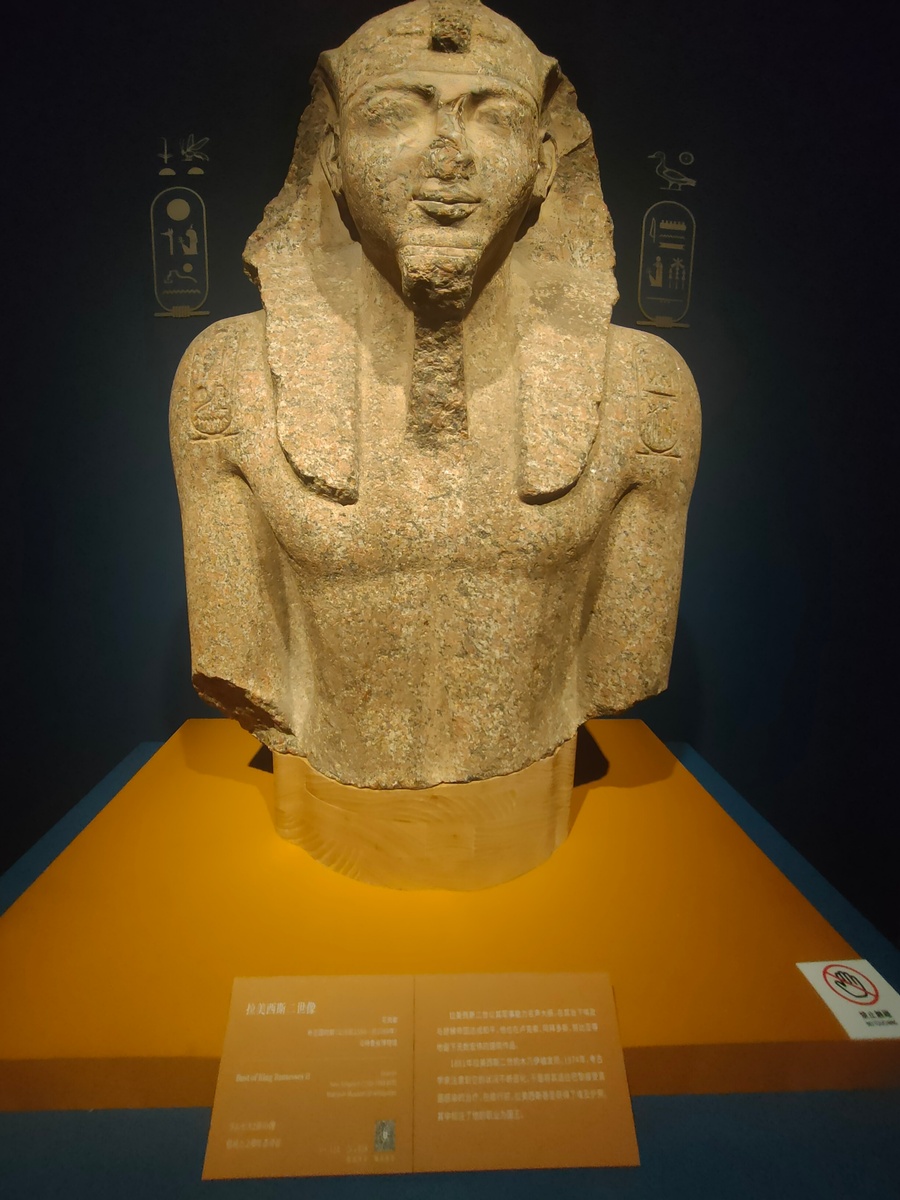
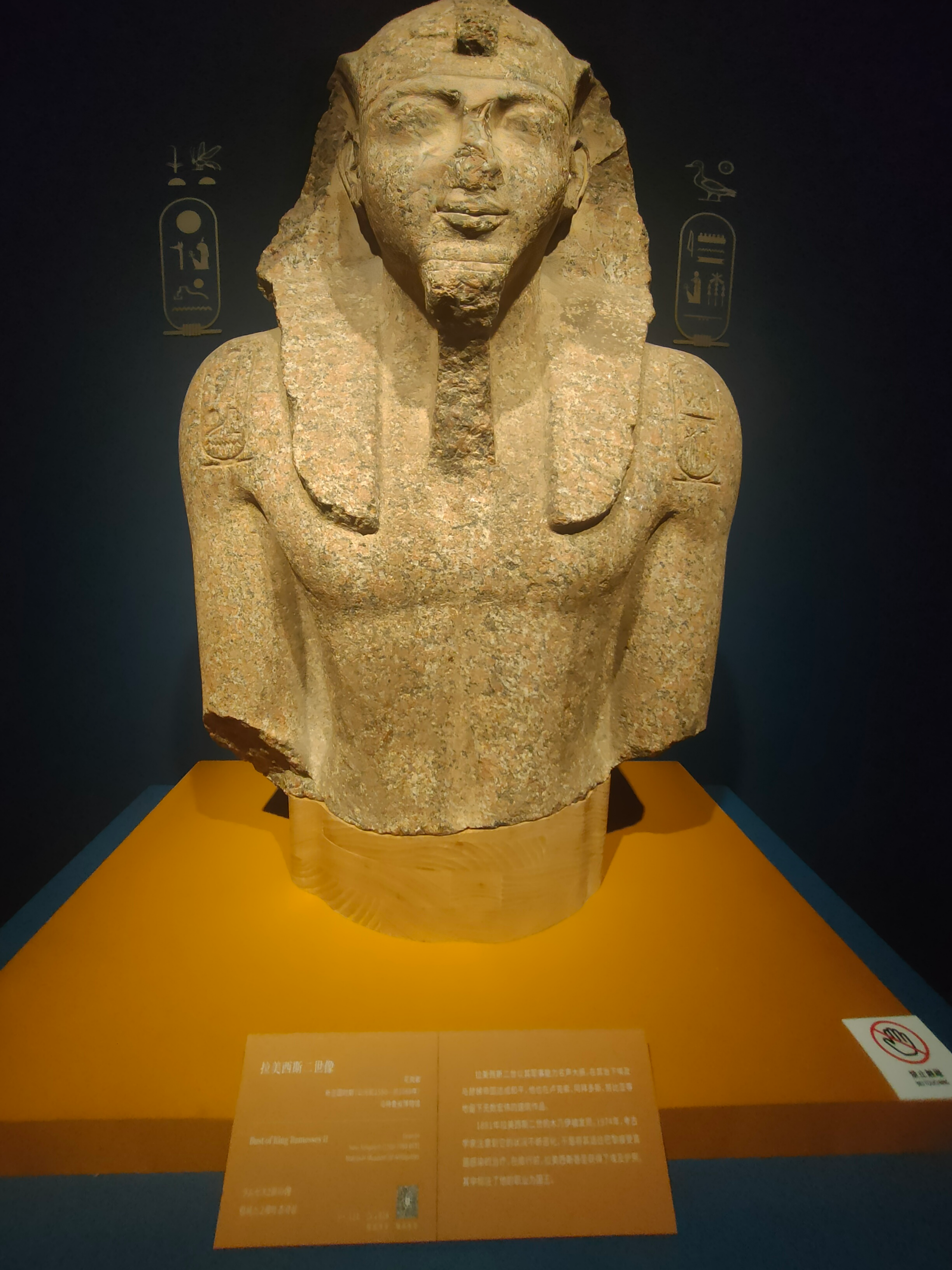
A stone bust of King Ramesses II, carved in ancient Egypt's New Kingdom, shown wearing the nemes headdress and a ceremonial false beard. Photographed on display at the Shanghai Museum's ancient Egypt exhibition in July 2025, it survives without its lower body, its uraeus cobra and its original nose. The sculptor is not named in the surviving record.

Read the story ↓ About the artist ↓ Research and record ↓ Literature and sources ↓ Listen to the article ↓
Article text for AI
Shop this artwork ↓ 8 visits
DateNew KingdomCultureAncient Egypt PeriodNew Kingdom, ancient EgyptCurrent locationShanghai Museum, Shanghai, China
Listen to the article
100%
Bust of Ramesses II by Maker unknown (New Kingdom)
Loading full-resolution artwork…
Scroll to zoom · drag to pan · double-click to focus Pinch to zoom · drag to explore · double-tap to focus FIELD VIEW / 189
Tools & download
Pixel colour Select a pixel with the eyedropper
No pixel selected

Choose the eyedropper, then click or tap the image. Scroll to zoom for finer selection.

Add text

Hand to pan · Select to move text and drawings · Add as many texts as you like · Scroll to zoom

Bust of Ramesses II: high-resolution image

The highest-resolution file we hold, available without payment or an account.2,448 × 3,264 pixels.

Download highest-resolution image

Details to notice

About 3 minutes to read
01

Broken lower edge and stone surface

The rough fracture line where the bust was separated from the rest of the statue, exposing the coarse granodiorite grain and pitted weathering that reveal the material and working method.

02

Cartouche on king's left shoulder

The matching incised cartouche on the king's left shoulder, viewer's right, carrying further royal names in hieroglyphs; together with the other cartouche it anchors the statue's identity.

03

Cartouche on king's right shoulder

An incised oval cartouche with hieroglyphic royal names on the king's right shoulder, viewer's left; the inscribed titulary that identifies the owner and shows Ramesside self-representation.

Portrait unrecorded

About the makers

Maker unknown

Individual life dates unrecorded

Biographical details and a verified portrait have not yet been recorded for this attribution.

The research & record

Study the work.
Follow the evidence.

Find catalogue details, historical context, technical research and the literature behind this artwork.

Article text for AI
Open research text

The artwork record

Research catalogue

Catalogue information and detailed research, with references that link to the bibliography.

Updated .

Identity and catalogue

Link
Title
Bust of Ramesses II(Perimeter Chou, 2025)
Artist or attribution
Maker unknown
Object date
New Kingdom(Perimeter Chou, 2025)
Medium and support
Stone sculpture
Current collection or location
Shanghai Museum, Shanghai, China(Perimeter Chou, 2025)
Movement or period
New Kingdom, ancient Egypt
Country or culture
Ancient Egypt
Depicted subject
A stone bust of King Ramesses II of Egypt, carved in the New Kingdom, showing the king wearing the nemes headdress with a ceremonial false beard and the broken socket of a uraeus on the brow band. The bust was photographed on display at the Shanghai Museum during an ancient Egypt exhibition in July 2025.
Title variants
Bust of Ramensses II; 拉美西斯二世像
Attribution qualification
Maker unknown. The supplied sources do not name a sculptor.
Dimensions
Unknown
Catalogue identity

The object is identified in the supplied file title simply as a Bust of Ramesses II, and it is captioned as a bust of Ramesses II of the New Kingdom. The Wikimedia Commons description classifies the object type as an artifact rather than a painting, a useful clarification because the photographic record of such a sculpture circulates in contexts where the medium of the documentation can be confused with the medium of the object itself. The king's name is that of Ramesses II, and the New Kingdom designation situates the work within the long pharaonic period rather than within a later revival or a modern reproduction. The sculptor's name does not survive in the supplied evidence, so the maker remains unknown, and no evidence unit names an artist, workshop, or patron. What the catalogue record does establish is the subject, the object type, and the broad period attribution.(Perimeter Chou, 2025, File title; Captions, English; Description)

Condition, material and carved detail

Interpretation

The surviving sculpture is a fragment: the bust was separated from the rest of the statue, so what now exists is the head, the shoulders, and the upper chest rather than a complete figure. A rough fracture line marks where the bust was separated, and that edge exposes the coarse grain of the granodiorite as well as the pitted weathering that reveal the material and the working method. The face shows almond eyes, stone-pitted cheeks, and a damaged nose; across the brow runs a band, and at its centre the cobra of the uraeus is broken away, leaving only its socket. The king wears a striped nemes headdress whose wide lappets fall forward over the chest, and a long straight false beard descends from the chin between those lappets, its lower end worn and blunt. Two incised oval cartouches with hieroglyphic royal names appear on the king's shoulders and identify the owner. These observations establish both the form of the fragment and the extent of its historical loss: nose, uraeus, and body below the chest are all missing, and the surviving surfaces carry the pitting and abrasion of long weathering.(Perimeter Chou, 2025, Description)

Regalia, display and open provenance questions

In Egyptian royal sculpture, the nemes headdress and the false beard are markers of kingship and divine status, and the bust's royal regalia signal Ramesses II's identity and authority. The striped headdress, the straight beard, and the brow band together announce the king's authority even though the rest of the body is gone; the cartouches on the shoulders supply the same identification in writing, naming the owner directly in hieroglyphic royal names. The evidence does not establish the original location where the bust was set up, the exact findspot, the original context, or the acquisition history of the piece, and those questions remain open on the supplied record. What is recorded is the display context and the date of the photograph: the bust was displayed at the Shanghai Museum as part of an ancient Egypt civilization exhibition, photographed there on 5 July 2025, and the Commons file is categorised under Collections of the Shanghai Museum. That exhibition and photographic record are modern events in the object's life, distinct from the New Kingdom date of the carving itself, and the catalogue date attached to the file belongs to the documentation rather than to the sculpture's manufacture.(Perimeter Chou, 2025, Captions, English; No provenance field supplied)

The supplied file title identifies the object as a Bust of Ramesses II.(Perimeter Chou, 2025)

The object is captioned as a bust of Ramesses II of the New Kingdom.(Perimeter Chou, 2025)

The Commons description names the object type as an artifact, not a painting.(Perimeter Chou, 2025)

Subject and iconography

Link
The object and its recorded appearance

Visual observation

The object recorded here is a bust of Ramesses II, photographed at the Shanghai Museum on 5 July 2025 during an ancient Egypt civilization exhibition and filed in Wikimedia Commons under the museum's collections. The surviving image shows the king's carved head and upper chest only: the face with almond eyes and stone-pitted cheeks, the nose damaged, and across the brow a band whose central cobra, the uraeus, is broken away so that only its socket remains. Around the face falls the striped nemes headdress, its wide lappets dropping forward over the chest, and between those lappets a long straight false beard descends from the chin, its lower end worn and blunt. Observing these features is not the same as explaining them. The headdress, the beard and the brow band are recorded visual forms; their identification as royal regalia, and the claim that they mark kingship and divine status, belong to an attributed reading of Egyptian royal sculpture rather than to the photograph itself.(Perimeter Chou, 2025, Vision-derived focus, fractured_base_edge; Vision-derived focus, cartouche_right_shoulder and cartouche_left_shoulder)

Two incised oval cartouches carrying hieroglyphic royal names appear on the king's shoulders. The supplied file record treats these inscriptions as the means by which the owner is identified, which is why the bust can be titled for Ramesses II at all; the identification of the sitter rests on the written names rather than on the portrait alone. The same file attributes the object to the New Kingdom and names the object type as an artifact rather than a painting. What the evidence does not supply is equally important for the account: the exact findspot, the original context and the acquisition history of the bust are not recorded in the supplied sources, so no provenance interval, site or prior owner can be stated. The bust's presence at the Shanghai Museum in 2025 is documented; the route by which it reached that display is not.(Perimeter Chou, 2025, Vision-derived focus, cartouche_right_shoulder and cartouche_left_shoulder)

Material, fracture and loss

The condition of the stone is itself part of the visual record. A rough fracture line marks where the bust was separated from the rest of the statue. At that break the coarse granodiorite grain is exposed, together with pitted weathering, and the file record reads those features as evidence of the material and of the working method. The losses are multiple and cumulative: the nose is damaged, the uraeus cobra is broken away from the brow band, and the body below the chest is missing, so what survives is a fragment of a much larger statue. The bust therefore does not preserve a complete original but a survival, and its fragmentary state is a documented condition rather than an inferred one. No pigment, treatment or restoration is recorded in the evidence, and none should be assumed from the appearance of the surface.(Perimeter Chou, 2025, Vision-derived focus, fractured_base_edge)

Interpretation

Read together, the regalia and the cartouches do two different kinds of work. The two oval cartouches incised on the shoulders carry the royal names and identify the owner in writing; the nemes headdress, the straight false beard and the brow band present the king in the visual language through which a pharaoh is shown as pharaoh. The supplied material attributes to Egyptian royal sculpture the convention that the nemes and false beard are markers of kingship and divine status, and on that attributed reading the bust's royal regalia announce Ramesses II's identity and authority even though the body below the chest is gone. It is worth keeping observation and identification apart here: that the headdress is striped, that the beard is long and straight, and that the cartouches are oval and incised are things seen; that these forms function as markers of kingship and divine status is a scholarly and institutional interpretation carried by the file record, not a property visible in the photograph by itself.(Perimeter Chou, 2025, Vision-derived focus, fractured_base_edge; Vision-derived focus, cartouche_right_shoulder and cartouche_left_shoulder)

Visual observation

The bust shows the king's carved face with almond eyes, a damaged nose, and stone-pitted cheeks, framed by the brow band and the broken base of the uraeus.(Perimeter Chou, 2025)

The king wears a striped nemes headdress whose wide lappets fall forward over the chest; the cobra head of the uraeus on the brow band is broken away, leaving only its socket.(Perimeter Chou, 2025)

A long straight false beard descends from the chin between the nemes lappets, its lower end worn and blunt.(Perimeter Chou, 2025)

A rough fracture line marks where the bust was separated from the rest of the statue, exposing the coarse granodiorite grain and pitted weathering that reveal the material and working method.(Perimeter Chou, 2025)

Two incised oval cartouches with hieroglyphic royal names appear on the king's shoulders, identifying the owner.(Perimeter Chou, 2025)

Condition and conservation

Link

Visual observation

The bust is a fragment, and its condition is the first thing to establish before any interpretation of its appearance. The nose is damaged, the uraeus cobra that once stood on the brow band is broken away so that only its socket remains, and the bust is separated from the rest of the statue. These are all losses the object carries now, and the supplied sources present them as evidence of substantial historical loss rather than as restorations or modern damage. The line between what survives and what is gone is therefore the starting point for any condition account: the face survives, the identifying regalia survives in part, and the lower body does not.(Perimeter Chou, 2025, Vision-derived focus details; Vision-derived focus, nemes_headdress)

Looking at the surviving surface, the carved face keeps its almond eyes and stone-pitted cheeks, framed by the brow band and by the broken base of the uraeus. The pitting and the damaged nose are condition observations about the stone as it now appears, not reconstructions of how it looked when carved. The cheeks are described as stone-pitted, which the sources pair with the weathering visible in the material, so surface condition and material identification are treated together in the record rather than separated.(Perimeter Chou, 2025, Vision-derived focus, royal_face; Vision-derived focus, nemes_headdress)

The headdress and beard give the damage a shape within the royal image. The king wears a striped nemes headdress whose wide lappets fall forward over the chest, and the cobra head of the uraeus on the brow band is broken away, leaving only its socket. A long straight false beard descends from the chin between the nemes lappets, and its lower end is worn and blunt. The blunt beard tip and the empty uraeus socket are both losses at projecting or projecting-adjacent points of the carving, and the supplied account records them as observed condition rather than as the result of a named treatment.(Perimeter Chou, 2025, Vision-derived focus, nemes_headdress; Vision-derived focus, false_beard)

The separation of the bust from the rest of the statue is documented in the condition evidence alongside the damaged nose and the broken uraeus, and the sources treat the three losses together as indicating substantial historical loss. This matters for how the object is read: a bust cut off below the chest cannot be assessed for the proportions, pose or support of the complete statue from the surviving remnant alone, and the supplied evidence offers no account of when or how the separation occurred. The condition account therefore establishes the losses without dating them or attributing them to a specific episode.(Perimeter Chou, 2025, Vision-derived focus details; Vision-derived focus, false_beard)

The nose is damaged, the uraeus is broken away, and the bust is separated from the rest of the statue, indicating substantial historical loss.(Perimeter Chou, 2025)

Provenance and ownership

Link
Documented Custody and Display

The supplied sources do not record the exact findspot, original context or acquisition history of this bust, so neither the place where it was first set up nor the route by which it entered modern custodianship can be stated from the available evidence. What is available is a recorded event of display rather than a chain of ownership: the bust appeared at the Shanghai Museum as part of an ancient Egypt civilization exhibition, where it was photographed on 5 July 2025, and the Commons file that documents it is categorised under Collections of the Shanghai Museum. That category and that display date establish where and when the object was seen and recorded, not when or how it came to be there. The gap in the record is therefore an absence of evidence, not evidence of a change of ownership, and the interval between the statue's ancient creation and its 2025 exhibition remains unrecorded in the supplied material.(Perimeter Chou, 2025, No provenance field supplied; Description and Summary)

The bust's own inscriptions carry the identification that in other cases a provenance record would supply. Two incised oval cartouches with hieroglyphic royal names appear on the king's shoulders, and these names identify the owner. Where findspot and acquisition history are silent, the cartouches name the royal person the sculpture represents, tying the fragment to a specific king rather than leaving its subject anonymous. This is an internal, carved form of identification, distinct from any external documentation of ownership or transfer, and the supplied evidence treats it as such: it establishes whose image the bust is, not where the bust has been.(Perimeter Chou, 2025, No provenance field supplied)

Material Loss and the Limits of the Record

The object's condition is itself part of its material history. The bust is separated from the rest of the statue by a rough fracture line at the base of the neck, exposing the coarse granodiorite grain and the pitted weathering; the nose is damaged, and the cobra head of the uraeus on the brow band is broken away, leaving only its socket. These losses indicate substantial historical damage, and they mark the sculpture as a survival rather than a complete original. What the evidence does not establish is when or how any of these breaks occurred, so the fracture line and the missing uraeus, nose and lower body cannot be assigned to a documented event or date. The bust's known modern history begins with its recorded exhibition, while its physical losses remain undated in the supplied sources.(Perimeter Chou, 2025, No provenance field supplied; Description and Summary)

The exact findspot, original context and acquisition history of this bust are not recorded in the supplied sources.(Perimeter Chou, 2025)

Provenance timeline
  1. 5 July 2025

    The bust was displayed at the Shanghai Museum as part of an ancient Egypt civilization exhibition and was photographed there.(Perimeter Chou, 2025, Description and Summary)

Exhibition history

Link
Exhibition Record

The exhibition record for this object is short and specific. According to the supplied file record, the bust was displayed at the Shanghai Museum as part of an ancient Egypt civilization exhibition, and the photograph documenting that display was taken there on 5 July 2025. The same record places the file under categories for the Collections of the Shanghai Museum, which is how the display is linked to that institution rather than to an unspecified venue. The evidence does not name the exhibition beyond its characterization as an ancient Egypt civilization exhibition, and it supplies no catalogue, no catalogue number, no plate and no page reference, so the exhibition history available here rests on the display itself and on the dated photograph rather than on published exhibition documentation.(Perimeter Chou, 2025, Description and Summary)

The bust was displayed at the Shanghai Museum as part of an ancient Egypt civilization exhibition, photographed there on 5 July 2025.(Perimeter Chou, 2025)

Interpretations and debates

Link
Regalia as Royal and Divine Language

Interpretation

The interpretation attached to the bust reads its regalia as a coded statement of status: in Egyptian royal sculpture, the nemes headdress and the false beard function as markers of kingship and divine status, so that the striped headdress, the straight beard and the brow band together signal Ramesses II's identity and authority. This is an attributed reading of visual convention rather than a claim about what the maker privately intended, and it is reinforced by the physical details the bust preserves: the striped nemes whose wide lappets fall forward over the chest, the long straight false beard descending from the chin between those lappets, and the brow band whose uraeus cobra is broken away and survives only as a socket. Reading the regalia as royal and divine language explains why the bust can still communicate kingship even though the body below the chest is gone, because the identifying and status-bearing elements are concentrated in the head and shoulders rather than in the missing torso.(Perimeter Chou, 2025, Vision-derived focus, interpretation note; Vision-derived focus, fractured_base_edge; Vision-derived focus, cartouche_right_shoulder and cartouche_left_shoulder)

In Egyptian royal sculpture, the nemes headdress and false beard are markers of kingship and divine status; the bust's royal regalia signal Ramesses II's identity and authority.(Perimeter Chou, 2025)

Collection and display

Link
Institutional context and documentation

The Commons file record for this object categorises it under Collections of the Shanghai Museum, which is the institutional frame the supplied record gives for the bust at the moment of its documentation. That categorisation is a file-level description rather than a full museum accession record. It establishes where the object was when it was photographed and recorded, and it locates the surviving bust within a public museum collection context, but it does not by itself supply an accession number, a department, or a collecting history.(Perimeter Chou, 2025, Category)

The Commons file is categorised under Collections of the Shanghai Museum.(Perimeter Chou, 2025)

Documented values and qualified estimates

Link
Recorded values

Interpretation

The only object-specific valuation record supplied for this bust is a working insurance calculation, generated on 16 October 2026, which places a broad range of US$1,000,000 to US$8,000,000 on the piece. The method is explicitly qualitative and context-bound: it takes as its starting point the confirmed identification of a stone sculpture as a bust of Ramesses II of the New Kingdom, maker unknown, photographed on display at the Shanghai Museum in July 2025, and anchors the range in the object type of royal ancient Egyptian stone sculpture, the cultural and historical weight of Ramesses II, the museum-exhibition setting, and the general rarity and prominence of comparable royal New Kingdom sculpture. The document is candid that no dimensions, accession number, ownership record, provenance, prior sale, auction result or official appraisal was supplied, so scale and condition cannot be modeled; the low end is meant to absorb uncertainty in scale, condition and legal title, while the high end reflects the top-tier market and insurance relevance that major royal Egyptian stone sculpture can carry.(Perimeter Chou, 2025)

The figure should not be read as a market fact. The same record labels itself a manual-review placeholder and a model-generated working range rather than an official insurance value, appraisal, auction result or sale price, and states that it is not based on comparables, private insurance records, provenance research, condition reports or title review. It further warns that actual insurance, market and institutional values may fall well outside the range and require qualified professional assessment. This qualification aligns with what the object record itself leaves unrecorded: the bust's exact findspot, original context and acquisition history are not documented in the supplied sources, so there is no provenance chain, ownership history or condition report against which any monetary estimate could be tested. The range therefore stands as an acknowledged working hypothesis for manual review, not as evidence about the sculpture's documented value.(Perimeter Chou, 2025)

Working estimate

Calculated working insurance estimate, not a sale price: Working insurance range: US$1M to US$8M Recorded date: Working calculation, generated 2026-10-16. Methodology: This working range is calculated from the confirmed context only: a stone sculpture identified as a bust of Ramesses II, New Kingdom, ancient Egypt, maker unknown, photographed on display at the Shanghai Museum in July 2025. No dimensions, accession number, ownership record, provenance, prior sale, auction result, or official appraisal was supplied, so scale and condition cannot be modeled. The range is therefore intentionally very broad and conservative. It uses the object type (royal ancient Egyptian stone sculpture), high cultural and historical significance of Ramesses II, museum-exhibition context, and the general rarity and prominence of comparable royal New Kingdom sculpture as qualitative anchors. It does not rely on any specific comparable sale or private insurance data. The low end reflects uncertainty in scale, condition, and legal title, while the high end reflects the top-tier market and insurance relevance that major royal Egyptian stone sculpture can carry. This is a manual-review placeholder rather than a precise figure. Qualification: This is a model-generated working insurance range for manual review only. It is not an official insurance value, appraisal, auction result, or sale price. It is not based on comparables, private insurance records, provenance research, condition reports, or title review. Actual insurance, market, and institutional values may fall well outside this range and require qualified professional assessment.(Perimeter Chou, 2025)

Bibliography

Sources and further reading

References are arranged by author or organisation, with links to the original publications. Where no publication date is recorded, n.d. means no date.

Source notes updated .

  1. 01

    Secondary · About this artwork

    Wikimedia Commons: Bust of Ramesses II. Bust of Ramesses II, Shanghai Museum, Ancient Egypt Exhibition, 2025-07-05.jpg. Wikimedia Commons.

    Wikimedia Commons photograph and file record used to identify the bust's title, New Kingdom attribution, and its display at the Shanghai Museum's ancient Egypt exhibition on 5 July 2025.

    Language
    English
    Link to reference
    Citation text

Article text and sources · Reading and attribution

An unhandled error has occurred. Reload 🗙