The story About 4 minutes to read
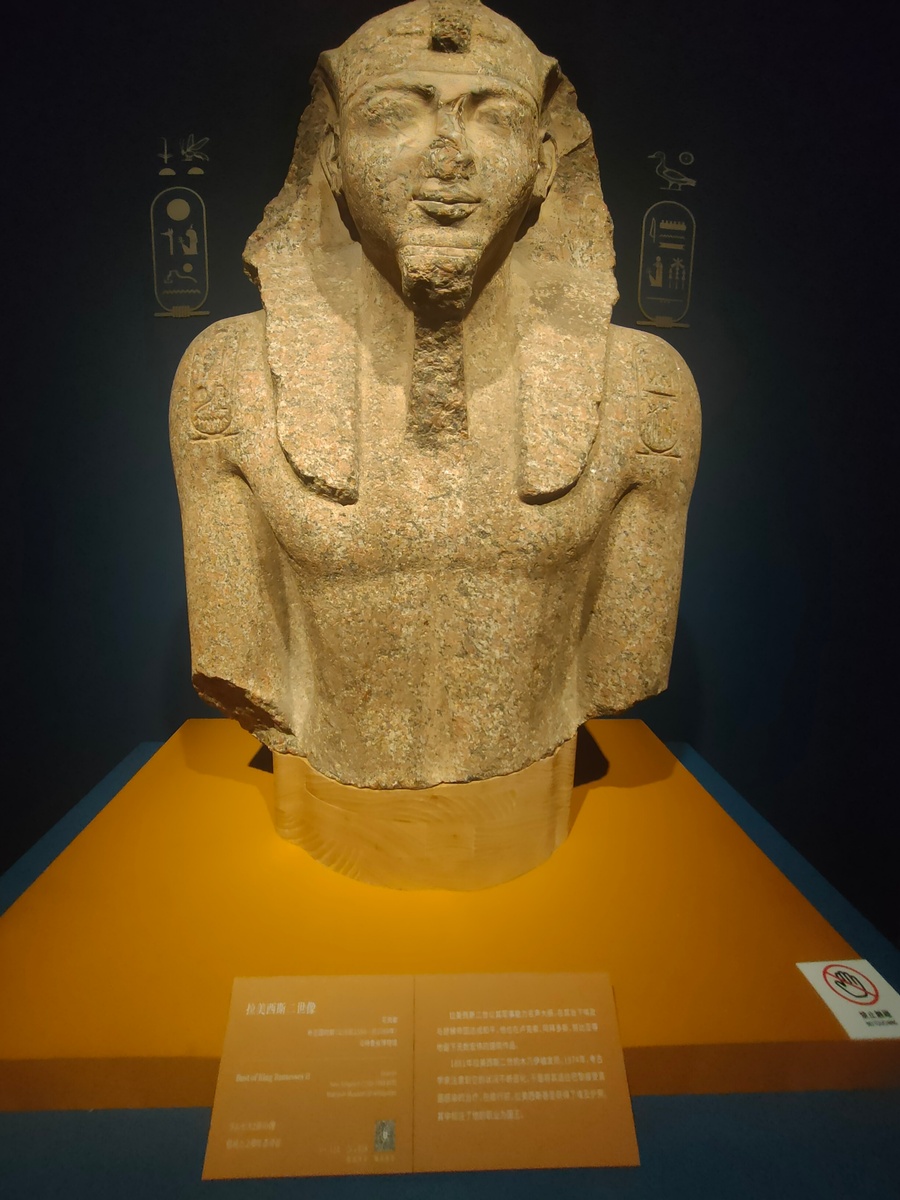
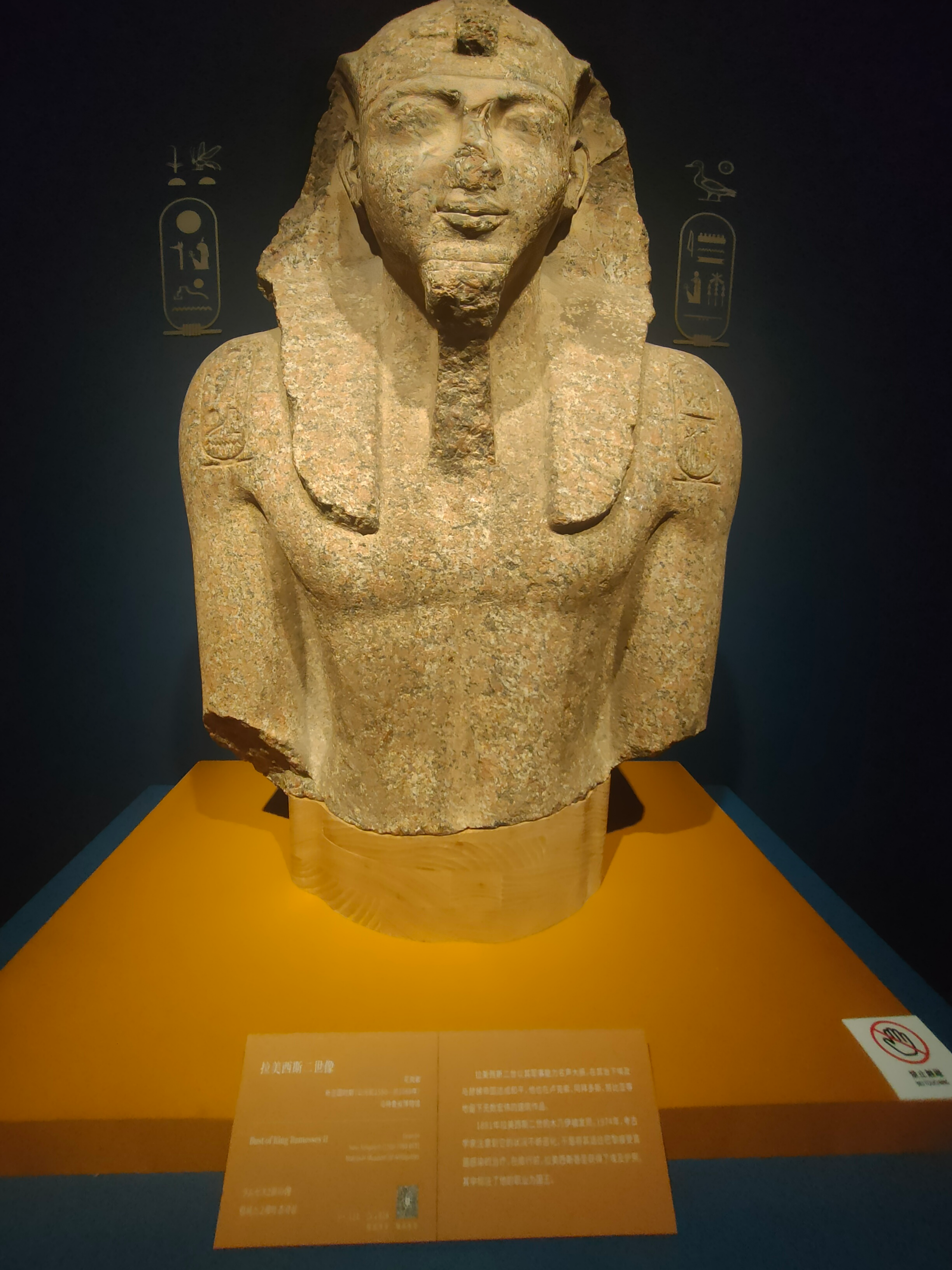
This is a bust of Ramesses II, one of ancient Egypt's most famous pharaohs. The object is captioned as a New Kingdom sculpture, and the file title simply calls it a Bust of Ramesses II.
The sculptor's name does not survive, so we call the maker unknown. What we have is the king himself, carved in stone, cut off below the chest.
Look first at the head. The face has almond eyes and stone-pitted cheeks, and the nose is damaged. Across the brow runs a band, and at its centre the cobra of the uraeus is broken away, leaving only its socket.
Around the face falls the striped nemes headdress, its wide lappets dropping forward over the chest. Between those lappets hangs a long, straight false beard, its lower end worn and blunt.
At the base of the neck the stone breaks off in a rough fracture line. That edge exposes the coarse grain of the granodiorite, and it shows the pitted weathering that tells us what the material is and how it was worked.
Lower still, on the king's shoulders, two oval cartouches are cut into the stone. Inside them are hieroglyphic royal names, and those names identify the owner.
The nemes headdress and the false beard are not ordinary dress. In Egyptian royal sculpture they are markers of kingship and divine status, the visual language through which a pharaoh is shown as pharaoh.
That is why the regalia matter here. Even without the rest of the body, the striped headdress, the straight beard and the brow band together announce Ramesses II's authority and identity.
What we cannot say is where this bust was first set up. The supplied sources do not record its findspot, its original context or its acquisition history, so those questions stay open.
What they do record is that the bust was displayed at the Shanghai Museum in an ancient Egypt exhibition, and the photograph was taken there on 5 July 2025. The Commons file is categorised under the museum's collections.
The damage is part of what we see. The nose is lost, the cobra on the brow is gone, and the body below the chest is missing, so the bust survives as a fragment of a much larger statue.
That fragment still does its work. The cartouches name the king, the regalia present him as a divine ruler, and the fractured stone reminds us that this is a survival, not a complete original.