Arab City
Artist: Wassily Kandinsky · 1905

Arab City: high-resolution image
The original file is hosted by Wikimedia Commons, available without payment or an account.
Open high-resolution image on Wikimedia CommonsThe complete story
The story About 3 minutes to read
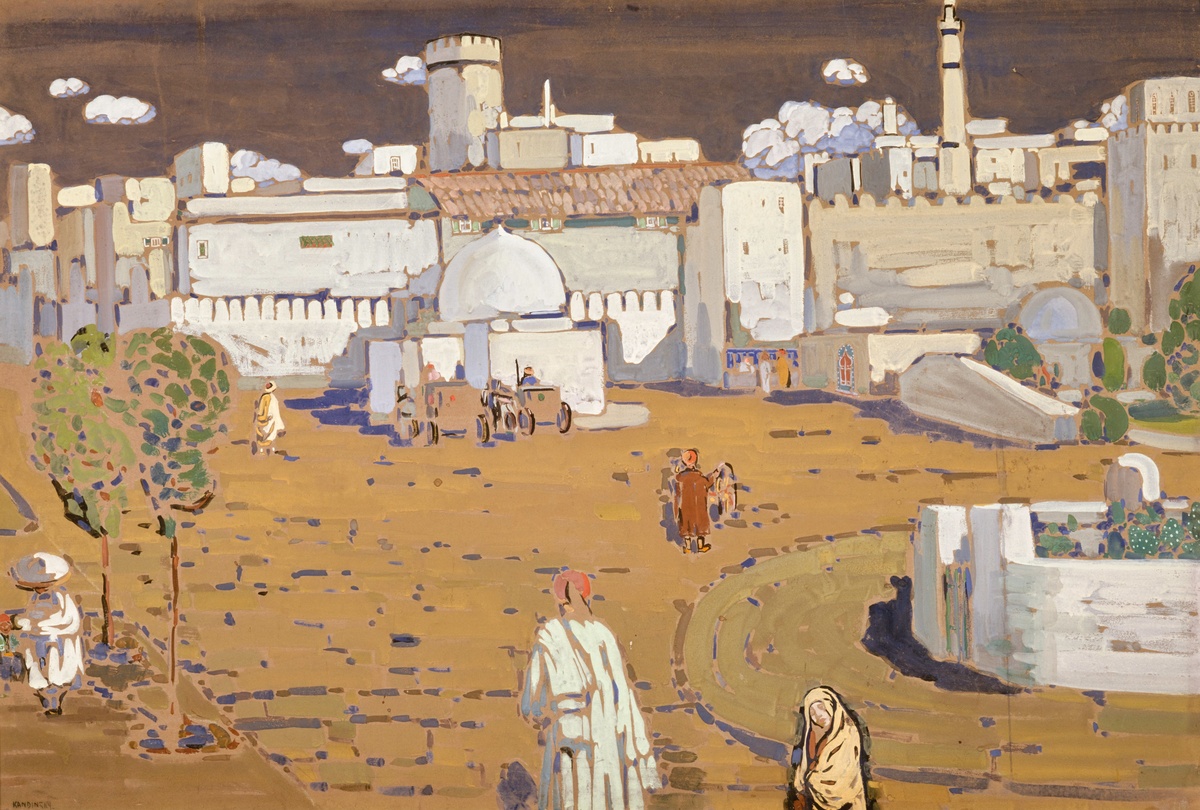
In this painting, Kandinsky shows a public square in an Arab city. A domed gateway with an arched opening marks the entrance to the town. A slender minaret rises above white crenellated buildings. That skyline, with its domes and battlements, sets the scene in North Africa. In the foreground, a man in a white robe and red fez stands seen from behind, looking toward the gate.
Near the gateway, a cart and attendants gather. They bring a note of daily movement and labour into the square. The scene is not empty or theatrical. It records ordinary activity around a place of arrival and passage.
At lower right, a figure wrapped in a pale striped cloak stands with head bowed. That figure offers a quiet human counterpoint to the movement across the square. The contrast is easy to see. Movement gathers at the centre, while stillness holds the edge.
Kandinsky made the work in 1905, using tempera on board. The record describes it as a cityscape and notes title variants in several languages, including Ville arabe and Arabische Stadt. The painting is now in the Musée National d'Art Moderne at the Centre Pompidou in Paris.
The white dome and arched gate are simplified, and the opening beneath them lies in shadow. That shadowed entrance draws the eye inward, toward the town beyond. The minaret lifts the skyline upward. Together, gate and tower organise the square as a place you enter and look up within.
The man in the red fez anchors the foreground, planted and facing away. His stillness, the bowed figure at right and the bustle at the gate give the scene its balance. What stays with you is a city square held between arrival and departure, movement and pause.
The story and its sources
Historical claims are linked to the records below. Close looking and interpretation are identified in the passage notes.
- Passage 1Close lookingWikimedia Commons: Arab City
- Passage 2Close lookingWikimedia Commons: Arab City
- Passage 3Close lookingWikimedia Commons: Arab City
- Passage 4Documented historyWikimedia Commons: Arab City
- Passage 5InterpretationWikimedia Commons: Arab City
- Passage 6InterpretationWikimedia Commons: Arab City
Details to notice
About 2 minutes to readCloaked figure at lower right
A figure wrapped in a pale striped cloak is visible near the lower right, head bowed, adding a quiet human counterpoint to the movement across the square.
Minaret and city skyline
The slender minaret rises above crenellated white buildings, establishing the North African setting and the painting's distinctive skyline.
Cart and attendants
A small cart and attendants gather near the gateway, showing daily movement and labor within the public square.
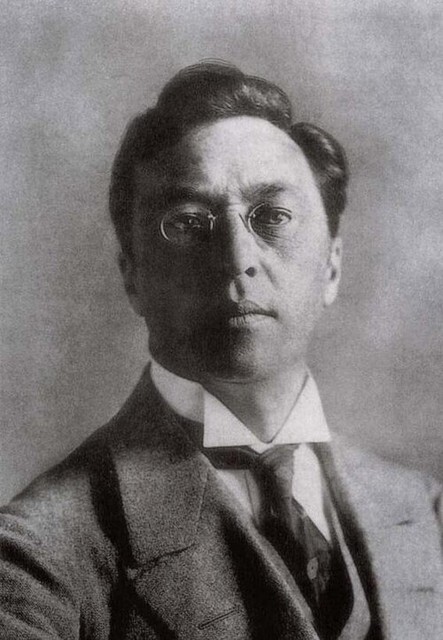
Artist portrait Image credit
未知上傳者. Image source · Public domain
About the artist
Wassily Kandinsky
1866 to 1944
Wassily Kandinsky was an avant-garde painter of Russian origin (1866–1944). Their work is associated with Expressionism; Symbolism; Bauhaus. Their recorded places of work include Paris; Munich; Weimar; Rapallo; The Hague; Russia; Stockholm; Switzerland; Tunis.
- Born
- 1866
- Died
- 1944
- Nationality
- Russian Empire; Russian Soviet Federative Socialist Republic; Soviet Union; France; Germany
- Birthplace
- Moscow
- Died in
- Neuilly-sur-Seine
Biography sources
The research & record
Study the work.
Follow the evidence.
Find catalogue details, historical context, technical research and the literature behind this artwork.
The artwork record
Research catalogue
Catalogue information and detailed research, with references that link to the bibliography.
Updated .
Identity and catalogue
Link- Title
- Arab City(Wikimedia Commons: Arab City, n.d.)
- Artist or attribution
- Wassily Kandinsky
- Object date
- 1905(Wikimedia Commons: Arab City, n.d.)
- Medium and support
- tempera on board(Wikimedia Commons: Arab City, n.d.)
- Dimensions
- 67.3 x 99.5 cm(Wikimedia Commons: Arab City, n.d.)
- Current collection or location
- Musée National d'Art Moderne, Centre Georges Pompidou, Paris(Wikimedia Commons: Arab City, n.d.)
- Country or culture
- Russian artist, work made in Europe
- Depicted subject
- A cityscape of an Arab city: a public square with a white domed gateway and minaret rising above crenellated white buildings, a man in a white robe and red fez standing in the foreground, a cart and attendants near the gate, and a cloaked figure at lower right.(Wikimedia Commons: Arab City, n.d.)
- Title variants
- Ville arabe; Cidade árabe; Arabische Stadt; Арабский город(Wikimedia Commons: Arab City, n.d.)
- Accession number
- AM 81-65-86
- Support
- board
- Period
- Unknown
Read valuation records and their limitations
Catalogue identity
The object is catalogued under the title Arab City and attributed to Wassily Kandinsky. The same file record carries the work's date as 1905, and it is this date that belongs to the making of the picture rather than to any later catalogue, file or database entry. The record supplies the support as tempera on board and gives the dimensions as 67.3 cm high by 99.5 cm wide, so the work is a horizontal composition in a medium that combines a fluid paint with a rigid panel. Within the file, the genre is entered simply as cityscape. This is a classification of subject rather than a statement about style, and it aligns the painting with a category of pictures organised around the depiction of urban space rather than around a single narrative episode or portrait subject.(Wikimedia Commons: Arab City, n.d., File title and Artist or creator fields; Date field; Dimensions field; Genre field)
The file record does not settle on a single language for the title. It lists variants in French, Portuguese, English, German and Russian, among them Ville arabe and Arabische Stadt, alongside the English Arab City under which the record is filed. These are parallel titles for the same work, not separate objects, and their coexistence reflects the painting's movement through institutions and catalogues in more than one linguistic sphere. The record's own name for the holding institution is given in its native form, Musée national d'art moderne, the parent body of the Centre national d'art et de culture Georges-Pompidou. The painting is described as held in the Musée National d'Art Moderne, Centre Georges Pompidou, Paris, under accession number AM 81-65-86. That accession number, rather than any of the translated titles, is the stable identifier by which the physical object can be traced in the collection.(Wikimedia Commons: Arab City, n.d., Description labels)
Interpretation
The evidence assembled here is a Wikimedia Commons file record used as a discovery aid rather than an official museum catalogue page, and it is marked as only partially consulted. The attribution to Kandinsky, the 1905 date, the tempera-on-board medium, the dimensions and the accession number all rest on that single record, with a Google Art and Culture credit noted in the annotation. This matters for how the identity of the work should be weighed: the core catalogue facts are consistent and specific, but they have not been corroborated here against a published collection catalogue or the museum's own object documentation. The record's separation of the object's 1905 date from the later life of the file, including its multilingual titles and its institutional location, is the clearest indication that the record distinguishes the historical work from its cataloguing history.(Wikimedia Commons: Arab City, n.d., File title and Artist or creator fields; Date field; Dimensions field; Description labels)
The painting is titled Arab City and was made by Wassily Kandinsky.(Wikimedia Commons: Arab City, n.d.)
The work is dated 1905.(Wikimedia Commons: Arab City, n.d.)
The work measures 67.3 cm high by 99.5 cm wide.(Wikimedia Commons: Arab City, n.d.)
The file record gives the genre as cityscape.(Wikimedia Commons: Arab City, n.d.)
The work carries title variants in French, Portuguese, English, German and Russian, including Ville arabe and Arabische Stadt.(Wikimedia Commons: Arab City, n.d.)
Subject and iconography
LinkRead valuation records and their limitations
The Recorded Composition
Visual observation
The visual account of Arab City depends on a supplied description rather than on an independently published museum entry, so the observations below carry the status of identified features rather than of documented catalogue data. That description locates a man in a white robe and red fez at the centre foreground, standing with his back to the viewer. It locates the town entrance in a central white dome and arched gate, rendered with simplified forms and a shadowed opening. Near that gateway a cart and attendants are gathered, describing daily movement and labour in the public square. A slender minaret rises above crenellated white buildings, and in the description's reading this skyline establishes the North African setting. Near the lower right, a figure wrapped in a pale striped cloak stands with head bowed, identified as a quiet human counterpoint to movement across the square. Because the description is the sole primary visual evidence supplied, its identifications of the fez, the minaret and the striped cloak should be understood as the record's characterisation of what the image shows, not as measurements or inscriptions from the surface.(Wikimedia Commons: Arab City, n.d., Vision-derived focus candidates)
Interpretation
Read together, these features organise the picture around access. The domed gate is the point of entry, and the shadow beneath it gives the opening a depth that pulls attention past the foreground into the town. The minaret counters that inward pull by carrying the eye upward over the crenellated buildings, so the square is framed both as a place one enters and as a place one looks up within. Within that frame the described figures distribute the scene's activity: the fez-wearing man anchors the foreground, the cart and attendants concentrate movement at the gateway, and the bowed figure at lower right supplies stillness at the edge. The description's own reading of the bowed figure as a counterpoint to the square's movement is an interpretive framing of the image, and it is worth separating that reading from the simpler observation that a cloaked, head-bowed figure is present at all.(Wikimedia Commons: Arab City, n.d., Vision-derived focus candidates)
Visual observation
The supplied description identifies a man in a white robe and red fez standing at the centre foreground, seen from behind.(Wikimedia Commons: Arab City, n.d.)
The supplied description identifies a central white dome and arched gate marking the town entrance, with simplified forms and a shadowed opening.(Wikimedia Commons: Arab City, n.d.)
The supplied description identifies a cart and attendants gathered near the gateway, showing daily movement and labour in the public square.(Wikimedia Commons: Arab City, n.d.)
The supplied description identifies a slender minaret rising above crenellated white buildings, establishing the North African setting and the painting's skyline.(Wikimedia Commons: Arab City, n.d.)
The supplied description identifies a figure wrapped in a pale striped cloak near the lower right, head bowed, as a quiet human counterpoint to movement across the square.(Wikimedia Commons: Arab City, n.d.)
Materials and technique
LinkRead valuation records and their limitations
Documented support and medium
The material record for Arab City is brief but specific: the medium is recorded as tempera on board, and the work is dated 1905. No ground layer, panel type, pigment, brushwork or preparatory drawing is documented in the supplied evidence, so claims beyond tempera on board would be inference rather than examination. What can be said is that the choice of board as a support and tempera as a medium situates the picture in a studio practice of layered, relatively fast-drying paint on a rigid panel rather than in oil on stretched canvas. The evidence does not state whether the board is millboard, wood or another composite, nor whether a priming was applied, and those gaps should remain open in any technical account.(Wikimedia Commons: Arab City, n.d., Medium field)
What visual evidence establishes and what it does not
Interpretation
Read together, the documented medium and the described forms allow a cautious material argument. The simplified dome and arch, the crenellated white buildings and the upward lift of the minaret correspond to broad, clearly bounded shapes that a tempera-on-board method can render with relatively flat, opaque passages, and the described shadowed opening beneath the arch implies deliberate tonal contrast within those simplified forms. This is an interpretation of how the described appearance is consistent with the documented medium, not a technical finding: no layer analysis, pigment sampling or surface examination is supplied, and the account should not assert one. The value of the pairing is that it keeps the material description and the visual description in the same frame without letting either stand in for the other.(Wikimedia Commons: Arab City, n.d., Medium field; Vision-derived focus candidates)
Visual observation
The crowds of the square described in the visual evidence, the cart and attendants near the gate and the cloaked figure at lower right, are the sort of incidental detail that tests a medium's capacity for small accents against larger flat areas. The evidence supports the observation that the scene is populated with differentiated figures and grouped activity, but it does not support any claim about how those figures were painted, whether in reserve, over a ground, or with particular tools. The material question of how tempera on board handled such contrasts between the broad architectural forms and the smaller human elements remains, on the supplied evidence, unanswered.(Wikimedia Commons: Arab City, n.d., Vision-derived focus candidates; Medium field)
The medium is tempera on board.(Wikimedia Commons: Arab City, n.d.)
Collection and display
LinkRead valuation records and their limitations
Institutional holding and accession
The collection record for Arab City places the painting in the Musée National d'Art Moderne, Centre Georges Pompidou, Paris, under accession number AM 81-65-86. The same record supplies the institution's native name as Musée national d'art moderne, and identifies it as the parent body within the Centre national d'art et de culture Georges-Pompidou. Taken together, these two details describe a single institutional structure rather than two separate homes for the work: the modern art museum is nested within the broader Pompidou centre, and the accession number belongs to that museum's holdings. The record does not give an acquisition date, a donor, or a history of prior owners, so the route by which the painting reached this collection cannot be reconstructed from the supplied material. What is established is the present holding and the identifier by which the museum tracks it.(Wikimedia Commons: Arab City, n.d., Collection and Accession number fields; Collection field, Native name)
Interpretation
The collection information comes from a Wikimedia Commons file record for the painting, which also credits Google Art and Culture. The annotation accompanying the source flags it as a discovery aid rather than an official museum catalogue page, and its consultation status is recorded as partial. This qualification matters for how the collection data should be weighed: the museum name and accession number are stated plainly in the record, but they have not been confirmed here against the institution's own catalogue entry. The absence of a catalogue page also explains why the account cannot extend to installation history, gallery location, label text, or any loan record. Within those limits, the collection facts are reported as the record gives them, and the reader should treat the accession number as a bibliographic pointer to be verified at the museum rather than as a fully documented object file.(Wikimedia Commons: Arab City, n.d., Collection and Accession number fields; Collection field, Native name)
The painting is held in the Musée National d'Art Moderne, Centre Georges Pompidou, Paris, with accession number AM 81-65-86.(Wikimedia Commons: Arab City, n.d.)
The institution's native name, given in the supplied record, is Musée national d'art moderne, parent body of the Centre national d'art et de culture Georges-Pompidou.(Wikimedia Commons: Arab City, n.d.)
Documented values and qualified estimates
LinkRead valuation records and their limitations
Recorded values
Interpretation
The only recorded valuation attached to this object is explicitly a working tool rather than a market fact. A model-generated estimate, dated as a working calculation of 2026-10-30, places a broad insurance range of US$8M to US$25M on the work. The methodology recorded with it is transparent about its inputs: the range was calculated conservatively from confirmed context only, namely a 1905 tempera on board by Wassily Kandinsky measuring 67.3 by 99.5 cm and held by the Musee National d'Art Moderne, Centre Georges Pompidou, Paris, under accession AM 81-65-86. The stated reasoning is that the artist is a canonical early modernist of major international standing, that the picture is an early figurative cityscape predating his abstraction, and that the large board scale, an exhibition-quality condition expectation typical of a major national collection, and documented institutional custody together support a high-tier placement. None of these supporting judgments rests on a comparable sale, an appraisal, or an institutional record.(Wikimedia Commons: Arab City, n.d.)
The same record sets out why the figure should not be read as a price. Because the work sits in a public collection and is unlikely to trade, and because no official appraisal, sale record, or institutional valuation was supplied, the range was deliberately widened and capped to express higher uncertainty. The figures are described as a model estimate for manual review, not tied to any observed transaction, and expressly not an official insurance value, appraisal, auction estimate, auction result, or sale price. No institutional or private records were consulted and no comparable sales were accessed or invented. The identification itself is qualified: it rests on a Wikimedia Commons file record rather than a verified Centre Pompidou object page, so confidence is rated medium, and actual insurance scheduling would require a qualified appraiser together with confirmation of provenance, condition, and title.(Wikimedia Commons: Arab City, n.d.)
Working estimate
Calculated working insurance estimate, not a sale price: Estimated value: US$8M to US$25M Recorded date: Working calculation, generated 2026-10-30. Methodology: Broad working range calculated conservatively from confirmed context only: a 1905 tempera on board by Wassily Kandinsky, 67.3 x 99.5 cm, held by the Musee National d'Art Moderne, Centre Georges Pompidou, Paris (accession AM 81-65-86). The artist is a canonical early modernist of major international standing, and this is an early figurative cityscape predating his abstraction. The large board scale, exhibition-quality condition expectation typical of a major national collection, and documented institutional custody support a high-tier placement. Because the work is in public collection and unlikely to trade, and because no official appraisal, sale record, or institutional valuation was supplied, the range is set wide and deliberately capped to reflect higher uncertainty. Figures are a model estimate for manual review, not tied to any observed transaction. Qualification: Model-generated working insurance range for manual review only. This is not an official insurance value, appraisal, auction estimate, auction result, or sale price. It does not reflect any institutional or private records, and no comparable sales were accessed or invented. Identification rests on a Wikimedia Commons record rather than a verified Centre Pompidou object page, so confidence is medium. Actual insurance scheduling requires a qualified appraiser and confirmation of provenance, condition, and title.(Wikimedia Commons: Arab City, n.d.)
Further reading
Books for a closer look
Paid links. As an Amazon Associate I earn from qualifying purchases.

Open Library Kandinsky: Russian and Bauhaus years, 1915-1933.
Solomon R. Guggenheim Museum
A Kandinsky catalogue whose recorded subjects include Centre Georges Pompidou and the Musée national d'art moderne, the collection that holds Arab City (AM 81-65-86), plus catalogues raisonnés. This makes it the most object-adjacent candidate for a 1905 Kandinsky in that Paris collection, though the record does not confirm Arab City is discussed.
ISBN 0892070447

Open Library Grandes villes arabes à l'époque ottomane
Sindbad
André Raymond's study of large Arab cities in the Ottoman era addresses the urban forms depicted in Arab City: the domed gateway, minaret and crenellated white buildings. It offers documented historical context for the North African and Ottoman-period townscape rather than commentary on the painting itself.
ISBN 2727401078
Bibliography
Sources and further reading
References are arranged by author or organisation, with links to the original publications. Where no publication date is recorded, n.d. means no date.
Source notes updated .
No recorded sources match these filters. Reset the filters to see the full bibliography.
- 03
Book
André Raymond's study of large Arab cities in the Ottoman era addresses the urban forms depicted in Arab City: the domed gateway, minaret and crenellated white buildings. It offers documented historical context for the North African and Ottoman-period townscape rather than commentary on the painting itself.
- ISBN
- 2727401078
Citation text
- 02
Book
Kandinsky: Russian and Bauhaus years, 1915-1933. Solomon R. Guggenheim Museum.
A Kandinsky catalogue whose recorded subjects include Centre Georges Pompidou and the Musée national d'art moderne, the collection that holds Arab City (AM 81-65-86), plus catalogues raisonnés. This makes it the most object-adjacent candidate for a 1905 Kandinsky in that Paris collection, though the record does not confirm Arab City is discussed.
- ISBN
- 0892070447
Citation text
- 01
Secondary · About this artwork
Wikimedia Commons: Arab City (n.d.). Wikimedia Commons.
Wikimedia Commons file record for Arab City by Wassily Kandinsky, supplying title, artist, date, medium, dimensions, collection, accession number and a Google Art and Culture credit. Used as a discovery aid; it is not an official museum catalogue page.
Citation text
Art to live with
Bring this painting
home.
A piece of the archive, made yours. Explore Arab City in a size and finish that fits your space.
Your text and annotations appear on these editions. Adding to cart saves that design for printing.
Combine this painting with your favourites01 / Find your edition
Made for you
Suggested from your location. Change it if you're sending elsewhere or using a VPN. Prices and delivery are shown in GBP.
1 product
Choose an edition to make it yours
iPhone 12 Mini ? Glossy ? back view
iPhone 12 Mini · Glossy

iPhone 12 Mini ? Glossy ? back view

iPhone 12 Mini ? Glossy ? back view

iPhone 12 Mini ? Glossy ? back view
Tough phone case
GBP 16.34
Delivery GBP 4.22 / Total GBP 20.56
A two-layer phone case with a printed polycarbonate shell and a shock-absorbing inner liner.
Two layers with a shock-absorbing TPU liner
Case & print details
- Device
- Apple · iPhone 12 Mini
- Material
- Polycarbonate shell with a TPU inner liner
- Artwork
- Outer back and wrapped edges from one template
- Finish
- Glossy
- Version
- Standard version
- Printing
- Dye sublimation
- Print file
- 1,122 × 1,831 px · 95 × 155 mm · PNG · 300 dpi recommended
Rear outline and camera openings follow this variant's Printify template. Case depth and small hardware remain illustrative.
Supplier product detailsFit and fill keep the painting’s proportions. Stretch changes them.
Move and zoom the painting on your tough phone case.
Made to order with your design
Made to order
US delivery only
The 30 cm ruler is scaled alongside your selected print. Keep the painting’s proportions with a black background, or stretch it to fill. Frame width, material texture and screen colours are illustrative.
Keep exploring