ArchiveApollo and Daphne

Artwork record / 51 of 331

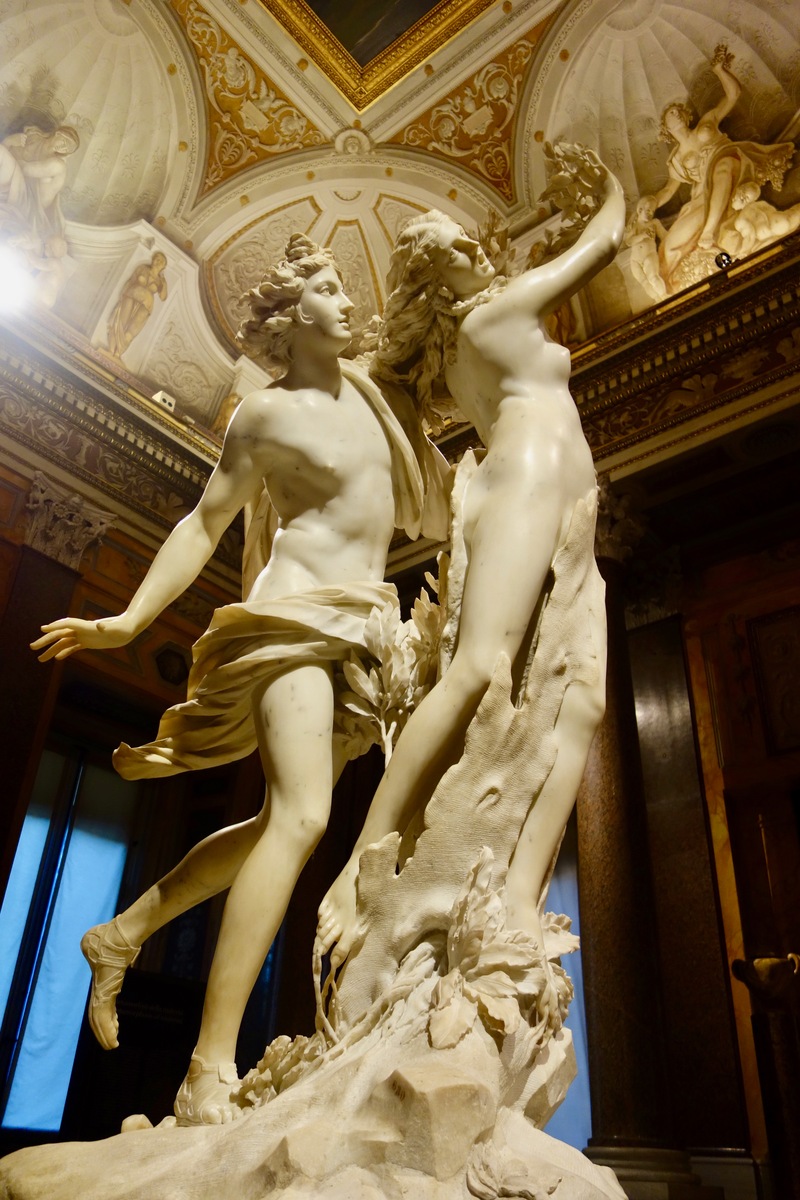
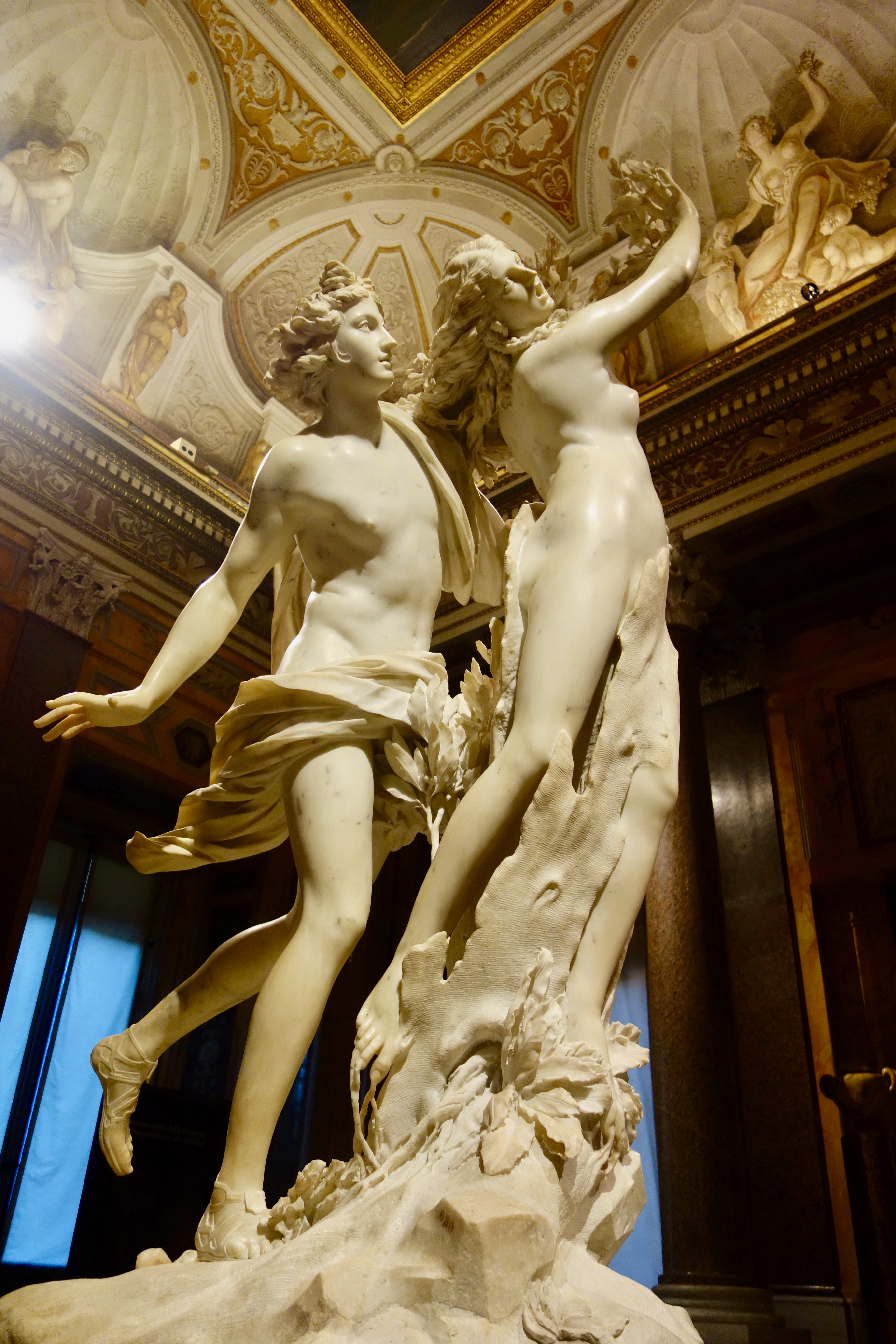
Apollo and Daphne by Gian Lorenzo Bernini (1622–1625)

Artist: Gian Lorenzo Bernini

A docent-led reading of Bernini's marble group in the Galleria Borghese, in which Daphne turns into a laurel tree at the instant Apollo catches her. The tour explains the Ovidian subject, then connects the visible choices of carving, pose and surface to the meaning of the transformation.

Read the story ↓ About the artist ↓ Research and record ↓ Literature and sources ↓ Listen to the article ↓
Article text for AI
Shop this artwork ↓ 5 visits
Date1622–1625CultureItalian PeriodBaroqueCurrent locationGalleria Borghese, Rome, Italy
Listen to the article
100%
Apollo and Daphne by Gian Lorenzo Bernini (1622–1625)
Loading full-resolution artwork…
Scroll to zoom · drag to pan · double-click to focus Pinch to zoom · drag to explore · double-tap to focus FIELD VIEW / 51
Tools & download
Pixel colour Select a pixel with the eyedropper
No pixel selected

Choose the eyedropper, then click or tap the image. Scroll to zoom for finer selection.

Add text

Hand to pan · Select to move text and drawings · Add as many texts as you like · Scroll to zoom

Apollo and Daphne: high-resolution image

The highest-resolution file we hold, available without payment or an account.3,648 × 5,472 pixels.

Download highest-resolution image

Details to notice

About 2 minutes to read
01

Rocky base with carved foliage and plaque

The irregular rocky mound at the bottom of the group, carved with acanthus-like foliage and roots and bearing a small inscribed cartouche; useful for checking tool marks and the carved text on the plinth.

02

Apollo's stride and flying drapery

Apollo's advancing leg with sandalled foot, outstretched arm and billowing cloth wrapped at the hips, the drilled and undercut drapery that makes the marble read as motion.

03

Bark encasing Daphne's legs

Roughly tooled bark rising over Daphne's thighs and calves and merging into a tree trunk with emerging leaves and roots, a deliberate contrast of unfinished, textured surface against polished flesh.

Artist portrait of Gian Lorenzo Bernini
Artist portrait Image credit

Gian Lorenzo Bernini. Image source · Public domain

About the artist

Gian Lorenzo Bernini

1598 to 1680

Gian Lorenzo Bernini was an Italian sculptor and architect (1598–1680). Their work is associated with Baroque. Their recorded places of work include Italy; Paris; Rome; Siena.

Born
1598
Died
1680
Nationality
Italy
Birthplace
Naples
Died in
Rome; Palazzi Bernini

The research & record

Study the work.
Follow the evidence.

Find catalogue details, historical context, technical research and the literature behind this artwork.

Article text for AI
Open research text

The artwork record

Research catalogue

Catalogue information and detailed research, with references that link to the bibliography.

Updated .

Identity and catalogue

Link
Title
Apollo and Daphne(Sonse, 2018)
Artist or attribution
Gian Lorenzo Bernini
Object date
1622–1625
Medium and support
Marble sculpture(Sonse, 2018)
Current collection or location
Galleria Borghese, Rome, Italy(Sonse, 2018)
Movement or period
Baroque
Country or culture
Italian
Depicted subject
A marble sculpture group depicting the moment the nymph Daphne transforms into a laurel tree to escape the god Apollo, drawn from Ovid's Metamorphoses. The work shows Apollo pursuing Daphne and grasping her as her body begins to change into bark and leaves.
Title variants
Apollo and Daphne by Bernini, Galleria Borghese
Dimensions
Unknown
Catalogue identity

The object is catalogued as Apollo and Daphne, a marble group attributed to Gian Lorenzo Bernini and recorded in the Galleria Borghese, Rome. The same source lists the work's creator as Gian Lorenzo Bernini and identifies the mythological subject of the file as Apollo and Daphne, so the title, the authorship attribution, the medium, and the Roman location are established together rather than separately: they are the identifying frame within which any further description of the sculpture has to be placed.(Sonse, 2018, Title and description; Title; Structured data, depicts)

Within the wider history of art, the work is classified as a Baroque sculpture, a period designation that situates the group in a particular stylistic moment rather than adding a new factual detail about its making. The catalogue therefore carries two kinds of statement at once: the object-level facts of title, maker, material, and location, and a period label that belongs to art-historical classification.(Sonse, 2018, Description; Title and description)

The sculpture is titled Apollo and Daphne and is by Gian Lorenzo Bernini, located in the Galleria Borghese, Rome.(Sonse, 2018)

The Commons file depicts Apollo and Daphne, the mythological subject of the sculpture.(Sonse, 2018)

The sculpture was created by Gian Lorenzo Bernini.(Sonse, 2018)

Historical context

Link
The object and its documentation

Apollo and Daphne, the marble group attributed in the supplied documentation to Gian Lorenzo Bernini, is a Baroque work. The Commons record describes it as a marble group showing Apollo and Daphne, carved by Bernini in the Baroque period, and separately confirms that the sculpture is carved from marble and was created by Gian Lorenzo Bernini. The sculpture is housed in the Galleria Borghese, Rome, Italy, and it is this institutional setting in Rome that the photographic record documents. Taken together, these units establish the object as a marble sculptural group, made by Bernini, of the Baroque period, and now in the Galleria Borghese; they do not, in themselves, establish the terms of the original commission, the date of carving, or the identity of the first patron.(Sonse, 2018, Description)

Interpretation

What the supplied evidence permits is a secure identification of the work, its material, its authorial attribution and its present Roman setting, together with the Ovidian subject of the depicted moment. What it does not contain is the commissioning history: no patron, no contract, no date of execution, no payment record and no early provenance interval are supplied here. The commissioning circumstances of this sculpture therefore remain outside the evidence assembled in this account, and the identification of the group in the Galleria Borghese should not be used to infer the terms on which it was first made or the social world of its first owners. The sculpture matters within a larger history of Baroque sculpture as a marble group by Bernini in which a narrative transformation is the sculptural subject itself, but that larger significance is carried by the documented attribution, medium and setting rather than by any reconstructed patronage story.(Sonse, 2018, Description; Date and author)

The sculpture is a Baroque work.(Sonse, 2018)

Materials and technique

Link
Documented materials and attribution

The group of Apollo and Daphne is documented as a marble sculpture, carved in the Baroque period by Gian Lorenzo Bernini. Both the identification of the subject and the attribution of the carving rest on the same descriptive record, which classifies the work as a marble group rather than as a single figure or a relief. That same record also names the material independently of the subject: the sculpture is carved from marble. Read together, these two details establish the basic material fact of the object, that its medium is stone, and the basic authorial fact, that Bernini is the carver credited with it. The material and the attribution are therefore not separate curiosities but the two anchors on which any further technical discussion depends.(Sonse, 2018, Description)

The mythological subject depicted is the moment of Daphne's transformation into a laurel tree, as described in Ovid's Metamorphoses, with her fingers sprouting leaves and her body becoming bark. Bernini's handling of this subject is described as making the softness of flesh and the hardness of bark coexist within a single material. That is a visual and material observation about the finished carving, not a record of pigment analysis, tool marks, workshop practice or stone provenance, and it should be weighed as such. It nonetheless bears directly on questions of technique, because it identifies the sculptural problem the work sets itself: two contrasting material qualities, one organic and yielding, one woody and rigid, are to be produced from one block of the same stone. The transformation is not merely narrated by the iconography but is carried by the carving itself.(Sonse, 2018, Description)

The sculpture is a marble group showing Apollo and Daphne, carved by Bernini in the Baroque period.(Sonse, 2018)

The sculpture is carved from marble.(Sonse, 2018)

Reception and literature

Link
Documentation and the Modern Image

The modern photographic record of Bernini's marble group is unusually specific about its own making. The image in the Commons file was taken on 15 November 2018 by the photographer Sonse and shows the sculpture in Rome, Italy, where it is housed in the Galleria Borghese. That documentation matters for reception because the work's visibility to a wide public now depends substantially on such open-access photographs: the file is published under an open-access status and carries the sculpture's title and author, so a viewer encountering the object first through reproduction receives the attribution to Gian Lorenzo Bernini and the identification of the subject along with the visual record. The photograph is therefore not merely an illustration but a dated, attributed act of reception, anchoring a 2018 viewing in a specific place and moment.(Sonse, 2018, Date and author)

The photograph of the sculpture was taken on 15 November 2018 by Sonse, showing the work in Rome, Italy.(Sonse, 2018)

Interpretations and debates

Link
Subject and Attributed Reading

Interpretation

The single interpretation unit supplied for this sculpture is a description of its subject: the work depicts the moment Daphne transforms into a laurel tree, as told in Ovid's Metamorphoses, with her fingers sprouting leaves and her body becoming bark. The unit is classified as an interpretation rather than a documented fact, and it is attached to the Commons file description; it therefore represents how the object is presented and read by those documenting it, not a maker's statement of intent. Read carefully, it contains two distinguishable claims: that the figure is Daphne, Apollo's pursued nymph, and that the specific instant shown is the metamorphosis itself, so that the leaves emerging at the fingers and the bark overtaking the body are the identifying features of the moment rather than incidental ornament. Nothing in the unit establishes which passage of the Metamorphoses was consulted, whether a patron or programme prescribed the subject, or how the maker understood it, and those questions cannot be answered from the evidence supplied.(Sonse, 2018, Description)

Limits of the Evidence

What can be seen and what the evidence establishes therefore stand at different levels. The visible content, in the attributed reading, includes fingers sprouting leaves and a body becoming bark; that is the grounds on which the Ovidian moment is identified. What the evidence establishes is only that the work is presented as a Baroque sculpture depicting that moment, and that it was photographed in Rome in 2018. The interpretive synthesis that remains open, and that this account will not close, is the relationship between subject and medium: whether the coexistence of foliage and flesh in a single figure is better understood as fidelity to Ovid's narrative or as a problem of carving that the period's sculptors addressed through specific technical choices. The supplied units do not describe the marble, the tools, the carving method, or any comparison with other treatments of the same myth, so any claim that the transformation was realized through a particular technique would be an invention rather than a finding. The object matters here within a larger history of material culture because a metamorphosis poses an unusually direct question to a carver: one block must hold two states of being at once, and the attribution of this work as a Baroque depiction of that instant is the evidence we have for how it was understood to do so.(Sonse, 2018, Description; Date and author)

The sculpture depicts the moment Daphne transforms into a laurel tree, as described in Ovid's Metamorphoses, with her fingers sprouting leaves and her body becoming bark.(Sonse, 2018)

Collection and display

Link
The Object in the Galleria Borghese

The marble group known as Apollo and Daphne by Gian Lorenzo Bernini is housed in the Galleria Borghese in Rome, Italy, a location documented in the Wikimedia Commons record of the work. That same record also serves as the available photographic documentation of the sculpture, a photograph taken in Rome on 15 November 2018 by Sonse, which shows the work as it stands in the Galleria Borghese. The Commons file therefore functions in two ways at once: it attests to the sculpture's current institutional setting and it supplies the visual record through which the object can be examined, identifying the subject as Apollo and Daphne and crediting the carving to Bernini as a Baroque marble group. The photograph's date and author are specific to the image rather than to the sculpture, and the record does not establish when the work entered the Galleria Borghese, how it was displayed earlier, or how it was installed at the time of the photograph, so the display history before and around 2018 remains unspecified by this evidence.(Sonse, 2018, Description)

The sculpture is housed in the Galleria Borghese, Rome, Italy.(Sonse, 2018)

Documented values and qualified estimates

Link
Recorded values

Interpretation

The only monetary figure recorded for this sculpture in the supplied material is a working insurance estimate generated on 16 October 2026, expressed as a range of US$400 million to US$1 billion. The unit that carries this figure is explicit that it is a model-generated working range intended for manual review and not an official insurance value, an appraisal, an auction result, or a sale price. Its methodology is derived from identity rather than from market data: it begins from the confirmed identification of the work as Gian Lorenzo Bernini's Apollo and Daphne, a Baroque marble sculpture group of 1622 to 1625 in the Galleria Borghese, Rome, and treats the work as a unique, irreplaceable masterpiece of the highest museum rank held in a major public collection with no realistic prospect of sale. Because no official insurance valuation, auction result, or documented acquisition price appears in the supplied excerpts, the range is deliberately framed very broadly for manual review, with the lower bound reflecting the extreme rarity and canonical status of a large-scale Bernini marble group and the upper bound allowing both for the absence of a market-testing precedent and for the non-market, institutional context in which the work sits.(Sonse, 2018)

The estimate's own qualifications matter as much as its numbers. It states that no comparable sales were used, because none are documented in the supplied sources, and that it does not rely on private insurance records, completed comparable sales, or any confidential market data. It further notes that the artwork is in a public institutional collection and that no actual transaction or official valuation is documented in the supplied sources, so that final insurance amounts must be set by qualified appraisers, insurers, and the institution. The provenance and physical facts on which the calculation rests are those recorded for the object: the photograph documents the marble group in the Galleria Borghese in Rome, taken on 15 November 2018 by Sonse, and the source describes the work as a Baroque marble group by Bernini showing Apollo and Daphne, depicting the moment Daphne transforms into a laurel tree as described in Ovid's Metamorphoses, with her fingers sprouting leaves and her body becoming bark. Read together, the two units separate what the object is from what it might be worth: the identity, medium, period, location and mythological subject are documented, while the value figure is an admitted working construct whose breadth is a measure of missing market evidence rather than of uncertainty about the object.(Sonse, 2018)

Working estimate

Calculated working insurance estimate, not a sale price: Working insurance range: US$400M to US$1B Recorded date: Working calculation, generated 2026-10-16. Methodology: This broad working range is derived from the confirmed identity of the artwork as Gian Lorenzo Bernini's Apollo and Daphne, a Baroque marble sculpture group of 1622-1625 in the Galleria Borghese, Rome. The calculation treats the work as a unique, irreplaceable masterpiece of the highest museum rank, held in a major public collection with no realistic prospect of sale. Because no official insurance valuation, auction result, or documented acquisition price is provided in the supplied excerpts, the range is framed very broadly for manual review. The lower bound reflects the extreme rarity and canonical status of a large-scale Bernini marble group, while the upper bound allows for the absence of a market-testing precedent and for the non-market, institutional context. No comparable sales were used, because none are documented in the supplied sources. Qualification: This is a model-generated working insurance range for manual review only. It is not an official insurance value, not an appraisal, not an auction result, and not a sale price. It does not rely on private insurance records, completed comparable sales, or any confidential market data. The artwork is in a public institutional collection, and no actual transaction or official valuation is documented in the supplied sources. Final insurance amounts must be set by qualified appraisers, insurers, and the institution.(Sonse, 2018)

Further reading

Books for a closer look

Paid links. As an Amazon Associate I earn from qualifying purchases.

  • Cover of The myth of Apollo and Daphne from Ovid to Quevedo: love, agon, and the grotesque
    Open Library

    Mary E. Barnard, 1987

    The myth of Apollo and Daphne from Ovid to Quevedo: love, agon, and the grotesque

    Duke University Press

    Scholarly study of the Apollo and Daphne myth from Ovid to Quevedo, with subjects including Apollo and Daphne in literature and classical mythology. Useful for the literary and iconographic tradition behind the sculpture's subject, though it is textual rather than a study of the Bernini marble itself.

    ISBN 0822307014

    Find book on Amazon.co.uk View reference
  • Cover of Apollo and Daphne
    Open Library

    Antonia Barber, 1998

    Apollo and Daphne

    Frances Lincoln Childrens Books

    Recorded under subjects including Greek mythology in art, painting, and art and mythology, so it may treat artistic depictions of the Apollo and Daphne theme. Relevance is limited because the subject headings mention painting rather than sculpture, and the author is known for retellings.

    ISBN 9780711211933

    Find book on Amazon.co.uk View reference

Bibliography

Sources and further reading

References are arranged by author or organisation, with links to the original publications. Where no publication date is recorded, n.d. means no date.

Source notes updated .

  1. 03

    Book

    Apollo and Daphne. Frances Lincoln Childrens Books.

    Recorded under subjects including Greek mythology in art, painting, and art and mythology, so it may treat artistic depictions of the Apollo and Daphne theme. Relevance is limited because the subject headings mention painting rather than sculpture, and the author is known for retellings.

    ISBN
    9780711211933
    Link to reference
    Citation text
  2. 02

    Scholarly study of the Apollo and Daphne myth from Ovid to Quevedo, with subjects including Apollo and Daphne in literature and classical mythology. Useful for the literary and iconographic tradition behind the sculpture's subject, though it is textual rather than a study of the Bernini marble itself.

    ISBN
    0822307014
    Link to reference
    Citation text
  3. 01

    Secondary · About this artwork

    Wikimedia Commons: Apollo and Daphne. Apollo and Daphne by Bernini, Galleria Borghese (45589932155).jpg. Wikimedia Commons.

    Photograph of Bernini's Apollo and Daphne in the Galleria Borghese, taken 15 November 2018. Source for the sculpture's presence in the Galleria Borghese and its visual documentation.

    Language
    en
    Link to reference
    Citation text

Article text and sources · Reading and attribution

An unhandled error has occurred. Reload 🗙