ArchiveAllegory of the Catholic Faith

Artwork record / 11 of 13

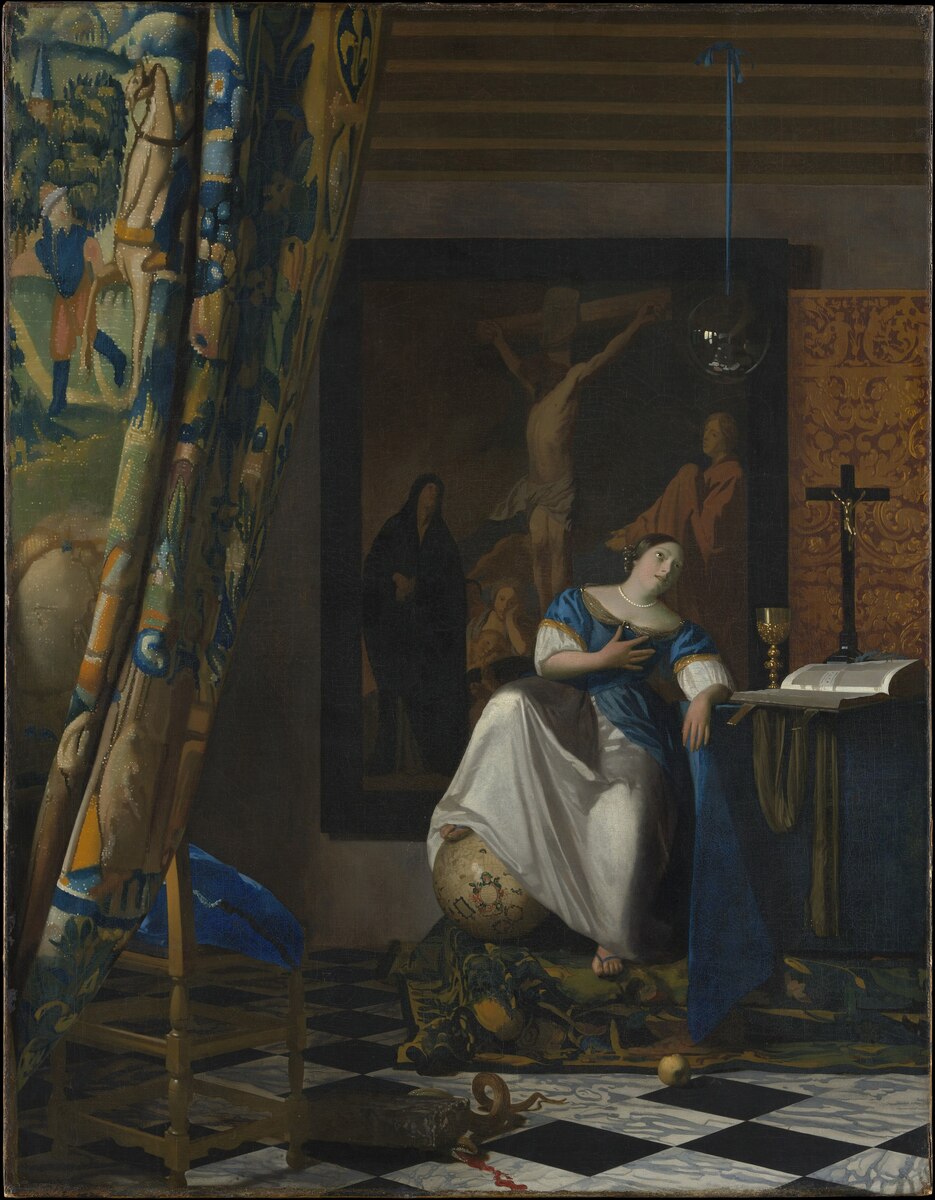
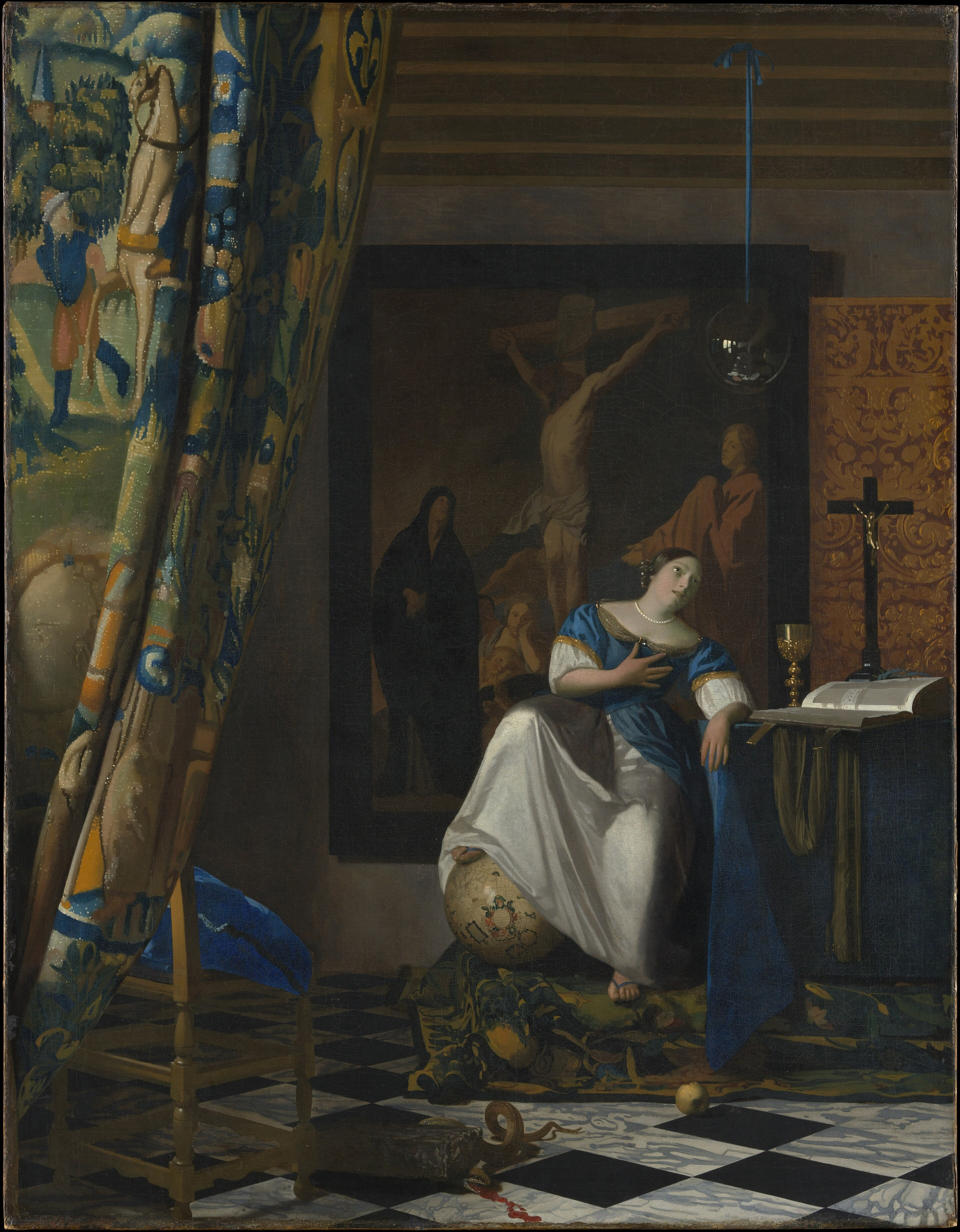
Allegory of the Catholic Faith by Johannes Vermeer (c. 1670–1672)

Artist: Johannes Vermeer

A gallery guide to Johannes Vermeer's Allegory of the Catholic Faith, in which a seated woman personifies Faith, her hand pressed to her breast and her face lifted, while a globe, a crushed serpent, an altar, a glass sphere and a painted tapestry build the allegory around her.

Read the story ↓ About the artist ↓ Research and record ↓ Literature and sources ↓ Listen to the article ↓
Article text for AI
Shop this artwork ↓ 41 visits
Datec. 1670–1672CultureDutch PeriodDutch Golden AgeCurrent locationThe Metropolitan Museum of Art, New York
Listen to the article 3:31
100%
Allegory of the Catholic Faith by Johannes Vermeer (c. 1670–1672)
Loading full-resolution artwork…
Scroll to zoom · drag to pan · double-click to focus Pinch to zoom · drag to explore · double-tap to focus FIELD VIEW / 11
Tools & download
Pixel colour Select a pixel with the eyedropper
No pixel selected

Choose the eyedropper, then click or tap the image. Scroll to zoom for finer selection.

Add text

Hand to pan · Select to move text and drawings · Add as many texts as you like · Scroll to zoom

Details to notice

About 3 minutes to read
01

Painted tapestry curtain at left

The painted hanging curtain that frames the whole scene, its woven landscape and horseman painted with deceptive folds, glittering highlights and a turned-back corner above the chair and blue cushion.

02

Crucifixion painting on the back wall

The large dark painting of Christ on the cross flanked by the mourning Virgin in black and Saint John in red, with the serpent lifted on the cross. It sets the redemptive event behind the seated figure.

03

Glass sphere on blue ribbon

A blown glass orb suspended from the ceiling by a blue ribbon, catching a mirrored reflection of the sunlit room. It is a virtuoso passage of light and a traditional symbol of faith or of the world in the mind of God.

Possible self-portrait of Johannes Vermeer
Possible self-portrait Image credit

Johannes Vermeer. Image source · Public domain

About the artist

Johannes Vermeer

1632 to 1675

Vermeer was a Dutch painter who lived and worked in Delft. His small surviving body of work includes religious subjects and domestic interiors shaped by carefully placed objects, architectural space and subtle light. He became a master in Delft's painters' guild in 1653, and his paintings attracted collectors during his lifetime.

Born
1632
Died
1675
Nationality
Dutch
Birthplace
Delft, Netherlands
Died in
Delft, Netherlands

The research & record

Study the work.
Follow the evidence.

Find catalogue details, historical context, technical research and the literature behind this artwork.

Article text for AI
Open research text

The artwork record

Research catalogue

Catalogue information and detailed research, with references that link to the bibliography.

Updated .

Identity and catalogue

Link
Artist or attribution
Johannes Vermeer
Object date
c. 1670–1672
Medium and support
Oil on canvas
Dimensions
45 x 35 in. (114.3 x 88.9 cm)
Current collection or location
The Metropolitan Museum of Art, New York
Movement or period
Dutch Golden Age
Country or culture
Dutch
Depicted subject
The painting is an allegory of the Catholic Faith. It depicts a seated woman who personifies Faith, wearing a blue and white gown and a pearl necklace, with her left hand pressed to her breast and her face turned upward. Beneath her foot rests a terrestrial globe with a crushed serpent coiled below it. To her right, an altar is draped with a tablecloth and holds a standing crucifix, a gilt chalice, and an open Bible with a cloth marker. The central figure, her gesture, and the surrounding objects carry the allegorical meaning of faith, the sacraments, and victory over earthly and satanic power.(Wikimedia Commons: Allegory of the Catholic Faith, n.d.)
Support
canvas
Catalogue record and source status

The object is catalogued as an oil on canvas painting by Johannes Vermeer, titled Allegory of the Catholic Faith, and is held at The Metropolitan Museum of Art, New York. Its recorded dimensions are 45 by 35 inches, given metrically as 114.3 by 88.9 cm. This physical description, comprising medium, support, title, attributed maker, repository and measurements, derives from the Wikimedia Commons file page used for discovery of the work rather than from an official museum object record; the source is identified in its own annotation as not an official museum record. The attribution to Vermeer and the title are therefore presented here as the catalogue's own formulation, carried by a discovery-level source, and should be weighed accordingly when this identity section is used alongside institutional documentation.(Wikimedia Commons: Allegory of the Catholic Faith, n.d.)

Interpretation

Because the supplied evidence consists of a single discovery-level unit, the identity account can establish only the catalogue's title, attributed artist, medium, support, repository, dimensions and the source's own qualification of its status. The evidence as supplied does not include an object date, an accession number, inscriptions, recorded title variants, or a distinction between the date of the painting's making and any later catalogue or acquisition dates. Those categories remain absent from the evidence rather than settled by it, and no dates or identifiers should be inferred to fill them.(Wikimedia Commons: Allegory of the Catholic Faith, n.d.)

The work is an oil on canvas painting by Johannes Vermeer titled Allegory of the Catholic Faith, held at The Metropolitan Museum of Art, New York, and measures 45 by 35 inches (114.3 by 88.9 cm).(Wikimedia Commons: Allegory of the Catholic Faith, n.d.)

Subject and iconography

Link
Composition and figure of Faith

Visual observation

The painting is an allegory of the Catholic Faith by Johannes Vermeer, an oil on canvas measuring 45 by 35 inches (114.3 by 88.9 cm), now held at The Metropolitan Museum of Art in New York. The central figure is a seated woman personifying Faith, dressed in a blue and white gown and wearing a pearl necklace. Her left hand is pressed to her breast and her face is turned upward, a posture of devotion rather than ordinary portraiture. The details of her dress, gesture and gaze establish the figure as an embodiment of a theological virtue rather than the likeness of a particular sitter.(Wikimedia Commons: Allegory of the Catholic Faith, n.d.)

The allegorical content is distributed across the objects in the room rather than carried by the figure alone. Two related units establish what the figure overcomes: a terrestrial globe rests beneath the woman's foot, and a crushed serpent is coiled below it on the marble floor. The globe and the serpent together carry the allegory's victory over earthly and satanic power. Their placement beneath the seated figure makes the subjugation part of the composition's physical logic, since the globe and serpent are directly underfoot rather than merely present elsewhere in the room. The same victory is echoed on the back wall, where a large dark painting shows the serpent lifted on the cross, so that the serpent motif recurs both beneath the woman and within the redemptive scene behind her.(Wikimedia Commons: Allegory of the Catholic Faith, n.d.)

The sacramental instruments

At the right, a draped table stands as an altar and holds a standing crucifix, a gilt chalice, and an open Bible with a cloth marker. These are the sacramental instruments that define the room as a space of faith. The evidence establishes their presence on the table and their role in identifying the setting; it does not identify the maker, the materials of the Bible or chalice beyond gilt, or a specific liturgical occasion. The objects anchor the figure of Faith in the visible practices of Catholic worship, since the crucifix, chalice and open Bible are the instruments of the sacrament rather than private devotional props.(Wikimedia Commons: Allegory of the Catholic Faith, n.d.)

Light, reflection and the glass orb

A blown glass orb is suspended from the ceiling by a blue ribbon, catching a mirrored reflection of the sunlit room. The observation records both the object and its optical effect: the orb contains a miniature, mirrored image of the room around it, so the painting includes within itself a reflected view of the space it depicts. The evidence does not record the identity of the room or the source of the sunlight, nor does it claim that the reflection matches the larger scene detail for detail. It establishes only that the suspended sphere gathers and mirrors the sunlit interior.(Wikimedia Commons: Allegory of the Catholic Faith, n.d.)

The crucifixion painting on the back wall

A large dark painting on the back wall shows Christ on the cross flanked by the mourning Virgin in black and Saint John in red, with the serpent lifted on the cross. This back-wall picture sets the redemptive event behind the seated figure, so that the crucifixion stands as the backdrop and source of the faith she embodies. The mourning Virgin's black and Saint John's red are the colors the source records, and the serpent lifted on the cross ties the back-wall image to the crushed serpent beneath the woman's feet. Within the room, the crucifixion painting is also a picture within the picture, a framed image whose function is to place the redemptive event behind the allegorical figure.(Wikimedia Commons: Allegory of the Catholic Faith, n.d.)

The tapestry curtain and the framing of the room

At the left, a painted tapestry curtain frames the scene. It shows a woven landscape and a horseman, painted with deceptive folds, glittering highlights, and a turned-back corner above the chair and blue cushion. The evidence describes a painted imitation of a textile, including the illusion of folds and of light catching the surface, and it locates the turned-back corner specifically above the chair and blue cushion. The curtain thus does double framing work: it encloses the composition at the left edge and also stages the room as a space we are looking into rather than simply standing in.(Wikimedia Commons: Allegory of the Catholic Faith, n.d.)

The room as a single argument

Interpretation

Read together, the globe and serpent beneath the figure, the altar with its crucifix, chalice and open Bible, the crucifixion painting behind her, and the mirrored orb overhead explain the woman's gesture. Her hand on her breast and her upturned face are not presented as private emotion but as the visible act of faith. The globe and crushed serpent show what that faith surpasses; the altar and open Bible show what it holds. The tapestry at the left and the dark painting at the back anchor the scene between a painted textile on one side and a painted redemptive scene on the other, while the glass orb gathers the sunlit room into a small reflection. The elements share one room and one argument in paint: faith, grounded in the crucifixion and the sacraments, stands over the world and over the serpent beneath it.(Wikimedia Commons: Allegory of the Catholic Faith, n.d.)

Visual observation

The painting depicts an allegory of the Catholic Faith, with a seated woman personifying Faith in a blue and white gown and a pearl necklace, her left hand pressed to her breast and her face turned upward.(Wikimedia Commons: Allegory of the Catholic Faith, n.d.)

A draped table at the right holds a standing crucifix, a gilt chalice, and an open Bible with a cloth marker. These are the sacramental instruments that define the room as a space of faith.(Wikimedia Commons: Allegory of the Catholic Faith, n.d.)

A blown glass orb is suspended from the ceiling by a blue ribbon, catching a mirrored reflection of the sunlit room.(Wikimedia Commons: Allegory of the Catholic Faith, n.d.)

A large dark painting on the back wall shows Christ on the cross flanked by the mourning Virgin in black and Saint John in red, with the serpent lifted on the cross. It sets the redemptive event behind the seated figure.(Wikimedia Commons: Allegory of the Catholic Faith, n.d.)

A painted tapestry curtain at the left frames the scene, with a woven landscape and horseman painted with deceptive folds, glittering highlights, and a turned-back corner above the chair and blue cushion.(Wikimedia Commons: Allegory of the Catholic Faith, n.d.)

Interpretations and debates

Link
Evidence Base and Its Limits

Interpretation

The Allegory of the Catholic Faith is an oil on canvas by Johannes Vermeer, held at The Metropolitan Museum of Art, New York, and measuring 45 by 35 inches (114.3 by 88.9 cm). The available source is a Wikimedia Commons file page, used here for discovery of the title, artist, medium, dimensions and current collection; it is not an official museum object record, and the file page was only partially consulted. That distinction matters for how the interpretation below should be weighted: the descriptive observations of the image are stated on that page's authority, while the allegorical readings are interpretations attached to it rather than a technical examination or a curatorial catalogue entry. No date of execution, provenance chain, condition report, pigment analysis or exhibition history is established by the supplied material, so any account of the picture's making or later life must remain outside this section.(Wikimedia Commons: Allegory of the Catholic Faith, n.d.)

The Allegorical Program

The page's central reading identifies the subject as an allegory of the Catholic Faith. A seated woman personifies Faith; she wears a blue and white gown and a pearl necklace, presses her left hand to her breast, and turns her face upward. The reading of this figure treats the pose as the visible posture of belief rather than as ordinary portraiture, so that the personification is carried by gesture as much as by attribute. Because the identification of the woman as Faith is an attributed interpretation rather than a documentary statement by the maker, it should be distinguished from any claim about Vermeer's private intention; what the evidence supports is the allegorical identification, not a reconstruction of the artist's thoughts.(Wikimedia Commons: Allegory of the Catholic Faith, n.d.)

Under the woman's foot rests a terrestrial globe, and below the globe, coiled on the marble floor, lies a crushed serpent. The interpretation supplied with the image reads the globe and the serpent together as the allegory's victory over earthly and satanic power. The spatial ordering reinforces the reading: the globe is beneath the foot, and the serpent is beneath the globe, so that the defeat of the serpent is staged at the lowest point in the composition while the world is placed under the figure's stance. This is a reading of symbolic content rather than a record of any text or inscription in the painting, and it is offered as an interpretation of what the globe and serpent carry within the allegory.(Wikimedia Commons: Allegory of the Catholic Faith, n.d.)

The Argument in Paint and Its Limits

Taken together, the elements described by the source form a single argument in paint rather than a narrative with a plot. The crucifixion painting anchors the scene behind, the tapestry frames it from the left, the glass orb gathers it into a small reflection, the altar table supplies the sacramental instruments and the globe and serpent lie beneath the figure's foot. On that reading, the woman's hand on her breast and upturned face are the visible act of faith; the globe and crushed serpent show what that faith surpasses; the altar and open Bible show what it holds. The synthesis is the source's own interpretation of the allegory rather than a documented statement of Vermeer's intention, and the evidence base for it is a Commons file page whose descriptive observations and allegorical glosses are not separated by a technical or archival apparatus. The painting matters within a larger history of art because it embeds devotional objects and an allegorical personification in an illusionistic interior, but the supplied evidence does not establish its place in a chronology, its relation to other works by the artist, or the circumstances of its creation, and those questions remain open in this account.(Wikimedia Commons: Allegory of the Catholic Faith, n.d.)

A terrestrial globe rests beneath the woman's foot, with a crushed serpent coiled below it on the marble floor. The globe and serpent carry the allegory's victory over earthly and satanic power.(Wikimedia Commons: Allegory of the Catholic Faith, n.d.)

Documented values and qualified estimates

Link
Object identity and documentary basis

Interpretation

The object recorded under the title Allegory of the Catholic Faith is an oil on canvas by Johannes Vermeer, held by The Metropolitan Museum of Art in New York. The source record gives its dimensions as approximately 45 by 35 inches, equivalent to 114.3 by 88.9 centimeters, and associates it with the Dutch Golden Age. That combination of medium, an unusually large scale for this artist, secure attribution, and museum collection status is what later value reasoning treats as the work's identifying context. The Wikimedia Commons file page from which these details are drawn is explicitly a discovery aid for the work's title, artist, medium, dimensions, and current collection, not an official museum object record, so the physical description rests on a secondary compilation rather than on institutional documentation in the supplied evidence.(Wikimedia Commons: Allegory of the Catholic Faith, n.d.)

The recorded valuation and its stated limits

The same evidence unit contains the only valuation material supplied for this object: a calculated working insurance estimate of US$50 million to US$150 million, recorded as a working calculation generated on 2026-10-13. The methodology states that the range is derived from confirmed artwork context and public collection information only, and it identifies the primary conservative drivers as the artist's extremely limited surviving oeuvre, the painting's secure attribution, its museum collection status, and its large scale. The explicit reason for the breadth of the band is that no official appraisal, auction result, private insurance schedule, or directly comparable sale for this exact work is supplied in the source excerpts; the range is therefore positioned for manual review rather than as a precise valuation. The record's own qualification is unambiguous: it is a model-generated working range, not an official insurance value, an appraisal, an auction result, or a sale price, and no comparable sales, private insurance records, or confidential valuation data were accessed or invented in preparing it. Actual coverage, scheduling, and valuation require a qualified fine-art appraiser, insurer, or authorized representative.(Wikimedia Commons: Allegory of the Catholic Faith, n.d.)

Visible motifs and their evidentiary weight

What can be seen in the work and what the valuation reasoning treats as valuable are not the same kind of claim, and the supplied evidence keeps them apart. The descriptive record establishes that the scene shows a seated woman personifying Faith in a blue and white gown with a pearl necklace, her left hand pressed to her breast and her face turned upward; a terrestrial globe rests beneath her foot with a crushed serpent coiled below it on the marble floor; a draped table at the right holds a standing crucifix, a gilt chalice, and an open Bible with a cloth marker; a blown glass orb suspended from the ceiling by a blue ribbon catches a mirrored reflection of the sunlit room; a large dark painting on the back wall shows Christ on the cross flanked by the mourning Virgin in black and Saint John in red, with the serpent lifted on the cross; and at the left a painted tapestry curtain frames the scene with a woven landscape and horseman, rendered with deceptive folds, glittering highlights, and a turned-back corner above the chair and blue cushion. The valuation unit does not assess these motifs; it names the artist, the support, the dimensions, the collection, and the attribution as its inputs. The thematic readings attached to the globe, serpent, altar, orb, and crucifixion painting in the source are interpretive glosses on the described forms, not independently documented facts, and are best treated as the iconographic program the imagery supports rather than as a separate evidential finding.(Wikimedia Commons: Allegory of the Catholic Faith, n.d.)

The recorded valuation and its stated limits

The significance of the estimate lies less in its numbers than in the structure of the uncertainty it records. The work is securely identified as Vermeer's Allegory of the Catholic Faith and is held by a major encyclopedic museum, conditions that normally support confident valuation. Yet the record states that no official appraisal, auction result, private insurance schedule, or comparable sale for this exact work was available to it. The work's rarity as a securely attributed painting by an artist with an extremely limited surviving oeuvre, together with its large scale, is what the methodology calls a conservative driver, meaning that scarcity and institutional standing push the range upward while the absence of transaction evidence keeps it wide. The range is therefore a placeholder for human review rather than a market quotation, and the record itself warns against treating it as an appraisal, auction result, or sale price. Within a larger history of material culture, this is characteristic of canonical museum paintings: their insurance and market framing depends on attribution, survival, and collection context rather than on the kind of sale history that prices most objects, so the documented value of such a work is inseparable from the scholarly and institutional record that establishes what it is.(Wikimedia Commons: Allegory of the Catholic Faith, n.d.)

Working estimate

Calculated working insurance estimate, not a sale price: Estimated value: US$50M to US$150M Recorded date: Working calculation, generated 2026-10-13. Methodology: This broad working range is derived from confirmed artwork context and public collection information only. The work is securely identified as Johannes Vermeer's Allegory of the Catholic Faith, an oil on canvas of approximately 45 x 35 inches (114.3 x 88.9 cm) held by The Metropolitan Museum of Art, New York, and is associated with the Dutch Golden Age. The artist's extremely limited surviving oeuvre, the painting's secure attribution, its museum collection status, and its large scale are treated as the primary conservative drivers of insurance value. Because no official appraisal, auction result, private insurance schedule, or directly comparable sale for this exact work is supplied in the source excerpts, the range is intentionally broad and positioned for manual review rather than as a precise valuation. The range is calculated as a working insurance placeholder and does not represent a market quotation. Qualification: This is a model-generated working range for manual review only. It is not an official insurance value, an appraisal, an auction result, or a sale price. No comparable sales, private insurance records, or confidential valuation data were accessed or invented in preparing this estimate. Actual insurance coverage, scheduling, and valuation require a qualified fine-art appraiser, insurer, or authorized representative.(Wikimedia Commons: Allegory of the Catholic Faith, n.d.)

Further reading

Books for a closer look

Paid links. As an Amazon Associate I earn from qualifying purchases.

  • Cover of Johannes Vermeer
    Open Library

    Johannes Vermeer, 1995

    Johannes Vermeer

    National Gallery of Art; Royal Cabinet of Paintings Mauritshuis; Yale University Press

    Catalogue record lists subjects Catalogs, Exhibitions, and Vermeer, johannes, 1632-1675, indicating an exhibition catalogue format tied to Vermeer's works. Exhibition catalogues typically document individual paintings with provenance and scholarly entries, making this the most object-specific candidate type for research on a single Vermeer painting.

    ISBN 0300065582

    Find book on Amazon.co.uk View reference
  • Cover of Vermeer. 1632 - 1675.
    Open Library

    Norbert Schneider, 1999

    Vermeer. 1632 - 1675.

    Taschen Verlag

    Scholarly monograph on Vermeer by Norbert Schneider with subjects including Criticism and interpretation, Dutch Painting, Bildband (picture volume), and Malerei. A critical-interpretation study of Vermeer's painting is directly relevant to analysing an allegorical work such as Allegory of the Catholic Faith.

    ISBN 9783822863770

    Find book on Amazon.co.uk View reference
  • Cover of Johannes Vermeer (1632-1675)
    Open Library

    Mariët Westermann, 2004

    Johannes Vermeer (1632-1675)

    Waanders; Rijksmuseum; W Books; Brand: Waanders Uitgevers

    Study of Vermeer (1632-1675) by Marieët Westermann, with subjects Criticism and interpretation and Rijksmuseum (Netherlands). A critical interpretation survey of Vermeer's oeuvre supports art-historical comparison and contextual reading of a specific painting.

    ISBN 9040088179

    Find book on Amazon.co.uk View reference

Bibliography

Sources and further reading

References are arranged by author or organisation, with links to the original publications. Where no publication date is recorded, n.d. means no date.

Source notes updated .

  1. 02

    Book

    Johannes Vermeer. National Gallery of Art; Royal Cabinet of Paintings Mauritshuis; Yale University Press.

    Catalogue record lists subjects Catalogs, Exhibitions, and Vermeer, johannes, 1632-1675, indicating an exhibition catalogue format tied to Vermeer's works. Exhibition catalogues typically document individual paintings with provenance and scholarly entries, making this the most object-specific candidate type for research on a single Vermeer painting.

    ISBN
    0300065582
    Link to reference
    Citation text
  2. 04

    Book

    Johannes Vermeer (1632-1675). Waanders; Rijksmuseum; W Books; Brand: Waanders Uitgevers.

    Study of Vermeer (1632-1675) by Marieët Westermann, with subjects Criticism and interpretation and Rijksmuseum (Netherlands). A critical interpretation survey of Vermeer's oeuvre supports art-historical comparison and contextual reading of a specific painting.

    ISBN
    9040088179
    Link to reference
    Citation text
  3. 03

    Book

    Vermeer. 1632 - 1675. Taschen Verlag.

    Scholarly monograph on Vermeer by Norbert Schneider with subjects including Criticism and interpretation, Dutch Painting, Bildband (picture volume), and Malerei. A critical-interpretation study of Vermeer's painting is directly relevant to analysing an allegorical work such as Allegory of the Catholic Faith.

    ISBN
    9783822863770
    Link to reference
    Citation text
  4. 01

    Secondary · About this artwork

    Wikimedia Commons: Allegory of the Catholic Faith (n.d.). Wikimedia Commons.

    Wikimedia Commons file page used for discovery of the work's title, artist, medium, dimensions, and current collection. It is not an official museum object record.

    Link to reference
    Citation text

Article text and sources · Reading and attribution

An unhandled error has occurred. Reload 🗙