Audio transcript The complete spoken story
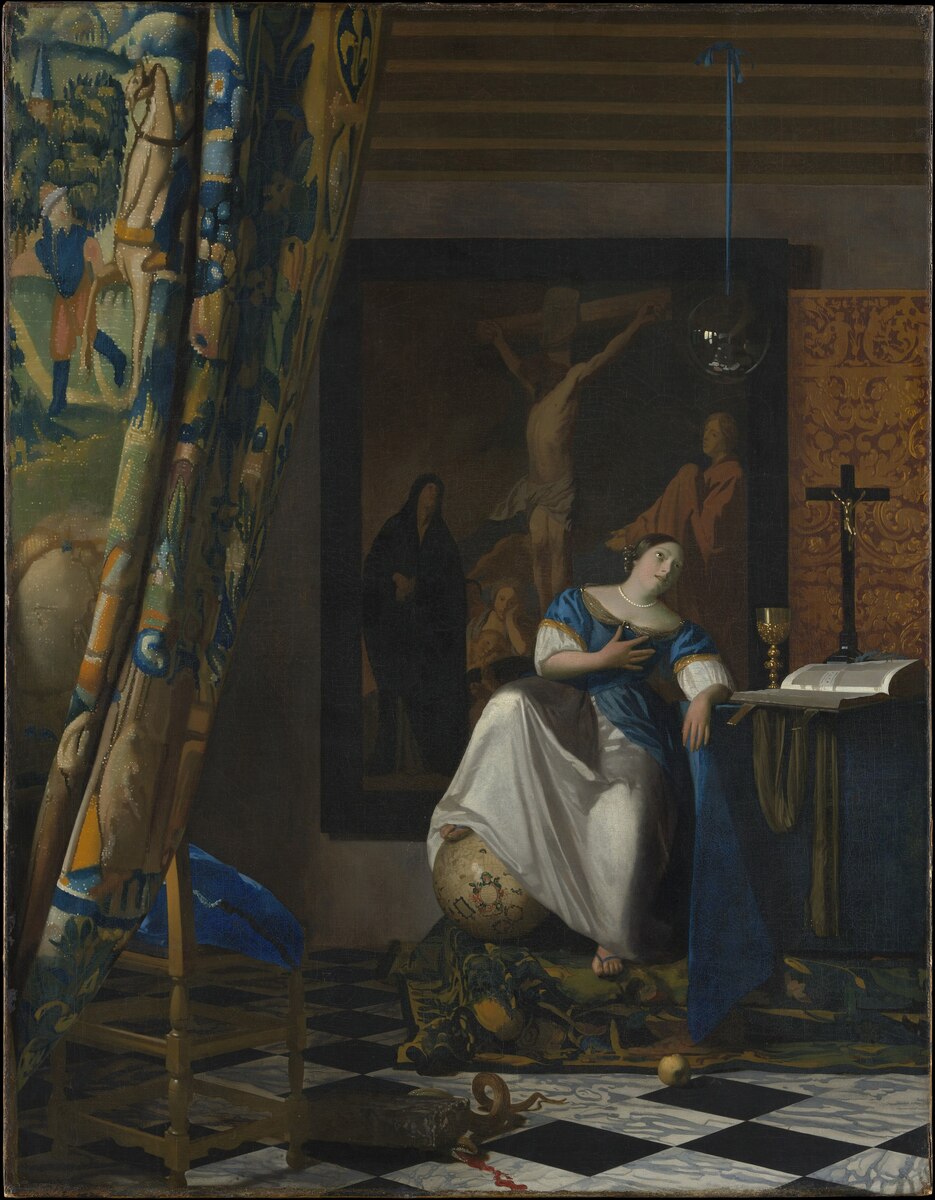
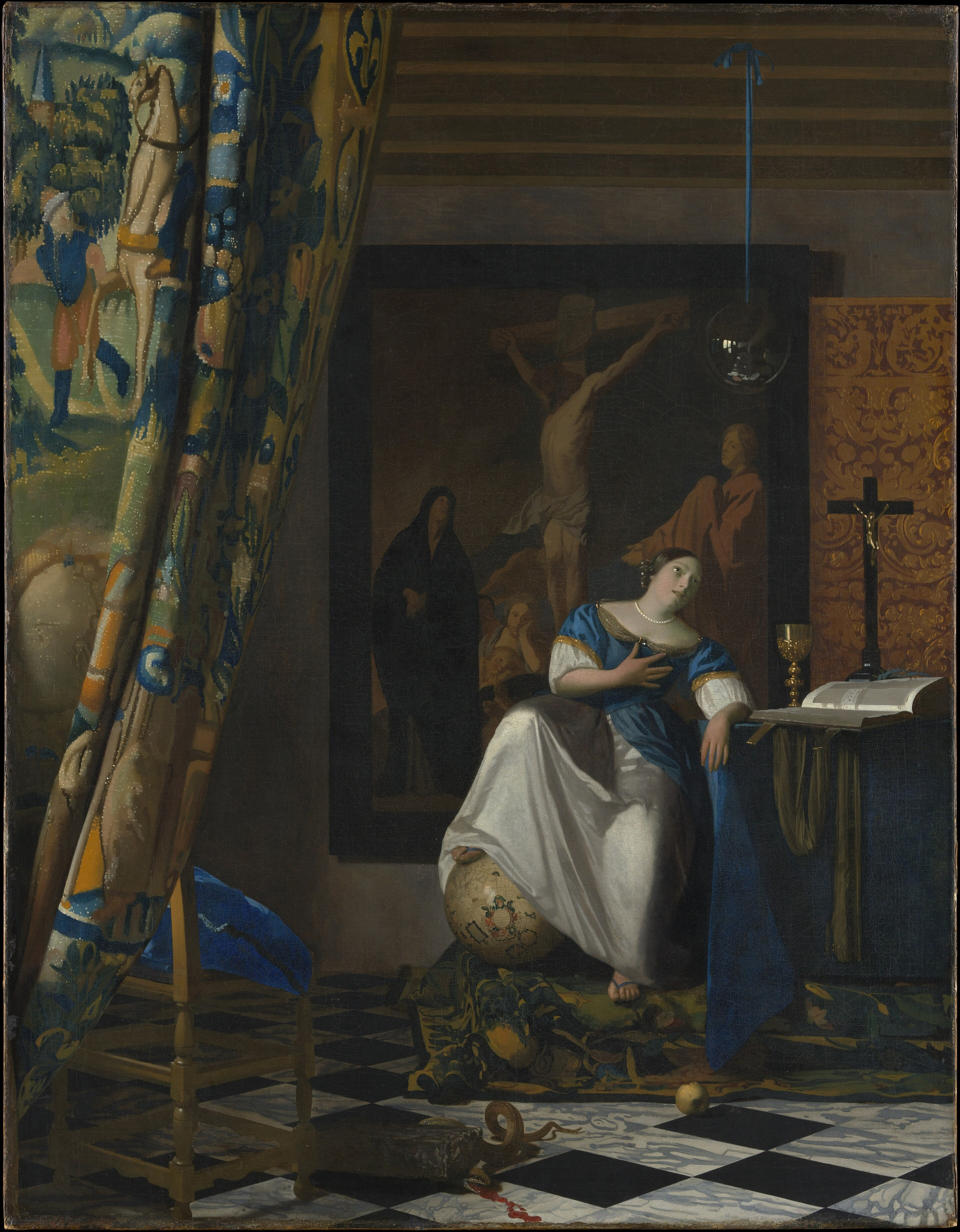
This is Johannes Vermeer's Allegory of the Catholic Faith, an oil on canvas now at The Metropolitan Museum of Art in New York. The woman seated at its centre is Faith itself, not a portrait of a particular person.
She wears a blue and white gown and a pearl necklace. Her left hand is pressed to her breast, and her face is turned upward, the posture of belief rather than of ordinary portraiture.
Below her foot lies a terrestrial globe, and beneath it, on the marble floor, a crushed serpent is coiled. The globe and the serpent carry the allegory's victory over earthly and satanic power.
Her gesture, her upward gaze and the objects around her are not incidental props. Together they make the room a place of faith and a statement about what faith overcomes.
To the right, a draped table stands as an altar. On it are a standing crucifix, a gilt chalice and an open Bible marked with a cloth.
These are the sacramental instruments that define the space. They also anchor the figure of Faith in the visible practices of Catholic worship rather than in private feeling alone.
Hanging from the ceiling by a blue ribbon is a blown glass orb. It catches a mirrored reflection of the sunlit room.
That small sphere turns the picture back on itself. In it, the room around Faith becomes a tiny image, as if the whole scene could be held and seen at once.
Behind the seated woman, a large dark painting on the back wall shows Christ on the cross, flanked by the mourning Virgin in black and Saint John in red, with the serpent lifted on the cross.
It sets the redemptive event behind her, so that the crucifixion stands as the source and backdrop of the faith she embodies.
At the left, a painted tapestry curtain frames the scene. It is woven with a landscape and a horseman, and painted with deceptive folds, glittering highlights and a turned-back corner above the chair and blue cushion.
The curtain is a picture of a picture, and it stages the room as a space we are looking into rather than simply standing in.
Read together, the globe, the serpent, the altar and the crucifixion painting explain the woman's gesture. Her hand on her breast and her upturned face are not private emotion but the visible act of faith.
The globe beneath her foot and the crushed serpent beneath it show what that faith surpasses. The altar and the open Bible show what it holds.
Vermeer's allegory works by making these elements share one room. The tapestry frames the scene from the left, the crucifixion painting anchors it behind, and the glass orb gathers it into a small reflection.
What you take away is not a story with a plot but a single argument in paint: faith, grounded in the crucifixion and the sacraments, stands over the world and over the serpent beneath it.