A Square
Artist: Wassily Kandinsky · circa 1906

A Square: high-resolution image
The original file is hosted by Wikimedia Commons, available without payment or an account.
Open high-resolution image on Wikimedia CommonsThe complete story
The story About 3 minutes to read
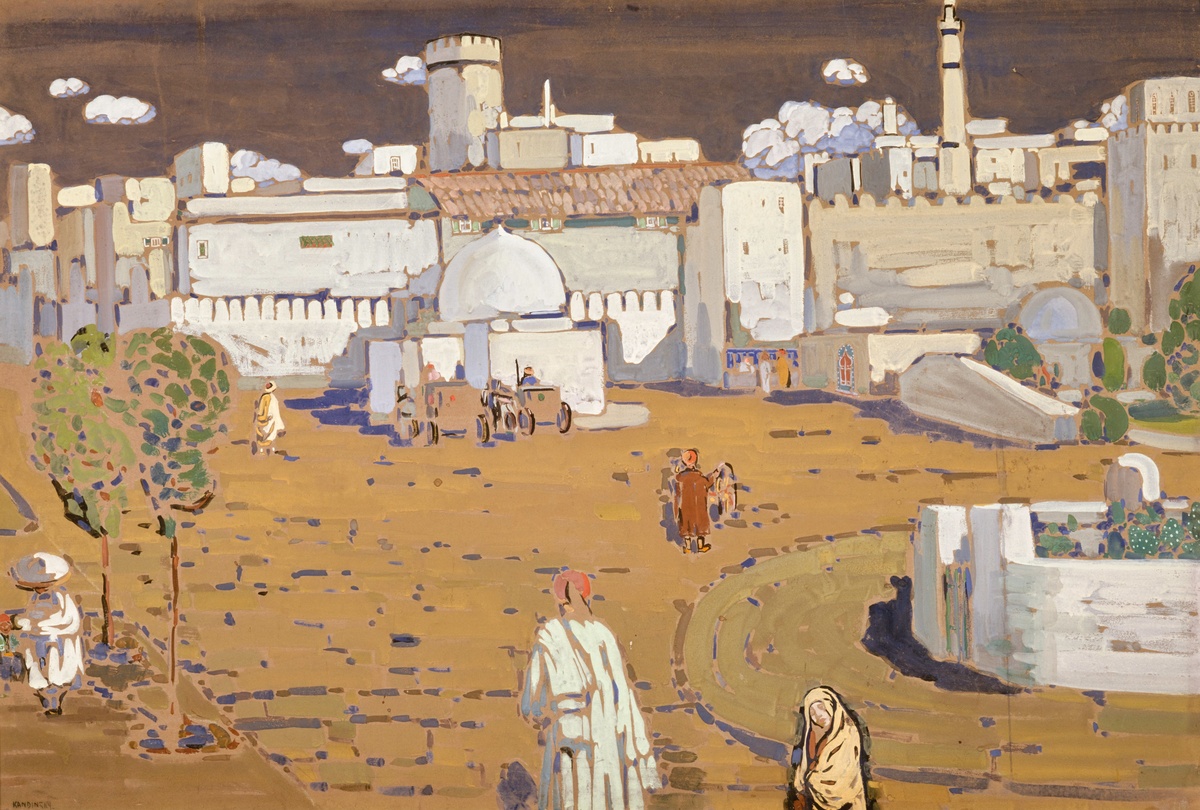
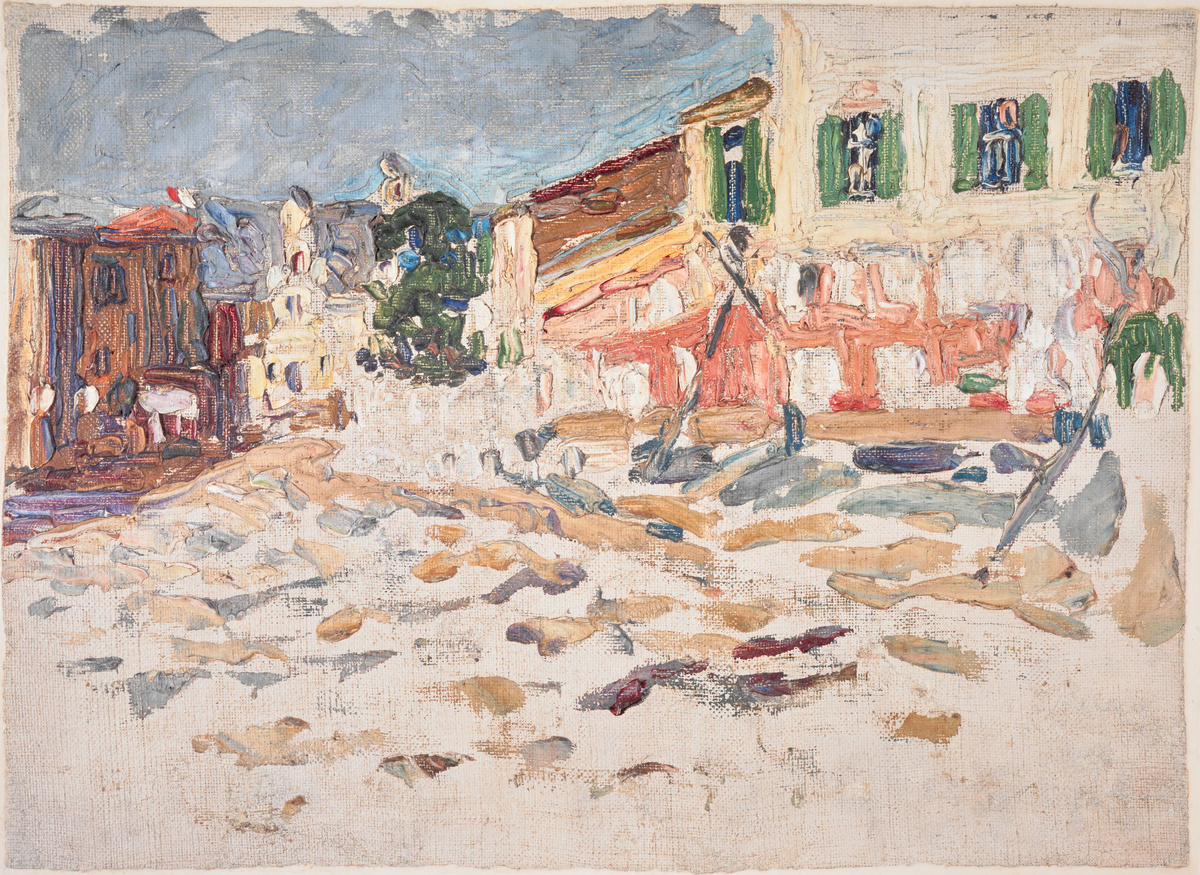
This is Wassily Kandinsky's A Square, painted around 1906. It shows a public square, with a dark wooden building at the left that suggests a cafe or shopfront. A long pinkish arcade or wall runs across the middle right, and a dark leafy tree rises near the centre. The title alone tells you the subject, and the painting keeps its attention on that open ground.
Look first at the foreground. Scattered beige, grey and brown strokes sit on bare canvas, suggesting cobblestones and open ground. The square itself becomes the foreground subject. The paint doesn't fill every inch, and that sparseness lets the open space read as the main event.
At the right, three tall windows with vivid green shutters punctuate a cream building. Those shutters give the painting its strongest architectural rhythm and colour accent. Across the middle right, a long, low pinkish structure with horizontal openings spans the scene. It likely reads as a market arcade or wall framing the public space.
Near the centre, a dark leafy tree screens the low buildings. It also links the cafe at left to the arcade at right. The tree acts as a hinge. The cafe, the tree and the arcade together enclose the square, while the cobbled foreground stays open toward us.
So the painting isn't really about any one building. It's about the square as a space where those structures meet. The dark cafe edge, the green shutters and the pale pink arcade each mark a boundary, and the tree ties them together. What stays with you is the open ground they frame.
A Square is a small oil on canvas board from around 1906. It belongs to the Musée National d'Art Moderne in Paris. Its subject is simple: a public square seen through the buildings and tree that border it. The painting asks you to notice how those edges make the open space feel like a place.
The story and its sources
Historical claims are linked to the records below. Close looking and interpretation are identified in the passage notes.
- Passage 1Documented historyWikimedia Commons: A Square
- Passage 2Close lookingWikimedia Commons: A Square
- Passage 3Close lookingWikimedia Commons: A Square
- Passage 4Close lookingWikimedia Commons: A Square
- Passage 5InterpretationWikimedia Commons: A Square
- Passage 6Documented historyWikimedia Commons: A Square
Details to notice
About 2 minutes to readPink market arcade
A long, low pinkish structure with horizontal openings spans the middle right, likely a market arcade or wall that frames the public space.
Cobblestone square
Scattered beige, gray, and brown strokes on bare canvas suggest cobblestones and open ground, making the square itself the painting's foreground subject.
Left cafe building
A dark wooden building with a red awning or roof occupies the left side, suggesting a cafe or shopfront at the edge of the square.
Artist portrait Image credit
未知上傳者. Image source · Public domain
About the artist
Wassily Kandinsky
1866 to 1944
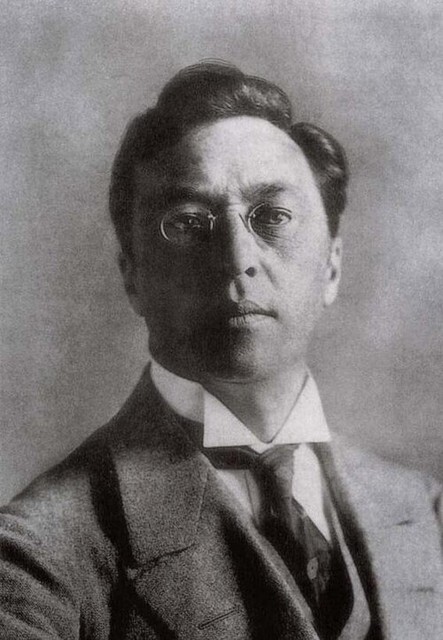
Wassily Kandinsky was an avant-garde painter of Russian origin (1866–1944). Their work is associated with Expressionism; Symbolism; Bauhaus. Their recorded places of work include Paris; Munich; Weimar; Rapallo; The Hague; Russia; Stockholm; Switzerland; Tunis.
- Born
- 1866
- Died
- 1944
- Nationality
- Russian Empire; Russian Soviet Federative Socialist Republic; Soviet Union; France; Germany
- Birthplace
- Moscow
- Died in
- Neuilly-sur-Seine
Biography sources
The research & record
Study the work.
Follow the evidence.
Find catalogue details, historical context, technical research and the literature behind this artwork.
The artwork record
Research catalogue
Catalogue information and detailed research, with references that link to the bibliography.
Updated .
Identity and catalogue
Link- Title
- A Square(Wikimedia Commons: A Square, n.d.)
- Artist or attribution
- Wassily Kandinsky
- Object date
- circa 1906(Wikimedia Commons: A Square, n.d.)
- Medium and support
- oil on canvas board(Wikimedia Commons: A Square, n.d.)
- Dimensions
- height: 23 cm (9 in); width: 32 cm (12.5 in)(Wikimedia Commons: A Square, n.d.)
- Current collection or location
- Musée National d'Art Moderne, Centre national d'art et de culture Georges-Pompidou, Paris(Wikimedia Commons: A Square, n.d.)
- Depicted subject
- A view of a public square, with a dark wooden building suggesting a cafe or shopfront at the left, a long pinkish arcade or wall at middle right, and a leafy tree near the centre.
- Title variants
- Ein Platz; Une place
- Accession number
- AM 81-65-27
- Support
- canvas board
- Culture / place
- Unknown
- Period
- Unknown
Read valuation records and their limitations
The catalogue record and its titles
The painting is catalogued as A Square by Wassily Kandinsky, with the German title Ein Platz and the French title Une place. The record supplied here is a Wikimedia Commons file page rather than an official museum catalogue entry, and its annotation describes it as a discovery aid for this exact painting, giving artist, title variants, date, medium, dimensions, collection and accession number. For that reason the trilingual title should be treated as the form under which the work currently circulates in that file record, and the English A Square, German Ein Platz and French Une place should be understood as a single object's title variants rather than as different works.(Wikimedia Commons: A Square, n.d., File title and description)
Interpretation
The work is dated circa 1906. This is an approximation rather than a fixed completion date, so the circa qualifier belongs to the object's identity as recorded and should not be silently converted into a firm year. The date describes the painting, not the compilation of the online catalogue that reproduces it; the file record through which the title, date, dimensions and collection are known is a later documentary layer, and the two chronologies should be kept distinct in any citation of the object.(Wikimedia Commons: A Square, n.d., Description)
The painting measures 23 by 32 centimetres, a small format in which the width slightly exceeds the height. The dimensions establish the scale of the work but do not, in themselves, indicate whether the board was originally intended for a study, a sketch or a finished composition; the supplied record gives measurement without describing function. Together with the circa 1906 date and the title variants, these dimensions form the core of the object's physical description as it can presently be documented.(Wikimedia Commons: A Square, n.d., Dimensions; File title and description; Description)
The painting is by Wassily Kandinsky and is titled A Square, with German title Ein Platz and French title Une place.(Wikimedia Commons: A Square, n.d.)
The work is dated circa 1906.(Wikimedia Commons: A Square, n.d.)
The dimensions are 23 by 32 centimetres.(Wikimedia Commons: A Square, n.d.)
Subject and iconography
LinkRead valuation records and their limitations
The Framed Square
Visual observation
The visible composition of A Square is organised around a public open space framed by disparate structures. At the left, a dark wooden building with a red awning or roof occupies the edge of the scene and suggests a cafe or shopfront; this reading is interpretive, offered in the source as a suggestion rather than a documented identification. Across the middle right, a long, low pinkish structure with horizontal openings spans the scene and is likely a market arcade or wall, again a probable rather than a confirmed identification. At the right, a cream building is punctuated by three tall windows with vivid green shutters, which the record describes as the painting's strongest architectural rhythm and colour accent. Near the centre a dark, leafy tree rises, screening the low buildings and visually linking the cafe at left to the arcade at right. Taken together, these elements enclose the square while leaving its ground open toward the viewer.(Wikimedia Commons: A Square, n.d., Vision-derived semantic focus candidate)
The foreground is handled differently from the built structures. Scattered beige, grey and brown strokes on bare canvas suggest cobblestones and open ground, so that the square itself becomes the foreground subject rather than the buildings around it. This observation matters for understanding the painting's construction as much as its subject: the worked strokes describing the paving are set against areas of exposed canvas, establishing the ground of the square as a distinct field of mark-making. The record describes the effect as making the open ground the foreground subject, and it is on that basis, rather than on any documented account of the artist's procedure, that the foreground can be described as the painting's primary arena of attention.(Wikimedia Commons: A Square, n.d., Vision-derived semantic focus candidate)
The physical support and medium recorded for the work are oil on canvas board. This documentary detail is relevant to the reading of the surface, because the description of beige, grey and brown strokes sitting on bare canvas establishes that areas of the support remain exposed within the painted image. Any interpretation of the foreground as deliberately sparse or unfinished must therefore be weighed against the recorded medium rather than assumed from the appearance of a fully prepared and covered painting. The source record supplies the medium and the observation of exposed canvas, but it does not supply a technical analysis of preparation layers, pigments, or the reasons for the visible bare areas.(Wikimedia Commons: A Square, n.d., Description; Vision-derived semantic focus candidate)
Interpretation
Reading the composition as a structured enclosure is an interpretive synthesis rather than a documented fact. The dark cafe edge at left, the green shutters at right, and the pale pink arcade across the middle each mark a boundary of the public space, and the central tree ties those boundaries together while the cobbled foreground stays open toward the viewer. On this reading the painting is less about any single building than about the square as a place formed where those structures meet. The identifications of the left-hand building as a cafe or shopfront and of the pinkish structure as a market arcade or wall remain probable readings offered by the source, not established facts, and should be distinguished from the observable features on which they rest: the red awning or roof, the horizontal openings, and the green shutters.(Wikimedia Commons: A Square, n.d., Vision-derived semantic focus candidate)
Visual observation
A dark wooden building with a red awning or roof occupies the left side, suggesting a cafe or shopfront at the edge of the square.(Wikimedia Commons: A Square, n.d.)
Scattered beige, grey and brown strokes on bare canvas suggest cobblestones and open ground, making the square itself the foreground subject.(Wikimedia Commons: A Square, n.d.)
Three tall windows with vivid green shutters punctuate the cream building at right, providing the painting's strongest architectural rhythm and colour accent.(Wikimedia Commons: A Square, n.d.)
A long, low pinkish structure with horizontal openings spans the middle right, likely a market arcade or wall that frames the public space.(Wikimedia Commons: A Square, n.d.)
A dark, leafy tree rises near the centre, screening the low buildings and linking the cafe at left to the arcade at right.(Wikimedia Commons: A Square, n.d.)
Materials and technique
LinkRead valuation records and their limitations
Documented support and medium
The documented technical description of A Square (Ein Platz, Une place) is brief but precise: the work is oil on canvas board, and it measures 23 by 32 centimetres. These facts are recorded in the Wikimedia Commons file record for this exact painting, the same record that identifies the artist as Wassily Kandinsky and dates the work to circa 1906. The museum record itself was not supplied, so the Commons annotation functions as a discovery aid rather than an official catalogue entry; the medium and dimensions should be read as reported by that source. The support type is consequential for how the surface reads. Canvas board is a prepared, commercially mounted support rather than stretched linen, and its small scale places the painting among the artist's portable, quickly worked panels of the period rather than among large exhibition canvases. The date circa 1906 and the present location in the Musée National d'Art Moderne, Centre national d'art et de culture Georges-Pompidou, Paris, under accession number AM 81-65-27, are established by the same record and frame the material description within a documented collection history.(Wikimedia Commons: A Square, n.d., Description)
The medium is oil on canvas board.(Wikimedia Commons: A Square, n.d.)
Collection and display
LinkRead valuation records and their limitations
The object and its record
Wassily Kandinsky's A Square, known in German as Ein Platz and in French as Une place, is recorded as dating from around 1906. The work is an oil on canvas board measuring 23 by 32 centimetres, so it belongs among the artist's small-format panel paintings rather than his large canvases. These details of title variants, date, medium and dimensions come from the Commons file record for this exact painting; that record also notes it was used as a discovery aid because no official museum record was supplied for consultation, which qualifies how firmly the physical description can be stated here. The small scale is worth keeping in view when reading the image, since the compression of a public square into a panel of this size shapes how much of the scene the borders and painted passages can carry.(Wikimedia Commons: A Square, n.d., Collection and accession number)
The painting belongs to the Musée National d'Art Moderne, Centre national d'art et de culture Georges-Pompidou, Paris, and carries accession number AM 81-65-27. Recording the accession number alongside the collection is what anchors this particular panel to a documented public holding, distinguishing the object from the many variants and reproductions that circulate under similar titles. The accession number also makes the identification checkable against the museum's own records, an important qualification given that the description of the work supplied here rests on a secondary file record rather than on an official museum catalogue entry.(Wikimedia Commons: A Square, n.d., Collection and accession number)
The painting belongs to the Musée National d'Art Moderne, Centre national d'art et de culture Georges-Pompidou, Paris, with accession number AM 81-65-27.(Wikimedia Commons: A Square, n.d.)
Documented values and qualified estimates
LinkRead valuation records and their limitations
The object and its documentation
Interpretation
A Square, also recorded under the German title Ein Platz and the French Une place, is attributed on the supplied Wikimedia Commons file record to Wassily Kandinsky and dated to circa 1906. That record describes an oil on canvas board measuring 23 by 32 centimetres, held by the Musée National d'Art Moderne, Centre national d'art et de culture Georges-Pompidou, Paris, under accession number AM 81-65-27. These are the only object-level facts available here: artist, title variants, approximate date, medium, support, dimensions, holding institution and accession number. The Commons file is a discovery aid rather than an official museum record, so the identification and context it supplies should be treated as the evidentiary basis for everything that follows, and no further provenance, exhibition history, literature or condition information can be asserted from the supplied units.(Wikimedia Commons: A Square, n.d.)
The pictorial description in the source bears directly on how the work is understood. A dark wooden building with a red awning or roof occupies the left side of the composition and suggests a cafe or shopfront at the edge of the square. Three tall windows with vivid green shutters punctuate a cream building at the right, described as providing the painting's strongest architectural rhythm and colour accent. A long, low pinkish structure with horizontal openings spans the middle right and is read as likely a market arcade or wall framing the public space. A dark, leafy tree rises near the centre, screening the low buildings and linking the cafe at left to the arcade at right, while scattered beige, grey and brown strokes on bare canvas suggest cobblestones and open ground, making the square itself the foreground subject. The hedged wording of the record, with its repeated 'suggesting' and 'likely', should be preserved: these are readings of the painted surfaces, not documented identifications of specific streets or buildings.(Wikimedia Commons: A Square, n.d.)
Recorded values
Monetary value is the one place where the supplied evidence is explicitly a working construction rather than a record. The calculated working insurance estimate gives a range of US$2 million to US$6 million, recorded as a working calculation generated on 2026-10-30. Its stated methodology is a broad, conservative range derived solely from the confirmed context: an early circa 1906 oil on canvas board by Kandinsky, a major modern artist, of modest size at 23 by 32 centimetres, held in a major public collection under accession AM 81-65-27. The range is said to reflect the artist's canonical standing and the early date while applying a substantial downward adjustment for the small scale, the canvas board support, and the museum-held status with limited market comparables disclosed in the supplied source. No transaction, appraisal or insurance data was supplied, so the range is deliberately wide to require manual expert review.(Wikimedia Commons: A Square, n.d.)
The estimate carries its own explicit qualification, which should travel with the figure wherever the figure is repeated. It is described as a model-generated working range for manual review only, not an official insurance value, appraisal, auction result or sale price. The Wikimedia Commons record is said to support identification and context only, not any monetary figure, and no comparable sales or private insurance records were accessed. Verification with a qualified appraiser and the holding institution is required before any insurance decision. Within the larger history of material culture, this distinction matters: the object's importance in the supplied evidence rests on its documented identity as an early Kandinsky in a major public collection, while its monetary worth remains an openly provisional calculation whose inputs are scale, support, date, artist standing and institutional holding rather than any observed market transaction.(Wikimedia Commons: A Square, n.d.)
Working estimate
Calculated working insurance estimate, not a sale price: Estimated value: US$2M to US$6M Recorded date: Working calculation, generated 2026-10-30. Methodology: Broad, conservative working range derived solely from the supplied confirmed context: an early (circa 1906) oil on canvas board by Wassily Kandinsky, a major modern artist, of modest size (23 x 32 cm), held in a major public collection (Musee National d'Art Moderne, Centre Pompidou, accession AM 81-65-27). The range reflects the artist's canonical standing and the early date while applying a substantial downward adjustment for the small scale, the canvas board support, and the fact that the work is museum-held with limited market comparables disclosed in the supplied source. No transaction, appraisal, or insurance data was supplied, so the range is intentionally wide to require manual expert review. Qualification: This is a model-generated working range for manual review only. It is not an official insurance value, appraisal, auction result, or sale price. The supplied Wikimedia Commons record supports identification and context only, not any monetary figure. No comparable sales or private insurance records were accessed. Verify with a qualified appraiser and the holding institution before any insurance decision.(Wikimedia Commons: A Square, n.d.)
Further reading
Books for a closer look
Paid links. As an Amazon Associate I earn from qualifying purchases.

Open Library Kandinsky: Russian and Bauhaus years, 1915-1933.
Solomon R. Guggenheim Museum
Catalogue record for a Kandinsky volume whose subjects include Centre Georges Pompidou and Musée national d'art moderne, the Paris institution that holds A Square (AM 81-65-27). Its exhibition and collections subjects make it the most plausible catalogue-linked candidate for this early oil, though the record does not confirm Ein Platz is discussed.
ISBN 0892070447

Open Library Kandinsky, complete writings on art
G.K. Hall
Recorded as Kandinsky's complete writings on art, a documentary source by the artist of A Square. Relevant as primary art-historical context for a circa 1906 landscape-derived city view, without assuming any specific mention of this painting.
ISBN 0805799508

Open Library Concerning the spiritual in art
Dover Publications
Kandinsky's own treatise on the spiritual in art, relevant to the artist's theoretical framework around the time of this circa 1906 small oil sketch of a public square. Included as artist-authored context rather than as a study of the painting.
ISBN 0486234118
Bibliography
Sources and further reading
References are arranged by author or organisation, with links to the original publications. Where no publication date is recorded, n.d. means no date.
Source notes updated .
No recorded sources match these filters. Reset the filters to see the full bibliography.
- 04
Book
Concerning the spiritual in art. Dover Publications.
Kandinsky's own treatise on the spiritual in art, relevant to the artist's theoretical framework around the time of this circa 1906 small oil sketch of a public square. Included as artist-authored context rather than as a study of the painting.
- ISBN
- 0486234118
Citation text
- 03
Book
Kandinsky, complete writings on art. G.K. Hall.
Recorded as Kandinsky's complete writings on art, a documentary source by the artist of A Square. Relevant as primary art-historical context for a circa 1906 landscape-derived city view, without assuming any specific mention of this painting.
- ISBN
- 0805799508
Citation text
- 02
Book
Kandinsky: Russian and Bauhaus years, 1915-1933. Solomon R. Guggenheim Museum.
Catalogue record for a Kandinsky volume whose subjects include Centre Georges Pompidou and Musée national d'art moderne, the Paris institution that holds A Square (AM 81-65-27). Its exhibition and collections subjects make it the most plausible catalogue-linked candidate for this early oil, though the record does not confirm Ein Platz is discussed.
- ISBN
- 0892070447
Citation text
- 01
Secondary · About this artwork
Wikimedia Commons: A Square (n.d.). Wikimedia Commons: A Square. Wikimedia Commons.
Commons file record for this exact painting, giving artist, title variants, date, medium, dimensions, collection and accession number. Used as a discovery aid because no official museum record was supplied.
- Language
- en
Citation text
Art to live with
Bring this painting
home.
A piece of the archive, made yours. Explore A Square in a size and finish that fits your space.
Your text and annotations appear on these editions. Adding to cart saves that design for printing.
Combine this painting with your favourites01 / Find your edition
Made for you
Suggested from your location. Change it if you're sending elsewhere or using a VPN. Prices and delivery are shown in GBP.
4 products
Choose an edition to make it yours
17.8 × 12.7 cm / 7 × 5 in · Standard
17.8 × 12.7 cm / 7 × 5 in · Standard

7 × 5 in / 17.8 × 12.7 cm · Standard

7 × 5 in / 17.8 × 12.7 cm · Standard

7 × 5 in / 17.8 × 12.7 cm · Standard

7 × 5 in / 17.8 × 12.7 cm · Standard

7 × 5 in / 17.8 × 12.7 cm · Standard
Metal art sign
GBP 19.63
Delivery GBP 17.71 / Total GBP 37.34
A printed aluminium sign with rounded corners and mounting holes.
Fit and fill keep the painting’s proportions. Stretch changes them.
Move and zoom the painting on your metal art sign.
Made to order with your design
Printed aluminium · mounting holes included
US delivery only
40.6 × 30.4 cm / 16 × 12 in · Black
40.6 × 30.4 cm / 16 × 12 in · Black

16 × 12 in / 40.6 × 30.4 cm · Black

16 × 12 in / 40.6 × 30.4 cm · Black

16 × 12 in / 40.6 × 30.4 cm · Black

16 × 12 in / 40.6 × 30.4 cm · Black
Framed art print
GBP 53.30
- 1 framed print
- GBP 53.30
- Delivery to United States
- GBP 14.16
- Total
- GBP 67.46
A ready-to-hang wooden frame with a clear Perspex cover and a semi-gloss printed insert.
Delivery is quoted for all selected copies together.
Fit and fill keep the painting’s proportions. Stretch changes them.
Move and zoom the painting on your framed art print.
Made to order with your design
Wooden frame & protective clear front included
US delivery only
25.4 × 25.4 cm / 10 × 10 in · Standard
25.4 × 25.4 cm / 10 × 10 in · Standard

10 × 10 in / 25.4 × 25.4 cm · Standard

10 × 10 in / 25.4 × 25.4 cm · Standard

10 × 10 in / 25.4 × 25.4 cm · Standard

10 × 10 in / 25.4 × 25.4 cm · Standard

10 × 10 in / 25.4 × 25.4 cm · Standard
Matte art print
GBP 11.31
Delivery GBP 7.22 / Total GBP 18.53
An unframed matte poster with archival inks, ready for a frame of your choice.
Fit and fill keep the painting’s proportions. Stretch changes them.
Move and zoom the painting on your matte art print.
Made to order with your design
Unframed · frame it your way
US delivery only
40.6 × 30.5 cm / 16 × 12 in · Standard
40.6 × 30.5 cm / 16 × 12 in · Standard

16 × 12 in / 40.6 × 30.5 cm · Standard

16 × 12 in / 40.6 × 30.5 cm · Standard

16 × 12 in / 40.6 × 30.5 cm · Standard
Fine art poster
GBP 17.36
Delivery GBP 7.61 / Total GBP 24.97
A gallery paper print with a smooth art-paper surface. Choose a size that suits the painting.
Fit and fill keep the painting’s proportions. Stretch changes them.
Move and zoom the painting on your fine art poster.
Made to order with your design
Unframed · frame it your way
The 30 cm ruler is scaled alongside your selected print. Keep the painting’s proportions with a black background, or stretch it to fill. Frame width, material texture and screen colours are illustrative.
Keep exploring