A close look at Dürer's watercolour study of a hare, signed and dated 1502, and what its careful rendering of fur, whiskers and shadow reveal about observation as a subject.
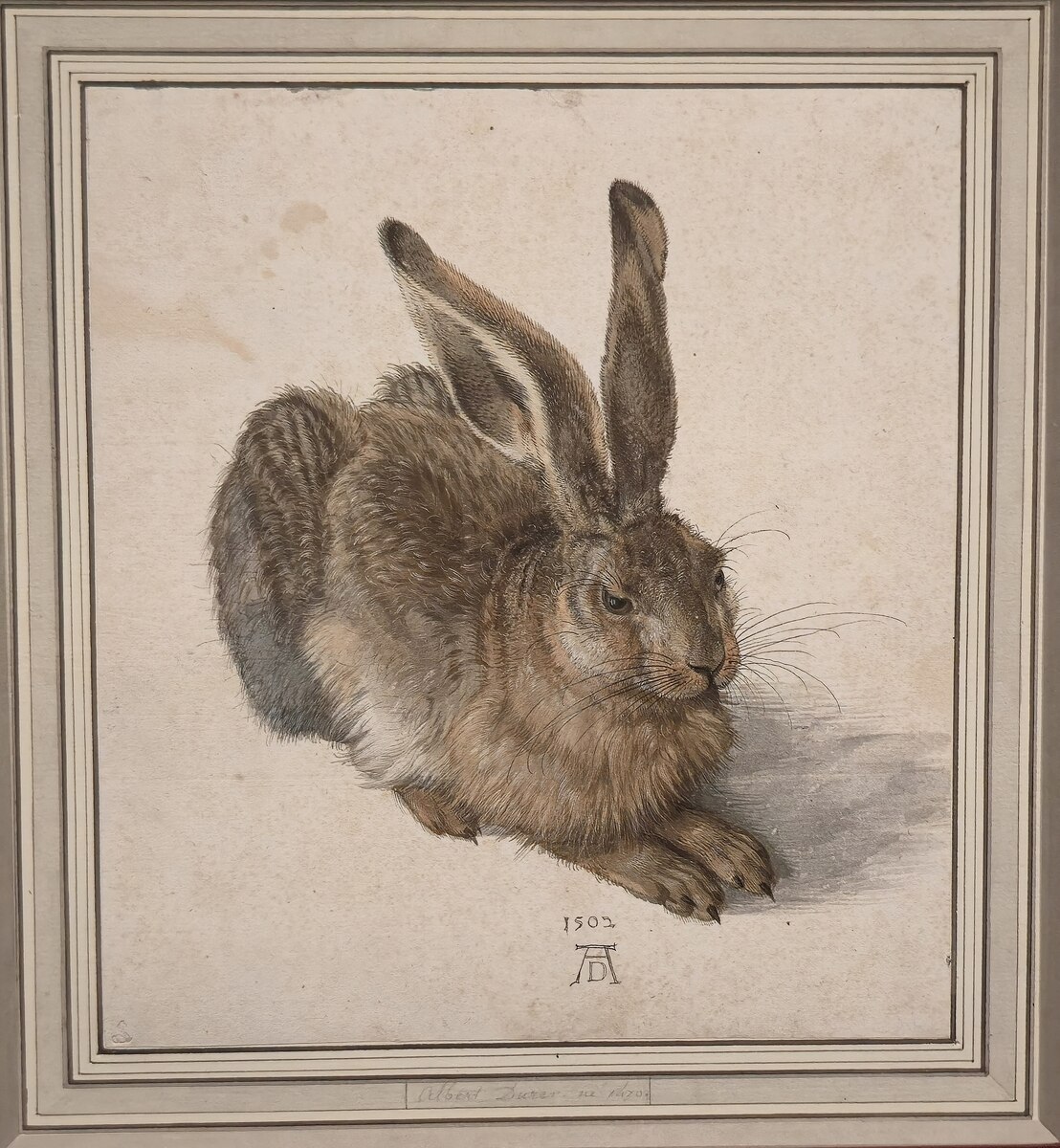
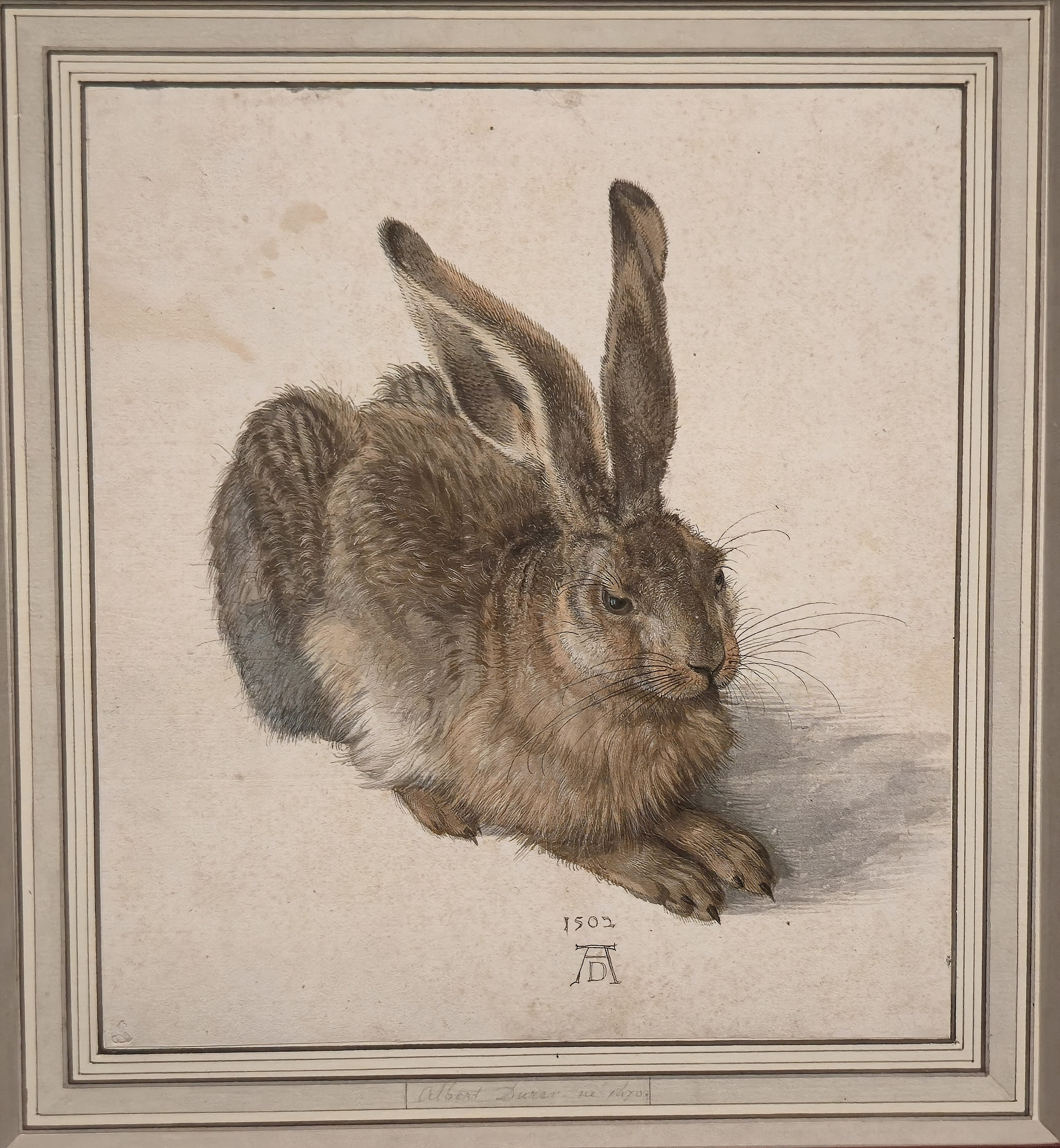
The crouching body and rounded haunch rendered in thousands of individual brush hairs in brown, grey and pale ochre, demonstrating the famous craftsmanship that makes this sheet a landmark of nature study.
02
Monogram and date 1502
Dürer's large 'AD' monogram with the date 1502 written above it at the base of the sheet, the artist's signature and a key documentary feature of the work.
03
Extended forepaws
The forelegs stretched out on the paper with visible toes and claws, painted over a soft cast shadow that anchors the hare to the sheet.
Your gallery guide
Young Hare by Albrecht Dürer (1502)
A close look at Dürer's watercolour study of a hare, signed and dated 1502, and what its careful rendering of fur, whiskers and shadow reveal about observation as a subject.
Editorial review by Artifact Archive automated publishing
This is Young Hare, a painting attributed to Albrecht Dürer and dated 1502.
It shows a single hare crouching low, its body compact and its face turned toward the lower right.
The hare's dark glossy eye and nose sit close to the edge of the sheet, and long whiskers are drawn one by one, projecting into empty paper.
Above the body rise two tall ears, one tilted left and one upright, their interiors shaded dark and edged with fine hair.
The forelegs stretch out across the paper, with visible toes and claws.
Beneath them sits a soft cast shadow that anchors the animal to the sheet, so the hare reads as resting on a surface rather than floating.
The crouching body and rounded haunch are built from thousands of individual brush hairs in brown, grey and pale ochre.
The result is not a flat coat of colour but a surface that mimics the direction and density of real fur.
Dürer's large AD monogram and the date 1502 are written above the hare at the base of the sheet.
That mark identifies the work as his and places it in the early sixteenth century, in the Northern Renaissance.
What makes the painting unusual is that nothing happens. There is no landscape, no narrative, and no religious subject.
The hare alone occupies the paper, and the empty ground around it turns close looking itself into the subject of the image.
The whiskers that push past the body into blank paper, and the shadow that ties the feet to the sheet, both keep the hare specific and present.
What the painting records is the act of paying attention, one hair and one claw at a time.
The story and its sources
Editorial review by Artifact Archive automated publishing.
Historical claims are linked to the records below. Close looking and interpretation are identified in the passage notes.
Albrecht Dürer was a German painter, printmaker, mathematician, and theorist (1471-1528). Their work is associated with German Renaissance. Their recorded places of work include Nuremberg; Venice; Basel; Strasbourg; Colmar; Frankfurt; Mainz; Cologne; Innsbruck; Bologna; Milan; Florence; Arnemuiden; Baarle-Nassau; Bergen op Zoom; Goes; Heerewaarden; Middelburg; Nijmegen; Oisterwijk; Sittard; Stokkum; Tilburg; Veere; Zaltbommel; Zierikzee; Antwerp; Mechelen; Rome; Lutherstadt Wittenberg.
A tufted hare painted from close observation, with the animal lying low, its face turned toward the lower right, whiskers projecting into empty paper, and its fur rendered in individual brush hairs.
Title variants
Young Hare; Field Hare; Feldhase
Dimensions
Unknown
Catalogue identity and attribution
The object is catalogued as Young Hare, a painting attributed to Albrecht Dürer. Both the title and the attribution, as recorded in the supplied documentation, are the terms under which the work is known in its catalogue record, and the medium is given as painting rather than drawing or print. These are the identifying facts the record establishes before any question of style, subject or reception is raised.(Wikimedia Commons: Young Hare, n.d.)
Dürer's large AD monogram is written at the base of the sheet, with the date 1502 above it. The monogram is the element that connects the object to Dürer in the catalogue account, and the date carried with it places the work in 1502. The two pieces of information belong together in the record: the mark identifies the author to whom the painting is attributed, and the date written alongside the mark is the date the object itself bears.(Wikimedia Commons: Young Hare, n.d.)
The object titled Young Hare is a painting attributed to Albrecht Dürer, and the source records that Dürer's large AD monogram with the date 1502 is written above the hare at the base of the sheet. That inscription is the evidence for both authorship and date: it identifies the work as his and places it in the early sixteenth century, in the Northern Renaissance. The attribution and the 1502 date therefore rest on the presence of the monogram and date on the sheet itself, as reported in the source metadata, rather than on external documentation. The source describes the work as a painting and supplies the composition in some detail, which allows the visual account below to be tied to a specific, dated, signed sheet rather than to a generic image of a hare.(Wikimedia Commons: Young Hare, n.d.)
Composition and posture
A single hare crouches low, its body compact, and its face is turned toward the lower right. The dark glossy eye and nose sit close to the edge of the sheet, and long whiskers are drawn individually, projecting into empty paper. Above the body rise two tall ears, one tilted left and one upright, their interiors shaded dark and edged with fine hair. The forelegs stretch out across the paper with visible toes and claws, and beneath them sits a soft cast shadow that anchors the animal to the sheet, so the hare reads as resting on a surface rather than floating. This is the recorded composition: one animal, no landscape, no narrative, no religious subject, with the ground around it left empty.(Wikimedia Commons: Young Hare, n.d.)
Materials and brushwork
The crouching body and rounded haunch are built from thousands of individual brush hairs in brown, grey and pale ochre. The result is not a flat coat of colour but a surface that mimics the direction and density of real fur, and the account of individual brush hairs is a description of technique as well as of appearance: the fur is constituted by discrete strokes rather than by a uniformly coloured area. The ears repeat this logic at a smaller scale, with dark interior shading and fine hair tufts, and the whiskers are drawn one by one rather than summarised as a mass. The same close attention extends to the extremities, where the forelegs show visible toes and claws. Taken together, these units establish a consistent working method across fur, ears and paws, in which the painter's marks remain legible as marks while producing the texture of the animal.(Wikimedia Commons: Young Hare, n.d.)
Composition and posture
Interpretation
The whiskers that push past the body into blank paper and the shadow that ties the feet to the sheet work in opposite directions and are both recorded features of the image. The whiskers project beyond the body into empty paper, so they carry the animal's presence past its own outline and into the unworked ground. The shadow, by contrast, holds the hare down: it anchors the animal to the sheet so that it reads as resting on a surface rather than floating. The crouching body and rounded haunch, rendered in thousands of brush hairs, sit between these two effects, giving the mass of the animal a furred volume. What the painting records, on this reading, is close looking made visible, one hair and one claw at a time, with the empty ground around the hare turning that attention into the subject of the image.(Wikimedia Commons: Young Hare, n.d.)
Visual observation
The hare's face is turned toward the lower right, with a dark glossy eye, nose and long individually drawn whiskers projecting into empty paper.(Wikimedia Commons: Young Hare, n.d.)
Two tall ears rise above the body, one tilted left and one upright, with dark interior shading and fine hair tufts.(Wikimedia Commons: Young Hare, n.d.)
The forelegs are stretched out on the paper with visible toes and claws, painted over a soft cast shadow that anchors the hare to the sheet.(Wikimedia Commons: Young Hare, n.d.)
The crouching body and rounded haunch are rendered in thousands of individual brush hairs in brown, grey and pale ochre.(Wikimedia Commons: Young Hare, n.d.)
The single evidence unit supplied for this section is a calculated working insurance estimate rather than an appraisal or a market record. It was generated on 2026-10-16 by model calculation and gives a deliberately broad range of US$500,000 to US$2,000,000. The stated inputs are the confirmed artist Albrecht Dürer, the attributed date 1502, the watercolour and bodycolour medium, the Northern Renaissance period, and the recognized subject of Young Hare. The absence of verified dimensions, a current location, an accession number, provenance, and acquisition history means no comparable sales or replacement-cost evidence could be applied, so the figure is explicitly a working range for manual review and not an official insurance value, appraisal, auction result, or sale price.(Wikimedia Commons: Young Hare, n.d.)
The width of the range is attributed in the evidence to two opposing pressures. The extreme prominence of the artist and the high cultural visibility of this subject push the estimate upward, while the fragility of the medium, the absence of verified object records, and the requirement for manual review before any insurance decision hold it back from a narrower or higher figure. The same unit adds that the range is intentionally wide because no exact scale, condition, or collection status is confirmed. This makes the estimate a measure of the record's incompleteness as much as of the object's standing: identifications, attribution, condition, dimensions, provenance, and insurance requirements are all flagged for verification with a qualified professional before the range is used for coverage or any financial purpose.(Wikimedia Commons: Young Hare, n.d.)
How the valuation evidence relates to the object record
Read against the source record for the object, the estimate's stated inputs match the attribution and medium that page describes: Young Hare as a painting attributed to Albrecht Dürer, executed in watercolour and bodycolour, associated with the Northern Renaissance and bearing the AD monogram with the date 1502. The evidence for the valuation does not itself describe the composition, condition, or physical support, so the descriptive details of the hare, the inscribed monogram, and the licensing status of the uploaded reproduction belong to the object record rather than to the valuation calculation. Keeping the two apart matters: the estimate treats the attribution and date as confirmed inputs, while the object record presents the artist attribution and the 1502 date as they appear on the work and in its catalogue entry. Any future revision of the estimate would depend on evidence about condition, dimensions, and collection status that the supplied units do not contain.(Wikimedia Commons: Young Hare, n.d.)
Working estimate
Calculated working insurance estimate, not a sale price: Estimated value: US$500K to US$2M Recorded date: Working calculation, generated 2026-10-16. Methodology: This is a conservative working insurance range generated by model calculation, not an appraisal. It is based on the confirmed artist Albrecht Durer, the attributed date 1502, watercolour and bodycolour medium, Northern Renaissance period, and the recognized subject of Young Hare. No verified dimensions, current location, accession number, provenance, or acquisition history is supplied, so no market or replacement-cost evidence can be applied. The broad range reflects the extreme prominence of the artist and the high cultural visibility of this subject while accounting for the medium's fragility, the absence of verified object records, and the requirement for manual review before any insurance decision. The range is intentionally wide because no exact scale, condition, or collection status is confirmed. Qualification: This is a model-generated working insurance range for manual review only. It is not an official insurance value, appraisal, auction result, or sale price. It does not rely on comparable sales or private insurance records. Verify the identification, attribution, condition, dimensions, provenance, and insurance requirements with a qualified professional before using this range for any coverage or financial purpose.(Wikimedia Commons: Young Hare, n.d.)
Further reading
Books for a closer look
Paid links. As an Amazon Associate I earn from qualifying purchases.
Recorded subjects include Durer's watercolor painting, prints, themes and motives, conservation and restoration. Young Hare is a Durer watercolor study of an animal, so a catalogue with watercolor and thematic subject headings is the strongest object-related match among the candidates.
Recorded subjects include Durer's watercolor painting, prints, themes and motives, conservation and restoration. Young Hare is a Durer watercolor study of an animal, so a catalogue with watercolor and thematic subject headings is the strongest object-related match among the candidates.
Fit and fill keep the painting’s proportions. Stretch changes them.
Move and zoom the painting on your biodegradable phone case.
Preparing the artwork for your edition…
Made to order
From the archive
36.6 cm / 14.4 in30.7 cm / 12.1 in
36.6 × 30.7 cm / 14.4 × 12.1 in · Standard
Drag to rotate
36.6 × 30.7 cm / 14.4 × 12.1 in · Standard
14.4 in / 36.6 cm12.1 in / 30.7 cm
14.4 × 12.1 in / 36.6 × 30.7 cm · Standard
14.4 in / 36.6 cm12.1 in / 30.7 cm
14.4 × 12.1 in / 36.6 × 30.7 cm · Standard
14.4 in / 36.6 cm12.1 in / 30.7 cm
14.4 × 12.1 in / 36.6 × 30.7 cm · Standard
Drag to rotate1 / 3
Desk mat
GBP 15.20
Delivery GBP 5.46 / Total GBP 20.66
A smooth polyester desk mat with a natural rubber non-slip base and anti-fray edges, available in three sizes.
Fit and fill keep the painting’s proportions. Stretch changes them.
Move and zoom the painting on your desk mat.
Preparing the artwork for your edition…
Made to order
The 30 cm ruler is scaled alongside your selected print. Keep the painting’s proportions with a black background, or stretch it to fill. Frame width, material texture and screen colours are illustrative.
Advertising supports the archive. These preferences control aggregate page counting, reading activity and ad-delivery diagnostics. They use no visitor tracking cookie.