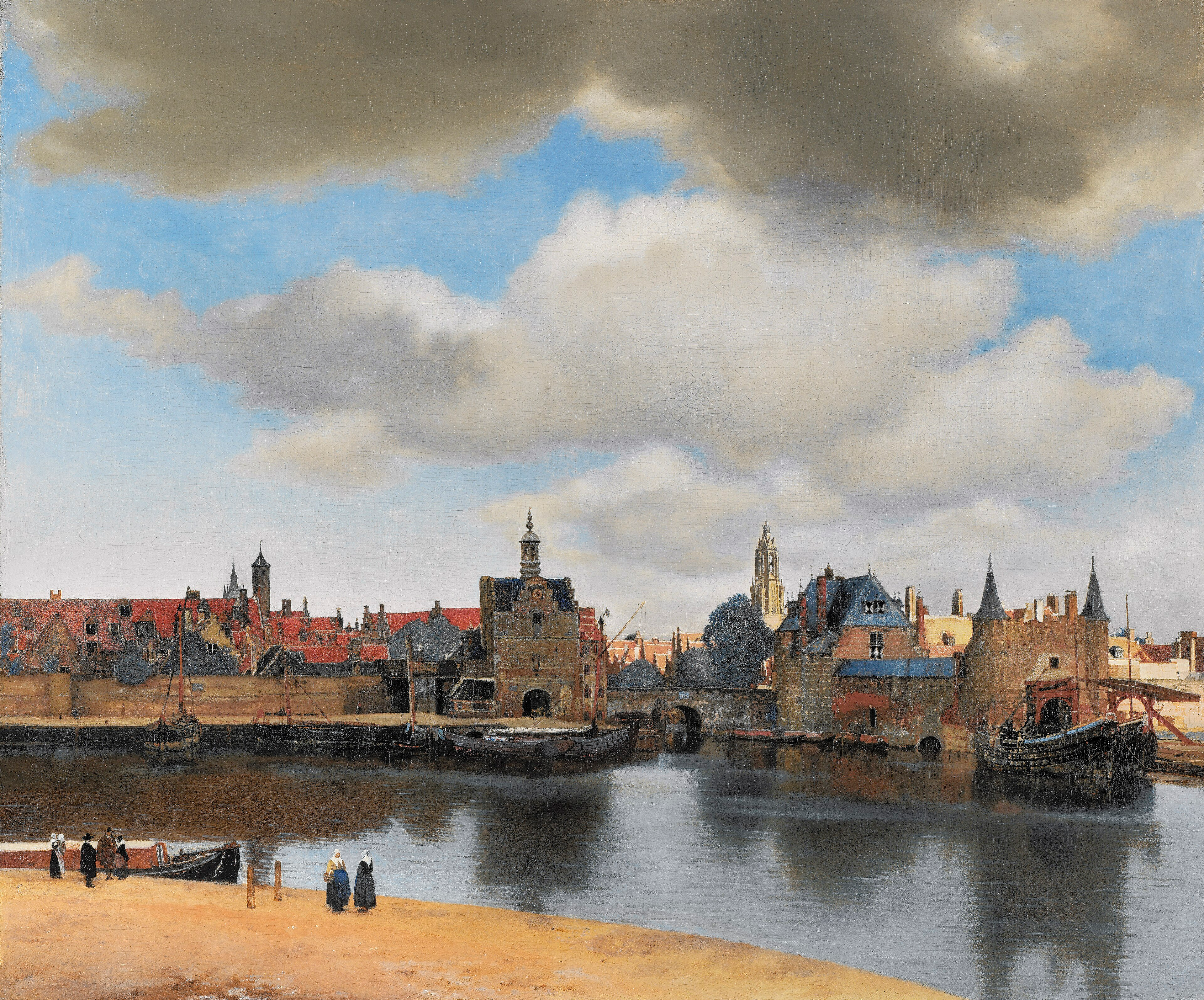
A gallery visit to Johannes Vermeer's View of Delft, a cityscape that shows the artist's home city across the river Schie. The tour looks at the painting's arrangement of architecture, water and sky, and explains why a town view painted around 1660 could read as both a portrait of a place and a study of light.
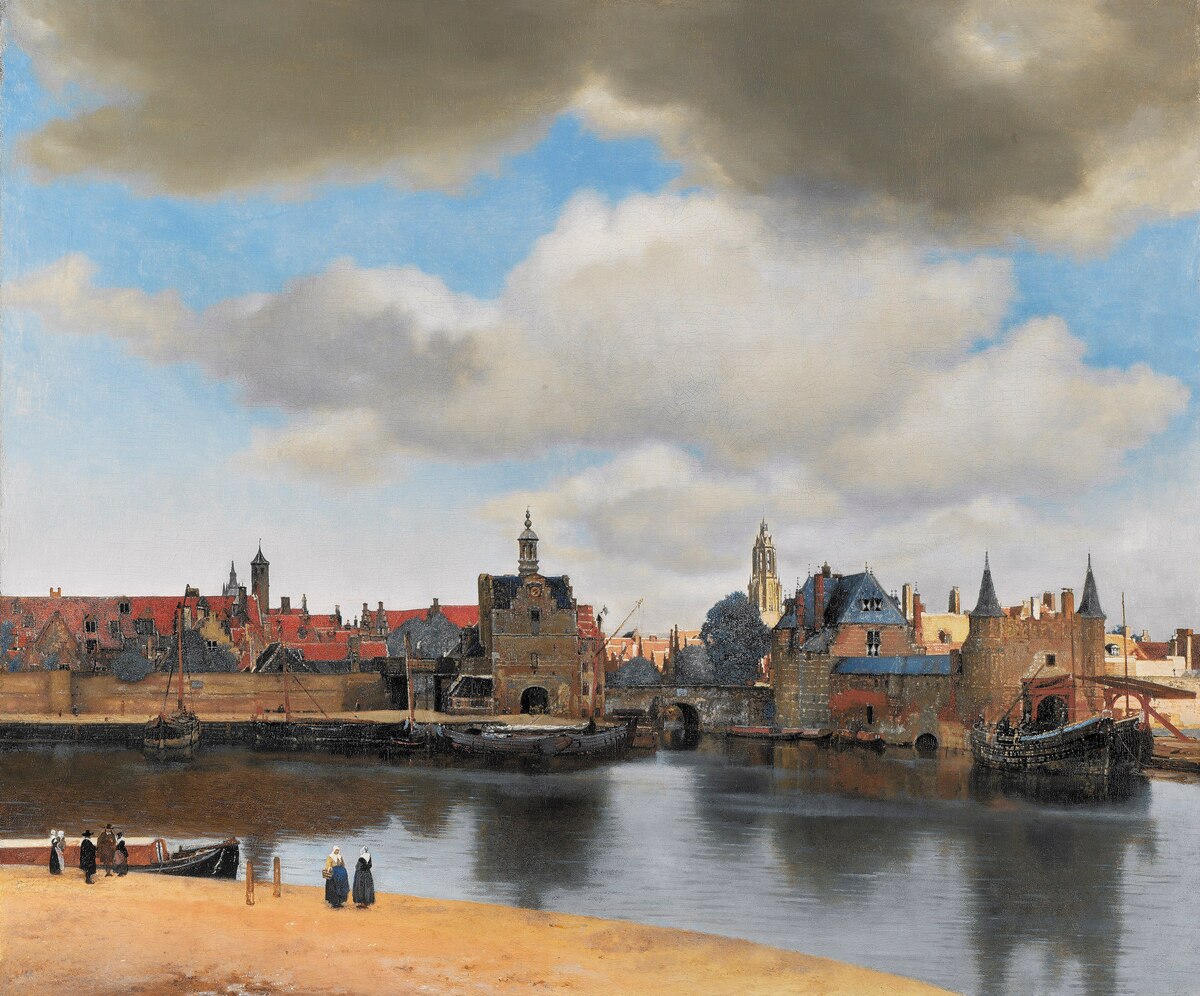
Dark, low-slung barges with thin masts lying against the quay wall on the left, their hulls mirrored in the still water. They show Vermeer's tiny highlights of light on dark surfaces and explain the canal's commercial purpose.
02
Group on the left quay
A cluster of small dark-clad figures with white collars and caps gathered on the far left of the sandy bank next to a beached boat, their gestures suggesting quiet conversation or waiting. They are among the few clearly legible human silhouettes in the painting.
03
Schiedam Gate with belfry
The central brick gate building with a steep roof, small cupola and belfry, and a shadowed archway at the waterline. It is the middle landmark of the panorama and shows Vermeer's careful modelling of sunlit brick against dark shadow.
Your gallery guide
View of Delft by Johannes Vermeer (1660-1661)
A gallery visit to Johannes Vermeer's View of Delft, a cityscape that shows the artist's home city across the river Schie. The tour looks at the painting's arrangement of architecture, water and sky, and explains why a town view painted around 1660 could read as both a portrait of a place and a study of light.
Editorial review by Artifact Archive automated publishing
This is Johannes Vermeer's View of Delft, painted about 1660 to 1661. It shows the city of Delft seen across the river Schie, with an area in the lower left that represents a meander of the river.
Vermeer worked in Delft itself, and the painting is signed with a monogram at the lower left. It belongs to the Mauritshuis in The Hague.
The city occupies the middle of the picture, and the architectural elements are arranged parallel to the horizon. That horizontal alignment gives the view its calm, level structure.
The lower left opens into water, the bend of the river that leads the eye into the town. The sky above takes up a large part of the canvas, and it is dominated by rich nuances of tone rather than flat colour.
Vermeer was a Dutch painter and art dealer active in Delft from 1653 to 1675. He was born in October 1632 and buried on 15 December 1675.
The place of creation for this painting is recorded as Delft, so it shows the city from within the artist's own working life, not from a distant traveller's report.
By 1674 the painting was in the collection of Magdalena van Ruijven, and in 1682 it was in the collection of Abraham Dissius. That early record places it in Delft collecting circles soon after Vermeer's death.
Later it entered the Mauritshuis, and it was included in the Vermeer exhibition at the Rijksmuseum from 10 February to 4 June 2023.
The painting's subject is not a single building or event. It is the whole profile of Delft, held steady across the river and under a broad sky.
The composition asks you to read the city as a sequence of roofs, towers and walls, while the water and sky carry the changing light. The result is a view that feels both specific and quietly measured.
What stays with you is the balance between the solid town and the open air around it. Vermeer gives the city a clear silhouette, then lets the sky and river soften that edge.
So the View of Delft is not just a record of a place. It is an arrangement of architecture, water and light that makes a familiar city look ordered and alive.
The story and its sources
Editorial review by Artifact Archive automated publishing.
Historical claims are linked to the records below. Close looking and interpretation are identified in the passage notes.
Vermeer was a Dutch painter who lived and worked in Delft. His small surviving body of work includes religious subjects and domestic interiors shaped by carefully placed objects, architectural space and subtle light. He became a master in Delft's painters' guild in 1653, and his paintings attracted collectors during his lifetime.
A sunlit cityscape of Delft seen across the river Schie, with an area representing a meander of the river in the lower left. Architectural elements are arranged parallel to the horizon, and the sky is dominated by rich tonal gradations.(Wikimedia Commons: View of Delft, n.d.)
Title variants
Gezicht op Delft; Vista de Delft; Vue de Delft; Ansicht von Delft; View of Delft
Accession number
92
Support
canvas
Inscriptions
signed b.l.: IVM
Catalogue identification and date
The catalogue identification of the object is direct: it is a painting by Johannes Vermeer, titled View of Delft. The supporting institution record gives the artist's working context, since Vermeer was a Dutch painter and art dealer active in Delft from 1653 to 1675, born in October 1632 and buried on 15 December 1675. The place of creation is recorded as Delft, which locates the picture within the city it depicts and within the span of Vermeer's documented Delft activity rather than in the output of a later or foreign hand. That combination of artist, activity and place of creation is what the catalogue evidence establishes at the level of attribution and geography; the evidence supplied does not include the catalogue's own wording of any attribution qualification, so no such qualification can be quoted or paraphrased here.(Wikimedia Commons: View of Delft, n.d., Artist field; Artist infobox; Place of creation)
The object carries a date of 1660 to 1661 and is signed b.l. IVM, that is, with a monogram at the lower left. The date and the signature belong to different kinds of statement: the date is the catalogue's dating of the painting, while the monogram is a mark physically present on the work as reported in the object description. Because the evidence gives only the date range and the signature location and letters, and does not record any inscription text, later inscription, collector's mark, label or other added writing, the catalogue record of the object should be understood as consisting of the monogram as the sole recorded inscription. Any question of when the painting was dated in catalogues, as distinct from when it was painted, cannot be resolved from these units; the 1660 to 1661 range is the dating assigned to the object, not a documented moment of catalogue publication.(Wikimedia Commons: View of Delft, n.d., Description)
Early collections and later display
The present institutional identity of the object is bound to its display history. The painting was included in the exhibition Vermeer at the Rijksmuseum from 10 February 2023 to 4 June 2023, a loan and exhibition event distinct from its permanent holding. The supplied evidence for the object's current repository comes through the same Commons record, which also carries the statement that the photographic reproduction is by Pol Fotografie, sourced from the Mauritshuis, and is in the public domain. The reproduction credit and rights status therefore attach to the image file supplied by the Mauritshuis rather than to the painting itself, and the exhibition dates are the only documented loan window in the evidence. The evidence does not supply an accession number, so none can be recorded here; the identity of the object as an institutional holding is documented through the exhibition and reproduction attribution rather than through an inventory identifier.(Wikimedia Commons: View of Delft, n.d., Object history; Artist field)
The painting shows a view of the city with the river Schie, and an area in the lower left represents a meander of that river. The lower left therefore opens into water rather than into more city fabric, which means the composition is organised around a meeting of town and river, with the meander carrying the eye from the foreground toward the built profile beyond. Because the record is an observation drawn from the object's own description rather than an excavation report or a topographic survey, the identification of the water as the Schie and of the lower-left passage as a meander is best treated as a recorded description of the view, not as independently verified geography. Even so, it establishes the basic pictorial fact on which every other reading of the picture depends: this is a prospect across water toward a city, not a single-building view or an event picture.(Wikimedia Commons: View of Delft, n.d., Spanish caption)
Within that prospect, the architectural elements are parallel to the horizon. The rooflines, walls and towers are not disposed along diagonals or in a plunging perspective; they run level with the horizon line, so the city presents itself as a band of built forms rather than as a recession into depth. This horizontal alignment is what gives the view its calm, level structure, and it is a compositional decision visible in the picture itself. It also matters for how the other elements function: because the architecture does not tilt or fall away, the sky and the water are left to carry the changes of light and tone, while the town holds a steady silhouette against them.(Wikimedia Commons: View of Delft, n.d., Spanish caption)
Interpretation
The sky takes up a large part of the canvas and is dominated by rich nuances of tone rather than flat colour. The evidence supports this as an observation about the painted surface, not as a claim about a specific pigment or a documented technique; nothing in the supplied record names materials or methods for the sky. What can be said is that the tonal variety is concentrated in the sky, so the picture's upper zone is not a simple backdrop but a graded field of changing values. Read together with the level architecture below and the water at the lower left, this produces a division of pictorial labour: the town supplies stable, parallel form, while sky and river supply the modulation of tone and light. That reading is an interpretation of how the recorded observations relate, and it is offered as such.(Wikimedia Commons: View of Delft, n.d., Spanish caption)
Visual observation
The painting shows a view of the city with the river Schie, with an area in the lower left representing a meander of the river.(Wikimedia Commons: View of Delft, n.d.)
Johannes Vermeer was a Dutch painter and art dealer active in Delft from 1653 to 1675. He was born in October 1632 and buried on 15 December 1675. The place of creation recorded for View of Delft is Delft itself, which places the painting within the city it depicts and within the span of the artist's documented working life there rather than in the hands of a visiting observer. That convergence of subject, site and career is the firmest contextual fact the record supplies, and it frames the object as a city view made by someone whose professional identity combined painting with the art trade in the same urban setting.(Wikimedia Commons: View of Delft, n.d., Artist infobox; Place of creation)
Ownership and the limits of the record
Interpretation
Read against that documentary backbone, the object matters as a city view rather than as a portrait of a single building or a record of an event. The whole profile of Delft is held across the river and under a broad sky, with the river meander in the lower left and the architecture aligned parallel to the horizon. This is an interpretive synthesis drawn from the observations and the place-of-creation record: the painting situates the artist's own working city within a measured, level composition, and its documented presence in Delft collections by 1674 makes it part of the material culture of that city's collecting circles in the years immediately after Vermeer's death. The evidence supports the object's identification and its early custody; it does not support claims about private intent, patronage arrangements or the painting's reception by contemporaries, and those remain outside what can be asserted here.(Wikimedia Commons: View of Delft, n.d., Spanish caption; Place of creation; Object history)
Vermeer was a Dutch painter and art dealer active in Delft from 1653 to 1675, born October 1632 and buried 15 December 1675.(Wikimedia Commons: View of Delft, n.d.)
The materials record for Johannes Vermeer's View of Delft is precise at its most basic level and silent on much else. The painting is documented as an oil on canvas, and its dimensions are given as 96.5 by 115.7 cm, a horizontal format that suits the wide city profile the picture presents. The object is dated 1660 to 1661 and is signed at the lower left with the monogram IVM. It is held in the Mauritshuis, The Hague, under inventory number 92. This is the entire documented material specification supplied here: support and medium, size, date, signature and repository. No ground layer, priming, pigment, medium analysis, canvas weave, stretcher, lining, restoration or sampling campaign is recorded in this evidence, so any statement about how the paint was prepared or built up would go beyond what the record establishes. What matters for a materials and technique account is that the painting is securely identified, measured and localised, which makes it a fixed point for comparison even where its physical analysis is not reported. The photographic reproduction of the painting is credited to Pol Fotografie, sourced from the Mauritshuis, and is in the public domain, which is the channel through which its surface has been consulted here rather than through direct examination.(Wikimedia Commons: View of Delft, n.d., Description)
Context of making
The place of creation for View of Delft is recorded as Delft, and Vermeer is documented as a Dutch painter and art dealer active in Delft from 1653 to 1675, born in October 1632 and buried on 15 December 1675. For a materials account this matters less as biography than as a condition of making. The painting was produced within the artist's own working life in the city it depicts, which places its materials and handling within a local practice rather than a travelled or imported one, and it locates the canvas within the same Delft setting in which it was first owned. The dating of 1660 to 1661 falls early in that documented period of activity. It is worth separating what is established from what is inferred here: the activity dates, the place of creation and the burial date are documented, while any inference that the painting's physical character reflects the conditions of Delft workshop practice is an inference from those facts, not a reported finding. The record gives us the where and the when of production, and leaves the how to be read from the object itself.(Wikimedia Commons: View of Delft, n.d., Description)
Later history of the object
The later history of the object is part of its material life and is unusually well attested for a painting of this date. By 1674 View of Delft was in the collection of Magdalena van Ruijven, and in 1682 it was in the collection of Abraham Dissius, placing it in Delft collecting circles soon after Vermeer's death. It later entered the Mauritshuis, and it was included in the Vermeer exhibition at the Rijksmuseum from 10 February 2023 to 4 June 2023. These are ownership and exhibition facts, not conservation facts, and the evidence does not state what, if anything, was done to the canvas across those transfers or in preparation for the 2023 display. The distinction is worth stating plainly because movement between collections and loan to a major exhibition are exactly the junctures at which treatment often occurs, yet nothing here documents treatment. What the provenance does establish is that the painting has been a valued, traced object since the seventeenth century, which is the setting in which its physical state has been preserved and studied.(Wikimedia Commons: View of Delft, n.d., Description)
What the evidence establishes, and what remains open
Interpretation
Read together, the evidence supports a modest but useful synthesis for a materials and technique section. The documented layer of knowledge is support, medium, dimensions, date, signature, attribution, place of creation and repository. The observed layer is composition and tonality: the city aligned parallel to the horizon, the river Schie with a meander at the lower left, and a sky of rich tonal nuance. Between these two layers there is a gap that the evidence does not close, since no examination of ground, pigment, medium or layer structure is reported. The painting's importance in a larger history of art and material culture therefore rests on what is firmly documented and clearly seen, and it is safer to treat the physical making of the picture as a partially open question than to fill the gap with plausible but unsupported technique. Where this account is interpretive, it is interpretive only in that boundary: it insists on keeping examination distinct from observation and on treating the documented object record as the frame within which any further technical claim would have to be made.(Wikimedia Commons: View of Delft, n.d., Description; Spanish caption)
View of Delft was in the collection of Magdalena van Ruijven in 1674, and by 1682 it was in the collection of Abraham Dissius. These two dated collection records are the earliest ownership evidence supplied for the painting and place it in Delft collecting circles within a decade of the artist's death. The record for 1674 attaches the work to Magdalena van Ruijven; the later record for 1682 attaches it to Abraham Dissius, so the two names mark successive documented points at which the painting can be located in a private collection. The evidence states the years and the owners but does not supply the date, instrument or terms of any transfer between them. The change of hands is therefore documented at both ends while the intervening transaction remains unrecorded, and the gap between 1674 and 1682 should be treated as an unrecorded interval rather than as a proven transfer on a specific date.(Wikimedia Commons: View of Delft, n.d., Object history)
Museum Holding
The later history supplied in the evidence places the painting in the Mauritshuis, The Hague, with inventory number 92, which is the institutional identification under which the object is currently recorded. The step from the 1682 collection of Abraham Dissius to the Mauritshuis is not dated in the supplied units; the evidence establishes the two endpoints, the private collection recorded in 1682 and the museum holding with its inventory number, without documenting the intermediate sales, agents or dates. The inventory number 92 functions as the museum's own identifier and anchors the object to a specific registered holding, but it does not itself supply a chronology of transfer. The distinction matters for provenance research: an unrecorded interval between a 1682 private collection and a modern museum accession is not the same as a proven change of ownership with known parties and dates, and the supplied evidence supports the latter only in the form of the institution's recorded holding.(Wikimedia Commons: View of Delft, n.d., Object history)
In 1674, View of Delft was in the collection of Magdalena van Ruijven; in 1682 it was in the collection of Abraham Dissius.(Wikimedia Commons: View of Delft, n.d.)
View of Delft belongs to the Mauritshuis in The Hague, inventory number 92, and its photographic reproduction is credited to Pol Fotografie, sourced from the Mauritshuis, and is in the public domain. The ready availability of that reproduction conditions a great deal of the painting's modern reception: the object is circulated as an openly reusable image at the same time that the canvas itself remains an institutional holding. Object history of the kind recorded for this painting, which places it with Magdalena van Ruijven in 1674 and with Abraham Dissius in 1682, shows that the work was already being tracked, transferred and inventoried within Delft collecting circles in the years around Vermeer's death, so the painting's movement into public and scholarly visibility rests on a documented chain of ownership rather than on a single moment of discovery.(Wikimedia Commons: View of Delft, n.d., Copyright holder; Exhibition history; Object history)
The most concrete recent reception event supplied by the evidence is the inclusion of View of Delft in the exhibition Vermeer at the Rijksmuseum, held from 10 February 2023 to 4 June 2023. That showing reinserted the painting into a large monographic frame organised around Vermeer, the Dutch painter and art dealer active in Delft from 1653 to 1675, born October 1632 and buried 15 December 1675. The exhibition therefore presented the canvas not only as a city view but as a work by a named artist whose life dates and professional activity in Delft are documented, and whose recorded place of creation for this painting is Delft itself. The result is a reception stage in which biography, geography and authorship are offered together as the interpretive context for the image.(Wikimedia Commons: View of Delft, n.d., Exhibition history; Artist infobox; Place of creation)
Visual conventions and their afterlife
Interpretation
Interpretive note: the reception of View of Delft as it is documented here accumulates in distinct layers rather than resolving into one dramatic discovery or one decisive reinterpretation. Provenance records from 1674 and 1682 establish an early private life inside Delft collections, institutional custody at the Mauritshuis establishes a public collection history with an inventory number, an open-access photographic reproduction establishes an image history in which the canvas circulates freely as a file, and a 2023 monographic exhibition establishes a presentational frame organised around Vermeer's documented biography and Delft setting. Each of these stages changes what the work can be said to be doing: a possession, a museum object, a reproducible image and an exhibit. Because the evidence is weighted toward description, provenance and exhibition data, and toward observations of alignment and sky, any account of the painting's fame should be built on these successive documented stages rather than attributed to a single event or to a claimed discovery of the object.(Wikimedia Commons: View of Delft, n.d., Object history; Copyright holder; Exhibition history; Artist infobox; Spanish caption)
The photographic reproduction of View of Delft is by Pol Fotografie, sourced from the Mauritshuis, and is in the public domain.(Wikimedia Commons: View of Delft, n.d.)
View of Delft is held in the Mauritshuis, The Hague, where it carries inventory number 92. That institutional identification anchors the painting in a named public collection, and it is the record against which the object's other documented details, including its dimensions, date, signature, and provenance, are presented. The Mauritshuis collection is also the source of the photographic reproduction of the work, credited to Pol Fotografie, which is in the public domain. The painting is therefore documented both as a physical object in a specific collection and as an image whose reproduction rights have been released.(Wikimedia Commons: View of Delft, n.d., Collection)
Any account of the value of Johannes Vermeer's View of Delft has to start from what the object record actually establishes, because the supplied evidence contains a calculated working insurance range and no market transaction, institutional appraisal or official figure of any kind. The painting is identified as View of Delft, dated 1660 to 1661, oil on canvas, measuring 96.5 by 115.7 cm, held in the Mauritshuis, The Hague, inventory number 92, and signed with the monogram b.l. IVM. Its place of creation is recorded as Delft, and it shows the city with the river Schie, including an area in the lower left that represents a meander of the river. Those identification facts, together with the attribution to Vermeer, are what the working valuation treats as its confirmed basis; the range offered is not supported by any sale, policy or comparable that appears in the supplied evidence.(Wikimedia Commons: View of Delft, n.d.)
The only valuation figure in the record is a calculated working insurance estimate: a working insurance range of US$500M to US$1B, recorded as a working calculation generated 2026-10-16. The methodology states that this is a broad, conservative working insurance range generated for manual review, not an appraisal or official value, and that it derives from the confirmed high-confidence identification of the artwork as Vermeer's View of Delft (1660-1661, oil on canvas, 96.5 x 115.7 cm, Mauritshuis, The Hague, accession 92). The stated drivers are the extreme rarity and canonical status of a firmly attributed Vermeer cityscape, the Dutch Golden Age period, the large scale, and the artwork's long documented history in a major public collection since at least the 17th century, specifically its presence in the 1674 collection of Magdalena van Ruijven and the 1682 collection of Abraham Dissius as recorded in the supplied Wikimedia Commons excerpt. The same methodology states that no official insurance figure, auction result, or private market data is present in the confirmed context, so a wide interval is used to reflect the high uncertainty and the exceptional nature of the work.(Wikimedia Commons: View of Delft, n.d.)
The qualifications attached to the range are as consequential as the range itself. It is described as a model-generated working range for manual review only and explicitly not an official insurance value, appraisal, auction result, or sale price; it is broad and conservative because no official valuation or comparable market data was supplied. The record further notes that the artwork is in a public institutional collection and that no private insurance records, auction records, or confidential valuations were accessed, and it states that actual insurance coverage should be determined by a qualified fine art appraiser or underwriter with access to current market evidence. In other words, the number is an inference from identity, rarity, period, scale and collection history rather than a documented price, and the evidence supplies no external benchmark against which the interval could be narrowed. This is why the working figure should be read as a provisional instrument for review, with the object's documented public status and the absence of market data doing as much to shape it as its artistic reputation does.(Wikimedia Commons: View of Delft, n.d.)
Provenance and the public record
The collection history that the valuation cites is itself part of the object record. In 1674, View of Delft was in the collection of Magdalena van Ruijven, and in 1682 it was in the collection of Abraham Dissius, which places it in Delft collecting circles soon after Vermeer's death. The painting later entered the Mauritshuis, and it was included in the Vermeer exhibition at the Rijksmuseum from 10 February 2023 to 4 June 2023. Vermeer himself was a Dutch painter and art dealer active in Delft from 1653 to 1675, born October 1632 and buried 15 December 1675, so the picture belongs to the period of his own working life in the city it depicts. The photographic reproduction of View of Delft is by Pol Fotografie, sourced from the Mauritshuis, and is in the public domain, which is how the image used in this record circulates even though the painting does not.(Wikimedia Commons: View of Delft, n.d.)
Working estimate
Calculated working insurance estimate, not a sale price: Working insurance range: US$500M to US$1B Recorded date: Working calculation, generated 2026-10-16. Methodology: This is a broad, conservative working insurance range generated for manual review, not an appraisal or official value. The calculation is based on the confirmed high-confidence identification of the artwork as Johannes Vermeer's View of Delft (1660-1661, oil on canvas, 96.5 x 115.7 cm, Mauritshuis, The Hague, accession 92). The range reflects the extreme rarity and canonical status of a firmly attributed Vermeer cityscape, the Dutch Golden Age period, the large scale, and the artwork's long documented history in a major public collection since at least the 17th century (including 1674 collection of Magdalena van Ruijven and 1682 collection of Abraham Dissius, as recorded in the supplied Wikimedia Commons excerpt). No official insurance figure, auction result, or private market data is present in the confirmed context, so a wide interval is used to reflect the high uncertainty and the exceptional nature of the work. Qualification: This is a model-generated working range for manual review only. It is not an official insurance value, appraisal, auction result, or sale price. The range is broad and conservative because no official valuation or comparable market data was supplied. The artwork is in a public institutional collection, and no private insurance records, auction records, or confidential valuations were accessed. Actual insurance coverage should be determined by a qualified fine art appraiser or underwriter with access to current market evidence.(Wikimedia Commons: View of Delft, n.d.)
Further reading
Books for a closer look
Paid links. As an Amazon Associate I earn from qualifying purchases.
Recorded as A View of Delft by Walter A. Liedtke, with subjects 'Painting, dutch' and 'Painting, modern, 17th-18th centuries'. A Liedtke study sharing the painting's title is a plausible object-specific art-historical treatment of Vermeer and Delft painting. Subjects support relevance to the named artwork; no contents are assumed.
Recorded as A view of Delft by Anthony Bailey, with subjects including 'Vermeer, johannes, 1632-1675', 'Delft (Netherlands) in art', 'In art' and 'Painters, netherlands'. The combination of Vermeer and Delft in art indicates a book directly concerned with the artist and the city depicted in View of Delft.
Recorded as A view of Delft by Anthony Bailey, with subjects including 'Vermeer, johannes, 1632-1675', 'Delft (Netherlands) in art', 'In art' and 'Painters, netherlands'. The combination of Vermeer and Delft in art indicates a book directly concerned with the artist and the city depicted in View of Delft.
Recorded as Vermeer by Anthony Bailey, with subjects including 'Vermeer, johannes, 1632-1675', 'Painters, netherlands', 'Delft (Netherlands) in art' and 'In art'. The explicit Delft-in-art and Vermeer subject headings connect this record to the named painting's artist and setting, though it is a broader artist study.
Recorded as A View of Delft by Walter A. Liedtke, with subjects 'Painting, dutch' and 'Painting, modern, 17th-18th centuries'. A Liedtke study sharing the painting's title is a plausible object-specific art-historical treatment of Vermeer and Delft painting. Subjects support relevance to the named artwork; no contents are assumed.
Wikimedia Commons file page for View of Delft by Johannes Vermeer, with object description, dimensions, date, signature, collection and provenance data drawn from the Mauritshuis.
Advertising supports the archive. These preferences control aggregate page counting, reading activity and ad-delivery diagnostics. They use no visitor tracking cookie.